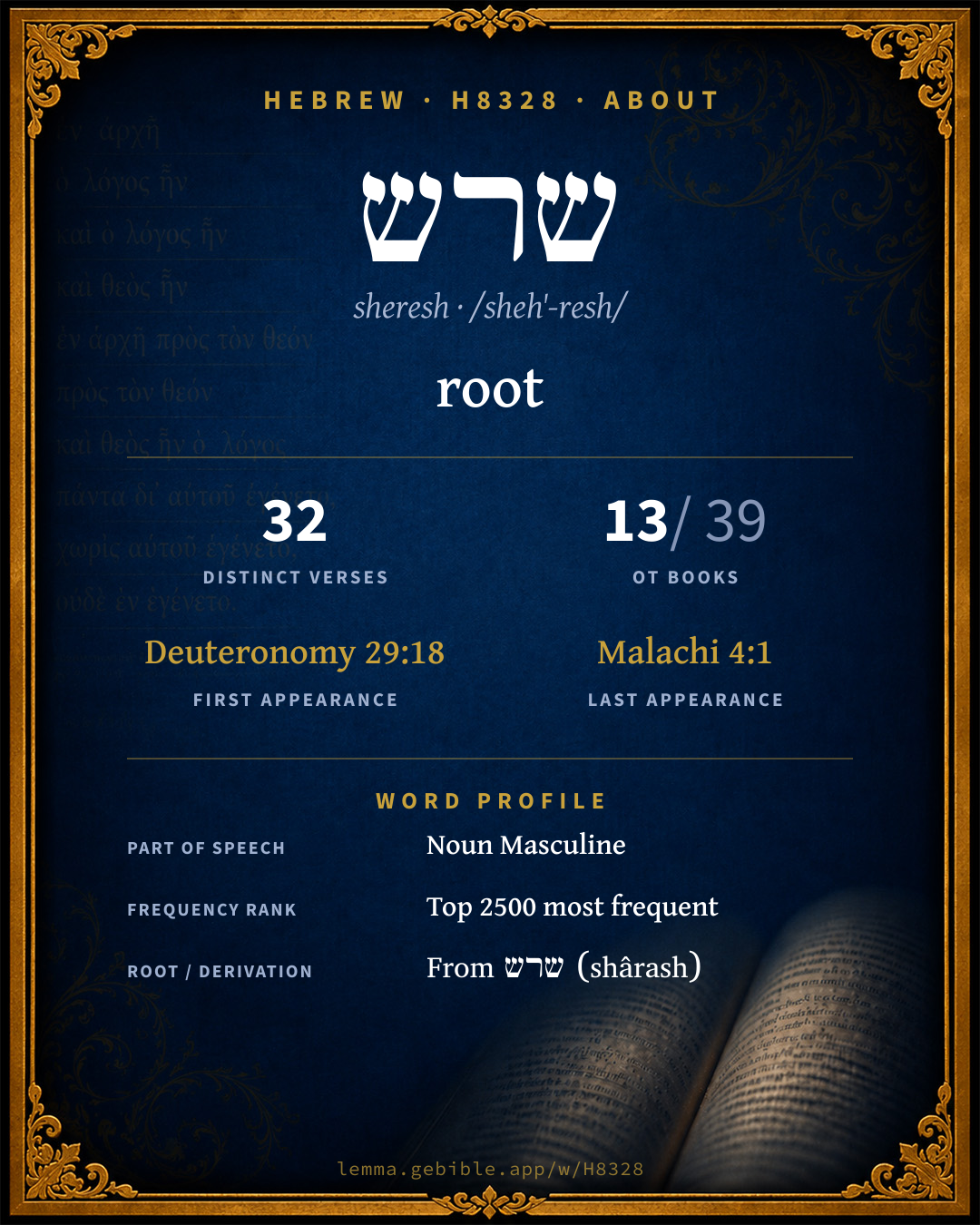
שֹׁ֫רֶשׁ
root
‘root’ is one of 4 main senses fuller range ↓
Full lexicon entry — Brown-Driver-Briggs (BDB)
From Brown-Driver-Briggs (BDB)
Where this word appears
See every Construct-state word in the Hebrew Bible →
Grammar key — what these labels mean
Part of speech
- Noun
- A naming word — a person, place, thing, or idea.
Noun type
- Common
- A common noun — a general class of person, place, or thing (“king,” “city,” “water”), not a specific name.
State
- Construct
- A noun bound to a following noun in a possessive / “of” relationship (the construct chain).
- Absolute
- The independent form of a noun, not bound to a following word.
Gender
- Masculine
- Grammatically masculine.
Number
- Singular
- One.
- Plural
- More than one (in Hebrew, generally three or more).
Grammatical forms
- Noun, Common, Masculine, Plural, Construct 14 times (42%)
- Noun, Common, Masculine, Singular, Construct 13 times (39%)
- Noun, Common, Masculine, Singular, Absolute 6 times (18%)
Parsed forms decoded from the imported morphology (morphhb / Westminster Leningrad Codex — WLC text public domain, morphhb tagging CC BY 4.0), counted across 33 parsed occurrences — not distinct verses.
Every verse where H8328 appears — 32 distinct verses across 13 books. Click any verse to open its interlinear word-by-word view. Verse text shown in the World English Bible for context — . Each verse’s Hebrew form is shown with its reference; the English is not keyword-highlighted, since the data carries no word-level English alignment. Use “Compare translations” on any verse to read it across multiple English versions. This concordance covers the Hebrew Bible; Septuagint (Greek Old Testament) occurrences are not indexed here.
Deuteronomy 1 verse
Judges 1 verse
2 Kings 1 verse
Job 9 verses
- Job 8:17 שָֽׁרָשָׁ֣י/ו n c mp cs + sfx pers 3ms His roots are wrapped around the rock pile, He sees the place of stones.
- Job 13:27 שָׁרְשֵׁ֥י n c mp cs You also put my feet in the stocks, And mark all my paths. You set a bound to the soles of my feet:
- Job 14:8 שָׁרְשׁ֑/וֹ n c ms cs + sfx pers 3ms Though the root of it grows old in the earth, And the stock of it dies in the ground;
- Job 18:16 שָֽׁרָשָׁ֣י/ו n c mp cs + sfx pers 3ms His roots shall be dried up beneath, Above shall his branch be cut off.
- Job 19:28 וְ/שֹׁ֥רֶשׁ conj + n c ms cs If you say, 'How we will persecute him!' Because the root of the matter is found in me,
- Job 28:9 מִ/שֹּׁ֣רֶשׁ prep + n c ms He puts forth his hand on the flinty rock, And he overturns the mountains by the roots.
- Job 29:19 שָׁרְשִׁ֣/י n c ms cs + sfx pers 1cs My root is spread out to the waters, The dew lies all night on my branch;
- Job 30:4 וְ/שֹׁ֖רֶשׁ conj + n c ms cs They pluck salt herbs by the bushes. The roots of the broom are their food.
- Job 36:30 וְ/שָׁרְשֵׁ֖י conj + n c mp cs Behold, he spreads his light around him. He covers the bottom of the sea.
Psalms 1 verse
Proverbs 2 verses
Isaiah 7 verses
- Isaiah 5:24 שָׁרְשָׁ/ם֙ n c ms cs + sfx pers 3mp Therefore as the tongue of fire devours the stubble, And as the dry grass sinks down in the flame, So their root shall be as rottenness, And their blossom shall go up as dust; Because they have rejected the law of Yahweh of Hosts, And despised the word of the Holy One of Israel.
- Isaiah 11:1 מִ/שָּׁרָשָׁ֥י/ו prep + n c mp cs + sfx pers 3ms There shall come forth a shoot out of the stock of Jesse, and a branch out of his roots shall bear fruit.
- Isaiah 11:10 שֹׁ֣רֶשׁ n c ms cs It shall happen in that day, that the root of Jesse, who stands for an ensign of the peoples, to him shall the nations seek; and his resting-place shall be glorious.
- Isaiah 14:29 מִ/שֹּׁ֤רֶשׁ prep + n c ms cs Don't rejoice, O Philistia, all of you, because the rod that struck you is broken; for out of the serpent's root shall come forth an adder, and his fruit shall be a fiery flying serpent.
- Isaiah 14:30 שָׁרְשֵׁ֔/ךְ n c ms cs + sfx pers 2fs The firstborn of the poor shall feed, and the needy shall lie down in safety; and I will kill your root with famine, and your remnant shall be killed.
- Isaiah 37:31 שֹׁ֣רֶשׁ n c ms The remnant that is escaped of the house of Judah shall again take root downward, and bear fruit upward.
- Isaiah 53:2 וְ/כַ/שֹּׁ֨רֶשׁ֙ conj + prep det + n c ms For he grew up before him as a tender plant, and as a root out of a dry ground: he has no form nor comeliness; and when we see him, there is no beauty that we should desire him.
Jeremiah 1 verse
Ezekiel 4 verses
- Ezekiel 17:6 וְ/שָׁרָשָׁ֖י/ו conj + n c mp cs + sfx pers 3ms It grew, and became a spreading vine of low stature, whose branches turned toward him, and the roots of it were under him: so it became a vine, and brought forth branches, and shot forth sprigs.
- Ezekiel 17:7 שָׁרֳשֶׁ֣י/הָ n c mp cs + sfx pers 3fs There was also another great eagle with great wings and many feathers: and, behold, this vine did bend its roots toward him, and shot forth its branches toward him, from the beds of its plantation, that he might water it.
- Ezekiel 17:9 שָׁרָשֶׁ֨י/הָ מִ/שָּׁרָשֶֽׁי/הָ n c mp cs + sfx pers 3fs prep + n c mp cs + sfx pers 3fs Say you, Thus says the Lord Yahweh: Shall it prosper? shall he not pull up the roots of it, and cut off the fruit of it, that it may wither; that all its fresh springing leaves may wither? and not by a strong arm or much people can it be raised from the roots of it.
- Ezekiel 31:7 שָׁרְשׁ֖/וֹ n c ms cs + sfx pers 3ms Thus was it beautiful in its greatness, in the length of its branches; for its root was by many waters.
Daniel 1 verse
Hosea 2 verses
- Hosea 9:16 שָׁרְשָׁ֥/ם n c ms cs + sfx pers 3mp Ephraim is struck. Their root has dried up. They will bear no fruit. Even though they bring forth, yet I will kill the beloved ones of their womb."
- Hosea 14:5 שָׁרָשָׁ֖י/ו n c mp cs + sfx pers 3ms I will be like the dew to Israel. He will blossom like the lily, And send down his roots like Lebanon.
Amos 1 verse
Malachi 1 verse
About this entry
At a glance — auto-summarized from this page’s data, not written by a person. Every figure links to its source below. This summary describes the numbers; it doesn’t interpret them.
שרש — transliterated sheresh — is a Hebrew noun carrying the sense “root.” The lexicon spreads it across several senses; see its full sense range. With 32 verses in 13 books, it is a moderately common word in the Hebrew Bible. Its uses concentrate in Job (28% of all occurrences). Debuting at Deuteronomy 29:18, it then recurs through the corpus. See the sense tree, 32-verse concordance, and the renderings breakdown below.
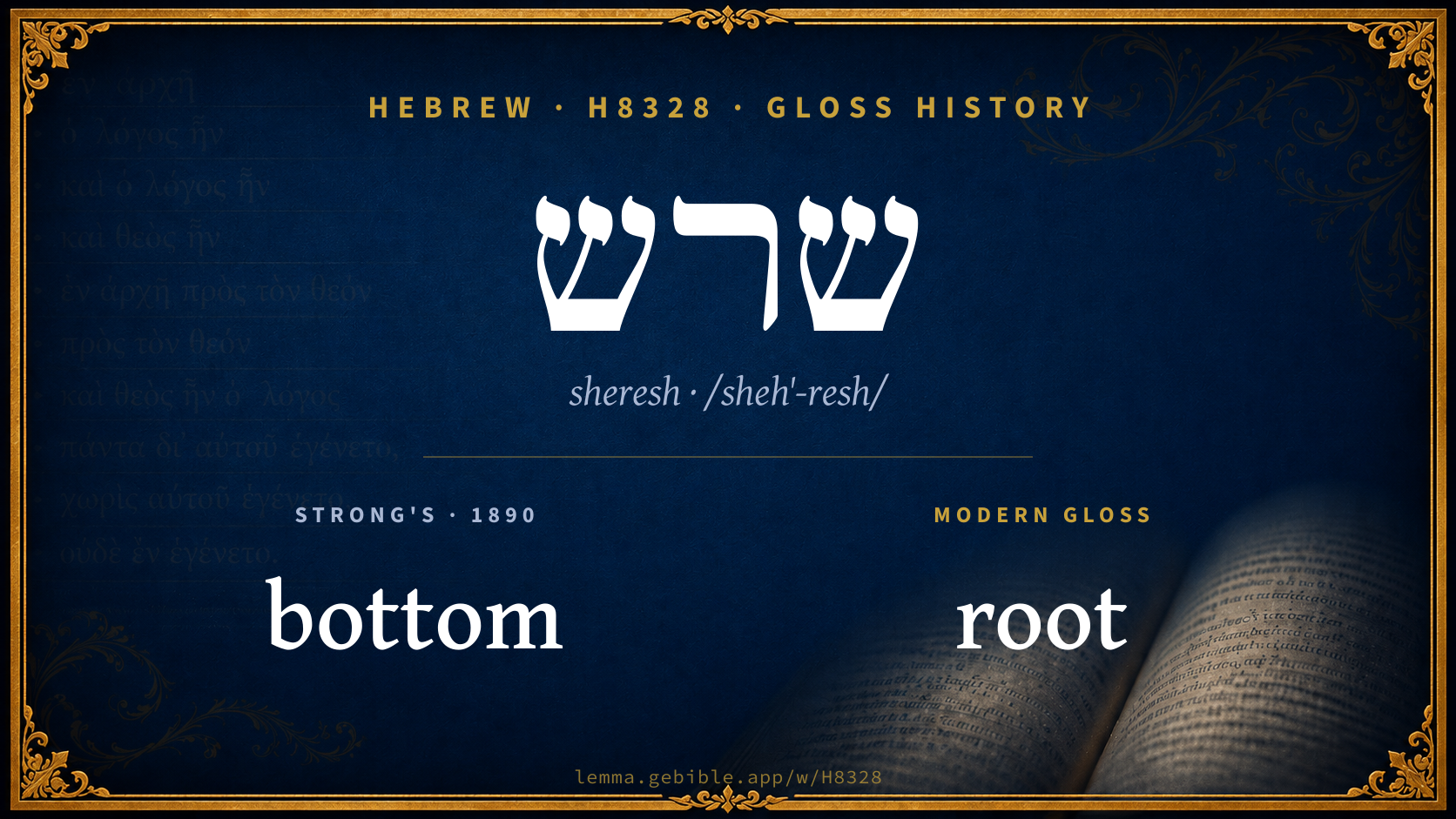
Gloss history
Strong's 1890 vs modern scholarship
About this word
Strong's H8328 catalogs a Hebrew word from the Hebrew Old Testament.
These counts are not copied from any lexicon or concordance. They are computed here, from the morphology-tagged Hebrew Old Testament. What Lemma adds →
- 32
- distinct verses
- The word appears in 32 distinct verses.
- 13 / 39
- OT books
- The word appears in 13 of 39 Old Testament books.
- #1,064
- by frequency
- Top 2500 most frequent Hebrew words (rank 1,064 of 8,640 Hebrew words by occurrence).
View all 32 occurrences in the concordance →
By section of the Old Testament
By traditional corpus
Conventional, traditional groupings — biblical authorship is debated, so this is a traditional corpus grouping, not an authorship claim. Each share is this word’s portion of its verses in that division of the Hebrew canon. Each figure is a share of the word’s 32 distinct verses.
- Prophets (Nevi'im) 18 verses · 56%
- Writings (Ketuvim) 13 verses · 41%
- Torah (Pentateuch) 1 verse · 3%
How translations render this word
Counts come from each version’s own published word-to-Strong’s tagging or interlinear alignment — an approximate guide to how each version renders this word, not a word-level alignment the data otherwise carries. Because each total is that version’s own tagged count, the per-version totals vary from one another and need not match the appearance or distinct-verse counts above. These counts may also differ from a printed concordance because Lemma counts each distinctly tagged rendering and does not collapse phrase taggings into a single head-word total. This is a fixed set of word-tagged versions (KJV, ASV, BSB, ULT) and does not change with the reading translation you choose elsewhere. Each version’s license is shown beside its name below (and on Sources).
- King James Version: Roots 12×, Root 10×, Take root 2×
- American Standard Version: Root 10×, Roots 10×, Take root 2×
- Berean Standard Bible: Roots 13×, Root 9×, Take root 2×
- unfoldingWord Literal Text: Roots 12×, Root 9×, Root of 6×
King James Version Public Domain
Renders H8328 across 33 tagged occurrences — most commonly:
Plus 9 renderings that appear only once — usually multi-word phrases or single function words the recovered tagging swept in, not distinct renderings.
American Standard Version Public Domain
Renders H8328 across 33 tagged occurrences — most commonly:
Plus 11 renderings that appear only once — usually multi-word phrases or single function words the recovered tagging swept in, not distinct renderings.
Berean Standard Bible Public Domain
Renders H8328 across 30 tagged occurrences — most commonly:
Plus 6 renderings that appear only once — usually multi-word phrases or single function words the recovered tagging swept in, not distinct renderings. Not rendered by a distinct English word in 3 further occurrences.
unfoldingWord Literal Text CC BY-SA 4.0
Renders H8328 across 34 tagged occurrences — most commonly:
Plus 7 renderings that appear only once — usually multi-word phrases or single function words the recovered tagging swept in, not distinct renderings.
Senses in the full BDB
What do BDB’s symbols mean?
BDB uses these scholarly abbreviations:
| Symbol | Meaning |
|---|---|
| 𝔊 | the Septuagint (the ancient Greek translation, LXX) |
| 𝔙 | the Vulgate (the Latin translation) |
| 𝔖 | the Syriac version (the Peshitta) |
| 𝔗 | the Targum (the Aramaic translation) |
| ψ | the Psalms |
| √ | root (the underlying root or stem) |
| ‖ | parallel passage (a synonymous or contrasted parallel) |
| † | the dagger: every passage where the word occurs is cited |
The 3 senses and sub-senses the full Brown-Driver-Briggs lexicon distinguishes for this word, in lexicon order (not ranked by frequency), with BDB’s own verbatim wording and sub-sense lettering. Shown in Hebrew script with BDB’s own scholarly abbreviations. The condensed entry is in the Lexicon Entry tab. See also the Forms in the corpus table below.
- 1. root of people under fig. of tree, involving firmness, permanence, Am 2:9; Ho 9:16; 14:6; Is 14:30; 2 K 19:30 = Is 37:31;—שָׁרְשָׁם Ju 5:14 is prob. corrupt, v. GFM;—so of pers. (cf. Ph., Eshmunazar 11 GACooke pp. 30, 36) Is 5:24; Mal 3:19; Jb 8:17; 18:16; 29:19; Pr 12:3, 12; = stock, family Is 11:1, 10; Dn 11:7, cf. (of serpent) Is 14:29; = source or cause Dt 29:17, שׁ׳ דָּבָר Jb 19:28. e.g. Amos 2:9
- 2. lit root of tree or shrub Je 17:8 (sim.), Ez 31:7 (metaph. of people), Is 53:2 (sim.), Jb 14:8; 30:4; of vine (metaph. of people) Ez 17:6, 7, 9(×2) ψ 80:10 (acc. cogn. c. שׁרשׁ Hiph.). e.g. Jeremiah 17:8
- 3. root, fig. = lowest stratum, of mt. Jb 28:9, of sea 36:30 = bottom (text strange and dub.: Du רָאשֵׁי הָרִים, with אֵדוֹ in v a); of feet, שָׁרְשֵׁי רַגְלַי 13:27, i.e. soles Ew Di De Da al. (elsewhere כַּף), Bu place of treading, footholds; Du (arbitrarily) שָׁרְשִׁי, del. רגלי. e.g. Job 28:9
Senses from the full Brown-Driver-Briggs lexicon (Brown, Driver, Briggs; Oxford 1906 — public domain), digitized via Sefaria, supplemented by the OpenScriptures HebrewLexicon (CC BY 4.0). Full attribution on Sources.
Word origin
n.m. Dt 29:17 root;—שׁ׳ abs. Dt 29:17 +, cstr. Is 11:10 +; sf. שָׁרְשִׁי Jb 29:19, etc.; pl. cstr. שָׁרְשֵׁי 13:27 (v. infr.) 36:30, sf. שָֽׁרָשָׁיו Am 2:9 +, שָֽׁרָשֶׁיהָ Ez 17:7 +;—
— Brown-Driver-Briggs (Oxford 1906, public domain), digitized via Sefaria, supplemented by the OpenScriptures HebrewLexicon (CC BY 4.0). See Sources.
Derived from שרש (shârash) (H8327) — to uproot.
Jastrow Dictionary
A second Hebrew/Aramaic lexicon for comparison, covering Aramaic and post-biblical (Talmudic, Targumic, Midrashic) usage that the biblical-Hebrew BDB does not. Matched by lemma rather than by Strong’s number, so a lemma may carry more than one Jastrow headword (shown separately below), and the entries cover usage well beyond the Bible.
שֹׁרֶשׁ
- , v. שָׁרָר) [chain, knot,] root. — Pl. שֳׁרָשִׁים, שֳׁרָשִׁין; constr. שָׁרְשֵׁי, שׁוֹרְשֵׁי. B. Bath. V, 4 העולה … ומן הש׳ וכ׳ that which shoots forth out of the trunk, or out of the roots, belongs to the landowner (v. גֶּזַע), expl. ib. 82ᵃ כל שאינו … זהו מן הש׳ that which does not see the light of day (when it shoots forth) is out of the roots’. Y. Ab. Zar. III, 43ᵃ top; Y. Taan. I, 64ᵇ ש׳ חטה the roots of wheat; ש׳ תאנה of fig-trees. Tosef. Shebi. VII, 17; ‘Uktsin I, 4, v. קוֹלָס. Ab. III, 17 וְשֳׁרָשָׁיו מרובין whose roots are many; a. fr.
שֹׁרֶשׁ ²
- Targ. Y. II, Deut. XXIX, 17. Targ. Job XIV, 8 (Ms. pl.).—Pl. שָׁרְשִׁין, שִׁוֹ׳. Ib. XVIII, 16. Targ. Is. LIII, 2. Targ. Ps. LXXX, 10 שׁוֹרָשֵׁיהוֹן (Ms. שׁוֹרְשְׁיָיהָא).
שָׁרַשׁ
- (b. h.), Hif. הִשְׁרִישׁ (denom. of שֹׁרֶשׁ) to take root. Shebi. II, 7 שהִשְׁרִישׁוּ לפני וכ׳ which have taken root before the New Year; R. Hash. 13ᵇ. Ib.; Tosef. Shebi. II, 5 ומקצתו ה׳ לאחר וכ׳ and part of which took root after the New Year; a. fr.
- to uproot, tear out. Ib. 11, sq. אין … לשָׁרֵשׁ וכ׳ we do not force him to tear out &c. Shebi. IV, 4 יְשָׁרֵשׁ he must take it out with the root, opp. יגום, v. גָּמַם. B. Bath. 80ᵇ חופר ומְשָׁרֵשׁ he has the right to dig and take them out with the roots; Taan. 25ᵇ חופר … ומְשָׁרֵישׁ.
- 1. to be uprooted, plucked out. Tanḥ. M’tsorʿa 2 (ref. to Ps. LII, 7) דואג נ׳ וכ׳ Doeg was rooted out of the life of this world and of the hereafter. e.g. Psalms 52:7
- 2. (of roots) to spread. Num. R. s. 144 (ref. to Koh. XII, 11) כשם … מִשְׁתָּרְשִׁים … ומשתרשים וכ׳ as roots of a tree spread in all directions, so the words of the Law enter and penetrate the whole body; (Pesik. R. s. 3 משתילים). e.g. Ecclesiastes 12:11
- 3. (v. next w.) to gain, profit (cmp. רָוַח). B. Kam. 67ᵇ sq. מפני שנ׳ בחטא because he became the gainer in sin (he gained possession of the stolen object by a change of form or ownership, v. שִׁינּוּי); אילימא לפני יאוש מי איכא נ׳ if you mean (that he slaughtered or sold it) before the owner had given it up (v. יֵאוּשׁ): there is no gain in sin in the case (since he has not gained possession through the change).
שְׁרַשׁ
- Af. אַשְׁרֵישׁ same, to take root. Men. 68ᵇ מהנך דאַשְׁרוּשׁ וכ׳ of that barley that has taken root before the ʿOmer time. Gitt. 22ᵃ בדאשרוש כולי וכ׳ when the planted trees have taken root, all agree (that they are subject to tithes); a. e.
- 1. to cause to take root, plant. Targ. Ps. LXXX, 10.
- 2. to uproot, tear out. Targ. Koh. III, 2.
- (v. P. Sm. 4340) [to expand,] to bring profit, benefit. M. Kat. 12ᵃ כיון … שָׁרָשׁוּיְי … מְשָׁרְשׁוּ ליה וכ׳ since they receive no wages, they (by working for him during the festive week) only intend to benefit him.
- to be uprooted. B. Bath. 82ᵃ למחפר ולמִשְּׁרַשׁ קיימי ed. (Ms. M. לחפור ולשרש Hebr.) they are liable to be dug for and taken out (when they cease to bear fruit). Ib. למיחפר ולשרש (corr. acc., or לחפור ולשרש).
- to be profitable; א׳ ל־ to profit. Gitt. 35ᵃ א׳ לה מקום דינר (Rashi אשתרש) she saved as much dough (in the bread which she gave away) as would have been in the space which was occupied by the Denar (that came into it). Ib. 44ᵃ; Ḥull. 131ᵃ קא מִשְׁתָּרְשֵׁי ליה he is benefited (by being released from a debt). B. Mets. 42ᵇ והא קא משתרשי ליה but did he not have the benefit (of using his neighbor’s cuscuta for brewing and saving his own? why, then, should he not indemnify his neighbor?). Keth. 108ᵃ הא קא משתרשי ליה is he (for whom the debt was paid) not benefited? (better הא קא מְשָׁרְשֵׁי ליה does he who pays the debt for him not benefit him?, v. supra).
A Dictionary of the Targumim, the Talmud Babli and Yerushalmi, and the Midrashic Literature (Marcus Jastrow; London, Luzac, 1903) — Public Domain. Digitized via Sefaria. Digitized via Sefaria. Full attribution on Sources.
Forms in the corpus
The 26 distinct written forms H8328 takes in the Hebrew Bible, most frequent first — each parse links to that state’s occurrences in the concordance. Hebrew forms include their vowel points and cantillation, so a single lemma takes many written forms.
Same root — word family
Other BDB entries built from the same root as H8328, grouped by Strong’s listed origin. These share a root / origin per the lexicon — not necessarily a shared meaning. Each links to that word’s own entry.
Derives from
Shares the same root
Derived from this word
Proper names from this root
People and places named from this root — a name, not an additional meaning of the word.
Compare all same-root words → Showing 4 of 7 — not the complete family. 1 of the same-root words is a proper name (a person or place). They share a root, not necessarily a meaning.
Septuagint verse parallels
This word appears in 31 verses that also exist in the Greek Old Testament (Septuagint), out of the 32 Hebrew verses it occurs in. You can read those verses in Greek by switching the Old Testament edition to the Septuagint.
Read these verses in the Septuagint
- Deuteronomy 29:18
- Judges 5:14
- 2 Kings 19:30
- Job 8:17
- Psalms 80:9
- Proverbs 12:3
- Isaiah 5:24
- Jeremiah 17:8
- Ezekiel 17:6
- Daniel 11:7
- Hosea 9:16
- Amos 2:9
This is a verse-level parallel only — the same verses exist in both the Hebrew and Greek Old Testaments. No word-level Hebrew↔Greek correspondence is claimed: the data carries no such alignment, so no Greek word is shown as this Hebrew word’s translation. Coverage is not total — the Septuagint omits the deuterocanon and renumbers the Psalms, so some Hebrew verses have no direct Greek parallel.