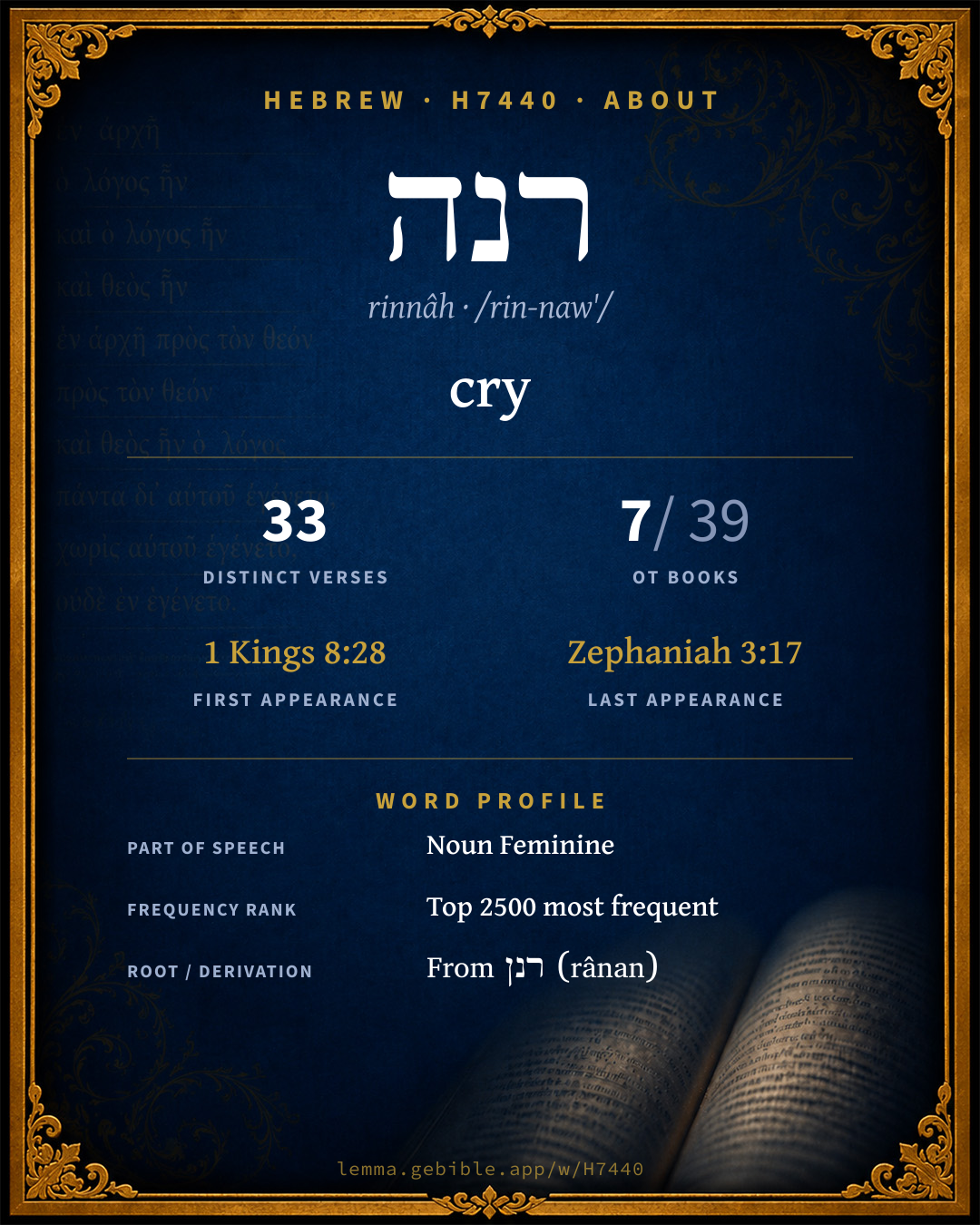
רִנָּה
cry
‘cry’ is one of 3 main senses fuller range ↓
Full lexicon entry — Brown-Driver-Briggs (BDB)
From Brown-Driver-Briggs (BDB)
Where this word appears
See every Absolute-state word in the Hebrew Bible →
Grammar key — what these labels mean
Part of speech
- Noun
- A naming word — a person, place, thing, or idea.
Noun type
- Common
- A common noun — a general class of person, place, or thing (“king,” “city,” “water”), not a specific name.
State
- Absolute
- The independent form of a noun, not bound to a following word.
- Construct
- A noun bound to a following noun in a possessive / “of” relationship (the construct chain).
Gender
- Feminine
- Grammatically feminine.
Number
- Singular
- One.
Grammatical forms
- Noun, Common, Feminine, Singular, Absolute 25 times (76%)
- Noun, Common, Feminine, Singular, Construct 8 times (24%)
Parsed forms decoded from the imported morphology (morphhb / Westminster Leningrad Codex — WLC text public domain, morphhb tagging CC BY 4.0), counted across 33 parsed occurrences — not distinct verses.
Every verse where H7440 appears — 33 distinct verses across 7 books. Click any verse to open its interlinear word-by-word view. Verse text shown in the World English Bible for context — . Each verse’s Hebrew form is shown with its reference; the English is not keyword-highlighted, since the data carries no word-level English alignment. Use “Compare translations” on any verse to read it across multiple English versions. This concordance covers the Hebrew Bible; Septuagint (Greek Old Testament) occurrences are not indexed here.
1 Kings 2 verses
- 1 Kings 8:28 הָֽ/רִנָּה֙ ptcl def.art + n c fs Yet have respect for the prayer of your servant, and for his supplication, Yahweh my God, to listen to the cry and to the prayer which your servant prays before you this day;
- 1 Kings 22:36 הָ/רִנָּה֙ ptcl def.art + n c fs There went a cry throughout the host about the going down of the sun, saying, Every man to his city, and every man to his country.
2 Chronicles 2 verses
- 2 Chronicles 6:19 הָ/רִנָּה֙ ptcl def.art + n c fs Yet have you respect to the prayer of your servant, and to his supplication, Yahweh my God, to listen to the cry and to the prayer which your servant prays before you;
- 2 Chronicles 20:22 בְ/רִנָּ֜ה prep + n c fs When they began to sing and to praise, Yahweh set liers-in-wait against the children of Ammon, Moab, and Mount Seir, who had come against Judah; and they were struck.
Psalms 15 verses
- Psalms 17:1 רִנָּתִ֗/י n c fs cs + sfx pers 1cs Hear, Yahweh, my righteous plea; Give ear to my prayer, that doesn't go out of deceitful lips.
- Psalms 30:5 רִנָּֽה n c fs For his anger is but for a moment; His favor is for a lifetime. Weeping may stay for the night, But joy comes in the morning.
- Psalms 42:4 רִנָּ֥ה n c fs These things I remember, and pour out my soul within me, How I used to go with the crowd, and led them to the house of God, With the voice of joy and praise, a multitude keeping a holy day.
- Psalms 47:1 רִנָּֽה n c fs Oh clap your hands, all you nations. Shout to God with the voice of triumph!
- Psalms 61:1 רִנָּתִ֑/י n c fs cs + sfx pers 1cs Hear my cry, God. Listen to my prayer.
- Psalms 88:2 לְ/רִנָּתִֽ/י prep + n c fs cs + sfx pers 1cs Let my prayer enter into your presence. Turn your ear to my cry.
- Psalms 105:43 בְּ֝/רִנָּ֗ה prep + n c fs He brought forth his people with joy, His chosen with singing.
- Psalms 106:44 רִנָּתָֽ/ם n c fs cs + sfx pers 3mp Nevertheless he regarded their distress, When he heard their cry.
- Psalms 107:22 בְּ/רִנָּֽה prep + n c fs Let them offer the sacrifices of thanksgiving, And declare his works with singing.
- Psalms 118:15 רִנָּ֬ה n c fs The voice of rejoicing and salvation is in the tents of the righteous. "The right hand of Yahweh does valiantly.
- Psalms 119:169 רִנָּתִ֣/י n c fs cs + sfx pers 1cs Let my cry come before you, Yahweh. Give me understanding according to your word.
- Psalms 126:2 רִ֫נָּ֥ה n c fs Then our mouth was filled with laughter, And our tongue with singing. Then they said among the nations, "Yahweh has done great things for them."
- Psalms 126:5 בְּ/רִנָּ֥ה prep + n c fs Those who sow in tears will reap in joy.
- Psalms 126:6 בְ/רִנָּ֑ה prep + n c fs He who goes out weeping, carrying seed for sowing, Will assuredly come again with joy, carrying his sheaves.
- Psalms 142:6 רִנָּתִ/י֮ n c fs cs + sfx pers 1cs Listen to my cry, For I am in desperate need. Deliver me from my persecutors, For they are stronger than me.
Proverbs 1 verse
Isaiah 9 verses
- Isaiah 14:7 רִנָּֽה n c fs The whole earth is at rest, [and] is quiet: they break forth into singing.
- Isaiah 35:10 בְּ/רִנָּ֔ה prep + n c fs and the ransomed of Yahweh shall return, and come with singing to Zion; and everlasting joy shall be on their heads: they shall obtain gladness and joy, and sorrow and sighing shall flee away.
- Isaiah 43:14 רִנָּתָֽ/ם n c fs cs + sfx pers 3mp Thus says Yahweh, your Redeemer, the Holy One of Israel: For your sake I have sent to Babylon, and I will bring down all of them as fugitives, even the Chaldeans, in the ships of their rejoicing.
- Isaiah 44:23 רִנָּ֔ה n c fs Sing, you heavens, for Yahweh has done it; shout, you lower parts of the earth; break forth into singing, you mountains, O forest, and every tree therein: for Yahweh has redeemed Jacob, and will glorify himself in Israel.
- Isaiah 48:20 רִנָּ֗ה n c fs Go you forth from Babylon, flee you from the Chaldeans; with a voice of singing declare you, tell this, utter it even to the end of the earth: say you, Yahweh has redeemed his servant Jacob.
- Isaiah 49:13 רִנָּ֑ה n c fs Sing, heavens; and be joyful, earth; and break forth into singing, mountains: for Yahweh has comforted his people, and will have compassion on his afflicted.
- Isaiah 51:11 בְּ/רִנָּ֔ה prep + n c fs The ransomed of Yahweh shall return, and come with singing to Zion; and everlasting joy shall be on their heads: they shall obtain gladness and joy; [and] sorrow and sighing shall flee away.
- Isaiah 54:1 רִנָּ֤ה n c fs Sing, barren, you who didn't bear; break forth into singing, and cry aloud, you who did not travail with child: for more are the children of the desolate than the children of the married wife, says Yahweh.
- Isaiah 55:12 רִנָּ֔ה n c fs For you shall go out with joy, and be led forth with peace: the mountains and the hills shall break forth before you into singing; and all the trees of the fields shall clap their hands.
Jeremiah 3 verses
- Jeremiah 7:16 רִנָּ֥ה n c fs Therefore don't you pray for this people, neither lift up a cry nor prayer for them, neither make intercession to me; for I will not hear you.
- Jeremiah 11:14 רִנָּ֣ה n c fs Therefore don't you pray for this people, neither lift up cry nor prayer for them; for I will not hear them in the time that they cry to me because of their trouble.
- Jeremiah 14:12 רִנָּתָ֔/ם n c fs cs + sfx pers 3mp When they fast, I will not hear their cry; and when they offer burnt offering and meal-offering, I will not accept them; but I will consume them by the sword, and by the famine, and by the pestilence.
Zephaniah 1 verse
About this entry
At a glance — auto-summarized from this page’s data, not written by a person. Every figure links to its source below. This summary describes the numbers; it doesn’t interpret them.
At its core, רנה (rinnâh) means “cry.” Scripture first uses it in 1 Kings 8:28. It appears 33 verses across 7 books of the Hebrew Bible, among its moderately common vocabulary. The word gravitates to Psalms (45%), then Isaiah and Jeremiah. Not a single-sense word: explore its full sense range. Dig into 33-verse concordance and the renderings breakdown below.
Gloss history
Strong's 1890 vs modern scholarship
About this word
Strong's H7440 catalogs a Hebrew word from the Hebrew Old Testament.
These counts are not copied from any lexicon or concordance. They are computed here, from the morphology-tagged Hebrew Old Testament. What Lemma adds →
- 33
- distinct verses
- The word appears in 33 distinct verses.
- 7 / 39
- OT books
- The word appears in 7 of 39 Old Testament books.
- #1,064
- by frequency
- Top 2500 most frequent Hebrew words (rank 1,064 of 8,640 Hebrew words by occurrence).
View all 33 occurrences in the concordance →
By section of the Old Testament
By traditional corpus
Conventional, traditional groupings — biblical authorship is debated, so this is a traditional corpus grouping, not an authorship claim. Each share is this word’s portion of its verses in that division of the Hebrew canon. Each figure is a share of the word’s 33 distinct verses.
- Writings (Ketuvim) 18 verses · 55%
- Prophets (Nevi'im) 15 verses · 45%
How translations render this word
Counts come from each version’s own published word-to-Strong’s tagging or interlinear alignment — an approximate guide to how each version renders this word, not a word-level alignment the data otherwise carries. Because each total is that version’s own tagged count, the per-version totals vary from one another and need not match the appearance or distinct-verse counts above. These counts may also differ from a printed concordance because Lemma counts each distinctly tagged rendering and does not collapse phrase taggings into a single head-word total. This is a fixed set of word-tagged versions (KJV, ASV, BSB, ULT) and does not change with the reading translation you choose elsewhere. Each version’s license is shown beside its name below (and on Sources).
BDB lists this Strong’s number as 3 distinct words (homographs). Each count above pools all of them and is not split by sense — see the Senses section below. A low-frequency rendering may belong to a different one of those words, not the primary meaning.
- King James Version†: Cry 11×, Singing 7×, Joy 3×
- American Standard Version†: Cry 11×, Singing 10×, Joy 3×
- Berean Standard Bible†: Cry 10×, Song 5×, Joy 4×
- unfoldingWord Literal Text†: Cry 12×, Singing 6×, Rejoicing 5×
King James Version Public Domain
Renders H7440 across 33† tagged occurrences — most commonly:
Plus 10 renderings that appear only once — usually multi-word phrases or single function words the recovered tagging swept in, not distinct renderings.
American Standard Version Public Domain
Renders H7440 across 33† tagged occurrences — most commonly:
Plus 7 renderings that appear only once — usually multi-word phrases or single function words the recovered tagging swept in, not distinct renderings.
Berean Standard Bible Public Domain
Renders H7440 across 33† tagged occurrences — most commonly:
Plus 7 renderings that appear only once — usually multi-word phrases or single function words the recovered tagging swept in, not distinct renderings.
unfoldingWord Literal Text CC BY-SA 4.0
Renders H7440 across 38† tagged occurrences — most commonly:
Plus 9 renderings that appear only once — usually multi-word phrases or single function words the recovered tagging swept in, not distinct renderings.
Senses in the full BDB
What do BDB’s symbols mean?
BDB uses these scholarly abbreviations:
| Symbol | Meaning |
|---|---|
| 𝔊 | the Septuagint (the ancient Greek translation, LXX) |
| 𝔙 | the Vulgate (the Latin translation) |
| 𝔖 | the Syriac version (the Peshitta) |
| 𝔗 | the Targum (the Aramaic translation) |
| ψ | the Psalms |
| √ | root (the underlying root or stem) |
| ‖ | parallel passage (a synonymous or contrasted parallel) |
| † | the dagger: every passage where the word occurs is cited |
The 3 senses and sub-senses the full Brown-Driver-Briggs lexicon distinguishes for this word, in lexicon order (not ranked by frequency), with BDB’s own verbatim wording and sub-sense lettering. Shown in Hebrew script with BDB’s own scholarly abbreviations. The condensed entry is in the Lexicon Entry tab. See also the Forms in the corpus table below.
רנה I i, ii. רִנָּה v. רנן.
רנה II ringing cry
- 1. in entreaty, supplication, to י׳, 1 K 8:28 = 2 Ch 6:19; Je 7:16; 11:14 ψ 17:1; 61:2; 88:3 (all + תְּפִלָּה), 106:44; 119:169; 142:7; Je 14:12. e.g. 1 Kings 8:28
- 2. in proclamation 1 K 22:36. e.g. 1 Kings 22:36
- 3. in joy, especially praise to י׳, + שִׂמְחָה Is 35:10; 51:11 (+ שָׂשׂוֹן); + תְּהִלָּה 2 Ch 20:22, + שָׂשׂוֹן ψ 105:43, + תּוֹדָה 107:22, + עלץ Pr 11:10; ‖ שְׂהוֹק ψ 126:2; opp. בְּכִי, etc. 30:6; 126:6, cf. v 5; קוֹל ר׳ Is 48:20 ψ 42:5 (+ תּוֹדָה), 47:2; 118:15 (+ יְשׁוּעָה); פָּצַח ר׳ Is 14:7; 44:23; 49:13; 54:1; 55:12; of י׳’s joy over Zion Zp 3:17;—בָּאֳנִיּוֹת רִנָּתָם Is 43:14 in the ships of their ringing cry, in which they exulted, but dub.; Hi Ew בַּאֲנִיּוֹת (bring down) into mourning their ר׳; cf. Kit-Di Du CheHpt. Marti. e.g. Isaiah 35:10
רנה III m. in Judah 1 Ch 4
Senses from the full Brown-Driver-Briggs lexicon (Brown, Driver, Briggs; Oxford 1906 — public domain), digitized via Sefaria, supplemented by the OpenScriptures HebrewLexicon (CC BY 4.0). Full attribution on Sources.
Word origin
I. n.f. ringing cry;—abs. ר׳ Je 7:16 +; sf. רִנָּתִי ψ 17:1 +, רִנָּתָם Je 14:12 +;—ringing cry:
II. n.pr.m. in Judah 1 Ch 4:20; Ανα, A Ραννων, 𝔊L Ρεννα.
— Brown-Driver-Briggs (Oxford 1906, public domain), digitized via Sefaria, supplemented by the OpenScriptures HebrewLexicon (CC BY 4.0). See Sources.
Derived from רנן (rânan) (H7442) — to shout.
Jastrow Dictionary
A second Hebrew/Aramaic lexicon for comparison, covering Aramaic and post-biblical (Talmudic, Targumic, Midrashic) usage that the biblical-Hebrew BDB does not. Matched by lemma rather than by Strong’s number, so a lemma may carry more than one Jastrow headword (shown separately below), and the entries cover usage well beyond the Bible.
רִנָּה
- chant, song. Yoma 70ᵃ; Sot. 41ᵃ. Ex. R. s. 47 ר׳ של תורה, v. רִינּוּן. Y. Succ. IV, 54ᵃ top בר׳ using the verb רָנַן; a. fr.
A Dictionary of the Targumim, the Talmud Babli and Yerushalmi, and the Midrashic Literature (Marcus Jastrow; London, Luzac, 1903) — Public Domain. Digitized via Sefaria. Digitized via Sefaria. Full attribution on Sources.
Forms in the corpus
The 24 distinct written forms H7440 takes in the Hebrew Bible, most frequent first — each parse links to that state’s occurrences in the concordance. Hebrew forms include their vowel points and cantillation, so a single lemma takes many written forms.
Same root — word family
Other BDB entries built from the same root as H7440, grouped by Strong’s listed origin. These share a root / origin per the lexicon — not necessarily a shared meaning. Each links to that word’s own entry.
Derives from
Shares the same root
- רן rôn H7438 ringing cry
- רנן renen H7443 ostrich
- רנן rannên H7444 shout
- רננה rᵉnânâh H7445 ringing cry
Proper names from this root
People and places named from this root — a name, not an additional meaning of the word.
Compare all same-root words → Showing 4 of 9 — not the complete family. 3 of the same-root words are proper names (people or places). They share a root, not necessarily a meaning.
Septuagint verse parallels
This word appears in 29 verses that also exist in the Greek Old Testament (Septuagint), out of the 33 Hebrew verses it occurs in. You can read those verses in Greek by switching the Old Testament edition to the Septuagint.
Read these verses in the Septuagint
This is a verse-level parallel only — the same verses exist in both the Hebrew and Greek Old Testaments. No word-level Hebrew↔Greek correspondence is claimed: the data carries no such alignment, so no Greek word is shown as this Hebrew word’s translation. Coverage is not total — the Septuagint omits the deuterocanon and renumbers the Psalms, so some Hebrew verses have no direct Greek parallel.