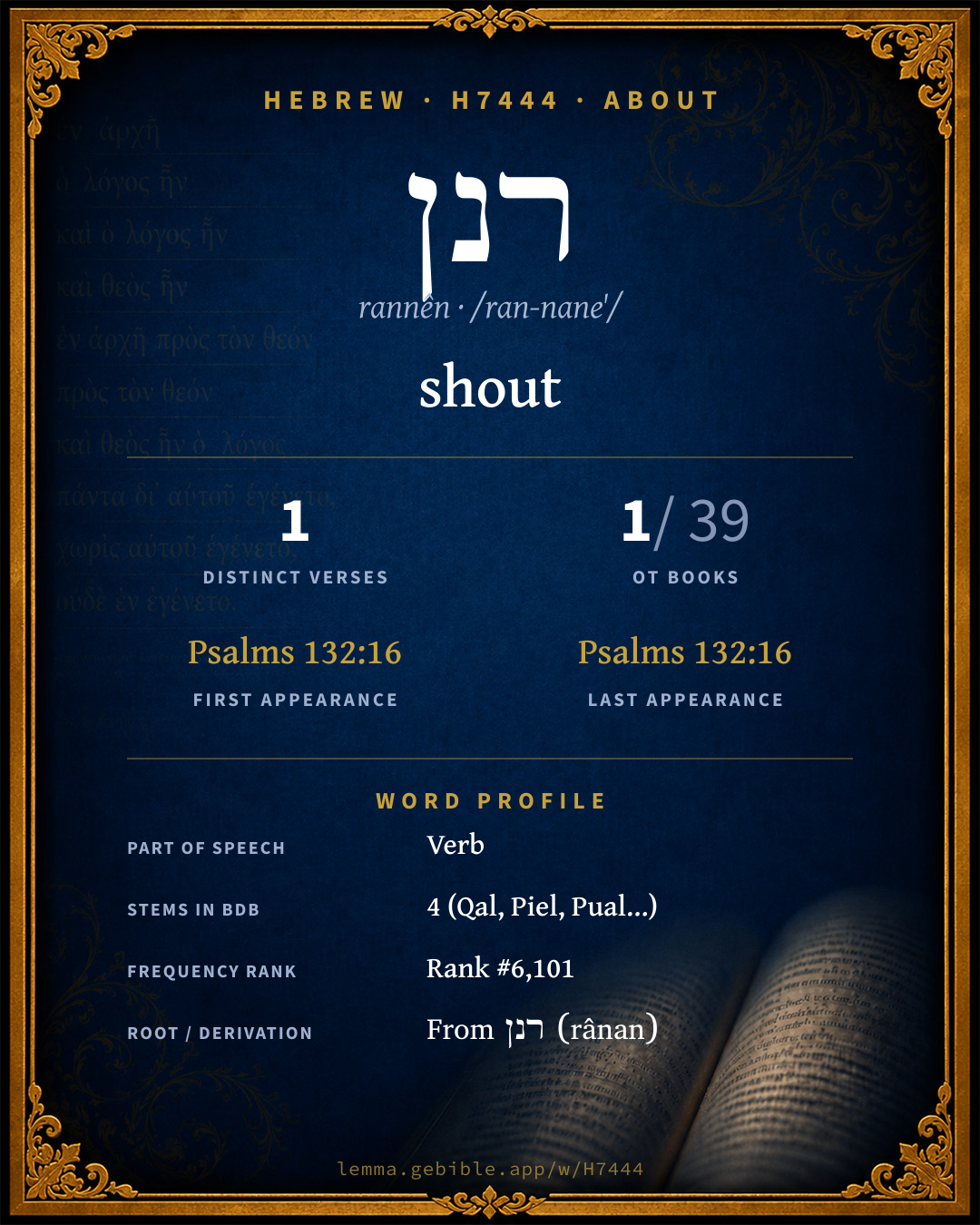
רַנֵּן
shout
Full lexicon entry — Brown-Driver-Briggs (BDB)
From Brown-Driver-Briggs (BDB)
Where this word appears
Grammar key — what these labels mean
Part of speech
- Verb
- An action or state-of-being word.
Stem
- Piel
- An intensive or resultative active stem.
Form
- Infinitive Absolute
- An unbound verbal noun, often intensifying or standing in for a finite verb.
Every verse where H7444 appears — 1 distinct verse across 1 book. Click any verse to open its interlinear word-by-word view. Verse text shown in the World English Bible for context — . Each verse’s Hebrew form is shown with its reference; the English is not keyword-highlighted, since the data carries no word-level English alignment. Use “Compare translations” on any verse to read it across multiple English versions. This concordance covers the Hebrew Bible; Septuagint (Greek Old Testament) occurrences are not indexed here.
Psalms 1 verse
About this entry
At a glance — auto-summarized from this page’s data, not written by a person. Every figure links to its source below. This summary describes the numbers; it doesn’t interpret them.
At its core, רנן (rannên) means “shout.” It is rare — just 1 verse in the entire Hebrew Bible. The word gravitates to Psalms (100%). It occurs only once, in Psalms 132:16. As a verb its force shifts by stem, across 4 stems (Qal, Piel, and more). Each statement above links to its evidence; the full detail follows below.
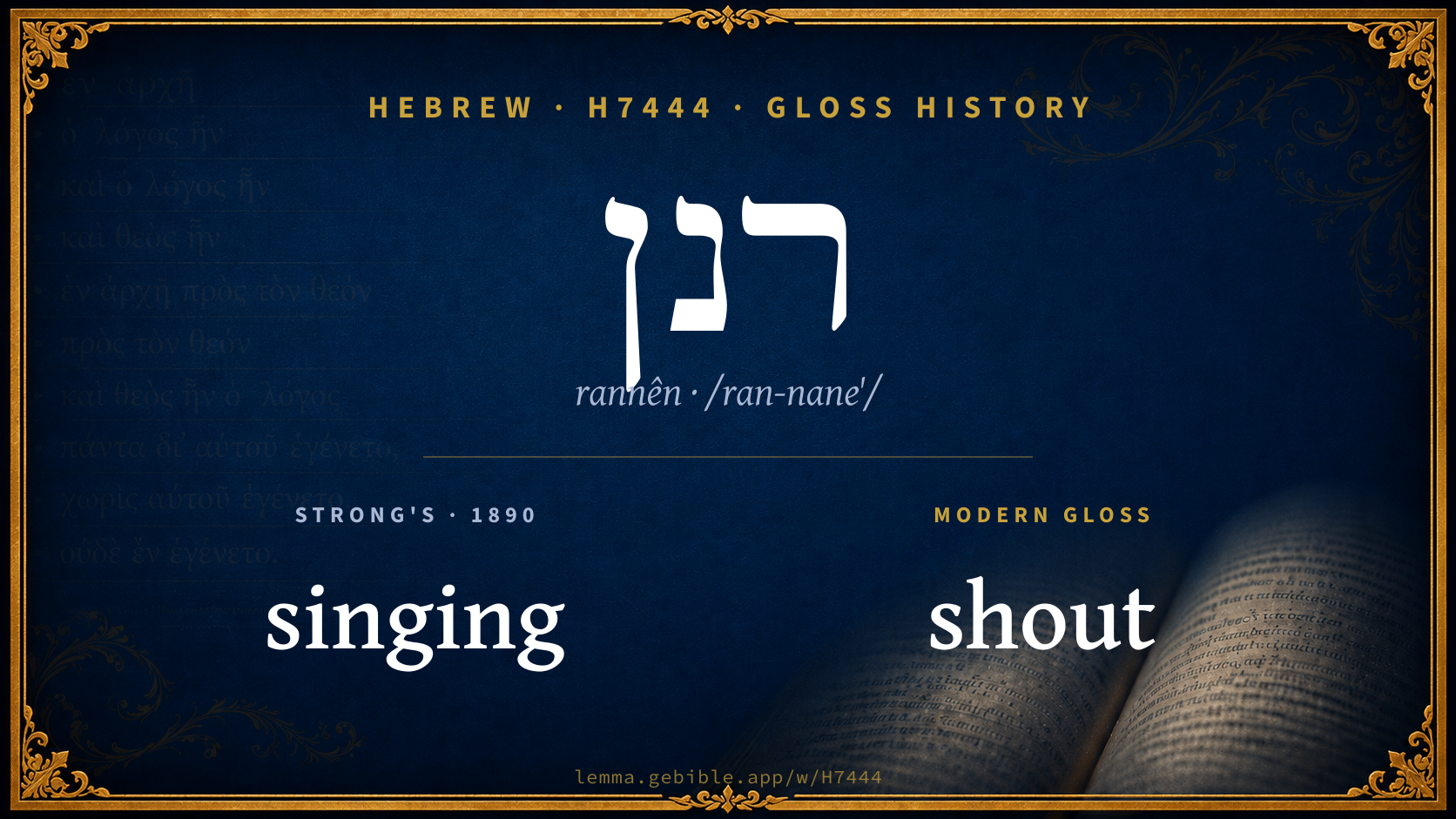
Gloss history
Strong's 1890 vs modern scholarship
About this word
Strong's H7444 catalogs a Hebrew word from the Hebrew Old Testament.
These counts are not copied from any lexicon or concordance. They are computed here, from the morphology-tagged Hebrew Old Testament. What Lemma adds →
- 1
- distinct verses
- The word appears in 1 distinct verse.
- 1 / 39
- OT books
- The word appears in 1 of 39 Old Testament books.
- #6,101
- by frequency
- Rank #6,101 (rank 6,101 of 8,640 Hebrew words by occurrence).
View all 1 occurrence in the concordance →
Most concentrated in
- Psalms 1 verse 100%
By section of the Old Testament
By traditional corpus
Conventional, traditional groupings — biblical authorship is debated, so this is a traditional corpus grouping, not an authorship claim. Each share is this word’s portion of its verses in that division of the Hebrew canon. Each figure is a share of the word’s 1 distinct verse.
- Writings (Ketuvim) 1 verse · 100%
How translations render this word
Counts come from each version’s own published word-to-Strong’s tagging or interlinear alignment — an approximate guide to how each version renders this word, not a word-level alignment the data otherwise carries. Because each total is that version’s own tagged count, the per-version totals vary from one another and need not match the appearance or distinct-verse counts above. These counts may also differ from a printed concordance because Lemma counts each distinctly tagged rendering and does not collapse phrase taggings into a single head-word total. This is a fixed set of word-tagged versions (KJV, ASV, BSB, ULT) and does not change with the reading translation you choose elsewhere. Each version’s license is shown beside its name below (and on Sources).
- King James Version: Joy 1×, Singing 1×
- American Standard Version: Joy 1×, Singing 1×
- unfoldingWord Literal Text: Shouting 1×
King James Version Public Domain
Renders H7444 across 2 tagged occurrences — most commonly:
American Standard Version Public Domain
Renders H7444 across 2 tagged occurrences — most commonly:
unfoldingWord Literal Text CC BY-SA 4.0
Renders H7444 across 1 tagged occurrence — most commonly:
7 senses and sub-senses in the full BDB
Hebrew verbs can shift meaning by stem (binyan): Qal is the basic action, Niphal is often passive or reflexive, Piel often intensifies or makes it factitive, and Hiphil is typically causative. The senses below are grouped under the stem BDB assigns to each. This entry also uses Pual (the passive of Piel).
What do BDB’s symbols mean?
BDB uses these scholarly abbreviations:
| Symbol | Meaning |
|---|---|
| 𝔊 | the Septuagint (the ancient Greek translation, LXX) |
| 𝔙 | the Vulgate (the Latin translation) |
| 𝔖 | the Syriac version (the Peshitta) |
| 𝔗 | the Targum (the Aramaic translation) |
| ψ | the Psalms |
| √ | root (the underlying root or stem) |
| ‖ | parallel passage (a synonymous or contrasted parallel) |
| † | the dagger: every passage where the word occurs is cited |
The 7 senses and sub-senses the full Brown-Driver-Briggs lexicon distinguishes for this word, in lexicon order (not ranked by frequency), with BDB’s own verbatim wording and sub-sense lettering. Shown in Hebrew script with BDB’s own scholarly abbreviations. The condensed entry is in the Lexicon Entry tab.
Qal
- Impf. 3 ms. יָרוּן (Ges§ 67 q) Pr 29:6 (but read perhaps יָרוּץ, Pinsk Toy, v. רוּץ 2); 3 fs. תָּרֹן Is 35:6; 3 mpl. יָרֹ֫נּוּ 24:14 +, וַיָּר׳ Lv 9:24; 3 fpl. תָּדֹ֫נָּה Pr 1:20; 8:3; Imv. fs. רָנִּי Is 54:1 +, רֹ֫נִּי 12:6; mpl. רָנּוּ Je 31:7 +; Inf. cstr. בְּרָן־ Jb 38:7;—give a ringing cry: e.g. Proverbs 29:6
- 1. in joy, exultation, ‖ צָהַל Je 31:7 (ר׳ שׂמְחָה), Is 12:6; 24:14 (‖ נָשָׂא קוֹל), 54:1 (+ פָּצַח רִנָּה); ‖ הֵרִיעַ Zp 3:14 (+ שׂמח, עלז), Is 44:23; Jb 38:7; ‖ שָׂמַח Zc 2:14 ψ 35:27 Pr 29:6 (v. supr.); ‖ גִּיל Is 49:13 (+ הֵרִים רִנָּה), ‖ צָוַח 42:11; opp. צָעַק (cry in distress) 65:14 (מִן of cause); Lv 9:24; Is 35:6 (subj. לָשׁוֹן).—Is 61:7 is corrupt; read perhaps וָרֹק and spitting, Klo CheHpt. e.g. Jeremiah 31:7
- 2. in distress, La 2:19. e.g. Lamentations 2:19
- 3. cry aloud, in summons, exhortation (of wisdom) Pr 1:20 (‖ נָתַן קוֹל). 8:3. e.g. Proverbs 1:20
Piel
- Pf. 3 pl. consec. וְרִנְּנוּ Je 31:12; 51:48; Impf. 3 fs. תְּרַנֵּן ψ 51:16, 3 mpl. יְרַנְּנוּ 84:3 +, יְרַנֵּנ֑וּ 5:12 +; 3 fpl. תְּרַנֵּ֫נָּה 71:23 (van d. H. תְּרַנֵּנָה), etc.; Imv. mpl. רַנְּנוּ Is 52:9 +; Inf. abs. רַנֵּן ψ 132:16, cstr. id. Is 35:2;—give a ringing cry, in joy, exultation, especially in praise to י׳, Je 31:12; 51:48; Is 26:19; 35:2 (+ גִּילַת, v. גִּילַה), 52:8 (‖ נָשָׂא קוֹל), v 9 (+ פָּצַח); elsewhere only ψψ: ψ 5:12 (‖ שָׂמַח, עָלַץ), 67:5; 90:14; 95:5 (c. ב rei; all ‖ ש׳ alone); 149:5 (‖ עָלַז); 98:4 (‖ הֵרִיעַ; + פָּצַח, זִמֵּר), 132:9; 145:7, רַנֵּן יְרַנֵּנ֑וּ 132:16; c. acc. of theme 51:16; 59:17 (‖ שִׁיר); בי׳ 33:1; ב rei 20:6; 63:8; 89:13; c. לי׳ 95:1 (‖ הֵרִיעַ), אֶל־אֵל 84:3, (מִ)לפני י׳ 96:12 (‖ עָלַז) = 1 Ch 16:33 (‖ עָלַץ), ψ 98:8; subj. שְׂפָתַיִם 71:23 (‖ זִמֵּר). e.g. Jeremiah 31:12
Pual
- Impf. 3 ms. impers. לֹא יְרֻנָּן Is 16:10 no ringing cry shall be given (‖ יְרֹעָ֑ע). e.g. Isaiah 16:10
Hiphil
- Impf. cause to ring out for joy, 1 s. לֵב אַלְמָנָה אַרְנִן Jb 29:13; 2 ms. מוֹצָאֵי בֹקֶר וָעֶרֶב תַּרְנִין ψ 65:9; Imv. mpl. הַרְנִינוּ ring out a cry of Joy ψ 32:11 (‖ שׂמח, גיל), לי׳ 81:2 (‖ הריע); c. acc. of theme, עַמּוֹ Dt 32:43 (v. Dr; cf. Pi.).—Hithpō. ψ 78:65 v. רון. e.g. Job 29:13
Senses from the full Brown-Driver-Briggs lexicon (Brown, Driver, Briggs; Oxford 1906 — public domain), digitized via Sefaria, supplemented by the OpenScriptures HebrewLexicon (CC BY 4.0). Full attribution on Sources.
Word origin
vb. give a ringing cry (onomatop.? cf. Arabic رَنَّ cry aloud, also twang (of bowstring); NH Pi. murmur, complain, cf. J.Aram (not 𝔗));—
— Brown-Driver-Briggs (Oxford 1906, public domain), digitized via Sefaria, supplemented by the OpenScriptures HebrewLexicon (CC BY 4.0). See Sources.
Derived from רנן (rânan) (H7442) — to shout.
Jastrow Dictionary
A second Hebrew/Aramaic lexicon for comparison, covering Aramaic and post-biblical (Talmudic, Targumic, Midrashic) usage that the biblical-Hebrew BDB does not. Matched by lemma rather than by Strong’s number, so a lemma may carry more than one Jastrow headword (shown separately below), and the entries cover usage well beyond the Bible.
רָנַן
- (b. h.) [to whiz, hum,]
- 1. to murmur, v. רוֹנָן.
- 2. to rejoice. Ab. Zar. 24ᵇ רוֹנִּי וכ׳ rejoice, O holy ark, v. רוּם I h.
- same,
- 1. to murmur, complain. Y. Ber. IV, 7ᵈ top עד שרִינְּנוּ כל העם until all the people murmured (became rebellious); Bab. Ber. 27ᵇ שרננו; Y. Taan. IV, 67ᵈ שריננו בו; Bekh. 36ᵃ. Y. Ber. IX, 14ᵇ מְרַנְּנִים אחריו, v. סְפִיקוּלָא I. Num. R. s. 127 כל … לא היתה מְרַנֶּנֶת as long as she was engaged in making the purple cloak, she did not grumble; Pesik. R. s. 5 מרנונית (corr. acc.; Tanḥ. Naso 12 מריבה). Num. R. l. c.; Pesik. R. l. c. ווי … וִירַּנְּנוּ כשם שהיו מרננים woe, (I am afraid,) lest they will again murmur as they were wont to do. Midr. Till. to Ps. XXXIII (ref. to Cant. IV, 11) בין משבחת בין מרננת אל תמנעי וכ׳ whether praising or complaining, refrain not thy voice, for ‘thy voice is sweet’; a. fr. e.g. Song of Solomon 4:11
- 2. to sing, praise. Ib. הכל מרננים צדיקים מרננים וכ׳ all give praise (to God), the righteous give praise, and the wicked give praise; אבל אין הרשעים מרננין וכ׳ but the wicked praise not until he brings plagues upon them &c. Ib. הכל מרננין לפניו וכ׳ all sing before Him, heaven and earth sing &c.; a. fr.
רְנַן
- 1. to think, meditate. Targ. Prov. XV, 28, v. רְנֵי. Targ. Ps. XXXVII, 30; a. e.
- 2. to murmur. Targ. I Sam. II, 24 דרַנְנִין (ed. Lag. דדננין, Var. דר׳, דמְרַנְּנִין).
- 1. to think, meditate. Targ. Ps. I, 2. Ib. XXXIX, 4 ברַנְּנִי Ms. (ed. ברִנְנִי, ברִי׳, v. next w.); a. e.
- 2. to murmur. Targ. I Sam. l. c., v. supra.—Y. Ab. Zar. III, 42ᶜ top והוו … מְרַנְּנִין ביה and the scholars murmured against him (considered his conduct unbecoming). Yeb. 34ᵇ קא מְרַנְּנֵי … אבתרך the scholars speak ill of thee; a. e.
- 3. to sing, rejoice. Targ. Ps. XIII, 5, sq. Ib. XIV, 7; a. fr.
A Dictionary of the Targumim, the Talmud Babli and Yerushalmi, and the Midrashic Literature (Marcus Jastrow; London, Luzac, 1903) — Public Domain. Digitized via Sefaria. Digitized via Sefaria. Full attribution on Sources.
Same root — word family
Other BDB entries built from the same root as H7444, grouped by Strong’s listed origin. These share a root / origin per the lexicon — not necessarily a shared meaning. Each links to that word’s own entry.
Derives from
Shares the same root
- רן rôn H7438 ringing cry
- רנה rinnâh H7440 cry
- רנן renen H7443 ostrich
- רננה rᵉnânâh H7445 ringing cry
Proper names from this root
People and places named from this root — a name, not an additional meaning of the word.
Compare all same-root words → Showing 4 of 8 — not the complete family. 2 of the same-root words are proper names (people or places). They share a root, not necessarily a meaning.