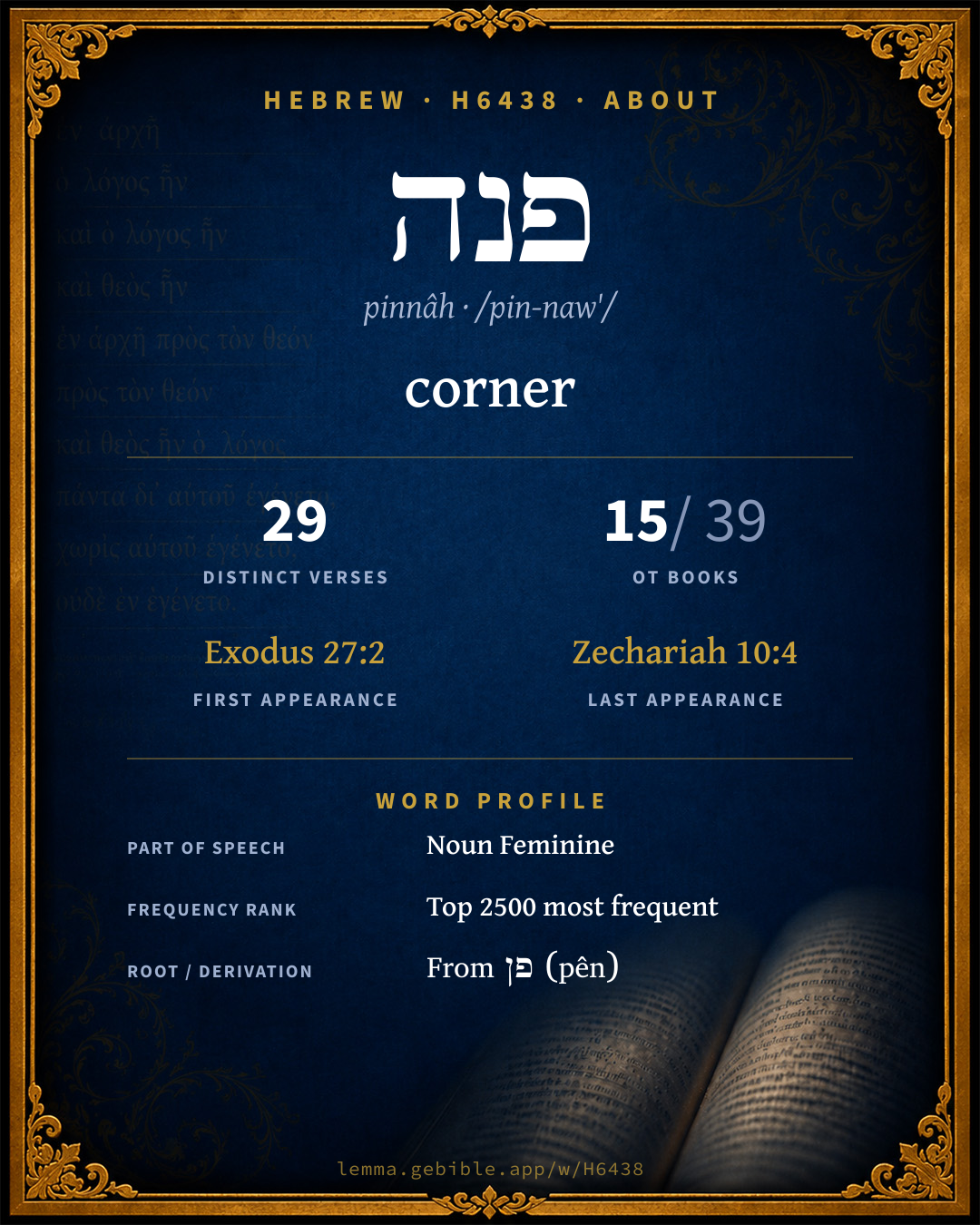
פִּנָּה
corner
‘corner’ is one of 3 main senses fuller range ↓
Full lexicon entry — Brown-Driver-Briggs (BDB)
From Brown-Driver-Briggs (BDB)
Where this word appears
See every Absolute-state word in the Hebrew Bible →
Grammar key — what these labels mean
Part of speech
- Noun
- A naming word — a person, place, thing, or idea.
Noun type
- Common
- A common noun — a general class of person, place, or thing (“king,” “city,” “water”), not a specific name.
State
- Construct
- A noun bound to a following noun in a possessive / “of” relationship (the construct chain).
- Absolute
- The independent form of a noun, not bound to a following word.
Gender
- Feminine
- Grammatically feminine.
Number
- Plural
- More than one (in Hebrew, generally three or more).
- Singular
- One.
1 verse where H6438 appears in the Construct state in the Book of Jeremiah. Filtered view — show all forms. Click any verse to open its interlinear word-by-word view. Verse text shown in the World English Bible for context — . Each verse’s Hebrew form is shown with its reference; the English is not keyword-highlighted, since the data carries no word-level English alignment. Use “Compare translations” on any verse to read it across multiple English versions. This concordance covers the Hebrew Bible; Septuagint (Greek Old Testament) occurrences are not indexed here.
Jeremiah
About this entry
At a glance — auto-summarized from this page’s data, not written by a person. Every figure links to its source below. This summary describes the numbers; it doesn’t interpret them.
פנה — transliterated pinnâh — is a Hebrew noun carrying the sense “corner.” Debuting at Exodus 27:2, it then recurs through the corpus. The Hebrew Bible uses it across 29 verses — moderately common. The lexicon spreads it across several senses; see its full sense range. It shares a root with פן and פנין. See the sense tree, 29-verse concordance, and the renderings breakdown below.
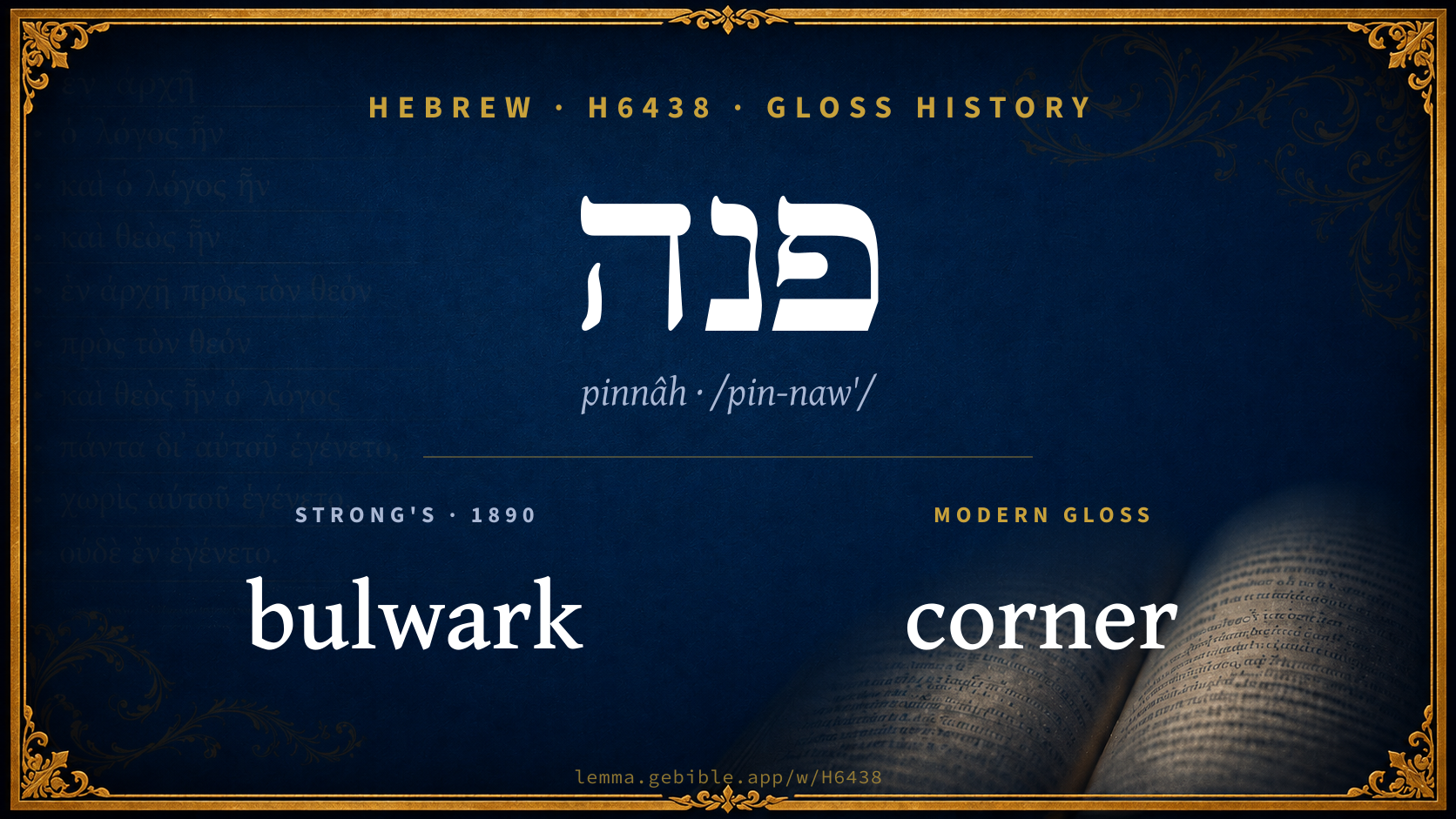
Gloss history
Strong's 1890 vs modern scholarship
About this word
Strong's H6438 catalogs a Hebrew word from the Hebrew Old Testament.
These counts are not copied from any lexicon or concordance. They are computed here, from the morphology-tagged Hebrew Old Testament. What Lemma adds →
- 29
- distinct verses
- The word appears in 29 distinct verses.
- 15 / 39
- OT books
- The word appears in 15 of 39 Old Testament books.
- #1,160
- by frequency
- Top 2500 most frequent Hebrew words (rank 1,160 of 8,640 Hebrew words by occurrence).
View all 29 occurrences in the concordance →
Most concentrated in
- Proverbs 4 verses 14%
- 2 Chronicles 3 verses 10%
- Nehemiah 3 verses 10%
By section of the Old Testament
By traditional corpus
Conventional, traditional groupings — biblical authorship is debated, so this is a traditional corpus grouping, not an authorship claim. Each share is this word’s portion of its verses in that division of the Hebrew canon. Each figure is a share of the word’s 29 distinct verses.
- Prophets (Nevi'im) 14 verses · 48%
- Writings (Ketuvim) 13 verses · 45%
- Torah (Pentateuch) 2 verses · 7%
How translations render this word
Counts come from each version’s own published word-to-Strong’s tagging or interlinear alignment — an approximate guide to how each version renders this word, not a word-level alignment the data otherwise carries. Because each total is that version’s own tagged count, the per-version totals vary from one another and need not match the appearance or distinct-verse counts above. These counts may also differ from a printed concordance because Lemma counts each distinctly tagged rendering and does not collapse phrase taggings into a single head-word total. This is a fixed set of word-tagged versions (KJV, ASV, BSB, ULT) and does not change with the reading translation you choose elsewhere. Each version’s license is shown beside its name below (and on Sources).
- King James Version: Corner 12×, Corners 6×, Every corner 2×
- American Standard Version: Corner 12×, Corners 5×, Battlements 3×
- Berean Standard Bible: Corner 10×, Corners 6×, Cornerstone 3×
- unfoldingWord Literal Text: Corner 9×, Corners 5×, The 3×
King James Version Public Domain
Renders H6438 across 28 tagged occurrences — most commonly:
Plus 6 renderings that appear only once — usually multi-word phrases or single function words the recovered tagging swept in, not distinct renderings.
American Standard Version Public Domain
Renders H6438 across 28 tagged occurrences — most commonly:
Plus 6 renderings that appear only once — usually multi-word phrases or single function words the recovered tagging swept in, not distinct renderings.
Berean Standard Bible Public Domain
Renders H6438 across 27 tagged occurrences — most commonly:
Plus 4 renderings that appear only once — usually multi-word phrases or single function words the recovered tagging swept in, not distinct renderings. Not rendered by a distinct English word in 2 further occurrences.
unfoldingWord Literal Text CC BY-SA 4.0
Renders H6438 across 31 tagged occurrences — most commonly:
Plus 4 renderings that appear only once — usually multi-word phrases or single function words the recovered tagging swept in, not distinct renderings.
Senses in the full BDB
What do BDB’s symbols mean?
BDB uses these scholarly abbreviations:
| Symbol | Meaning |
|---|---|
| 𝔊 | the Septuagint (the ancient Greek translation, LXX) |
| 𝔙 | the Vulgate (the Latin translation) |
| 𝔖 | the Syriac version (the Peshitta) |
| 𝔗 | the Targum (the Aramaic translation) |
| ψ | the Psalms |
| √ | root (the underlying root or stem) |
| ‖ | parallel passage (a synonymous or contrasted parallel) |
| † | the dagger: every passage where the word occurs is cited |
The 3 senses and sub-senses the full Brown-Driver-Briggs lexicon distinguishes for this word, in lexicon order (not ranked by frequency), with BDB’s own verbatim wording and sub-sense lettering. Shown in Hebrew script with BDB’s own scholarly abbreviations. The condensed entry is in the Lexicon Entry tab. See also the Forms in the corpus table below.
- 1.
- a. corner, of square objects 1 K 7:34 + v 30 (read פִּנּוֹתָיו for פַּעֲמֹתָיו, cf. Kit), Ex 27:2; 38:2; Ez 43:20; 45:19; of house Jb 1:19, roof Pr 7:12; 21:9 = 25:24; אֶבֶן לְפ׳ Je 51:26 i.e. a corner-stone; אֶבֶן פ׳ of earth Jb 38:9; cf. (fig.) ψ 118:22, and (אבן om.) Is 28:16; פ׳ = street-corner 2 Ch 28:24. e.g. 1 Kings 7:34
- b. specif. of wall of Jerus., Ne 3:24 (in SE.), v 31, 32 (NE.); שַׁעַר הַפּ׳ 2 K 14:13 + ‖ 2 Ch 25:23 𝔊 𝔖 𝔗 and most (for MT שׁ׳ הַפּוֹנֶה), + (v. שַׁעַר); הַפִּנּוֹת appar. with battlements 2 Ch 26:15; of cities in gen. הַפּ׳ הַגְּבֹהוֹת Zp 1:16; of the nations 3:6. e.g. Nehemiah 3:24
- 2. fig. of chief, ruler as corner (support or defence), Ju 20:2; 1 S 14:38; Is 19:13 (read perhaps pl.); Zc 10:4 (+ יָתֵד q.v.). e.g. Judges 20:2
Senses from the full Brown-Driver-Briggs lexicon (Brown, Driver, Briggs; Oxford 1906 — public domain), digitized via Sefaria, supplemented by the OpenScriptures HebrewLexicon (CC BY 4.0). Full attribution on Sources.
Word origin
n.f. corner;—abs. פ׳ 2 K 14:13 +, cstr. פִּנַּת Je 31:40 +; sf. פִּנָּתָהּ Jb 38:9, פִּנָּהּ Pr 7:8 (Ges§ 91 e); pl. פִּנּוֹת abs. Zp 1:16 2 Ch 26:15, פִּנִּים Zc 14:10; cstr. פִּנּוֹת 1 K 7:34 +, etc.;—
— Brown-Driver-Briggs (Oxford 1906, public domain), digitized via Sefaria, supplemented by the OpenScriptures HebrewLexicon (CC BY 4.0). See Sources.
Derived from פן (pên) (H6434) — corner.
Jastrow Dictionary
A second Hebrew/Aramaic lexicon for comparison, covering Aramaic and post-biblical (Talmudic, Targumic, Midrashic) usage that the biblical-Hebrew BDB does not. Matched by lemma rather than by Strong’s number, so a lemma may carry more than one Jastrow headword (shown separately below), and the entries cover usage well beyond the Bible.
פָּנָה
- , v. פני
פָּנֶה
- , v. פָּנִים
פִּנָּה
- , v. פִּינָּה
פני
- (b. h.)
- 1. to turn (one’s face). Yoma 17ᵇ, a. e. שאתה פוֹנֶה, v. פִּינָּה. Y. Ab. Zar. III, 42ᵇ sq. (ref. to Lev. XIX, 4) אל תִּפְנֶה לעובדן do not turn thy face to them to worship them; אל תפנה לראותן ממש it is meant literally, do not turn thy face to look at them; Sifra K’dosh. beg. אל תפנה לראותם וַדַּיי. Ib. תחלתם אלילים הם אם פּוֹנֶה את אחריהן וכ׳ at first they are ‘nothings’, but if thou turnest after them, thou wilt make them (thy) gods; Yalk. Lev. 604. Ib.; Sabb. 149ᵃ (ref. to Lev. l. c.) אל תִּפְנוּ אֶל מדעתכם turn not to the creation of your fancy (Rashi; anoth. interpret., v. infra); a. v. fr. e.g. Leviticus 19:4
- 2. to turn around, go away. Lam. R. to I, 1 כיון ששתה ופ׳ לילך (מעשה) רבתי when he had drunk and turned to go away. Gen. R. s. 68 יצא משם פ׳ זיוה פ׳ הדרה when he (the righteous) goes away from a place, its splendor is gone, its glory is gone; Ruth R. to I, 7. Sifra K’dosh., ch. VIII, Par. 4, a. e. (ref. to ונתתי את פני, Lev. XX, 6; cmp. פְּנַאי) פּוֹנֶה אני מכל וכ׳, v. עֵסֶק. Midr. Prov. to XVI, 11 לִפְנוֹת היום when the day was going away (towards evening); a. v. fr. e.g. Leviticus 20:6
- 3. (act. verb) to turn, pervert. Cant. R. to VII, 9 (play on אח̇ש̇ד̇רפ̇נ̇יא, Dan. III, 2) אלו ארכונות שהן נש̇ח̇ד̇ין ופ̇וני̇ן דין וכ׳ (not נחשדין) those are the officers that are bribed and turn justice in any direction; ib. שמה̇ד̇ר̇ין פ̇נ̇ים ופ̇ונ̇ין דין who respect persons and pervert justice; a. fr. e.g. Daniel 3:2
- 4. to turn aside, go out, (euphem.) to ease one’s self. Y. Sot. I, 16ᵈ אם יִפְנֶה אחד מהן לצורכו if one of them goes out for a human need. Toh. X, 2 ופוֹנִים (Ber. 62ᵃ ונִפְנִין, Nif.).
- 5. to vacate (v. infra); to free, release. Pesik. R. s. 42 הספינה … ולא תטריח עליה לִפְנוֹתָהּ (not הטריח) thy friend’s ship has been seized (for public service), and wilt thou not take pains to release it? ועכשיו של אחרים הוא פוֹנֶה ושלו אינה נפנית and now he releases other men’s ships, and shall not his be released.?—Part. pass. פָּנוּי; f. פְּנוּיָה vacant, empty, free. Ber. 43ᵃ אין בית הבליעה פ׳ his œsophagus is not free (which makes speaking dangerous). Y. Kil. III, beg. 28ᶜ אי אפשר … נקב אחד פ׳ וכ׳ it is not possible that there should not be one cavity free for planting &c.; Y. Sabb. IX, 11ᵈ bot. אפשר … פניי (corr. acc.). Num. R. s. 14 והיה הבית פ׳ and the house was empty (none at home); a. fr.—V. פָּנוּי.
- 1. to empty, remove, transfer. Sabb. III, 5 המיחם שפִּינָּהוּ וכ׳ in the kettle which one has emptied (or: which one has removed from the oven) &c.; ib. 41ᵃ המיחם שפ׳ ממנו מים וכ׳ in the kettle out of which one has removed the hot water. Ib. XVIII, 1 מְפַנִּין אפי׳ וכ׳ you may clear away (on the Sabbath) even four or five piles … to make room for guests. Y. Gitt. VIII, 49ᵈ top אם … איש מְפַנֶּה if the court belongs to the wife, the husband (after divorce) must vacate it, ושל איש אשה מְפַנָּה and if it belongs to the husband, the wife must vacate it; מי מפנה מפני מי which of them must vacate it for the other? Taan. 21ᵃ בקשו תלמידיו לפַנּוֹת את וכ׳ his disciples wanted to move his bed first and then his furniture; פַּנּוּ את הכלים וכ׳ move the furniture first. Ab. III, 4 מפנה לבו לבטלה empties his heart (of serious thoughts to make room) for frivolous subjects. Sabb. 149ᵃ (ref. to Lev. XIX, 4, v. supra) אל תְּפַנוּ אֵל מדעתכם do not remove God from your minds (to make room for idols). B. Kam. 81ᵇ מְפַנֵּיהוּ לשדה וכ׳ he must remove the corpse to &c. Y. Maasr. II, 49ᵈ רוצה אדם לפנות עסקיו וכ׳ (ed. Krot. רוצה הוא אדם לפנע; ed. Zyt. לפלה, corr. acc.) a man is anxious to dispose of his goods in the first place he strikes &c.; a. fr. e.g. Leviticus 19:4
- 2. to free, acquit. Tanḥ. Vayikra 6 פ׳ לקרתני ולבן פלטרין וכ׳ he acquitted the commoner, but convicted the courtier. Ib. לקרתני פִּנִּיתִי וכ׳ I acquitted the commoner, because he knows not the royal customs; a. fr.
- 1. to turn. Midr. Till. to Ps. XVIII, 5 נִפְנֵיתִי לכאן וכ׳ I turned in all directions, and there is no redeemer but thee; Yalk. Sam. 157; a. e.
- 2. to be removed, to die. Gen. R. s. 98 שהיה נ׳ מן העולם who was going to die. Tosef. Par. III (II), 8 נ׳ בני my son is dead (v. infra); a. e.
- 3. to be free, at leisure. Ib. לכשאֶפָּנֶה לך when I shall have leisure for thee, i.e. I shall take revenge on thee, when opportunity offers; אמר לו כשתִּפָּנֶה said he to him, when thou shalt be at leisure (or when thou shalt be dead, v. supra); ib. (Vers. of R. S. to Par. III, 8) לא נ׳ בני שהעריב שמשו my son has found no leisure (to take revenge), for his sun has set (he is dead). Ab. II, 4 אל תאמר לכשאפנה אשנה שמא לא תפנה say not, when I shall be at leisure, I will study; may be thou wilt never find leisure; a. fr.
- 4. to ease one’s self. Sabb. 82ᵃ הנצרך לִפָּנוֹת ואינו נפנה (Alf. להִפָּנוֹת) he who feels the want of easing himself, and is not relieved; ib. הנצרך ליפנות ואינו יכול ליפנות. Ber. 62ᵃ ונִפְנִין, v. supra; a. fr.
- 5. to be released. Pesik. R. l. c., v. supra.
- to vacate. —Part. pass. מוּפְנֶה a) free, disengaged, single. Yeb. III, 5 שלשה אחין … ואחד מ׳ three brothers two of whom were married to two sisters, and one is free (unmarried or married to one who is a stranger to his brothers’ wives); Y. ib. III, 4ᵈ top; a. e.—b) (dialectical exegesis) free for interpretation, unnecessary for the plain sense or context. Nidd. 22ᵇ וייצר מ׳ משני צדדין מ׳ … ומ׳ גבי בהמה vayitser is free for interpretation on both sides, it is free with regard to man (Gen. II, 7, because man’s creation is mentioned in ויברא, ib. I, 27), and free with regard to beasts (ib. II, 19, their creation being stated in ויעש, ib. I, 25). Ib. כל גזירה שוה שאינה מוּפְנָה כל עיקר וכ׳ analogous words which are not entirely free (in both texts) cannot be made the basis for interpretation as g’zerah shavah (v. גְּזֵרָה). Ib. מ׳ מצד אחד free in one of the texts; Sabb. 64ᵃ; a. fr. e.g. Genesis 2:7
- 1. to be vacated, cleared, removed. Y. Naz. IX, 57ᵈ bot. כל הקברות מִתְפַּנִּין וכ׳ all graves may be vacated (transferred), except &c.; Treat. S’maḥ. ch. XIV.
- 2. to be released. Pesik. R. l. c. כדי הוא (ש)תִּיתְפִּנֶּה he deserves it to have his ship released (ed. Prag כדי הוא שיִתְפַּנֶּה he deserves to be released).
A Dictionary of the Targumim, the Talmud Babli and Yerushalmi, and the Midrashic Literature (Marcus Jastrow; London, Luzac, 1903) — Public Domain. Digitized via Sefaria. Digitized via Sefaria. Full attribution on Sources.
Forms in the corpus
The 22 distinct written forms H6438 takes in the Hebrew Bible, most frequent first — each parse links to that state’s occurrences in the concordance. Hebrew forms include their vowel points and cantillation, so a single lemma takes many written forms.
Same root — word family
Other BDB entries built from the same root as H6438, grouped by Strong’s listed origin. These share a root / origin per the lexicon — not necessarily a shared meaning. Each links to that word’s own entry.
Derives from
Shares the same root
Compare all same-root words → They share a root, not necessarily a meaning.
Septuagint verse parallels
This word appears in 26 verses that also exist in the Greek Old Testament (Septuagint), out of the 29 Hebrew verses it occurs in. You can read those verses in Greek by switching the Old Testament edition to the Septuagint.
Read these verses in the Septuagint
- Exodus 27:2
- Judges 20:2
- 1 Samuel 14:38
- 1 Kings 7:34
- 2 Kings 14:13
- 2 Chronicles 26:9
- Job 1:19
- Psalms 118:22
- Proverbs 7:8
- Isaiah 19:13
- Jeremiah 31:38
- Ezekiel 43:20
This is a verse-level parallel only — the same verses exist in both the Hebrew and Greek Old Testaments. No word-level Hebrew↔Greek correspondence is claimed: the data carries no such alignment, so no Greek word is shown as this Hebrew word’s translation. Coverage is not total — the Septuagint omits the deuterocanon and renumbers the Psalms, so some Hebrew verses have no direct Greek parallel.