
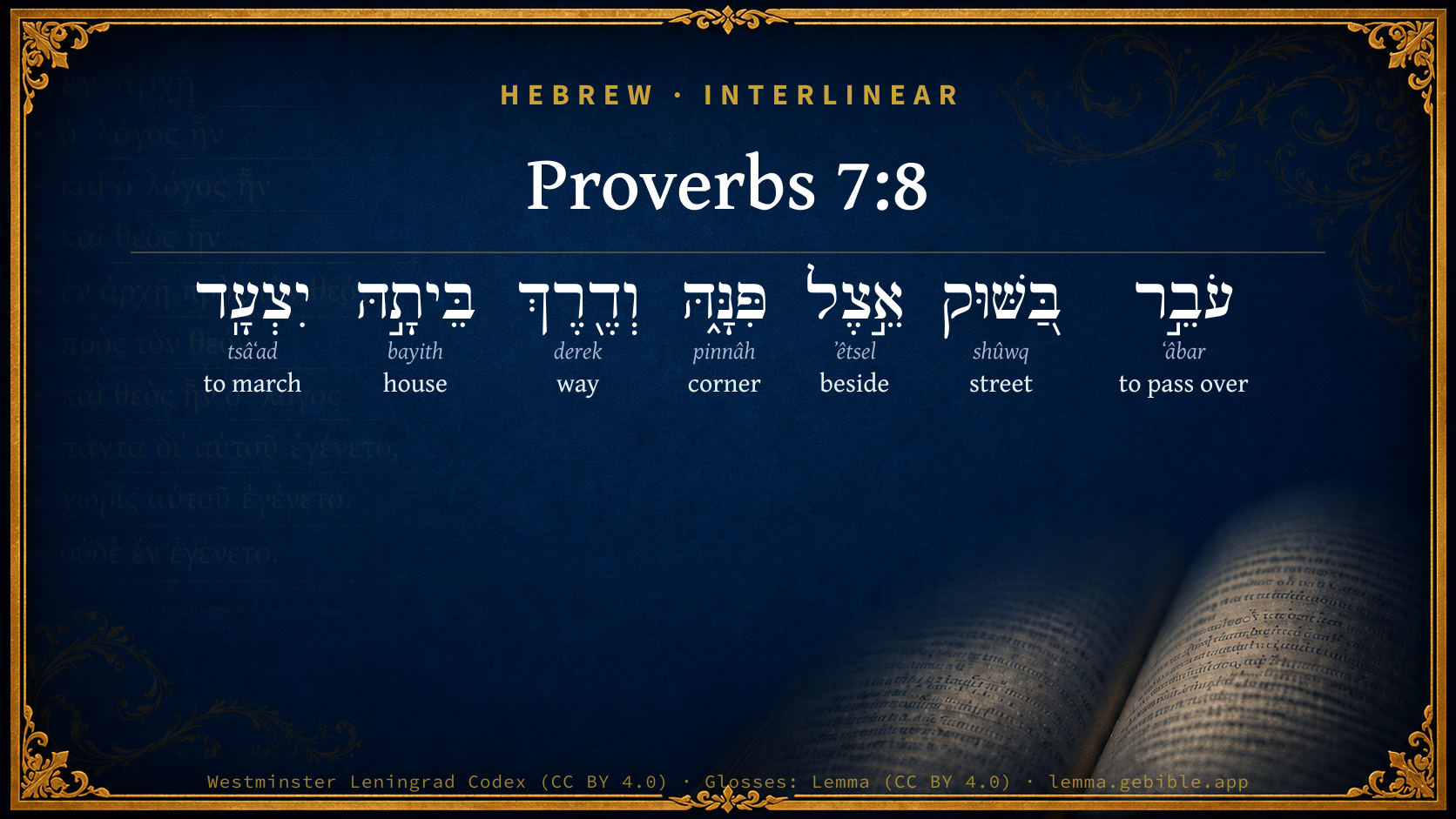
Proverbs 7:8

Hebrew (Westminster Leningrad Codex) Proverbs 7:8 appears in the Hebrew Old Testament. The text above is from the Westminster Leningrad Codex. Each word links to its Strong’s number, a concise gloss, and parsing drawn from the Open Scriptures Hebrew Bible morphology. Click any word for its full Brown-Driver-Briggs (BDB) entry.
Download image
Cite this verse

Proverbs 7:8 (World English Bible). Public Domain. Lemma interlinear Bible study tool, https://lemma.gebible.app/v/proverbs/7/8.

Show BibTeX & RIS
BibTeX
RIS
English Translation
Passing through the street near her corner, He went the way to her house,
World English Bible · Public Domain
Highlights Full analysis ↓
Download a study sheet

One document with this verse’s original text, its word-by-word gloss line, the meaning frame, cross-references with their text, attributed commentary, and full source and license credits — printable, and it pastes into notes with its structure intact.

This verse Autodidact and up

Study sheet (.html) Plain text (.txt)

A passage Seminary Student

Up to 50 verses in one chapter. A passage sheet keeps up to 6 commentary sources and 12 cross-references per verse, in the order this page ranks them, and says so on the sheet whenever that leaves anything out. Ask for a single verse and you get the Autodidact verse sheet above.

Everything on this page stays free to read, with no account — the sheet is a download of what is already on screen, not access to it.

Want to remove ads? Support Godless Engineer
Compare translations 3

The same verse in 3 English versions, stacked beneath the original-language interlinear above. Click any original word for its lexicon entry.

Each is an independent rendering of the whole verse — the interlinear is not word-aligned to these translations.

Highlighted words mark where these versions differ — a whole-verse word diff, not a word-by-word alignment.

  • World English Bible Public Domain
    Passing through the street near her corner, He went the way to her house,
  • King James Version Public Domain
    Passing through the street near her corner; and he went the way to her house,
  • unfoldingWord Literal Text CC BY-SA 4.0
    passing through the lane beside her corner, and he steps the way of her house,

unfoldingWord Literal Text — © unfoldingWord, licensed CC BY-SA 4.0. Word-aligned USFM3 via Door43 (git.door43.org/unfoldingWord/en_ult).

Versions to compare (up to 4)

3 of 4 selected

Show all 18 translations

Every available English version of this verse, each an independent rendering of the whole verse.

  • World English Bible Public Domain
    Passing through the street near her corner, He went the way to her house,
  • Berean Standard Bible Public Domain
    crossing the street near her corner, strolling down the road to her house,
  • Majority Standard Bible Public Domain
    crossing the street near her corner, strolling down the road to her house,
  • King James Version Public Domain
    Passing through the street near her corner; and he went the way to her house,
  • American Standard Version (1901) Public Domain
    Passing through the street near her corner; And he went the way to her house,
  • Revised Version (1885) Public Domain
    Passing through the street near her corner, and he went the way to her house;
  • Geneva Bible (1599) Public Domain
    Who passed through the streete by her corner, and went toward her house,
  • Douay-Rheims (1899) Public Domain
    Who passeth through the street by the corner, and goeth nigh the way of her house.
  • Young's Literal Translation Public Domain
    Passing on in the street, near her corner, And the way `to' her house he doth step,
  • Literal Standard Version CC BY-SA 4.0
    Passing on in the street, near her corner, || And the way [to] her house he steps,
  • Unlocked Literal Bible CC BY-SA 4.0
    That young man passed down the street near her corner, and he went toward her house.
  • unfoldingWord Literal Text CC BY-SA 4.0
    passing through the lane beside her corner, and he steps the way of her house,
  • Darby Bible Public Domain
    passing through the street near her corner; and he went the way to her house,
  • World Messianic Bible Public Domain
    passing through the street near her corner, he went the way to her house,
  • Webster's Bible Public Domain
    Passing through the street near her corner; and he went the way to her house.
  • Free Bible Version CC BY-SA 4.0
    He was walking down the street near the corner where she lived and took the road passing her house.
  • Bible in Basic English Public Domain
    Walking in the street near the turn of her road, going on the way to her house,
  • JPS Tanakh (1917) Public Domain
    Passing through the street near her corner, and he went the way to her house;

Literal Standard Version (2020), Covenant Press — licensed CC BY-SA 4.0. Text via the HelloAO Bible API (eBible.org). Unlocked Literal Bible (unfoldingWord) — licensed CC BY-SA 4.0. Text via the HelloAO Bible API (eBible.org). unfoldingWord Literal Text — © unfoldingWord, licensed CC BY-SA 4.0. Word-aligned USFM3 via Door43 (git.door43.org/unfoldingWord/en_ult). Free Bible Version, Dr. Jonathan Gallagher — licensed CC BY-SA 4.0. Text via the HelloAO Bible API (eBible.org).

Word by word

More ways to search: Search by grammar → Find every occurrence → Compare this word →

Practice this passage: Drill this verse → Learn its vocabulary →

About this verse

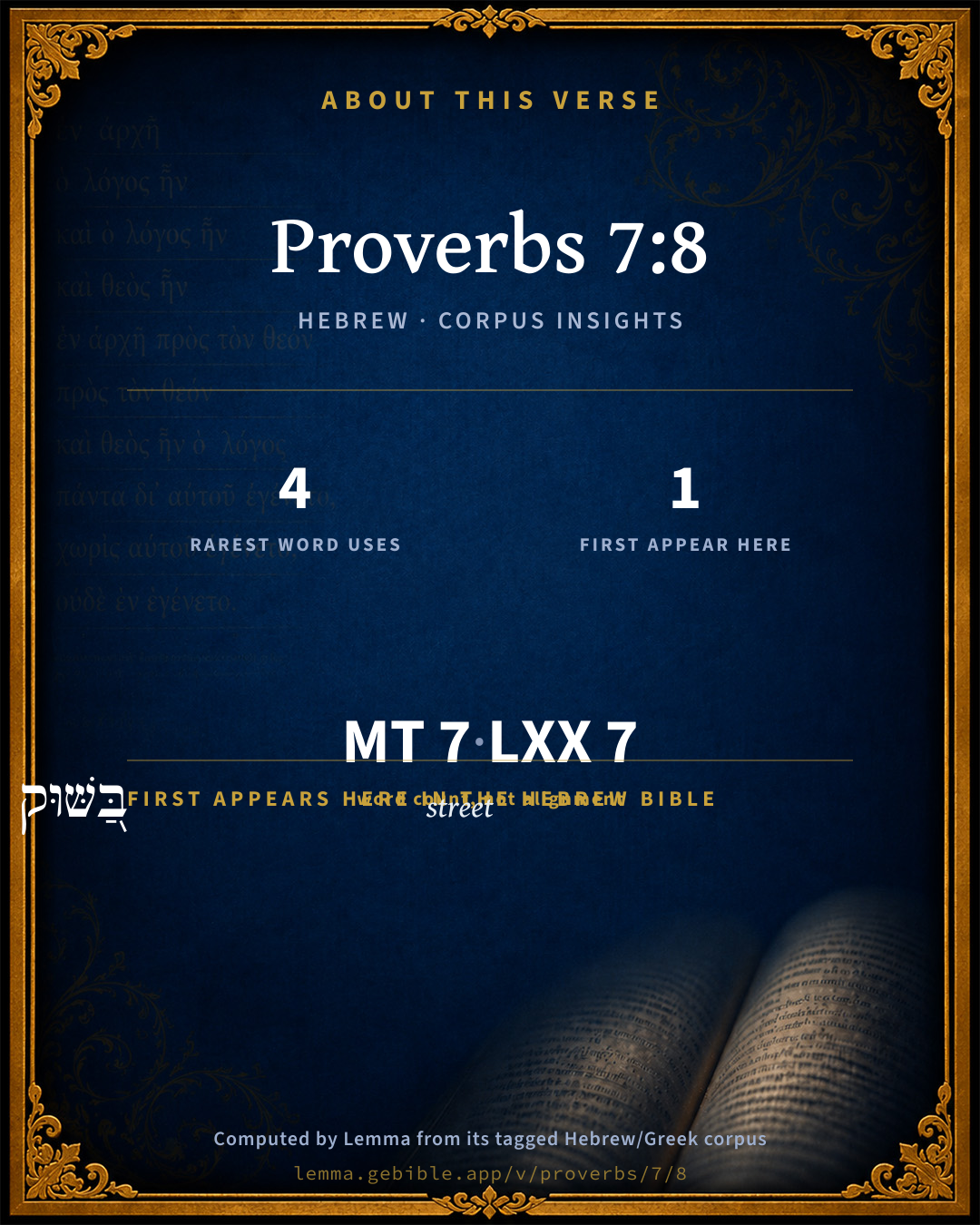
These counts appear in no published source. They are computed here, from the morphology-tagged text and Lemma’s own curated glosses. What Lemma adds →

7
words
7
distinct lemmas
Wisdom
section

Notable vocabulary

The rarest word here is בַּ֭שּׁוּק street H7784 — appearing just 4 times in the whole Hebrew Bible.

First appearance in Scripture

This word makes its first canonical appearance in the Hebrew Bible here:

  • בַּ֭שּׁוּק street H7784

Shared distinctive vocabulary

בַּ֭שּׁוּק street H7784 occurs in 4 verses of the Hebrew Bible. Also found in:

Grammatical profile

  • 2 verbs
  • 4 nouns
  • 1 preposition

Verb forms

  • עֹבֵ֣ר Qal · Participle Active
  • יִצְעָֽד Qal · Imperfect

Hebrew & Septuagint length

In English translation the verse runs 14 words from the Hebrew and 8 from the Septuagint (LXX English) — the Septuagint runs noticeably shorter here. See the side-by-side →

A rough comparison of the two English renderings, which tokenize alike — not a word-level alignment.

Word counts can differ between the Hebrew and the Greek without any difference in meaning — e.g. the Hebrew direct-object marker אֵת has no separate Greek word, and Greek often adds the article ὁ.

In the original languages it is 7 Hebrew tokens and 7 Greek tokens — but the two are counted differently (Hebrew bundles its prefixes and suffixes into one token; the Greek is in lemma form), so that isn’t a like-for-like length.

Cross-references

8

Topical passages linked to Proverbs 7:8 in the Treasury of Scripture Knowledge — connected by theme and wording, ordered by reader-vote popularity; previews shown in the World English Bible.

  • Judges 16:1 Samson went to Gaza, and saw there a prostitute, and went in to her.
  • 2 Samuel 11:2–3 It happened at evening, that David arose from off his bed, and walked on the roof of the king's house: and from the roof he saw a woman bathing; and the woman was very beautiful to look on.
  • Proverbs 4:14–15 Don't enter into the path of the wicked. Don't walk in the way of evil men.
  • Proverbs 5:8 Remove your way far from her. Don't come near the door of her house,
  • Proverbs 7:12 Now she is in the streets, now in the squares, And lurking at every corner.
  • 1 Corinthians 6:18 Flee sexual immorality! "Every sin that a man does is outside the body," but he who commits sexual immorality sins against his own body.
  • 2 Timothy 2:22 Flee from youthful lusts; but pursue righteousness, faith, love, and peace with those who call on the Lord out of a pure heart.
  • Jude 1:23 and some save, snatching them out of the fire with fear, hating even the clothing stained by the flesh.

Cross-references courtesy of OpenBible.info (CC BY 4.0).

Hebrew and Greek witnesses Masoretic Hebrew ↔ Greek Septuagint

The same verse in the two great witnesses to the Old Testament, shown verse-for-verse.

Here the Septuagint runs noticeably shorter than the Hebrew — LXX2012 (modern English Septuagint) 8 words vs World English Bible 14. A rough length comparison of the two English translations, not a word-level alignment — read both below.

These are two independent witnesses, not word-aligned to each other, and the Septuagint is shown in lemma (dictionary) form.

Hebrew Proverbs 7:8 Masoretic · Westminster Leningrad Codex

עֹבֵ֣ר בַּ֭שּׁוּק אֵ֣צֶל פִּנָּ֑הּ וְדֶ֖רֶךְ בֵּיתָ֣הּ יִצְעָֽד

Passing through the street near her corner, He went the way to her house,

World English Bible · Public Domain

Greek LXX Proverbs 7:8 Septuagint · lemma form

παραπορεύομαι παρά γωνία ἐν δίοδος οἶκος αὐτός

and speaking, in the dark of the evening,

LXX2012 (modern English Septuagint) · Public Domain

On this verse, The Pulpit Commentary discusses the Septuagint’s reading. Read the note in Commentary ↓

Hebrew: Westminster Leningrad Codex (CC BY 4.0). Greek: Septuagint (public domain); English from LXX2012 (modern English Septuagint) (Public Domain). How the Septuagint differs from the Hebrew →

Commentary

Notes on Proverbs 7:8 from classic Christian and Jewish commentators (each source and its license shown beneath its notes). The classic Christian expositions comment on the surrounding passage and are grouped to its opening verse, so a note may address several verses; the Jewish commentaries on the Tanakh (Rashi and others) are per-verse, so they appear only where the commentator wrote on this verse.

Lemma curates 59 commentaries, every one of them public domain or Creative Commons licensed, each selected and text-cleaned for this edition rather than reprinted as found. About our sources →

Trapp's Complete Commentary

John Trapp

Pro 7:8 Passing through the street near her corner; and he went the way to her house,

Ver. 8. Near her corner.] Which he should have balked, according to Pro 5:8. {See Trapp on "Pro 5:8"} Men’s own inconsideration, security, and dallying with the beginnings of sin, or with the occasion, doth usually tempt the devil to tempt them; and he feeling their pulse thereby which way it beats, fits them a penny worth, provides them of mates, sets one Delilah or other to bind them, as she did Samson, with the green withes of fleshly pleasure. But let a man divorce the flesh from the world, and the devil can do him no harm.

John Trapp, A Commentary or Exposition upon All the Books of the Old and New Testament (1647–1656) — public domain. Text from a community e-Sword module.

The Biblical Illustrator

Joseph S. Exell

Pro_7:8

He went the way to her house.

Occasions of sin

I. Many occasions of sin present themselves unlooked for.

1. All places afford temptations.

2. All times have theirs.

3. All things afford it.

4. So do all conditions, all actions, and all persons.

Therefore we need to keep a constant watch, since we are not secure in any place, time, or condition. Then suspect all things with a holy suspicion.

II. It is dangerous coming near bad houses.

1. Much danger may come from within.

2. Much danger from without; for ruffians and quarrellers haunt such places.

3. Judgment may be feared from heaven.

III. Idleness is the nurse of wantonness.

1. Because nature is corrupt, and of all sins most inclines to wantonness.

2. The soul is very active both in our waking and sleeping, and if it move us not to good it will move us to bad actions.

3. Because labour removes the rubs in the way of wantonness. Spiritual duties and labour in our vocation take the heart, eyes, and ears off from wanton objects. The heart set at liberty by idleness falls upon them with greediness.

4. Gods judgment follows idleness to give such over to wantonness. Take heed of idleness. Many think it either no sin or a light one. (Francis Taylor, B. D.)

The Biblical Illustrator, edited by Joseph S. Exell (c. 1880s–1900s) — public domain. Text from a community e-Sword module.

Jamieson, Fausset & Brown

Robert Jamieson, A. R. Fausset & David Brown

her corner--where she was usually found.

went . . . house--implying, perhaps, confidence in himself by his manner, as denoted in the word

went--literally, "tread pompously."

Jamieson, Fausset & Brown — Commentary Critical and Explanatory on the Whole Bible (1871) — public domain (CC PDM 1.0). Text via the HelloAO Bible API.

Adam Clarke's Commentary

Verse 8. He went the way to her house.] She appears to have had a corner house sufficiently remarkable; and a way from the main street to it.

Adam Clarke's Commentary on the Bible (1810–1826) — public domain. Text from a community e-Sword/MySword module.

Ellicott's Commentary for English Readers

(8) And he went the way . . .—The word is used of the slow step of a religious procession (2Sa_6:13), here of the sauntering of the idle youth up and down the street within view of the temptress’s house.

A Bible Commentary for English Readers, edited by Charles John Ellicott (1878–1897) — public domain. Text from a community e-Sword module.

John Gill's Exposition

Passing through the street near her corner,.... The house of the harlot that stood in a corner to take in persons that came both ways; to come near which is dangerous; this was putting himself in the way of temptation; or the corner of the street where she stood to pick up young men; it could be with no good design to walk the streets in the night, and to go where harlots haunt, and where they dwell or stand; or, however, it was exposing himself to danger, and, had he took the wise man's advice, would not have done it, Pro 5:8; we should abstain from all appearance of evil, and from everything that leads to sin; and as to immorality and uncleanness, so to false doctrine and false worship; the synagogues of Satan and Popish chapels should be avoided;

and he went the way to her house; that led directly to her house, which shows a bad intention; and if his design was not to commit fornication, yet to gratify his lusts by looks, dalliances, and impure discourse with her; and hither he went in a set, stately manner, as the word (f) signifies; with an air pleasing to the harlot, as a beau and fop of the town; and by which air and gait he was known by her to be a proper person to attack.

(f) "intelligitur incessus, compositus et pomposus", Piscator; "magnis et patheticis possibus", Michaelis; "est aliquid grande et audax in verbo", Schultens.

John Gill's Exposition of the Whole Bible (1746–1763) — public domain (CC PDM 1.0). Text via the HelloAO Bible API.

Matthew Poole's English Annotations

Passing through the street; idle and careless.

Near her corner; near the corner of the street in which her house stood; such places being most convenient for that wicked purpose, as giving opportunity either for the discovery of passengers in several streets, or for the escape of such as might be in danger of being taken in her house. Compare Pro 7:12.

He went the way to her house; not with intention to act gross filthiness with her, as may be gathered from the following passages, but to gratify his curiosity, and to understand the manner of such persons, and to please himself with the sight of her, or discourse of her.

Matthew Poole's English Annotations on the Holy Bible (1683–1685) — public domain. Text from a community e-Sword/MySword module.

Whedon's Commentary on the Bible

Daniel D. Whedon

8. Street — “Back street.” — Miller.

Near her corner — Where she dwelt. Zockler, “near a corner.”

To (or, toward) her house — He was sauntering along towards her house.

Daniel D. Whedon (gen. ed.), Commentary on the Old and New Testaments (1874–1909) — public domain. Text from a community e-Sword module.

The Pulpit Commentary

Near her corner. He kept near the corner of the house of the woman for whom he waited. Another reading gives, "near a corner;" juxta angulum. Vulgate; para gwnian , Septuagint; i.e. he did not take to the broad, open street, but sneaked about at corners, whence he could watch the woman"s house without being observed by others. He went the way to her house. He sauntered slowly along, as the verb signifies. Septuagint, "Passing by a corner in the passages of her house (en diodoiv oikwn authv )."

The Pulpit Commentary (1880–1919), ed. H.D.M. Spence-Jones & Joseph S. Exell — public domain. Text from a community e-Sword module.

John Wesley's Explanatory Notes

Passing - Idle and careless, near the corner of the street in which her house stood.

John Wesley, Explanatory Notes Upon the Whole Bible (1754–1765) — public domain. Text via the GEBible commentary corpus.

Keil & Delitzsch

C. F. Keil & F. Delitzsch

Now follows, whither he saw the young fop [Laffen] then go in the darkness.

8 Going up and down the street near her corner,

And he walked along the way to her house,

9 In the twilight, when the day declined,

In the midst of the night and deep darkness.

We may interpret עבר as appos.: juvenem amentem, ambulantem, or as the predicate accus.: vidi juvenem ... ambulantem; for that one may so express himself in Hebrew (cf. e.g., Isa 6:1; Dan 8:7), Hitzig unwarrantably denies. The passing over of the part. into the finite, 8b, is like Pro 2:14, Pro 2:17, and that of the inf. Pro 1:27; Pro 2:8. שׁוּק, Arab. suk (dimin. suweiḳa, to separate, from sikkat, street, alley), still means, as in former times, a broad street, a principal street, as well as an open place, a market-place where business is transacted, or according to its etymon: where cattle are driven for sale. On the street he went backwards and forwards, yet so that he kept near to her corner (i.e., of the woman whom he waited for), i.e., he never withdrew himself far from the corner of her house, and always again returned to it. The corner is named, because from that place he could always cast a look over the front of the house to see whether she whom he waited for showed herself. Regarding פּנּהּ for פּנּתהּ, vid., at Psa 27:5 : a primary form פּן has never been in use; פּנּים, Zac 14:10, is plur. of פּנּהּ. אצל (from אצל, Arab. wasl, to bind) is, as a substantive, the side (as the place where one thing connects itself with another), and thus as a preposition it means (like juxta from jungere) beside, Ital. allato. דּרכו is the object. accus., for thus are construed verbs eundi (e.g., Hab 3:12, Num. 30:17, cf. Pro 21:22).

Pro 7:9

The designations of time give the impression of progress to a climax; for Hitzig unwarrantably denies that נשׁף means the twilight; the Talmud, Berachoth 3b, correctly distinguishes תרי נשׁפי two twilights, the evening and the morning twilight. But the idea is not limited to this narrow sense, and does not need this, since the root-word נשׁף (vid., at Isa 40:24) permits the extension of the idea to the whole of the cool half (evening and night) of the entire day; cf. the parallel of the adulterer who veils himself by the darkness of the night and by a mask on his countenance, Job 24:15 with Jer 13:16. However, the first group of synonyms, בּנשׁף בּערב יום (with the Cod. Frankf. 1294, to be thus punctuated), as against the second, appears to denote an earlier period of the second half of the day; for if one reads, with Hitzig, בּערב יום (after Jdg 19:9), the meaning remains the same as with בּערב יום, viz., advesperascente die (Jerome), for ערב = Arab. gharab, means to go away, and particularly to go under, of the sun, and thus to become evening. He saw the youth in the twilight, as the day had declined (κέκλικεν, Luk 24:29), going backwards and forwards; and when the darkness of night had reached its middle, or its highest point, he was still in his lurking-place. אישׁון לילה, apple of the eye of the night, is, like the Pers. dili scheb, heart of the night, the poetic designation of the middle of the night. Gusset incorrectly: crepusculum in quo sicut in oculi pupilla est nigredo sublustris et quasi mistura lucis ac tenebrarum. אישׁון is, as elsewhere לב, particularly the middle; the application to the night was specially suitable, since the apple of the eye is the black part in the white of the eye (Hitzig). It is to be translated according to the accus., in pupilla noctis et caligine (not caliginis); and this was probably the meaning of the poet, for a ב is obviously to be supplied to ואפלה.

Keil & Delitzsch — Biblical Commentary on the Old Testament (1861–1891) — public domain (CC PDM 1.0). Text via the HelloAO Bible API. (Old Testament only.)

unfoldingWord translationNotes

Door43 World Missions Community

her corner

Here "her" refers to any female stranger, as referred to in Proverbs 07:05. She was standing at a certain corner, waiting for a suitable man to pass by. AT: "the corner where a female stranger was standing"

corner

This refers to where two roads meet.

twilight

the time of day when it is getting darker and about to become night

unfoldingWord translationNotes — © Distant Shores Media and the Door43 World Missions Community, licensed CC BY-SA 4.0. Source: git.door43.org/Door43/en_tn.

Rashi

Rabbi Shlomo Yitzchaki (Rashi)

next to her corner The corner of the harlot and of the pagan house of worship.

Rashi on the Tanakh — English translations: “The Judaica Press complete Tanach with Rashi, translated by A. J. Rosenberg” (CC BY 4.0); “Pentateuch with Rashi's commentary by M. Rosenbaum and A.M. Silbermann, 1929-1934” (public domain); “The Metsudah Tanach series, Lakewood, N.J” (CC BY 4.0); and “The Book of Joshua, Metsudah Publications, 1997” (CC BY 4.0). Text via Sefaria.

Lesson kit

Teaching starters — assembled from the data on this page, not authored interpretation. Every prompt links to the verse data it draws on. Edit before teaching.

Proverbs, in the Wisdom, opens this verse with 7 words (7 distinct Hebrew lemmas). Its most distinctive word is shûwq (“street”). The Greek Septuagint runs shorter here. A historical commentator’s framing appears above. Read the whole chapter for the surrounding context.

Discussion questions

  1. The word shûwq carries the sense “street.” How does it shape the verse?
  2. The word “street” first appears here in Scripture. What is being introduced at this debut?
  3. Ecclesiastes 12:4 shares the word «street» with this verse. How do the two illuminate each other?
  4. Compared with the Hebrew, the Septuagint runs shorter here. What questions does that raise?
  5. These translations render this verse differently. What is at stake in choosing one wording over another?
  6. The verb «עֹבֵ֣ר» is Qal Participle Active. How does its form color the action?
  7. Reading how Trapp's Complete Commentary and The Biblical Illustrator read this verse, where do the two commentators agree and where do they part?

Things to notice

Reading settings

Reading text

Shown beneath each verse's original-language words.

Old Testament
Old Testament edition

Read the OT as the Masoretic Hebrew (MT) or the Greek Septuagint (LXX).

English shown for the Greek Septuagint (in the Hebrew ↔ Greek comparison).

Comparing translations? Open the Compare panel on any verse page to stack up to four side by side.