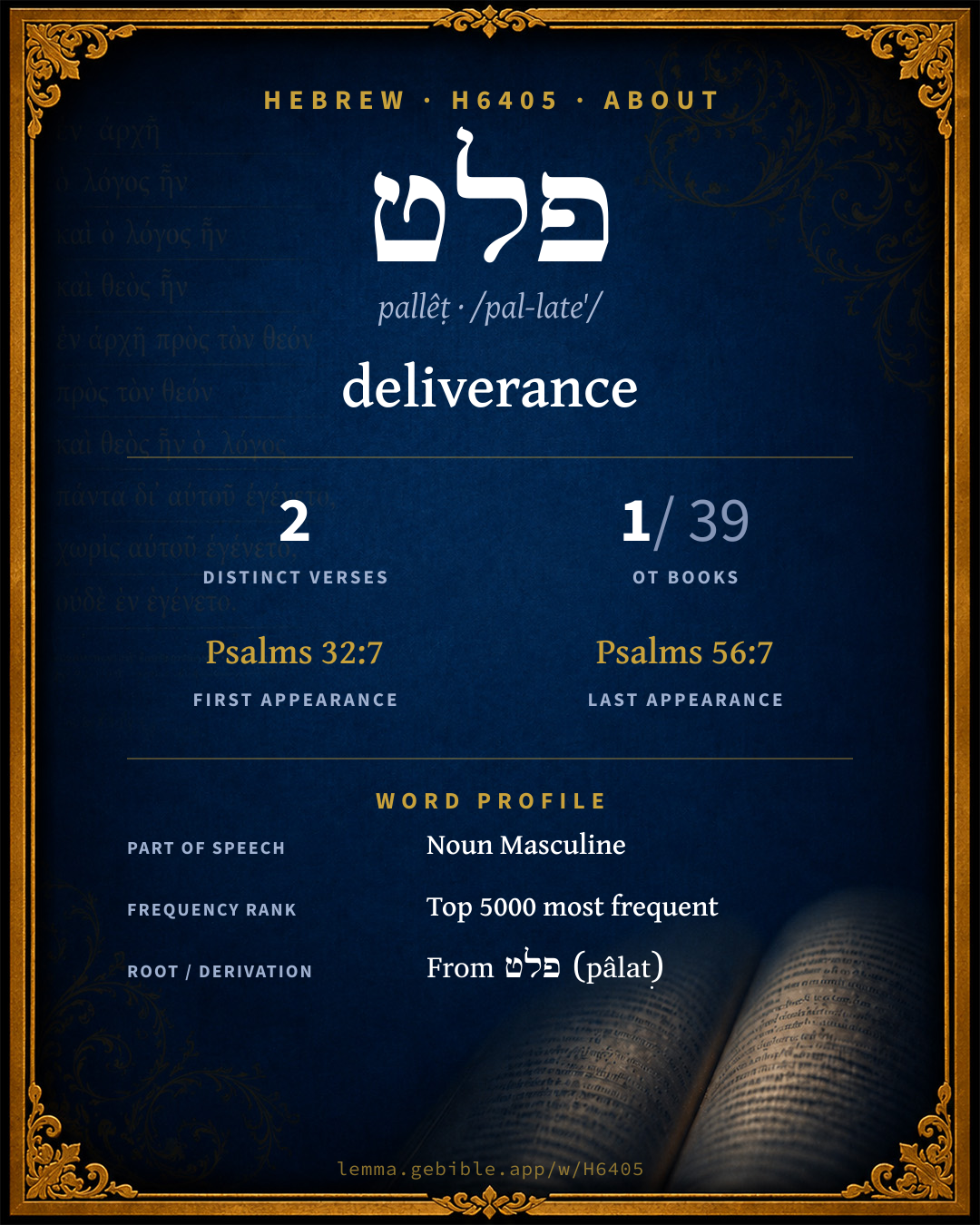
פַּלֵּט
deliverance
Full lexicon entry — Brown-Driver-Briggs (BDB)
From Brown-Driver-Briggs (BDB)
Where this word appears
Grammar key — what these labels mean
Part of speech
- Verb
- An action or state-of-being word.
Stem
- Piel
- An intensive or resultative active stem.
Form
- Infinitive Construct
- A bound verbal noun, frequently with prepositions (“to write / in writing”).
- Imperative
- A direct command (“write!”).
Person
- 2nd Person
- The one addressed (“you”).
Gender
- Masculine
- Grammatically masculine.
Number
- Singular
- One.
Grammatical forms
- Verb, Piel, Infinitive Construct 1 time (50%)
- Verb, Piel, Imperative, 2nd Person, Masculine, Singular 1 time (50%)
Parsed forms decoded from the imported morphology (morphhb / Westminster Leningrad Codex — WLC text public domain, morphhb tagging CC BY 4.0), counted across 2 parsed occurrences — not distinct verses.
Every verse where H6405 appears — 2 distinct verses across 1 book. Click any verse to open its interlinear word-by-word view. Verse text shown in the World English Bible for context — . Each verse’s Hebrew form is shown with its reference; the English is not keyword-highlighted, since the data carries no word-level English alignment. Use “Compare translations” on any verse to read it across multiple English versions. This concordance covers the Hebrew Bible; Septuagint (Greek Old Testament) occurrences are not indexed here.
Psalms 2 verses
About this entry
At a glance — auto-summarized from this page’s data, not written by a person. Every figure links to its source below. This summary describes the numbers; it doesn’t interpret them.
The Hebrew noun פלט centers on the idea of “deliverance.” It is rare — just 2 verses in the entire Hebrew Bible. The word gravitates to Psalms (100%). Its earliest occurrence is Psalms 32:7. It clusters with פלט, מפלט and פליט under a shared root. Dig into 2-verse concordance and the renderings breakdown below.
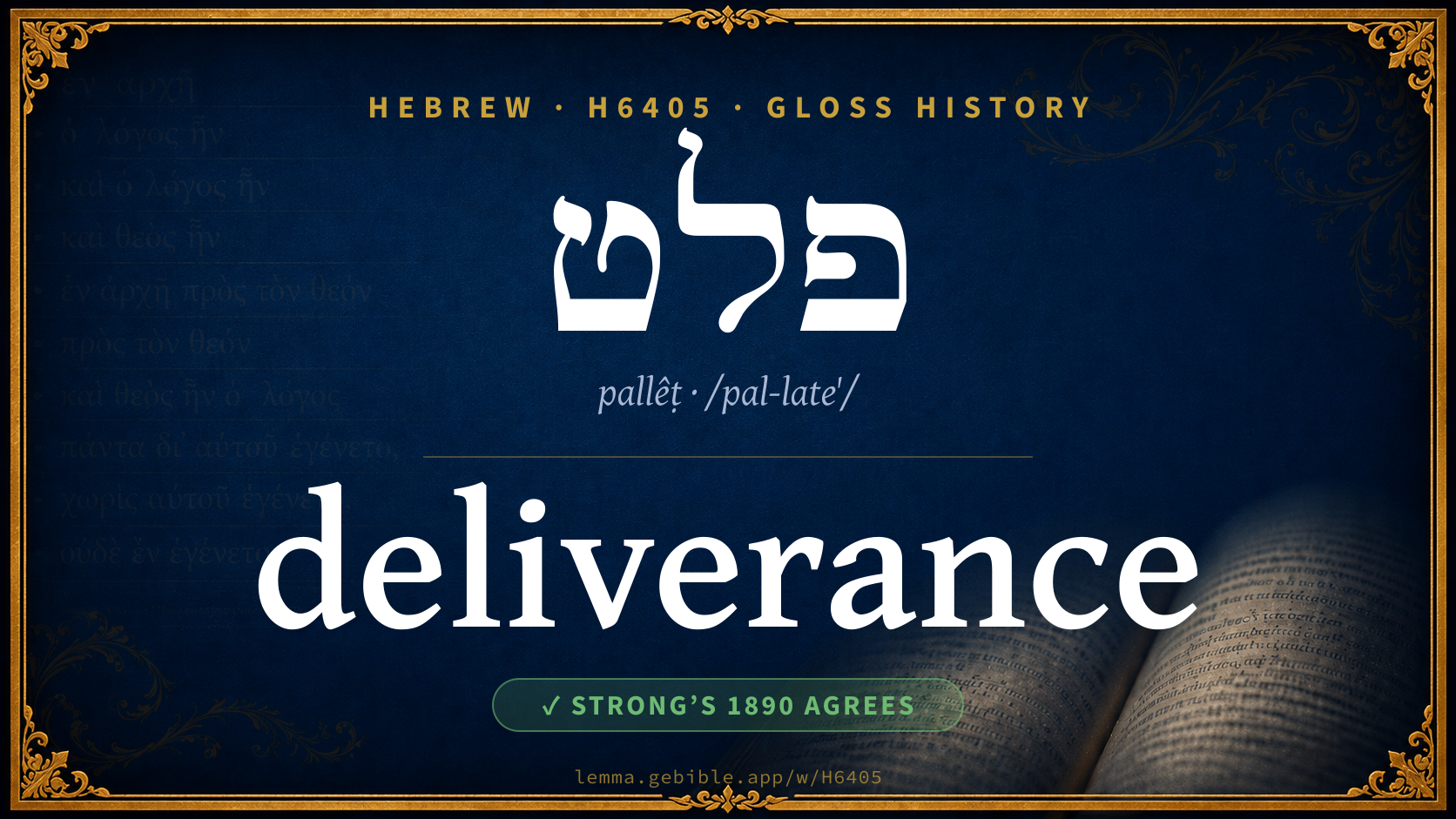
Gloss history
Strong's 1890 vs modern scholarship
About this word
Strong's H6405 catalogs a Hebrew word from the Hebrew Old Testament.
These counts are not copied from any lexicon or concordance. They are computed here, from the morphology-tagged Hebrew Old Testament. What Lemma adds →
- 2
- distinct verses
- The word appears in 2 distinct verses.
- 1 / 39
- OT books
- The word appears in 1 of 39 Old Testament books.
- #4,807
- by frequency
- Top 5000 most frequent Hebrew words (rank 4,807 of 8,640 Hebrew words by occurrence).
View all 2 occurrences in the concordance →
Most concentrated in
- Psalms 2 verses 100%
By section of the Old Testament
By traditional corpus
Conventional, traditional groupings — biblical authorship is debated, so this is a traditional corpus grouping, not an authorship claim. Each share is this word’s portion of its verses in that division of the Hebrew canon. Each figure is a share of the word’s 2 distinct verses.
- Writings (Ketuvim) 2 verses · 100%
How translations render this word
Counts come from each version’s own published word-to-Strong’s tagging or interlinear alignment — an approximate guide to how each version renders this word, not a word-level alignment the data otherwise carries. Because each total is that version’s own tagged count, the per-version totals vary from one another and need not match the appearance or distinct-verse counts above. These counts may also differ from a printed concordance because Lemma counts each distinctly tagged rendering and does not collapse phrase taggings into a single head-word total. This is a fixed set of word-tagged versions (KJV, ASV, BSB, ULT) and does not change with the reading translation you choose elsewhere. Each version’s license is shown beside its name below (and on Sources).
- King James Version: Deliverance 1×, Escape out 1×, Shall escape 1×
- American Standard Version: Deliverance 1×, Escape out 1×, None shall return save such as shall escape 1×
- Berean Standard Bible: Deliverance 1×
- unfoldingWord Literal Text: Deliverance 1×, Shall there be an escape 1×
King James Version Public Domain
Renders H6405 across 5 tagged occurrences — most commonly:
American Standard Version Public Domain
Renders H6405 across 5 tagged occurrences — most commonly:
Berean Standard Bible Public Domain
Renders H6405 across 1 tagged occurrence — most commonly:
unfoldingWord Literal Text CC BY-SA 4.0
Renders H6405 across 2 tagged occurrences — most commonly:
Senses in BDB
The 1 sense BDB distinguishes for this word, in lexicon order (not ranked by frequency or importance). The full entry — with sub-senses — is in the Lexicon Entry tab.
- deliverance, escape
Word origin
Derived from פלט (pâlaṭ) (H6403) — to escape.
Jastrow Dictionary
A second Hebrew/Aramaic lexicon for comparison, covering Aramaic and post-biblical (Talmudic, Targumic, Midrashic) usage that the biblical-Hebrew BDB does not. Matched by lemma rather than by Strong’s number, so a lemma may carry more than one Jastrow headword (shown separately below), and the entries cover usage well beyond the Bible.
פָּלַט
- (b. h.) [to break through,]
- 1. to discharge, vomit, give out. Y. B. Kam. I, 2ᵇ top [read:] היתה מהלכת ופוֹלֶטֶת על עשבים if the animal walked and discharged on plants. Ter. X, 11; Ḥull. 110ᵇ, v. בָּלַע. Ber. III, 6 שפָּלְטָה שכבת וכ׳ who discharged the (conceived) semen virile. Pes. 118ᵇ פְּלוֹט אותן ליבשה throw their bodies out on the dry land; a. fr.
- 2. to escape, be spared. Nidd. 61ᵃ (ref. to הפליט, Gen. XIV, 13) זה עוג שפ׳ מדור וכ׳ that was Og who escaped the fate of the generation of the flood. Num. R. s. 9 לא פָלְטוּ did not escape (punishment); a. fr.—V. פָּלֵט.—3) to save. Pirké d’R. El. ch. XXVII ופְלָטוֹ הק"בה מידו and the Lord saved him from his (Samael’s) power. Snh. 19ᵇ (ref. to פלטיאל, II Sam. III, 15) שפלטו אל מן וכ׳ for God saved him from sin; a. e. e.g. Genesis 14:13
- 4. to tear off, detach. Ḥull. 121ᵃ בשר שפְּלָטַתּוּ סכין flesh which the knife has taken off, i.e. which came off in flaying, v. מוּרְדְּקָא; ib. מקצתו פלטתו חיה an animal tore one portion of the flesh off; ib. 124ᵃ; a. e.
- to be saved. Tanḥ. Sh’moth 17 ויִתְפַּלֵּט ממנו וכ׳ and Noah and his children shall be saved from it (the flood).
פְּלַט
- 1. to discharge, vomit. Targ. Jon. II, 11. Targ. Job XX, 15 Ms. (ed. Pa.); a. e.—Ned. 49ᵇ; Tam. 27ᵇ כל מילי לא תִיפְלוֹט וכ׳ thou must not spit out anything in the presence of thy teacher (thou must suppress vomiting), except &c. Ḥull. 112ᵇ אגב דוחקא דסכינא פָּלֵיט through the pressure of the knife it (the flesh) gives out (blood). Ib. קדמי ופלטי are the first to give out (their serum); בתר … פְּלִיטֵי עופות וכ׳ after the fish cease to discharge, the fowl (lying in salt with them) discharge, and they (the fish) absorb; a. fr.
- 2. to escape. Targ. Prov. XII, 13; a. e.—Yeb. 114ᵇ הוא פליט is it likely that he will escape? Keth. 112ᵃ פַּלְטִי לי מחדא I have escaped one (evil destiny). Y. Ber. III, 6ᵃ חדא מתרתי לא פַלְטַת לכון one of two (mistakes) did not fail you, i.e. of the two things you did, one must be wrong; a. e.
- 3. to detach, take off. Targ. Job XIII, 4, v. מוּרְדְּקָא.
- same, to give out, discharge. Ib. XX, 15, v. supra.—Y. Taan. I, 63ᵈ top (transl. וארץ רפאים תפיל, Is. XXVI, 19) וארעא תפקידה תְּפַלֵּט the earth shall give forth her trust (the dead); Y. Ber. V, 9ᵇ top; Yalk. Kings 207. e.g. Isaiah 26:19
פָּלֵט
- (preced.) escaping, spared. Hor. 8ᵃ ממונן פ׳ their property is spared (from destruction); Yeb. 9ᵃ. Tanḥ. Kor. 5 שכולן אובדין ואחד פ׳ that all will perish and one will escape; Num. R. s. 18; a. e.—Pl. פְּלֵטִים, פְּלֵטִין, פְּלֵי׳. Num. R. s. 19; Yalk. ib. 765, v. פָּרִיץ. Cant. R. to VII, 8. Snh. 108ᵃ שבחוצה לה פ׳ the property outside of the city is spared; a. e.—Fem. פְּלֵטָה, פְּלֵיטָה; pl. פְּלֵטוֹת, פְּלֵי׳. Tosef. Maasr. I, 6 שיבלים הפ׳ מן וכ׳ (Var. הפולטות) ears which escaped the storage.
A Dictionary of the Targumim, the Talmud Babli and Yerushalmi, and the Midrashic Literature (Marcus Jastrow; London, Luzac, 1903) — Public Domain. Digitized via Sefaria. Digitized via Sefaria. Full attribution on Sources.
Forms in the corpus
The 2 distinct written forms H6405 takes in the Hebrew Bible, most frequent first — each parse links to that stem’s occurrences in the concordance. Hebrew forms include their vowel points and cantillation, so a single lemma takes many written forms.
| Form | Parsing | Example | Uses |
|---|---|---|---|
| פַלֵּ֑ט | Verb, Piel, Infinitive Construct | Psalms 32:7 | 1 |
| פַּלֶּט | Verb, Piel, Imperative, 2nd Person, Masculine, Singular | Psalms 56:7 | 1 |
Same root — word family
Other BDB entries built from the same root as H6405, grouped by Strong’s listed origin. These share a root / origin per the lexicon — not necessarily a shared meaning. Each links to that word’s own entry.
Derives from
Shares the same root
Proper names from this root
People and places named from this root — a name, not an additional meaning of the word.
- יפלט Yaphlêṭ H3310 Japhlet
- פלט Peleṭ H6404 Pelet
- פלטי Palṭîy H6406 Palti
- פלטיה Pᵉlaṭyâh H6410 Pelatiah
Compare all same-root words → Showing 4 of 8 — not the complete family. 4 of the same-root words are proper names (people or places). They share a root, not necessarily a meaning.
Septuagint verse parallels
This word appears in 2 verses that also exist in the Greek Old Testament (Septuagint), out of the 2 Hebrew verses it occurs in. You can read those verses in Greek by switching the Old Testament edition to the Septuagint.
Read these verses in the Septuagint
This is a verse-level parallel only — the same verses exist in both the Hebrew and Greek Old Testaments. No word-level Hebrew↔Greek correspondence is claimed: the data carries no such alignment, so no Greek word is shown as this Hebrew word’s translation. Coverage is not total — the Septuagint omits the deuterocanon and renumbers the Psalms, so some Hebrew verses have no direct Greek parallel.