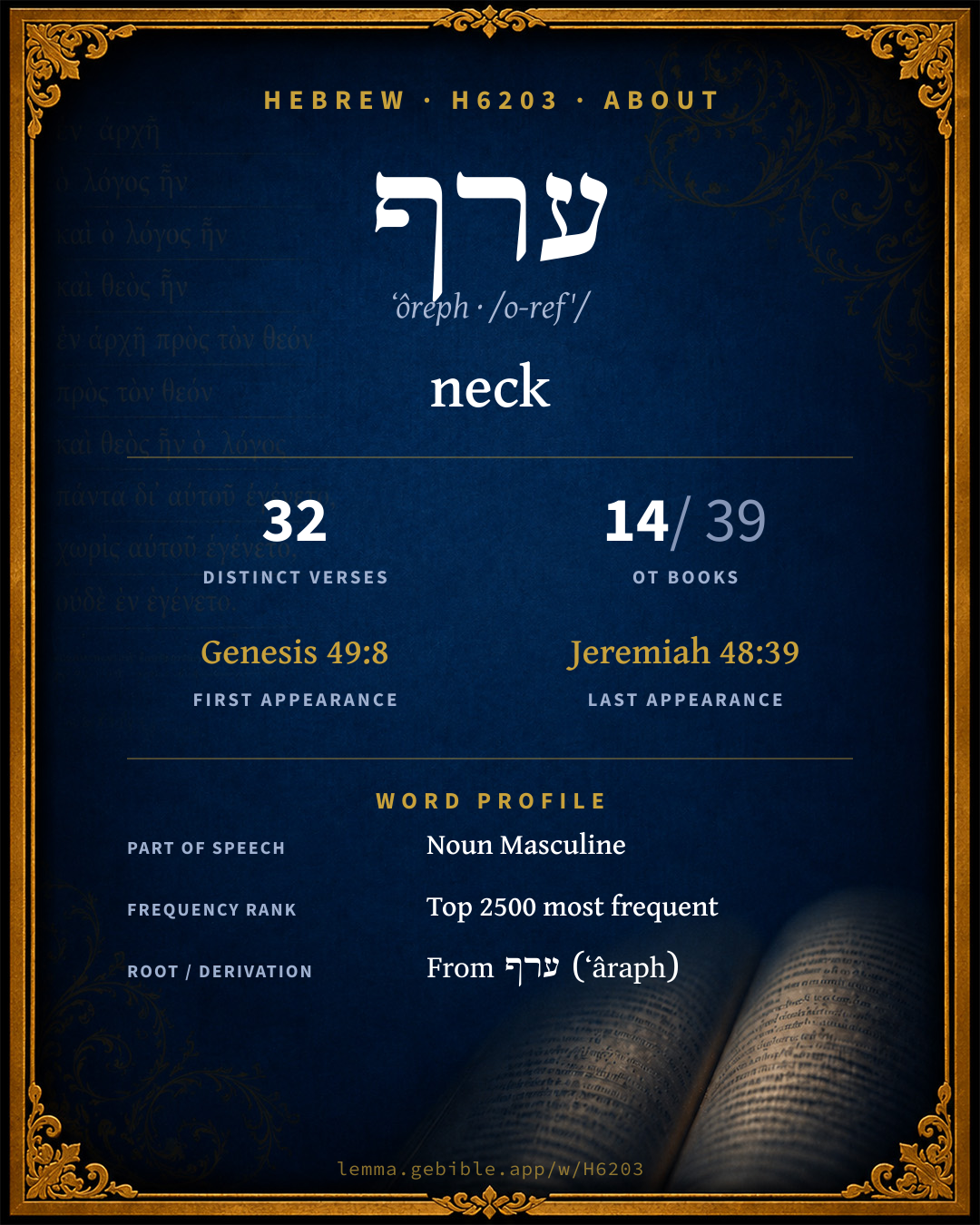
עֹ֫רֶף
neck
‘neck’ is one of 3 main senses fuller range ↓
Full lexicon entry — Brown-Driver-Briggs (BDB)
From Brown-Driver-Briggs (BDB)
Where this word appears
Grammar key — what these labels mean
Part of speech
- Noun
- A naming word — a person, place, thing, or idea.
Noun type
- Common
- A common noun — a general class of person, place, or thing (“king,” “city,” “water”), not a specific name.
State
- Absolute
- The independent form of a noun, not bound to a following word.
- Construct
- A noun bound to a following noun in a possessive / “of” relationship (the construct chain).
Gender
- Masculine
- Grammatically masculine.
Number
- Singular
- One.
Every verse where H6203 appears in the Book of Nehemiah — 3 distinct verses. Click any verse to open its interlinear word-by-word view. Verse text shown in the World English Bible for context — . Each verse’s Hebrew form is shown with its reference; the English is not keyword-highlighted, since the data carries no word-level English alignment. Use “Compare translations” on any verse to read it across multiple English versions. This concordance covers the Hebrew Bible; Septuagint (Greek Old Testament) occurrences are not indexed here.
Nehemiah
- Nehemiah 9:16 עָרְפָּ֔/ם n c ms cs + sfx pers 3mp But they and our fathers dealt proudly and hardened their neck, and didn't listen to your commandments,
- Nehemiah 9:17 עָרְפָּ֔/ם n c ms cs + sfx pers 3mp and refused to obey, neither were mindful of your wonders that you did among them, but hardened their neck, and in their rebellion appointed a captain to return to their bondage. But you are a God ready to pardon, gracious and merciful, slow to anger, and abundant in loving kindness, and didn't forsake them.
- Nehemiah 9:29 וְ/עָרְפָּ֥/ם conj + n c ms cs + sfx pers 3mp and testified against them, that you might bring them again to your law. Yet they dealt proudly, and didn't listen to your commandments, but sinned against your ordinances, (which if a man do, he shall live in them), and withdrew the shoulder, and hardened their neck, and would not hear.
About this entry
At a glance — auto-summarized from this page’s data, not written by a person. Every figure links to its source below. This summary describes the numbers; it doesn’t interpret them.
“neck” is the headline sense of the Hebrew noun ערף (ʻôreph). First canonically at Genesis 49:8, it enters the text early. It turns up in 32 verses across 14 books, a moderately common footprint. Carrying more than one sense, it rewards its full sense range. From the same root come ערף and ערפה. For the data behind this summary, explore the sense tree and the renderings breakdown below.
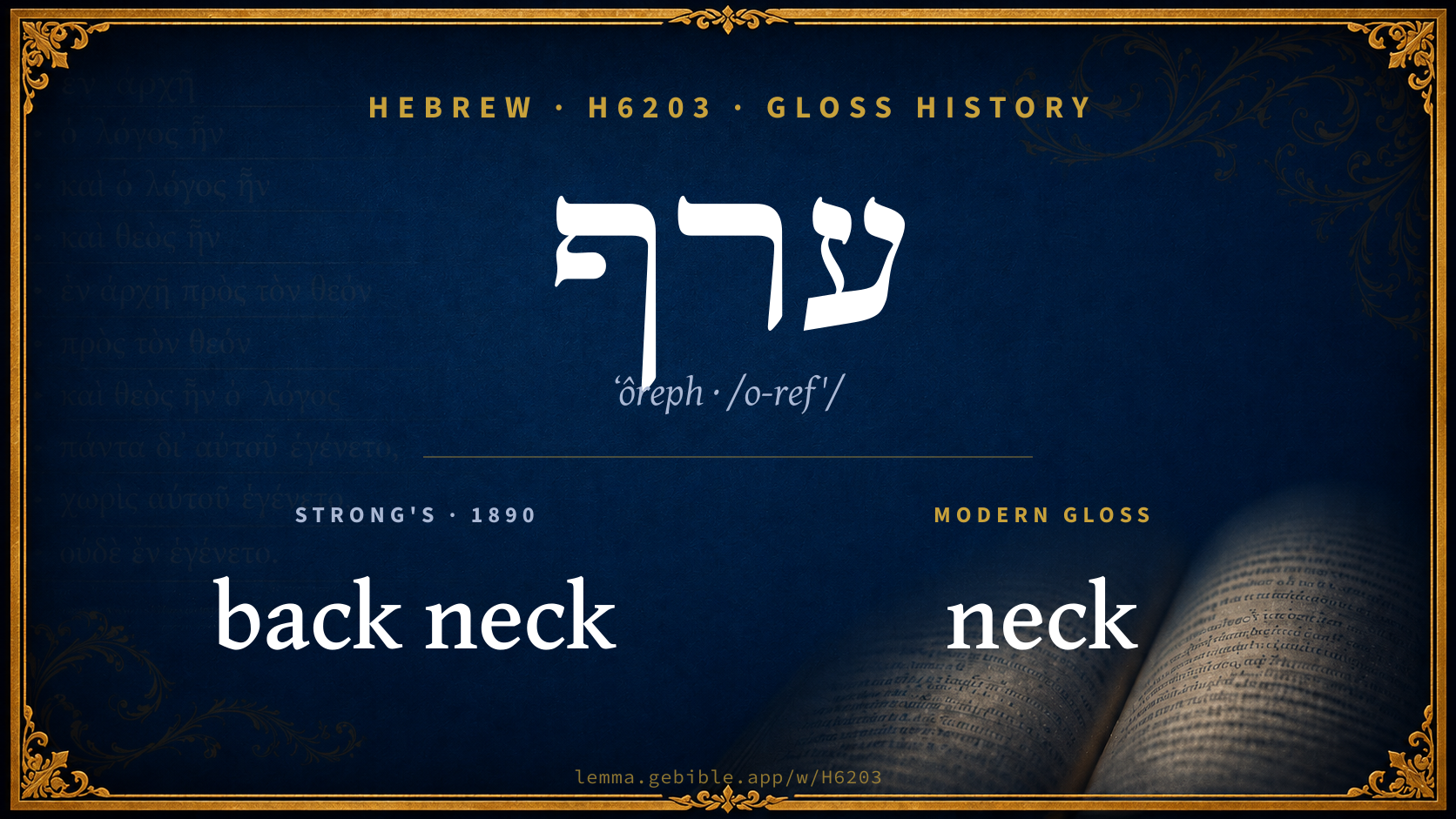
Gloss history
Strong's 1890 vs modern scholarship
About this word
Strong's H6203 catalogs a Hebrew word from the Hebrew Old Testament.
These counts are not copied from any lexicon or concordance. They are computed here, from the morphology-tagged Hebrew Old Testament. What Lemma adds →
- 32
- distinct verses
- The word appears in 32 distinct verses.
- 14 / 39
- OT books
- The word appears in 14 of 39 Old Testament books.
- #1,064
- by frequency
- Top 2500 most frequent Hebrew words (rank 1,064 of 8,640 Hebrew words by occurrence).
View all 32 occurrences in the concordance →
Most concentrated in
- Jeremiah 7 verses 22%
- Exodus 5 verses 16%
- Deuteronomy 4 verses 13%
By section of the Old Testament
By traditional corpus
Conventional, traditional groupings — biblical authorship is debated, so this is a traditional corpus grouping, not an authorship claim. Each share is this word’s portion of its verses in that division of the Hebrew canon. Each figure is a share of the word’s 32 distinct verses.
- Prophets (Nevi'im) 12 verses · 38%
- Torah (Pentateuch) 11 verses · 34%
- Writings (Ketuvim) 9 verses · 28%
How translations render this word
Counts come from each version’s own published word-to-Strong’s tagging or interlinear alignment — an approximate guide to how each version renders this word, not a word-level alignment the data otherwise carries. Because each total is that version’s own tagged count, the per-version totals vary from one another and need not match the appearance or distinct-verse counts above. These counts may also differ from a printed concordance because Lemma counts each distinctly tagged rendering and does not collapse phrase taggings into a single head-word total. This is a fixed set of word-tagged versions (KJV, ASV, BSB, ULT) and does not change with the reading translation you choose elsewhere. Each version’s license is shown beside its name below (and on Sources).
- King James Version: Neck 8×, Necks 6×, Back 4×
- American Standard Version: Neck 8×, Back 4×, Backs 3×
- Berean Standard Bible: Necks 8×, Neck 4×, Back 3×
- unfoldingWord Literal Text: Neck 23×, And 2×, Back 2×
King James Version Public Domain
Renders H6203 across 28 tagged occurrences — most commonly:
Plus 7 renderings that appear only once — usually multi-word phrases or single function words the recovered tagging swept in, not distinct renderings. Not rendered by a distinct English word in 5 further occurrences.
American Standard Version Public Domain
Renders H6203 across 28 tagged occurrences — most commonly:
Plus 9 renderings that appear only once — usually multi-word phrases or single function words the recovered tagging swept in, not distinct renderings.
Berean Standard Bible Public Domain
Renders H6203 across 23 tagged occurrences — most commonly:
Plus 3 renderings that appear only once — usually multi-word phrases or single function words the recovered tagging swept in, not distinct renderings. Not rendered by a distinct English word in 10 further occurrences.
unfoldingWord Literal Text CC BY-SA 4.0
Renders H6203 across 36 tagged occurrences — most commonly:
Plus 5 renderings that appear only once — usually multi-word phrases or single function words the recovered tagging swept in, not distinct renderings.
Senses in the full BDB
What do BDB’s symbols mean?
BDB uses these scholarly abbreviations:
| Symbol | Meaning |
|---|---|
| 𝔊 | the Septuagint (the ancient Greek translation, LXX) |
| 𝔙 | the Vulgate (the Latin translation) |
| 𝔖 | the Syriac version (the Peshitta) |
| 𝔗 | the Targum (the Aramaic translation) |
| ψ | the Psalms |
| √ | root (the underlying root or stem) |
| ‖ | parallel passage (a synonymous or contrasted parallel) |
| † | the dagger: every passage where the word occurs is cited |
The 3 senses and sub-senses the full Brown-Driver-Briggs lexicon distinguishes for this word, in lexicon order (not ranked by frequency), with BDB’s own verbatim wording and sub-sense lettering. Shown in Hebrew script with BDB’s own scholarly abbreviations. The condensed entry is in the Lexicon Entry tab. See also the Forms in the corpus table below.
- 1. back of neck of fleeing foe יָֽדְךָ בְּע׳ אֹיְבֶיךָ Gn 49:8 (poem in J), cf. וְאָחַז בְּעָרְפִּי Jb 16:12 (fig.); Ex 23:27 (E), ψ 18:41 = 2 S 22:41; turn (הָפַךְ, פָּנָה) one’s back before (לִפְנֵי) a foe Jos 7:8, 12 (JE), abs. Je 48:39; fig. of apostasy פָּנָה ע׳אֶל Je 2:27; 32:33 (opp. פָּנָה פָנִים) abs. וַיִּתְּנוּ ע׳ 2 Ch 29:6; of י׳’s disfavour ע׳ וְלֹא פָנִים אֶרְאֵם Je 18:17 with the back and not the face will I look at them. e.g. Genesis 49:8
- 2. fig. in קְשֵׁה־ע׳ stiff of neck, i.e. obstinate, of Isr. Ex 32:8; 33:3, 5; 34:9 (all JE), Dt 9:6, 13; עָרְפְּךָ הַקָּשֶׁה Dt 31:27; with vb. הִקְשָׁה ע׳ i.e. be obstinate, intractable 10:16; Je 7:26; 17:23; 19:15; 2 K 17:14(×2) Ne 9:16, 17, 29; 2 Ch 30:8; cf. גִּיד בַּרְזֶל ע׳ Is 48:4 (‖ קָשֶׁה אָ֑תָּת); הִקְשָׁה ע׳ of individual 2 Ch 36:13; Pr 29:1. e.g. Exodus 32:8
- 3. of bird: nip its head מִמּוּל עָרְפּוֹ Lv 5:8 (P). e.g. Leviticus 5:8
Senses from the full Brown-Driver-Briggs lexicon (Brown, Driver, Briggs; Oxford 1906 — public domain), digitized via Sefaria, supplemented by the OpenScriptures HebrewLexicon (CC BY 4.0). Full attribution on Sources.
Word origin
n.m. Dt 31:27 back of neck, neck;—ע׳ abs. Jos 7:12 +; cstr. Gn 49:8 +; sf. עָרְפִּי Jb 16:12, עָרְפְּךָ Dt 31:27, etc.;—
— Brown-Driver-Briggs (Oxford 1906, public domain), digitized via Sefaria, supplemented by the OpenScriptures HebrewLexicon (CC BY 4.0). See Sources.
Derived from ערף (ʻâraph) (H6202) — to break neck.
Jastrow Dictionary
A second Hebrew/Aramaic lexicon for comparison, covering Aramaic and post-biblical (Talmudic, Targumic, Midrashic) usage that the biblical-Hebrew BDB does not. Matched by lemma rather than by Strong’s number, so a lemma may carry more than one Jastrow headword (shown separately below), and the entries cover usage well beyond the Bible.
עָרַף
- (b. h.)
- 1. to divide, cut. Sifré Deut. 306 (ref. to יערף, Deut. XXXII, 2) אין יַעֲרֹף … פרוט … אלא עֲרוֹף לי וכ׳ yaʿʿărof is a Phoenician (mercantile) term, e.g. one does not say to one’s neighbor, pʾroṭ (break into small change) this Selʿa for me, but ʿărof for me &c.—Denom. עוֹרֶף.—2) (cmp. קָטַף a. קְטָף) to drop, distill. Taan. 7ᵃ (ref. to Deut. l. c.) אם ת"ח … ואם לאו עוֹרְפֵיהוּ כמטר if a scholar is worthy, he is like dew; if unworthy, drop him like rain; Yalk. Deut. 942 עָרְפֵהוּ. e.g. Deuteronomy 32:2
- 3. (denom. of עוֹרֶף) to break the neck of; esp. to break the neck of a heifer to atone for a murder the author of which is unknown (Deut. XXI, 1–9); to perform the ceremony of atonement. Sot. IX, 2 לא היו עוֹרְפִין they did not perform the ceremony. Ib. 45ᵇ; a. fr.—Ib. IX, 5 ועורפין אותה בקופיץ וכ׳ and (if the ground is not hard and rough) they cut her head from behind with a hatchet.—Part. pass. עָרוּף; f. עֲרוּפָה.—עגלה ע׳, v. עֶגְלָה. e.g. Deuteronomy 21:1
- 4. (cmp. אָחַר) (of copulations of animals) to cover (from behind). Ib. 42ᵇ (play on עָרְפָּה) שהכל עורפין וכ׳ all covered her from behind.
- to have the neck broken. Ib. IX, 7 (47ᵃ) נמצא … עד שלא נֶעֶרְפָּה וכ׳ (Y. ed. עד שלא תֵיעָרֵף) if the murderer was discovered before the heifer was put to death; משנִתְעָרְפָה העגלה Mish. (Y. a. Bab. ed. משנערפה) after the ceremony had taken place. Ib. 46ᵃ יבוא דבר … ויֵעָרֵף וכ׳ let there be brought a thing which has not yet produced fruit (a heifer) and be broken in a place which produces no fruit, and atone for the murder of him who was prevented from producing fruit (good deeds on earth). Ex. R. s. 42, end (play on קשה ערף, Ex. XXXII, 9) ראויים הם להֵעָרֵף they deserve to have their necks broken; a. e. e.g. Exodus 32:9
עֲרַף
- , to break the neck of the heifer. Sot. 46ᵃ הכי נמי דלא עַרְפִינָן is it really so that we do not perform the ceremony (in such a case)?
עֵרֶף
- , pl. עֲרָפִין, substitute for עֲרָכִין, v. עֵרֶךְ. Y. Ned. I, beg. 36ᶜ ואילו תנינן … ע׳ ערצין ערקין but if we were to teach (substitutes for ʿărakhin), what would we teach? ʿĂrafin, ʿăratsin, ʿăraḳin
עֹרֶף
- , v. עוֹרֶף
A Dictionary of the Targumim, the Talmud Babli and Yerushalmi, and the Midrashic Literature (Marcus Jastrow; London, Luzac, 1903) — Public Domain. Digitized via Sefaria. Digitized via Sefaria. Full attribution on Sources.
Forms in the corpus
The 20 distinct written forms H6203 takes in the Hebrew Bible, most frequent first — each parse links to that state’s occurrences in the concordance. Hebrew forms include their vowel points and cantillation, so a single lemma takes many written forms.
Same root — word family
Other BDB entries built from the same root as H6203, grouped by Strong’s listed origin. These share a root / origin per the lexicon — not necessarily a shared meaning. Each links to that word’s own entry.
Derives from
Proper names from this root
People and places named from this root — a name, not an additional meaning of the word.
Compare all same-root words → 1 of the same-root words is a proper name (a person or place). They share a root, not necessarily a meaning.
Septuagint verse parallels
This word appears in 25 verses that also exist in the Greek Old Testament (Septuagint), out of the 32 Hebrew verses it occurs in. You can read those verses in Greek by switching the Old Testament edition to the Septuagint.
Read these verses in the Septuagint
- Genesis 49:8
- Exodus 23:27
- Leviticus 5:8
- Deuteronomy 9:6
- Joshua 7:8
- 2 Samuel 22:41
- 2 Kings 17:14
- 2 Chronicles 29:6
- Job 16:12
- Proverbs 29:1
- Isaiah 48:4
- Jeremiah 2:27
This is a verse-level parallel only — the same verses exist in both the Hebrew and Greek Old Testaments. No word-level Hebrew↔Greek correspondence is claimed: the data carries no such alignment, so no Greek word is shown as this Hebrew word’s translation. Coverage is not total — the Septuagint omits the deuterocanon and renumbers the Psalms, so some Hebrew verses have no direct Greek parallel.