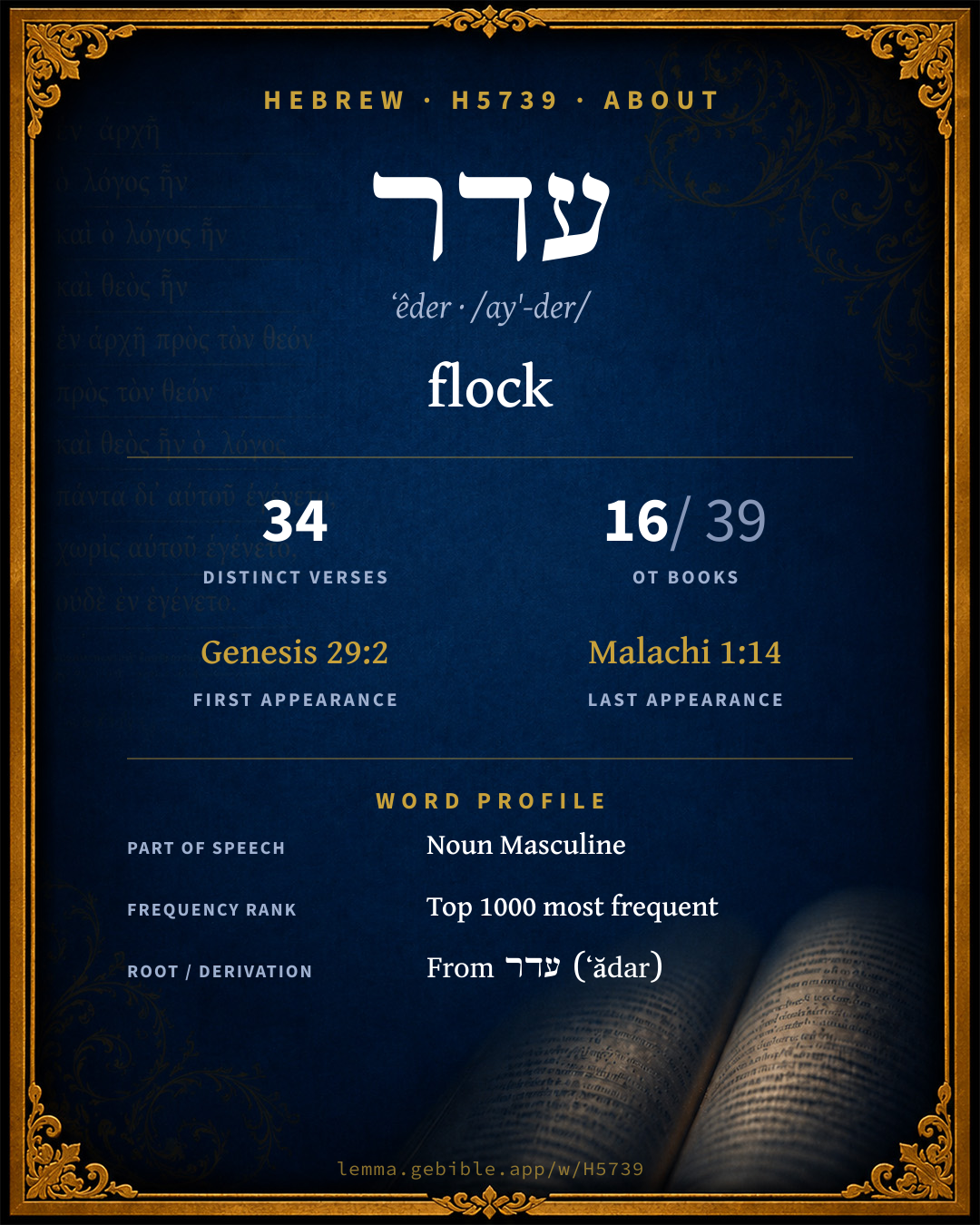
עֵ֫דֶר
flock
‘flock’ is one of 3 main senses fuller range ↓
Full lexicon entry — Brown-Driver-Briggs (BDB)
From Brown-Driver-Briggs (BDB)
Where this word appears
See every Absolute-state word in the Hebrew Bible →
Grammar key — what these labels mean
Part of speech
- Noun
- A naming word — a person, place, thing, or idea.
Noun type
- Common
- A common noun — a general class of person, place, or thing (“king,” “city,” “water”), not a specific name.
State
- Absolute
- The independent form of a noun, not bound to a following word.
- Construct
- A noun bound to a following noun in a possessive / “of” relationship (the construct chain).
Gender
- Masculine
- Grammatically masculine.
Number
- Singular
- One.
- Plural
- More than one (in Hebrew, generally three or more).
16 distinct verses where H5739 appears in the Construct state, across 9 books. Filtered view — show all forms. Click any verse to open its interlinear word-by-word view. Verse text shown in the World English Bible for context — . Each verse’s Hebrew form is shown with its reference; the English is not keyword-highlighted, since the data carries no word-level English alignment. Use “Compare translations” on any verse to read it across multiple English versions. This concordance covers the Hebrew Bible; Septuagint (Greek Old Testament) occurrences are not indexed here.
Genesis 1 verse
Song of Solomon 5 verses
- Song of Solomon 1:7 עֶדְרֵ֥י n c mp cs Tell me, you whom my soul loves, Where you graze your flock, Where you rest them at noon; For why should I be as one who is veiled Beside the flocks of your companions? Lover
- Song of Solomon 4:1 כְּ/עֵ֣דֶר prep + n c ms cs Behold, you are beautiful, my love. Behold, you are beautiful. Your eyes are doves behind your veil. Your hair is as a flock of goats, That descend from Mount Gilead.
- Song of Solomon 4:2 כְּ/עֵ֣דֶר prep + n c ms cs Your teeth are like a newly shorn flock, Which have come up from the washing, Where every one of them has twins. None is bereaved among them.
- Song of Solomon 6:5 כְּ/עֵ֣דֶר prep + n c ms cs Turn away your eyes from me, For they have overcome me. Your hair is like a flock of goats, That lie along the side of Gilead.
- Song of Solomon 6:6 כְּ/עֵ֣דֶר prep + n c ms cs Your teeth are like a flock of ewes, Which have come up from the washing; Of which every one has twins; None is bereaved among them.
Isaiah 1 verse
Jeremiah 4 verses
- Jeremiah 6:3 וְ/עֶדְרֵי/הֶ֑ם conj + n c mp cs + sfx pers 3mp Shepherds with their flocks shall come to her; they shall pitch their tents against her round about; they shall feed everyone in his place.
- Jeremiah 13:17 עֵ֥דֶר n c ms cs But if you will not hear it, my soul shall weep in secret for [your] pride; and my eye shall weep sore, and run down with tears, because Yahweh's flock is taken captive.
- Jeremiah 31:10 עֶדְרֽ/וֹ n c ms cs + sfx pers 3ms Hear the word of Yahweh, you nations, and declare it in the isles afar off; and say, He who scattered Israel will gather him, and keep him, as shepherd does his flock.
- Jeremiah 51:23 וְ/עֶדְר֔/וֹ conj + n c ms cs + sfx pers 3ms and with you will I break in pieces the shepherd and his flock; and with you will I break in pieces the farmer and his yoke [of oxen]; and with you will I break in pieces governors and deputies.
Ezekiel 1 verse
Joel 1 verse
Micah 1 verse
Zechariah 1 verse
Malachi 1 verse
About this entry
At a glance — auto-summarized from this page’s data, not written by a person. Every figure links to its source below. This summary describes the numbers; it doesn’t interpret them.
עדר (ʻêder) is a Hebrew noun most often rendered “flock.” It first appears in Genesis 29:2. With 34 verses in 16 books, it is a moderately common word in the Hebrew Bible. Not a single-sense word: explore its full sense range. It clusters with עדר, מעדר and עדר under a shared root. The sections below give every sense, occurrence, and version rendering.
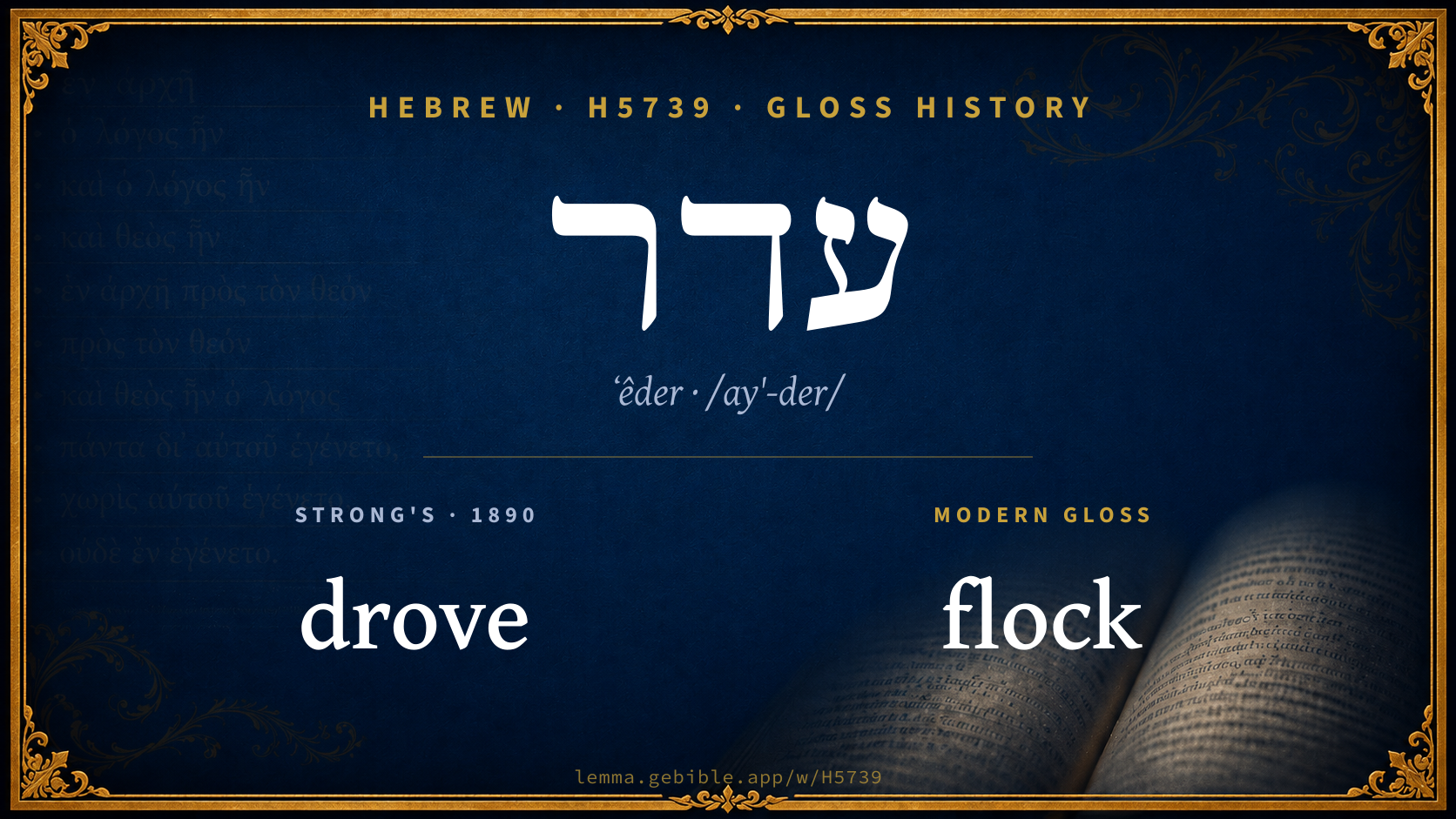
Gloss history
Strong's 1890 vs modern scholarship
About this word
Strong's H5739 catalogs a Hebrew word from the Hebrew Old Testament.
These counts are not copied from any lexicon or concordance. They are computed here, from the morphology-tagged Hebrew Old Testament. What Lemma adds →
- 34
- distinct verses
- The word appears in 34 distinct verses.
- 16 / 39
- OT books
- The word appears in 16 of 39 Old Testament books.
- #922
- by frequency
- Top 1000 most frequent Hebrew words (rank 922 of 8,640 Hebrew words by occurrence).
View all 34 occurrences in the concordance →
Most concentrated in
- Genesis 6 verses 18%
- Jeremiah 6 verses 18%
- Song of Solomon 5 verses 15%
By section of the Old Testament
By traditional corpus
Conventional, traditional groupings — biblical authorship is debated, so this is a traditional corpus grouping, not an authorship claim. Each share is this word’s portion of its verses in that division of the Hebrew canon. Each figure is a share of the word’s 34 distinct verses.
- Prophets (Nevi'im) 19 verses · 56%
- Writings (Ketuvim) 9 verses · 26%
- Torah (Pentateuch) 6 verses · 18%
How translations render this word
Counts come from each version’s own published word-to-Strong’s tagging or interlinear alignment — an approximate guide to how each version renders this word, not a word-level alignment the data otherwise carries. Because each total is that version’s own tagged count, the per-version totals vary from one another and need not match the appearance or distinct-verse counts above. These counts may also differ from a printed concordance because Lemma counts each distinctly tagged rendering and does not collapse phrase taggings into a single head-word total. This is a fixed set of word-tagged versions (KJV, ASV, BSB, ULT) and does not change with the reading translation you choose elsewhere. Each version’s license is shown beside its name below (and on Sources).
BDB lists this Strong’s number as 3 distinct words (homographs). Each count above pools all of them and is not split by sense — see the Senses section below. A low-frequency rendering may belong to a different one of those words, not the primary meaning.
- King James Version†: Flocks 10×, Flock 8×, Drove 2×
- American Standard Version†: Flocks 7×, Flock 6×, Herds 3×
- Berean Standard Bible†: Flocks 12×, Flock 7×, Herds 6×
- unfoldingWord Literal Text†: Flocks 9×, Flock 8×, Flocks of 3×
King James Version Public Domain
Renders H5739 across 38† tagged occurrences — most commonly:
Plus 14 renderings that appear only once — usually multi-word phrases or single function words the recovered tagging swept in, not distinct renderings.
American Standard Version Public Domain
Renders H5739 across 38† tagged occurrences — most commonly:
Plus 18 renderings that appear only once — usually multi-word phrases or single function words the recovered tagging swept in, not distinct renderings.
Berean Standard Bible Public Domain
Renders H5739 across 36† tagged occurrences — most commonly:
Plus 3 renderings that appear only once — usually multi-word phrases or single function words the recovered tagging swept in, not distinct renderings. Not rendered by a distinct English word in 2 further occurrences.
unfoldingWord Literal Text CC BY-SA 4.0
Renders H5739 across 36† tagged occurrences — most commonly:
Plus 6 renderings that appear only once — usually multi-word phrases or single function words the recovered tagging swept in, not distinct renderings.
7 senses and sub-senses in the full BDB
What do BDB’s symbols mean?
BDB uses these scholarly abbreviations:
| Symbol | Meaning |
|---|---|
| 𝔊 | the Septuagint (the ancient Greek translation, LXX) |
| 𝔙 | the Vulgate (the Latin translation) |
| 𝔖 | the Syriac version (the Peshitta) |
| 𝔗 | the Targum (the Aramaic translation) |
| ψ | the Psalms |
| √ | root (the underlying root or stem) |
| ‖ | parallel passage (a synonymous or contrasted parallel) |
| † | the dagger: every passage where the word occurs is cited |
The 7 senses and sub-senses the full Brown-Driver-Briggs lexicon distinguishes for this word, in lexicon order (not ranked by frequency), with BDB’s own verbatim wording and sub-sense lettering. Shown in Hebrew script with BDB’s own scholarly abbreviations. The condensed entry is in the Lexicon Entry tab. See also the Forms in the corpus table below.
עדר I Gn 29, 2 flock, herd (NH id.
- 1. flock:
- a. of sheep, ע׳ צֹאן Gn 29:2 (J), Mi 5:7, ע׳ הַצּ׳ Jo 1:18; cf. Gn 29:2, 3, 8; 30:40 (all J), 1 S 17:34 Je 51:23 Mal 1:14; ‖ צֹאן Ez 34:12 (sim.), Pr 27:23; + בְּהֵמָה 2 Ch 32:28; ע׳ הָֽרְחֵלִים Ct 6:6 = 4:2 (ins. prob. הָֽר׳); sign of desolation Is 17:2; 32:14 (מִרְעֵה ע׳), Zp 2:14 Je 6:3, of peace 31:24; in sim. also Mi 2:12 Je 31:10 ψ 78:52; fig. of Isr. Is 40:11 Je 13:20 (‖ זֹאן), ע׳ יהוה v 17, so עֶדְרוֹ Zc 10:3. e.g. Genesis 29:2
- b. of goats, ע׳ הָעִוִּים Ct 4:1; 6:5. e.g. Song of Solomon 4:1
- c. undefined Ju 5:16 Jb 24:2 Ct 1:7. e.g. Judges 5:16
- 2. herds, flocks and herds:
- a. incl. sheep, cattle, etc., Gn 32:17(×4), 20 (cf. v 14; all E) e.g. Genesis 32:17
- b. specif. ע׳ בָקָר Jo 1:18.—מִגְדַּל־עֵדֶר v. p. 154 supr. e.g. Joel 1:18
עדר II m. (cf. Nab. n.pr. עדרו = Arabic غُدَرُ Lzb 337)
עדר III loc. in extreme S. of Judah Jos 15
Senses from the full Brown-Driver-Briggs lexicon (Brown, Driver, Briggs; Oxford 1906 — public domain), digitized via Sefaria, supplemented by the OpenScriptures HebrewLexicon (CC BY 4.0). Full attribution on Sources.
Word origin
I. n.m. Gn 29, 2 flock, herd (NH id.; Aramaic עַדְרָא on 𝔊 Γαδερ Gn 35:16 (= ℌ v 21) v LagBN 76 f., who assigns ע׳ therefore, plausibly, to III. עדר (غدر), as lagging, loitering);—ע׳ abs. Gn 32:17(×2) +, cstr. Ct 4:1 +; sf. עֶדְרוֹ Is 40:11 +; pl. עֲדָרִים Gn 29:2 +, cstr. עֶדְרֵי Mi 5:7 +, etc.;—
II. n.pr.m. (cf. Nab. n.pr. עדרו = Arabic غُدَرُ Lzb 337);—a Levite 1 Ch 23:23; 24:30, 𝔊 Αιδαθ, Ηλα, A 𝔊L Εδερ.
III. n.pr.loc. in extreme S. of Judah Jos 15:21, site unknown; 𝔊 Αρα, A Εδραι, 𝔊L Εβερ.
— Brown-Driver-Briggs (Oxford 1906, public domain), digitized via Sefaria, supplemented by the OpenScriptures HebrewLexicon (CC BY 4.0). See Sources.
Derived from עדר (ʻădar) (H5737) — to help.
Jastrow Dictionary
A second Hebrew/Aramaic lexicon for comparison, covering Aramaic and post-biblical (Talmudic, Targumic, Midrashic) usage that the biblical-Hebrew BDB does not. Matched by lemma rather than by Strong’s number, so a lemma may carry more than one Jastrow headword (shown separately below), and the entries cover usage well beyond the Bible.
עָדַר
- 1. to strip.—Part. pass. עָדוּר; f. עֲדוּרָה, v. אָדַר.
- 2. to pluck, clear (of weeds); to hoe; to pick (figs, cmp. אָרָה); [b. h. also: to sift an army, to discharge the unfit &c., to muster out, v. I Chr. XII, 34; 39]. Neg. II, 4; Sifra Thazr., Neg., Par. 3, ch. IV כעוֹדֵר in the position of one hoeing; כעודר בבית הסתרים the position of one hoeing is required for the examination of the posteriors. Tosef. Maasr. II, 14 פועלים שהיו עוֹדְרִין בתאנים laborers engaged in picking figs; B. Mets. 89ᵇ (Ar. אורין, v. אָרָה). Ib. לַעֲדוֹר ולקשקש וכ׳ Rashi (ed. לעַדֵּר, Pi.) to hoe and to cover up the roots of olive trees. B. Kam. 119ᵇ עוֹדְרֵי ירקות engaged in thinning vegetables (cmp. דָּלַל); a. fr. e.g. 1 Chronicles 12:34
- same. Tosef. Maasr. II, 13 מְעַדְּרִין בשדה engaged in hoeing a field. Gen. R. s. 82 better is he who rents one field ומזבלה ומְעַדְּרָהּ וכ׳ and manures and hoes it &c. Y. Maasr. III, end, 51ᵃ והוא שעי׳ רובה provided he broke the ground of the larger portion of the court; a. fr.—[Tosef. Makhsh. I, 3 מעודר, ed. Zuck. מעודרון, v. עוּד.]
- 1. to be hoed, to be prepared for tillage. Y. l. c. והיא שתהא נעדרת provided the ground of the court has been broken (before sowing). Ib. 50ᵈ bot. חצר שהיא נעדרת ונזרעת R. S. to Maasr. III, 9 (ed. only נעדרת) a court which has been hoed up and planted with seeds; a. e.
- 2. to be cast out, rejected, banished. Sot. IX, 15 (49ᵇ) והאמת תהא נעדרת and Truth shall be banished (fr. Is. LIX, 15); Snh. 97ᵃ; Cant. R. to II, 13; v. עֵדֶר. e.g. Isaiah 59:15
- 3. to withdraw one’s self, fail. Lev. R. s. 31; Midr. Till. to Ps. XIX; Yalk. ib. 673 (expl. Zeph. III, 5), v. פְּסַק. e.g. Zephaniah 3:5
עֲדַר I
- , to hoe; (of chickens) to pick. Lev. R. s. 25 זיל עֲדוֹר וכ׳ go and pick in thy own dunghill; Yalk. Job 925.
- same. Lev. R. l. c. ומְעַדְּרָה קדמיהון (not ומעדרנה) and she (the mother) picks for them; Yalk. l. c. (not ומעררה).
עֲדַר II
- = h. עָזַר, to help. Targ. Prov. XIII, 12 דמשרי למְעַדְרֵיה (ed. Lag. a. oth. דמשדי) who begins to help himself (v. Pesh. a. LXX).
- to be helped. Ib. XVIII, 19 דמִתְעֲדַר (oth. ed. דמתעוי; v. Pesh. a. LXX).
עֵדֶר
- enclosure, pen, fold; herd, flock. Ohol. VIII, 1 ע׳ בהמה וכ׳ clean or unclean beasts closely penned; Tosef. ib. IX, 1; [Ar. s. v. אדר, ed. Koh. s. v. אדורה, I, p. 39ᵃ, explains our w.: hide, v. עָדַר 1, a. עָדַד]. Yoma 34ᵇ; 70ᵇ; Meg. 28ᵃ אחד מיוחד שבעֶדְרוֹ ‘one’ (Num. XXVIII, 4) means one singled out (the best) of its fold. Bekh. 24ᵃ הנכנס לתוך עדרו וכ׳ if one enters his pen at night. Naz. V, 3 תצא ותרעה בע׳ let it go and be fed in the fold (as a profane animal). Yoma 61ᵇ, sq. וכי עדרו משלח … וכי עדרו שורף shall one send off his whole flock (of goats)?… shall one burn &c.?; a. fr.—Pl. עֲדָרִים, עֲדָרִין. Ex. R. s. 1 באין ע׳ ע׳ וכ׳ they came to their homes in flocks; א"ת עדי עדיים אלא עֶדְרֵי ע׳ read not (Ez. XVI, 7) ʿădi ʿădayim (choice attractions) but ‘edré ʿădarim (flocks after flocks). Cant. R. to II, 13 (ref. to Is. LIX, 5) להיכן הולכת … ויושבת ע׳ ע׳ במדבר whither does banished Truth go (v. עָדַר)? She goes and sits down in groups (of eremites) in the desert; Snh. 97ᵃ; Yalk. Is. 357; a. fr.—Tosef. Eduy. III, 2 נוחרין היו עֲדָרוֹת וכ׳ they stabbed entire herds in the camp. (v., however, עָרוֹד).—מִגְדַּל עֵדֶר (b. h.) pr. n. pl. Migdal Eder (Fold Tower), between Bethlehem and Jerusalem. Shek. VII, 4; Kidd. 55ᵃ e.g. Numbers 28:4
A Dictionary of the Targumim, the Talmud Babli and Yerushalmi, and the Midrashic Literature (Marcus Jastrow; London, Luzac, 1903) — Public Domain. Digitized via Sefaria. Digitized via Sefaria. Full attribution on Sources.
Forms in the corpus
The 31 distinct written forms H5739 takes in the Hebrew Bible, most frequent first — each parse links to that state’s occurrences in the concordance. Hebrew forms include their vowel points and cantillation, so a single lemma takes many written forms.
Same root — word family
Other BDB entries built from the same root as H5739, grouped by Strong’s listed origin. These share a root / origin per the lexicon — not necessarily a shared meaning. Each links to that word’s own entry.
Derives from
Shares the same root
Proper names from this root
People and places named from this root — a name, not an additional meaning of the word.
Compare all same-root words → Showing 4 of 6 — not the complete family. 3 of the same-root words are proper names (people or places). They share a root, not necessarily a meaning.
Septuagint verse parallels
This word appears in 33 verses that also exist in the Greek Old Testament (Septuagint), out of the 34 Hebrew verses it occurs in. You can read those verses in Greek by switching the Old Testament edition to the Septuagint.
Read these verses in the Septuagint
- Genesis 29:2
- Judges 5:16
- 1 Samuel 17:34
- 2 Chronicles 32:28
- Job 24:2
- Proverbs 27:23
- Song of Solomon 1:7
- Isaiah 17:2
- Jeremiah 6:3
- Ezekiel 34:12
- Joel 1:18
- Micah 2:12
This is a verse-level parallel only — the same verses exist in both the Hebrew and Greek Old Testaments. No word-level Hebrew↔Greek correspondence is claimed: the data carries no such alignment, so no Greek word is shown as this Hebrew word’s translation. Coverage is not total — the Septuagint omits the deuterocanon and renumbers the Psalms, so some Hebrew verses have no direct Greek parallel.