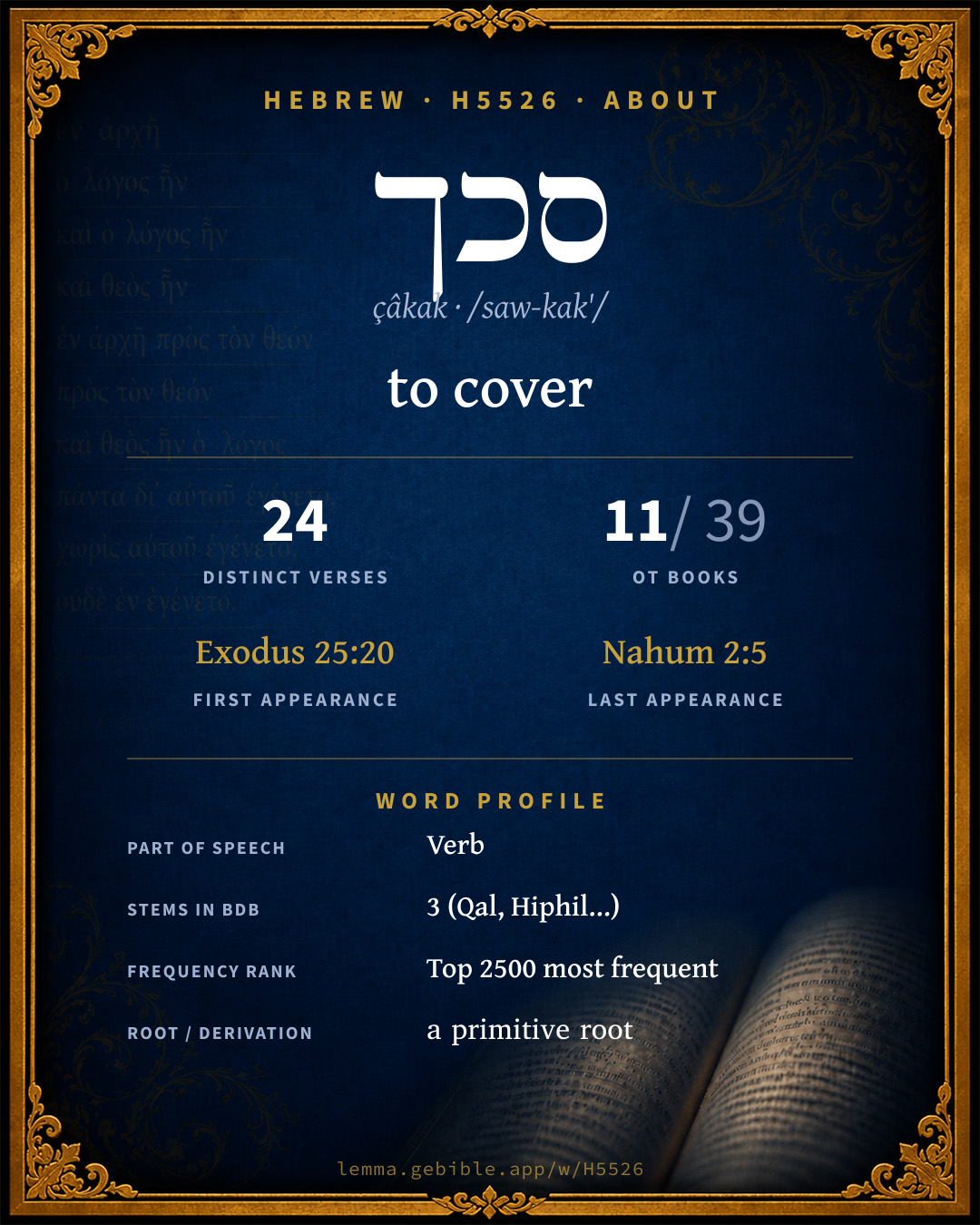
סכך
to cover
‘to cover’ is one of 5 main senses fuller range ↓
Full lexicon entry — Brown-Driver-Briggs (BDB)
From Brown-Driver-Briggs (BDB)
Where this word appears
See every Hiphil verb in the Hebrew Bible →
Grammar key — what these labels mean
Part of speech
- Verb
- An action or state-of-being word.
Noun type
- Common
- A common noun — a general class of person, place, or thing (“king,” “city,” “water”), not a specific name.
Stem
- Hiphil
- The causative active stem (“he caused / brought about”). Here: ‘elsewhere Impf.’
- Qal
- The basic, simple active stem — the plain form of the verb (“he wrote”). Here: ‘refl. anoint oneself’
- Pilpel
- A reduplicated intensive stem of two-letter or hollow roots.
Form
- Sequential Imperfect
- An imperfect with prefixed waw — the standard past-narrative form (waw-consecutive imperfect).
- Perfect
- A completed action or state — Hebrew marks aspect (completeness) more than strict tense (“he wrote”).
- Participle Active
- A verbal adjective expressing ongoing or characteristic action (“writing / one who writes”).
- Imperfect
- An incomplete, ongoing, or future action (“he will / would write”).
- Sequential Perfect
- A perfect with prefixed waw continuing a preceding imperfect or command (waw-consecutive perfect).
- Infinitive Construct
- A bound verbal noun, frequently with prepositions (“to write / in writing”).
State
- Absolute
- The independent form of a noun, not bound to a following word.
Person
- 3rd Person
- The one spoken about (“he / she / it / they”).
- 2nd Person
- The one addressed (“you”).
- 1st Person
- The speaker (“I / we”).
Gender
- Masculine
- Grammatically masculine.
- Common
- Either gender — not distinguished for this form.
Number
- Singular
- One.
- Plural
- More than one (in Hebrew, generally three or more).
1 verse where H5526 appears in the Poel stem in the Book of Job. Filtered view — show all forms. Click any verse to open its interlinear word-by-word view. Verse text shown in the World English Bible for context — . Each verse’s Hebrew form is shown with its reference; the English is not keyword-highlighted, since the data carries no word-level English alignment. Use “Compare translations” on any verse to read it across multiple English versions. This concordance covers the Hebrew Bible; Septuagint (Greek Old Testament) occurrences are not indexed here.
Job
About this entry
At a glance — auto-summarized from this page’s data, not written by a person. Every figure links to its source below. This summary describes the numbers; it doesn’t interpret them.
The Hebrew verb סכך centers on the idea of “to cover.” First canonically at Exodus 25:20, it enters the text early. It turns up in 24 verses across 11 books, an uncommon footprint. Different stems carry different senses — BDB groups them under 3 stems, among them Qal and Hiphil. It clusters with מיסך, מסך and סך under a shared root. Dig into 24-verse concordance and the renderings breakdown below.
Gloss history
Strong's 1890 vs modern scholarship
About this word
Strong's H5526 catalogs a Hebrew word from the Hebrew Old Testament.
These counts are not copied from any lexicon or concordance. They are computed here, from the morphology-tagged Hebrew Old Testament. What Lemma adds →
- 24
- distinct verses
- The word appears in 24 distinct verses.
- 11 / 39
- OT books
- The word appears in 11 of 39 Old Testament books.
- #1,327
- by frequency
- Top 2500 most frequent Hebrew words (rank 1,327 of 8,640 Hebrew words by occurrence).
View all 24 occurrences in the concordance →
By section of the Old Testament
By traditional corpus
Conventional, traditional groupings — biblical authorship is debated, so this is a traditional corpus grouping, not an authorship claim. Each share is this word’s portion of its verses in that division of the Hebrew canon. Each figure is a share of the word’s 24 distinct verses.
- Writings (Ketuvim) 11 verses · 46%
- Prophets (Nevi'im) 8 verses · 33%
- Torah (Pentateuch) 5 verses · 21%
How translations render this word
Counts come from each version’s own published word-to-Strong’s tagging or interlinear alignment — an approximate guide to how each version renders this word, not a word-level alignment the data otherwise carries. Because each total is that version’s own tagged count, the per-version totals vary from one another and need not match the appearance or distinct-verse counts above. These counts may also differ from a printed concordance because Lemma counts each distinctly tagged rendering and does not collapse phrase taggings into a single head-word total. This is a fixed set of word-tagged versions (KJV, ASV, BSB, ULT) and does not change with the reading translation you choose elsewhere. Each version’s license is shown beside its name below (and on Sources).
BDB lists this Strong’s number as 8 distinct words (homographs). Each count above pools all of them and is not split by sense — see the Senses section below. A low-frequency rendering may belong to a different one of those words, not the primary meaning.
- King James Version†: Thou hast covered 4×, Cover 3×, Covered 3×
- American Standard Version†: Thou hast covered 3×, Covering 2×
- Berean Standard Bible†: Guardian 2×, Overshadowed 2×, Overshadowing 2×
- unfoldingWord Literal Text†: And 4×, Covering 3×, You covered 2×
King James Version Public Domain
Renders H5526 across 24† tagged occurrences — most commonly:
Plus 14 renderings that appear only once — usually multi-word phrases or single function words the recovered tagging swept in, not distinct renderings.
American Standard Version Public Domain
Renders H5526 across 23† tagged occurrences — most commonly:
Plus 18 renderings that appear only once — usually multi-word phrases or single function words the recovered tagging swept in, not distinct renderings.
Berean Standard Bible Public Domain
Renders H5526 across 24† tagged occurrences — most commonly:
Plus 16 renderings that appear only once — usually multi-word phrases or single function words the recovered tagging swept in, not distinct renderings.
unfoldingWord Literal Text CC BY-SA 4.0
Renders H5526 across 29† tagged occurrences — most commonly:
Plus 20 renderings that appear only once — usually multi-word phrases or single function words the recovered tagging swept in, not distinct renderings.
14 senses and sub-senses in the full BDB
Hebrew verbs can shift meaning by stem (binyan): Qal is the basic action, Niphal is often passive or reflexive, Piel often intensifies or makes it factitive, and Hiphil is typically causative. The senses below are grouped under the stem BDB assigns to each. This entry also uses one or more reduplicated stems (the Pōlēl/Pilpēl type), which for hollow or geminate roots behave much like Piel — often intensive or iterative.
What do BDB’s symbols mean?
BDB uses these scholarly abbreviations:
| Symbol | Meaning |
|---|---|
| 𝔊 | the Septuagint (the ancient Greek translation, LXX) |
| 𝔙 | the Vulgate (the Latin translation) |
| 𝔖 | the Syriac version (the Peshitta) |
| 𝔗 | the Targum (the Aramaic translation) |
| ψ | the Psalms |
| √ | root (the underlying root or stem) |
| ‖ | parallel passage (a synonymous or contrasted parallel) |
| † | the dagger: every passage where the word occurs is cited |
The 14 senses and sub-senses the full Brown-Driver-Briggs lexicon distinguishes for this word, in lexicon order (not ranked by frequency), with BDB’s own verbatim wording and sub-sense lettering. Shown in Hebrew script with BDB’s own scholarly abbreviations. The condensed entry is in the Lexicon Entry tab. See also the Forms in the corpus table below.
סכך I pour in anointing, anoint (NH Aramaic סוּךְ anoint)
Qal
- Pf. 2 fs. וָסַכְתְּ consec. Ru 3:3; 1 s. סָ֑כְתִּי Dn 10:3; Impf. 2 ms. תָּסוּךְ Dt 28:40 Mi 6:15; 2 fs. תָּסוּכִי 2 S 14:2; 1 s. sf. וָאֲסֻכֵֿךְ Ez 16:9; 3 mpl. sf. וַיְסֻכוּם 2 Ch 28:15; also (prob.) 3 ms. וַיָּ֫סֶךְ 2 S 12:20 (Ges§ 73 f.); Inf. abs. סוֹךְ Dn 10:3; appar. Impf. pass. is יִיסָ֔ךְ read יוסך Sam. (Köi.436) Ex 30:32 (and not Hoph., cf. Gesl.c.);—anoint, in the toilet, often after washing; usually e.g. Ruth 3:3
- 1. refl. anoint oneself, 2 S 12:20; Ru 3:3, סוֹךְ לֹא־סָ֑כְתִּי Dn 10:3; + שֶׁמֶן as acc. mat. 2 S 14:2 Mi 6:15; Dt 28:40. e.g. 2 Samuel 12:20
- 2. act., anoint another Ez 16:9 (בַּשֶּׁמֶן), 2 Ch 28:15. e.g. Ezekiel 16:9
- 3. pass., be poured, Ex 30:32 (P; subj. the sacred oil). e.g. Exodus 30:32
סכך II hedge, or fence about, shut in (‖ form of שׂוּךְ
Qal
- (al. Hiph., but cf. שׂוּךְ) Impf. 3 ms. וַיָּ֫סֶךְ אֱלוֹהַּ בַּעֲדוֹ Jb 3:23, c. acc. + בְּ instr. וַיָּ֫סֶךְ בִּדְלָתַיִם יָ֑ם 38:8 and (who) shut in the sea with doors? (Bi Bu וּמִי סָךְ, Me מִי סָךְ). e.g. Job 3:23
סכך III overshadow, screen, cover (‖ √ to I. שׂכך (which is prob. orig., cf. Arabic شَكَّ, and Frä90)
Qal
- Pf. only 2 ms. סַכֹּ֫תָ Ex 40:3, סַכֹּ֫תָה La 3:43, 44, סַכּ֫וֹתָה ψ 140:8; Impf. 3 mpl. וַיָּסֹ֫כּוּ 1 K 8:7, sf. יְסֻכֻּ֫הוּ Jb 40:22; Pt. act. סוֹכֵךְ Ez 28:14, 16, pl. סֹכֲכִים Ex 25:20 + 2 times;— e.g. Exodus 40:3
- 1. screen, cover, usually c. עַל־ of thing covered, 1 K 8:7; 1 Ch 28:18; + acc. of covering Ex 40:3 (P); + בְּ of covering 25:20; 37:9 (both P); c. לְ of thing covered ψ 140:8; so (+ בְּ instr.) ס׳ בֶּעָנָן לָךְ La 3:44 thou hast screened thyself with the clouds; c. acc. Jb 40:22 lotus-trees, as its shade, screen it; abs. Ez 28:14, 16 (difficult, text prob. corrupt, Co Toy del. as gloss). e.g. 1 Kings 8:7
- 2. reflex. cover oneself ס׳ בָאָף La 3:43 thou hast covered (clothed, panoplied) thyself with anger (si vera l.; cf. v 44 supr.). e.g. Lamentations 3:43
Hiphil
- Impf. 3 ms. יָ֑סֶךְ לָךְ ψ 91:4, וַיָּ֑סֶךְ Ex 40:21 + 2 times; 2 ms. תָּסֵךְ ψ 5:12; Inf. cstr. הָסֵךְ 1 S 24:4; Pt. מֵסִיךְ Je 3:24 (Ges§ 67 v);—screen, cover, e.g. Psalms 91:4
- 1. specif. c. אֶת־רַגְלָיו, i.e. with long garments, euphemism for evacuating the bowels, from posture assumed, so inf. Ju 3:24, pt. 1 S 24:4 (cf. NH הֵסֵיךְ, and v. GFM, HPS). e.g. Judges 3:24
- 2. elsewhere Impf., as Qal (expl. as Qal BaZMG xliii (1889), 178), c. עַל־ Ex 40:21, of protection ψ 5:12; c. לְ pers. + בְּ instr. 91:4 (of protection). e.g. Exodus 40:21
Pilp
- סִכְסֵהּ, denom., v. sub IV. שׂכך.—v. סוך for Jb 3:23; 38:8. e.g. Job 3:23
סכך IV weave together (‖ form of II. שָׂכַךְ
Qal
- Impf. 2 ms. sf. תְּסֻכֵּנִי ψ 139:13 thou didst weave me together. Pô. id. Jb 10:11. e.g. Psalms 139:13
סכך V [m.] protector
סכך VI cover, lay over, so as to screen (cf. ‖ √ I. סכך)
Qal
- Pf. 1 s. וְשַׂכֹּתִי כַפִּי עָלֶיךָ Ex 33:22 (JE). e.g. Exodus 33:22
סכך VII weave (cf. ‖ √ II. סכך)
סכך VIII Pilp. prick or spur on (cf. Arabic شَاكَ pierce (perhaps denom. from) شَوْكٌ thorn, شَوْكَةٌ point of spear, etc.
Senses from the full Brown-Driver-Briggs lexicon (Brown, Driver, Briggs; Oxford 1906 — public domain), digitized via Sefaria, supplemented by the OpenScriptures HebrewLexicon (CC BY 4.0). Full attribution on Sources.
Word origin
I. vb. pour in anointing, anoint (NH Aramaic סוּךְ anoint);—
II. vb. hedge, or fence about, shut in (‖ form of שׂוּךְ; prob. not connected with Arabic شَوْكٌ, Ethiopic ሦክ thorns; poss. cf. Syriac ܣܳܟ finish, Pa. ܣܰܝܶܟ finish, conclude, comprehend, and Arabic سَكَّ close, close up, stop, stop up, lock up, Lane 1386);—
I. vb. overshadow, screen, cover (‖ √ to I. שׂכך (which is prob. orig., cf. Arabic شَكَّ, and Frä90); NH הֵסֵיךְ cover, and perhaps סִכֵּךְ roof over);—
II. vb. weave together (‖ form of II. שָׂכַךְ; NH Hiph. הֵסֵיךְ weave, סוּכָּה, booth);—
I. n.[m.] protector;—term. techn. of structure shielding stormers of city (Lat. testudo) הַסּ׳ Na 2:6; 𝔊 τὰς προφυλακὰς αὐτῶν.
I. vb. cover, lay over, so as to screen (cf. ‖ √ I. סכך);—
II. vb. weave (cf. ‖ √ II. סכך); Pôʿ. Impf. 2 ms. sf. תְּשׂכְכֵנִי Jb 10:11 with bones and sinews thou weavest me together.
III. Pilp. prick or spur on (cf. Arabic شَاكَ pierce (perhaps denom. from) شَوْكٌ thorn, شَوْكَةٌ point of spear, etc.; Ethiopic ሦክ thorn);—prick or spur on, acc. pers.: Pf. 1 S וְסִכְסַכְתִּ֫י Is 19:2 (+ ב against); Impf. 3 ms. יְסַכְסֵךְ 9:10.
— Brown-Driver-Briggs (Oxford 1906, public domain), digitized via Sefaria, supplemented by the OpenScriptures HebrewLexicon (CC BY 4.0). See Sources.
Origin: a primitive root
Jastrow Dictionary
A second Hebrew/Aramaic lexicon for comparison, covering Aramaic and post-biblical (Talmudic, Targumic, Midrashic) usage that the biblical-Hebrew BDB does not. Matched by lemma rather than by Strong’s number, so a lemma may carry more than one Jastrow headword (shown separately below), and the entries cover usage well beyond the Bible.
סָכַךְ I
- (b. h.) to interlace, entangle; to be entangled, ramified.—Denom. סֻכָּה.
- 1. to weave. Sabb. VII, 2 והמֵיסֵךְ and the work of the weaver. Y. ib. VII, 10ᶜ top משום מֵיסֵיךְ his act coming under the category of weaving; משום מֵיסֶכֶת her act coming &c. Tosef. ib. VIII (IX), 2 המוסיך שלשה וכ׳ ed. Zuck. (corr. acc.) he who weaves three threads (on the Sabbath); a. fr.
- 2. (denom. of סֻכָּה) to hang over, shade. Ohol. VIII, 2; M. Kat. 5ᵇ אילן המיסך על הארץ a tree (with a seat of uncleanness on one of its boughs) throwing a shadow (forming a tent, cmp. אֹהֶל) over the ground; a. e.; v. סְכָכָה.
- 3. ה׳ רגליו to cross one’s feet, euphem. for: to ease one’s self. Yoma III, 2. Y. Ber. IX, 14ᵇ bot.; a. e.
- 1. to cover with boughs &c., esp. to cover the festive booth (Succah). Ber. 62ᵇ (ref. to להסך את רגליו, I Sam. XXIV, 4, v. supra) מלמד שס׳ עצמו כסוכה this intimates that he shaded himself (retired in a chaste manner) as in a booth. Succ. I, 4 הדלה … וס׳ על גבה if he trained a vine over the booth and put twigs over it. Ib. אין מְסַכְּכִים בו you must not use it for covering. Ib. 14ᵇ סִיכַּכְנוּ על וכ׳ we covered a stable with them. Lam. R. to I, 17 (ref. to בסך, Ps. XLII, 5) לשעבר … ואילנות מְסַכְּכוֹת וכ׳ formerly I went up (to Jerusalem) with trees forming shades over my head; a. fr.—Part. pass. מְסוּכָּךְ; f. מְסוּכֶּכֶת. Succ. 8ᵇ ובלבד שתהא מס׳ וכ׳ provided the Succah is covered according to law. Gen. R. s. 42 (ref. to עמק סכות, Ps. LX, 8) עמק שהוא מס׳ וכ׳ the valley which is shaded with trees. B. Bath. 25ᵇ Ms. M., v. אַכְסַדְרָא. e.g. 1 Samuel 24:4
- 2. to weave; to intertwine plants; to train a creeper over another plant. Men. 97ᵃ (expl. יֻסַּךְ, Ex. XXV, 29) the tubes שמְסַכְּכִין בהן וכ׳ with which they interweave the show bread (which they lay crosswise between the loaves, to allow the air to pass through). Tosef. Kil. I, 6, v. סִיכּוּךְ. Y. ib. II, end, 28ᵇ (not מסבכין). Lev. R. s. 14, end (ref. to Job X, 11 תשככני) סִכַּכְתַּנִי אינו אומר אלא תְּסוֹכְכֵנִי it does not say, Thou hast woven me, but, Thou shalt weave me (in the future world). e.g. Exodus 25:29
- 3. to form shade, to creep, intergrow. Y. Kil. l. c. דלעת מצרית שהיא מְסַכֶּכֶת the Egyptian gourd which creeps. Ib. שאין כולן מְסַכְּכִין וכ׳ not all of them creep like the Egyptian gourd.
סְכַךְ
- , esp. to hedge in. Koh. R. to V, 8 למִיסַּךְ גיניא (not למסיך); Lev. R. s. 22, beg. למסוך ניניא (נניא) (corr. acc.); v. סִיגָא.
- 1. to weave. Targ. Prov. XXX, 28, v. סְבַךְ.—
- *2. to fence in. Yoma 84ᵇ מְסַכֵּךְ סַכּוּכֵי Ms. L. (ed., v. מְכַךְ) he forms a fence (by placing vessels filled with water to check the fire).
סָכַךְ II
- (sec. r. of סָכָה; cmp. סְכוּכִית I), Nithpo. נִסְתּוֹכָךְ to be enlightened. Tanḥ. Vayakh. 8 (play on שׂוּכָתִים, I Chr. II, 55) שנִסְתּוֹכְכוּ ברוח הקודש they (the men of the Great Assembly) were enlightened by holy inspiration. e.g. 1 Chronicles 2:55
סְכָךְ
- (סָכַךְ I)
- 1. overhanging boughs or twigs. Tosef. Kel. B. Mets. III, 3 חותך בה את הס׳ he cuts the twigs (trims the trees) with it. Tosef. Nidd. IX, 13 יושב על גבי ס׳ sitting on boughs (in which there is a seat of uncleanness), v. סְכָכָה.
- 2. ceiling of twigs or matting, esp. the cover of the festive booth. Succ. 17ᵃ סְכָכָן ס׳ כשר הוא their cover is a proper one (such as is prescribed for the Succah); סְכָכָהּ ס׳ פסול הוא its cover is an unfit one; a. fr.—Y. Maasr. V, 51ᵈ bot. זרע בבית והעביר הס׳ if he planted in a covered space and (after the seed reached a certain stage) removed the ceiling; [strike out the following וסיכך על גביו].—Pl. סְכָכִין. Y. Succ. I, 52ᵇ
A Dictionary of the Targumim, the Talmud Babli and Yerushalmi, and the Midrashic Literature (Marcus Jastrow; London, Luzac, 1903) — Public Domain. Digitized via Sefaria. Digitized via Sefaria. Full attribution on Sources.
Forms in the corpus
The 24 distinct written forms H5526 takes in the Hebrew Bible, most frequent first — each parse links to that stem’s occurrences in the concordance. Hebrew forms include their vowel points and cantillation, so a single lemma takes many written forms.
Same root — word family
Other BDB entries built from the same root as H5526, grouped by Strong’s listed origin. These share a root / origin per the lexicon — not necessarily a shared meaning. Each links to that word’s own entry.
Derived from this word
- מיסך mêyçâk H4329 covert
- מסך mâçâk H4539 covering
- סך çâk H5519 multitude
- סך çôk H5520 thicket
- שך sêk H7899 thorn
- שך sôk H7900 booth
Proper names from this root
People and places named from this root — a name, not an additional meaning of the word.
Compare all same-root words → Showing 4 of 8 — not the complete family. 1 of the same-root words is a proper name (a person or place). They share a root, not necessarily a meaning.
Septuagint verse parallels
This word appears in 24 verses that also exist in the Greek Old Testament (Septuagint), out of the 24 Hebrew verses it occurs in. You can read those verses in Greek by switching the Old Testament edition to the Septuagint.
Read these verses in the Septuagint
- Exodus 25:20
- Judges 3:24
- 1 Samuel 24:3
- 1 Kings 8:7
- 1 Chronicles 28:18
- Job 3:23
- Psalms 5:11
- Isaiah 9:11
- Lamentations 3:43
- Ezekiel 28:14
- Nahum 2:5
This is a verse-level parallel only — the same verses exist in both the Hebrew and Greek Old Testaments. No word-level Hebrew↔Greek correspondence is claimed: the data carries no such alignment, so no Greek word is shown as this Hebrew word’s translation. Coverage is not total — the Septuagint omits the deuterocanon and renumbers the Psalms, so some Hebrew verses have no direct Greek parallel.