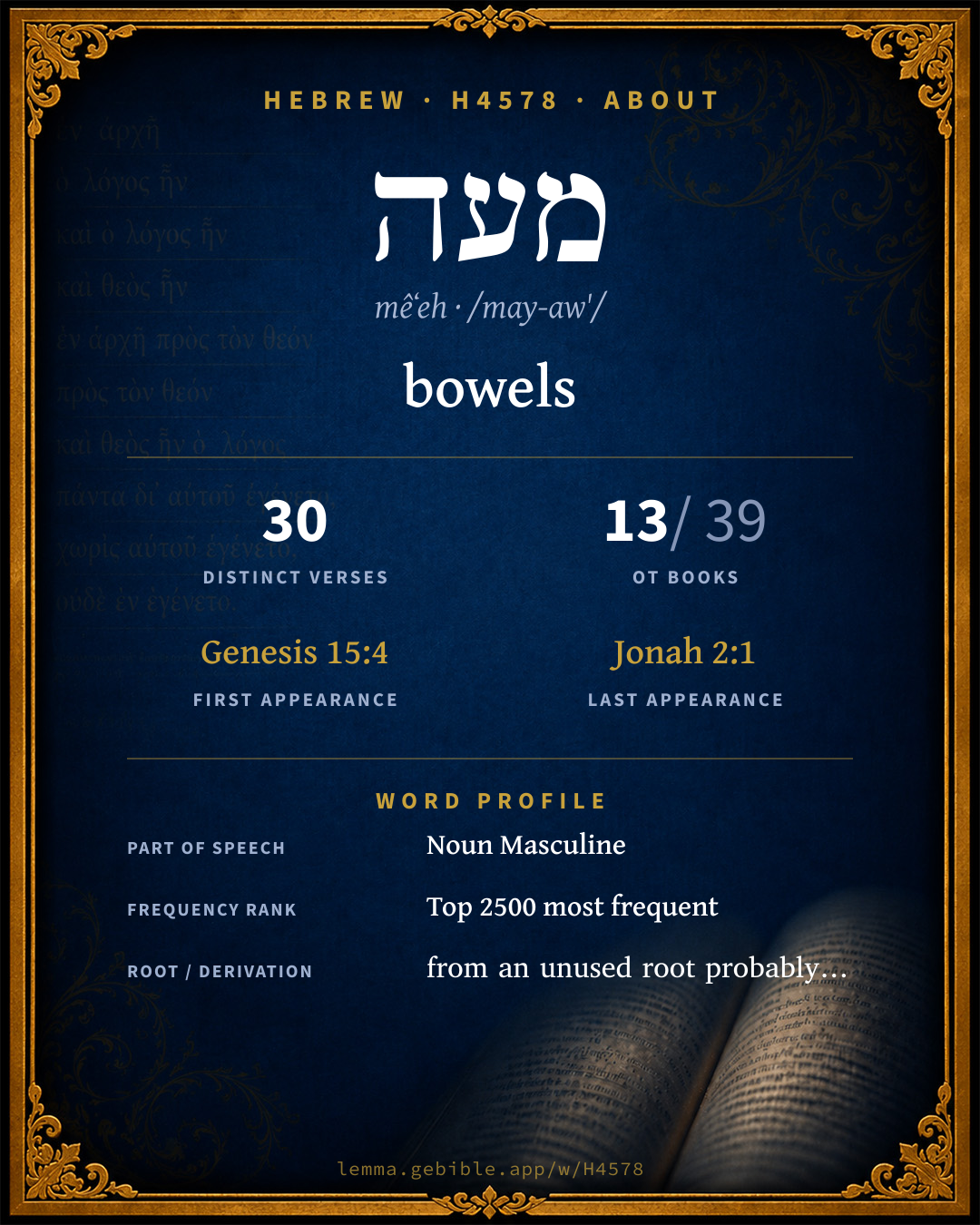
מֵעֶה
bowels
also: internal organs, inward parts, intestines, belly fuller range ↓
Full lexicon entry — Brown-Driver-Briggs (BDB)
From Brown-Driver-Briggs (BDB)
Where this word appears
Grammar key — what these labels mean
Part of speech
- Noun
- A naming word — a person, place, thing, or idea.
Noun type
- Common
- A common noun — a general class of person, place, or thing (“king,” “city,” “water”), not a specific name.
State
- Construct
- A noun bound to a following noun in a possessive / “of” relationship (the construct chain).
Gender
- Masculine
- Grammatically masculine.
Number
- Plural
- More than one (in Hebrew, generally three or more).
Every verse where H4578 appears in the Book of Ruth — 1 distinct verse. Click any verse to open its interlinear word-by-word view. Verse text shown in the World English Bible for context — . Each verse’s Hebrew form is shown with its reference; the English is not keyword-highlighted, since the data carries no word-level English alignment. Use “Compare translations” on any verse to read it across multiple English versions. This concordance covers the Hebrew Bible; Septuagint (Greek Old Testament) occurrences are not indexed here.
Ruth
About this entry
At a glance — auto-summarized from this page’s data, not written by a person. Every figure links to its source below. This summary describes the numbers; it doesn’t interpret them.
מעה (mêʻeh) is a Hebrew noun most often rendered “bowels.” Beyond its headline sense, its full sense range takes in “internal organs”, “inward parts”, and “intestines”. With 30 verses in 13 books, it is a moderately common word in the Hebrew Bible. It first appears in Genesis 15:4. It clusters with מעה, מעה and מעי under a shared root. For the data behind this summary, explore the sense tree and the renderings breakdown below.
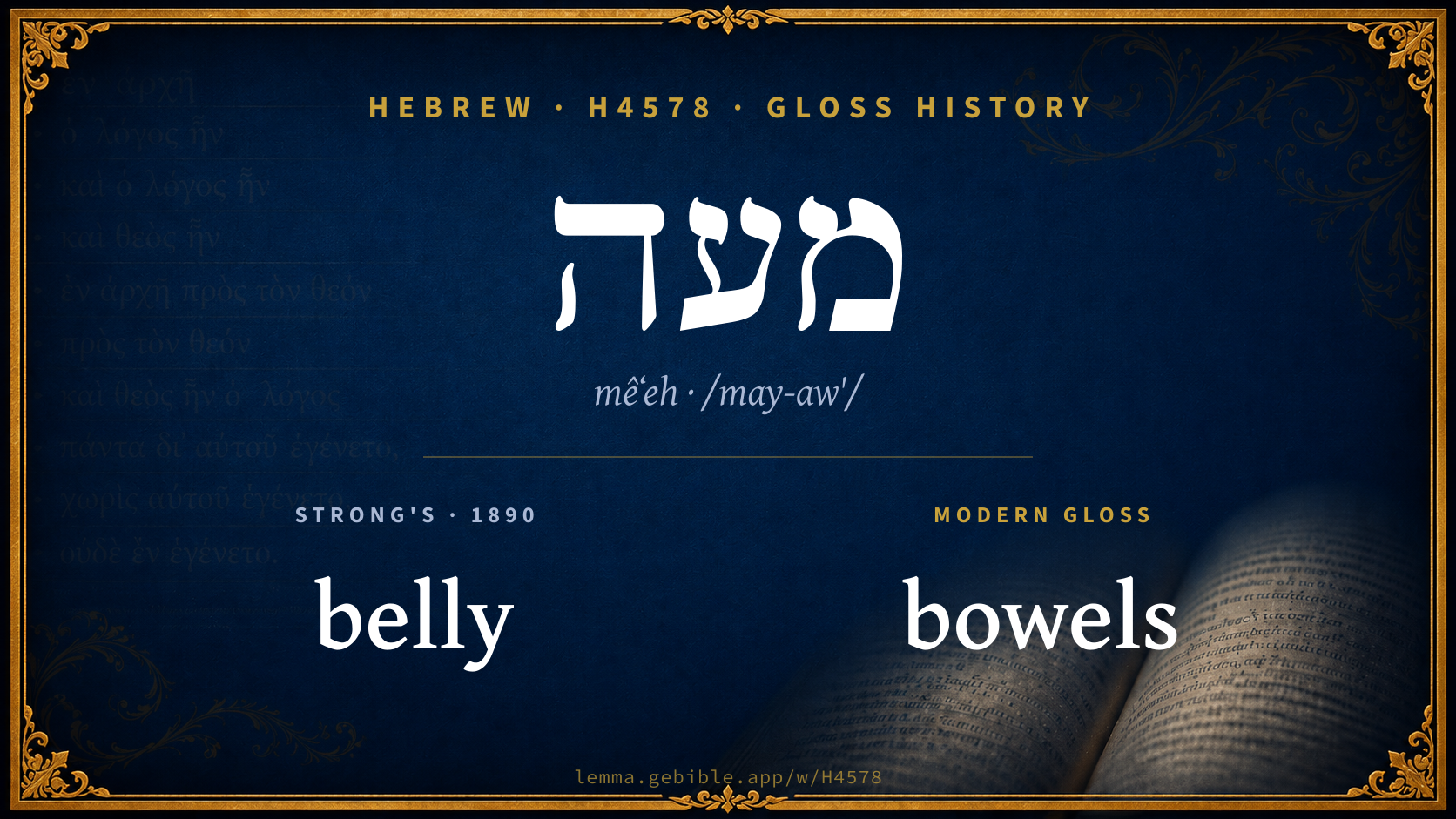
Gloss history
Strong's 1890 vs modern scholarship
About this word
Strong's H4578 catalogs a Hebrew word from the Hebrew Old Testament.
These counts are not copied from any lexicon or concordance. They are computed here, from the morphology-tagged Hebrew Old Testament. What Lemma adds →
- 30
- distinct verses
- The word appears in 30 distinct verses.
- 13 / 39
- OT books
- The word appears in 13 of 39 Old Testament books.
- #1,086
- by frequency
- Top 2500 most frequent Hebrew words (rank 1,086 of 8,640 Hebrew words by occurrence).
View all 30 occurrences in the concordance →
Most concentrated in
- 2 Chronicles 4 verses 13%
- Isaiah 4 verses 13%
- 2 Samuel 3 verses 10%
By section of the Old Testament
By traditional corpus
Conventional, traditional groupings — biblical authorship is debated, so this is a traditional corpus grouping, not an authorship claim. Each share is this word’s portion of its verses in that division of the Hebrew canon. Each figure is a share of the word’s 30 distinct verses.
- Writings (Ketuvim) 14 verses · 47%
- Prophets (Nevi'im) 13 verses · 43%
- Torah (Pentateuch) 3 verses · 10%
How translations render this word
Counts come from each version’s own published word-to-Strong’s tagging or interlinear alignment — an approximate guide to how each version renders this word, not a word-level alignment the data otherwise carries. Because each total is that version’s own tagged count, the per-version totals vary from one another and need not match the appearance or distinct-verse counts above. These counts may also differ from a printed concordance because Lemma counts each distinctly tagged rendering and does not collapse phrase taggings into a single head-word total. This is a fixed set of word-tagged versions (KJV, ASV, BSB, ULT) and does not change with the reading translation you choose elsewhere. Each version’s license is shown beside its name below (and on Sources).
- King James Version: Bowels 21×, Belly 2×, Own bowels 2×
- American Standard Version: Bowels 12×, Heart 4×, Anguish 2×
- Berean Standard Bible: Heart 4×, Bowels 3×, Stomach 3×
- unfoldingWord Literal Text: Belly 5×, Intestines 5×, Inward parts 5×
King James Version Public Domain
Renders H4578 across 32 tagged occurrences — most commonly:
Plus 7 renderings that appear only once — usually multi-word phrases or single function words the recovered tagging swept in, not distinct renderings.
American Standard Version Public Domain
Renders H4578 across 32 tagged occurrences — most commonly:
Plus 12 renderings that appear only once — usually multi-word phrases or single function words the recovered tagging swept in, not distinct renderings.
Berean Standard Bible Public Domain
Renders H4578 across 30 tagged occurrences — most commonly:
Plus 9 renderings that appear only once — usually multi-word phrases or single function words the recovered tagging swept in, not distinct renderings. Not rendered by a distinct English word in 2 further occurrences.
unfoldingWord Literal Text CC BY-SA 4.0
Renders H4578 across 32 tagged occurrences — most commonly:
Plus 6 renderings that appear only once — usually multi-word phrases or single function words the recovered tagging swept in, not distinct renderings.
8 senses and sub-senses in the full BDB
What do BDB’s symbols mean?
BDB uses these scholarly abbreviations:
| Symbol | Meaning |
|---|---|
| 𝔊 | the Septuagint (the ancient Greek translation, LXX) |
| 𝔙 | the Vulgate (the Latin translation) |
| 𝔖 | the Syriac version (the Peshitta) |
| 𝔗 | the Targum (the Aramaic translation) |
| ψ | the Psalms |
| √ | root (the underlying root or stem) |
| ‖ | parallel passage (a synonymous or contrasted parallel) |
| † | the dagger: every passage where the word occurs is cited |
The 8 senses and sub-senses the full Brown-Driver-Briggs lexicon distinguishes for this word, in lexicon order (not ranked by frequency), with BDB’s own verbatim wording and sub-sense lettering. Shown in Hebrew script with BDB’s own scholarly abbreviations. The condensed entry is in the Lexicon Entry tab. See also the Forms in the corpus table below.
- 1. lit.:
- a. וַיִּשְׁפֹּךְ מֵעָיו אַ֫רְצָה 2 S 20:10 and he poured out his inward parts on the ground (through a wound); cf. מַחֲלֵה מ׳ 2 Ch 21:15, 18, יָֽצְאוּ מ׳ v 15, 19. e.g. 2 Samuel 20:10
- b. as digestive organs, but without precision, nearly=stomach, belly, Jb 20:14; Ez 3:3 (‖ בֶּטֶן), 7:19 (‖ נֶפֶשׁ; both c. מָלֵא), Nu 5:22; so of fish that swallowed Jonah Jon 2:1, 2. e.g. Job 20:14
- 2. source of procreation: אשׁר יצא מִמּ׳ (said of offspring) Gn 15:4 (JE), 2 S 7:12 (‖ זַרְעֲךָ), 16:11; צֶאֱצָאֵי מ׳ Is 48:19 (‖ id.); מִיצִיאֵי מ׳ 2 Ch 32:21. e.g. Genesis 15:4
- 3. = womb, שְׁנֵי לְאֻמִּים מִמֵּעַיִךְ יִפָּרֵ֑דוּ Gn 25:23 (J; ‖ בֶּטֶן), cf. Is 49:1 (‖ id.), ψ 71:6 (‖ id.), Ru 1:11. e.g. Genesis 25:23
- 4. in gen.=inwards, inward part, לִבִּי … נָמֵס בְּתוֹךְ מ׳ ψ 22:15, cf. תּוֹרָֽתְךָ בְּתוֹךְ מ׳ 40:9. e.g. Psalms 22:15
- 5. fig.=seat of emotions: pity, Is 16:11 (‖ קֶרֶב); of God’s compassion, Je 31:20 (‖ רחם; in both subj. of vb. הָמוּ); הֲמוֹן מֵעֶיךָ Is 63:15 (‖ רַחֲמֶיךָ); distress, Je 4:19(×2) (‖ לֵב), מֵעַי חֳמַרְמָרוּ La 1:20 (‖ לֵב), 2:11 (‖ כָּבֵד liver); מֵעַי רֻתְּחוּ Jb 30:27 (dub., v. Bu); love, מֵעַי הָמוּ עָלָיו Ct 5:4. e.g. Isaiah 16:11
- 6. the external belly, מֵעָיו עֶשֶׁת שֵׁן Ct 5:14. e.g. Song of Solomon 5:14
Senses from the full Brown-Driver-Briggs lexicon (Brown, Driver, Briggs; Oxford 1906 — public domain), digitized via Sefaria, supplemented by the OpenScriptures HebrewLexicon (CC BY 4.0). Full attribution on Sources.
Word origin
n.m. Is 16:11 only pl. internal organs, inward parts (intestines, bowels), belly (NH id.; Aramaic מְעָא, מַעֲיָא, ܡܥܶܐ, ܡܥܰܝܴ̈ܐ; Arabic مّعَّى / مِعٍى; Ethiopic አማዑት;—on form cf. LagBN156 BaZMG xlii. 1888, 345);—pl. [מֵעִים] cstr. מְעֵי ψ 71:6 + 3 times; sf. מֵעַי 2 S 16:11 + 9 times, מֵעָ֑י ψ 22:15; 40:9; מֵעֶיךָ Gn 15:4 + 6 times; מֵעַיִךְ Gn 25:23 Nu 5:22; מֵעָיו 2 S 20:10 + 5 times; מֵעֵיהֶם Ez 7:19;—
— Brown-Driver-Briggs (Oxford 1906, public domain), digitized via Sefaria, supplemented by the OpenScriptures HebrewLexicon (CC BY 4.0). See Sources.
Origin: from an unused root probably meaning to be soft
Jastrow Dictionary
A second Hebrew/Aramaic lexicon for comparison, covering Aramaic and post-biblical (Talmudic, Targumic, Midrashic) usage that the biblical-Hebrew BDB does not. Matched by lemma rather than by Strong’s number, so a lemma may carry more than one Jastrow headword (shown separately below), and the entries cover usage well beyond the Bible.
מְעָה
- Is. XLVIII, 19, v. Targ.; cmp. next w.) [grain of sand &c.) m’ah, (cmp. גֵּרָה) e.g. Isaiah 48:19
- 1. a weight. Y. Kil. I, 27ᵃ top מ׳ אחת וכ׳ one m’ah’s weight from the top of a melon, cucumber &c.; [R. S. to Kil. I, 2: one seed taken from the top &c., v. next w.].—Lev. R. s. 17 מ׳ אחת עבה ומ׳ וכ׳ one m’ah’s weight of coarse thread &c.; (Midr. Till. to Ps. LXXIII, 4 מַטְוֶה).
- 2. a coin, corresp. to the Tyrian Obolus (v. Zuckerm. Talm. Münz. p. 4). Tosef. B. Bath. V, 12 שש מ׳ כסף וכ׳ six m’ah silver make one denar; מ׳ כסף שני וכ׳ one m. silver is equal to two dupondia; Y. Kidd. I, 58ᵈ; Bab. Kidd. 12ᵃ; Bekh. 50ᵃ. Y. Shebu. VI, beg. 36ᵈ; a. fr.—Pl. מָעִין. Ib.; a. fr.—מָעוֹת in gen. small coins, money. B. Mets. IV, 1, v. קָנָה. Pes. 50ᵇ מ׳ הבאות ממדינת הים proceeds from trans-oceanic traffic. Ib. מְ׳ יתומים orphans’ money (invested at half-profits between executor and orphans). Ab. Zar. 17ᵇ מ׳ של פורים money laid aside for Purim enjoyments; מ׳ של צדקה charity fund. Ib. לא יתן אדם מְעוֹתָיו וכ׳ one must not give his contribution to the charity fund, unless its manager be &c.; a. fr.
מֵעֶה
- ) m.; pl. מֵעַיִם, מֵעַיִים, מֵעַיִין, מֵי׳(b. h.; [curve; cmp. חָלָל,] inside, bowels, belly. Kinn. III, 6 מֵעָיו לנבלים בני מֵעָיו לכנורות its large intestines are used for harp-strings &c., v. כִּנּוֹר. Nidd. 22ᵇ מכה יש לה בתוך מֵעֶיהָ has an internal wound (abscess); (Tosef. ib. IV, 3 מבפנים). Y. Naz. VII, 56ᶜ bot. תחת מֵעֵי הגמל under the belly of the camel; תחת מעי השקוף under the arch of the gate. Snh. VIII, 2 (52ᵃ) יורדת לתוך מעיו וחומרת בני מעיו runs into his inside and scalds his bowels. Ḥull. 56ᵇ באלו בני מ׳ אמרו וכ׳ by the intestines of birds (Mish. ib. III, 3) are meant the stomach, the heart &c.—Eduy. III, 3 מעי אבטיח the seeds and the juice of the melon (v. preced.). Y. Maasr. I, 48ᵈ מה בין מֵיעֵי מלפפון למ׳ אבטיח what is the difference between the core of the melopepon and that of the melon?—Y. Ter. VIII, 46ᵃ top, v. מִסְמֵס I.—Tosef. Kel. B. Mets. IX, 2 מעיין שלה the stuffings of the sofa.
A Dictionary of the Targumim, the Talmud Babli and Yerushalmi, and the Midrashic Literature (Marcus Jastrow; London, Luzac, 1903) — Public Domain. Digitized via Sefaria. Digitized via Sefaria. Full attribution on Sources.
Forms in the corpus
The 28 distinct written forms H4578 takes in the Hebrew Bible, most frequent first — each parse links to that state’s occurrences in the concordance. Hebrew forms include their vowel points and cantillation, so a single lemma takes many written forms.
| Form | Parsing | Example | Uses |
|---|---|---|---|
| מֵעַ֣/י | Noun, Common, Masculine, Plural, Construct | Isaiah 16:11 | 3 |
| מֵעָֽ/י | Noun, Common, Masculine, Plural, Construct | Psalms 22:14 | 2 |
| מֵעָי/ו֙ | Noun, Common, Masculine, Plural, Construct | 2 Chronicles 21:19 | 2 |
| בְּ/מֵעָ֛י/ו | Noun, Common, Masculine, Plural, Construct | 2 Chronicles 21:18 | 1 |
| בְּ/מֵעָ֣י/ו | Noun, Common, Masculine, Plural, Construct | Job 20:14 | 1 |
| בְּֽ/מֵעַ֔/י | Noun, Common, Masculine, Plural, Construct | Ruth 1:11 | 1 |
| בְּֽ/מֵעַ֔יִ/ךְ | Noun, Common, Masculine, Plural, Construct | Numbers 5:22 | 1 |
| בִּ/מְעֵ֣י | Noun, Common, Masculine, Plural, Construct | Jonah 1:17 | 1 |
| וּ/מֵעֵי/הֶ֖ם | Noun, Common, Masculine, Plural, Construct | Ezekiel 7:19 | 1 |
| וּ/מֵעֶ֣י/ךָ | Noun, Common, Masculine, Plural, Construct | Ezekiel 3:3 | 1 |
| וּ/מֵעַ֖/י | Noun, Common, Masculine, Plural, Construct | Song of Solomon 5:4 | 1 |
| מִ/מְּעֵ֖י | Noun, Common, Masculine, Plural, Construct | Jonah 2:1 | 1 |
| מִ/מְּעֵ֣י | Noun, Common, Masculine, Plural, Construct | Psalms 71:6 | 1 |
| מִ/מְּעֵ֥י | Noun, Common, Masculine, Plural, Construct | Isaiah 49:1 | 1 |
| מִ/מֵּעֶ֑י/ךָ | Noun, Common, Masculine, Plural, Construct | 2 Samuel 7:12 | 1 |
| מִ/מֵּעֶ֔י/ךָ | Noun, Common, Masculine, Plural, Construct | Genesis 15:4 | 1 |
| מִ/מֵּעַ֖/י | Noun, Common, Masculine, Plural, Construct | 2 Samuel 16:11 | 1 |
| מִ/מֵּעַ֖יִ/ךְ | Noun, Common, Masculine, Plural, Construct | Genesis 25:23 | 1 |
| מֵעֶ֑י/ךָ | Noun, Common, Masculine, Plural, Construct | 2 Chronicles 21:15 | 1 |
| מֵעֶ֖י/ךָ | Noun, Common, Masculine, Plural, Construct | Isaiah 48:19 | 1 |
| מֵעֶ֛י/ךָ | Noun, Common, Masculine, Plural, Construct | Isaiah 63:15 | 1 |
| מֵעֶ֨י/ךָ֙ | Noun, Common, Masculine, Plural, Construct | 2 Chronicles 21:15 | 1 |
| מֵעַ/י֙ | Noun, Common, Masculine, Plural, Construct | Jeremiah 31:20 | 1 |
| מֵעַ֔/י | Noun, Common, Masculine, Plural, Construct | Lamentations 2:11 | 1 |
| מֵעַ֖/י | Noun, Common, Masculine, Plural, Construct | Job 30:27 | 1 |
| מֵעַ֨/י | Noun, Common, Masculine, Plural, Construct | Jeremiah 4:19 | 1 |
| מֵעָ֔י/ו | Noun, Common, Masculine, Plural, Construct | 2 Chronicles 32:21 | 1 |
| מֵעָ֥י/ו | Noun, Common, Masculine, Plural, Construct | 2 Samuel 20:10 | 1 |
Same root — word family
Other BDB entries built from the same root as H4578, grouped by Strong’s listed origin. These share a root / origin per the lexicon — not necessarily a shared meaning. Each links to that word’s own entry.
Derived from this word
Proper names from this root
People and places named from this root — a name, not an additional meaning of the word.
Compare all same-root words → 1 of the same-root words is a proper name (a person or place). They share a root, not necessarily a meaning.
Septuagint verse parallels
This word appears in 28 verses that also exist in the Greek Old Testament (Septuagint), out of the 30 Hebrew verses it occurs in. You can read those verses in Greek by switching the Old Testament edition to the Septuagint.
Read these verses in the Septuagint
- Genesis 15:4
- Numbers 5:22
- Ruth 1:11
- 2 Samuel 7:12
- 2 Chronicles 21:15
- Job 20:14
- Psalms 40:8
- Song of Solomon 5:4
- Isaiah 16:11
- Jeremiah 4:19
- Lamentations 1:20
- Ezekiel 3:3
This is a verse-level parallel only — the same verses exist in both the Hebrew and Greek Old Testaments. No word-level Hebrew↔Greek correspondence is claimed: the data carries no such alignment, so no Greek word is shown as this Hebrew word’s translation. Coverage is not total — the Septuagint omits the deuterocanon and renumbers the Psalms, so some Hebrew verses have no direct Greek parallel.