
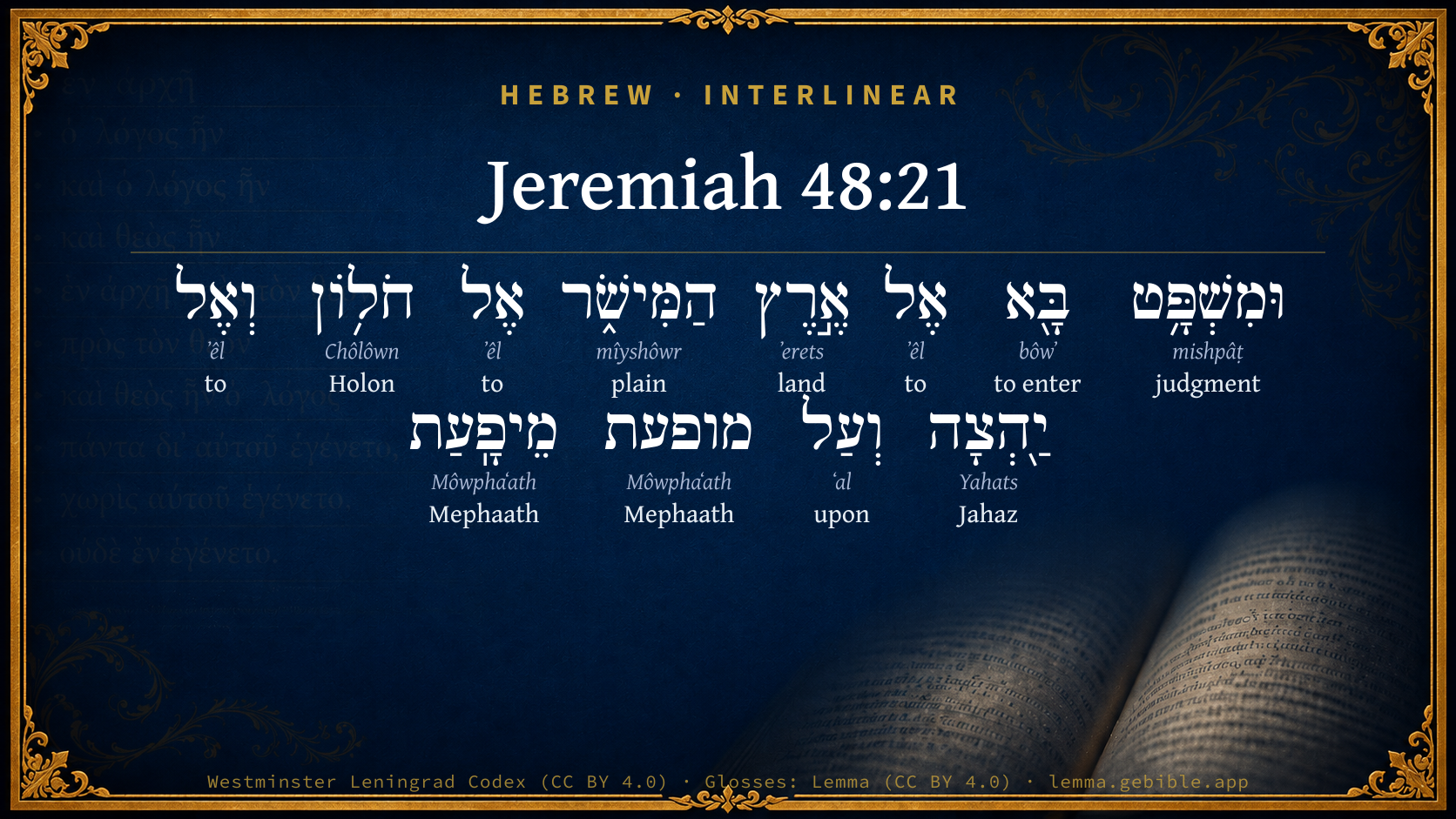
Jeremiah 48:21

Hebrew (Westminster Leningrad Codex) Jeremiah 48:21 appears in the Hebrew Old Testament. The text above is from the Westminster Leningrad Codex. Each word links to its Strong’s number, a concise gloss, and parsing drawn from the Open Scriptures Hebrew Bible morphology. Click any word for its full Brown-Driver-Briggs (BDB) entry.
Download image
Cite this verse

Jeremiah 48:21 (World English Bible). Public Domain. Lemma interlinear Bible study tool, https://lemma.gebible.app/v/jeremiah/48/21.

Show BibTeX & RIS
BibTeX
RIS
English Translation
Judgment is come on the plain country, on Holon, and on Jahzah, and on Mephaath,
World English Bible · Public Domain
Download a study sheet

One document with this verse’s original text, its word-by-word gloss line, the meaning frame, cross-references with their text, attributed commentary, and full source and license credits — printable, and it pastes into notes with its structure intact.

This verse Autodidact and up

Study sheet (.html) Plain text (.txt)

A passage Seminary Student

Up to 50 verses in one chapter. A passage sheet keeps up to 6 commentary sources and 12 cross-references per verse, in the order this page ranks them, and says so on the sheet whenever that leaves anything out. Ask for a single verse and you get the Autodidact verse sheet above.

Everything on this page stays free to read, with no account — the sheet is a download of what is already on screen, not access to it.

Want to remove ads? Support Godless Engineer
Compare translations 3

The same verse in 3 English versions, stacked beneath the original-language interlinear above. Click any original word for its lexicon entry.

Each is an independent rendering of the whole verse — the interlinear is not word-aligned to these translations.

Highlighted words mark where these versions differ — a whole-verse word diff, not a word-by-word alignment.

  • World English Bible Public Domain
    Judgment is come on the plain country, on Holon, and on Jahzah, and on Mephaath,
  • King James Version Public Domain
    And judgment is come upon the plain country; upon Holon, and upon Jahazah, and upon Mephaath,
  • unfoldingWord Literal Text CC BY-SA 4.0
    Now punishment has come to the hill country, to Holon, Jahzah, and Mephaath,

unfoldingWord Literal Text — © unfoldingWord, licensed CC BY-SA 4.0. Word-aligned USFM3 via Door43 (git.door43.org/unfoldingWord/en_ult).

Versions to compare (up to 4)

3 of 4 selected

Show all 18 translations

Every available English version of this verse, each an independent rendering of the whole verse.

  • World English Bible Public Domain
    Judgment is come on the plain country, on Holon, and on Jahzah, and on Mephaath,
  • Berean Standard Bible Public Domain
    Judgment has come upon the high plain—upon Holon, Jahzah, and Mephaath,
  • Majority Standard Bible Public Domain
    Judgment has come upon the high plain—upon Holon, Jahzah, and Mephaath,
  • King James Version Public Domain
    And judgment is come upon the plain country; upon Holon, and upon Jahazah, and upon Mephaath,
  • American Standard Version (1901) Public Domain
    And judgment is come upon the plain country, upon Holon, and upon Jahzah, and upon Mephaath,
  • Revised Version (1885) Public Domain
    And judgment is come upon the plain country; upon Holon, and upon Jahzah, and upon Mephaath;
  • Geneva Bible (1599) Public Domain
    And iudgement is come vpon the plaine countrey, vpon Holon and vpon Iahazah, and vpon Mephaath,
  • Douay-Rheims (1899) Public Domain
    And judgment is come upon the plain country: upon Helon, and upon Jasa, and upon Mephaath.
  • Young's Literal Translation Public Domain
    And judgment hath come in unto the land of the plain -- unto Holon, And unto Jahazah, and on Mephaath,
  • Literal Standard Version CC BY-SA 4.0
    And judgment has come to the land of the plain—to Holon, || And to Jahazah, and on Mephaath,
  • Unlocked Literal Bible CC BY-SA 4.0
    Now punishment has come to the hill country, to Holon, Jahzah, and Mephaath,
  • unfoldingWord Literal Text CC BY-SA 4.0
    Now punishment has come to the hill country, to Holon, Jahzah, and Mephaath,
  • Darby Bible Public Domain
    And judgment is come upon the country of the plateau; upon Holon, and upon Jahzah, and upon Mephaath;
  • World Messianic Bible Public Domain
    Judgment has come on the plain country— on Holon, on Jahzah, on Mephaath,
  • Webster's Bible Public Domain
    And judgment is come upon the plain country; upon Holon, and upon Jahazah, and upon Mephaath,
  • Free Bible Version CC BY-SA 4.0
    Punishment has arrived on the towns of the high plain—on Holon, Jahzah, and Mephaath,
  • Bible in Basic English Public Domain
    And punishment has come on the lowlands; on Holon and Jahzah, and on Mephaath,
  • JPS Tanakh (1917) Public Domain
    And judgment is come upon the country of the Plain; upon Holon, and upon Jahzah, and upon Mephaath;

Literal Standard Version (2020), Covenant Press — licensed CC BY-SA 4.0. Text via the HelloAO Bible API (eBible.org). Unlocked Literal Bible (unfoldingWord) — licensed CC BY-SA 4.0. Text via the HelloAO Bible API (eBible.org). unfoldingWord Literal Text — © unfoldingWord, licensed CC BY-SA 4.0. Word-aligned USFM3 via Door43 (git.door43.org/unfoldingWord/en_ult). Free Bible Version, Dr. Jonathan Gallagher — licensed CC BY-SA 4.0. Text via the HelloAO Bible API (eBible.org).

Word by word

More ways to search: Search by grammar → Find every occurrence → Compare this word →

Practice this passage: Drill this verse → Learn its vocabulary →

About this verse

These counts appear in no published source. They are computed here, from the morphology-tagged text and Lemma’s own curated glosses. What Lemma adds →

12
words
9
distinct lemmas
Prophets
section

Notable vocabulary

The rarest word here is חֹל֥וֹן Holon H2473 — appearing just 3 times in the whole Hebrew Bible.

Shared distinctive vocabulary

חֹל֥וֹן Holon H2473 occurs in 3 verses of the Hebrew Bible. Also found in:

Grammatical profile

  • 1 verb
  • 7 nouns
  • 4 prepositions

Verb forms

  • בָּ֖א Qal · Perfect

Repetition

Words recur within this verse — often emphatic in Hebrew:

  • מופעת Mephaath H4158 ×2
  • אֶל to H413 ×3

Cross-references

7

Topical passages linked to Jeremiah 48:21 in the Treasury of Scripture Knowledge — connected by theme and wording, ordered by reader-vote popularity; previews shown in the World English Bible.

  • Joshua 13:18 and Jahaz, and Kedemoth, and Mephaath,
  • Isaiah 15:4 Heshbon cries out, and Elealeh; their voice is heard even to Jahaz: therefore the armed men of Moab cry aloud; his soul trembles within him.
  • Numbers 21:23 Sihon would not allow Israel to pass through his border: but Sihon gathered all his people together, and went out against Israel into the wilderness, and came to Jahaz; and he fought against Israel.
  • Jeremiah 48:8 The destroyer shall come on every city, and no city shall escape; the valley also shall perish, and the plain shall be destroyed; as Yahweh has spoken.
  • Joshua 21:36–37 Out of the tribe of Reuben, Bezer with its suburbs, and Jahaz with its suburbs,
  • Ezekiel 25:9 therefore, behold, I will open the side of Moab from the cities, from his cities which are on his frontiers, the glory of the country, Beth-jeshimoth, Baal Meon, and Kiriathaim,
  • Zephaniah 2:9 Therefore as I live, says Yahweh of Hosts, the God of Israel, surely Moab will be as Sodom, and the children of Ammon as Gomorrah, a possession of nettles, and salt pits, and a perpetual desolation. The remnant of my people will plunder them, and the survivors of my nation will inherit them.

Cross-references courtesy of OpenBible.info (CC BY 4.0).

Hebrew and Greek witnesses Masoretic Hebrew ↔ Greek Septuagint

The same verse in the two great witnesses to the Old Testament, shown verse-for-verse.

These are two independent witnesses, not word-aligned to each other, and the Septuagint is shown in lemma (dictionary) form.

Hebrew Jeremiah 48:21 Masoretic · Westminster Leningrad Codex

וּמִשְׁפָּ֥ט בָּ֖א אֶל אֶ֣רֶץ הַמִּישֹׁ֑ר אֶל חֹל֥וֹן וְאֶל יַ֖הְצָה וְעַל מופעת מֵיפָֽעַת

Judgment is come on the plain country, on Holon, and on Jahzah, and on Mephaath,

World English Bible · Public Domain

Greek LXX Structure differs

In the Septuagint, Jeremiah is about an eighth shorter than the Hebrew and arranges its material differently — the Oracles Against the Nations (Hebrew chapters 46–51) appear in the middle of the Greek book, after 25:13. Because the chapter and verse boundaries do not line up, a verse-for-verse comparison with the Hebrew is not shown.

A verse-for-verse comparison isn’t shown here because the chapters and verses don’t line up. Switch to the LXX edition with the MT / LXX toggle above to read the Greek directly.

Hebrew: Westminster Leningrad Codex (CC BY 4.0). Greek: Septuagint (public domain); English from a public-domain English Septuagint. How the Septuagint differs from the Hebrew →

Targum (Aramaic paraphrase)

1

The Targum is the ancient Jewish Aramaic paraphrase of the Hebrew Scriptures — an interpretive translation, not the Hebrew text itself. Onkelos (literal) and Pseudo-Jonathan (expansive) render the Torah, and Jonathan the Prophets. Coverage is partial: where no permissively-licensed English translation exists for a verse, only the Aramaic is shown. This is verse-level text, not a word-by-word alignment to the Hebrew.

  1. Targum Jonathan Prophets (Joshua–Malachi)
    וְעָבְדֵי פּוּרְעֲנוּתָא מָטוּ לַאֲרַע מֵישִׁרָא לְחוֹלוֹן וּלְיַהֵץ וְעַל מֵיפָעַת:

    (no public-domain English translation for this verse)

    Targum Jonathan — Aramaic: “Mikraot Gedolot” (public domain). English: “Sefaria Community Translation” (CC0 1.0 (public-domain dedication)); “London "Chaldee Paraphrase," 1871” (public domain). Text via Sefaria.

Commentary

Notes on Jeremiah 48:21 from classic Christian and Jewish commentators (each source and its license shown beneath its notes). The classic Christian expositions comment on the surrounding passage and are grouped to its opening verse, so a note may address several verses; the Jewish commentaries on the Tanakh (Rashi and others) are per-verse, so they appear only where the commentator wrote on this verse.

Lemma curates 59 commentaries, every one of them public domain or Creative Commons licensed, each selected and text-cleaned for this edition rather than reprinted as found. About our sources →

Trapp's Complete Commentary

John Trapp

Jer 48:21 And judgment is come upon the plain country; upon Holon, and upon Jahazah, and upon Mephaath,

Ver. 21. And judgment is come upon the plain country.] Such as the most part of Moab was.

John Trapp, A Commentary or Exposition upon All the Books of the Old and New Testament (1647–1656) — public domain. Text from a community e-Sword module.

Keil & Delitzsch

C. F. Keil & F. Delitzsch

In Jer 48:21-24 the general idea of Moab's being laid waste is specialized by the enumeration of a long list of towns on which judgment has come. They are towns of ארץ המּישׁור, the table-land to the north of the Arnon, the names of which early all occur in the Pentateuch and Joshua as towns in the tribe of Reuben. But Holon is mentioned only here. According to Eusebius, in the Onomasticon, s.v. ̓Ιεσσά, Jahzah was situated between Μηδαβῶν (Medeba) and Δηβοῦς (Dibon); according to Jerome, between Medeba and Debus, or Deblathai; but from Num 21:23, we conclude that it lay in an easterly direction, on the border of the desert, near the commencement of the Wady Wale. Mophaath or Mephaath, where, according to the Onomasticon, a Roman garrison was placed, on account of the near proximity of the desert, is to be sought for in the neighbourhood of Jahzah; see on Jos 13:18. As to Dibon, see on Jer 48:18; for Nebo, see on Jer 48:1. Beth-diblathaim is mentioned only in this passage. It is probably identical with Almon-diblathaim, Num 33:46, and to be sought for somewhere north from Dibon. For Kirjahthaim see Jer 48:1. Beth-gamul is nowhere else mentioned; its site, too, is unknown. Eli Smith, in Robinson's Palestine, iii. App. p. 153, is inclined to recognise it in the ruins of Um-el-Jemel, lying on the southern boundary of the Hauran, about twenty miles south-west from Bozrah; but a consideration of the position shows that they cannot be the same. Beth-meon, or Baal-meon (Num 32:38), or more fully, Beth-baal-meon (Jos 13:17), lay about three miles south from Heshbon, where Burckhardt (p. 365) found some ruins called Mi-n (Robinson, iii. App. p. 170, Ma-n); see on Num 32:38. Kerioth, Jer 48:24 and Jer 48:41, and Amo 2:2, is not to be identified with the ruins called Kereyath or Kreiyath, mentioned by Burckhardt (p. 367) and Seetzen (Reisen, ii. 342, iv. 384), as Ritter has assumed; for this Kereyath is more probably Kirjathaim (see on Jer 48:1). Rather, as is pretty fully proved by Dietrich (in Merx' Archiv. i. 320ff.), it is a synonym of Ar, the old capital of Moab, Num 22:36; and the plural form is to be accounted for by supposing that Ar was made up of two or several large portions. We find two great arguments supporting this position: (1.) When Ar, the capital, occurs among the names of the towns of Moab, as in the list of those in Reuben, Jos 13:16-21, and in the prophecy against Moab in Isaiah, Jer 15 and 16, where so many Moabitic towns are named, we find no mention of Kerioth; and on the other hand, where Kerioth is named as an important town in Moab, Amo 2:2; Jer 48:1, there is no mention of Ar. (2.) Kerioth is mentioned as an important place in the country in Amo 2:2, where, from the whole arrangement of the prophecy, it can only be the capital of Moab; in this present chapter also, Jer 48:24, Kerioth and Bozrah are introduced as two very important towns which maintained the strength of Moab; and immediately afterwards it is added, "The horn of Moab is cut off," etc. Further, in Jer 48:41 the capture of Kerioth is put on a level with the taking of the fortresses; while it is added, that the courage of the mighty men has failed, just as in Jer 49:22 the capture of Bozrah is coupled with the loss of courage on the part of Edom's heroes. Bozrah is not to be confounded with Bozrah in Edom (Jer 49:13), nor with the later flourishing city of Bostra in Hauran: it is the same with Bezer (בּצר), which, according to Deu 4:43 and Jos 20:8, was situated in the Mishor of the tribe of Reuben, but has not yet been discovered; see on Deu 4:43. For the purpose of completing the enumeration, it is further added, "all the towns of the land of Moab, those which are far off (i.e., those which are situated towards the frontier) and those which are near" (i.e., the towns of the interior, as Kimchi has already explained). Thereby the horn of Moab is cut off, and his arm broken. Horn and arm are figures of power: the horn an emblem of power that boldly asserts itself, and pushes down all that opposes (cf. Psa 75:5, 11); the arm being rather an emblem of dominion.

Keil & Delitzsch — Biblical Commentary on the Old Testament (1861–1891) — public domain (CC PDM 1.0). Text via the HelloAO Bible API. (Old Testament only.)

Tyndale Open Study Notes

Tyndale Open Resources

48:21-25 Eleven Moabite villages would soon hear that the strength of Moab’s arm was broken. This meant that the villages had no one to defend them against the advancing enemy.

Tyndale Open Study Notes — © Tyndale Open Resources, licensed CC BY-SA 4.0. Text via the HelloAO Bible API.

Jamieson, Fausset & Brown

Robert Jamieson, A. R. Fausset & David Brown

plain-- (Jer 48:8). Not only the mountainous regions, but also the plain, shall be wasted.

Holon--(Compare Jos 15:51).

Jahazah-- (Num 21:23; Isa 15:4).

Mephaath-- (Jos 13:18; Jos 21:37).

Jamieson, Fausset & Brown — Commentary Critical and Explanatory on the Whole Bible (1871) — public domain (CC PDM 1.0). Text via the HelloAO Bible API.

Adam Clarke's Commentary

Verse 21. Upon Holon, &c.] All these were cities of the Moabites, but several of them are mentioned in no other place.

Adam Clarke's Commentary on the Bible (1810–1826) — public domain. Text from a community e-Sword/MySword module.

Ellicott's Commentary for English Readers

(21) And judgment is come upon the plain country . . .—We enter here upon a list of less known names, of which Jahaz, Beth-diblathaim, Beth-Baal-meon are found on the Moabite Stone inscription (Records of the Past, xi. 165-168). Holon does not appear elsewhere. Jahazah (under the form Jahaz) appears in Num_21:23; Deu_2:32; Jdg_11:20, as the scene of a famous battle between Sihon and the Israelites, and in Isa_15:4 in connexion with Heshbon and Elealeh. Mephaath was assigned to the Reubenites (Jos_13:18), and afterwards to the Levites (Jos_21:37; 1Ch_6:79), but it had clearly fallen afterwards into the hands of the Moabites. Like the other cities named, it was in the Mishor, or “plain,” on the north of the Arnon.

A Bible Commentary for English Readers, edited by Charles John Ellicott (1878–1897) — public domain. Text from a community e-Sword module.

The Cambridge Bible for Schools and Colleges

gen. ed. J. J. S. Perowne

21. the plain country] See Jer_48:8.

Holon] not known. It is not the H. near Hebron of Jos_15:51; Jos_21:15.

Jahzah] one of the Levitical cities (the Jahaz of Jos_21:36). There Moses defeated Sihon (Num_21:23).

Mephaath] also a Levitical city (Jos_21:37). Both M. and Jahzah were in Reuben’s territory.

The Cambridge Bible for Schools and Colleges (gen. ed. J. J. S. Perowne; Cambridge University Press, 1878–1918) — public domain. Text from a community e-Sword module.

John Gill's Exposition

And upon Dibon,.... Whose destruction by this time was come upon it, as suggested, Jer 48:18;

and upon Nebo: of which see Jer 48:1;

and upon Bethdiblathaim: the same with Almondiblathaim in Num 33:46 and Diblath in Eze 6:14.

John Gill's Exposition of the Whole Bible (1746–1763) — public domain (CC PDM 1.0). Text via the HelloAO Bible API.

Albert Barnes' Notes on the Bible

Holon - This place apparently took its name from caverns in its neighborhood.

Albert Barnes' Notes on the Bible (1834–1885) — public domain. Text from a community e-Sword/MySword module.

Whedon's Commentary on the Bible

Daniel D. Whedon

21. Holon… Jahazah, etc. — This is a list of towns and cities in Moab, most of which are mentioned elsewhere, but this first one, Holon, is found nowhere else.

Daniel D. Whedon (gen. ed.), Commentary on the Old and New Testaments (1874–1909) — public domain. Text from a community e-Sword module.

The Pulpit Commentary

The plain country. The mishor (see on ver. 8). Holon is not known from other sources. Jahazah (called Jahaz in ver. 34), according to Eusebius, still existed in his days, and lay between Medeba and Dibon. Like Heshbon and Dibon, it was claimed by the Reubenites, (Jos_13:18) and Mesha, in the famous inscription, states that the then King of Israel (Jehoram) "fortified Jahaz and dwelt in it, when he fought against me" (lines 18, 19). This was a great but only a temporary success, for Mesha adds that "Chemosh drove him out before me" (line 19). Mephaath was apparently near Jahaz, since it is always mentioned with that town. (Jos_13:18 Jos_21:37 1Ch_6:79)

The Pulpit Commentary (1880–1919), ed. H.D.M. Spence-Jones & Joseph S. Exell — public domain. Text from a community e-Sword module.

unfoldingWord translationNotes

Door43 World Missions Community

punishment has come to the hill country, to Holon ... to all the cities

Yahweh punishing the people of the hill country and cities of Moab is spoken of as if punishment were something that could travel and arrive in a place. AT: "Yahweh will punish the people of the hill country, of Holon ... of all the cities" (See: Active or Passive)

Holon, Jahzah, and Mephaath ... Bozrah

These are cities in Moab. (See: How to Translate Names)

The horn of Moab has been hacked off; its arm has been broken

Both of these statements mean the same thing. Here "horn" and "arm" represent power. To have these hacked off or broken means to lose one's power. This can be stated in active form. AT: "Moab has become weak; the people are not able to fight anymore" (See: Parallelism and Metonymy and Active or Passive)

this is Yahweh's declaration

Yahweh speaks of himself by name to express the certainty of what he is declaring. See how you translated this in Jeremiah 1:8. AT: "this is what Yahweh has declared" or "this is what I, Yahweh, have declared" (See: First, Second, or Third Person)

translationWords

punish

Yahweh

declare

unfoldingWord translationNotes — © Distant Shores Media and the Door43 World Missions Community, licensed CC BY-SA 4.0. Source: git.door43.org/Door43/en_tn.

Rashi

Rabbi Shlomo Yitzchaki (Rashi)

and judgment has come Retribution has come.

Rashi on the Tanakh — English translations: “The Judaica Press complete Tanach with Rashi, translated by A. J. Rosenberg” (CC BY 4.0); “Pentateuch with Rashi's commentary by M. Rosenbaum and A.M. Silbermann, 1929-1934” (public domain); “The Metsudah Tanach series, Lakewood, N.J” (CC BY 4.0); and “The Book of Joshua, Metsudah Publications, 1997” (CC BY 4.0). Text via Sefaria.

Lesson kit

Teaching starters — assembled from the data on this page, not authored interpretation. Every prompt links to the verse data it draws on. Edit before teaching.

Jeremiah, in the Prophets, opens this verse with 12 words (9 distinct Hebrew lemmas). Its most distinctive word is Chôlôwn (“Holon”). A historical commentator’s framing appears above. Read the whole chapter for the surrounding context.

Discussion questions

  1. What does “Holon” (Chôlôwn) contribute to the verse as a whole?
  2. Joshua 15:51 shares the word «Holon» with this verse. How do the two illuminate each other?
  3. “Mephaath” occurs 2× in this one verse. What is the effect of the repetition?
  4. These translations render this verse differently; the difference is in the English rendering, not the original. What questions does that raise?
  5. The verb «בָּ֖א» is Qal Perfect. How does its form color the action?
  6. Reading how Trapp's Complete Commentary and Keil & Delitzsch read this verse, where do the two commentators agree and where do they part?

Things to notice

  • These translations choose different wording for 9 words in this verse.
  • “Mephaath” occurs 2× in this single verse.
  • 9 distinct Hebrew lemmas span 12 words in this verse.

Reading settings

Reading text

Shown beneath each verse's original-language words.

Old Testament
Old Testament edition

Read the OT as the Masoretic Hebrew (MT) or the Greek Septuagint (LXX).

English shown for the Greek Septuagint (in the Hebrew ↔ Greek comparison).

Comparing translations? Open the Compare panel on any verse page to stack up to four side by side.