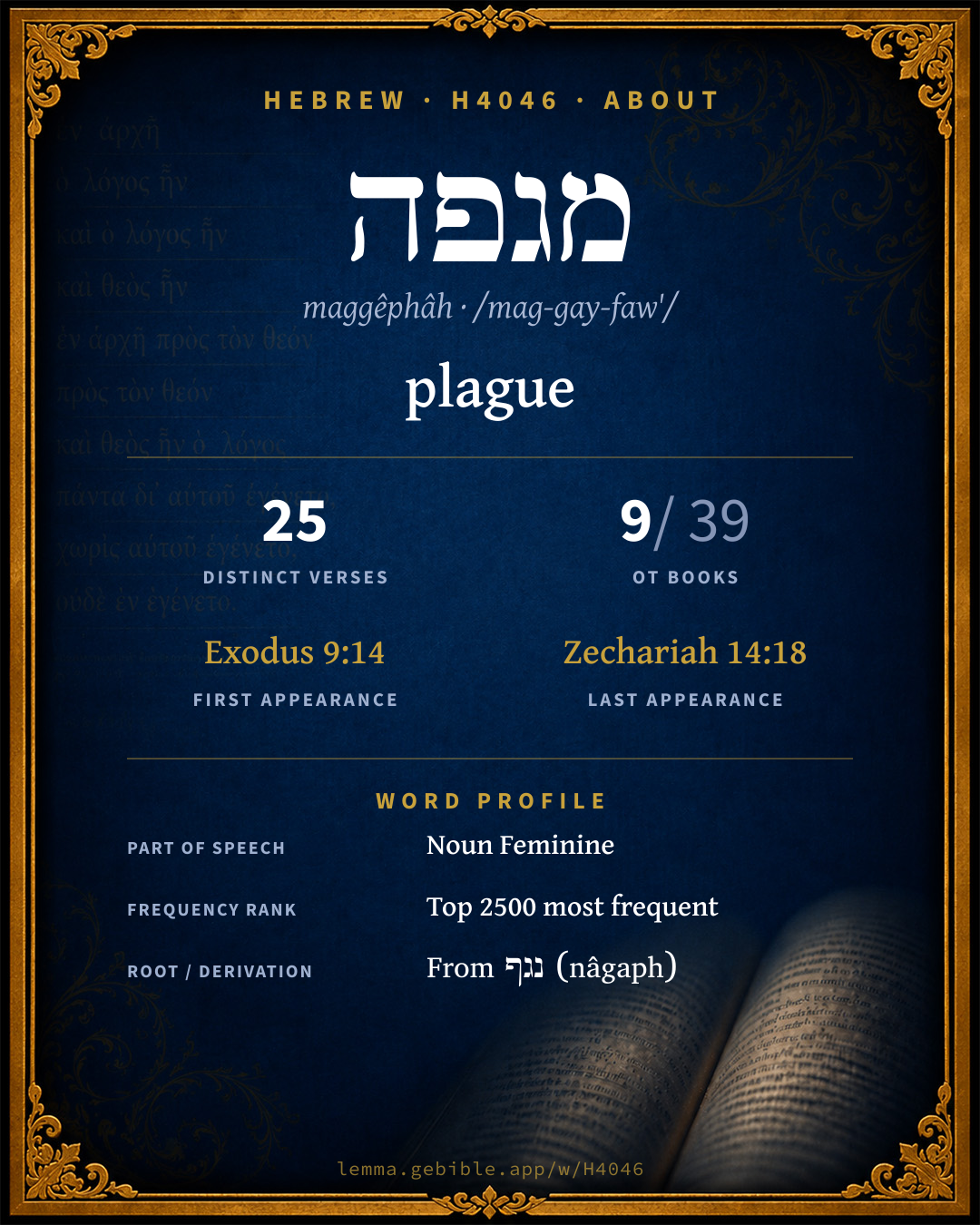
מַגֵּפָה
plague
also: blow, slaughter, pestilence, strike fuller range ↓
Full lexicon entry — Brown-Driver-Briggs (BDB)
From Brown-Driver-Briggs (BDB)
Where this word appears
See every Absolute-state word in the Hebrew Bible →
Grammar key — what these labels mean
Part of speech
- Noun
- A naming word — a person, place, thing, or idea.
Noun type
- Common
- A common noun — a general class of person, place, or thing (“king,” “city,” “water”), not a specific name.
State
- Absolute
- The independent form of a noun, not bound to a following word.
- Construct
- A noun bound to a following noun in a possessive / “of” relationship (the construct chain).
Gender
- Feminine
- Grammatically feminine.
Number
- Singular
- One.
- Plural
- More than one (in Hebrew, generally three or more).
24 distinct verses where H4046 appears in the Absolute state, across 8 books. Filtered view — show all forms. Click any verse to open its interlinear word-by-word view. Verse text shown in the World English Bible for context — . Each verse’s Hebrew form is shown with its reference; the English is not keyword-highlighted, since the data carries no word-level English alignment. Use “Compare translations” on any verse to read it across multiple English versions. This concordance covers the Hebrew Bible; Septuagint (Greek Old Testament) occurrences are not indexed here.
Numbers 9 verses
- Numbers 14:37 בַּ/מַּגֵּפָ֖ה prep det + n c fs even those men who did bring up an evil report of the land, died by the plague before Yahweh.
- Numbers 16:48 הַ/מַּגֵּפָֽה ptcl def.art + n c fs He stood between the dead and the living; and the plague was stayed.
- Numbers 16:49 בַּ/מַּגֵּפָ֔ה prep det + n c fs Now those who died by the plague were fourteen thousand and seven hundred, besides those who died about the matter of Korah.
- Numbers 16:50 וְ/הַ/מַּגֵּפָ֖ה conj + ptcl def.art + n c fs Aaron returned to Moses to the door of the tent of meeting: and the plague was stayed.
- Numbers 25:8 הַ/מַּגֵּפָ֔ה ptcl def.art + n c fs and he went after the man of Israel into the pavilion, and thrust both of them through, the man of Israel, and the woman through her body. So the plague was stayed from the children of Israel.
- Numbers 25:9 בַּ/מַּגֵּפָ֑ה prep det + n c fs Those who died by the plague were twenty-four thousand.
- Numbers 25:18 הַ/מַּגֵּפָ֖ה ptcl def.art + n c fs for they vex you with their wiles, with which they have deceived you in the matter of Peor, and in the matter of Cozbi, the daughter of the prince of Midian, their sister, who was slain on the day of the plague in the matter of Peor.
- Numbers 26:1 הַ/מַּגֵּפָ֑ה ptcl def.art + n c fs It happened after the plague, that Yahweh spoke to Moses and to Eleazar the son of Aaron the priest, saying,
- Numbers 31:16 הַ/מַּגֵּפָ֖ה ptcl def.art + n c fs Behold, these caused the children of Israel, through the counsel of Balaam, to commit trespass against Yahweh in the matter of Peor, and so the plague was among the congregation of Yahweh.
1 Samuel 2 verses
- 1 Samuel 4:17 מַגֵּפָ֥ה n c fs He who brought the news answered, Israel is fled before the Philistines, and there has been also a great slaughter among the people, and your two sons also, Hophni and Phinehas, are dead, and the ark of God is taken.
- 1 Samuel 6:4 מַגֵּפָ֥ה n c fs Then they said, "What shall be the trespass-offering which we shall return to him?" They said, "Five golden tumors, and five golden mice, [according to] the number of the lords of the Philistines; for one plague was on you all, and on your lords.
2 Samuel 4 verses
- 2 Samuel 17:9 מַגֵּפָ֔ה n c fs Behold, he is hid now in some pit, or in some [other] place: and it will happen, when some of them are fallen at the first, that whoever hears it will say, There is a slaughter among the people who follow Absalom.
- 2 Samuel 18:7 הַ/מַּגֵּפָ֧ה ptcl def.art + n c fs The people of Israel were struck there before the servants of David, and there was a great slaughter there that day of twenty thousand men.
- 2 Samuel 24:21 הַ/מַּגֵּפָ֖ה ptcl def.art + n c fs Araunah said, Why is my lord the king come to his servant? David said, To buy the threshing floor of you, to build an altar to Yahweh, that the plague may be stayed from the people.
- 2 Samuel 24:25 הַ/מַּגֵּפָ֖ה ptcl def.art + n c fs David built there an altar to Yahweh, and offered burnt offerings and peace-offerings. So Yahweh was entreated for the land, and the plague was stayed from Israel.
1 Chronicles 2 verses
- 1 Chronicles 21:17 לְ/מַגֵּפָֽה prep + n c fs David said to God, Isn't it I who commanded the people to be numbered? It is even I who have sinned and done very wickedly; but these sheep, what have they done? Please let your hand, O Yahweh my God, be against me, and against my father's house; but not against your people, that they should be plagued.
- 1 Chronicles 21:22 הַ/מַּגֵּפָ֖ה ptcl def.art + n c fs Then David said to Ornan, Give me the place of this threshing floor, that I may build thereon an altar to Yahweh: for the full price shall you give it me, that the plague may be stayed from the people.
2 Chronicles 1 verse
Psalms 2 verses
Ezekiel 1 verse
Zechariah 3 verses
- Zechariah 14:12 הַ/מַּגֵּפָ֗ה ptcl def.art + n c fs This will be the plague with which Yahweh will strike all the peoples who have warred against Jerusalem: their flesh will consume away while they stand on their feet, and their eyes will consume away in their sockets, and their tongue will consume away in their mouth.
- Zechariah 14:15 מַגֵּפַ֣ת כַּ/מַּגֵּפָ֖ה n c fs cs prep det + n c fs So will be the plague of the horse, of the mule, of the camel, and of the donkey, and of all the animals that will be in those camps, as that plague.
- Zechariah 14:18 הַ/מַּגֵּפָ֗ה ptcl def.art + n c fs If the family of Egypt doesn't go up, and doesn't come, neither will it rain on them. This will be the plague with which Yahweh will strike the nations that don't go up to keep the feast of tents.
About this entry
At a glance — auto-summarized from this page’s data, not written by a person. Every figure links to its source below. This summary describes the numbers; it doesn’t interpret them.
The Hebrew noun מגפה centers on the idea of “plague.” Alongside “plague” the lexicon also lists “blow”, “slaughter”, and “pestilence” — part of its full sense range. It turns up in 25 verses across 9 books, an uncommon footprint. The word gravitates to Numbers (36%), then 2 Samuel and Zechariah. Its earliest occurrence is Exodus 9:14. For the data behind this summary, explore the sense tree and the renderings breakdown below.
Gloss history
Strong's 1890 vs modern scholarship
About this word
Strong's H4046 catalogs a Hebrew word from the Hebrew Old Testament.
These counts are not copied from any lexicon or concordance. They are computed here, from the morphology-tagged Hebrew Old Testament. What Lemma adds →
- 25
- distinct verses
- The word appears in 25 distinct verses.
- 9 / 39
- OT books
- The word appears in 9 of 39 Old Testament books.
- #1,251
- by frequency
- Top 2500 most frequent Hebrew words (rank 1,251 of 8,640 Hebrew words by occurrence).
View all 25 occurrences in the concordance →
By section of the Old Testament
By traditional corpus
Conventional, traditional groupings — biblical authorship is debated, so this is a traditional corpus grouping, not an authorship claim. Each share is this word’s portion of its verses in that division of the Hebrew canon. Each figure is a share of the word’s 25 distinct verses.
- Torah (Pentateuch) 10 verses · 40%
- Prophets (Nevi'im) 10 verses · 40%
- Writings (Ketuvim) 5 verses · 20%
How translations render this word
Counts come from each version’s own published word-to-Strong’s tagging or interlinear alignment — an approximate guide to how each version renders this word, not a word-level alignment the data otherwise carries. Because each total is that version’s own tagged count, the per-version totals vary from one another and need not match the appearance or distinct-verse counts above. These counts may also differ from a printed concordance because Lemma counts each distinctly tagged rendering and does not collapse phrase taggings into a single head-word total. This is a fixed set of word-tagged versions (KJV, ASV, BSB, ULT) and does not change with the reading translation you choose elsewhere. Each version’s license is shown beside its name below (and on Sources).
- King James Version: Plague 16×, Shall be the plague 2×, Slaughter 2×
- American Standard Version: Plague 16×, Shall be the plague 2×, Slaughter 2×
- Berean Standard Bible: Plague 17×, Slaughter 3×
- unfoldingWord Literal Text: Plague 19×, A 2×, Slaughter 2×
King James Version Public Domain
Renders H4046 across 26 tagged occurrences — most commonly:
Plus 6 renderings that appear only once — usually multi-word phrases or single function words the recovered tagging swept in, not distinct renderings.
American Standard Version Public Domain
Renders H4046 across 26 tagged occurrences — most commonly:
Plus 6 renderings that appear only once — usually multi-word phrases or single function words the recovered tagging swept in, not distinct renderings.
Berean Standard Bible Public Domain
Renders H4046 across 25 tagged occurrences — most commonly:
Plus 5 renderings that appear only once — usually multi-word phrases or single function words the recovered tagging swept in, not distinct renderings. Not rendered by a distinct English word in 1 further occurrence.
unfoldingWord Literal Text CC BY-SA 4.0
Renders H4046 across 29 tagged occurrences — most commonly:
Plus 4 renderings that appear only once — usually multi-word phrases or single function words the recovered tagging swept in, not distinct renderings.
Senses in the full BDB
What do BDB’s symbols mean?
BDB uses these scholarly abbreviations:
| Symbol | Meaning |
|---|---|
| 𝔊 | the Septuagint (the ancient Greek translation, LXX) |
| 𝔙 | the Vulgate (the Latin translation) |
| 𝔖 | the Syriac version (the Peshitta) |
| 𝔗 | the Targum (the Aramaic translation) |
| ψ | the Psalms |
| √ | root (the underlying root or stem) |
| ‖ | parallel passage (a synonymous or contrasted parallel) |
| † | the dagger: every passage where the word occurs is cited |
The 3 senses and sub-senses the full Brown-Driver-Briggs lexicon distinguishes for this word, in lexicon order (not ranked by frequency), with BDB’s own verbatim wording and sub-sense lettering. Shown in Hebrew script with BDB’s own scholarly abbreviations. The condensed entry is in the Lexicon Entry tab. See also the Forms in the corpus table below.
- 1. blow, = fatal stroke Ez 24:16; in divine judgment (plague) Ex 9:14 (J). e.g. Ezekiel 24:16
- 2. slaughter in battle, 1 S 4:17; 2 S 17:9; 18:7. e.g. 1 Samuel 4:17
- 3. plague, pestilence (divine judgment), of tumours on Philistines 1 S 6:4; against Isr Nu 14:37; 17:13, 14, 15; 25:8, 9, 18, 19; 31:16 2 S 24:21, 25 (ins. also v 15 𝔊 Th We Klo Dr Kit Bu), 1 Ch 21:22 ψ 106:29, 30; specif. disease of bowels 2 Ch 21:14; מ׳ = infected people 1 Ch 21:17; wasting of flesh, eyes and tongue, of hostile peoples Zc 14:12, 18; attacking beasts v 15(×2). e.g. 1 Samuel 6:4
Senses from the full Brown-Driver-Briggs lexicon (Brown, Driver, Briggs; Oxford 1906 — public domain), digitized via Sefaria, supplemented by the OpenScriptures HebrewLexicon (CC BY 4.0). Full attribution on Sources.
Word origin
n.f. blow, slaughter, plague, pestilence;—מ׳ abs. Nu 14:37 + 23 times; cstr. מַגֵּפַת Zc 14:15; pl. sf. מַגֵּפֹתַי Ex 9:14;—
— Brown-Driver-Briggs (Oxford 1906, public domain), digitized via Sefaria, supplemented by the OpenScriptures HebrewLexicon (CC BY 4.0). See Sources.
Derived from נגף (nâgaph) (H5062) — to strike.
Jastrow Dictionary
A second Hebrew/Aramaic lexicon for comparison, covering Aramaic and post-biblical (Talmudic, Targumic, Midrashic) usage that the biblical-Hebrew BDB does not. Matched by lemma rather than by Strong’s number, so a lemma may carry more than one Jastrow headword (shown separately below), and the entries cover usage well beyond the Bible.
מַגֵּפָה
- [striking,]
- 1. wound. Makhsh. VI, 8 דם מַגֵּפָתָהּ the blood flowing from a woman’s wound. Nidd. 55ᵇ; Ker. 13ᵃ. Ḥull. 35ᵇ. Yalk. Num. 710; a. e.
- 2. sudden death, plague. Mekh. B’shall. s. 2 אין הממה אלא מ׳ the verb המם (Ex. XIV, 24) means pestilence. M. Kat. 28ᵃ מיתת מ׳ a sudden death. Ber. 4ᵇ בשעת המ׳ during an epidemic; a. fr.—[מגפות, Mekh. l. c., v. מְנָפָה a. סִגְנוֹן.] e.g. Exodus 14:24
A Dictionary of the Targumim, the Talmud Babli and Yerushalmi, and the Midrashic Literature (Marcus Jastrow; London, Luzac, 1903) — Public Domain. Digitized via Sefaria. Digitized via Sefaria. Full attribution on Sources.
Forms in the corpus
The 18 distinct written forms H4046 takes in the Hebrew Bible, most frequent first — each parse links to that state’s occurrences in the concordance. Hebrew forms include their vowel points and cantillation, so a single lemma takes many written forms.
Same root — word family
Other BDB entries built from the same root as H4046, grouped by Strong’s listed origin. These share a root / origin per the lexicon — not necessarily a shared meaning. Each links to that word’s own entry.
Derives from
Shares the same root
Compare all same-root words → They share a root, not necessarily a meaning.
Septuagint verse parallels
This word appears in 22 verses that also exist in the Greek Old Testament (Septuagint), out of the 25 Hebrew verses it occurs in. You can read those verses in Greek by switching the Old Testament edition to the Septuagint.
Read these verses in the Septuagint
- Exodus 9:14
- Numbers 14:37
- 1 Samuel 4:17
- 2 Samuel 17:9
- 1 Chronicles 21:17
- 2 Chronicles 21:14
- Psalms 106:29
- Ezekiel 24:16
- Zechariah 14:12
This is a verse-level parallel only — the same verses exist in both the Hebrew and Greek Old Testaments. No word-level Hebrew↔Greek correspondence is claimed: the data carries no such alignment, so no Greek word is shown as this Hebrew word’s translation. Coverage is not total — the Septuagint omits the deuterocanon and renumbers the Psalms, so some Hebrew verses have no direct Greek parallel.