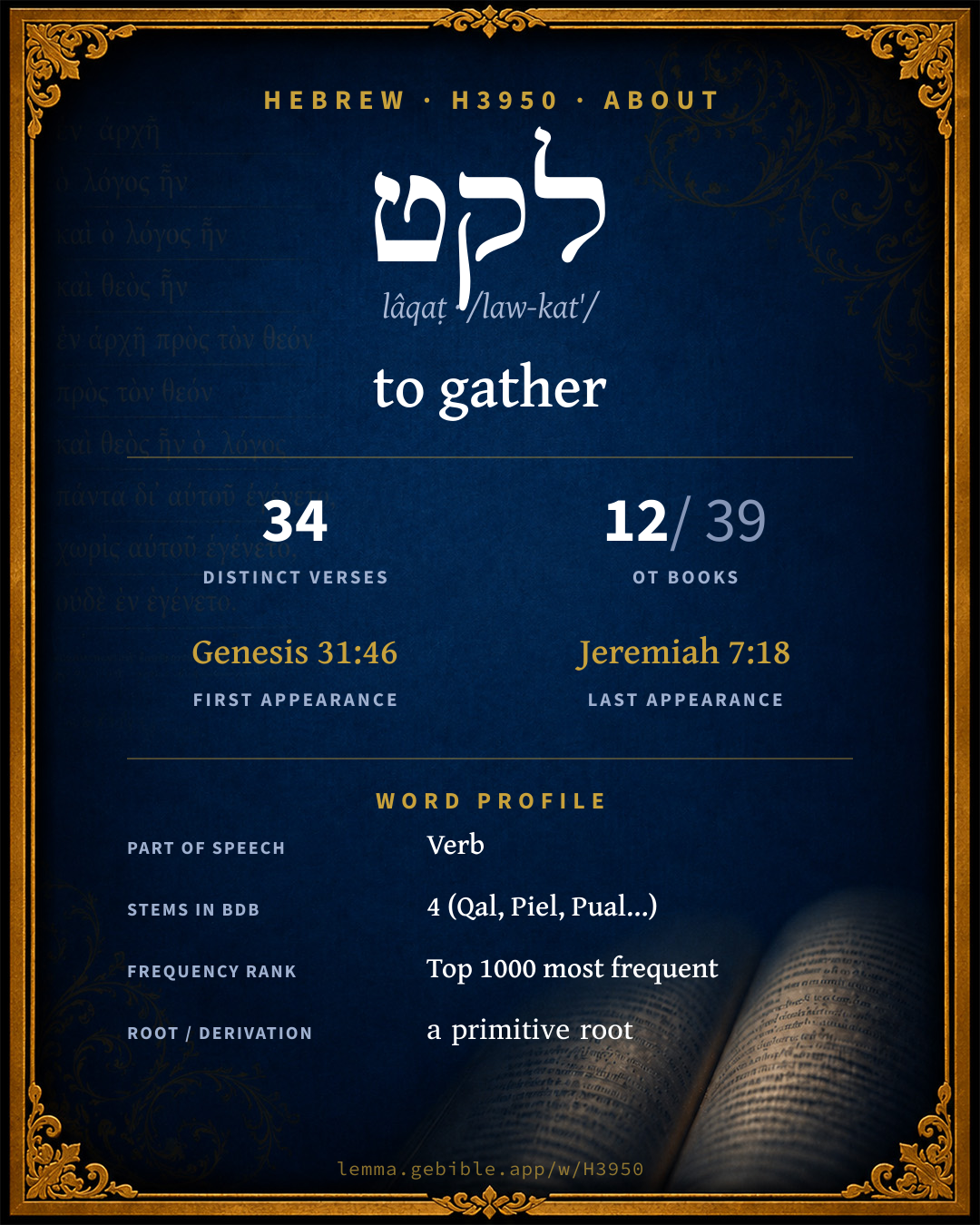
לָקַט
to gather
‘to gather’ is one of 3 main senses fuller range ↓
Full lexicon entry — Brown-Driver-Briggs (BDB)
From Brown-Driver-Briggs (BDB)
Where this word appears
See every Piel verb in the Hebrew Bible →
Grammar key — what these labels mean
Part of speech
- Verb
- An action or state-of-being word.
Stem
- Piel
- An intensive or resultative active stem. Here: ‘gather’
- Qal
- The basic, simple active stem — the plain form of the verb (“he wrote”). Here: ‘pick up’
- Hithpael
- The reflexive or reciprocal stem (the subject acts on itself).
- Pual
- The passive counterpart of the Piel.
Form
- Sequential Imperfect
- An imperfect with prefixed waw — the standard past-narrative form (waw-consecutive imperfect).
- Infinitive Construct
- A bound verbal noun, frequently with prepositions (“to write / in writing”).
- Imperfect
- An incomplete, ongoing, or future action (“he will / would write”).
- Sequential Perfect
- A perfect with prefixed waw continuing a preceding imperfect or command (waw-consecutive perfect).
- Perfect
- A completed action or state — Hebrew marks aspect (completeness) more than strict tense (“he wrote”).
- Participle Active
- A verbal adjective expressing ongoing or characteristic action (“writing / one who writes”).
- Imperative
- A direct command (“write!”).
- Cohortative
- A first-person volitional form expressing wish or resolve (“let me / let us write”).
State
- Absolute
- The independent form of a noun, not bound to a following word.
Person
- 3rd Person
- The one spoken about (“he / she / it / they”).
- 2nd Person
- The one addressed (“you”).
- 1st Person
- The speaker (“I / we”).
Gender
- Masculine
- Grammatically masculine.
- Feminine
- Grammatically feminine.
- Common
- Either gender — not distinguished for this form.
Number
- Singular
- One.
- Plural
- More than one (in Hebrew, generally three or more).
Every verse where H3950 appears in the Book of Genesis — 2 distinct verses. Click any verse to open its interlinear word-by-word view. Verse text shown in the World English Bible for context — . Each verse’s Hebrew form is shown with its reference; the English is not keyword-highlighted, since the data carries no word-level English alignment. Use “Compare translations” on any verse to read it across multiple English versions. This concordance covers the Hebrew Bible; Septuagint (Greek Old Testament) occurrences are not indexed here.
Genesis
- Genesis 31:46 לִקְט֣וּ Qal impv 2mp Jacob said to his relatives, "Gather stones." They took stones, and made a heap. They ate there by the heap.
- Genesis 47:14 וַ/יְלַקֵּ֣ט conj + Piel wimpf 3ms Joseph gathered up all the money that was found in the land of Egypt, and in the land of Canaan, for the grain which they bought: and Joseph brought the money into Pharaoh's house.
About this entry
At a glance — auto-summarized from this page’s data, not written by a person. Every figure links to its source below. This summary describes the numbers; it doesn’t interpret them.
לקט — transliterated lâqaṭ — is a Hebrew verb carrying the sense “to gather.” Its English rendering has broadened — “gather” classically, “glean” (unfoldingWord Literal Text) in modern versions; see the renderings breakdown. The Hebrew Bible uses it across 34 verses — moderately common. More than a quarter of its appearances fall in Ruth. Across 4 stems, its meaning turns on the binyan (Qal, Piel). Each statement above links to its evidence; the full detail follows below.
Gloss history
Strong's 1890 vs modern scholarship
About this word
Strong's H3950 catalogs a Hebrew word from the Hebrew Old Testament.
These counts are not copied from any lexicon or concordance. They are computed here, from the morphology-tagged Hebrew Old Testament. What Lemma adds →
- 34
- distinct verses
- The word appears in 34 distinct verses.
- 12 / 39
- OT books
- The word appears in 12 of 39 Old Testament books.
- #967
- by frequency
- Top 1000 most frequent Hebrew words (rank 967 of 8,640 Hebrew words by occurrence).
View all 34 occurrences in the concordance →
By section of the Old Testament
By traditional corpus
Conventional, traditional groupings — biblical authorship is debated, so this is a traditional corpus grouping, not an authorship claim. Each share is this word’s portion of its verses in that division of the Hebrew canon. Each figure is a share of the word’s 34 distinct verses.
- Torah (Pentateuch) 15 verses · 44%
- Writings (Ketuvim) 12 verses · 35%
- Prophets (Nevi'im) 7 verses · 21%
How translations render this word
Counts come from each version’s own published word-to-Strong’s tagging or interlinear alignment — an approximate guide to how each version renders this word, not a word-level alignment the data otherwise carries. Because each total is that version’s own tagged count, the per-version totals vary from one another and need not match the appearance or distinct-verse counts above. These counts may also differ from a printed concordance because Lemma counts each distinctly tagged rendering and does not collapse phrase taggings into a single head-word total. This is a fixed set of word-tagged versions (KJV, ASV, BSB, ULT) and does not change with the reading translation you choose elsewhere. Each version’s license is shown beside its name below (and on Sources).
- King James Version: Gather 7×, Gathered 4×, Glean 4×
- American Standard Version: Gather 7×, Glean 4×, Gathered 3×
- Berean Standard Bible: Gather 7×, Glean 4×, Or gather 3×
- unfoldingWord Literal Text: Glean 9×, Gather 5×, They gathered 4×
King James Version Public Domain
Renders H3950 across 37 tagged occurrences — most commonly:
Plus 12 renderings that appear only once — usually multi-word phrases or single function words the recovered tagging swept in, not distinct renderings.
American Standard Version Public Domain
Renders H3950 across 37 tagged occurrences — most commonly:
Plus 13 renderings that appear only once — usually multi-word phrases or single function words the recovered tagging swept in, not distinct renderings.
Berean Standard Bible Public Domain
Renders H3950 across 37 tagged occurrences — most commonly:
Plus 19 renderings that appear only once — usually multi-word phrases or single function words the recovered tagging swept in, not distinct renderings.
unfoldingWord Literal Text CC BY-SA 4.0
Renders H3950 across 44 tagged occurrences — most commonly:
Plus 16 renderings that appear only once — usually multi-word phrases or single function words the recovered tagging swept in, not distinct renderings.
7 senses and sub-senses in the full BDB
Hebrew verbs can shift meaning by stem (binyan): Qal is the basic action, Niphal is often passive or reflexive, Piel often intensifies or makes it factitive, and Hiphil is typically causative. The senses below are grouped under the stem BDB assigns to each. This entry also uses Pual (the passive of Piel) and Hithpael (reflexive or reciprocal).
What do BDB’s symbols mean?
BDB uses these scholarly abbreviations:
| Symbol | Meaning |
|---|---|
| 𝔊 | the Septuagint (the ancient Greek translation, LXX) |
| 𝔙 | the Vulgate (the Latin translation) |
| 𝔖 | the Syriac version (the Peshitta) |
| 𝔗 | the Targum (the Aramaic translation) |
| ψ | the Psalms |
| √ | root (the underlying root or stem) |
| ‖ | parallel passage (a synonymous or contrasted parallel) |
| † | the dagger: every passage where the word occurs is cited |
The 7 senses and sub-senses the full Brown-Driver-Briggs lexicon distinguishes for this word, in lexicon order (not ranked by frequency), with BDB’s own verbatim wording and sub-sense lettering. Shown in Hebrew script with BDB’s own scholarly abbreviations. The condensed entry is in the Lexicon Entry tab. See also the Forms in the corpus table below.
Qal
- 1. pick up, gather
- 2. specif. glean
Piel
- 1. gather, gather up
- 2. fig. collect (money)
- 3. specif. glean
Pual
- . ye shall be picked up
Hithpael
- . and there collected themselves worthless men unto Jephthah
Senses from the full Brown-Driver-Briggs lexicon (Brown, Driver, Briggs; Oxford 1906 — public domain), digitized via Sefaria, supplemented by the OpenScriptures HebrewLexicon (CC BY 4.0). Full attribution on Sources.
Word origin
[ לָקַט ] vb. pick or gather up, specif. glean
— Brown-Driver-Briggs (Oxford 1906, public domain), digitized via Sefaria, supplemented by the OpenScriptures HebrewLexicon (CC BY 4.0). See Sources.
Origin: a primitive root
Jastrow Dictionary
A second Hebrew/Aramaic lexicon for comparison, covering Aramaic and post-biblical (Talmudic, Targumic, Midrashic) usage that the biblical-Hebrew BDB does not. Matched by lemma rather than by Strong’s number, so a lemma may carry more than one Jastrow headword (shown separately below), and the entries cover usage well beyond the Bible.
לָקַט
- (b. h.) [to seize,]
- 1. to gather, glean; to pick, v. Pi.—Part. לוֹקֵט gleaner, huckster, v. לָקוֹט.
- 2. (in sewing) to gather, pucker. M. Kat. 26ᵃ bot. ללוֹקְטָן ולעשותן כמין סולמות to mend (the rents for the dead) by gathering or making a sort of stairs (chain-stitches), v. סוּלָּם.
- same,
- 1. to pick, harvest; to pick up, collect. Tosef. Shebi. IV, 21 לי׳ אתרוג באחד וכ׳ he harvested Ethrogs on the first of Sh’bat; R. Hash. 14ᵃ; Erub. 7ᵃ; Yeb. 15ᵃ. Tosef. R. Hash. I, 9 לי׳ ירק if one picked vegetables; a. v. fr.—Maas. Sh. II, 5 מה שלי׳ לי׳ וכ׳ Y. ed. (Mish. a. Bab. ed. מה שלקט לקט) what coins he picked up singly belong to the second-tithe fund. Y. ib. 53ᶜ והוא שלי׳ מיכן ומיכן אבל לי׳ על אומד וכ׳ (not אומן) provided he picked up here and there (deliberately selecting), but if he did so at random &c. Bekh. 7ᵇ כל המטיל בצים מְלַקֵּט וכ׳ every animal that lays eggs supports its brood by picking up food for it, except the bat … which gives suck.—M. Kat. I, 5 מלקט אדם וכ׳ one may (during the festive week) collect for final burial the bones of &c., v. לִיקּוּט. Snh. VI, 6 מְלַקְּטִין את העצמות וכ׳ the bones (of the convict) may be collected and buried in their family tomb; a. fr.—Esp. to glean, to take the poor man’s share in the crop. Peah IV, 9 מי שלקט וכ׳ (Y. ed. שלי׳) if one gleaned the corner of the field and said, this is to belong to &c.; Gitt. 11ᵇ; B. Mets. 9ᵇ.—Peah V, 6 לִלְקוֹט (Y. ed. ללַקֵּט). Y. ib. IV, 18ᵇ ילכו וִילַקְּטוּ וכ׳ let them have an opportunity to go and glean in another field &c., v. כִּילּוּי, a. v. fr.—[Peah IV, 5, v. Hif.].—[Sot. 11ᵇ ומלקט להן וכ׳, v. נָקַט.]
- 2. to pluck (hair) out singly. Naz. 40ᵇ לִיקְּטוֹ במלקט if he plucked it singly with pinchers; Macc. III, 5 לְקָטוֹ. Ib. 20ᵇ במְלַקֵּט לבנות וכ׳ when one plucks out the white hair among the black; Sabb. 94ᵇ; a. e.—[Naz. l. c. עד שילקטנו בתער, read שיטלנו as Macc. III, 5.]
- 1. to be collected, harvested. Tosef. Shebi. IV, 21 שגדל בחובה ונ׳ בחובה what has been growing under obligation (as eventually subject to tithes) and been harvested under obligation; שגדל בשביעית ונ׳ בשביעית what has been growing in the Sabbatical year and collected in &c.; R. Hash. 15ᵃ; a. e.
- 2. to be made smooth by plucking. Sabb. 97ᵃ, v. מַלְקֵט.
- to be gleaned. Peah V, 1 גדיש שלא ל׳ תחתיו a stack of grain under which the gleaning for the poor has been left.
- 1. to cause picking, to strew feed for birds. Tosef. Sabb. XVIII, 4 מַלְקִיטִין, contrad. to מהלקטין (v. הִילְקט); Sabb. 155ᵇ
- 2. to arrange the gleaning by the poor. Peah IV, 5 (3) היו מַלְקִיטִין על החבל Y. ed. (Bab. ed. a. Mish. מלקטין) arranged the gleaning by the line, leaving a corner at the end of each furrow.
- to be collected; to require collection. Maas. Sh. II, 5 המִתְלַקְּטִים those coins which have been picked up singly, opp. הנבללין.—Ḥull. 46ᵃ מִתְלַקֵּט מהו if the required size of sound flesh can be obtained only by collecting (it not being in one place), how is it?—Ib. 77ᵃ מתל׳ מהו how is it, if the quantity of flesh required to cover the broken bone is scattered?
לְקַט
- , ch. same, to pick up; to gather. Targ. Gen. XXXI, 46. Ib. XLVII, 14 (ed. Berl. לַקֵּיט). Targ. Ex. XVI, 26; a. e.—Part. לָקֵיט, לָקֵט. Targ. O. Deut. XXIX, 10 לָקֵיט ed. Berl. (ed. Amst. לַקֵּט, corr. acc.; h. text חטב); Targ. Josh. IX, 21 לַקְטֵי Bxt. (ed. מְלַקְּטֵי).—Sabb. 156ᵃ דלא לָקֵיט בלישניה (a calf) that does not take up with its tongue (the fodder placed before it), v. infra; a. e.
- same. Targ. Gen. XLVII, 14, v. supra. Targ. Lev. XIX, 9 (Y. II Pe.); a. fr.—Targ. II Esth. III, 8 ומְלַקְּטִין (not ומְלָקְטִין), v. חַצְבָּא.—Lev. R. s. 6 שרי ההוא מְלַקֵּט א"ל לַקֵּט לַקֵּט … את מלקט he began to pick up (the scattered Denars); said he to him, pick up, pick up, for it is thine own thou art picking up.—Y. Sabb. VII, 10ᵃ bot. ומְלַקְּטָן (not וולקטה) and gathers them (the sun-dried fruits in cakes or strings; v. Maim. Sabb. VIII, 6); a. e.
- to cause to take up, to put the mouth to. Sabb. 156ᵃ מַלְקִיטִין יתיה Ms. O. (Ms. M. מַלְקְטִין ליה, ed. מהלקיטין, v. Rabb. D. S. a. l. note) we may make it take up (taste the fodder).
לֶקֶט
- preced. wds.)
- 1. gleanings; the poor man’s share in the crop (Lev. XIX, 9). Peah IV, 3. Ib. 10 איזהו ל׳ הנושר וכ׳ what is called leḳet (the poor man’s share)? That which drops &c. Ib. 11 ספק ל׳ ל׳ where there is a doubt about leḳet, it is leḳet, i.e. the poor man has the benefit of the doubt. Ib. V, 1 אומדין אותה כמה ל׳ וכ׳ we calculate how much it would ordinarily give out for the poor man. Y. ib. V, beg. 18ᵈ שגדש ע"ג לִיקְטָן של וכ׳ for he piled up the stack over the poor man’s share; a. fr. e.g. Leviticus 19:9
- 2. pucker, seam. M. Kat. 26ᵇ הקורע … מתוך הל׳ he who rends his garment … in a place which has been mended by a pucker (after having been rent for a death).
לֶקֶט ²
- 1. same, gleanings, poor man’s share. Targ. Lev. XIX, 9.
- 2. the accumulated food in a bird’s crop. Targ. Y. I Lev. I, 16.
A Dictionary of the Targumim, the Talmud Babli and Yerushalmi, and the Midrashic Literature (Marcus Jastrow; London, Luzac, 1903) — Public Domain. Digitized via Sefaria. Digitized via Sefaria. Full attribution on Sources.
Forms in the corpus
The 35 distinct written forms H3950 takes in the Hebrew Bible, most frequent first — each parse links to that stem’s occurrences in the concordance. Hebrew forms include their vowel points and cantillation, so a single lemma takes many written forms.
Same root — word family
Other BDB entries built from the same root as H3950, grouped by Strong’s listed origin. These share a root / origin per the lexicon — not necessarily a shared meaning. Each links to that word’s own entry.
Derived from this word
Compare all same-root words → They share a root, not necessarily a meaning.
Septuagint verse parallels
This word appears in 34 verses that also exist in the Greek Old Testament (Septuagint), out of the 34 Hebrew verses it occurs in. You can read those verses in Greek by switching the Old Testament edition to the Septuagint.
Read these verses in the Septuagint
- Genesis 31:46
- Exodus 16:4
- Leviticus 19:9
- Numbers 11:8
- Judges 1:7
- Ruth 2:2
- 1 Samuel 20:38
- 2 Kings 4:39
- Psalms 104:28
- Song of Solomon 6:2
- Isaiah 17:5
- Jeremiah 7:18
This is a verse-level parallel only — the same verses exist in both the Hebrew and Greek Old Testaments. No word-level Hebrew↔Greek correspondence is claimed: the data carries no such alignment, so no Greek word is shown as this Hebrew word’s translation. Coverage is not total — the Septuagint omits the deuterocanon and renumbers the Psalms, so some Hebrew verses have no direct Greek parallel.