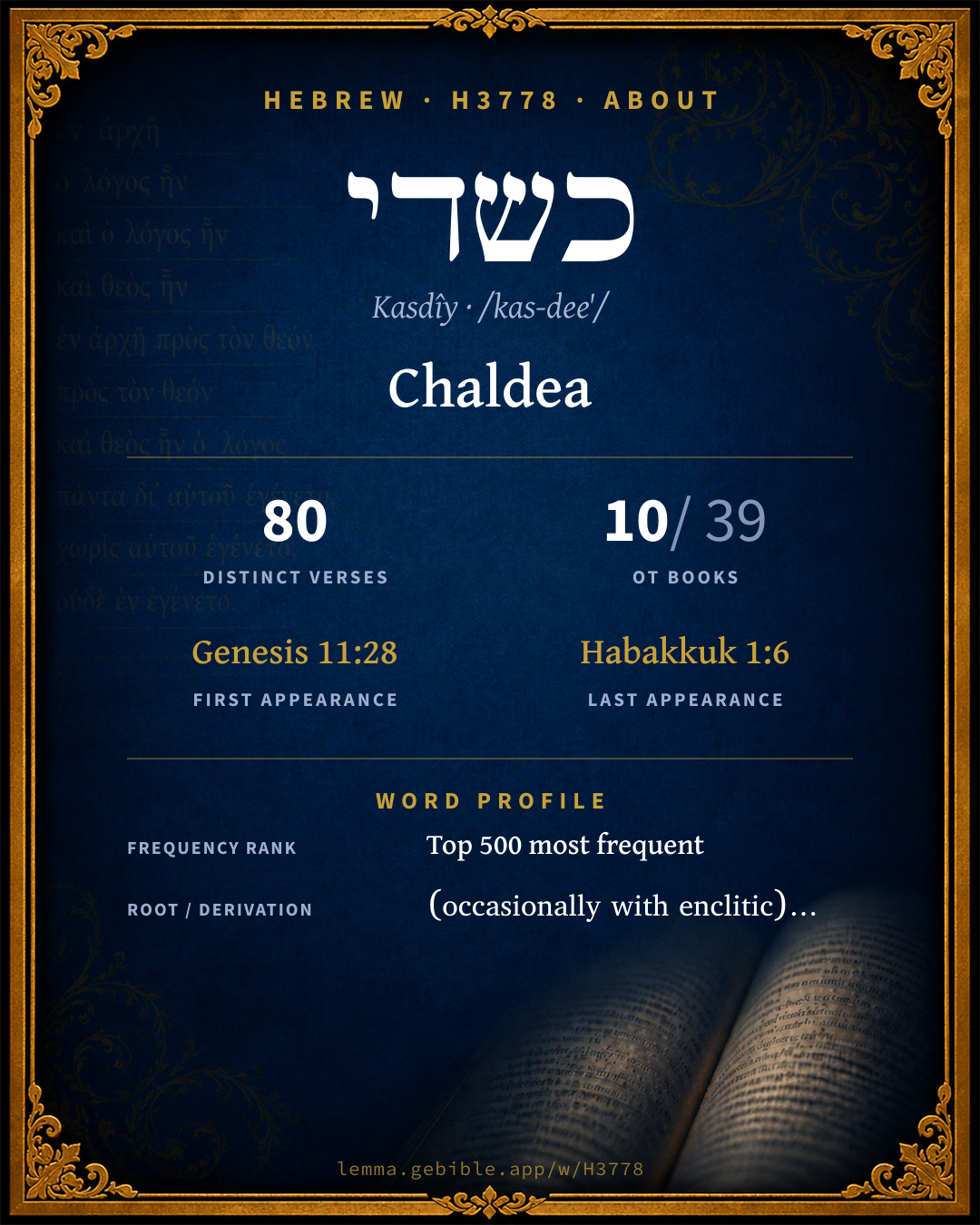
כַּשְׂדִּים
Chaldea
BDB lists 4 entries for ‘Chaldea’ fuller range ↓
Full lexicon entry — Brown-Driver-Briggs (BDB)
From Brown-Driver-Briggs (BDB)
Where this word appears
Grammar key — what these labels mean
Part of speech
- Noun
- A naming word — a person, place, thing, or idea.
Noun type
- Proper
- A name of a specific person, place, or people (e.g. Abraham, Zion, Israel).
- Gentilic
- A noun naming a member of a people, tribe, or region of origin (e.g. an Israelite, a Moabite).
State
- Absolute
- The independent form of a noun, not bound to a following word.
Gender
- Masculine
- Grammatically masculine.
Number
- Plural
- More than one (in Hebrew, generally three or more).
Every verse where H3778 appears in the Book of 2 Chronicles — 1 distinct verse. Click any verse to open its interlinear word-by-word view. Verse text shown in the World English Bible for context — . Each verse’s Hebrew form is shown with its reference; the English is not keyword-highlighted, since the data carries no word-level English alignment. Use “Compare translations” on any verse to read it across multiple English versions. This concordance covers the Hebrew Bible; Septuagint (Greek Old Testament) occurrences are not indexed here.
2 Chronicles
About this entry
At a glance — auto-summarized from this page’s data, not written by a person. Every figure links to its source below. This summary describes the numbers; it doesn’t interpret them.
כשדי (Kasdîy) is a Hebrew name most often rendered “Chaldea.” Jeremiah dominates its distribution — 46 of 80 verses. Spanning 80 verses in 10 books, it ranks among the moderately common words of the Hebrew Bible. Its earliest occurrence is Genesis 11:28. Dig into 80-verse concordance and the renderings breakdown below.
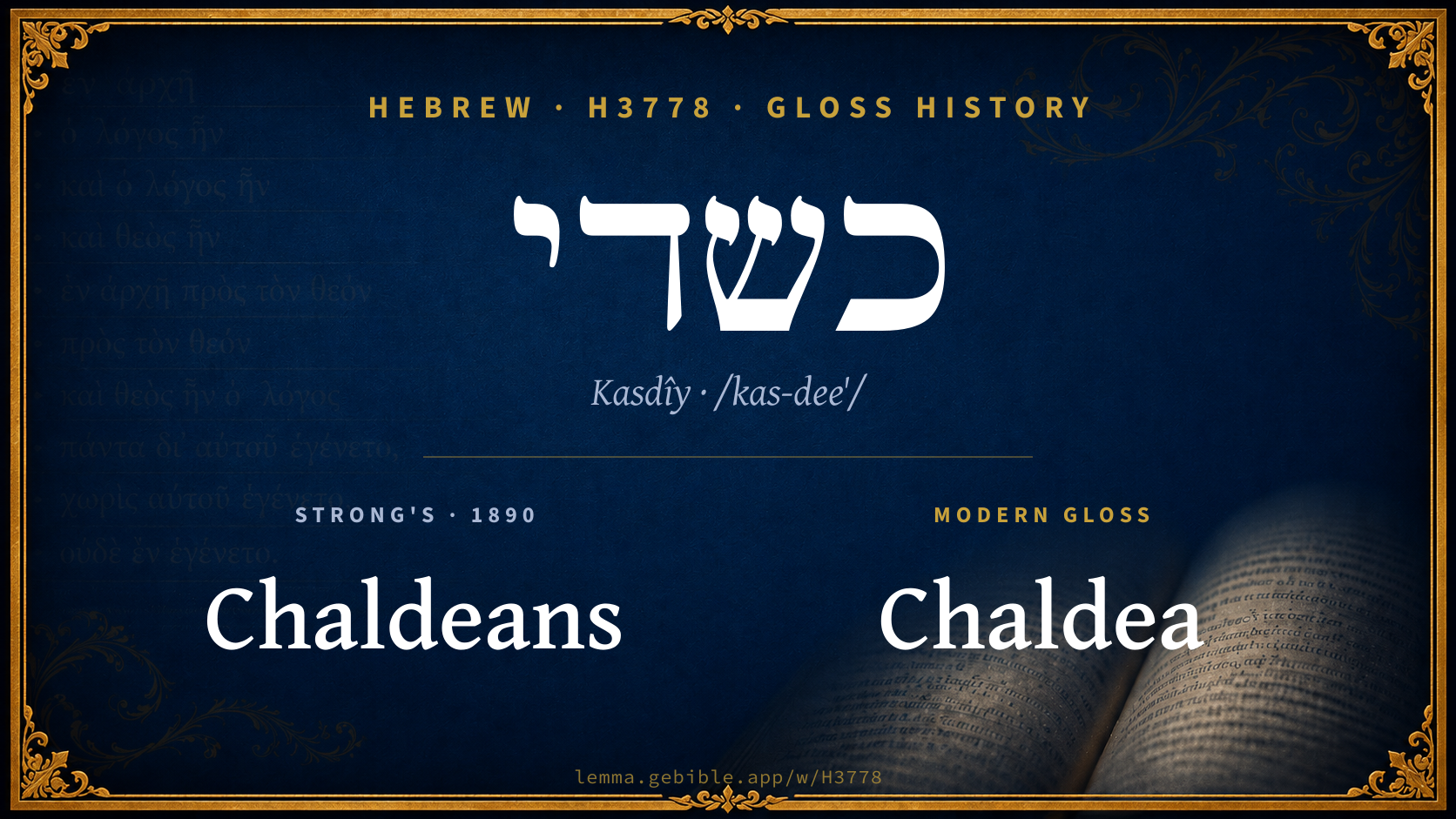
Gloss history
Strong's 1890 vs modern scholarship
About this word
Strong's H3778 catalogs a Hebrew word from the Hebrew Old Testament.
These counts are not copied from any lexicon or concordance. They are computed here, from the morphology-tagged Hebrew Old Testament. What Lemma adds →
- 80
- distinct verses
- The word appears in 80 distinct verses.
- 10 / 39
- OT books
- The word appears in 10 of 39 Old Testament books.
- #487
- by frequency
- Top 500 most frequent Hebrew words (rank 487 of 8,640 Hebrew words by occurrence).
View all 80 occurrences in the concordance →
By section of the Old Testament
By traditional corpus
Conventional, traditional groupings — biblical authorship is debated, so this is a traditional corpus grouping, not an authorship claim. Each share is this word’s portion of its verses in that division of the Hebrew canon. Each figure is a share of the word’s 80 distinct verses.
- Prophets (Nevi'im) 70 verses · 88%
- Writings (Ketuvim) 7 verses · 9%
- Torah (Pentateuch) 3 verses · 4%
How translations render this word
Counts come from each version’s own published word-to-Strong’s tagging or interlinear alignment — an approximate guide to how each version renders this word, not a word-level alignment the data otherwise carries. Because each total is that version’s own tagged count, the per-version totals vary from one another and need not match the appearance or distinct-verse counts above. These counts may also differ from a printed concordance because Lemma counts each distinctly tagged rendering and does not collapse phrase taggings into a single head-word total. This is a fixed set of word-tagged versions (KJV, ASV, BSB, ULT) and does not change with the reading translation you choose elsewhere. Each version’s license is shown beside its name below (and on Sources).
- King James Version: Chaldeans 52×, Chaldees 11×, Chaldea 7×
- American Standard Version: Chaldeans 52×, Chaldea 7×, Chaldees 4×
- Berean Standard Bible: Chaldeans 67×, Chaldea 7×, Astrologers 2×
- unfoldingWord Literal Text: Chaldeans 30×, Chaldea 3×, Against the chaldeans 2×
King James Version Public Domain
Renders H3778 across 80 tagged occurrences — most commonly:
Plus 10 renderings that appear only once — usually multi-word phrases or single function words the recovered tagging swept in, not distinct renderings.
American Standard Version Public Domain
Renders H3778 across 80 tagged occurrences — most commonly:
Plus 13 renderings that appear only once — usually multi-word phrases or single function words the recovered tagging swept in, not distinct renderings.
Berean Standard Bible Public Domain
Renders H3778 across 80 tagged occurrences — most commonly:
Plus 2 renderings that appear only once — usually multi-word phrases or single function words the recovered tagging swept in, not distinct renderings.
unfoldingWord Literal Text CC BY-SA 4.0
Renders H3778 across 39 tagged occurrences — most commonly:
Plus 4 renderings that appear only once — usually multi-word phrases or single function words the recovered tagging swept in, not distinct renderings.
Senses in the full BDB
What do BDB’s symbols mean?
BDB uses these scholarly abbreviations:
| Symbol | Meaning |
|---|---|
| 𝔊 | the Septuagint (the ancient Greek translation, LXX) |
| 𝔙 | the Vulgate (the Latin translation) |
| 𝔖 | the Syriac version (the Peshitta) |
| 𝔗 | the Targum (the Aramaic translation) |
| ψ | the Psalms |
| √ | root (the underlying root or stem) |
| ‖ | parallel passage (a synonymous or contrasted parallel) |
| † | the dagger: every passage where the word occurs is cited |
The 5 senses and sub-senses the full Brown-Driver-Briggs lexicon distinguishes for this word, in lexicon order (not ranked by frequency), with BDB’s own verbatim wording and sub-sense lettering. Shown in Hebrew script with BDB’s own scholarly abbreviations. The condensed entry is in the Lexicon Entry tab. See also the Forms in the corpus table below.
- 1. Chaldeans:
- a. people dwelling on lower Euphrates and Tigris; in n.pr.loc. אוּר כ׳ Gn 11:28 (J), v 31 (P), 15:7 (J), Ne 9:7. e.g. Genesis 11:28
- b. especially the people ruled by Nebuchadrezzar;—כ׳ Je 37:10; 39:5; Ez 23:23; 2 K 24:2; 25:4, 5, 10, 13 = Je 52:7, 8, 14, 17 (2 K 24:5, 10 = also Je 39:5, 8), 2 K 25:26; Is 13:19; 43:14; 48:14, 20; Jb 1:17; Kt כַּשְׁדִּיִּים Ez 23:14; 2 Ch 36:17; הַכּ׳ Je 21:4, 9; 22:25; 32:4, 5, 24, 25, 28, 29, 43; 33:5; 35:11; 37:5, 8, 9, 11, 13, 14; 38:2, 18, 19, 23; 39:8; 40:9, 10; 41:3, 18; 43:3; 50:35 Hb 1:6; 2 K 25:24, 25; בַּת־כ׳ Is 47:1, 5 = Babylon (in dirge); אֶרֶץ כ׳ ἡ γῆ Χαλδαίων (on locality v. Schr Dl l.c.) Je 24:5; 25:12; 50:1, 8, 25, 45; 51:4, 54; Ez 1:3; 12:3, also Is 23:13 (inauthentic, Di Che; read כְּנַעֲנִים Ew Schr, or כִּתִּים Du); סֵפֶר וּלְשׁוֹן כ׳ Dn 1:4; מַלְכוּת כ׳ 9:1. e.g. Jeremiah 37:10
- c. Chaldeans as learned class, skilled in interpretations Dn 2:2 (+ חַרְטֻמִּים, אַשָּׁפִים, מְכַשְּׁפִים), v 4. e.g. Daniel 2:2
- 2. Chaldea, וְהָֽיְתָה כַּשְׂדִּים לְשָׁלָל Je 50:10 and Chaldea shall be despoiled; יוֹשְׁבֵי כ׳ 51:24, 35; כַּשְׂדִּים אֶרֶץ מוֹלַדְתָּם Ez 23:15; c. ה loc.; כַּשְׂדִּ֫ימָה Ez 11:24; 16:29; 23:16. e.g. Jeremiah 50:10
Senses from the full Brown-Driver-Briggs lexicon (Brown, Driver, Briggs; Oxford 1906 — public domain), digitized via Sefaria, supplemented by the OpenScriptures HebrewLexicon (CC BY 4.0). Full attribution on Sources.
Word origin
n.pr.gent. et terr. Kasdim = Chaldeans, Chaldea, 𝔊 Χαλδαῖοι and (Je 50:10) ἡ Χαλδαία (Assyrian (mat) Kaldu, Kaldû; from earlier (Bab.) form [Kašdu]—š before dental becoming l, DlPar 128 f. 200 f.; Assyrian Gr. § 51, 3; Schr KGF 94 ff.; COT on Gn 11:28);—
— Brown-Driver-Briggs (Oxford 1906, public domain), digitized via Sefaria, supplemented by the OpenScriptures HebrewLexicon (CC BY 4.0). See Sources.
Origin: (occasionally with enclitic) Kasdiymah kas-dee'- maw
Jastrow Dictionary
A second Hebrew/Aramaic lexicon for comparison, covering Aramaic and post-biblical (Talmudic, Targumic, Midrashic) usage that the biblical-Hebrew BDB does not. Matched by lemma rather than by Strong’s number, so a lemma may carry more than one Jastrow headword (shown separately below), and the entries cover usage well beyond the Bible.
כַּשְׂדִּי
- , pl.) Chaldean. Meg. 12ᵇ כלי … כשדיי the vessel which I use (my wife) is neither …, but a Chaldean.—Pl. כַּשְׂדִּים, כַּשְׂדִּיִּים. Succ. 52ᵇ. Pesik. R. s. 37 כשנפרע מן הכ׳ when the Lord punished the Chaldeans (Babylonia, v. Midr. Till. to Ps. XCIII, 1).—B. Bath. 15ᵇ. Lam. R. to I, 14 כ׳ קשה the Chaldean government was tyrannical (contrad. to בבל); a. e.—Fem. כַּשְׂדִּית, pl. כַּשְׂדִּיּוֹת. Snh. 92ᵇ
A Dictionary of the Targumim, the Talmud Babli and Yerushalmi, and the Midrashic Literature (Marcus Jastrow; London, Luzac, 1903) — Public Domain. Digitized via Sefaria. Digitized via Sefaria. Full attribution on Sources.
Forms in the corpus
The 30 distinct written forms H3778 takes in the Hebrew Bible, most frequent first — each parse links to that state’s occurrences in the concordance. Hebrew forms include their vowel points and cantillation, so a single lemma takes many written forms.
| Form | Parsing | Example | Uses |
|---|---|---|---|
| הַ/כַּשְׂדִּ֔ים | Noun, Proper | Habakkuk 1:6 | 13 |
| כַּשְׂדִּ֑ים | Noun, Proper | Isaiah 13:19 | 8 |
| כַּשְׂדִּֽים | Noun, Proper | Daniel 1:4 | 6 |
| כַּשְׂדִּ֔ים | Noun, Proper | Ezekiel 12:13 | 5 |
| כַּשְׂדִּ֗ים | Noun, Proper | Ezekiel 23:23 | 4 |
| הַ/כַּשְׂדִּ֑ים | Noun, Proper | 2 Kings 25:24 | 4 |
| הַ/כַּשְׂדִּ֖ים | Noun, Proper | Jeremiah 32:5 | 4 |
| כַּשְׂדִּ֖ים | Noun, Proper | Ezekiel 1:3 | 4 |
| הַ/כַּשְׂדִּֽים | Noun, Proper | Jeremiah 22:25 | 3 |
| הַ/כַּשְׂדִּים֙ | Noun, Proper | Jeremiah 32:24 | 3 |
| כַּשְׂדִּים֙ | Noun, Proper | 2 Kings 25:5 | 3 |
| כַשְׂדִּ֔ים | Noun, Gentilic, Masculine, Plural, Absolute | Ezekiel 23:14 | 2 |
| הַ/כַּשְׂדִּ֗ים | Noun, Proper | Jeremiah 32:28 | 2 |
| הַ/כַּשְׂדִּ֜ים | Noun, Proper | Jeremiah 21:9 | 2 |
| וְ/כַשְׂדִּ֥ים | Noun, Proper | 2 Kings 25:4 | 2 |
| כַשְׂדִּ֑ים | Noun, Proper | 2 Kings 25:13 | 2 |
| כשדיים | Noun, Gentilic, Masculine, Plural, Absolute | Ezekiel 23:14 | 2 |
| הַ/כַּשְׂדִּ֛ים | Noun, Gentilic, Masculine, Plural, Absolute | Daniel 2:4 | 1 |
| וְ/כַשְׂדִּ֖ים | Noun, Proper | Isaiah 43:14 | 1 |
| וְ/לַ/כַּשְׂדִּ֔ים | Noun, Gentilic, Masculine, Plural, Absolute | Daniel 2:2 | 1 |
| כַשְׂדִּ֖ים | Noun, Proper | Jeremiah 50:10 | 1 |
| כַשְׂדִּ֗ים | Noun, Proper | Jeremiah 51:24 | 1 |
| כַשְׂדִּ֨ימָ/ה֙ | Noun, Proper | Ezekiel 11:24 | 1 |
| כַשְׂדִּֽים | Noun, Proper | 2 Kings 25:26 | 1 |
| כַשְׂדִּים֩ | Noun, Proper | 2 Kings 24:2 | 1 |
| כַּשְׂדִּ֑ימָ/ה | Noun, Proper | Ezekiel 16:29 | 1 |
| כַּשְׂדִּ֜ים | Noun, Proper | Jeremiah 39:5 | 1 |
| כַּשְׂדִּ֞ים | Noun, Proper | Job 1:17 | 1 |
| כַּשְׂדִּֽימָ/ה | Noun, Proper | Ezekiel 23:16 | 1 |
| מִ/כַּשְׂדִּים֒ | Noun, Proper | Isaiah 48:20 | 1 |
Same root — word family
Other BDB entries built from the same root as H3778, grouped by Strong’s listed origin. These share a root / origin per the lexicon — not necessarily a shared meaning. Each links to that word’s own entry.
Proper names from this root
People and places named from this root — a name, not an additional meaning of the word.
Compare all same-root words → 2 of the same-root words are proper names (people or places). They share a root, not necessarily a meaning.
Bible dictionary
Public-domain dictionary articles matched to this entry by name (Chaldea). A biblical name can be shared by more than one person or place, so an article may treat several.
Easton's Bible Dictionary · M. G. Easton, 1897
The southern portion of Babylonia, Lower Mesopotamia, lying chiefly on the right bank of the Euphrates, but commonly used of the whole of the Mesopotamian plain. The Hebrew name is Kasdim, which is usually rendered "Chaldeans" (Jer. 50:10; 51:24, 35).
The country so named is a vast plain formed by the deposits of the Euphrates and the Tigris, extending to about 400 miles along the course of these rivers, and about 100 miles in average breadth. "In former days the vast plains of Babylon were nourished by a complicated system of canals and water-courses, which spread over the surface of the country like a network. The wants of a teeming population were supplied by a rich soil, not less bountiful than that on the banks of the Egyptian Nile. Like islands rising from a golden sea of waving corn stood frequent groves of palm-trees and pleasant gardens, affording to the idler or traveller their grateful and highly-valued shade. Crowds of passengers hurried along the dusty roads to and from the busy city. The land was rich in corn and wine."
Recent discoveries, more especially in Babylonia, have thrown much light on the history of the Hebrew patriarchs, and have illustrated or confirmed the Biblical narrative in many points. The ancestor of the Hebrew people, Abram, was, we are told, born at "Ur of the Chaldees." "Chaldees" is a mistranslation of the Hebrew Kasdim, Kasdim being the Old Testament name of the Babylonians, while the Chaldees were a tribe who lived on the shores of the Persian Gulf, and did not become a part of the Babylonian population till the time of Hezekiah. Ur was one of the oldest and most famous of the Babylonian cities. Its site is now called Mugheir, or Mugayyar, on the western bank of the Euphrates, in Southern Babylonia. About a century before the birth of Abram it was ruled by a powerful dynasty of kings. Their conquests extended to Elam on the one side, and to the Lebanon on the other. They were followed by a dynasty of princes whose capital was Babylon, and who seem to have been of South Arabian origin. The founder of the dynasty was Sumu-abi ("Shem is my father"). But soon afterwards Babylonia fell under Elamite dominion. The kings of Babylon were compelled to acknowledge the supremacy of Elam, and a rival kingdom to that of Babylon, and governed by Elamites, sprang up at Larsa, not far from Ur, but on the opposite bank of the river. In the time of Abram the king of Larsa was Eri-Aku, the son of an Elamite prince, and Eri-Aku, as has long been recognized, is the Biblical "Arioch king of Ellasar" (Gen. 14:1). The contemporaneous king of Babylon in the north, in the country termed Shinar in Scripture, was Khammu-rabi. (See BABYLON; ABRAHAM; AMRAPHEL.)
Smith's Bible Dictionary · William Smith, 1863
more correctly Chaldae'a, the ancient name of a country of Asia bordering on the Persian Gulf. Chaldea proper was the southern part of Babylonia, and is used in Scripture to signify that vast alluvial plain which has been formed by the deposits of the Euphrates and the Tigris. This extraordinary flat, unbroken except by the works of man, extends a distance of 400 miles along the course of the rivers, and is on an average about 100 miles in width. In addition to natural advantages these plains were nourished by a complicated system of canals, and vegetation flourished bountifully. It is said to be the only country in the world where wheat grows wild. Herodotus declared (i. 193) that grain commonly returned two hundred fold to the sower, and occasionally three hundred fold. Cities.--Babylonia has long been celebrated for the number and antiquity of its cities. The most important of those which have been identified are Borsippa (Birs-Nimrun), Sippara or Sepharvaim (Mosaib), Cutha (Ibrahim), Calneh (Niffer), Erech (Warka), Ur (Mugheir), Chilmad (Kalwadha), Larancha (Senkereh), Is (Hit), Durabe (Akkerkuf); but besides these there were a multitude of others, the sites of which have not been determined. Present condition--This land, once so rich in corn and wine, is to-day but a mass of mounds, "an arid waste; the dense population of former times is vanished, and no man dwells there." The Hebrew prophets applied the term "land of the Chaldeans" to all Babylonia and "Chaldeans" to all the subjects of the Babylonian empire.
Hitchcock's Bible Names Dictionary · Roswell D. Hitchcock, 1869
as demons, or as robbers
Classic public-domain reference works; full attribution on Sources.
Septuagint verse parallels
This word appears in 70 verses that also exist in the Greek Old Testament (Septuagint), out of the 80 Hebrew verses it occurs in. You can read those verses in Greek by switching the Old Testament edition to the Septuagint.
Read these verses in the Septuagint
- Genesis 11:28
- 2 Kings 24:2
- 2 Chronicles 36:17
- Job 1:17
- Isaiah 13:19
- Jeremiah 21:4
- Ezekiel 1:3
- Daniel 1:4
- Habakkuk 1:6
This is a verse-level parallel only — the same verses exist in both the Hebrew and Greek Old Testaments. No word-level Hebrew↔Greek correspondence is claimed: the data carries no such alignment, so no Greek word is shown as this Hebrew word’s translation. Coverage is not total — the Septuagint omits the deuterocanon and renumbers the Psalms, so some Hebrew verses have no direct Greek parallel.