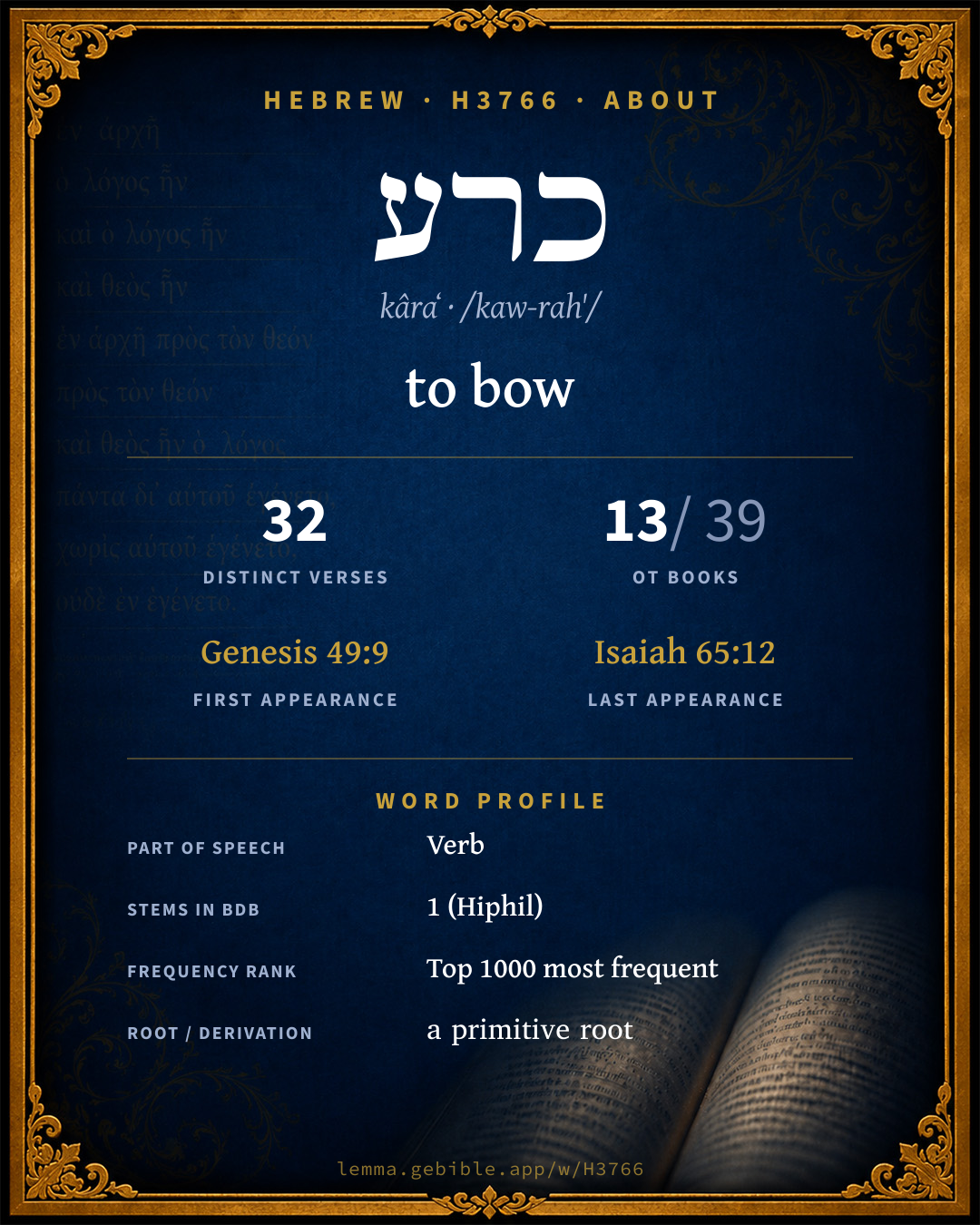
כָּרַע
to bow
‘to bow’ is one of 2 main senses fuller range ↓
Full lexicon entry — Brown-Driver-Briggs (BDB)
From Brown-Driver-Briggs (BDB)
Where this word appears
See every Qal verb in the Hebrew Bible →
Grammar key — what these labels mean
Part of speech
- Verb
- An action or state-of-being word.
Stem
- Qal
- The basic, simple active stem — the plain form of the verb (“he wrote”).
- Hiphil
- The causative active stem (“he caused / brought about”). Here: ‘cause to bow in grief Ju 11’
Form
- Perfect
- A completed action or state — Hebrew marks aspect (completeness) more than strict tense (“he wrote”).
- Sequential Imperfect
- An imperfect with prefixed waw — the standard past-narrative form (waw-consecutive imperfect).
- Imperfect
- An incomplete, ongoing, or future action (“he will / would write”).
- Cohortative
- A first-person volitional form expressing wish or resolve (“let me / let us write”).
- Infinitive Construct
- A bound verbal noun, frequently with prepositions (“to write / in writing”).
- Infinitive Absolute
- An unbound verbal noun, often intensifying or standing in for a finite verb.
- Imperative
- A direct command (“write!”).
- Participle Active
- A verbal adjective expressing ongoing or characteristic action (“writing / one who writes”).
State
- Absolute
- The independent form of a noun, not bound to a following word.
Person
- 3rd Person
- The one spoken about (“he / she / it / they”).
- 2nd Person
- The one addressed (“you”).
- 1st Person
- The speaker (“I / we”).
Gender
- Masculine
- Grammatically masculine.
- Common
- Either gender — not distinguished for this form.
- Feminine
- Grammatically feminine.
Number
- Singular
- One.
- Plural
- More than one (in Hebrew, generally three or more).
3 verses where H3766 appears in the Hiphil stem in the Book of Psalms. Filtered view — show all forms. Click any verse to open its interlinear word-by-word view. Verse text shown in the World English Bible for context — . Each verse’s Hebrew form is shown with its reference; the English is not keyword-highlighted, since the data carries no word-level English alignment. Use “Compare translations” on any verse to read it across multiple English versions. This concordance covers the Hebrew Bible; Septuagint (Greek Old Testament) occurrences are not indexed here.
Psalms
- Psalms 17:13 הַכְרִיעֵ֑/הוּ Hiphil impv 2ms + sfx pers 3ms Arise, Yahweh, Confront him, cast him down. Deliver my soul from the wicked by your sword;
- Psalms 18:39 תַּכְרִ֖יעַ Hiphil impf 2ms For you have girded me with strength to the battle. You have subdued under me those who rose up against me.
- Psalms 78:31 הִכְרִֽיעַ Hiphil pf 3ms When the anger of God went up against them, Killed some of the fattest of them, And struck down the young men of Israel.
About this entry
At a glance — auto-summarized from this page’s data, not written by a person. Every figure links to its source below. This summary describes the numbers; it doesn’t interpret them.
כרע — transliterated kâraʻ — is a Hebrew verb carrying the sense “to bow.” Debuting at Genesis 49:9, it then recurs through the corpus. It appears 32 verses across 13 books of the Hebrew Bible, among its moderately common vocabulary. It is not a single-sense word — see its full sense range. Related forms include כרע. See the sense tree, 32-verse concordance, and the renderings breakdown below.
Gloss history
Strong's 1890 vs modern scholarship
About this word
Strong's H3766 catalogs a Hebrew word from the Hebrew Old Testament.
These counts are not copied from any lexicon or concordance. They are computed here, from the morphology-tagged Hebrew Old Testament. What Lemma adds →
- 32
- distinct verses
- The word appears in 32 distinct verses.
- 13 / 39
- OT books
- The word appears in 13 of 39 Old Testament books.
- #990
- by frequency
- Top 1000 most frequent Hebrew words (rank 990 of 8,640 Hebrew words by occurrence).
View all 32 occurrences in the concordance →
By section of the Old Testament
By traditional corpus
Conventional, traditional groupings — biblical authorship is debated, so this is a traditional corpus grouping, not an authorship claim. Each share is this word’s portion of its verses in that division of the Hebrew canon. Each figure is a share of the word’s 32 distinct verses.
- Prophets (Nevi'im) 15 verses · 47%
- Writings (Ketuvim) 15 verses · 47%
- Torah (Pentateuch) 2 verses · 6%
How translations render this word
Counts come from each version’s own published word-to-Strong’s tagging or interlinear alignment — an approximate guide to how each version renders this word, not a word-level alignment the data otherwise carries. Because each total is that version’s own tagged count, the per-version totals vary from one another and need not match the appearance or distinct-verse counts above. These counts may also differ from a printed concordance because Lemma counts each distinctly tagged rendering and does not collapse phrase taggings into a single head-word total. This is a fixed set of word-tagged versions (KJV, ASV, BSB, ULT) and does not change with the reading translation you choose elsewhere. Each version’s license is shown beside its name below (and on Sources).
- King James Version: Bowed 4×, Bow down 3×, He bowed 3×
- American Standard Version: Bowed 3×, He bowed 3×, Shall bow 3×
- Berean Standard Bible: Bow down 3×, He collapsed 3×, Bowed down 2×
- unfoldingWord Literal Text: Bow down 9×, He bowed 3×, Knelt 2×
King James Version Public Domain
Renders H3766 across 37 tagged occurrences — most commonly:
Plus 24 renderings that appear only once — usually multi-word phrases or single function words the recovered tagging swept in, not distinct renderings.
American Standard Version Public Domain
Renders H3766 across 37 tagged occurrences — most commonly:
Plus 26 renderings that appear only once — usually multi-word phrases or single function words the recovered tagging swept in, not distinct renderings.
Berean Standard Bible Public Domain
Renders H3766 across 35 tagged occurrences — most commonly:
Plus 23 renderings that appear only once — usually multi-word phrases or single function words the recovered tagging swept in, not distinct renderings. Not rendered by a distinct English word in 1 further occurrence.
unfoldingWord Literal Text CC BY-SA 4.0
Renders H3766 across 44 tagged occurrences — most commonly:
Plus 24 renderings that appear only once — usually multi-word phrases or single function words the recovered tagging swept in, not distinct renderings.
7 senses and sub-senses in the full BDB
What do BDB’s symbols mean?
BDB uses these scholarly abbreviations:
| Symbol | Meaning |
|---|---|
| 𝔊 | the Septuagint (the ancient Greek translation, LXX) |
| 𝔙 | the Vulgate (the Latin translation) |
| 𝔖 | the Syriac version (the Peshitta) |
| 𝔗 | the Targum (the Aramaic translation) |
| ψ | the Psalms |
| √ | root (the underlying root or stem) |
| ‖ | parallel passage (a synonymous or contrasted parallel) |
| † | the dagger: every passage where the word occurs is cited |
The 7 senses and sub-senses the full Brown-Driver-Briggs lexicon distinguishes for this word, in lexicon order (not ranked by frequency), with BDB’s own verbatim wording and sub-sense lettering. Shown in Hebrew script with BDB’s own scholarly abbreviations. The condensed entry is in the Lexicon Entry tab. See also the Forms in the corpus table below.
- 1. bow על ברכים to drink Ju 7:5, 6, in supplication to Elijah 2 K 1:13; in the worship of God 1 K 8:54; Ezr 9:5; c. ברכים subj. and ל of God 1 K 19:18; Is 45:23; without ברכים c. לִפְנֵי ψ 22:30; 72:9; ‖ השׁתחוה 2 Ch 7:3; 29:29 ψ 95:6, worship of God, but Est 3:2(×2), 5 in obeisance to Haman. e.g. Judges 7:5
- 2. bow down, of the couching lion Gn 49:9; Nu 24:9 (both poetry). e.g. Genesis 49:9
- 3. preg. c. על, bow down over (in order to lie with) a woman Jb 31:10. e.g. Job 31:10
- 4. bow down, of a woman in childbirth 1 S 4:19, so of animals Jb 39:3; idols, removed by enemies Is 46:1, 2; בִּרְכַּיִם כֹּרְעוֹת Jb 4:4 tottering (feeble) knees; of enemies in death, כרע [ו]נפל bow and fall down Ju 5:27(×3) ψ 20:9, preg. without נפל 2 K 9:24; Is 65:12, c. תַּחַת Is 10:4.— e.g. 1 Samuel 4:19
Hiphil
- Pf. 3 ms. הִכְרִיעַ ψ 78:31; 2 fs. sf. הִכְרַעְתִּנִי Ju 11:35; Impf. 2 ms. תַּכְרִיעַ 2 S 22:40 = ψ 18:40; Imv. sf. הַכְרִיעֵהוּ ψ 17:13; Inf. abs. הַכְרֵעַ Ju 11:35.— e.g. Psalms 78:31
- 1. cause to bow in grief Ju 11:35(×2). e.g. Judges 11:35
- 2. cause to bow down in death ψ 17:13; 78:31, c. תַּחַת 2 S 22:40 = ψ 18:40. e.g. Psalms 17:13
Senses from the full Brown-Driver-Briggs lexicon (Brown, Driver, Briggs; Oxford 1906 — public domain), digitized via Sefaria, supplemented by the OpenScriptures HebrewLexicon (CC BY 4.0). Full attribution on Sources.
Word origin
bow down (NH id.; Aramaic כְּרַע; Arabic كَرَعَ put one’s mouth into water, or water-vessel; i.e. kneel to drink? denom. from foll.?);—Qal Pf. 3 m. כ׳ Gn 49:6 + 6 times; 3 mpl. כָּֽרְעוּ Ju 7:6 + 4 times; Impf. יִכְרַע Ju 7:5 + 3 times; 1 s. וָאֶכְרְעָה Ezr 9:5; 3 mpl. יִכְרְעוּן Jb 31:10; 2 mpl. תִּכְרָ֑עוּ Is 65:12; 1 pl. וְנִכְרָ֑עָה ψ 95:6 + 6 times Impf.; Inf. cstr. כְּרֹעַ 1 K 8:54; Pt. כֹּרֵעַ Est 3:5; pl. כֹּרְעִים Est 3:2; f. כֹּרְעוֹת Jb 4:4.—
— Brown-Driver-Briggs (Oxford 1906, public domain), digitized via Sefaria, supplemented by the OpenScriptures HebrewLexicon (CC BY 4.0). See Sources.
Origin: a primitive root
Jastrow Dictionary
A second Hebrew/Aramaic lexicon for comparison, covering Aramaic and post-biblical (Talmudic, Targumic, Midrashic) usage that the biblical-Hebrew BDB does not. Matched by lemma rather than by Strong’s number, so a lemma may carry more than one Jastrow headword (shown separately below), and the entries cover usage well beyond the Bible.
כָּרַע
- to bow, bend the knee. Ber. 12ᵃ כשהוא כוֹרֵעַ וכ׳ when bowing in prayer, one must bow at the word barukh, opp. זָקַף. Ib. 34ᵇ; Y. ib. I, 3ᶜ bot. (interch. with שחה); a. v. fr.
- 1. to cause to kneel; to subdue; to humiliate, sadden. Gen. R. s. 65; Yalk. Gen. 114 אני מַכְרִיעַ את אוהבי I shall sadden my friend. Gen. R. s. 75, beg., v. כָּרַח. Gen. R. s. 67 מה אני מכריע וכ׳ (Yalk. ib. 116 מַעֲכִיר) why shall I sadden my father?
- 2. to put the knee of the balance down; to overbalance; to outweigh. Y. Peah I, 16ᵇ bot. הזכיות מַכְרִיעוֹת the good deeds overbalance (the sins). Ab. II, 8 מַכְרִיעַ את כלם outweighs them all. B. Bath. V, 11 חייב להַכְרִיעַ לו טפח (weighing a litra of meat or more) he must allow the scale (which contains the meat) to sink one handbreadth lower than the scale of weights, i.e. he must give overweight, opp. עיין to weigh exactly. Ib. 89ᵃ שקול לי … והַכְרִיעָהּ weigh for me each litra for itself and give me the legal overweight on it; a. fr.—Y. Sabb. I, 3ᶜ bot. הַכְרַע עליו כסף put money to it in the balance (bribe him). Gen. R. s. 80 כמה ממון ה׳ how much money he put in the balance (paid for it).—Trnsf. to cast the deciding vote, to decide. Tosef. Ḥull. VII, 1; Ḥull. 90ᵇ; Pes. 83ᵇ הדעת מַכְרַעַת reason decides, v. דַּעַת. Y. Keth. II, 26ᵇ; Y. Yeb. X, 10ᵈ bot. הדעת מכרעת בעידי מיתה (not לידי) reason decides in favor of trusting the witnesses testifying to the death of a person.
- 3. to keep the balance; trnsf. to harmonize two contrary opinions, to compromise. Sifra introd. שני כתובים המכחישים … ויַכְרִיעַ ביניהם when two Biblical verses contradict each other, you must not draw any conclusions until a third verse is found which harmonizes them. Ib. end (ref. to Ex. XIX, 20 a. Deut. IV, 36) הכ׳ השלישי a third passage (Ex. XX, 22) harmonizes (that the Lord lowered the heavens so as to make them rest on Mount Sinai); Mekh. Yithro, Baḥod. s. 9. Sifré Num. 58.—Kidd. 24ᵇ המַכְרִיעִים לפני חכמים the harmonizers arguing before the scholars. Sabb. 39ᵇ כל מקום … ואחד מכריע הלכה כדברי המכ׳ whenever you find two scholars differing and one compromising, the practice follows the opinion of the compromiser; a. fr.—V. הֶכְרַע, הַכְרָעָה. e.g. Exodus 19:20
כְּרַע
- 1. to bow, bend the knee. Targ. O. Gen. XXIV, 26 (Y. גחן). Targ. II Esth. III, 2; a. e.—Y. Ber. II, 5ᵃ bot. הוא כ׳ מגרמיה it (the head) bowed spontaneously.
- 2. (of the balance) to sink, outweigh. Targ. Y. Ex. I, 15.
- 3. to decide by majority. Targ. Y. Deut. XXV, 1 (v. Snh. 10ᵃ).
- 1. to sadden. Targ. Jud. XI, 35.
- 2. to weigh. Pesik. B’shall., p. 82ᵃ באכרעתא דאַכְרְעוּן וכ׳, v. אַכְרַעְתָּא.
- to be weighed. Ib.
כֶּרַע
- c. (b. h.; [hollow, cmp. בֶּרֶךְ,] knee, leg. Zeb. VIII, 5 כַּרְעוֹ של וכ׳ the leg of one of them (Talm. ed. 77ᵇ כרעים du.). Kel. XVIII, 7 כ׳ שהיתה וכ׳ a knee-shaped piece of wood which became unclean … and which one fastened to a bedstead; Tosef. Kel. B. Mets. IX, 3. Ib. VIII, 8 כ׳ שפרש וכ׳ a leg of a bedstead which was taken off with the longside &c.; a. e.—Du. כְּרָעַיִם, כְּרָעַיִים; pl. כְּרָעִים, כְּרָעִין. Tam. IV, 2. Zeb. VIII, 5. Succ. 15ᵇ, v. אֲרוּכָה. Cant. R. to VII, 3 מה כרס … והכ׳ וכ׳ as the belly is bounded by the heart (chest) on the one, and the legs on the other. Kel. XVIII, 5; Tosef. Kel. B. Mets. VIII, 5; a. fr.
רַע I
- [shaken,] weak, sick; bad; (noun) evil. Ber. 7ᵃ מפני מה … ורע לו why is there a righteous man who fares well, and another righteous man who fares badly? Ib. 23ᵃ (ref. to Koh. IV, 17) בין טוב לרע וכ׳ they cannot distinguish between good and evil, and want to offer a sacrifice before me? Kidd. 40ᵃ (ref. to Is. III, 11) וכי יש רשע רע ויש שאינו רע is there a bad wicked man and a wicked man that is not bad?; רע לשמים ורע לבריות וכ׳ one bad in his relation to heaven (irreligious) and bad to men is a bad wicked man &c. Ohol. XVIII, 6 שכחן רע whose strength is feeble, v. כֹּחַ. Ab. II, 9 חבר רע a bad companion; לב רע a bad heart; a. v. fr.—Fem. רָעָה bad; (noun) evil. Ib., a. fr. עין ר׳, v. עַיִן. Sabb. 11ᵃ כל ד׳ ולא אשה ר׳ any evil, only not a bad wife. Ber. 61ᵃ אחת … ואחת יועצתו לר׳ one (kidney) counsels for good, the other for evil. Y. Shek. I, beg. 45ᵈ לטובה … לר׳ וכ׳ for a good purpose—‘every liberal-hearted’ (Ex. XXXV, 22), for a bad purpose—‘the whole people’ (ib. XXXII, 3). Hor. 10ᵇ אפי׳ טובתם … ר׳ היא וכ׳ even the good which wicked men do is an evil with the righteous (they do not enjoy it); Yeb. 103ᵃ sq. Koh. R. to V, 12, v. חוֹלָה I. Ber. l. c. (ref. to Koh. IV, 17) אל תהי … אם על ר׳ הם מביאים be not like the fools who sin and offer a sacrifice, not knowing whether they offer it for the good they have done or for the evil; a. v. fr.—Pl. רָעִים; רָעוֹת. Keth. 110ᵇ (quot. fr. Ben Sira) כל ימי עני ר׳ all the days of a poor man are bad; Snh. 101ᵃ. Y. Ber. V, 8ᵈ bot., v. חָצַף. Ex. R. s. 42 (ref. to Jer. II, 13) ושתי ר׳ עשו לבד have they committed no more than two evils?; a. v. fr. e.g. Ecclesiastes 4:17
רַע II
- to be evil, v. רָעַע.
רַע III
- ch. = אֲרַע, v. לרַע
רֵעַ
- , v. רֵיעַ
A Dictionary of the Targumim, the Talmud Babli and Yerushalmi, and the Midrashic Literature (Marcus Jastrow; London, Luzac, 1903) — Public Domain. Digitized via Sefaria. Digitized via Sefaria. Full attribution on Sources.
Forms in the corpus
The 33 distinct written forms H3766 takes in the Hebrew Bible, most frequent first — each parse links to that stem’s occurrences in the concordance. Hebrew forms include their vowel points and cantillation, so a single lemma takes many written forms.
Same root — word family
Other BDB entries built from the same root as H3766, grouped by Strong’s listed origin. These share a root / origin per the lexicon — not necessarily a shared meaning. Each links to that word’s own entry.
Derived from this word
Compare all same-root words → They share a root, not necessarily a meaning.
Septuagint verse parallels
This word appears in 29 verses that also exist in the Greek Old Testament (Septuagint), out of the 32 Hebrew verses it occurs in. You can read those verses in Greek by switching the Old Testament edition to the Septuagint.
Read these verses in the Septuagint
- Genesis 49:9
- Numbers 24:9
- Judges 5:27
- 1 Samuel 4:19
- 2 Samuel 22:40
- 1 Kings 8:54
- 2 Kings 1:13
- 2 Chronicles 7:3
- Ezra 9:5
- Esther 3:2
- Job 4:4
- Psalms 17:13
This is a verse-level parallel only — the same verses exist in both the Hebrew and Greek Old Testaments. No word-level Hebrew↔Greek correspondence is claimed: the data carries no such alignment, so no Greek word is shown as this Hebrew word’s translation. Coverage is not total — the Septuagint omits the deuterocanon and renumbers the Psalms, so some Hebrew verses have no direct Greek parallel.