
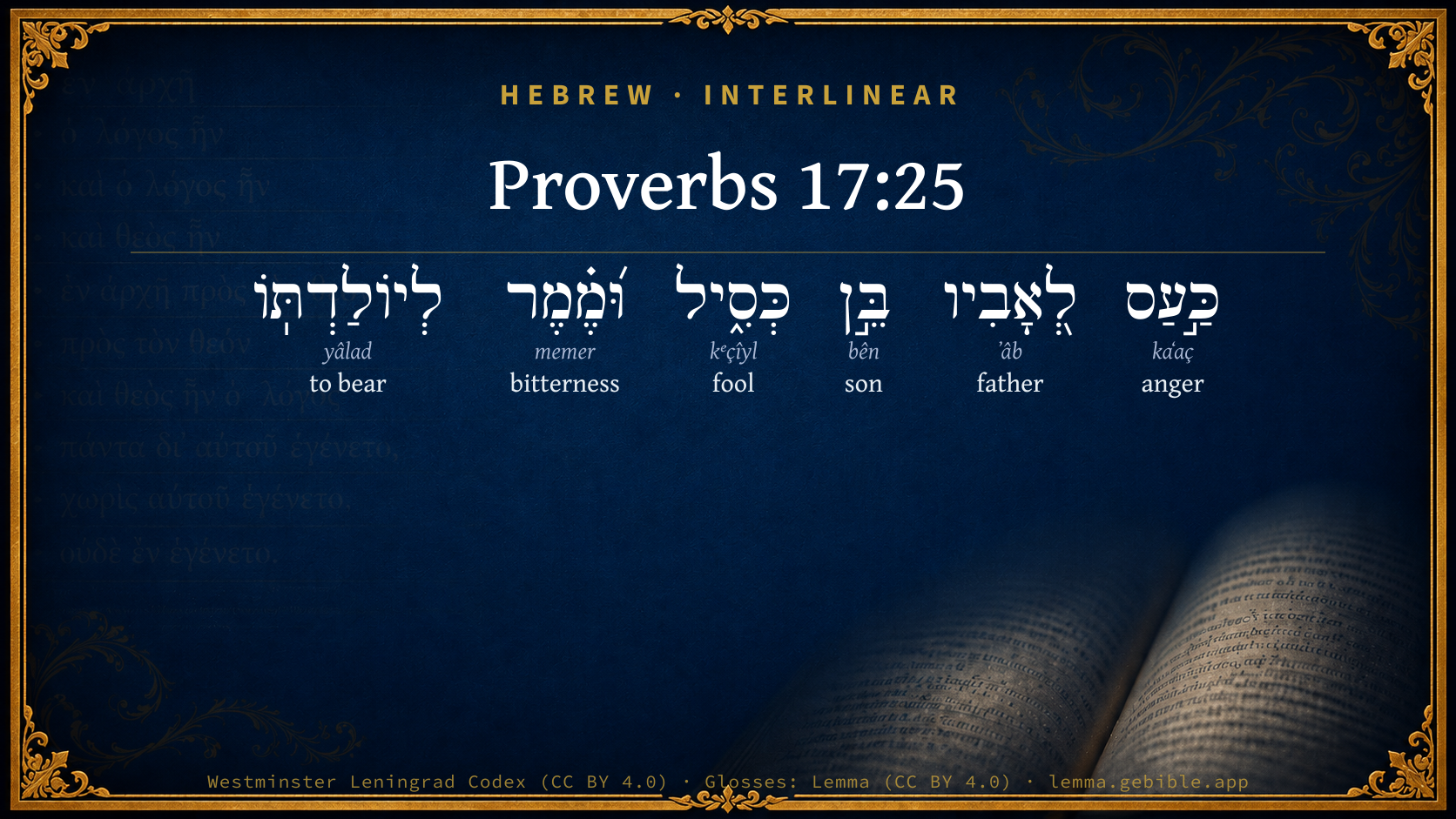
Proverbs 17:25

Hebrew (Westminster Leningrad Codex) Proverbs 17:25 appears in the Hebrew Old Testament. The text above is from the Westminster Leningrad Codex. Each word links to its Strong’s number, a concise gloss, and parsing drawn from the Open Scriptures Hebrew Bible morphology. Click any word for its full Brown-Driver-Briggs (BDB) entry.
Download image
Cite this verse

Proverbs 17:25 (World English Bible). Public Domain. Lemma interlinear Bible study tool, https://lemma.gebible.app/v/proverbs/17/25.

Show BibTeX & RIS
BibTeX
RIS
English Translation
A foolish son brings grief to his father, And bitterness to her who bore him.
World English Bible · Public Domain
Highlights
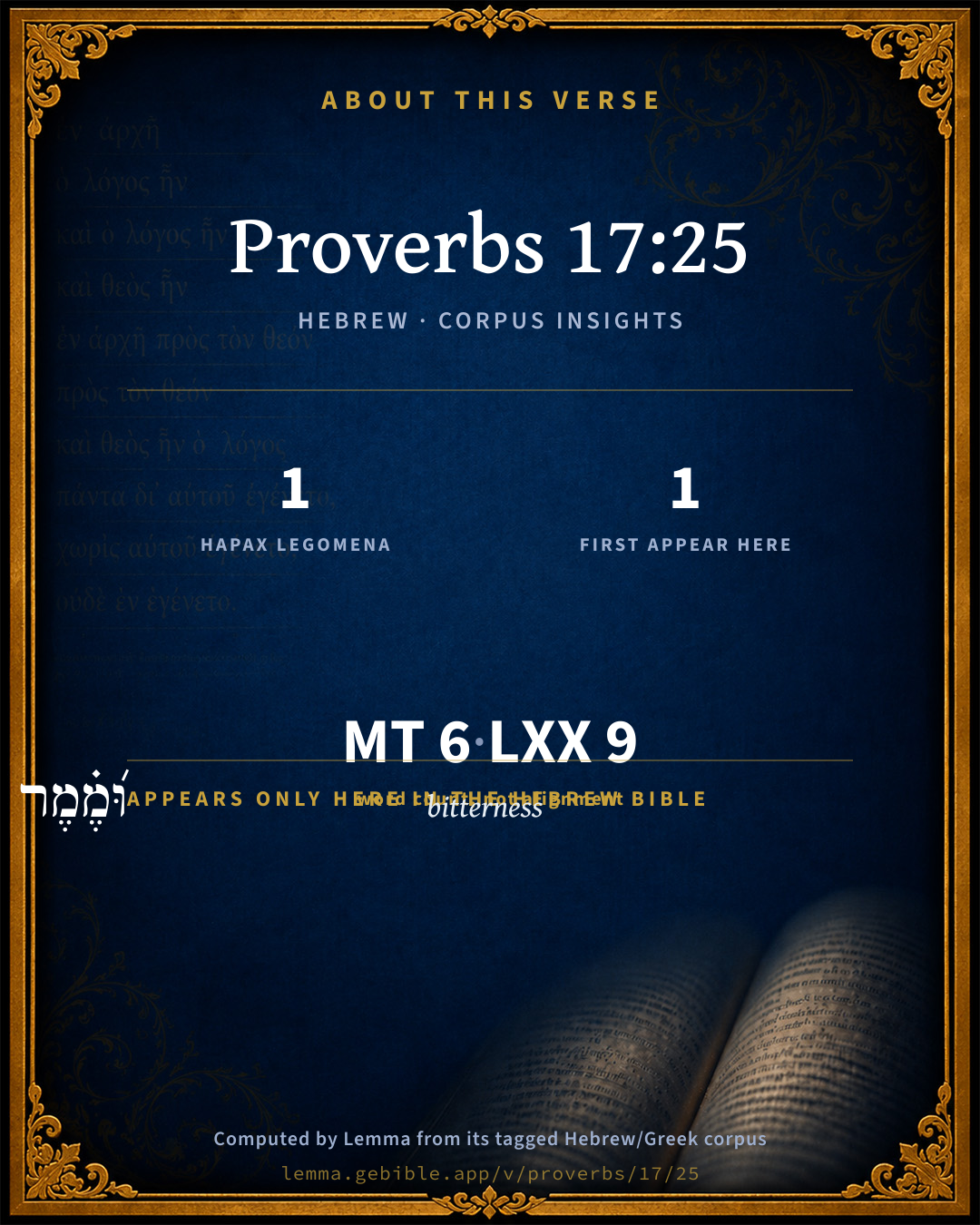
  • 1 hapax legomenon — only here in the Hebrew Bible
  • 1 first appearance in the Hebrew Bible
Full analysis ↓
Download a study sheet

One document with this verse’s original text, its word-by-word gloss line, the meaning frame, cross-references with their text, attributed commentary, and full source and license credits — printable, and it pastes into notes with its structure intact.

This verse Autodidact and up

Study sheet (.html) Plain text (.txt)

A passage Seminary Student

Up to 50 verses in one chapter. A passage sheet keeps up to 6 commentary sources and 12 cross-references per verse, in the order this page ranks them, and says so on the sheet whenever that leaves anything out. Ask for a single verse and you get the Autodidact verse sheet above.

Everything on this page stays free to read, with no account — the sheet is a download of what is already on screen, not access to it.

Want to remove ads? Support Godless Engineer
Compare translations 3

The same verse in 3 English versions, stacked beneath the original-language interlinear above. Click any original word for its lexicon entry.

Each is an independent rendering of the whole verse — the interlinear is not word-aligned to these translations.

Highlighted words mark where these versions differ — a whole-verse word diff, not a word-by-word alignment.

  • World English Bible Public Domain
    A foolish son brings grief to his father, And bitterness to her who bore him.
  • King James Version Public Domain
    A foolish son is a grief to his father, and bitterness to her that bare him.
  • unfoldingWord Literal Text CC BY-SA 4.0
    A stupid son a grief to his father and bitterness to her who bore him.

unfoldingWord Literal Text — © unfoldingWord, licensed CC BY-SA 4.0. Word-aligned USFM3 via Door43 (git.door43.org/unfoldingWord/en_ult).

Versions to compare (up to 4)

3 of 4 selected

Show all 18 translations

Every available English version of this verse, each an independent rendering of the whole verse.

  • World English Bible Public Domain
    A foolish son brings grief to his father, And bitterness to her who bore him.
  • Berean Standard Bible Public Domain
    A foolish son brings grief to his father and bitterness to her who bore him.
  • Majority Standard Bible Public Domain
    A foolish son brings grief to his father and bitterness to her who bore him.
  • King James Version Public Domain
    A foolish son is a grief to his father, and bitterness to her that bare him.
  • American Standard Version (1901) Public Domain
    A foolish son is a grief to his father, And bitterness to her that bare him.
  • Revised Version (1885) Public Domain
    A foolish son is a grief to his father, and bitterness to her that bare him.
  • Geneva Bible (1599) Public Domain
    A foolish sonne is a griefe vnto his father, and a heauines to her that bare him.
  • Douay-Rheims (1899) Public Domain
    A foolish son is the anger of the father: and the sorrow of the mother that bore him.
  • Young's Literal Translation Public Domain
    A provocation to his father `is' a foolish son, And bitterness to her that bare him.
  • Literal Standard Version CC BY-SA 4.0
    A foolish son [is] a provocation to his father, || And bitterness to her bearing him.
  • Unlocked Literal Bible CC BY-SA 4.0
    A foolish son is a grief to his father and bitterness to the woman who bore him.
  • unfoldingWord Literal Text CC BY-SA 4.0
    A stupid son a grief to his father and bitterness to her who bore him.
  • Darby Bible Public Domain
    A foolish son is a grief to his father, and bitterness to her that bore him.
  • World Messianic Bible Public Domain
    A foolish son brings grief to his father, and bitterness to her who bore him.
  • Webster's Bible Public Domain
    A foolish son is a grief to his father, and bitterness to her that bore him.
  • Free Bible Version CC BY-SA 4.0
    A stupid son brings grief to his father and sadness to his mother who gave birth to him.
  • Bible in Basic English Public Domain
    A foolish son is a grief to his father, and bitter pain to her who gave him birth.
  • JPS Tanakh (1917) Public Domain
    A foolish son is vexation to his father, and bitterness to her that bore him.

Literal Standard Version (2020), Covenant Press — licensed CC BY-SA 4.0. Text via the HelloAO Bible API (eBible.org). Unlocked Literal Bible (unfoldingWord) — licensed CC BY-SA 4.0. Text via the HelloAO Bible API (eBible.org). unfoldingWord Literal Text — © unfoldingWord, licensed CC BY-SA 4.0. Word-aligned USFM3 via Door43 (git.door43.org/unfoldingWord/en_ult). Free Bible Version, Dr. Jonathan Gallagher — licensed CC BY-SA 4.0. Text via the HelloAO Bible API (eBible.org).

Word by word

More ways to search: Search by grammar → Find every occurrence → Compare this word →

Practice this passage: Drill this verse → Learn its vocabulary →

About this verse

These counts appear in no published source. They are computed here, from the morphology-tagged text and Lemma’s own curated glosses. What Lemma adds →

6
words
6
distinct lemmas
Wisdom
section

Notable vocabulary

1 hapax legomenon — a word that appears only here in the entire Hebrew Bible:

  • וּ֝מֶ֗מֶר bitterness H4470

First appearance in Scripture

This word makes its first canonical appearance in the Hebrew Bible here:

  • וּ֝מֶ֗מֶר bitterness H4470

Shared distinctive vocabulary

כַּ֣עַס anger H3708 occurs in 25 verses of the Hebrew Bible. Also found in:

Grammatical profile

  • 1 verb
  • 4 nouns
  • 1 adjective

Verb forms

  • לְיוֹלַדְתּֽוֹ Qal · Participle Active

Hebrew & Septuagint length

In English translation the verse runs 15 words from the Hebrew and 18 from the Septuagint (LXX English) — closely comparable.

A rough comparison of the two English renderings, which tokenize alike — not a word-level alignment.

Word counts can differ between the Hebrew and the Greek without any difference in meaning — e.g. the Hebrew direct-object marker אֵת has no separate Greek word, and Greek often adds the article ὁ.

In the original languages it is 6 Hebrew tokens and 9 Greek tokens — but the two are counted differently (Hebrew bundles its prefixes and suffixes into one token; the Greek is in lemma form), so that isn’t a like-for-like length.

Cross-references

5

Topical passages linked to Proverbs 17:25 in the Treasury of Scripture Knowledge — connected by theme and wording, ordered by reader-vote popularity; previews shown in the World English Bible.

  • Proverbs 10:1 The proverbs of Solomon. A wise son makes a glad father; But a foolish son brings grief to his mother.
  • 2 Samuel 13:1–22 It happened after this, that Absalom the son of David had a beautiful sister, whose name was Tamar; and Amnon the son of David loved her.
  • Proverbs 15:20 A wise son makes a father glad, But a foolish man despises his mother.
  • Proverbs 19:13 A foolish son is the calamity of his father. A wife's quarrels are a continual dripping.
  • Ecclesiastes 2:18–19 I hated all my labor in which I labored under the sun, seeing that I must leave it to the man who comes after me.

Cross-references courtesy of OpenBible.info (CC BY 4.0).

Hebrew and Greek witnesses Masoretic Hebrew ↔ Greek Septuagint

The same verse in the two great witnesses to the Old Testament, shown verse-for-verse.

These are two independent witnesses, not word-aligned to each other, and the Septuagint is shown in lemma (dictionary) form.

Hebrew Proverbs 17:25 Masoretic · Westminster Leningrad Codex

כַּ֣עַס לְ֭אָבִיו בֵּ֣ן כְּסִ֑יל וּ֝מֶ֗מֶר לְיוֹלַדְתּֽוֹ

A foolish son brings grief to his father, And bitterness to her who bore him.

World English Bible · Public Domain

Greek LXX Proverbs 17:25 Septuagint · lemma form

ὀργή πατήρ υἱός ἄφρων καί ὀδύνη ὁ τίκτω αὐτός

A foolish son is a cause of anger to his father, and grief to her that bore him.

LXX2012 (modern English Septuagint) · Public Domain

On this verse, The Pulpit Commentary discusses the Septuagint’s reading. Read the note in Commentary ↓

Hebrew: Westminster Leningrad Codex (CC BY 4.0). Greek: Septuagint (public domain); English from LXX2012 (modern English Septuagint) (Public Domain). How the Septuagint differs from the Hebrew →

Commentary

Notes on Proverbs 17:25 from classic Christian and Jewish commentators (each source and its license shown beneath its notes). The classic Christian expositions comment on the surrounding passage and are grouped to its opening verse, so a note may address several verses; the Jewish commentaries on the Tanakh (Rashi and others) are per-verse, so they appear only where the commentator wrote on this verse.

Lemma curates 59 commentaries, every one of them public domain or Creative Commons licensed, each selected and text-cleaned for this edition rather than reprinted as found. About our sources →

Trapp's Complete Commentary

John Trapp

Pro 17:25 A foolish son [is] a grief to his father, and bitterness to her that bare him.

Ver. 25. A foolish son is a grief to his father.] {See Trapp on "Pro 10:1"} {See Trapp on "Pro 15:20"}

John Trapp, A Commentary or Exposition upon All the Books of the Old and New Testament (1647–1656) — public domain. Text from a community e-Sword module.

Joseph Benson's Commentary

Pro 17:25-26. A foolish son, &c. — This was said before, Pro 15:20, and elsewhere; but he here repeats it, as a point of great moment and constant use, and as a powerful motive to oblige both children to conduct themselves wisely and dutifully toward their parents, as they would not be thought to be unnatural and inhuman, and parents to educate their children prudently and religiously, at least for their own comfort, if not for the public good. Also to punish, &c. — The particle also, here, seems to have relation to the foregoing sentence, and to imply that, as it is a very evil thing for children to cause grief to their parents, so is it also to do what here follows. To punish the just is not good — For parents, princes, or rulers, (to whom alone this power belongs,) to punish innocent and good men, is highly evil and abominable; nor to strike princes for equity — Nor to smite magistrates, either with the hand or tongue, for the execution of justice, as condemned persons are apt to do. But some learned interpreters read this clause, Nor for princes to strike any man for equity, or for doing his duty, or what is just. The Hebrew will very well bear this reading, and it agrees better with the former clause than that which our translators have adopted. Besides that it belongs properly to princes, or magistrates, to punish or strike.

Joseph Benson's Commentary on the Old and New Testaments (1811–1818) — public domain. Text from a community e-Sword module.

Tyndale Open Study Notes

Tyndale Open Resources

17:25 Foolish children: This proverb is equally true of sons and daughters.

Tyndale Open Study Notes — © Tyndale Open Resources, licensed CC BY-SA 4.0. Text via the HelloAO Bible API.

Matthew Henry's Commentary

Observe, 1. Wicked children are an affliction to both their parents. They are an occasion of anger to the father (so the word signifies), because they contemn his authority, but of sorrow and bitterness to the mother, because they abuse her tenderness. The parents, being joint-sufferers, should therefore bring mutual comfort to bear them up under it, and strive to make it as easy as they can, the mother to mollify the father's anger, the father to alleviate the mother's grief. 2. That Solomon often repeats this remark, probably because it was his own case; however, it is a common case.

Matthew Henry's Commentary on the Whole Bible (1708–1710) — public domain (CC PDM 1.0). Text via the HelloAO Bible API.

Jamieson, Fausset & Brown

Robert Jamieson, A. R. Fausset & David Brown

a grief--or cross, vexation (compare Pro 17:21; Pro 10:1).

Jamieson, Fausset & Brown — Commentary Critical and Explanatory on the Whole Bible (1871) — public domain (CC PDM 1.0). Text via the HelloAO Bible API.

John Gill's Exposition

A foolish son is a grief to his father,.... Because of his folly and wickedness, and the ruin he is bringing himself to;

and bitterness to her that bare him; a cause of bitterness of soul to his mother, more distressing than the bitter pains with which she brought him forth into the world. Jarchi, by the father, understands the blessed God; and by her that bare him, the congregation of Israel; to whom Jeroboam, the son of Nebat, was bitterness, who caused Israel to sin; see Pro 10:1.

John Gill's Exposition of the Whole Bible (1746–1763) — public domain (CC PDM 1.0). Text via the HelloAO Bible API.

Albert Barnes' Notes on the Bible

Compare Pro 17:21. Here is added a reference to the sorrow which the folly of a child brings especially to the mother.

Albert Barnes' Notes on the Bible (1834–1885) — public domain. Text from a community e-Sword/MySword module.

Matthew Poole's English Annotations

This he said before, Pro 15:20, and elsewhere; but he here repeats it as a point of great moment and constant use, and as a powerful motive to oblige both children to carry themselves wisely and dutifully to their parents, as they would not be thought to be unnatural or inhuman, and parents to educate their children prudently and religiously, at least for their own comfort, if not for the public good.

Matthew Poole's English Annotations on the Holy Bible (1683–1685) — public domain. Text from a community e-Sword/MySword module.

Whedon's Commentary on the Bible

Daniel D. Whedon

25. Foolish son — Comp, Pro_17:21; Pro_10:1.

Daniel D. Whedon (gen. ed.), Commentary on the Old and New Testaments (1874–1909) — public domain. Text from a community e-Sword module.

The Pulpit Commentary

This verse is more or less a repetition of ver. 21; Pro_10:1 Pro_15:20; and comp. Pro_19:13. A grief (kaas). The Vulgate and Septuagint translate, "anger." A foolish son provokes the wrath of his father, and is bitterness to her that bare him, "Bitterness" (memer) oesurs nowhere else; mar and marar are common enough.

The Pulpit Commentary (1880–1919), ed. H.D.M. Spence-Jones & Joseph S. Exell — public domain. Text from a community e-Sword module.

Keil & Delitzsch

C. F. Keil & F. Delitzsch

The series of proverbs, v. 25-18:2, begins and closes in the same way as the preceding, and only Pro 17:26 stands by itself without apparent connection.

This verse begins connecting itself with Pro 17:21 :

A grief to his father is a foolish son,

And a bitter woe for her that bare him.

The ἅπ. λεγ. ממר is formed from מרר (to be bitter, properly harsh), as מכס from כּסס. The Syr. and Targ. change the subst. into participles; some codd. also have ממר (after the forms מחל, מסב, מפר, מרע), but as may be expected in 25a, מבעיס. The dat. obj. instead of the accus. may be possible; the verse immediately following furnishes a sufficient example of this.

Keil & Delitzsch — Biblical Commentary on the Old Testament (1861–1891) — public domain (CC PDM 1.0). Text via the HelloAO Bible API. (Old Testament only.)

Bridges on Proverbs

Charles Bridges

Surely the Divine Spirit did not repeat the proverb (Pro 17:21 ) for nought. Was it not to deepen our sense of parental responsibility and filial obligation? Can parents be insensible to the prospect of this grief? Can children be hardened into the unnatural selfishness of piercing a parent’s heart with such bitterness? (Pro 19:13 .) The mother’s anguish is here added to the father’s grief. (Gen 26:35 .) "As a sword in her bones," is the apprehension of having "brought forth children to the murderer." (Hos 9:13 .) How uncertain are the dearest comforts of earth! Our fallen mother anticipated the joy of "having gotten a man" — perhaps the promised seed — "from the LORD." (Gen 4:1 .) Yet to the bitterness of her soul "he was of that wicked one, and slew his brother." (1Jn 3:12 .) Her daughter naturally "remembereth no more her sorrow, for joy that a man is born into the world." (Joh 16:21 .) Already she grasps the delightful vision of his infant training, and ripening maturity. And yet too often he proves in the end a foolish son, and bitterness to her that bare him.

Absalom was named ’His father’s peace.’ Yet was he the source of his most poignant grief. This is not the "weeping of a night," succeeded by a "joyous morning" (Psa 30:5 ); but the "heaviness that maketh the heart stoop" (Pro 12:25 ), perhaps for years, perhaps to the end of days. Its connection with eternity gives to the trial its keenest edge. To see a foolish son hurried irrevocably into his eternal doom — Oh! this to the godly parent is an awful conflict. (2Sa 18:33 .) Strong indeed must be that faith (yet such faith has been vouchsafed)†1 which bows reverentially to the Divine Sovereignty, and maintains the serenity of peaceful submission.

But parental anxieties and sorrows must stimulate the enquiry — ’How may this piercing thorn be spared, this bitter grief — the bitterest that ever a parent’s heart can know — averted?’ The primary root of this sorrow is the indulgence of the will.†2 The vast power of parental influence must be used wisely, at once, at any cost. We must not instruct, or entreat only, but command.†3 We must allow no appeal from our authority, no reversal of our decision. This discipline in the spirit of love, and enforced by example, is God’s honoured ordinance.

Then to give power to all other means, there must be a living faith in the word of God. For if I really believe that awful fact, that my child is "a child of wrath," that Satan claims a right in him, and that if he die unconverted, hell must be his everlasting portion; shall not I apply myself with ceaseless energy to all the means for his soul’s salvation; under the clear conviction, that if he be not saved, "good were it for him that he had not been born"?

But this faith brings encouragement fully proportioned to the tremendous anxiety. For, if I be a Christian Parent, may I not claim a place for my child in the covenant of God? (Gen 17:7 .) May I not plead with him, and for him as a covenanted child? Here I desire to exercise a sound balance of well-disciplined confidence; encouraging parental hopes, and moderating parental anxieties. The law of the kingdom is, "that men should pray always, and not faint." (Luk 18:1 .) The fondest desires may not be accomplished till the eleventh hour. There may be many haltings, many withering blasts, many windings of the path. But "the bread cast upon the waters shall be found," though it be not till "after many days." (Ecc 11:1 .)

Only let us see to it, that our faith proves it soundness as a practical principle. Do parents never pray, that God would take their children as his own, while yet they train them, as if they were for the world? Are we sure, that we desire nothing for them besides, or unconnected with, eternal life?†4 One such desire stirs up another; till at length these few little things thrust down the primary blessing from its place, and it becomes a nullity.

In fine — would we look for rest in our beloved children? (Gen 5:29, margin=Noah: Gr. Noe: that is Rest, or, Comfort ) Hold them loose for ourselves; fast for God. Connect them early with his Church. Train their first years in his yoke. Instead of a sinking grief to us, they will then be "the restorers of our life, and the nourishers of our age." (Rth 4:15 .) Instead of being our bitterness as rebels against God, he will own and seal them, as "a seed to serve him, to declare his righteousness," to set forth his praise. (Psa 22:31 ; Psa 92:13 .)

Footnotes:

†1 Lev 10:1-3. 1Sa 3:18 .

†2 Pro 29:15.

†3 Gen 18:19. 1Sa 2:23-25 .

†4 Mark the golden rule, on which all hangs, Mat 6:33 .

Charles Bridges, An Exposition of the Book of Proverbs (1846) — public domain. Text from a community e-Sword module.

Kretzmann's Popular Commentary

Paul E. Kretzmann

v. 25. A foolish son is a grief to his father, causing him sorrow and mourning, and bitterness to her that bare him, by the vexation which he causes.

Paul E. Kretzmann, Popular Commentary of the Bible (1921–1924) — public domain. Text from a community e-Sword module.

unfoldingWord translationNotes

Door43 World Missions Community

A foolish son is a grief to his father

This speaks of a son causing his father grief as if the son himself were "grief." AT: "A foolish son brings grief to his father"

A foolish son ... and bitterness to the woman

This speaks of a son causing his mother bitterness as if the son himself were "bitterness." AT: "A foolish son ... and brings bitterness to the woman"

who bore him

"who gave birth to him"

bitterness

emotional pain, sorrow

it is never good ... neither is it good

These statements can be written in positive form. AT: "it is always wrong ... and it is evil" (See: Litotes)

the righteous person

Another possible meaning is "the innocent person," anyone whom others have accused of a crime that he did not commit.

flog

whip severely

who have integrity

The word "integrity" can be expressed with the adjective "honest." AT: "who are honest" (See: Abstract Nouns)

translationWords

fool

punish

noble

integrity

unfoldingWord translationNotes — © Distant Shores Media and the Door43 World Missions Community, licensed CC BY-SA 4.0. Source: git.door43.org/Door43/en_tn.

Rashi

Rabbi Shlomo Yitzchaki (Rashi)

A foolish son causes anger to his father [A foolish son] like Jeroboam causes anger to the Holy One, blessed be He.

and bitterness to her who bore him To the people of Israel, whom he caused to sin.

Rashi on the Tanakh — English translations: “The Judaica Press complete Tanach with Rashi, translated by A. J. Rosenberg” (CC BY 4.0); “Pentateuch with Rashi's commentary by M. Rosenbaum and A.M. Silbermann, 1929-1934” (public domain); “The Metsudah Tanach series, Lakewood, N.J” (CC BY 4.0); and “The Book of Joshua, Metsudah Publications, 1997” (CC BY 4.0). Text via Sefaria.

Lesson kit

Teaching starters — assembled from the data on this page, not authored interpretation. Every prompt links to the verse data it draws on. Edit before teaching.

Proverbs, in the Wisdom, opens this verse with 6 words (6 distinct Hebrew lemmas). Its most distinctive word is memer (“bitterness”). A historical commentator’s framing appears above. Read the whole chapter for the surrounding context.

Discussion questions

  1. How does “bitterness” (memer) shape what this verse is saying?
  2. This verse holds 1 word here found nowhere else in the Hebrew Bible. What might the rare word draw attention to?
  3. The word “bitterness” first appears here in Scripture. What is being introduced at this debut?
  4. Deuteronomy 32:19 shares the word «anger» with this verse. How do the two illuminate each other?
  5. The translations on this page render this verse differently — a whole-verse word diff, not a word-by-word alignment. What might account for the different wordings?
  6. The verb «לְיוֹלַדְתּֽוֹ» is Qal Participle Active. How does its form color the action?
  7. Reading how Trapp's Complete Commentary and Joseph Benson's Commentary read this verse, where do the two commentators agree and where do they part?

Things to notice

Reading settings

Reading text

Shown beneath each verse's original-language words.

Old Testament
Old Testament edition

Read the OT as the Masoretic Hebrew (MT) or the Greek Septuagint (LXX).

English shown for the Greek Septuagint (in the Hebrew ↔ Greek comparison).

Comparing translations? Open the Compare panel on any verse page to stack up to four side by side.