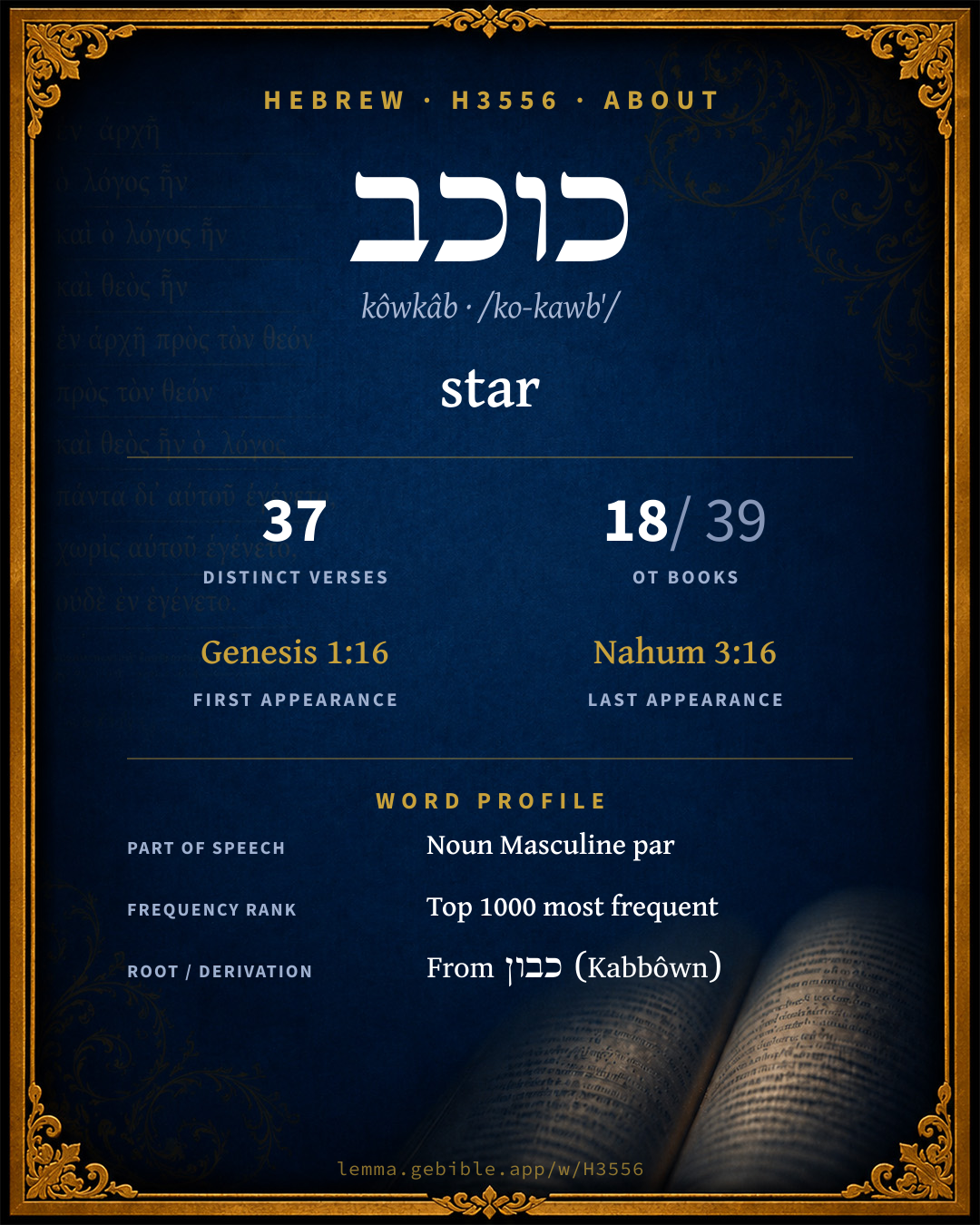
כּוֹכָב
star
‘star’ is one of 2 main senses fuller range ↓
Full lexicon entry — Brown-Driver-Briggs (BDB)
From Brown-Driver-Briggs (BDB)
Where this word appears
See every Absolute-state word in the Hebrew Bible →
Grammar key — what these labels mean
Part of speech
- Noun
- A naming word — a person, place, thing, or idea.
Noun type
- Common
- A common noun — a general class of person, place, or thing (“king,” “city,” “water”), not a specific name.
State
- Construct
- A noun bound to a following noun in a possessive / “of” relationship (the construct chain).
- Absolute
- The independent form of a noun, not bound to a following word.
Gender
- Masculine
- Grammatically masculine.
Number
- Plural
- More than one (in Hebrew, generally three or more).
- Singular
- One.
Grammatical forms
- Noun, Common, Masculine, Plural, Absolute 20 times (54%)
- Noun, Common, Masculine, Plural, Construct 15 times (41%)
- Noun, Common, Masculine, Singular, Absolute 1 time (3%)
- Noun, Common, Masculine, Singular, Construct 1 time (3%)
Parsed forms decoded from the imported morphology (morphhb / Westminster Leningrad Codex — WLC text public domain, morphhb tagging CC BY 4.0), counted across 37 parsed occurrences — not distinct verses.
Every verse where H3556 appears — 37 distinct verses across 18 books. Click any verse to open its interlinear word-by-word view. Verse text shown in the World English Bible for context — . Each verse’s Hebrew form is shown with its reference; the English is not keyword-highlighted, since the data carries no word-level English alignment. Use “Compare translations” on any verse to read it across multiple English versions. This concordance covers the Hebrew Bible; Septuagint (Greek Old Testament) occurrences are not indexed here.
Genesis 5 verses
- Genesis 1:16 הַ/כּוֹכָבִֽים ptcl def.art + n c mp God made the two great lights: the greater light to rule the day, and the lesser light to rule the night. He also made the stars.
- Genesis 15:5 הַ/כּ֣וֹכָבִ֔ים ptcl def.art + n c mp Yahweh brought him outside, and said, "Look now toward the sky, and count the stars, if you are able to count them." He said to Abram, "So shall your seed be."
- Genesis 22:17 כְּ/כוֹכְבֵ֣י prep + n c mp cs that in blessing I will bless you, and in multiplying I will multiply your seed as the stars of the heavens, and as the sand which is on the seashore. Your seed will possess the gate of his enemies.
- Genesis 26:4 כְּ/כוֹכְבֵ֣י prep + n c mp cs I will multiply your seed as the stars of the sky, and will give to your seed all these lands. In your seed will all the nations of the earth be blessed,
- Genesis 37:9 כּֽוֹכָבִ֔ים n c mp He dreamed yet another dream, and told it to his brothers, and said, "Behold, I have dreamed yet another dream: and behold, the sun and the moon and eleven stars bowed down to me."
Exodus 1 verse
Numbers 1 verse
Deuteronomy 4 verses
- Deuteronomy 1:10 כְּ/כוֹכְבֵ֥י prep + n c mp cs Yahweh your God has multiplied you, and, behold, you are this day as the stars of the sky for multitude.
- Deuteronomy 4:19 הַ/כּֽוֹכָבִ֗ים ptcl def.art + n c mp and lest you lift up your eyes to the sky, and when you see the sun and the moon and the stars, even all the host of the sky, you are drawn away and worship them, and serve them, which Yahweh your God has allotted to all the peoples under the whole sky.
- Deuteronomy 10:22 כְּ/כוֹכְבֵ֥י prep + n c mp cs Your fathers went down into Egypt with seventy persons; and now Yahweh your God has made you as the stars of the sky for multitude.
- Deuteronomy 28:62 כְּ/כוֹכְבֵ֥י prep + n c mp cs You shall be left few in number, whereas you were as the stars of the sky for multitude; because you didn't listen to the voice of Yahweh your God.
Judges 1 verse
1 Chronicles 1 verse
Nehemiah 2 verses
- Nehemiah 4:21 הַ/כּוֹכָבִֽים ptcl def.art + n c mp So we worked in the work: and half of them held the spears from the rising of the morning until the stars appeared.
- Nehemiah 9:23 כְּ/כֹכְבֵ֖י prep + n c mp cs Their children also multiplied you as the stars of the sky, and brought them into the land concerning which you did say to their fathers, that they should go in to possess it.
Job 5 verses
- Job 3:9 כּוֹכְבֵ֪י n c mp cs Let the stars of the twilight of it be dark. Let it look for light, but have none, Neither let it see the eyelids of the morning,
- Job 9:7 כּוֹכָבִ֣ים n c mp Who commands the sun, and it doesn't rise, And seals up the stars;
- Job 22:12 כּוֹכָבִ֣ים n c mp "Isn't God in the heights of heaven? See the height of the stars, how high they are!
- Job 25:5 וְ֝/כוֹכָבִ֗ים conj + n c mp Behold, even the moon has no brightness, And the stars are not pure in his sight;
- Job 38:7 כּ֣וֹכְבֵי n c mp cs When the morning stars sang together, And all the sons of God shouted for joy?
Psalms 4 verses
- Psalms 8:3 וְ֝/כוֹכָבִ֗ים conj + n c mp When I consider your heavens, the work of your fingers, The moon and the stars, which you have ordained;
- Psalms 136:9 וְ֭/כוֹכָבִים conj + n c mp The moon and stars to rule by night; For his loving kindness endures forever:
- Psalms 147:4 לַ/כּוֹכָבִ֑ים prep det + n c mp He counts the number of the stars. He calls them all by their names.
- Psalms 148:3 כּ֥וֹכְבֵי n c mp cs Praise him, sun and moon! Praise him, all you shining stars!
Ecclesiastes 1 verse
Isaiah 3 verses
- Isaiah 13:10 כוֹכְבֵ֤י n c mp cs For the stars of the sky and the constellations of it shall not give their light; the sun shall be darkened in its going forth, and the moon shall not cause its light to shine.
- Isaiah 14:13 לְ/כֽוֹכְבֵי prep + n c mp cs You said in your heart, I will ascend into heaven, I will exalt my throne above the stars of God; and I will sit on the mountain of congregation, in the uttermost parts of the north;
- Isaiah 47:13 בַּ/כּ֣וֹכָבִ֔ים prep det + n c mp You are wearied in the multitude of your counsels: let now the astrologers, the star-gazers, the monthly prognosticators, stand up, and save you from the things that shall come on you.
Jeremiah 1 verse
Ezekiel 1 verse
Daniel 2 verses
- Daniel 8:10 הַ/כּוֹכָבִ֖ים ptcl def.art + n c mp It grew great, even to the host of the sky; and some of the host and of the stars it cast down to the ground, and trampled on them.
- Daniel 12:3 כַּ/כּוֹכָבִ֖ים prep det + n c mp Those who are wise shall shine as the brightness of the expanse; and those who turn many to righteousness as the stars forever and ever.
Joel 2 verses
Amos 1 verse
Obadiah 1 verse
Nahum 1 verse
About this entry
At a glance — auto-summarized from this page’s data, not written by a person. Every figure links to its source below. This summary describes the numbers; it doesn’t interpret them.
The Hebrew noun כוכב centers on the idea of “star.” Debuting at Genesis 1:16, it then recurs through the corpus. Spanning 37 verses in 18 books, it ranks among the moderately common words of the Hebrew Bible. BDB distinguishes 2 senses for it. Sharing its root, it stands alongside כבון, כרכב and מכבנא. Dig into 37-verse concordance and the renderings breakdown below.
Gloss history
Strong's 1890 vs modern scholarship
About this word
Strong's H3556 catalogs a Hebrew word from the Hebrew Old Testament.
These counts are not copied from any lexicon or concordance. They are computed here, from the morphology-tagged Hebrew Old Testament. What Lemma adds →
- 37
- distinct verses
- The word appears in 37 distinct verses.
- 18 / 39
- OT books
- The word appears in 18 of 39 Old Testament books.
- #967
- by frequency
- Top 1000 most frequent Hebrew words (rank 967 of 8,640 Hebrew words by occurrence).
View all 37 occurrences in the concordance →
Most concentrated in
- Genesis 5 verses 14%
- Job 5 verses 14%
- Deuteronomy 4 verses 11%
By section of the Old Testament
By traditional corpus
Conventional, traditional groupings — biblical authorship is debated, so this is a traditional corpus grouping, not an authorship claim. Each share is this word’s portion of its verses in that division of the Hebrew canon. Each figure is a share of the word’s 37 distinct verses.
- Writings (Ketuvim) 15 verses · 41%
- Torah (Pentateuch) 11 verses · 30%
- Prophets (Nevi'im) 11 verses · 30%
How translations render this word
Counts come from each version’s own published word-to-Strong’s tagging or interlinear alignment — an approximate guide to how each version renders this word, not a word-level alignment the data otherwise carries. Because each total is that version’s own tagged count, the per-version totals vary from one another and need not match the appearance or distinct-verse counts above. These counts may also differ from a printed concordance because Lemma counts each distinctly tagged rendering and does not collapse phrase taggings into a single head-word total. This is a fixed set of word-tagged versions (KJV, ASV, BSB, ULT) and does not change with the reading translation you choose elsewhere. Each version’s license is shown beside its name below (and on Sources).
BDB lists this Strong’s number as 2 distinct words (homographs). Each count above pools all of them and is not split by sense — see the Senses section below. A low-frequency rendering may belong to a different one of those words, not the primary meaning.
- King James Version†: Stars 22×, Star 2×
- American Standard Version†: Stars 22×
- Berean Standard Bible†: Stars 30×, Like the stars 3×, Star 2×
- unfoldingWord Literal Text†: Stars 19×, Stars of 9×, Like the stars of 4×
King James Version Public Domain
Renders H3556 across 36† tagged occurrences — most commonly:
Plus 12 renderings that appear only once — usually multi-word phrases or single function words the recovered tagging swept in, not distinct renderings. Not rendered by a distinct English word in 1 further occurrence.
American Standard Version Public Domain
Renders H3556 across 36† tagged occurrences — most commonly:
Plus 14 renderings that appear only once — usually multi-word phrases or single function words the recovered tagging swept in, not distinct renderings.
Berean Standard Bible Public Domain
Renders H3556 across 37† tagged occurrences — most commonly:
Plus 2 renderings that appear only once — usually multi-word phrases or single function words the recovered tagging swept in, not distinct renderings.
unfoldingWord Literal Text CC BY-SA 4.0
Renders H3556 across 36† tagged occurrences — most commonly:
Plus 2 renderings that appear only once — usually multi-word phrases or single function words the recovered tagging swept in, not distinct renderings.
Senses in BDB
The 2 senses BDB distinguishes for this word, in lexicon order (not ranked by frequency or importance). The full entry — with sub-senses — is in the Lexicon Entry tab.
- star
- of Messiah, brothers, youth, numerous progeny, personification, God's omniscience (figuratively)
Word origin
n.m. Gn 15:5 star (NH id.; Aramaic כּוֹכְבָא, כּוֹכַבְתָּא, ܟܰܘܟܒܳܐ, ܟܰܘܟܰܒܬܳܐ, fem. form specifically of planet Venus, v. also WeSkizzen iii. 36, 38; Arabic كَوْكَبٌ gen. of single stars and prob. Aramaic loan-word, WeSkizzen iii. 173; Ethiopic ኮከብ; prob. for כבכב v. Mahri kubkob, kobkîb, etc., Maltzan ZMG 1873, 227 and Assyrian kakkabu Dl HWB 336; Pun. κακαβουμ (Dioscorides), name of a plant, prob. from shape of seed-cup, BlauZMG xxvii, 1873, 529; on formation cf. NöM § 109 BaNB§ 138. 1)—כ׳ abs. Nu 24:17; cstr. כּוֹכַב Am 5:26; pl. כּוֹכָבִים Gn 1:16 + 19 times; cstr. כּוֹכְבֵי (כֹּכְבֵי) Gn 22:17 + 13 times; כֹּכְבֵיהֶם Ez 32:7;—sg. only כ׳ אֱלֹהֵיכֶם Am 5:26 (where, however, כ׳ is prob. a gloss, so GFM Dec. 19, 1890, and now We; v. further כִּיּוּן), and כ׳ מִיַּעֲקֹב Nu 24:17 (JE; ‖ שֵׁבֶט בישׂראל, metaph. of future ruler); elsewhere pl. stars, ‖ sun and moon (cf. also infr.) Gn 1:16 (P) ψ 136:9 (to rule the night, cf. Gn 1:16), Je 31:35 Gn 37:9 (E), Joseph’s dream (אַחַד עָשָׂר כ׳ = 11 brethren); Dt 4:19 obj. of idol. worship (cf. infr.); observed in augury הַחֹזִים בַּכּ׳ Is 47:13 (of Babylon); Ec 12:2 (‖ (also) light; fig. of brightness of youth); ‖ sun Jb 9:7; ‖ moon ψ 8:4; sign of evening Ne 4:15 (מֵעֲלוֹת הַשַּׁחַר עַד צֵאת הַכּ׳) cf. כּוֹכְבֵּי נִשְׁכּוֹ Jb 3:9 (appar. sign of dawn); numbered by God ψ 147:4; sim. of abundant posterity, Gn 15:5; 22:17; 26:4 Ex 32:13 (all JE); of Isr. Dt 1:10; 10:22; 28:62 1 Ch 27:32 Ne 9:23; of number of merchants of Nineveh Na 3:16; as lofty, Jb 22:12; so in fig. of haughty nations Ob 4 is 14:13; cf. symbolic vision of Dn (‖ צָבָא, צְבָא הַשָּׁמַיִם) Dn 8:10; sim. of brightness of righteous Dn 12:3; not pure (זַכּוּ) before God Jb 25:5 (‖ moon); darkened in Yahweh’s judgment Jo 2:10; 4:15 Ez 32:7 (‖ sun and moon; so) Is 13:10 (‖ also כְּסִילֵיהֶם); personified: as fighting Ju 5:20; shouting Jb 38:7 (בְּרָן־יַחַד כּוֹכְבֵי בֹקֶר, ‖ בְּנֵי אֱלֹהִים); praising ψ 148:3 (כּוֹכְבֵי אוֹר, ‖ sun and moon).—On stars in Arabic mythol. v. WeSkizzen iii.173 f.
— Brown-Driver-Briggs (Oxford 1906, public domain), digitized via Sefaria, supplemented by the OpenScriptures HebrewLexicon (CC BY 4.0). See Sources.
Derived from כבון (Kabbôwn) (H3522) — Cabbon.
Jastrow Dictionary
A second Hebrew/Aramaic lexicon for comparison, covering Aramaic and post-biblical (Talmudic, Targumic, Midrashic) usage that the biblical-Hebrew BDB does not. Matched by lemma rather than by Strong’s number, so a lemma may carry more than one Jastrow headword (shown separately below), and the entries cover usage well beyond the Bible.
כּוֹכָב
- (b. h.; = כבכב, v. כבב) [rounded, globe,] star, planet. Y. Ber. I, 2ᵇ כ׳ אחד ודאי יום as long as one star only is visible, it is surely day-time. Hor. 10ᵃ כ׳ אחד יש ועולה וכ׳ Ms. M. (v. Rabb. D. S. a. l. note) there is a certain star (comet) which appears once in seventy years. Gen. R. s. 100 עשרה כוכבים בקשו לאבד כ׳ אחד ten stars (sons of Jacob) desired to destroy one star (Joseph); a. fr.—Pl. כּוֹכָבִים, כֹּכָ׳. Ib.—Ber. 10ᵃ כ׳ ומזלות stars and planets; a. fr.—עובד כ׳, עובד כ׳ ומזלות (abbr. עו"כ, עכו"ם), עבודת כ׳, v. עָבַד, עֲבוֹדָה. Succ. 22ᵇ; Y. ib. II, beg. 22ᵈ כּוֹכְבֵי חמה scintillations of the sun as seen through the covering of the festive booth. Yalk. Esth. 1053 כ׳ חנגה, v. next w.
כּוֹכָב ²
- Targ. Am. V, 26.—Y. Maas. Sh. IV, 55ᵇ bot.; a. fr.—Esp. the planet Mercury. Sabb. 156ᵃ האי מאן דבכ׳ he who was born under Mercury.—כ׳ נוגה, כ׳ נוגהא Venus. Targ. II Esth. II, 7 (v. אִיסְתִּירָא); Yalk. Esth. 1053 (hebr.), v. אִסְתְּהַר.—Sabb. l. c.; a. e.—כ׳ רשביט comet. Ber. 58ᵇ.—Pl. כּוֹכְבַיָּא, כּוֹכְבֵי, כֹּכְ׳. Targ. Gen. I, 16; a. fr.—Snh. 39ᵃ מצינא למימני כ׳ I can count the stars. Ib. מני לי כ׳ the number of the stars is known to me. Ab. Zar. 29ᵃ דתלי לה בי כ׳ which he suspended under the stars (in open air over night); a. fr.—[B. Mets. 86ᵃ כֹּכְבִין דנרדא Ar. balls of nardus, ed. כִּכְּרִין.]
A Dictionary of the Targumim, the Talmud Babli and Yerushalmi, and the Midrashic Literature (Marcus Jastrow; London, Luzac, 1903) — Public Domain. Digitized via Sefaria. Digitized via Sefaria. Full attribution on Sources.
Forms in the corpus
The 28 distinct written forms H3556 takes in the Hebrew Bible, most frequent first — each parse links to that state’s occurrences in the concordance. Hebrew forms include their vowel points and cantillation, so a single lemma takes many written forms.
Same root — word family
Other BDB entries built from the same root as H3556, grouped by Strong’s listed origin. These share a root / origin per the lexicon — not necessarily a shared meaning. Each links to that word’s own entry.
Derives from
Shares the same root
Proper names from this root
People and places named from this root — a name, not an additional meaning of the word.
Compare all same-root words → 2 of the same-root words are proper names (people or places). They share a root, not necessarily a meaning.
Septuagint verse parallels
This word appears in 34 verses that also exist in the Greek Old Testament (Septuagint), out of the 37 Hebrew verses it occurs in. You can read those verses in Greek by switching the Old Testament edition to the Septuagint.
Read these verses in the Septuagint
- Genesis 1:16
- Exodus 32:13
- Numbers 24:17
- Deuteronomy 1:10
- Judges 5:20
- 1 Chronicles 27:23
- Job 3:9
- Psalms 8:3
- Ecclesiastes 12:2
- Isaiah 13:10
- Jeremiah 31:35
- Ezekiel 32:7
This is a verse-level parallel only — the same verses exist in both the Hebrew and Greek Old Testaments. No word-level Hebrew↔Greek correspondence is claimed: the data carries no such alignment, so no Greek word is shown as this Hebrew word’s translation. Coverage is not total — the Septuagint omits the deuterocanon and renumbers the Psalms, so some Hebrew verses have no direct Greek parallel.