
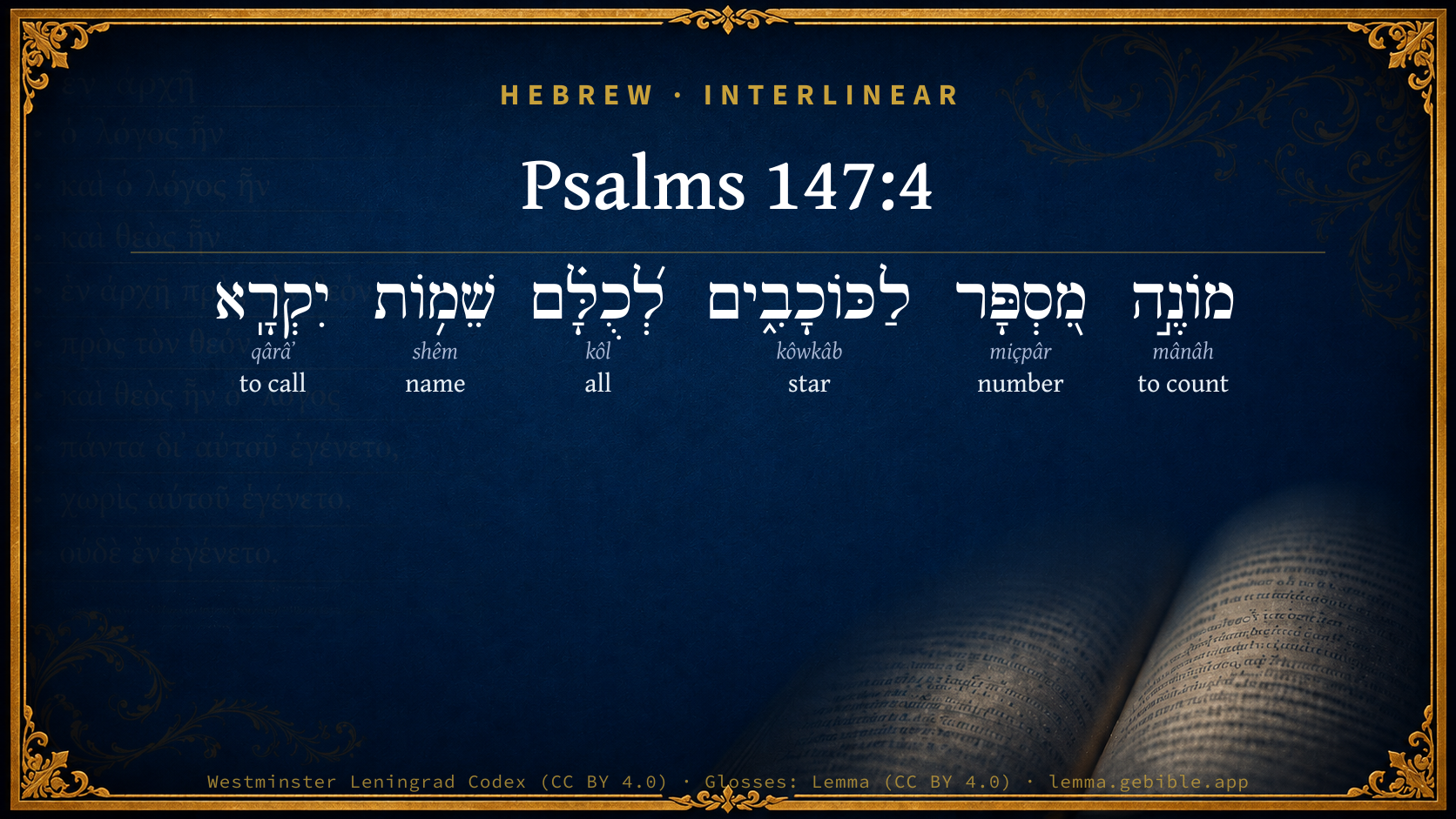
Psalms 147:4

Hebrew (Westminster Leningrad Codex) Psalms 147:4 appears in the Hebrew Old Testament. The text above is from the Westminster Leningrad Codex. Each word links to its Strong’s number, a concise gloss, and parsing drawn from the Open Scriptures Hebrew Bible morphology. Click any word for its full Brown-Driver-Briggs (BDB) entry.
Download image
Cite this verse

Psalms 147:4 (World English Bible). Public Domain. Lemma interlinear Bible study tool, https://lemma.gebible.app/v/psalms/147/4.

Show BibTeX & RIS
BibTeX
RIS
English Translation
He counts the number of the stars. He calls them all by their names.
World English Bible · Public Domain
Download a study sheet

One document with this verse’s original text, its word-by-word gloss line, the meaning frame, cross-references with their text, attributed commentary, and full source and license credits — printable, and it pastes into notes with its structure intact.

This verse Autodidact and up

Study sheet (.html) Plain text (.txt)

A passage Seminary Student

Up to 50 verses in one chapter. A passage sheet keeps up to 6 commentary sources and 12 cross-references per verse, in the order this page ranks them, and says so on the sheet whenever that leaves anything out. Ask for a single verse and you get the Autodidact verse sheet above.

Everything on this page stays free to read, with no account — the sheet is a download of what is already on screen, not access to it.

Want to remove ads? Support Godless Engineer
Compare translations 3

The same verse in 3 English versions, stacked beneath the original-language interlinear above. Click any original word for its lexicon entry.

Each is an independent rendering of the whole verse — the interlinear is not word-aligned to these translations.

Highlighted words mark where these versions differ — a whole-verse word diff, not a word-by-word alignment.

  • World English Bible Public Domain
    He counts the number of the stars. He calls them all by their names.
  • King James Version Public Domain
    He telleth the number of the stars; he calleth them all by their names.
  • unfoldingWord Literal Text CC BY-SA 4.0
    counting the number of the stars, he calls names to all of them.

unfoldingWord Literal Text — © unfoldingWord, licensed CC BY-SA 4.0. Word-aligned USFM3 via Door43 (git.door43.org/unfoldingWord/en_ult).

Versions to compare (up to 4)

3 of 4 selected

Show all 18 translations

Every available English version of this verse, each an independent rendering of the whole verse.

  • World English Bible Public Domain
    He counts the number of the stars. He calls them all by their names.
  • Berean Standard Bible Public Domain
    He determines the number of the stars; He calls them each by name.
  • Majority Standard Bible Public Domain
    He determines the number of the stars; He calls them each by name.
  • King James Version Public Domain
    He telleth the number of the stars; he calleth them all by their names.
  • American Standard Version (1901) Public Domain
    He counteth the number of the stars; He calleth them all by `their' names.
  • Revised Version (1885) Public Domain
    He telleth the number of the stars; he giveth them all their names.
  • Geneva Bible (1599) Public Domain
    He counteth the nomber of the starres, and calleth them all by their names.
  • Douay-Rheims (1899) Public Domain
    His spirit shall go forth, and he shall return into his earth: in that day all their thoughts shall perish.
  • Young's Literal Translation Public Domain
    Appointing the number of the stars, To all them He giveth names.
  • Literal Standard Version CC BY-SA 4.0
    Appointing the number of the stars, || He gives names to all of them.
  • Unlocked Literal Bible CC BY-SA 4.0
    He counts the stars, he gives names to all of them.
  • unfoldingWord Literal Text CC BY-SA 4.0
    counting the number of the stars, he calls names to all of them.
  • Darby Bible Public Domain
    He counteth the number of the stars; he giveth names to them all.
  • World Messianic Bible Public Domain
    He counts the number of the stars. He calls them all by their names.
  • Webster's Bible Public Domain
    He telleth the number of the stars; he calleth them all by their names.
  • Free Bible Version CC BY-SA 4.0
    He knows how many stars he made, and commands all of them by name.
  • Bible in Basic English Public Domain
    He sees the number of the stars; he gives them all their names.
  • JPS Tanakh (1917) Public Domain
    He counteth the number of the stars; He giveth them all their names.

Literal Standard Version (2020), Covenant Press — licensed CC BY-SA 4.0. Text via the HelloAO Bible API (eBible.org). Unlocked Literal Bible (unfoldingWord) — licensed CC BY-SA 4.0. Text via the HelloAO Bible API (eBible.org). unfoldingWord Literal Text — © unfoldingWord, licensed CC BY-SA 4.0. Word-aligned USFM3 via Door43 (git.door43.org/unfoldingWord/en_ult). Free Bible Version, Dr. Jonathan Gallagher — licensed CC BY-SA 4.0. Text via the HelloAO Bible API (eBible.org).

Word by word

More ways to search: Search by grammar → Find every occurrence → Compare this word →

Practice this passage: Drill this verse → Learn its vocabulary →

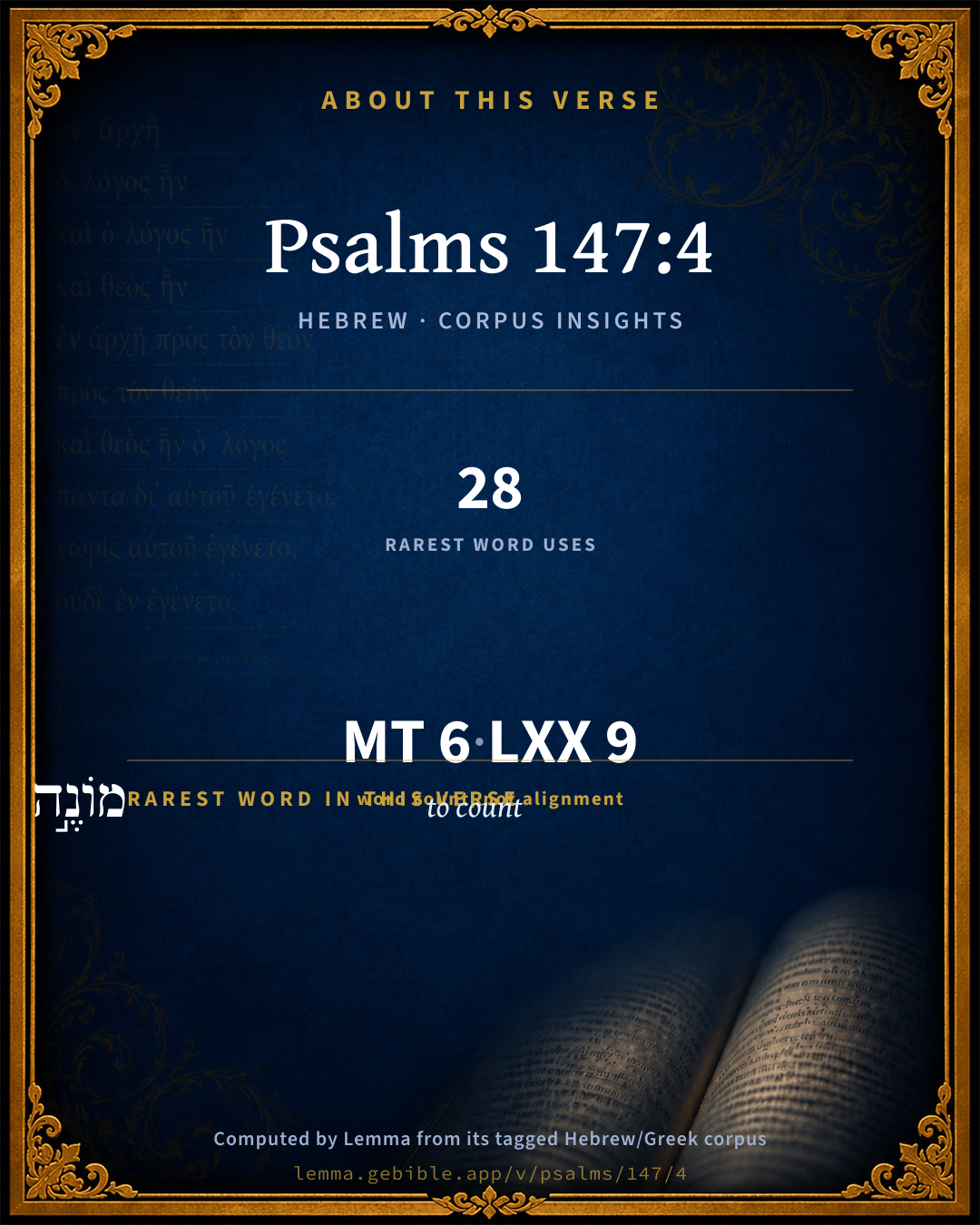
About this verse

These counts appear in no published source. They are computed here, from the morphology-tagged text and Lemma’s own curated glosses. What Lemma adds →

6
words
6
distinct lemmas
Wisdom
section

Shared distinctive vocabulary

מוֹנֶ֣ה to count H4487 occurs in 27 verses of the Hebrew Bible. Also found in:

Grammatical profile

  • 2 verbs
  • 4 nouns

Verb forms

  • מוֹנֶ֣ה Qal · Participle Active
  • יִקְרָֽא Qal · Imperfect

Hebrew & Septuagint length

In English translation the verse runs 14 words from the Hebrew and 12 from the Septuagint (LXX English) — closely comparable.

A rough comparison of the two English renderings, which tokenize alike — not a word-level alignment.

Word counts can differ between the Hebrew and the Greek without any difference in meaning — e.g. the Hebrew direct-object marker אֵת has no separate Greek word, and Greek often adds the article ὁ.

In the original languages it is 6 Hebrew tokens and 9 Greek tokens — but the two are counted differently (Hebrew bundles its prefixes and suffixes into one token; the Greek is in lemma form), so that isn’t a like-for-like length.

Cross-references

4

Topical passages linked to Psalms 147:4 in the Treasury of Scripture Knowledge — connected by theme and wording, ordered by reader-vote popularity; previews shown in the World English Bible.

  • Isaiah 40:26 Lift up your eyes on high, and see who has created these, who brings out their host by number; he calls them all by name; by the greatness of his might, and because he is strong in power, not one is lacking.
  • Psalms 8:3 When I consider your heavens, the work of your fingers, The moon and the stars, which you have ordained;
  • Psalms 148:3 Praise him, sun and moon! Praise him, all you shining stars!
  • Genesis 15:5 Yahweh brought him outside, and said, "Look now toward the sky, and count the stars, if you are able to count them." He said to Abram, "So shall your seed be."

Cross-references courtesy of OpenBible.info (CC BY 4.0).

Hebrew and Greek witnesses Masoretic Hebrew ↔ Greek Septuagint

The same verse in the two great witnesses to the Old Testament, shown verse-for-verse.

You’re reading Greek Psalm 146 (Hebrew Psalm 147). The Septuagint counts the superscription, so verse numbers can differ from the Hebrew — chapter-level alignment, not verse-by-verse. Numbering follows Rahlfs.

These are two independent witnesses, not word-aligned to each other, and the Septuagint is shown in lemma (dictionary) form.

Hebrew Psalms 147:4 Masoretic · Westminster Leningrad Codex

מוֹנֶ֣ה מִ֭סְפָּר לַכּוֹכָבִ֑ים לְ֝כֻלָּ֗ם שֵׁמ֥וֹת יִקְרָֽא

He counts the number of the stars. He calls them all by their names.

World English Bible · Public Domain

Greek LXX Greek Psalm 146:4 Septuagint · lemma form

ὁ ἀριθμέω πλῆθος ἄστρον καί πᾶς αὐτός ὄνομα καλός

He numbers the multitudes of stars; and calls them all by names.

LXX2012 (modern English Septuagint) · Public Domain

Hebrew: Westminster Leningrad Codex (CC BY 4.0). Greek: Septuagint (public domain); English from LXX2012 (modern English Septuagint) (Public Domain). How the Septuagint differs from the Hebrew →

Commentary

Notes on Psalms 147:4 from classic Christian and Jewish commentators (each source and its license shown beneath its notes). The classic Christian expositions comment on the surrounding passage and are grouped to its opening verse, so a note may address several verses; the Jewish commentaries on the Tanakh (Rashi and others) are per-verse, so they appear only where the commentator wrote on this verse.

Lemma curates 59 commentaries, every one of them public domain or Creative Commons licensed, each selected and text-cleaned for this edition rather than reprinted as found. About our sources →

Trapp's Complete Commentary

John Trapp

Psa 147:4 He telleth the number of the stars; he calleth them all by [their] names.

Ver. 4. He telleth the number of the stars] Which to man is impossible, as Aristotle maintaineth against those astronomers, that tell us they are a thousand and some hundreds. But Abraham was a great astronomer; yet he could never do it, Gen 15:5, and the wiser sort of astrologers have rightly distinguished the stars into numerable and innumerable as to men.

He calleth them all by their names] As knowing exactly their nature; and authoritatively commanding every of them to do his pleasure. How much more can God call together his outcasts, and cause them to return; especially since he calleth those things that are not as if they were, Rom 4:17

John Trapp, A Commentary or Exposition upon All the Books of the Old and New Testament (1647–1656) — public domain. Text from a community e-Sword module.

The Biblical Illustrator

Joseph S. Exell

Psa_147:4

He telleth the number of the stars.

The stars and the Cross

As the best, known constellation in our northern hemisphere is Ursa Major (sometimes called the Plough), so the best known, probably, in the southern hemisphere is Cruz Australis, or the Southern Cross. Each side of our globe has, therefore, its own most conspicuous sign, or group of shining stars. But it is the privilege of those who reside at or near the Equator to command a view of both of these beautiful constellations. Standing within the vicinity of the Line, and looking up, the eye can sweep a wide celestial dome, which includes the Northern Plough on the one side, and the Southern Cross upon the other. Now, it is of extreme importance that intelligent Christians should be able to behold at the same time the two hemispheres of nature and of grace. In the same field of vision we should embrace the Plough and the Cross, and intelligently identify the God of nature with the God of grace. The psalmist David always did so, and notably does so in the passage before us. What particularly strikes me here is the marvellous combination of Divine act. I find three statements, each of which commands our admiring thought, but the union of which--for they are closely bracketed together--is positively startling. Slightly varying the order, for the sake of convenience, I would take the whole as a descending climax, a diminuendo bar, of which the three steps are these:

1. God in the heavens: He tolleth the number of the stars: He calleth them all by their names.

2. God in the Church: The Lord doth build up Jerusalem; He gathereth together the outcasts of Israel.

3. God in the home of the afflicted: He healeth the broken in heart; He bindeth up their wounds.

I. God in the heavens. Do we not well from time to time to turn away from the distractions of this lower world, from the petty interests of this mere grain of sand on which we dwell, and, lifting up our eyes in intelligent contemplation to the glorious canopy overhead, to muse on the magnificent empire of Him who alone spreadeth out the heavens, and treadeth on the waves of the sea; who maketh Arcturus, Orion, and the Pleiades, and the chambers of the south; who doeth great things past finding out: yea, and wonders without number? Oh! it will deepen our sense of the condescending love of God shown towards His Church and towards His afflicted people, when we behold His stately and majestic march over the fields of immensity, and see His own hand kindling and trimming every one of those innumerable lamps of heaven!

II. God in the Church There is, as we all know, a literal sense in which the scattered tribes of Abrahams family shall yet be gathered in. He that scattered Israel shall gather him as a shepherd doth his flock. Not more certain is the fact of his dispersion than is the decree of his restoration. A day is coming when Jacobs captivity shall be turned. But the words have also a wider meaning. Blessed be God, He hath devised means whereby His banished of all nations may be brought back; and He is daily, by those means and in all lands where the Gospel is proclaimed, gathering in the outcasts to His fold; and let me say that never have we better evidence that God is in any particular locality building up His Jerusalem than when the outcasts are being gathered in. The surest token of a prosperous Church is zealous and unwearied effort on the part of its members to win the lost and the lapsed around it to Christ. Oh! let us be stirred by the view of the Divine condescension, by the thought that He who sitteth on the circle of the universe, whose arm swings the solar system round yonder star Alcyone, and who holds in His hand the reins of all those stellar steeds that bound around the circuit of immensity, stoops down to this little planet on which we dwell, not only to build up upon it a Church of ransomed men, but even to go out after those who have been poor outcasts from His fold.

III. God in the chamber of the stricken heart. Oh! is it not a marvellous conception: away from the Bible, man never entertained the shadow of such a thought: the Mighty and Eternal One, from whose hand worlds upon worlds are sent forth like sparks from the blacksmiths anvil, or like chaff from the summer threshing-floor, bending to the humblest ministry of mercy, and putting liniments round the wounded heart! Ah! it is only the Gospel of the Lord Jesus Christ that can make the text intelligible. Only in New Testament light can we interpret this mystery; but the person and the mission of the Divine Redeemer make all plain. His mediatorial arms stretch from the highest throne in heaven to the place of deepest woe. In Him the majesty of Divine Omnipotence comes down to the door of human poverty and sorrow. (J. T. Davidson, D. D.)

He telleth the number of the stars

Sir Robert Ball says, The number of the stars visible in England without a telescope may be estimated at about three thousand. Argelander has given to the world a well-known catalogue of the stars in the northern hemisphere, accompanied by a series of charts on which these stars are depicted. All the stars of the first nine magnitudes are included, as well as a very large number of stars lying between the ninth and the tenth magnitude. The total number of these stars is three hundred and twenty-four thousand one hundred and eighty-eight, and yet they are all within reach of a telescope of three inches in aperture. It almost invites us to the belief that the universe which we behold bears but a very small ratio to the far larger part which is invisible in the sombre shades of night. Sir Robert Ball himself estimates the number of the stars at no less than one hundred millions, and an even higher estimate still is given by some astronomers. (R. Brewin.)

The geometry of God

It was truly said by the famous astronomer Kepler that God is the great arithmetician. He counts everything that He has made. He makes all things in fixed numbers. He forms the flowers according to certain numerical relations, so fixed and precise that the Linnaean system of classification was based upon them. The roses have five divisions, the lilies three, the seaweeds, lichens and mushrooms two or four, and every other part of their structure is arranged in fives or threes or twos, or by multiplying these figures. Even the little fringe around the mouth of the seed-vessel of a moss growing on the wayside wall, which you can hardly see with your naked eye, if you magnify it with a lens you will find it arranged in exact numbers--four, eight, sixteen, thirty-two--a series in which every number is the double of the preceding one. The leaves of plants are all arranged around the stem on the same principle, and a fir-cone is one of the most beautiful illustrations of it. Crystals are constructed with mathematical regularity. You cannot unite the chemical elements of Nature to form a compound body by chance or in any proportion you please. (H. Macmillan, D. D.)

Geometry of God

God counts the number of the stars, and He arranges them in the heaven-s not by chance, but according to a fixed system. In the Solar system, for example, the intervals between the orbits of the planets go on doubling as we recede from the sun. Thus Venus is twice as far from Mercury as Mercury is from the sun; the earth is twice as far from Venus as Venus is from Mercury; Mars is twice as far from the earth as the earth is from Venus, and so on. In this way the planets are arranged in the sky around the sun in the same numerical order as the leaves are arranged around the stem of a plant or the scales around a pine-cone, or the teeth around the edge of the seed-vessel of a microscopic moss. And that extraordinary law, the most universal of all laws, which everything throughout the universe obeys--the law of gravitation--is also expressed by a numerical formula: the force of an object thrown into the air decreases just in proportion as the distance is increased; it decreases according to the square of the number expressing the distance; so that at twice the distance the force of gravitation is not twice less, but four times less; at thrice the distance nine times, and so on. (H. Macmillan, D. D.)

Human mind fails to grasp the number of stars

In one of the most recent, standard works upon astronomy it is stated that in Great Britain the number of stars visible to the naked eye does not exceed three thousand. So accurate are the charts of the heavens that are now prepared that every individual star is there; the disappearance of one or the arrival of another would be at once discovered and recorded. Three thousand probably strikes you as being a small figure; but stay a moment. If you make use of a common binocular field-glass you will at once discern ten times as many as with the unaided eye, and if, laying aside the field-glass, you look through a good ordinary telescope, the tens will immediately become hundreds; while if you should have the rare privilege of beholding the celestial dome through one of the great astronomical instruments, the hundreds will become thousands, and you will be fairly bewildered at the sight. Our great telescopes can show at least fifty millions of stars; nor is this all, for, through the recent wonderful development of celestial photography, millions more are discovered registering their existence upon the sensitive plate. (J. T. Davidson, D. D.)

The Biblical Illustrator, edited by Joseph S. Exell (c. 1880s–1900s) — public domain. Text from a community e-Sword module.

Joseph Benson's Commentary

Psa 147:4. He telleth the number of the stars — Which no man can do, for those which astronomers number are only such as are most distinctly visible to the eye, and most considerable for their influences. He calleth them all by their names — That is, “He as distinctly and exactly knows them, how numerous soever they be, (Gen 15:5,) and how confusedly soever they seem to us to be scattered in the sky, as we do those things which we call by their proper names, and thus he knows how to gather the outcasts of Israel out of all their dispersions, and to find every one of them wheresoever they are.”

Joseph Benson's Commentary on the Old and New Testaments (1811–1818) — public domain. Text from a community e-Sword module.

J. A. Alexander on Psalms

Joseph Addison Alexander

4. (Psa 147:4) Telling the number of the stars—to all of them names he calls. The God who thus provides for Israel is the God of nature no less than of grace. Telling, counting, reckoning, estimating. Not determining beforehand, but simply doing what man cannot. See Gen. 15:5, and compare Gen 13:16, Num 32:10, Isa 65:12. He not only counts but names them, calling them all by name. The verse is borrowed from Isa 40:26, where, as here, God's knowledge and control of nature is presented as a source of consolation to his people.

Joseph Addison Alexander, The Psalms Translated and Explained (1850) — public domain. Text from a community e-Sword module.

Tyndale Open Study Notes

Tyndale Open Resources

147:4-5 The Lord created the heavens. • He counts the stars: God’s people can feel secure in knowing that the Lord attends to every detail of his creation; he knows all that belongs to him.

Tyndale Open Study Notes — © Tyndale Open Resources, licensed CC BY-SA 4.0. Text via the HelloAO Bible API.

Geneva Bible (1599)

Geneva Bible translators

Though it seem to man incredible, that God should assemble his Church, being so dispersed, yet nothing can be too hard to him that can number and name all the stars.

Geneva Bible (1599) marginal notes — public domain. Text via Bolls.life.

Jamieson, Fausset & Brown

Robert Jamieson, A. R. Fausset & David Brown

God's power in nature (Isa 40:26-28, and often) is presented as a pledge of His power to help His people.

telleth . . . stars--what no man can do (Gen 15:5).

Jamieson, Fausset & Brown — Commentary Critical and Explanatory on the Whole Bible (1871) — public domain (CC PDM 1.0). Text via the HelloAO Bible API.

Adam Clarke's Commentary

Verse 4. He telleth the number of the stars] He whose knowledge is so exact as to tell every star in heaven, can be under no difficulty to find out and collect all the scattered exiles of Israel.

Adam Clarke's Commentary on the Bible (1810–1826) — public domain. Text from a community e-Sword/MySword module.

John Calvin's Commentaries

4. Numbering the multitude, etc. As the gathering together of the people of whom the Psalmist spoke might appear to be an impossibility, there seems some ground for the opinion of those who think that he confirms it in this verse. The connection they give to the Psalmist’s words is this — that as it is at least not more difficult to gather men together who are outcast and scattered, than to number the stars, there was no reason why the wandering exile Israelites should despair of their return, provided they should resort with one consent to God as their only head. There is some probability, too, in the conjecture that the Psalmist may allude to that promise —

“Look now towards the stars of heaven, if thou canst tell them, so shall thy seed be.” (Genesis 15:5.)

But as the Psalmist immediately afterwards treats of the order of things in nature generally, the simplest rendering, I think, is to understand this verse with reference to the admirable work of God to be seen in the heavens, where we behold his matchless wisdom, in regulating, without one degree of aberration, the manifold, complex, winding courses of the stars. To each of them he assigns its fixed and distinct office, and in all the multitude there is no confusion. He therefore exclaims immediately — Great is God, and boundless, both in power and understanding. We learn from this that there cannot be greater folly than to make our judgment the measure of God’s works, displaying in these, as he often does, his incomprehensible power and wisdom.

John Calvin's Commentaries (1540-1563) — public domain. Text from the Calvin Translation Society English edition (1840s-50s) via the Christian Classics Ethereal Library (ccel.org). Calvin's coverage is partial (roughly two-thirds of the Bible); uncommented books and verses are honest gaps, never fabricated. The 19th-century editor's footnotes and remarks are omitted so the notes are faithfully Calvin's own voice.

Ellicott's Commentary for English Readers

(4) Stars.—This proof of God’s power to help, by reference to the stars of heaven, which are beyond man’s power to count, much more to name, but which the Almighty both numbers and names, seems rather abruptly introduced, but the train of thought is clear. To assemble the dispersed of Israel, however numerous and scattered, was easy to the ruler of the hosts of heaven. The original promise to Abraham was, of course, in the poet’s mind, but still more Isa_40:26-28, from which the expression may have been taken. The dramatic “Lift your eyes on high and behold” supplies the link needed in the abrupt entrance of the thought of the psalm.

A Bible Commentary for English Readers, edited by Charles John Ellicott (1878–1897) — public domain. Text from a community e-Sword module.

The Cambridge Bible for Schools and Colleges

gen. ed. J. J. S. Perowne

4, 5. An imitation of Isa_40:26; Isa_40:28. Jehovah’s omniscience and omnipotence are partly a ground for praise, partly an encouragement to trust Him. Cp. Psa_146:6. He who knows each separate star will not lose sight of one single Israelite.

He telleth &c.] Either simply, he counteth the number of the stars, which to man seem innumerable (Gen_15:5): or, he appointeth a number for the stars, i.e. as in Isa_40:26, “he bringeth out their host by number,” marshals them in order like a well disciplined army.

he calleth them all by their names] He giveth them all names; i.e. He knows them individually. The original passage in Isa_40:26, “calleth them all by name,” taken in connexion with the preceding clause, means rather that He summons them as the soldiers of an army are summoned when the roll is called.

The Cambridge Bible for Schools and Colleges (gen. ed. J. J. S. Perowne; Cambridge University Press, 1878–1918) — public domain. Text from a community e-Sword module.

John Gill's Exposition

He telleth the number of the stars,.... Which no man can do exactly; see Gen 15:5; the ancient astronomers pretended to tell them, as Aratus and Eudoxus (o), and fixed their number at a thousand and some odd; but then these were only such as were of some magnitude and influence, and such as commonly appeared; but since the use of telescopes many are seen which were not before; and especially those clusters of them in the Milky Way cannot be distinctly discerned and told; but the Lord that made them can tell their exact number. Aben Ezra thinks this is said with respect to the outcasts of Israel scattered throughout the whole earth, as the stars are in the upper orb; and that as the Lord knows the one, he knows the other; which is not amiss, especially spiritually understood;

he calleth them all by their names; not that he calls one Jupiter and another Verus, &c. as the Heathens have done; but the sense is, that he has as perfect, distinct, and exact knowledge of them, as we have of any persons or things that we can call by name, and more so; see Isa 40:26. This may be applied to the saints, who are like to stars for the light they receive from Christ the sun of righteousness, and are a number which no man can number; but Christ knows them all distinctly and exactly, and can call them by name, and holds them in his right hand, and will preserve them; and they shall shine for ever like stars, yea, like the sun in the kingdom of his Father; so Arama interprets this of the righteous, who are compared to stars; see Dan 12:4.

(o) Vid. Augustin de Civ. Dei, l. 16. c. 23.

John Gill's Exposition of the Whole Bible (1746–1763) — public domain (CC PDM 1.0). Text via the HelloAO Bible API.

Albert Barnes' Notes on the Bible

He telleth the number of the stars - He counts them all. God only can do this. The stars are so numerous that no astronomer can count them; they lie so far in the depths of space, and are so remote from each other, that no man can be so presumptuous as to suppose that he has even seen any considerable part of them, even by the aid of the most powerful telescopes.

He calleth them all by their names - As if each one had a name, and God could call them forth one by one by their names, like the muster-roll of an army. This language seems to be taken from Isa 40:26 : “Lift up your eyes on high, and behold who hath created these things, that bringeth out their host by numbers; he calleth them all by names, by the greatness of his might, for that he is strong in power; not one faileth.” See the notes at that passage.

Albert Barnes' Notes on the Bible (1834–1885) — public domain. Text from a community e-Sword/MySword module.

Matthew Poole's English Annotations

He telleth the number of the stars, which no man can do, Gen 22:17. For those thousand and twenty-five which astrononers number, are only such as are most distinctly visible to the eye, and most considerable for their influences.

He calleth them all by their names: this signifies,

1. That He exactly knows them as we do those whom we can call by name; he is able to give distinct names to each of them, because he accurately understands their several natures and operations.

2. That he hath a sovereign power over them, as men have over their children, or servants, or soldiers, whom they can call by name; that he appointeth and governeth all their motions and influences to the fulfilling of his own pleasure and purposes.

Matthew Poole's English Annotations on the Holy Bible (1683–1685) — public domain. Text from a community e-Sword/MySword module.

The Treasury of David

Charles H. Spurgeon

Ver. 4. He telleth the number of the stars. None but he can count the mighty host, but as he made them and sustains them he can number them. To Jehovah stars are as mere coins, which the merchant tells as he puts them into his bag. He calleth them all by their names. He has an intimate acquaintance with each separate orb, so as to know its name or character. Indeed, he gives to each its appropriate title, because he knows its constitution and nature. Vast as these stars are, they are perfectly obedient to his bidding; even as soldiers to a captain who calls their names, and allots them their stations. Do they not rise, and set, and move, or stand, precisely according to his order? What a change is here from the preceding verse! Read the two without a break, and feel the full force of the contrast. From stars to sighs is a deep descent! From worlds to wounds is a distance which only infinite compassion can bridge. Yet he who acts a surgeon's part with wounded hearts, marshals the heavenly host, and reads the muster roll of suns and their majestic systems. O Lord, it is good to praise thee as ruling the stars, but it is pleasant to adore thee as healing the broken in heart!

Ver. 4. He telleth the number of the stars, etc. In which similitude he showeth, that albeit Abraham could not comprehend the multitude of the children, either of his faith or of his flesh, more than he could count the number of the stars; yet the Lord knoweth every believer by name, as he knoweth every star and can call every one by its name. David Dickson.

Ver. 4. He telleth the number of the stars, etc. Among the heathen every constellation represented some god. But the Scriptures show Jehovah, not as one of many starry gods, but as the one God of all the stars. He is, too, as he taught his people by Abraham, the God of a firmament of nobler stars. His people are scattered and trodden as the sands of the sea-shore. But he turns dust and dirt to stars of glory. He will make of every saint a star, and Heaven is his people's sky, where broken hearted sufferers of earth are glorified into glittering galaxies. Hermann Venema.

Ver. 4. He calleth them all by their names. Literally, "calleth names to all of them", an expression marking not only God's power in marshalling them all as a host (Isa 40:26), but also the most intimate knowledge and watchful care, as that of a shepherd for his flock. Joh 10:3. J.J. Stewart Perowne.

Ver. 4. He calleth them all by their names. They render a due obedience to him, as servants to their master. When he singles them out and calls them by name to do some official service, he calls them out to their several offices, as the general of an army appoints the station of every regiment in a battalion; or, "he calls them by name", i.e. he imposes names upon them, a sign of dominion, the giving names to the inferior creatures being the first act of Adam's derivative dominion over them. These are under the sovereignty of God. The stars by their influences fight against Sisera (Jud 5:20); and the sun holds in its reins, and stands stone still to light Joshua to a complete victory: Jos 10:12. They are all marshalled in their ranks to receive his word of command, and fight in close order, as being desirous to have a share in the ruin of the enemies of their sovereign. Stephen Charnock.

Ver. 4. The immense distance at which the nearest stars are known to be placed, proves that they are bodies of a prodigious size, not inferior to our own sun, and that they shine, not, by reflected rays, but by their own native light. But bodies encircled with such refulgent splendour, would be of little use in Jehovah's empire, unless surrounding worlds were cheered by their benign influence, and enlightened by their beams. Every star is therefore concluded to be a sun surrounded by planetary globes. Nearly a thousand of these luminaries may be seen in a clear winter's night by the naked eye. But these do not form the eighty-thousandth part of what may be descried by the help of telescopes. While Dr. Herschel was exploring the most crowded part of the milky way, in one quarter of an hour's time no less than 116,000 stars passed through the field of view of his telescope. It has been computed, that nearly one hundred millions of stars might be perceived by our most perfect instruments, if all the regions of the sky were thoroughly explored. But immeasurable regions of space lie beyond the utmost boundaries of human vision, even thus assisted, into which imagination itself can scarcely penetrate, but which are doubtless filled with operations of divine wisdom and divine omnipotence. Thomas Dick, in "The Christian Philosopher."

Psalms 147:5*

Charles H. Spurgeon's The Treasury of David (1869–1885) — public domain. Psalms only. Text from a community e-Sword/MySword module.

Whedon's Commentary on the Bible

Daniel D. Whedon

4. He telleth the… stars—Here is something more than poetical embellishment. He who thus knows and calls the stars, much more knows and names his people.

Daniel D. Whedon (gen. ed.), Commentary on the Old and New Testaments (1874–1909) — public domain. Text from a community e-Sword module.

The Pulpit Commentary

He telleth the number of the stars. Nothing escapes God"s knowledge. He knew the number of the exiles, and the place and name of each, just as he knows the number of the stars and their names. (comp. Isa_40:26) He calleth them all by their names. (see Job_9:9)

The Pulpit Commentary (1880–1919), ed. H.D.M. Spence-Jones & Joseph S. Exell — public domain. Text from a community e-Sword module.

John Wesley's Explanatory Notes

Calleth them - He exactly knows them as we do those whom we can call by name.

John Wesley, Explanatory Notes Upon the Whole Bible (1754–1765) — public domain. Text via the GEBible commentary corpus.

unfoldingWord translationNotes

Door43 World Missions Community

his understanding cannot be measured

This can be stated in active form. AT: "no one can measure his understanding" or "his understanding has no limit" (See: Active or Passive)

translationWords

name

lord

awe

power

understand

unfoldingWord translationNotes — © Distant Shores Media and the Door43 World Missions Community, licensed CC BY-SA 4.0. Source: git.door43.org/Door43/en_tn.

Lesson kit

Teaching starters — assembled from the data on this page, not authored interpretation. Every prompt links to the verse data it draws on. Edit before teaching.

Psalms, in the Wisdom, opens this verse with 6 words (6 distinct Hebrew lemmas). Its most distinctive word is mânâh (“to count”). A historical commentator’s framing appears above. Read the whole chapter for the surrounding context.

Discussion questions

  1. What does “to count” (mânâh) contribute to the verse as a whole?
  2. Genesis 13:16 shares the word «to count» with this verse. How do the two illuminate each other?
  3. These translations render this verse differently; the difference is in the English rendering, not the original. What questions does that raise?
  4. The verb «מוֹנֶ֣ה» is Qal Participle Active. How does its form color the action?
  5. Reading how Trapp's Complete Commentary and The Biblical Illustrator read this verse, where do the two commentators agree and where do they part?

Things to notice

Reading settings

Reading text

Shown beneath each verse's original-language words.

Old Testament
Old Testament edition

Read the OT as the Masoretic Hebrew (MT) or the Greek Septuagint (LXX).

English shown for the Greek Septuagint (in the Hebrew ↔ Greek comparison).

Comparing translations? Open the Compare panel on any verse page to stack up to four side by side.