Obadiah 1:4

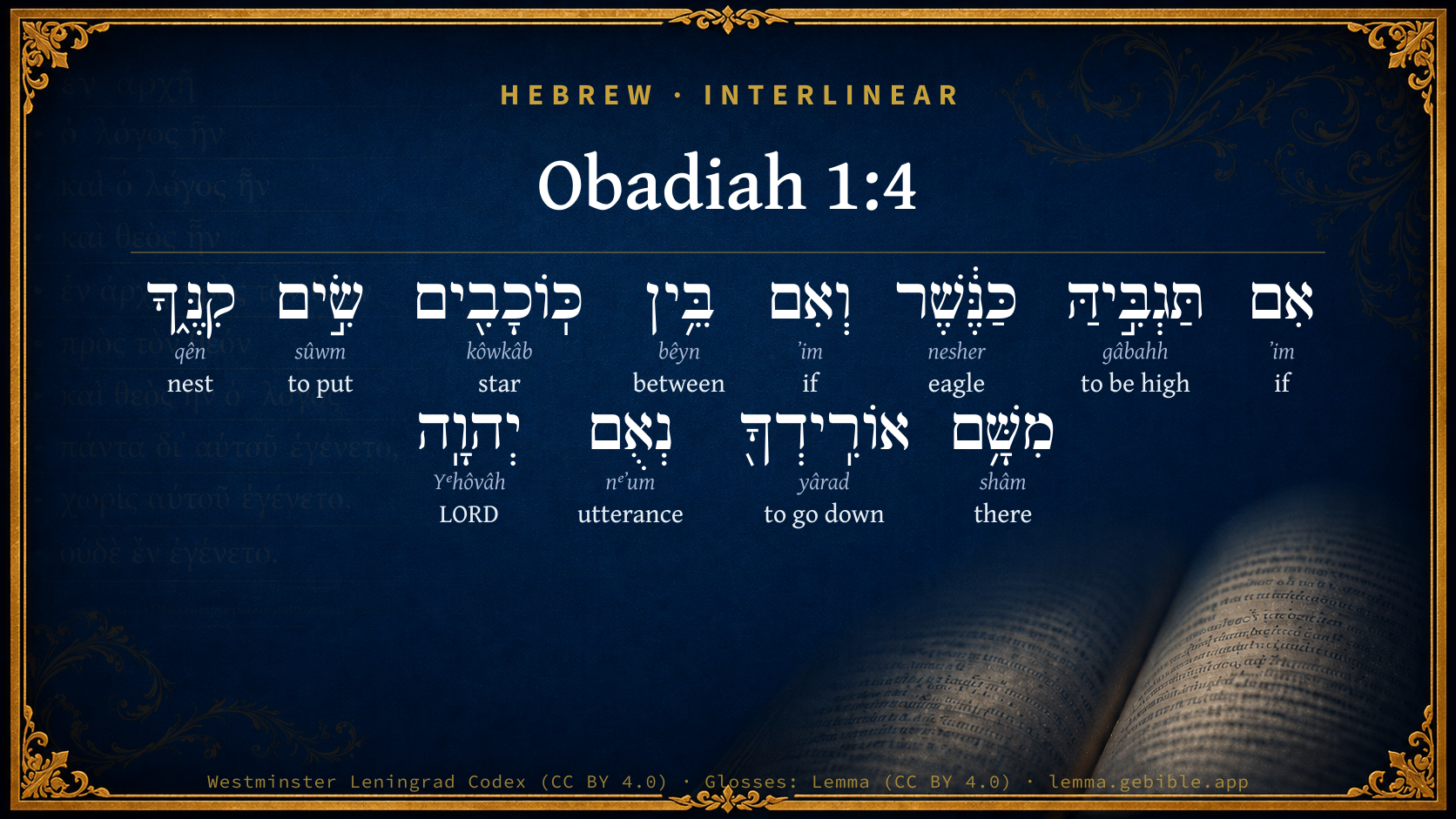
Hebrew (Westminster Leningrad Codex) Obadiah 1:4 appears in the Hebrew Old Testament. The text above is from the Westminster Leningrad Codex. Each word links to its Strong’s number, a concise gloss, and parsing drawn from the Open Scriptures Hebrew Bible morphology. Click any word for its full Brown-Driver-Briggs (BDB) entry.
Download image
Cite this verse

Obadiah 1:4 (World English Bible). Public Domain. Lemma interlinear Bible study tool, https://lemma.gebible.app/v/obadiah/1/4.

Show BibTeX & RIS
BibTeX
RIS
English Translation
Though you mount on high as the eagle, and though your nest is set among the stars, I will bring you down from there, says Yahweh.
World English Bible · Public Domain
Download a study sheet

One document with this verse’s original text, its word-by-word gloss line, the meaning frame, cross-references with their text, attributed commentary, and full source and license credits — printable, and it pastes into notes with its structure intact.

This verse Autodidact and up

Study sheet (.html) Plain text (.txt)

A passage Seminary Student

Up to 50 verses in one chapter. A passage sheet keeps up to 6 commentary sources and 12 cross-references per verse, in the order this page ranks them, and says so on the sheet whenever that leaves anything out. Ask for a single verse and you get the Autodidact verse sheet above.

Everything on this page stays free to read, with no account — the sheet is a download of what is already on screen, not access to it.

Want to remove ads? Support Godless Engineer
Compare translations 3

The same verse in 3 English versions, stacked beneath the original-language interlinear above. Click any original word for its lexicon entry.

Each is an independent rendering of the whole verse — the interlinear is not word-aligned to these translations.

Highlighted words mark where these versions differ — a whole-verse word diff, not a word-by-word alignment.

  • World English Bible Public Domain
    Though you mount on high as the eagle, and though your nest is set among the stars, I will bring you down from there, says Yahweh.
  • King James Version Public Domain
    Though thou exalt thyself as the eagle, and though thou set thy nest among the stars, thence will I bring thee down, saith the LORD.
  • unfoldingWord Literal Text CC BY-SA 4.0
    If you make yourself high like the eagle, even if your nest is set between the stars, from there I will bring you down: a declaration of Yahweh.

unfoldingWord Literal Text — © unfoldingWord, licensed CC BY-SA 4.0. Word-aligned USFM3 via Door43 (git.door43.org/unfoldingWord/en_ult).

Versions to compare (up to 4)

3 of 4 selected

Show all 18 translations

Every available English version of this verse, each an independent rendering of the whole verse.

  • World English Bible Public Domain
    Though you mount on high as the eagle, and though your nest is set among the stars, I will bring you down from there, says Yahweh.
  • Berean Standard Bible Public Domain
    Though you soar like the eagle and make your nest among the stars, even from there I will bring you down,” declares the LORD.
  • Majority Standard Bible Public Domain
    Though you soar like the eagle and make your nest among the stars, even from there I will bring you down,” declares the LORD.
  • King James Version Public Domain
    Though thou exalt thyself as the eagle, and though thou set thy nest among the stars, thence will I bring thee down, saith the LORD.
  • American Standard Version (1901) Public Domain
    Though thou mount on high as the eagle, and though thy nest be set among the stars, I will bring thee down from thence, saith Jehovah.
  • Revised Version (1885) Public Domain
    Though thou mount on high as the eagle, and though thy nest be set among the stars, I will bring thee down from thence, saith the LORD.
  • Geneva Bible (1599) Public Domain
    Though thou exalt thy selfe as the eagle, and make thy nest among the starres, thence will I bring thee downe, sayth the Lord.
  • Douay-Rheims (1899) Public Domain
    Though thou be exalted as an eagle, and though thou set thy nest among the stars: thence will I bring thee down, saith the Lord.
  • Young's Literal Translation Public Domain
    If thou dost go up high as an eagle, And if between stars thou dost set thy nest, From thence I bring thee down, An affirmation of Jehovah.
  • Literal Standard Version CC BY-SA 4.0
    If you go up high as an eagle, || And if you set your nest between stars, || From there I bring you down,” || A declaration of YHWH.
  • Unlocked Literal Bible CC BY-SA 4.0
    Though you soar high like the eagle and though your nest is set among the stars, I will bring you down from there, says Yahweh.
  • unfoldingWord Literal Text CC BY-SA 4.0
    If you make yourself high like the eagle, even if your nest is set between the stars, from there I will bring you down: a declaration of Yahweh.
  • Darby Bible Public Domain
    Though thou exalt thyself as the eagle, and though thou set thy nest among the stars, thence will I bring thee down, saith Jehovah.
  • World Messianic Bible Public Domain
    Though you mount on high as the eagle, and though your nest is set among the stars, I will bring you down from there,” says the LORD.
  • Webster's Bible Public Domain
    Though thou shalt exalt thyself as the eagle, and though thou shalt set thy nest among the stars, thence will I bring thee down, saith the LORD.
  • Free Bible Version CC BY-SA 4.0
    But even though you soar like an eagle, even though you make your nest among the stars, I will bring you down from there, declares the Lord.
  • Bible in Basic English Public Domain
    Though you go up on high like an eagle, though your house is placed among the stars, I will make you come down from there, says the Lord.
  • JPS Tanakh (1917) Public Domain
    Though thou make thy nest as high as the eagle, and though thou set it among the stars, I will bring thee down from thence, saith the LORD.

Literal Standard Version (2020), Covenant Press — licensed CC BY-SA 4.0. Text via the HelloAO Bible API (eBible.org). Unlocked Literal Bible (unfoldingWord) — licensed CC BY-SA 4.0. Text via the HelloAO Bible API (eBible.org). unfoldingWord Literal Text — © unfoldingWord, licensed CC BY-SA 4.0. Word-aligned USFM3 via Door43 (git.door43.org/unfoldingWord/en_ult). Free Bible Version, Dr. Jonathan Gallagher — licensed CC BY-SA 4.0. Text via the HelloAO Bible API (eBible.org).

Word by word

More ways to search: Search by grammar → Find every occurrence → Compare this word →

Practice this passage: Drill this verse → Learn its vocabulary →

קִנֶּ֑ךָ
qên
H7064
“nest · your”
Noun, Common, Masculine, Singular, Construct + Suffix, Personal, 2nd Person, Masculine, Singular
Part of Speech
Noun
Type
Common
Gender
Masculine
Number
Singular
State
Construct
Full BDB Definition

Origin: contracted from H7077

TWOT: 2042a

nest - nest (of bird) - cells (like nests in Noah's ark)
  1. אִם ʼim H518 “if” Conjunction
  2. תַּגְבִּ֣יהַּ gâbahh H1361 “to be high” Verb, Hiphil, Imperfect, 2nd Person, Masculine, Singular
  3. כַּנֶּ֔שֶׁר nesher H5404 “like/as the · eagle” Preposition, Determined + Noun, Common, Masculine, Singular, Absolute
  4. וְאִם ʼim H518 “and · if” Conjunction + Conjunction
  5. בֵּ֥ין bêyn H996 “between” Preposition
  6. כּֽוֹכָבִ֖ים kôwkâb H3556 “stars” Noun, Common, Masculine, Plural, Absolute
  7. שִׂ֣ים sûwm H7760 “put” Verb, Qal, Participle Passive, Masculine, Singular, Absolute
  8. מִשָּׁ֥ם shâm H8033 “from · there” Preposition + Adverb
  9. אוֹרִֽידְךָ֖ yârad H3381 “to go down · you” Verb, Hiphil, Imperfect, 1st Person, Common, Singular + Suffix, Personal, 2nd Person, Masculine, Singular
  10. נְאֻם nᵉʼum H5002 “utterance of” Noun, Common, Masculine, Singular, Construct
  11. יְהוָֽה Yᵉhôvâh H3068 “LORD” Noun, Proper

About this verse

These counts appear in no published source. They are computed here, from the morphology-tagged text and Lemma’s own curated glosses. What Lemma adds →

12
words
11
distinct lemmas
Prophets
section

Notable vocabulary

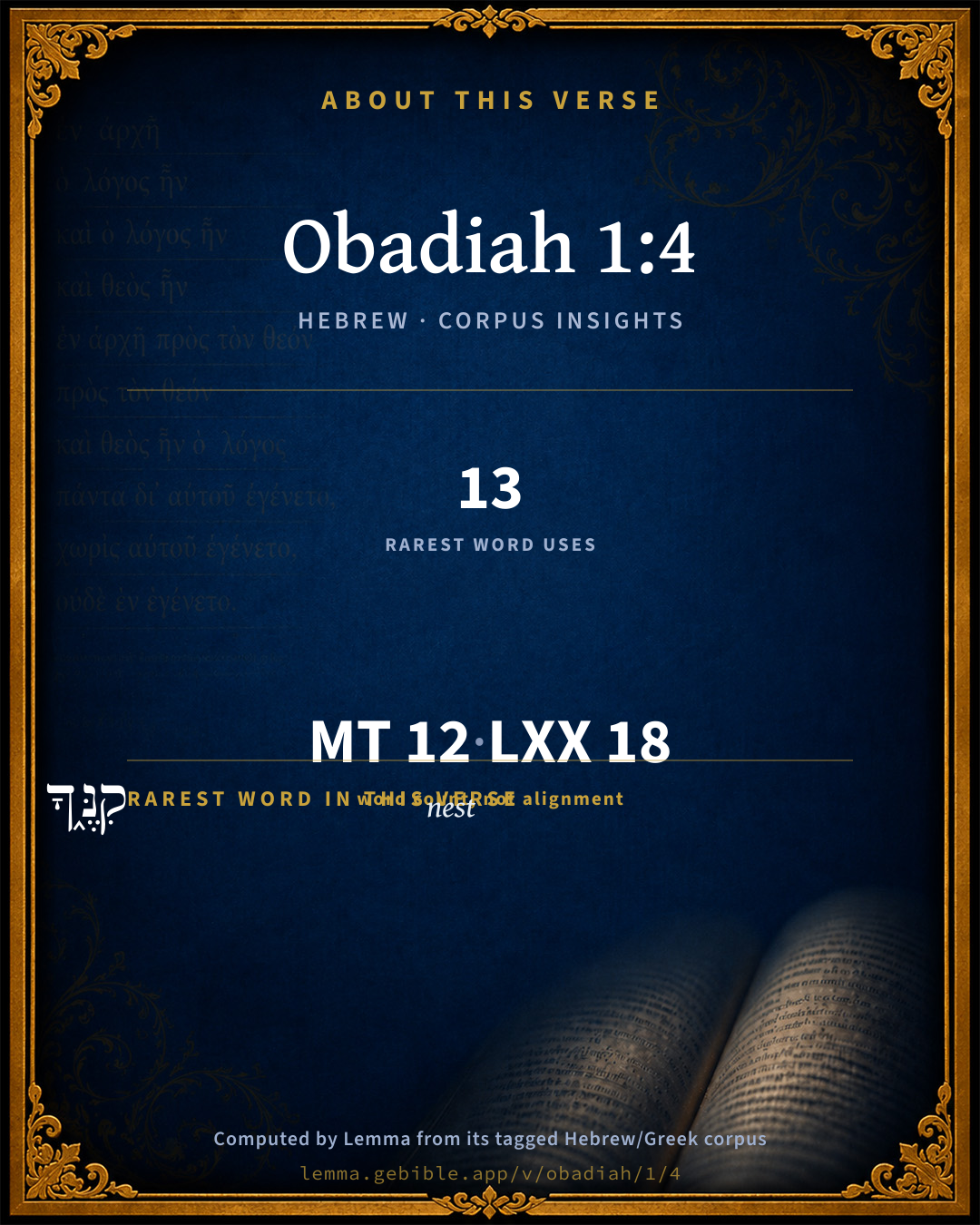
The rarest word here is קִנֶּ֑ךָ nest H7064 — appearing just 13 times in the whole Hebrew Bible.

Shared distinctive vocabulary

קִנֶּ֑ךָ nest H7064 occurs in 13 verses of the Hebrew Bible. Also found in:

Grammatical profile

  • 3 verbs
  • 5 nouns
  • 1 preposition
  • 2 conjunctions
  • 1 adverb

Verb forms

  • תַּגְבִּ֣יהַּ Hiphil · Imperfect
  • שִׂ֣ים Qal · Participle Passive
  • אוֹרִֽידְךָ֖ Hiphil · Imperfect

Repetition

A word recurs within this verse — often emphatic in Hebrew:

  • אִם if H518 ×2

Hebrew & Septuagint length

In English translation the verse runs 26 words from the Hebrew and 27 from the Septuagint (LXX English) — closely comparable.

A rough comparison of the two English renderings, which tokenize alike — not a word-level alignment.

Word counts can differ between the Hebrew and the Greek without any difference in meaning — e.g. the Hebrew direct-object marker אֵת has no separate Greek word, and Greek often adds the article ὁ.

In the original languages it is 12 Hebrew tokens and 18 Greek tokens — but the two are counted differently (Hebrew bundles its prefixes and suffixes into one token; the Greek is in lemma form), so that isn’t a like-for-like length.

Cross-references

7

Topical passages linked to Obadiah 1:4 in the Treasury of Scripture Knowledge — connected by theme and wording, ordered by reader-vote popularity; previews shown in the World English Bible.

  • Job 20:6–7 Though his height mount up to the heavens, And his head reach to the clouds,
  • Isaiah 14:12–15 How you are fallen from heaven, day-star, son of the morning! How you are cut down to the ground, who laid the nations low!
  • Amos 9:2 Though they dig into Sheol, there my hand will take them; and though they climb up to heaven, there I will bring them down.
  • Habakkuk 2:9 Woe to him who gets an evil gain for his house, that he may set his nest on high, that he may be delivered from the hand of evil!
  • Jeremiah 49:16 As for your terror, the pride of your heart has deceived you, O you who dwell in the clefts of the rock, who hold the height of the hill: though you should make your nest as high as the eagle, I will bring you down from there, says Yahweh.
  • Jeremiah 51:53 Though Babylon should mount up to the sky, and though she should fortify the height of her strength, yet from me shall destroyers come to her, says Yahweh.
  • Job 39:27–28 Is it at your command that the eagle mounts up, And makes his nest on high?

Cross-references courtesy of OpenBible.info (CC BY 4.0).

Hebrew and Greek witnesses Masoretic Hebrew ↔ Greek Septuagint

The same verse in the two great witnesses to the Old Testament, shown verse-for-verse.

These are two independent witnesses, not word-aligned to each other, and the Septuagint is shown in lemma (dictionary) form.

Hebrew Obadiah 1:4 Masoretic · Westminster Leningrad Codex

אִם תַּגְבִּ֣יהַּ כַּנֶּ֔שֶׁר וְאִם בֵּ֥ין כּֽוֹכָבִ֖ים שִׂ֣ים קִנֶּ֑ךָ מִשָּׁ֥ם אוֹרִֽידְךָ֖ נְאֻם יְהוָֽה

Though you mount on high as the eagle, and though your nest is set among the stars, I will bring you down from there, says Yahweh.

World English Bible · Public Domain

Greek LXX Obadiah 1:4 Septuagint · lemma form

ἐάν μετεωρίζω ὡς ἀετός καί ἐάν ἀνά μέσος ὁ ἄστρον τίθημι νοσσιά σύ ἐκεῖθεν καταἄγω σύ λέγω κύριος

If you should mount up as the eagle, and if you should make your nest among the stars, thence will I bring you down, says the Lord.

LXX2012 (modern English Septuagint) · Public Domain

Hebrew: Westminster Leningrad Codex (CC BY 4.0). Greek: Septuagint (public domain); English from LXX2012 (modern English Septuagint) (Public Domain). How the Septuagint differs from the Hebrew →

Targum (Aramaic paraphrase)

1

The Targum is the ancient Jewish Aramaic paraphrase of the Hebrew Scriptures — an interpretive translation, not the Hebrew text itself. Onkelos (literal) and Pseudo-Jonathan (expansive) render the Torah, and Jonathan the Prophets. Coverage is partial: where no permissively-licensed English translation exists for a verse, only the Aramaic is shown. This is verse-level text, not a word-by-word alignment to the Hebrew.

  1. Targum Jonathan Prophets (Joshua–Malachi)
    אִם תְּרִים כְּנִשְׁרָא וְאִם בֵּינֵי כוֹכְבַיָא תְּשַׁוֵי מְדוֹרָךְ מִתַּמָן אַחֲתִינָךְ אֲמַר יְיָ:

    (no public-domain English translation for this verse)

    Targum Jonathan — Aramaic: “Mikraot Gedolot” (public domain). English: “Sefaria Community Translation” (CC0 1.0 (public-domain dedication)); “London "Chaldee Paraphrase," 1871” (public domain). Text via Sefaria.

Commentary

Notes on Obadiah 1:4 from classic Christian and Jewish commentators (each source and its license shown beneath its notes). The classic Christian expositions comment on the surrounding passage and are grouped to its opening verse, so a note may address several verses; the Jewish commentaries on the Tanakh (Rashi and others) are per-verse, so they appear only where the commentator wrote on this verse.

Lemma curates 59 commentaries, every one of them public domain or Creative Commons licensed, each selected and text-cleaned for this edition rather than reprinted as found. About our sources →

Trapp's Complete Commentary

John Trapp

Oba 1:4 Though thou exalt [thyself] as the eagle, and though thou set thy nest among the stars, thence will I bring thee down, saith the LORD.

Ver. 4. Though thou exalt thyself as the eagle] Or, as the Arabic text hath it, ad aquilam, hard by the eagle; couldst thou fly as high a pitch as that bird, which is said to soar out of sight, and build thy nest aloft, as he doth, on the highest mountains and tallest trees, that the serpent may not come at his young.

And though thou set thy nest among the stars] i.e. Upon such high hills as reach to the upper region of the air. Of Ithaca (Ulysses’ country) the orator saith, that it was in scopulis quasi nidus affixa, set as a nest upon the rocks. And Paulus Aemilius, the Roman general, pulled down the castles at Athens, saying that they were tyrannorum nidi nests of despots; and our Henry VIII commanded the abbeys here to be demolished, saying that those crows’ nests were to be destroyed, ne iterum ad cohabitandum convolent, that they might never breed again among us. Lucifer and his antitype Nebuchadnezzar spake of ascending into heaven, above the heights of the clouds, and of the setting their thrones above the stars of God, Isa 14:13-14. See the like language, or bigger, from the prince of Tyre, Eze 28:2, with the issue, much like this that here followeth.

Thence will I bring thee down] Down with a vengeance, as he did Pharaoh, Nebuchadnezzar, Herod, Edom, Attilas, Gensericus, Bajazet, &c. The Philistines flouted Jonathan and his armourbearer, and said, Come up to us, and we will show you a thing: that is, we will give you your payment before we part with you. They held it impossible to get up that sharp, steep, craggy rock where they kept garrison. But Jonathan clambered over that rock on his hands and feet, and put them to the rout, 1Sa 14:13. An exploit of as great, or rather of greater valour, than that of Alexander the Great, for which he is so crowned and chronicled by Plutarch and Curtius. The story is this. Arimazes having garrisoned a very strong rock (held almost inaccessible, and to which there was but one only passage) in the Sogdian country, with thirty thousand men; and being sent unto by Alexander to yield up his stronghold, derided him, and asked whether Alexander could fly? whereunto Alexander returned this answer, I will make thee know ere thou art a night older that the Macedonians can fly. Hereupon he picked out three hundred of the boldest men he had, and by great promises prevailed with them the next night to climb up the back side of the rock to the top of it, which accordingly they did, and killing the guards, took the garrison, letting in Alexander, who nailed Arimazes to a cross.

Saith the Lord] Who will surely do it, how improbable or impossible soever you may judge it.

John Trapp, A Commentary or Exposition upon All the Books of the Old and New Testament (1647–1656) — public domain. Text from a community e-Sword module.

Jamieson, Fausset & Brown

Robert Jamieson, A. R. Fausset & David Brown

exalt thyself--or supply from the second clause, "thy nest" [MAURER] (Compare ; ; ).

set . . . nest among . . . stars--namely, on the loftiest hills which seem to reach the very stars. Edom is a type of Antichrist (; ; ).

thence will I bring thee down--in spite of thy boast (), "Who shall bring me down?"

Jamieson, Fausset & Brown — Commentary Critical and Explanatory on the Whole Bible (1871) — public domain (CC PDM 1.0). Text via the HelloAO Bible API.

Adam Clarke's Commentary

Verse 4. Though thou exalt thyself as the eagle] Though like this bird thou get into the highest cliff of the highest rock, it will not avail thee. To defend thee, when Jehovah has determined thy destruction, thy deepest caves and highest rocks will be equally useless. See Jer 49:16.

Adam Clarke's Commentary on the Bible (1810–1826) — public domain. Text from a community e-Sword/MySword module.

The Cambridge Bible for Schools and Colleges

gen. ed. J. J. S. Perowne

4. thou exalt thyself] There is no need to supply the word “thyself,” as is done by A.V. and others (“though thou wentest as high as the eagle.” Ewald). “Thy nest” is the subject of both clauses. The words as they stand give a perfectly clear sense in English, as in Hebrew: though thou exaltest as the eagle, and though among the stars thou settest thy nest. Comp. Num_24:21, Hab_2:9.

The Cambridge Bible for Schools and Colleges (gen. ed. J. J. S. Perowne; Cambridge University Press, 1878–1918) — public domain. Text from a community e-Sword module.

John Gill's Exposition

Though thou exaltest thyself as the eagle,.... That soars aloft, flies on high, even out of sight, higher than any other bird does: or, "exaltest thy habitation"; and makest it as high as the eagle's nest; see Jer 49:16;

and though thou set thy nest among the stars; even higher than the eagle's; an hyperbolical expression, supposing that which never was or can be done; yet, if it was possible, would not secure from danger: or should their castles and fortresses be built upon the top of the highest mountains, which seem to reach the heavens, and be among the stars:

thence will I bring thee down, saith the Lord; this is said in answer to the question put, or bold challenge made, in Oba 1:3; if men cannot do it, God will; and, if he employs instruments to effect it, it shall be done by them; all seeming difficulties are easily surmounted by an omnipotent Being; what are the heights of mountains, or the strength of fortresses, to him? thus the whore of Rome sits upon seven mountains, and mystical Babylon reigns over the kings of the earth; yet shall be thrown down and found no more, for the Lord is strong that judgeth her, Rev 17:9.

John Gill's Exposition of the Whole Bible (1746–1763) — public domain (CC PDM 1.0). Text via the HelloAO Bible API.

Albert Barnes' Notes on the Bible

Though thou exalt thyself as the eagle - (or, thy nest) The eagle builds its nest in places nearly inaccessible to man. The Edomites were a race of eagles. It is not the language of poetry or exaggeration; but is poetic, because so true. “And though thou set thy nest in the stars.” This is men’s language, strange as it is. “I shall touch the stars with my crown;” “I shall strike the stars with my lofty crown;” “since I have touched heaven with my lance.” As Job says Job 20:6-7, “Though his excellency mount up to the heavens and his head reacheth unto the clouds,” yet,” he shall perish forever, like his own dung.” And Isaiah to the king of Babylon, the type of Anti Christ and of the Evil one Isa 14:13, Isa 14:11, “Thou hast said in thy heart, I will exalt my throne above the stars of God; thy pomp is brought down to the grave, the worm is spread under thee, and the worms cover thee” . “The pagan saw this. AEsop, when asked, what doeth God? said, ‘He humbles the proud and exalts the humble.’ And another , ‘whom morning’s dawn beholdeth proud, The setting sun beholdeth bowed. ‘“

“They who boast of being Christians, and are on that ground self-satisfied, promising themselves eternal life, and thinking that they need not fear Hell, because they are Christians and hold the faith of the Apostles, while their lives are altogether alien from Christianity, are such Edomites, priding themselves because they dwell in clefts of the rocks. For it sufficeth not to believe what Christ and the apostles taught, unless thou do what they commanded. These spiritual Edomites, from a certain love or some fear of future torments, are moved by grief for sin, and give themselves to repentance, fastings, almsgiving, which is no other than to enter the clefts of the rocks; because they imitate the works of Christ and the Italy apostles who are called rocks, like those to whom John said, Mat 3:7. “O ye generation of vipers, who hath warned you to flee from the wrath to come?”

But, since they have no humility, they become thereby the more inflated with pride, and the more of such works they do, the more pleasures they allow themselves, and become daily the prouder and the wickeder. “The pride” then “of” their “heart deceiveth” them, because they seem in many things to follow the deeds of the holy, and they fear no enemies, as though they “dwelt in clefts of the rocks.” They exalt their throne, in that, through the shadow of lofty deeds, they seem to have many below them, mount as high as they can, and place themselves, where they think they need fear no peril. But to them the Lord saith, “Though thou exalt thyself as the eagle - thence will I bring thee down.” For, however exalted they be, and however they seem good and great, they are “brought down to the ground” and out from the caverns of the rocks, wherein they deemed that they dwelt securely, in that they lapse into overt shameful sin; from where all perceive, what they were then too, when they were thought to be righteous.

And striking is it, that they are compared to “eagles.” For although the eagle fly aloft, yet thence, it looks to the earth and the carcasses and animals which it would devour, as Job writes of it Job 39:28-30, “She dwelleth and abideth upon the rock, upon the crag of the rock, and the strong place. From thence she seeketh the prey; her eyes behold afar off; her young ones also suck up blood, and where the slain are, there is she.” So these, while they pretend perfection, never turn their eyes away from earthly goods, always casting them on honors, or wealth, or pleasure, without which they count life to be no life. Well, too, is it called their nest. For, toil how they may, in seeking an assured, restful, security of life, yet, what they build, is a nest made of hay and stubble, constructed with great toil, but lightly destroyed. This security of rest they lose, when they are permitted, by the just judgment of God, to fall into uncleanness, ambition or foulest sins, and are deprived of the glory which they unjustly gained, and their folly becomes manifest to all. Of such, among the apostles, was the traitor Judas. But the rich too and the mighty of this world, although they think that their possessions and what, with great toil, they have gained, when they have raised themselves above others, are most firm, it is but that nest which they have placed among the stars, soon to be dissipated by wind and rain.”

Albert Barnes' Notes on the Bible (1834–1885) — public domain. Text from a community e-Sword/MySword module.

Haydock's Catholic Bible Commentary

Down. (Job xx. 6.) How vain is all human power!

George Leo Haydock (1774–1849), Haydock's Catholic Family Bible and Commentary, 1859 edition — public domain. Excludes Psalms (Douay-Rheims chapter numbering differs from Protestant) and Deuterocanonical books (Catholic canon only).

Matthew Poole's English Annotations

Though thou exalt thyself as the eagle: Edom boasted of his strength from the height of the rocks he dwelt on, Oba 1:3, but here he is answered, if he could build his nest as the eagles, which build and fly much higher than any other bird, neither the height of the nest should save the young ones, nor the height of his flight save the old one.

Though thou set thy nest among the stars; nay yet, in a more lofty strain, suppose you could lodge your brood among the stars for safety, and there fly above the reach of man, yet should you not be out of the reach of danger.

Thence will I bring thee down, saith the Lord; God who is in the heavens would throw thee down; when men could not marshal armies against thee, stars should fight in their courses against thee. Nothing can stand which God will cast down. See Jer 49:16,17.

Matthew Poole's English Annotations on the Holy Bible (1683–1685) — public domain. Text from a community e-Sword/MySword module.

Whedon's Commentary on the Bible

Daniel D. Whedon

4. No human expedient can prevent the execution of the divine purpose.

Though thou exalt thyself — R.V., “Though thou mount on high.” The verb is transitive, and the object “thy nest” should be supplied: “Though thou place high thy nest as the eagle” (so Jer_49:16). The eagle builds his nest in places almost inaccessible to men, but God can reach it; and though the nests of the Edomites should be among the stars, Jehovah will find it easy to bring them down (Amo_9:2; compare Job_20:6-7; Isa_14:13).

Daniel D. Whedon (gen. ed.), Commentary on the Old and New Testaments (1874–1909) — public domain. Text from a community e-Sword module.

The Pulpit Commentary

Though thou exalt thyself as the eagle. The Hebrew gives "nest" as the subject of both clauses, thus: "Though thou exaltest... and settest thy nest." Job (Job_39:27, Job_39:28) speaks of the eagle making its nest in the highest rocks. The metaphor is found in Num_24:21 Hab_2:9. Will I bring thee down. (Amo_9:3) The seizure of Petra by the Nabathaeans is the judgment referred to in this part of the prophecy; the complete ruin is mentioned later (vers. 18, etc.).

The Pulpit Commentary (1880–1919), ed. H.D.M. Spence-Jones & Joseph S. Exell — public domain. Text from a community e-Sword module.

John Wesley's Explanatory Notes

Bring thee down - God who is in the heavens would throw thee down. When men could not marshal armies against thee, stars should fight in their courses against thee. Nothing can stand which God will cast down, Jer. xlix, 16, 17.

John Wesley, Explanatory Notes Upon the Whole Bible (1754–1765) — public domain. Text via the GEBible commentary corpus.

Lesson kit

Teaching starters — assembled from the data on this page, not authored interpretation. Every prompt links to the verse data it draws on. Edit before teaching.

Obadiah, in the Prophets, opens this verse with 12 words (11 distinct Hebrew lemmas). Its most distinctive word is qên (“nest”). A historical commentator’s framing appears above. Read the whole chapter for the surrounding context.

Discussion questions

  1. What does “nest” (qên) contribute to the verse as a whole?
  2. How does Genesis 6:14, which shares the word «nest», read alongside this verse?
  3. What does the repetition of “if” (2× in this one verse) do in this verse?
  4. These translations render this verse differently. What is at stake in choosing one wording over another?
  5. «תַּגְבִּ֣יהַּ» is a Hiphil Imperfect verb. How does that grammatical form shape the action described?
  6. Compare how Trapp's Complete Commentary and Jamieson, Fausset & Brown read this verse. Where do they agree or differ?

Things to notice

Reading settings

Reading text

Shown beneath each verse's original-language words.

Old Testament
Old Testament edition

Read the OT as the Masoretic Hebrew (MT) or the Greek Septuagint (LXX).

English shown for the Greek Septuagint (in the Hebrew ↔ Greek comparison).

Comparing translations? Open the Compare panel on any verse page to stack up to four side by side.