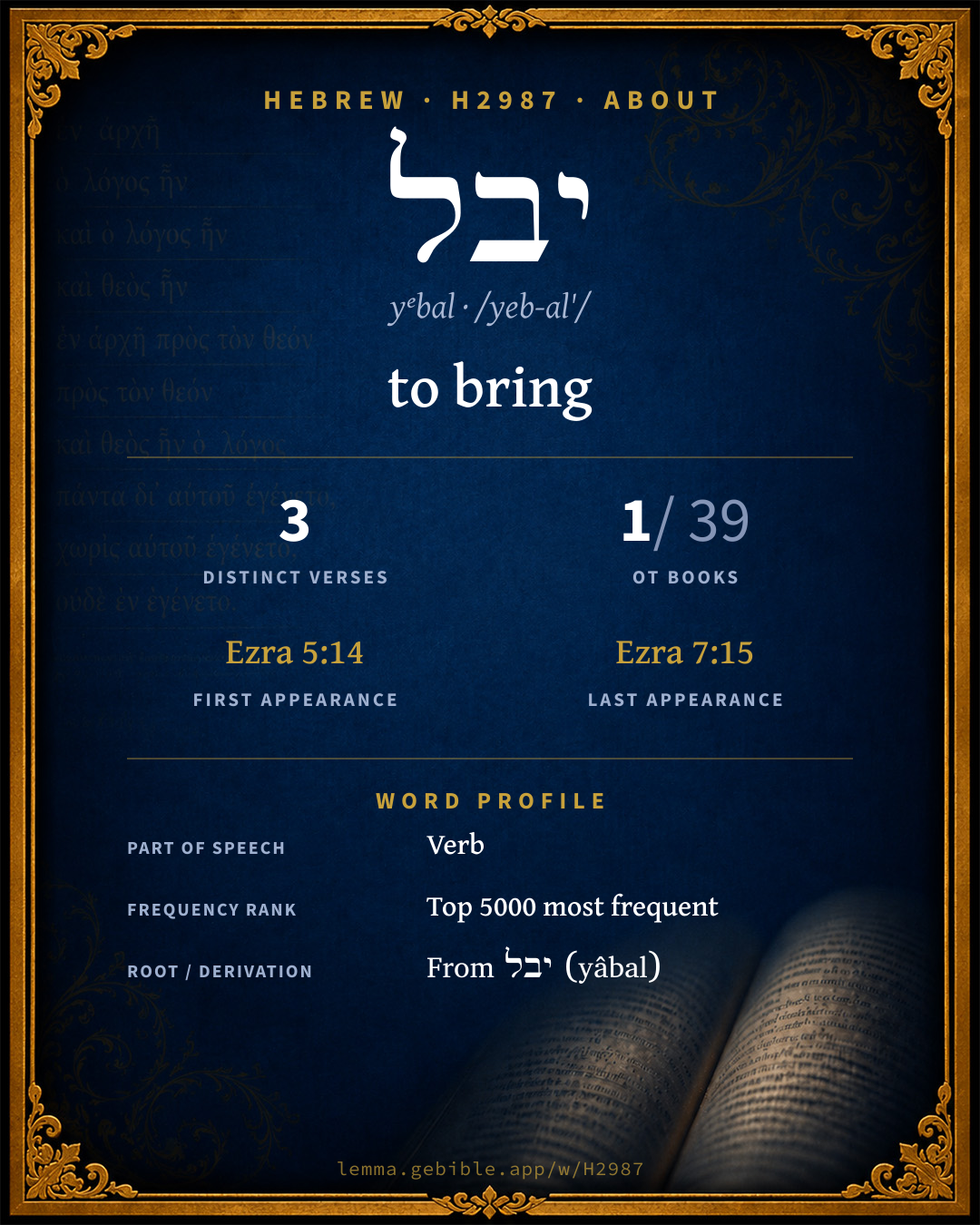
יְבַל
to bring
Full lexicon entry — Brown-Driver-Briggs (BDB)
From Brown-Driver-Briggs (BDB)
Where this word appears
Grammar key — what these labels mean
Stem
- Hiphil
- The causative active stem (“he caused / brought about”).
Form
- Perfect
- A completed action or state — Hebrew marks aspect (completeness) more than strict tense (“he wrote”).
- Infinitive Construct
- A bound verbal noun, frequently with prepositions (“to write / in writing”).
Person
- 3rd Person
- The one spoken about (“he / she / it / they”).
Gender
- Masculine
- Grammatically masculine.
Number
- Singular
- One.
Grammatical forms
- Verb, Hiphil, Perfect, 3rd Person, Masculine, Singular 2 times (67%)
- Verb, Hiphil, Infinitive Construct 1 time (33%)
Parsed forms decoded from the imported morphology (morphhb / Westminster Leningrad Codex — WLC text public domain, morphhb tagging CC BY 4.0), counted across 3 parsed occurrences — not distinct verses.
Every verse where H2987 appears — 3 distinct verses across 1 book. Click any verse to open its interlinear word-by-word view. Verse text shown in the World English Bible for context — . Each verse’s Hebrew form is shown with its reference; the English is not keyword-highlighted, since the data carries no word-level English alignment. Use “Compare translations” on any verse to read it across multiple English versions. This concordance covers the Hebrew Bible; Septuagint (Greek Old Testament) occurrences are not indexed here.
Ezra 3 verses
- Ezra 5:14 וְ/הֵיבֵ֣ל conj + Hiphil pf 3ms The gold and silver vessels also of the house of God, which Nebuchadnezzar took out of the temple that was in Jerusalem, and brought into the temple of Babylon, those did Cyrus the king take out of the temple of Babylon, and they were delivered to one whose name was Sheshbazzar, whom he had made governor;
- Ezra 6:5 וְ/הֵיבֵ֣ל conj + Hiphil pf 3ms Also let the gold and silver vessels of the house of God, which Nebuchadnezzar took forth out of the temple which is at Jerusalem, and brought to Babylon, be restored, and brought again to the temple which is at Jerusalem, everyone to its place; and you shall put them in the house of God.
- Ezra 7:15 וּ/לְ/הֵיבָלָ֖ה conj + prep + Hiphil inf.cs and to carry the silver and gold, which the king and his counselors have freely offered to the God of Israel, whose habitation is in Jerusalem,
About this entry
At a glance — auto-summarized from this page’s data, not written by a person. Every figure links to its source below. This summary describes the numbers; it doesn’t interpret them.
At its core, יבל (yᵉbal) means “to bring.” With only 3 verses it sits in the long tail of Hebrew Bible vocabulary. The word gravitates to Ezra (100%). Scripture first uses it in Ezra 5:14. It shares a root with יבל, אובל and יבול. Dig into 3-verse concordance and the renderings breakdown below.
Gloss history
Strong's 1890 vs modern scholarship
About this word
Strong's H2987 catalogs a Hebrew word from the Hebrew Old Testament.
These counts are not copied from any lexicon or concordance. They are computed here, from the morphology-tagged Hebrew Old Testament. What Lemma adds →
- 3
- distinct verses
- The word appears in 3 distinct verses.
- 1 / 39
- OT books
- The word appears in 1 of 39 Old Testament books.
- #4,179
- by frequency
- Top 5000 most frequent Hebrew words (rank 4,179 of 8,640 Hebrew words by occurrence).
View all 3 occurrences in the concordance →
Most concentrated in
- Ezra 3 verses 100%
By section of the Old Testament
By traditional corpus
Conventional, traditional groupings — biblical authorship is debated, so this is a traditional corpus grouping, not an authorship claim. Each share is this word’s portion of its verses in that division of the Hebrew canon. Each figure is a share of the word’s 3 distinct verses.
- Writings (Ketuvim) 3 verses · 100%
How translations render this word
Counts come from each version’s own published word-to-Strong’s tagging or interlinear alignment — an approximate guide to how each version renders this word, not a word-level alignment the data otherwise carries. Because each total is that version’s own tagged count, the per-version totals vary from one another and need not match the appearance or distinct-verse counts above. These counts may also differ from a printed concordance because Lemma counts each distinctly tagged rendering and does not collapse phrase taggings into a single head-word total. This is a fixed set of word-tagged versions (KJV, ASV, BSB, ULT) and does not change with the reading translation you choose elsewhere. Each version’s license is shown beside its name below (and on Sources).
- King James Version: Brought 2×
- American Standard Version: Brought 2×
- Berean Standard Bible: Carried 2×
- unfoldingWord Literal Text: Had brought 2×
King James Version Public Domain
Renders H2987 across 3 tagged occurrences — most commonly:
Plus 1 rendering that appears only once — usually multi-word phrases or single function words the recovered tagging swept in, not distinct renderings.
American Standard Version Public Domain
Renders H2987 across 3 tagged occurrences — most commonly:
Plus 1 rendering that appears only once — usually multi-word phrases or single function words the recovered tagging swept in, not distinct renderings.
Berean Standard Bible Public Domain
Renders H2987 across 3 tagged occurrences — most commonly:
Plus 1 rendering that appears only once — usually multi-word phrases or single function words the recovered tagging swept in, not distinct renderings.
unfoldingWord Literal Text CC BY-SA 4.0
Renders H2987 across 3 tagged occurrences — most commonly:
Plus 1 rendering that appears only once — usually multi-word phrases or single function words the recovered tagging swept in, not distinct renderings.
Senses in BDB
The 1 sense BDB distinguishes for this word, in lexicon order (not ranked by frequency or importance). The full entry — with sub-senses — is in the Lexicon Entry tab.
- (Aphel) to bring, carry, bear along
Word origin
[ יְבַל ] vb. Haph. bear along, carry
— Brown-Driver-Briggs (Oxford 1906, public domain), digitized via Sefaria, supplemented by the OpenScriptures HebrewLexicon (CC BY 4.0). See Sources.
Derived from יבל (yâbal) (H2986) — to bring.
Jastrow Dictionary
A second Hebrew/Aramaic lexicon for comparison, covering Aramaic and post-biblical (Talmudic, Targumic, Midrashic) usage that the biblical-Hebrew BDB does not. Matched by lemma rather than by Strong’s number, so a lemma may carry more than one Jastrow headword (shown separately below), and the entries cover usage well beyond the Bible.
יָבַל I
- (b. h.) [to break through, come forth, run, flow.—V. יְבוּל, יִבְלָא &c.]
- to lead; to carry, bring. Sifré Deut. 43 (ref. to יבולה, Deut. XI, 17) אף לא מה שאתה מוֹבִיל לה not even as much as thou carriest to it (as seed); Yalk. ib. 869. R. Hash. 9ᵇ, v. דּוּר ch.—Part. pass. מוּבָל one carried, unable to move, feetless &c. Toh. VII, 5 אפי׳ מ׳ אפי׳ כפות even if he is unable to move, even if he is tied; Tosef. ib. VIII, 7 והלה מוּוָל או כפות ed. Zuck. (ed. ממלאו, read: מוול או); Y. Ḥag. II, end, 78ᶜ אפי׳ מאכל ואפי׳ כסות (corr. acc.). [For הוֹבִיל to study, v. בִּיל h.] e.g. Deuteronomy 11:17
יְבַל
- , Af. אוֹבִיל, אֵיבֵיל (הֵיבֵל), אַיְיבֵל ch. same. Targ. Ps. LXVI, 6. Targ. Is. X, 32 (v. infra); a. fr.—Erub. 27ᵇ, a. e. מוֹבִילְנָא מאניה וכ׳ I will carry his clothes after him to the bath-house. Snh. 95ᵃ (ref. to ינפף, Is. l. c.) מוֹבִיל ומייתי וכ׳ moving his hand to and back (= h. מוליך ומביא, v. בּוֹא); a. fr.—[Ezra V, 14; VI, 5.]—Y. Meg. IV, 75ᵇ bot. כד דאינן תרתייתי מֵיבֵל וכ׳ when two scrolls are used, he carries one away and brings another in; Y. Sot. VII, end, 22ᵃ תרתיי תו מַיְיבֵל (corr. acc.); Y. Yoma VIII, 44ᵇ top מייכל (corr. acc.). Y. Sot. l. c. מַיְיבְלִין, v. אוֹרָיָיא. Y. Taan. III, 66ᵈ bot. הוה מַיְיבְלָהּ וכ׳ (not מייבללה) brought it thither.—[Y. Ab. Zar. III, 43ᵃ נייבל, v. בִּיל ch. e.g. Ezra 5:14
- to be carried. Targ. Is. XXXIX, 6.
יָבַל II
- Pi. יִיבֵּל (denom. of יַבֶּלֶת) to cut off dry twigs, warts &c., to trim. Shebi. II, 2 מְיַבְּלִין מפרקין (Ms. M. a. Y. ed. מְזַבְּלִין, incorr.); expl. Y. ib. 33ᵈ top, v. יַבֶּלֶת.
A Dictionary of the Targumim, the Talmud Babli and Yerushalmi, and the Midrashic Literature (Marcus Jastrow; London, Luzac, 1903) — Public Domain. Digitized via Sefaria. Digitized via Sefaria. Full attribution on Sources.
Forms in the corpus
The 2 distinct written forms H2987 takes in the Hebrew Bible, most frequent first — each parse links to that stem’s occurrences in the concordance. Hebrew forms include their vowel points and cantillation, so a single lemma takes many written forms.
| Form | Parsing | Example | Uses |
|---|---|---|---|
| וְ/הֵיבֵ֣ל | Verb, Hiphil, Perfect, 3rd Person, Masculine, Singular | Ezra 5:14 | 2 |
| וּ/לְ/הֵיבָלָ֖ה | Verb, Hiphil, Infinitive Construct | Ezra 7:15 | 1 |
Same root — word family
Other BDB entries built from the same root as H2987, grouped by Strong’s listed origin. These share a root / origin per the lexicon — not necessarily a shared meaning. Each links to that word’s own entry.
Derives from
Shares the same root
- אובל ʼûwbâl H180 stream
- יבול yᵉbûwl H2981 produce
- יבל yâbâl H2988 stream
- יבל yabbêl H2990 running sore
- יובל yôwbêl H3104 ram's horn
- יובל yûwbal H3105 stream
- מבול mabbûwl H3999 flood
- תבל têbêl H8398 world
Proper names from this root
People and places named from this root — a name, not an additional meaning of the word.
Compare all same-root words → Showing 4 of 12 — not the complete family. 2 of the same-root words are proper names (people or places). They share a root, not necessarily a meaning.
Septuagint verse parallels
This word appears in 3 verses that also exist in the Greek Old Testament (Septuagint), out of the 3 Hebrew verses it occurs in. You can read those verses in Greek by switching the Old Testament edition to the Septuagint.
Read these verses in the Septuagint
This is a verse-level parallel only — the same verses exist in both the Hebrew and Greek Old Testaments. No word-level Hebrew↔Greek correspondence is claimed: the data carries no such alignment, so no Greek word is shown as this Hebrew word’s translation. Coverage is not total — the Septuagint omits the deuterocanon and renumbers the Psalms, so some Hebrew verses have no direct Greek parallel.