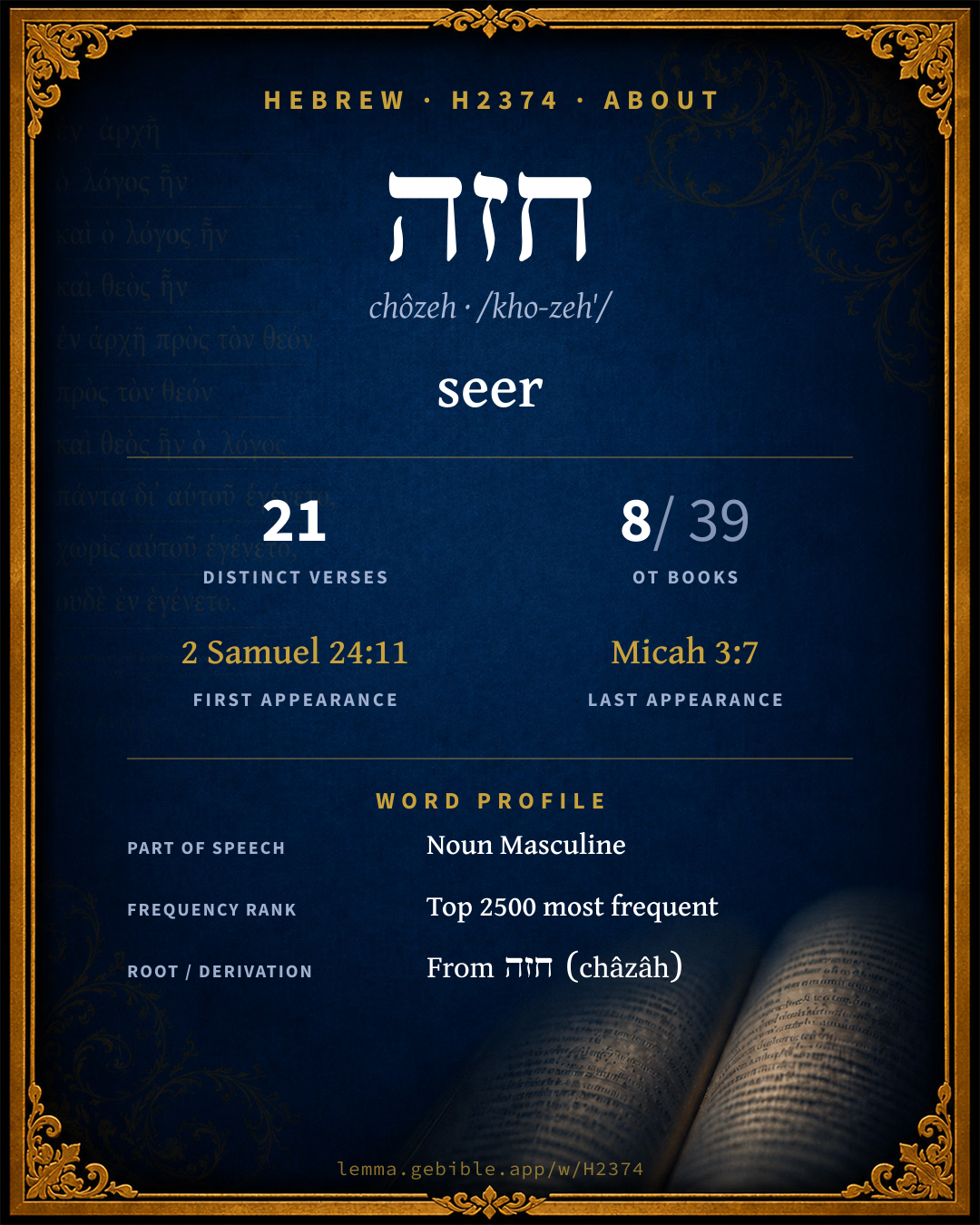
חֹזֶה
seer
‘seer’ is one of 2 main senses fuller range ↓
Full lexicon entry — Brown-Driver-Briggs (BDB)
From Brown-Driver-Briggs (BDB)
Where this word appears
See every Absolute-state word in the Hebrew Bible →
Grammar key — what these labels mean
Part of speech
- Noun
- A naming word — a person, place, thing, or idea.
- Verb
- An action or state-of-being word.
Noun type
- Common
- A common noun — a general class of person, place, or thing (“king,” “city,” “water”), not a specific name.
Stem
- Qal
- The basic, simple active stem — the plain form of the verb (“he wrote”).
Form
- Participle Active
- A verbal adjective expressing ongoing or characteristic action (“writing / one who writes”).
State
- Construct
- A noun bound to a following noun in a possessive / “of” relationship (the construct chain).
- Absolute
- The independent form of a noun, not bound to a following word.
Gender
- Masculine
- Grammatically masculine.
Number
- Singular
- One.
- Plural
- More than one (in Hebrew, generally three or more).
Grammatical forms
- Noun, Common, Masculine, Singular, Absolute 7 times (33%)
- Verb, Qal, Participle Active, Masculine, Plural, Absolute 7 times (33%)
- Noun, Common, Masculine, Singular, Construct 5 times (24%)
- Noun, Common, Masculine, Plural, Absolute 1 time (5%)
- Verb, Qal, Participle Active, Masculine, Singular, Absolute 1 time (5%)
Parsed forms decoded from the imported morphology (morphhb / Westminster Leningrad Codex — WLC text public domain, morphhb tagging CC BY 4.0), counted across 21 parsed occurrences — not distinct verses.
Every verse where H2374 appears — 21 distinct verses across 8 books. Click any verse to open its interlinear word-by-word view. Verse text shown in the World English Bible for context — . Each verse’s Hebrew form is shown with its reference; the English is not keyword-highlighted, since the data carries no word-level English alignment. Use “Compare translations” on any verse to read it across multiple English versions. This concordance covers the Hebrew Bible; Septuagint (Greek Old Testament) occurrences are not indexed here.
2 Samuel 1 verse
2 Kings 1 verse
1 Chronicles 3 verses
- 1 Chronicles 21:9 חֹזֵ֥ה n c ms cs Yahweh spoke to Gad, David's seer, saying,
- 1 Chronicles 25:5 חֹזֵ֥ה n c ms cs All these were the sons of Heman the king's seer in the words of God, to lift up the horn. God gave to Heman fourteen sons and three daughters.
- 1 Chronicles 29:29 הַ/חֹזֶֽה ptcl def.art + n c ms Now the acts of David the king, first and last, behold, they are written in the history of Samuel the seer, and in the history of Nathan the prophet, and in the history of Gad the seer,
2 Chronicles 7 verses
- 2 Chronicles 9:29 הַ/חֹזֶ֔ה ptcl def.art + n c ms Now the rest of the acts of Solomon, first and last, aren't they written in the history of Nathan the prophet, and in the prophecy of Ahijah the Shilonite, and in the visions of Iddo the seer concerning Jeroboam the son of Nebat?
- 2 Chronicles 12:15 הַ/חֹזֶ֖ה ptcl def.art + n c ms Now the acts of Rehoboam, first and last, aren't they written in the histories of Shemaiah the prophet and of Iddo the seer, after the manner of genealogies? There were wars between Rehoboam and Jeroboam continually.
- 2 Chronicles 19:2 הַ/חֹזֶה֒ ptcl def.art + Qal ptcp.act ms Jehu the son of Hanani the seer went out to meet him, and said to king Jehoshaphat, Should you help the wicked, and love those who hate Yahweh? for this thing wrath is on you from before Yahweh.
- 2 Chronicles 29:25 חֹזֵֽה n c ms cs He set the Levites in the house of Yahweh with cymbals, with psalteries, and with harps, according to the commandment of David, and of Gad the king's seer, and Nathan the prophet; for the commandment was of Yahweh by his prophets.
- 2 Chronicles 29:30 הַ/חֹזֶ֑ה ptcl def.art + n c ms Moreover Hezekiah the king and the princes commanded the Levites to sing praises to Yahweh with the words of David, and of Asaph the seer. They sang praises with gladness, and they bowed their heads and worshiped.
- 2 Chronicles 33:18 הַֽ/חֹזִ֔ים ptcl def.art + Qal ptcp.act mp Now the rest of the acts of Manasseh, and his prayer to his God, and the words of the seers who spoke to him in the name of Yahweh, the God of Israel, behold, they are written among the acts of the kings of Israel.
- 2 Chronicles 35:15 חוֹזֵ֣ה n c ms cs The singers the sons of Asaph were in their place, according to the commandment of David, and Asaph, and Heman, and Jeduthun the king's seer; and the porters were at every gate: they didn't need to depart from their service; for their brothers the Levites prepared for them.
Isaiah 4 verses
- Isaiah 28:15 חֹזֶ֑ה n c ms Because you have said, We have made a covenant with death, and with Sheol are we at agreement; when the overflowing scourge shall pass through, it shall not come to us; for we have made lies our refuge, and under falsehood have we hid ourselves:
- Isaiah 29:10 הַ/חֹזִ֖ים ptcl def.art + n c mp For Yahweh has poured out on you the spirit of deep sleep, and has closed your eyes, the prophets; and your heads, the seers, has he covered.
- Isaiah 30:10 וְ/לַ֣/חֹזִ֔ים conj + prep det + Qal ptcp.act mp who tell the seers, "Don't see;" and to the prophets, "Don't prophesy to us right things, speak to us smooth things, prophesy deceits,
- Isaiah 47:13 הַֽ/חֹזִים֙ ptcl def.art + Qal ptcp.act mp You are wearied in the multitude of your counsels: let now the astrologers, the star-gazers, the monthly prognosticators, stand up, and save you from the things that shall come on you.
Ezekiel 3 verses
- Ezekiel 13:9 הַ/חֹזִ֣ים ptcl def.art + Qal ptcp.act mp My hand shall be against the prophets who see false visions, and who divine lies: they shall not be in the council of my people, neither shall they be written in the writing of the house of Israel, neither shall they enter into the land of Israel; and you shall know that I am the Lord Yahweh.
- Ezekiel 13:16 וְ/הַ/חֹזִ֥ים conj + ptcl def.art + Qal ptcp.act mp [to wit], the prophets of Israel who prophesy concerning Jerusalem, and who see visions of peace for her, and there is no peace, says the Lord Yahweh.
- Ezekiel 22:28 חֹזִ֣ים Qal ptcp.act mp Her prophets have daubed for them with whitewash, seeing false visions, and divining lies to them, saying, Thus says the Lord Yahweh, when Yahweh has not spoken.
Amos 1 verse
Micah 1 verse
About this entry
At a glance — auto-summarized from this page’s data, not written by a person. Every figure links to its source below. This summary describes the numbers; it doesn’t interpret them.
The Hebrew noun חזה centers on the idea of “seer.” First canonically at 2 Samuel 24:11, it enters the text early. The Hebrew Bible uses it across 21 verses — uncommon. 2 Chronicles dominates its distribution — 7 of 21 verses. Its meaning spans more than one sense — see its full sense range. For the data behind this summary, explore the sense tree and the renderings breakdown below.
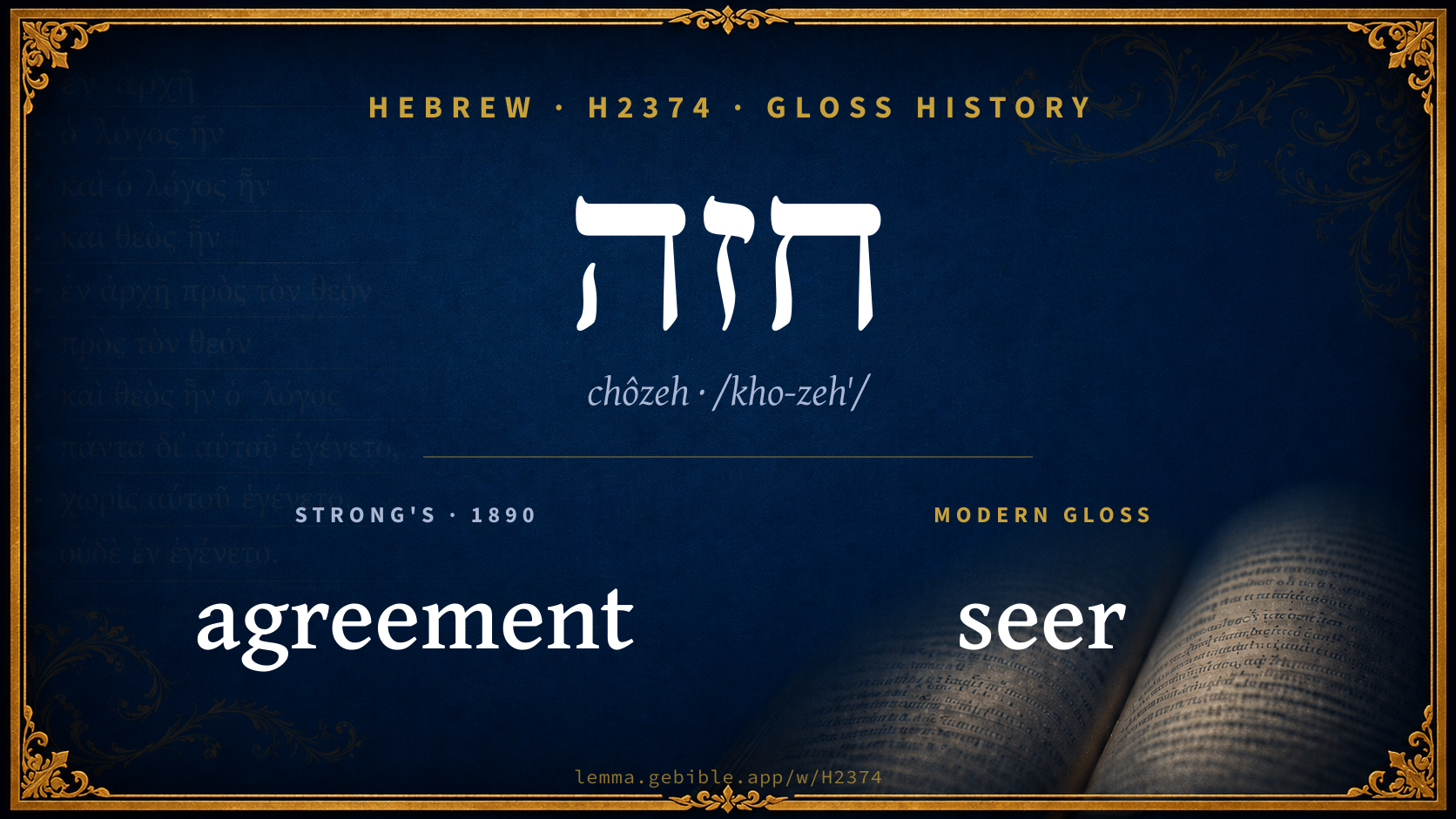
Gloss history
Strong's 1890 vs modern scholarship
About this word
Strong's H2374 catalogs a Hebrew word from the Hebrew Old Testament.
These counts are not copied from any lexicon or concordance. They are computed here, from the morphology-tagged Hebrew Old Testament. What Lemma adds →
- 21
- distinct verses
- The word appears in 21 distinct verses.
- 8 / 39
- OT books
- The word appears in 8 of 39 Old Testament books.
- #1,462
- by frequency
- Top 2500 most frequent Hebrew words (rank 1,462 of 8,640 Hebrew words by occurrence).
View all 21 occurrences in the concordance →
Most concentrated in
- 2 Chronicles 7 verses 33%
- Isaiah 4 verses 19%
- 1 Chronicles 3 verses 14%
By section of the Old Testament
By traditional corpus
Conventional, traditional groupings — biblical authorship is debated, so this is a traditional corpus grouping, not an authorship claim. Each share is this word’s portion of its verses in that division of the Hebrew canon. Each figure is a share of the word’s 21 distinct verses.
- Prophets (Nevi'im) 11 verses · 52%
- Writings (Ketuvim) 10 verses · 48%
How translations render this word
Counts come from each version’s own published word-to-Strong’s tagging or interlinear alignment — an approximate guide to how each version renders this word, not a word-level alignment the data otherwise carries. Because each total is that version’s own tagged count, the per-version totals vary from one another and need not match the appearance or distinct-verse counts above. These counts may also differ from a printed concordance because Lemma counts each distinctly tagged rendering and does not collapse phrase taggings into a single head-word total. This is a fixed set of word-tagged versions (KJV, ASV, BSB, ULT) and does not change with the reading translation you choose elsewhere. Each version’s license is shown beside its name below (and on Sources).
- King James Version: Seer 10×, Seers 3×, See 2×
- American Standard Version: 's seer 5×, Seer 5×, Seers 3×
- Berean Standard Bible: Seer 10×, Seers 4×
- unfoldingWord Literal Text: Seer 6×, Seer of 5×, Seers 4×
King James Version Public Domain
Renders H2374 across 22 tagged occurrences — most commonly:
Plus 7 renderings that appear only once — usually multi-word phrases or single function words the recovered tagging swept in, not distinct renderings.
American Standard Version Public Domain
Renders H2374 across 22 tagged occurrences — most commonly:
Plus 7 renderings that appear only once — usually multi-word phrases or single function words the recovered tagging swept in, not distinct renderings.
Berean Standard Bible Public Domain
Renders H2374 across 17 tagged occurrences — most commonly:
Plus 3 renderings that appear only once — usually multi-word phrases or single function words the recovered tagging swept in, not distinct renderings.
unfoldingWord Literal Text CC BY-SA 4.0
Renders H2374 across 21 tagged occurrences — most commonly:
Plus 3 renderings that appear only once — usually multi-word phrases or single function words the recovered tagging swept in, not distinct renderings.
Senses in the full BDB
What do BDB’s symbols mean?
BDB uses these scholarly abbreviations:
| Symbol | Meaning |
|---|---|
| 𝔊 | the Septuagint (the ancient Greek translation, LXX) |
| 𝔙 | the Vulgate (the Latin translation) |
| 𝔖 | the Syriac version (the Peshitta) |
| 𝔗 | the Targum (the Aramaic translation) |
| ψ | the Psalms |
| √ | root (the underlying root or stem) |
| ‖ | parallel passage (a synonymous or contrasted parallel) |
| † | the dagger: every passage where the word occurs is cited |
The 5 senses and sub-senses the full Brown-Driver-Briggs lexicon distinguishes for this word, in lexicon order (not ranked by frequency), with BDB’s own verbatim wording and sub-sense lettering. Shown in Hebrew script with BDB’s own scholarly abbreviations. The condensed entry is in the Lexicon Entry tab. See also the Forms in the corpus table below.
- 1. seer:
- a. of unnamed persons, syn. נבא(ים) 2 K 17:13 Is 29:10; רֹאִים Is 30:10; קֹסְמִים Mi 3:7; historical writers דִּבְרֵי הַחֹזִים 2 Ch 33:18, דברי חוזים (𝔊) 2 Ch 33:19 (MT appar. n.pr.) e.g. 2 Kings 17:13
- b. named prophets; Gad 2 S 24:11 = 1 Ch 21:9, 1 Ch 29:29 2 Ch 29:25; Amos Am 7:12; Iddo 2 Ch 9:29; 12:15; Jehu 2 Ch 19:2. e.g. 2 Samuel 24:11
- c. the singers: Heman 1 Ch 25:5; Asaph 2 Ch 29:30; Jeduthun 2 Ch 35:15. e.g. 1 Chronicles 25:5
- It seems best to add 2. vision (cf. רֹאֶה Is 28:7) עִם שְׁאוֹל עָשִׂינוּ חֹזֶה Is 28:15 with Sheʾôl we made a vision (had a vision, in connexion with Sheʾôl—i.e. by necromancy, v. Du—which makes us secure; ‖ כרת ברית אֶת־מָוֶת); Ew§ 156 e trans. oracle here and 2 K 17:13; HoffmZAW iii. 95 puts this under 1: ‘we have appointed a prophet with Sheʾôl (SS “Ein bei der Scheol bestellter Seher”), who is answerable to us for it;’ 𝔊 𝔙 𝔗 AV RV Che Di al., are at (or have made an) agreement (prophetic advice of seers being taken at time of making treaties; v. חָזוּת 1)—Vid. also כָּל־חֹזֶה n.pr.m. sub כל. e.g. Isaiah 28:7
Senses from the full Brown-Driver-Briggs lexicon (Brown, Driver, Briggs; Oxford 1906 — public domain), digitized via Sefaria, supplemented by the OpenScriptures HebrewLexicon (CC BY 4.0). Full attribution on Sources.
Word origin
n.m. seer;—abs. ח׳ Am 7:12 + 7 times; cstr. חֹזֵה 1 Ch 21:9 + 3 times; חוֹזֵה 2 Ch 35:15; pl. חֹזִים Is 29:10 + 4 times; חוֹזִים 2 Ch 33:19 (so read with 𝔊; חוֹזָ֑י MT scribal error)—
— Brown-Driver-Briggs (Oxford 1906, public domain), digitized via Sefaria, supplemented by the OpenScriptures HebrewLexicon (CC BY 4.0). See Sources.
Derived from חזה (châzâh) (H2372) — to see.
Jastrow Dictionary
A second Hebrew/Aramaic lexicon for comparison, covering Aramaic and post-biblical (Talmudic, Targumic, Midrashic) usage that the biblical-Hebrew BDB does not. Matched by lemma rather than by Strong’s number, so a lemma may carry more than one Jastrow headword (shown separately below), and the entries cover usage well beyond the Bible.
חזי
- (b. h.) [to divide,] to discern, see (cmp. בּוּן). B. Bath. 91ᵃ חֲזִיתֶם נעמי וכ׳ have you seen what has become of Naomi &c.?
- to distribute kindled chips between logs of wood. Sabb. I, 11 (19ᵇ) ומְחַזִּין Mss. (ed. Ven. מחיזין; Y. ed. Krot. ומחזיזן, read ומַחֲזִיזִין, Hif. of חזז, or מְחַזְּזִין), v. אָחַז.—V. חָזִית.
A Dictionary of the Targumim, the Talmud Babli and Yerushalmi, and the Midrashic Literature (Marcus Jastrow; London, Luzac, 1903) — Public Domain. Digitized via Sefaria. Digitized via Sefaria. Full attribution on Sources.
Forms in the corpus
The 19 distinct written forms H2374 takes in the Hebrew Bible, most frequent first — each parse links to that state’s occurrences in the concordance. Hebrew forms include their vowel points and cantillation, so a single lemma takes many written forms.
Same root — word family
Other BDB entries built from the same root as H2374, grouped by Strong’s listed origin. These share a root / origin per the lexicon — not necessarily a shared meaning. Each links to that word’s own entry.
Derives from
Shares the same root
- הזה hâzâh H1957 to dream
- חזא chăzâʼ H2370 to see
- חזה châzeh H2373 breast
- חזון châzôwn H2377 vision
- חזות châzôwth H2378 visions
- חזות châzûwth H2380 vision
- חזיון chizzâyôwn H2384 vision
- מחזה machăzeh H4236 vision
- מחזה mechĕzâh H4237 window
Derived from this word
Proper names from this root
People and places named from this root — a name, not an additional meaning of the word.
- חזאל Chăzâʼêl H2371 Hazael
- חזו Chăzôw H2375 Hazo
- חזיאל Chăzîyʼêl H2381 Haziel
- חזיה Chăzâyâh H2382 Hazaiah
- חזיון Chezyôwn H2383 Hezion
- יחזיאל Yachăzîyʼêl H3166 Jahaziel
- יחזיה Yachzᵉyâh H3167 Jahaziah
- מחזיאות Machăzîyʼôwth H4238 Mahazioth
Compare all same-root words → Showing 4 of 20 — not the complete family. 8 of the same-root words are proper names (people or places). They share a root, not necessarily a meaning.
Septuagint verse parallels
This word appears in 21 verses that also exist in the Greek Old Testament (Septuagint), out of the 21 Hebrew verses it occurs in. You can read those verses in Greek by switching the Old Testament edition to the Septuagint.
Read these verses in the Septuagint
- 2 Samuel 24:11
- 2 Kings 17:13
- 1 Chronicles 21:9
- 2 Chronicles 9:29
- Isaiah 28:15
- Ezekiel 13:9
- Amos 7:12
- Micah 3:7
This is a verse-level parallel only — the same verses exist in both the Hebrew and Greek Old Testaments. No word-level Hebrew↔Greek correspondence is claimed: the data carries no such alignment, so no Greek word is shown as this Hebrew word’s translation. Coverage is not total — the Septuagint omits the deuterocanon and renumbers the Psalms, so some Hebrew verses have no direct Greek parallel.