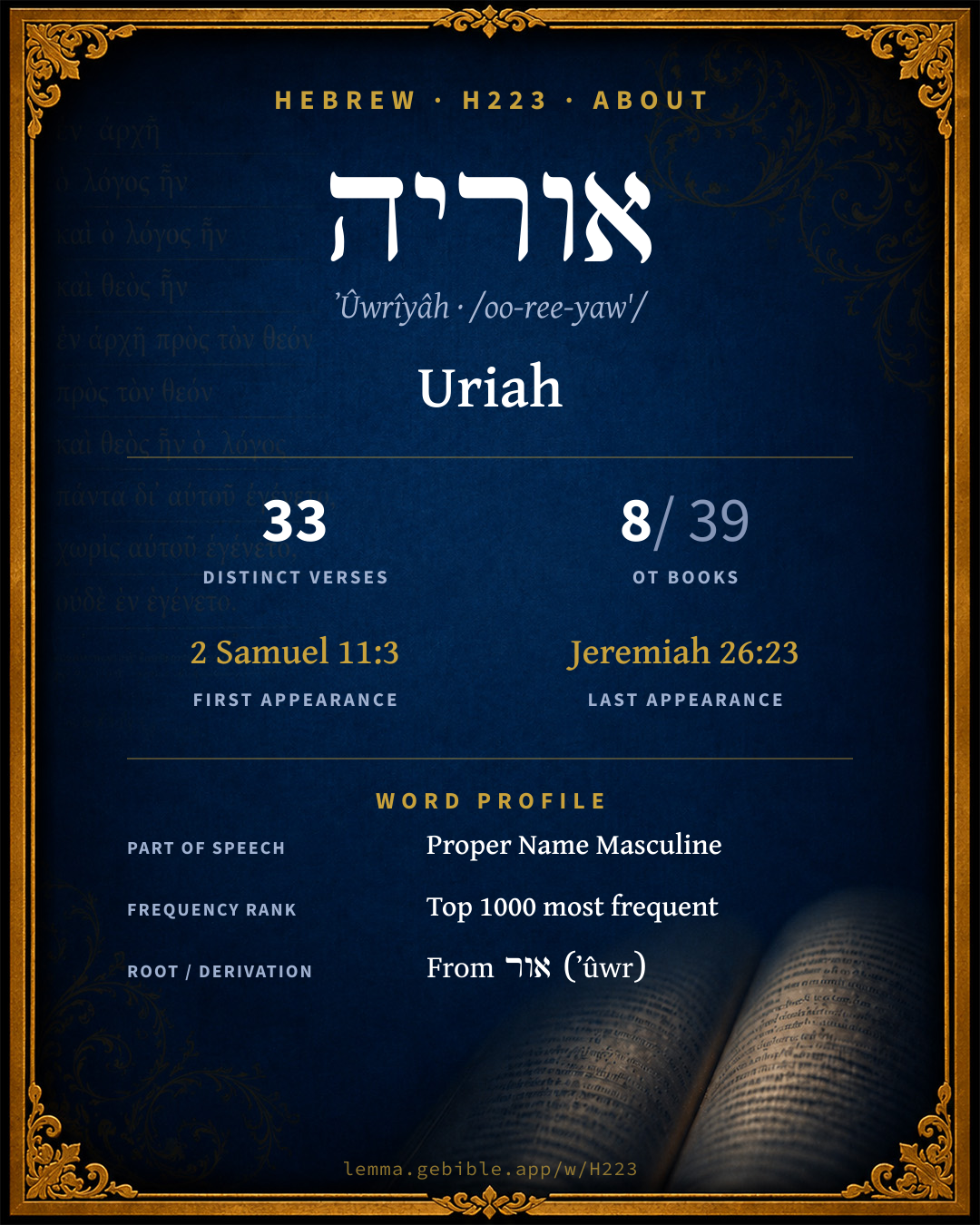
אוּרִיָּה
Uriah
BDB lists 5 entries for ‘Uriah’ fuller range ↓
Full lexicon entry — Brown-Driver-Briggs (BDB)
From Brown-Driver-Briggs (BDB)
Where this word appears
Grammar key — what these labels mean
Part of speech
- Noun
- A naming word — a person, place, thing, or idea.
Noun type
- Proper
- A name of a specific person, place, or people (e.g. Abraham, Zion, Israel).
Every verse where H223 appears in the Book of Jeremiah — 3 distinct verses. Click any verse to open its interlinear word-by-word view. Verse text shown in the World English Bible for context — . Each verse’s Hebrew form is shown with its reference; the English is not keyword-highlighted, since the data carries no word-level English alignment. Use “Compare translations” on any verse to read it across multiple English versions. This concordance covers the Hebrew Bible; Septuagint (Greek Old Testament) occurrences are not indexed here.
Jeremiah
- Jeremiah 26:20 אֽוּרִיָּ֨הוּ֙ n Proper There was also a man who prophesied in the name of Yahweh, Uriah the son of Shemaiah of Kiriath Jearim; and he prophesied against this city and against this land according to all the words of Jeremiah:
- Jeremiah 26:21 אוּרִיָּ֨הוּ֙ n Proper and when Jehoiakim the king, with all his mighty-men, and all the princes, heard his words, the king sought to put him to death; but when Uriah heard it, he was afraid, and fled, and went into Egypt:
- Jeremiah 26:23 אוּרִיָּ֜הוּ n Proper and they fetched forth Uriah out of Egypt, and brought him to Jehoiakim the king, who killed him with the sword, and cast his dead body into the graves of the common people.
About this entry
At a glance — auto-summarized from this page’s data, not written by a person. Every figure links to its source below. This summary describes the numbers; it doesn’t interpret them.
אוריה — transliterated ʼÛwrîyâh — is a Hebrew name carrying the sense “Uriah.” Its uses cluster heavily in 2 Samuel (58% of all occurrences). With 33 verses in 8 books, it is a moderately common word in the Hebrew Bible. It first appears in 2 Samuel 11:3. Each statement above links to its evidence; the full detail follows below.
Gloss history
Strong's 1890 vs modern scholarship
About this word
Strong's H223 catalogs a Hebrew word from the Hebrew Old Testament.
These counts are not copied from any lexicon or concordance. They are computed here, from the morphology-tagged Hebrew Old Testament. What Lemma adds →
- 33
- distinct verses
- The word appears in 33 distinct verses.
- 8 / 39
- OT books
- The word appears in 8 of 39 Old Testament books.
- #922
- by frequency
- Top 1000 most frequent Hebrew words (rank 922 of 8,640 Hebrew words by occurrence).
View all 33 occurrences in the concordance →
By section of the Old Testament
By traditional corpus
Conventional, traditional groupings — biblical authorship is debated, so this is a traditional corpus grouping, not an authorship claim. Each share is this word’s portion of its verses in that division of the Hebrew canon. Each figure is a share of the word’s 33 distinct verses.
- Prophets (Nevi'im) 28 verses · 85%
- Writings (Ketuvim) 5 verses · 15%
How translations render this word
Counts come from each version’s own published word-to-Strong’s tagging or interlinear alignment — an approximate guide to how each version renders this word, not a word-level alignment the data otherwise carries. Because each total is that version’s own tagged count, the per-version totals vary from one another and need not match the appearance or distinct-verse counts above. These counts may also differ from a printed concordance because Lemma counts each distinctly tagged rendering and does not collapse phrase taggings into a single head-word total. This is a fixed set of word-tagged versions (KJV, ASV, BSB, ULT) and does not change with the reading translation you choose elsewhere. Each version’s license is shown beside its name below (and on Sources).
BDB lists this Strong’s number as 2 distinct words (homographs). Each count above pools all of them and is not split by sense — see the Senses section below. A low-frequency rendering may belong to a different one of those words, not the primary meaning.
- King James Version†: Uriah 26×, Urijah 11×
- American Standard Version†: Uriah 32×, Urijah 4×
- Berean Standard Bible†: Uriah 34×, Uriah’s 2×
- unfoldingWord Literal Text†: Uriah 39×
King James Version Public Domain
Renders H223 across 39† tagged occurrences — most commonly:
Plus 2 renderings that appear only once — usually multi-word phrases or single function words the recovered tagging swept in, not distinct renderings.
American Standard Version Public Domain
Renders H223 across 39† tagged occurrences — most commonly:
Plus 3 renderings that appear only once — usually multi-word phrases or single function words the recovered tagging swept in, not distinct renderings.
Berean Standard Bible Public Domain
Renders H223 across 36† tagged occurrences — most commonly:
Not rendered by a distinct English word in 3 further occurrences.
unfoldingWord Literal Text CC BY-SA 4.0
Renders H223 across 39† tagged occurrences — most commonly:
Senses in the full BDB
What do BDB’s symbols mean?
BDB uses these scholarly abbreviations:
| Symbol | Meaning |
|---|---|
| 𝔊 | the Septuagint (the ancient Greek translation, LXX) |
| 𝔙 | the Vulgate (the Latin translation) |
| 𝔖 | the Syriac version (the Peshitta) |
| 𝔗 | the Targum (the Aramaic translation) |
| ψ | the Psalms |
| √ | root (the underlying root or stem) |
| ‖ | parallel passage (a synonymous or contrasted parallel) |
| † | the dagger: every passage where the word occurs is cited |
The 3 senses and sub-senses the full Brown-Driver-Briggs lexicon distinguishes for this word, in lexicon order (not ranked by frequency), with BDB’s own verbatim wording and sub-sense lettering. Shown in Hebrew script with BDB’s own scholarly abbreviations. The condensed entry is in the Lexicon Entry tab. See also the Forms in the corpus table below.
אוריה I m. (flame of Yah or my light is Yah v. יָהּ).
- 1. Hittite husband of Bathsheba 2 S 11:3f; 23:39. e.g. 2 Samuel 11:3
- 2. priest in reign of Ahaz Is 8:2 2 K 16:10f. e.g. Isaiah 8:2
- 3. priest in time of Nehemiah Ezr 8:33 Ne 3:4, 21; 8:4. e.g. Ezra 8:33
אוריה II m. (flame of Yahweh or my light is Yahweh v. יהוה) a prophet slain by Jehoiakim Je 26
Senses from the full Brown-Driver-Briggs lexicon (Brown, Driver, Briggs; Oxford 1906 — public domain), digitized via Sefaria, supplemented by the OpenScriptures HebrewLexicon (CC BY 4.0). Full attribution on Sources.
Word origin
I. n.pr.m. (flame of Yah or my light is Yah v. יָהּ).
I. n.pr.m. (flame of Yahweh or my light is Yahweh v. יהוה) a prophet slain by Jehoiakim Je 26:20.
— Brown-Driver-Briggs (Oxford 1906, public domain), digitized via Sefaria, supplemented by the OpenScriptures HebrewLexicon (CC BY 4.0). See Sources.
Derived from אור (ʼûwr) (H217) — flame.
Jastrow Dictionary
A second Hebrew/Aramaic lexicon for comparison, covering Aramaic and post-biblical (Talmudic, Targumic, Midrashic) usage that the biblical-Hebrew BDB does not. Matched by lemma rather than by Strong’s number, so a lemma may carry more than one Jastrow headword (shown separately below), and the entries cover usage well beyond the Bible.
אוּרְיָה I, II
- , v. אוּרְיָא
אוֹרְיָה
- , v. אוֹרָיָיא
אוֹרָיָיא
- (ירי, Af. אוֹרִי = h. תֹּורָה)
- 1. instruction, the Law, Bible-verse. Targ. Lev. VI, 7; a. fr.—מילה דא׳ (= דברי תורה) religious discourse, lesson, remarks &c. Y. B. Bath. VIII, 16ᵃ אורייא; Y. Taan. III, 66ᶜ bot. ייתא …—Y. Snh. I, 18ᶜ אפלגינון במילי דא׳ he entertained them with religious discussions. Y. Hor. III, beg. 47ᵃ עתיד לך מילה דא׳ be prepared for a religious discourse. Y. Shek. III, 47ᶜ top מאי א׳ חדתא שמעת what novel interpretation hast thou heard? Y. Yeb. II, 4ᵃ top מן הדא אורייה from what verse?—Taan. 4ᵃ ליה א׳ … מרתח׳ it is the zeal of study that makes him warm (excited). Kidd. 71ᵇ אורייתין כשר׳ my instruction is acceptable, but my daughters are not desired. Sabb. 116ᵇ א׳ דמשה the Mosaic dispensation (opp. א׳ אחריתי the new dispensation, v. אָוֶון).—דְּאוֹרַיְיתָא (sub. הלכה = h. התורה מן) an enactment founded on the Bible text, opp. דרבנן. Succ. 44ᵃ לולב דא׳ Lulab, the law concerning which is Biblical &c.; a. fr.—מִדְּאוֹרַיְיתָא, adv. biblically, according to the Biblical law, opp. מדרבנן. Pes. 10ᵃ; a. fr.
- 2. the Torah, the scroll containing the Pentateuch, used at divine service. Y. Yoma VII, 44ᵇ top כד היא חדא אוריא when you have no more than one scroll. Y. Meg. IV, 75ᵇ bot.; Y. Sot. VII, end, 22ᵃ כד חזרא אורייה (corr. as Y. Yoma l. c.). Ib. תא וכ׳—תמן מייבלין א there (in Babylon) the Torah is carried to the Resh Galutha.—בר אוריא a scholar, man of learning. Yoma 78ᵃ. Ḥag. 14ᵃ אריא (corr. acc.); v. next w.
A Dictionary of the Targumim, the Talmud Babli and Yerushalmi, and the Midrashic Literature (Marcus Jastrow; London, Luzac, 1903) — Public Domain. Digitized via Sefaria. Digitized via Sefaria. Full attribution on Sources.
Forms in the corpus
The 21 distinct written forms H223 takes in the Hebrew Bible, most frequent first — each parse links to that state’s occurrences in the concordance. Hebrew forms include their vowel points and cantillation, so a single lemma takes many written forms.
| Form | Parsing | Example | Uses |
|---|---|---|---|
| אוּרִיָּ֣ה | Noun, Proper | 2 Kings 16:10 | 6 |
| אוּרִיָּ֥ה | Noun, Proper | 1 Kings 15:5 | 6 |
| אֽוּרִיָּה֙ | Noun, Proper | Ezra 8:33 | 4 |
| אוּרִיָּ֗ה | Noun, Proper | 2 Samuel 11:9 | 3 |
| אֽוּרִיָּ֖ה | Noun, Proper | 2 Samuel 11:6 | 2 |
| אוּרִיָּ֖ה | Noun, Proper | 2 Samuel 11:7 | 2 |
| אוּרִיָּ֛ה | Noun, Proper | 2 Samuel 12:15 | 2 |
| א֣וּרִיָּ֔ה | Noun, Proper | 2 Samuel 11:16 | 1 |
| אֽוּרִיָּ֔ה | Noun, Proper | 2 Samuel 11:26 | 1 |
| אֽוּרִיָּ֗ה | Noun, Proper | 2 Samuel 11:15 | 1 |
| אֽוּרִיָּ֨הוּ֙ | Noun, Proper | Jeremiah 26:20 | 1 |
| אוּרִיָּ֜ה | Noun, Proper | 2 Samuel 11:11 | 1 |
| אוּרִיָּ֜הוּ | Noun, Proper | Jeremiah 26:23 | 1 |
| אוּרִיָּ֤ה | Noun, Proper | 2 Samuel 12:9 | 1 |
| אוּרִיָּ֧ה | Noun, Proper | 2 Samuel 11:12 | 1 |
| אוּרִיָּ֨ה | Noun, Proper | 2 Kings 16:15 | 1 |
| אוּרִיָּ֨הוּ֙ | Noun, Proper | Jeremiah 26:21 | 1 |
| אוּרִיָּֽה | Noun, Proper | 2 Samuel 11:14 | 1 |
| אוּרִיָּה֙ | Noun, Proper | Nehemiah 3:4 | 1 |
| וְ/אוּרִיָּ֧ה | Noun, Proper | Nehemiah 8:4 | 1 |
| לְ/א֣וּרִיָּ֔ה | Noun, Proper | 2 Samuel 11:8 | 1 |
Same root — word family
Other BDB entries built from the same root as H223, grouped by Strong’s listed origin. These share a root / origin per the lexicon — not necessarily a shared meaning. Each links to that word’s own entry.
Derives from
Proper names from this root
People and places named from this root — a name, not an additional meaning of the word.
- אור ʼÛwr H218 Ur
- אורי ʼÛwrîy H221 Uri
- אוריאל ʼÛwrîyʼêl H222 Uriel
- אורים ʼÛwrîym H224 Urim
- Ουριας Ourías G3774 Uriah
Compare all same-root words → Showing 4 of 7 — not the complete family. 5 of the same-root words are proper names (people or places). They share a root, not necessarily a meaning.
Bible dictionary
Public-domain dictionary articles matched to this entry by name (Uriah). A biblical name can be shared by more than one person or place, so an article may treat several.
Easton's Bible Dictionary · M. G. Easton, 1897
The Lord is my light. (1.) A Hittite, the husband of Bathsheba, whom David first seduced, and then after Uriah's death married. He was one of the band of David's "mighty men." The sad story of the curel wrongs inflicted upon him by David and of his mournful death are simply told in the sacred record (2 Sam. 11:2-12:26). (See BATHSHEBA; DAVID.)
(2.) A priest of the house of Ahaz (Isa. 8:2).
(3.) The father of Meremoth, mentioned in Ezra 8:33.
Smith's Bible Dictionary · William Smith, 1863
(light of Jehovah).
+ One of the thirty commanders of the thirty bands into which the Israelite army of David was divided. (1 Chronicles 11:41; 2 Samuel 23:39) Like others of David's officers he was a foreigner--a Hittite. His name, however and his manner of speech (2 Samuel 11:11) indicate that he had adopted the Jewish religion. He married Bath-sheba a woman of extraordinary beauty, the daughter of Eliam--possibly the same as the son of Ahithophel, and one of his brother officers, (2 Samuel 23:34) and hence, perhaps, Uriah's first acquaintance with Bath-sheba. It may be inferred from Nathan's parable, (2 Samuel 12:3) that he was passionately devoted to his wife, and that their union was celebrated in Jerusalem as one of peculiar tenderness. In the first war with Ammon, B.C. 1035, he followed Joab to the siege, and with him remained encamped in the open field. (2 Samuel 12:11) He returned to Jerusalem, at an order from the king on the pretext of asking news of the war--really in the hope that his return to his wife might cover the shame of his own crime. The king met with an unexpected obstacle in the austere, soldier-like spirit which guided all Uriah's conduct, and which gives us a high notion of the character and discipline of David's officers. On the morning of the third day David sent him back to the camp with a letter containing the command to Joab to cause his destruction in the battle. The device of Joab was to observe the part of the wall of Rabbath-ammon where the greatest force of the besieged was congregated, and thither, as a kind of forlorn hope to send Uriah. A sally took place. Uriah and the officers with him advanced as far as the gate of the city, and were there shot down by the archers on the wall. Just as Joab had forewarned the messenger, the king broke into a furious passion on hearing of the loss. The messenger, as instructed by Joab, calmly continued, and ended the story with the words, "Thy servant also Uriah the Hittite, is dead." In a moment David's anger is appeased. It is one of the touching parts of the story that Uriah falls unconscious of his wife's dishonor. + High priest in the reign of Ahaz. (Isaiah 8:2; 2 Kings 16:10-16) He is probably the same as Urijah the priest, who built the altar for Ahaz. (2 Kings 16:10) (B.C. about 738.) + A priest of the family of Hakkoz, the head of the seventh course of priests. (Ezra 8:33; Nehemiah 3:4,21) (B.C. 458.)
Hitchcock's Bible Names Dictionary · Roswell D. Hitchcock, 1869
or Urijah, the Lord is my light or fire
Classic public-domain reference works; full attribution on Sources.
Septuagint verse parallels
This word appears in 30 verses that also exist in the Greek Old Testament (Septuagint), out of the 33 Hebrew verses it occurs in. You can read those verses in Greek by switching the Old Testament edition to the Septuagint.
Read these verses in the Septuagint
This is a verse-level parallel only — the same verses exist in both the Hebrew and Greek Old Testaments. No word-level Hebrew↔Greek correspondence is claimed: the data carries no such alignment, so no Greek word is shown as this Hebrew word’s translation. Coverage is not total — the Septuagint omits the deuterocanon and renumbers the Psalms, so some Hebrew verses have no direct Greek parallel.