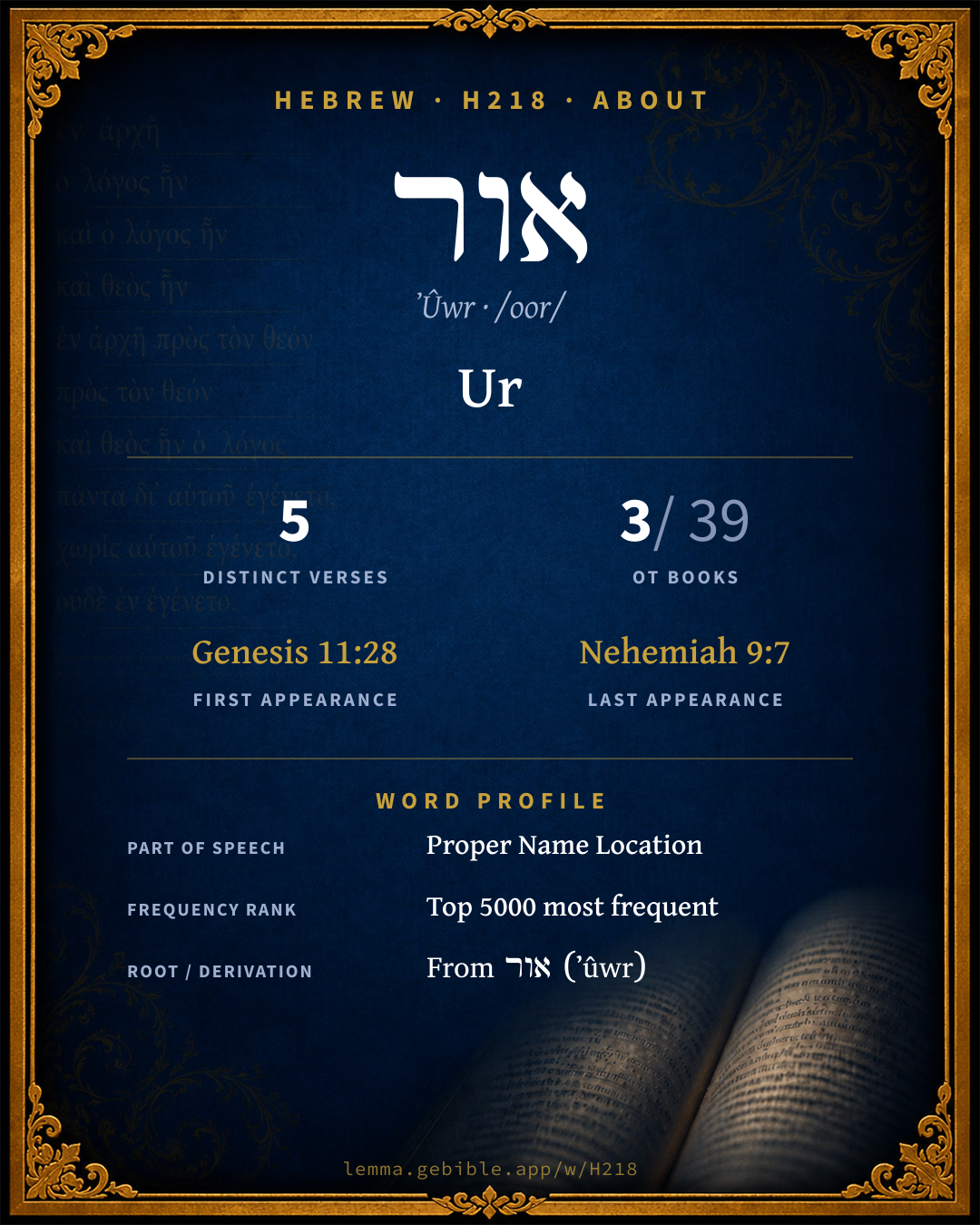
אוּר
Ur
BDB lists 2 entries for ‘Ur’ fuller range ↓
Full lexicon entry — Brown-Driver-Briggs (BDB)
From Brown-Driver-Briggs (BDB)
Where this word appears
Grammar key — what these labels mean
Part of speech
- Noun
- A naming word — a person, place, thing, or idea.
Noun type
- Proper
- A name of a specific person, place, or people (e.g. Abraham, Zion, Israel).
Every verse where H218 appears — 5 distinct verses across 3 books. Click any verse to open its interlinear word-by-word view. Verse text shown in the World English Bible for context — . Each verse’s Hebrew form is shown with its reference; the English is not keyword-highlighted, since the data carries no word-level English alignment. Use “Compare translations” on any verse to read it across multiple English versions. This concordance covers the Hebrew Bible; Septuagint (Greek Old Testament) occurrences are not indexed here.
Genesis 3 verses
- Genesis 11:28 בְּ/א֥וּר prep + n Proper Haran died before his father Terah in the land of his birth, in Ur of the Chaldees.
- Genesis 11:31 מֵ/א֣וּר prep + n Proper Terah took Abram his son, Lot the son of Haran, his son's son, and Sarai his daughter-in-law, his son Abram's wife. They went forth from Ur of the Chaldees, to go into the land of Canaan. They came to Haran, and lived there.
- Genesis 15:7 מֵ/א֣וּר prep + n Proper He said to him, "I am Yahweh who brought you out of Ur of the Chaldees, to give you this land to inherit it."
1 Chronicles 1 verse
Nehemiah 1 verse
About this entry
At a glance — auto-summarized from this page’s data, not written by a person. Every figure links to its source below. This summary describes the numbers; it doesn’t interpret them.
אור (ʼÛwr) is a Hebrew name most often rendered “Ur.” With only 5 verses it sits in the long tail of Hebrew Bible vocabulary. Genesis dominates its distribution — 3 of 5 verses. It first appears in Genesis 11:28. The sections below give every occurrence and version rendering.
Gloss history
Strong's 1890 vs modern scholarship
About this word
Strong's H218 catalogs a Hebrew word from the Hebrew Old Testament.
These counts are not copied from any lexicon or concordance. They are computed here, from the morphology-tagged Hebrew Old Testament. What Lemma adds →
- 5
- distinct verses
- The word appears in 5 distinct verses.
- 3 / 39
- OT books
- The word appears in 3 of 39 Old Testament books.
- #3,337
- by frequency
- Top 5000 most frequent Hebrew words (rank 3,337 of 8,640 Hebrew words by occurrence).
View all 5 occurrences in the concordance →
Most concentrated in
- Genesis 3 verses 60%
- 1 Chronicles 1 verse 20%
- Nehemiah 1 verse 20%
By section of the Old Testament
By traditional corpus
Conventional, traditional groupings — biblical authorship is debated, so this is a traditional corpus grouping, not an authorship claim. Each share is this word’s portion of its verses in that division of the Hebrew canon. Each figure is a share of the word’s 5 distinct verses.
- Torah (Pentateuch) 3 verses · 60%
- Writings (Ketuvim) 2 verses · 40%
How translations render this word
Counts come from each version’s own published word-to-Strong’s tagging or interlinear alignment — an approximate guide to how each version renders this word, not a word-level alignment the data otherwise carries. Because each total is that version’s own tagged count, the per-version totals vary from one another and need not match the appearance or distinct-verse counts above. These counts may also differ from a printed concordance because Lemma counts each distinctly tagged rendering and does not collapse phrase taggings into a single head-word total. This is a fixed set of word-tagged versions (KJV, ASV, BSB, ULT) and does not change with the reading translation you choose elsewhere. Each version’s license is shown beside its name below (and on Sources).
BDB lists this Strong’s number as 3 distinct words (homographs). Each count above pools all of them and is not split by sense — see the Senses section below. A low-frequency rendering may belong to a different one of those words, not the primary meaning.
- King James Version†: Ur 5×
- American Standard Version†: Ur 5×
- Berean Standard Bible†: Ur 5×
- unfoldingWord Literal Text†: Ur of 3×
King James Version Public Domain
Renders H218 across 5† tagged occurrences — most commonly:
American Standard Version Public Domain
Renders H218 across 5† tagged occurrences — most commonly:
Berean Standard Bible Public Domain
Renders H218 across 5† tagged occurrences — most commonly:
unfoldingWord Literal Text CC BY-SA 4.0
Renders H218 across 5† tagged occurrences — most commonly:
Plus 2 renderings that appear only once — usually multi-word phrases or single function words the recovered tagging swept in, not distinct renderings.
Senses in the full BDB
What do BDB’s symbols mean?
BDB uses these scholarly abbreviations:
| Symbol | Meaning |
|---|---|
| 𝔊 | the Septuagint (the ancient Greek translation, LXX) |
| 𝔙 | the Vulgate (the Latin translation) |
| 𝔖 | the Syriac version (the Peshitta) |
| 𝔗 | the Targum (the Aramaic translation) |
| ψ | the Psalms |
| √ | root (the underlying root or stem) |
| ‖ | parallel passage (a synonymous or contrasted parallel) |
| † | the dagger: every passage where the word occurs is cited |
The 0 senses and sub-senses the full Brown-Driver-Briggs lexicon distinguishes for this word, in lexicon order (not ranked by frequency), with BDB’s own verbatim wording and sub-sense lettering. Shown in Hebrew script with BDB’s own scholarly abbreviations. The condensed entry is in the Lexicon Entry tab. See also the Forms in the corpus table below.
אור I flame. לְכוּ בְאוּר אֶשְׁכֶם walk in the flame of your fire Is 50
אור II m. (flame) father of one of David’s heroes 1 Ch 11
אור III loc. Ur (Bab. Uru
Senses from the full Brown-Driver-Briggs lexicon (Brown, Driver, Briggs; Oxford 1906 — public domain), digitized via Sefaria, supplemented by the OpenScriptures HebrewLexicon (CC BY 4.0). Full attribution on Sources.
Word origin
I. n.m. flame. לְכוּ בְאוּר אֶשְׁכֶם walk in the flame of your fire Is 50:11, & so fire itself, whose light & flame were seen 44:16; 47:14—exile Is. + 31:9 & Ez 5:2 (Co אשׁ).
II. n.pr.m. (flame) father of one of David’s heroes 1 Ch 11:35 (iii. אוּר n.pr.loc. v. infr.)—iii. אוּר in אוּר כַּשְׂדִּים. Ur of the Chaldees Gn 11:28, 31; 15:7 Ne 9:7.
III. n.pr.loc. Ur (Bab. Uru; seat of moon-god worship; hence Eupolemos in EusebPraep. Ev. ix. 17 says Καμαρίνῃ ἥν τινας λέγειν πόλιν Οὐρίην), ancient city in Southern Babylonia; OT always אוּר כַּשְׂדִּים, i.e. Ur of the Kasdim (Chaldeans) v. כַּשְׂדִּים sub כשׂד; home of Terah, Abram’s father, & A.’s point of departure for Mesopotamia & Canaan Gn 11:28; 15:7 (both J), & hence Ne 9:7; also Gn 11:31 (P);—mod. Muqayyar, south of Euphrates, c. 150 miles SE. of Babylon; v. KG94 f DlPa 226 f COT on Gn 11:28.
— Brown-Driver-Briggs (Oxford 1906, public domain), digitized via Sefaria, supplemented by the OpenScriptures HebrewLexicon (CC BY 4.0). See Sources.
Derived from אור (ʼûwr) (H217) — flame.
Jastrow Dictionary
A second Hebrew/Aramaic lexicon for comparison, covering Aramaic and post-biblical (Talmudic, Targumic, Midrashic) usage that the biblical-Hebrew BDB does not. Matched by lemma rather than by Strong’s number, so a lemma may carry more than one Jastrow headword (shown separately below), and the entries cover usage well beyond the Bible.
אוֹר I
- to perforate, break through, shine.—Denom. אַוִּיר, מְאוּרָה &c.
- to be broken through, grow light. Y. Ber. I, 2ᶜ משיֵאוֹר המזרח from the time the Eastern horizon is broken through, grows light.
- 1. (neut. v.) (neut. v.) to break through, shine. Y. ib. III, 6ᶜ bot. open thy lips ויָאִירוּ דבריך and let thy words come forth, speak out boldly. Yoma III, 1 ה׳ פני כל וכ׳ it has grown light all over the Eastern horizon.—פנים מֵאִירוֹת bright countenance. Num. R. s. 11; a. e.
- 2. (act. v.) to enlighten, brighten, make shine. Y. M. Kat. III, 83ᵇ ה׳ עיניו וכ׳ (the teacher had opened his (Samuel’s) eyes &c. B. Mets. 33ᵃ. Num. R. l. c. Ib. המזבח מֵאִירִים את (fr. Mal. I, 10) making the altar bright (with fire), feeding the fire on the altar. Yoma 73ᵇ, v. אוּר. e.g. Malachi 1:10
אוֹר
- Part. pass. נָאוֹר clear. Targ. Prov. IV, 25 נְאוֹרָן, נְאֹרָן, v. חֲוַר.
אוֹר II
- foreg.) breaking forth (cmp. Is. LVIII, 8) whence e.g. Isaiah 58:8
- 1. break of day, light, day; fire; trnsf. rise, glory, power, happiness. Ber. 2ᵇ ביאת אוֹרוֹ the entrance of his day-break (dawn of his eighth day; Tosaf. a. l. the sunset of his seventh day). Y. Pes. I, beg. 27ᵃ א׳ החמה sun-light. Ib. א׳ הנר candle light. Keth. 111ᵇ א׳ תורה light of the Law. B. Bath. 4ᵃ אוֹרוֹ של עולם intellectual light of the wold (a great man; the Law). Num. R. s. 15 אור של מעלן the celestial fire (believed to be the source of all light and fire); a. v. fr.
- 2. (breaking in of night) twilight, evening. Pes. I, 1 לארבעה וכ׳ א׳ on the evening (eve) of the fourteenth day of Nissan; v. discussion ibid. 2ᵃ sq., about the meaning of our w. R. Hash. 22ᵇ; Snh. 70ᵇ לא׳ עיבורו the evening following the eventual intercalation, i.e. the evening from the thirtieth of the past to the first of the beginning month.
- 3. (homil. = אוֹרָה II) rue. Gen. R. s. 20 in the Pentat. of R. M. it read כתנות אור וכ׳ (in place of עור Gen. III, 21) this alludes to the garments of Adam resembling the rue, wide below and narrow above; Ar. (Rashi diff.). e.g. Genesis 3:21
אוּר I
- foreg.) prop. light, flame; esp. Pl. אוּרִים ותומים the Urim and Tummim in the High-priest’s breast-plate. Yoma 73ᵇ א׳ שמאירים את דבריהם they are called Urim because they give their decisions in a clear way (not ambiguous as the oracles); cmp. Y. ib. VII, end, 44ᶜ. Sot. IX, 12. Y. Kidd. IV, beg. 65ᵇ
*אוּר II
- (= עוּר q. v.) chaff. Y. Ab. Zar. II, 40ᵈ א׳ דשערין chaff of barley; (Y. Sabb. XIV, 14ᵈ עור דסערין).
A Dictionary of the Targumim, the Talmud Babli and Yerushalmi, and the Midrashic Literature (Marcus Jastrow; London, Luzac, 1903) — Public Domain. Digitized via Sefaria. Digitized via Sefaria. Full attribution on Sources.
Forms in the corpus
The 3 distinct written forms H218 takes in the Hebrew Bible, most frequent first — each parse links to that state’s occurrences in the concordance. Hebrew forms include their vowel points and cantillation, so a single lemma takes many written forms.
| Form | Parsing | Example | Uses |
|---|---|---|---|
| מֵ/א֣וּר | Noun, Proper | Genesis 11:31 | 3 |
| אֽוּר | Noun, Proper | 1 Chronicles 11:35 | 1 |
| בְּ/א֥וּר | Noun, Proper | Genesis 11:28 | 1 |
Same root — word family
Other BDB entries built from the same root as H218, grouped by Strong’s listed origin. These share a root / origin per the lexicon — not necessarily a shared meaning. Each links to that word’s own entry.
Derives from
Proper names from this root
People and places named from this root — a name, not an additional meaning of the word.
Compare all same-root words → Showing 4 of 6 — not the complete family. 4 of the same-root words are proper names (people or places). They share a root, not necessarily a meaning.
Bible dictionary
Public-domain dictionary articles matched to this entry by name (Ur). A biblical name can be shared by more than one person or place, so an article may treat several.
Easton's Bible Dictionary · M. G. Easton, 1897
Light, or the moon city, a city "of the Chaldees," the birthplace of Haran (Gen. 11:28, 31), the largest city of Shinar or northern Chaldea, and the principal commercial centre of the country as well as the centre of political power. It stood near the mouth of the Euphrates, on its western bank, and is represented by the mounds (of bricks cemented by bitumen) of el-Mugheir, i.e., "the bitumined," or "the town of bitumen," now 150 miles from the sea and some 6 miles from the Euphrates, a little above the point where it receives the Shat el-Hie, an affluent from the Tigris. It was formerly a maritime city, as the waters of the Persian Gulf reached thus far inland. Ur was the port of Babylonia, whence trade was carried on with the dwellers on the gulf, and with the distant countries of India, Ethiopia, and Egypt. It was abandoned about B.C. 500, but long continued, like Erech, to be a great sacred cemetery city, as is evident from the number of tombs found there. (See ABRAHAM.)
The oldest king of Ur known to us is Ur-Ba'u (servant of the goddess Ba'u), as Hommel reads the name, or Ur-Gur, as others read it. He lived some twenty-eight hundred years B.C., and took part in building the famous temple of the moon-god Sin in Ur itself. The illustration here given represents his cuneiform inscription, written in the Sumerian language, and stamped upon every brick of the temple in Ur. It reads: "Ur-Ba'u, king of Ur, who built the temple of the moon-god."
"Ur was consecrated to the worship of Sin, the Babylonian moon-god. It shared this honour, however, with another city, and this city was Haran, or Harran. Harran was in Mesopotamia, and took its name from the highroad which led through it from the east to the west. The name is Babylonian, and bears witness to its having been founded by a Babylonian king. The same witness is still more decisively borne by the worship paid in it to the Babylonian moon-god and by its ancient temple of Sin. Indeed, the temple of the moon-god at Harran was perhaps even more famous in the Assyrian and Babylonian world than the temple of the moon-god at Ur.
"Between Ur and Harran there must, consequently, have been a close connection in early times, the record of which has not yet been recovered. It may be that Harran owed its foundation to a king of Ur; at any rate the two cities were bound together by the worship of the same deity, the closest and most enduring bond of union that existed in the ancient world. That Terah should have migrated from Ur to Harran, therefore, ceases to be extraordinary. If he left Ur at all, it was the most natural place to which to go. It was like passing from one court of a temple into another.
"Such a remarkable coincidence between the Biblical narrative and the evidence of archaeological research cannot be the result of chance. The narrative must be historical; no writer of late date, even if he were a Babylonian, could have invented a story so exactly in accordance with what we now know to have been the truth. For a story of the kind to have been the invention of Palestinian tradition is equally impossible. To the unprejudiced mind there is no escape from the conclusion that the history of the migration of Terah from Ur to Harran is founded on fact" (Sayce).
Smith's Bible Dictionary · William Smith, 1863
was the land of Haran's nativity, (Genesis 11:28) the place from which Terah and Abraham started "to go into the land of Canaan." (Genesis 11:31) It is called in Genesis "Ur of the Chaldaeans," while in the Acts St. Stephen places it, by implication, in Mesopotamia. (Acts 7:2,4) These are all the indications which Scripture furnishes as to its locality. It has been identified by the most ancient traditions with the city of Orfah in the highlands of Mesopotamia, which unite the table-land of Armenia to the valley of the Euphrates. In later ages it was called Edessa, and was celebrated as the capital of Abgarus or Acbarus who was said to have received the letter and portrait of our Saviour. "Two, physical features must have secured Orfah, from the earliest times, as a nucleus for the civilization of those regions. One is a high-crested crag, the natural fortifications of the crested citadel....The other is an abundant spring, issuing in a pool of transparent clearness, and embosomed in a mass of luxuriant verdure, which, amidst the dull brown desert all around, makes and must always have made, this spot an oasis, a paradise, in the Chaldaean wilderness. Round this sacred pool,'the beautiful spring Callirrhoe,' as it was called by the Greek writers, gather the modern traditions of the patriarch."--Stanley, Jewish Church, part i.p.7. A second tradition, which appears in the Talmud, finds Ur in Warka, 120 miles southeast from Babylon and four east of the Euphrates. It was the Orchoe of the Greeks, and probably the Ereck of Holy Scripture. This place bears the name of Huruk in the native inscriptions, and was in the countries known to the Jews as the land of the Chaldaeans. But in opposition to the most ancient traditions, many modern writers have fixed the site of Ur at a very different position, viz. in the extreme south of Chaldaea, at Mugheir, not very far above-- and probably in the time of Abraham actually upon--the head of the Persian Gulf. Among the ruins which are now seen at the spot are the remains of one of the great temples, of a model similar to that of Babel, dedicated to the moon, to whom the city was sacred. (Porter and Rawlinson favor this last place.)
Hitchcock's Bible Names Dictionary · Roswell D. Hitchcock, 1869
fire, light, a valley
Classic public-domain reference works; full attribution on Sources.
Septuagint verse parallels
This word appears in 4 verses that also exist in the Greek Old Testament (Septuagint), out of the 5 Hebrew verses it occurs in. You can read those verses in Greek by switching the Old Testament edition to the Septuagint.
Read these verses in the Septuagint
This is a verse-level parallel only — the same verses exist in both the Hebrew and Greek Old Testaments. No word-level Hebrew↔Greek correspondence is claimed: the data carries no such alignment, so no Greek word is shown as this Hebrew word’s translation. Coverage is not total — the Septuagint omits the deuterocanon and renumbers the Psalms, so some Hebrew verses have no direct Greek parallel.