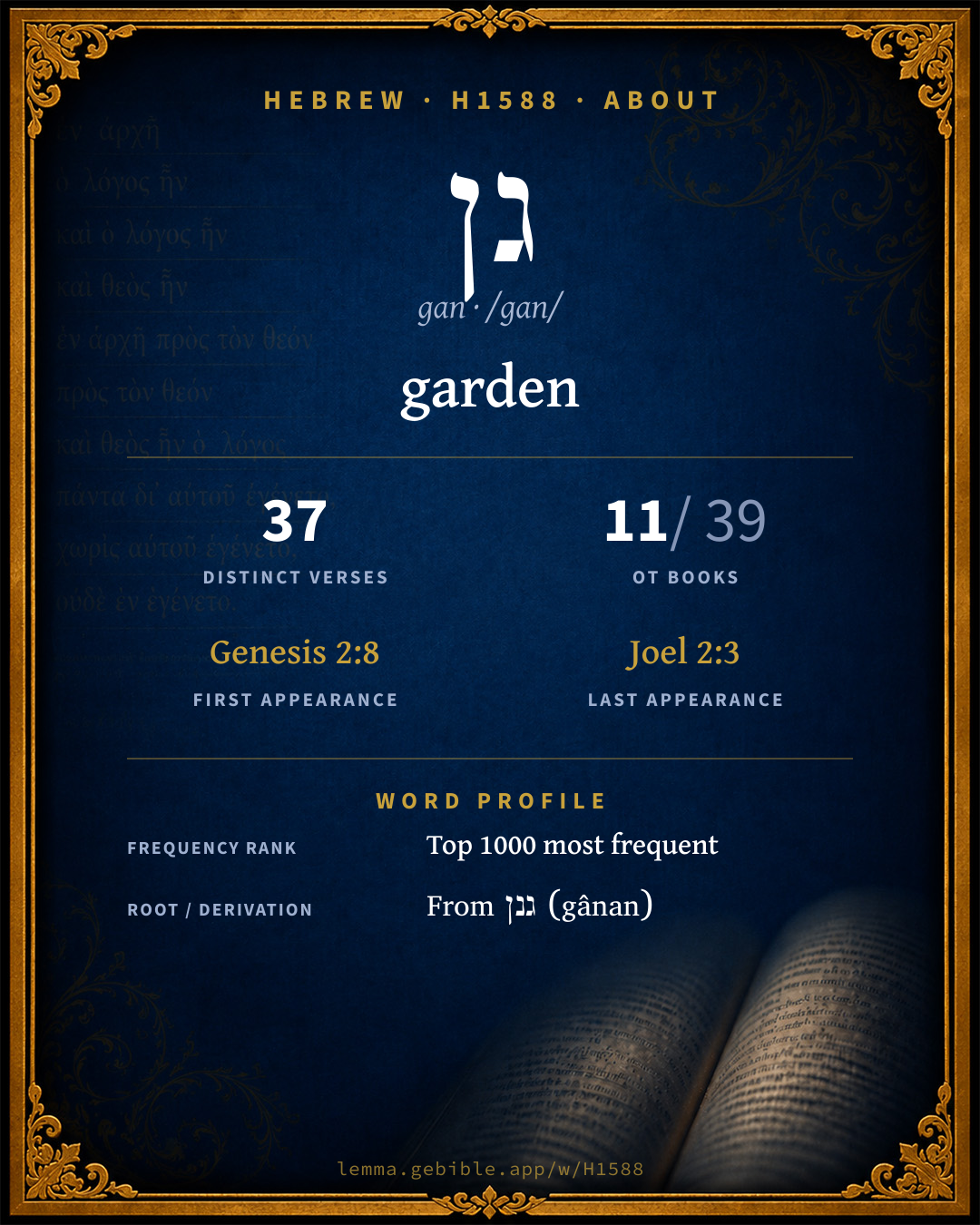
גַּן
garden
‘garden’ is one of 4 main senses fuller range ↓
Full lexicon entry — Brown-Driver-Briggs (BDB)
From Brown-Driver-Briggs (BDB)
Where this word appears
Grammar key — what these labels mean
Part of speech
- Noun
- A naming word — a person, place, thing, or idea.
Noun type
- Common
- A common noun — a general class of person, place, or thing (“king,” “city,” “water”), not a specific name.
- Proper
- A name of a specific person, place, or people (e.g. Abraham, Zion, Israel).
State
- Construct
- A noun bound to a following noun in a possessive / “of” relationship (the construct chain).
- Absolute
- The independent form of a noun, not bound to a following word.
Gender
- Both
- Attested as both masculine and feminine.
Number
- Singular
- One.
- Plural
- More than one (in Hebrew, generally three or more).
Every verse where H1588 appears in the Book of 1 Kings — 1 distinct verse. Click any verse to open its interlinear word-by-word view. Verse text shown in the World English Bible for context — . Each verse’s Hebrew form is shown with its reference; the English is not keyword-highlighted, since the data carries no word-level English alignment. Use “Compare translations” on any verse to read it across multiple English versions. This concordance covers the Hebrew Bible; Septuagint (Greek Old Testament) occurrences are not indexed here.
1 Kings
About this entry
At a glance — auto-summarized from this page’s data, not written by a person. Every figure links to its source below. This summary describes the numbers; it doesn’t interpret them.
The Hebrew word גן centers on the idea of “garden.” Lexicons map it across 4 senses. It turns up in 37 verses across 11 books, a moderately common footprint. The word gravitates to Genesis (35%), then Song of Solomon and 2 Kings. First canonically at Genesis 2:8, it enters the text early. For the data behind this summary, explore the sense tree and the renderings breakdown below.
Gloss history
Strong's 1890 vs modern scholarship
About this word
Strong's H1588 catalogs a Hebrew word from the Hebrew Old Testament.
These counts are not copied from any lexicon or concordance. They are computed here, from the morphology-tagged Hebrew Old Testament. What Lemma adds →
- 37
- distinct verses
- The word appears in 37 distinct verses.
- 11 / 39
- OT books
- The word appears in 11 of 39 Old Testament books.
- #864
- by frequency
- Top 1000 most frequent Hebrew words (rank 864 of 8,640 Hebrew words by occurrence).
View all 37 occurrences in the concordance →
Most concentrated in
- Genesis 13 verses 35%
- Song of Solomon 6 verses 16%
- 2 Kings 4 verses 11%
By section of the Old Testament
By traditional corpus
Conventional, traditional groupings — biblical authorship is debated, so this is a traditional corpus grouping, not an authorship claim. Each share is this word’s portion of its verses in that division of the Hebrew canon. Each figure is a share of the word’s 37 distinct verses.
- Prophets (Nevi'im) 15 verses · 41%
- Torah (Pentateuch) 14 verses · 38%
- Writings (Ketuvim) 8 verses · 22%
How translations render this word
Counts come from each version’s own published word-to-Strong’s tagging or interlinear alignment — an approximate guide to how each version renders this word, not a word-level alignment the data otherwise carries. Because each total is that version’s own tagged count, the per-version totals vary from one another and need not match the appearance or distinct-verse counts above. These counts may also differ from a printed concordance because Lemma counts each distinctly tagged rendering and does not collapse phrase taggings into a single head-word total. This is a fixed set of word-tagged versions (KJV, ASV, BSB, ULT) and does not change with the reading translation you choose elsewhere. Each version’s license is shown beside its name below (and on Sources).
BDB lists this Strong’s number as 3 distinct words (homographs). Each count above pools all of them and is not split by sense — see the Senses section below. A low-frequency rendering may belong to a different one of those words, not the primary meaning.
- King James Version†: Garden 33×, Gardens 3×
- American Standard Version†: Garden 28×, 's garden 4×, Gardens 3×
- Berean Standard Bible†: Garden 32×, Like the garden 3×, Gardens 2×
- unfoldingWord Literal Text†: Garden 22×, Garden of 10×, Gardens 3×
King James Version Public Domain
Renders H1588 across 42† tagged occurrences — most commonly:
Plus 6 renderings that appear only once — usually multi-word phrases or single function words the recovered tagging swept in, not distinct renderings.
American Standard Version Public Domain
Renders H1588 across 42† tagged occurrences — most commonly:
Plus 5 renderings that appear only once — usually multi-word phrases or single function words the recovered tagging swept in, not distinct renderings.
Berean Standard Bible Public Domain
Renders H1588 across 42† tagged occurrences — most commonly:
Plus 5 renderings that appear only once — usually multi-word phrases or single function words the recovered tagging swept in, not distinct renderings.
unfoldingWord Literal Text CC BY-SA 4.0
Renders H1588 across 46† tagged occurrences — most commonly:
Plus 9 renderings that appear only once — usually multi-word phrases or single function words the recovered tagging swept in, not distinct renderings.
Senses in BDB
The 4 senses BDB distinguishes for this word, in lexicon order (not ranked by frequency or importance). The full entry — with sub-senses — is in the Lexicon Entry tab.
- garden, enclosure (noun masculine or feminine)
- enclosed garden
(figuratively of a bride)
- garden (of plants)
- Garden of Eden (noun proper locative)
Word origin
I. n.pr.loc.? 𝔊 Βαιθαν (Βαιατγαν), 𝔊L Βαιθωρων, 2 K 9:27; mod. Jenîn? v. גַּן, sub גנן, and עֵין גַּנִּים; cf. StaGesch. i. 542.
II. n.m. Ct 4:12 & (Gn 2:15) f. enclosure, garden (NH id., גַּנָּה, Arabic جَنَّةٌ, Ethiopic ገnነት Assyrian gannu or gannatu word of unc. meaning; Aramaic גִּנָּא, גִּנְתָּא, ܓܰܢܬܳܐ; Ph. פר אגנן אם צץ[צ] CISi, 165, 11 & p. 232 f. birds of enclosure (domestic fowls) or of wing)—abs. גַּן Gn 2:8 + 3 times; cstr. id. Gn 2:15 + 19 times; c. art. הַגָּן Gn 2:9 + 9 times, but כַּגַּן La 2:6; sf. גַּנִּי Ct 4:16; 5:1, גַּנּוֹ Ct 4:16; 6:2; Pl. גַּנִּים Ct 4:15 + 2 times—garden as enclosure La 2:6 (simile); הַיּוֹשֶׁבֶת בַּגַּנִּים Ct 8:13; cf. Ct 4:12 (fig. of bride גַּן נָעוּל); g. of herbs (יָרָק) Dt 11:10 1 K 21:2; fig. of bride, g. of plants, fruits, and spices Ct 4:16(×2); 5:1; 6:2(×2) cf. מַעְיַן גנים Ct 4:15; g. of (king’s) house 2 K 21:18 = גַּן־עֻזָּא 2 K 21:18, 26; גַּן הַמֶּלֶךְ 2 K 25:4 Je 39:4; 52:7 Ne 3:15, cf. בֵּית הַגָּן 2 K 9:27 (at Jezreel? but this perhaps n.pr.loc. v. sub בית p. 111); most often of garden (orchard?) in Eden (Hex only Gn & only J) Gn 2:8, 9, 10, 16; 3:1, 2, 3, 8(×2), 10, called גַּן־עֵדֶן Gn 2:15; 3:23, 24 Ez 36:35 Jo 2:3, cf. גן־י׳ Gn 13:10 Is 51:3 (both in simile); גן־אלהים Ez 28:13 (עֵדֶן גן־אל׳), 31:8(×2), 9 (‖ עֵדֶן); in last three the trees of the garden are comp. with Assyrian under fig. of cedar of Lebanon.
— Brown-Driver-Briggs (Oxford 1906, public domain), digitized via Sefaria, supplemented by the OpenScriptures HebrewLexicon (CC BY 4.0). See Sources.
Derived from גנן (gânan) (H1598) — to defend.
Jastrow Dictionary
A second Hebrew/Aramaic lexicon for comparison, covering Aramaic and post-biblical (Talmudic, Targumic, Midrashic) usage that the biblical-Hebrew BDB does not. Matched by lemma rather than by Strong’s number, so a lemma may carry more than one Jastrow headword (shown separately below), and the entries cover usage well beyond the Bible.
גַּן
- a fenced-in place, garden.—גַּן עֵדֶן paradise, place of future reward, opp. גֵּיהִינָּם. Pes. 54ᵃ; Ned. 39ᵇ; a. fr.—Gen. R. s. 15 beg. גן גדול מעדן the garden was larger than Eden (Eden was a portion of the garden, ref. to Ez. XXXI, 9). Taan. 10ᵃ וגן אחד וכ׳ and the garden was one sixtieth portion of Eden.—Gen. R. l. c. כפיגי שהיא נתונה בגי׳ like a spring in a garden. Kil. II, 2 זרעוני גנה garden plants. Ex. R. s. 31 גלגל שבגי׳ the wheel works of the well in the garden; a. fr.—Trnsf. (cmp. hortulus a. κῆπος) woman. Pirké d’R. El. ch. XXI אין גן אלא האשה וכ׳ gan (Gen. III, 3) means woman who is compared to a garden (ref. to Cant. IV, 12), מה הגנה זו וכ׳ as a garden &c. Cant. R. to IV, 12 גַּנָּתִי נעולה והיא מתגניא my consort (Israel) is closed (chaste), and yet defamed.—Pl. גַּנּוֹת. Lev. R. s. 3, beg. better off is he who owns גינה one garden and &c. ממי שנוטל ג׳ של וכ׳ than he who takes other people’s gardens on half-shares; a. fr.—Gen. R. s. 85 חורש בגנות (euphem. for sexual intercourse). e.g. Ezekiel 31:9
A Dictionary of the Targumim, the Talmud Babli and Yerushalmi, and the Midrashic Literature (Marcus Jastrow; London, Luzac, 1903) — Public Domain. Digitized via Sefaria. Digitized via Sefaria. Full attribution on Sources.
Forms in the corpus
The 26 distinct written forms H1588 takes in the Hebrew Bible, most frequent first — each parse links to that state’s occurrences in the concordance. Hebrew forms include their vowel points and cantillation, so a single lemma takes many written forms.
Same root — word family
Other BDB entries built from the same root as H1588, grouped by Strong’s listed origin. These share a root / origin per the lexicon — not necessarily a shared meaning. Each links to that word’s own entry.
Derives from
Shares the same root
Derived from this word
Proper names from this root
People and places named from this root — a name, not an additional meaning of the word.
Compare all same-root words → Showing 4 of 6 — not the complete family. 2 of the same-root words are proper names (people or places). They share a root, not necessarily a meaning.
Septuagint verse parallels
This word appears in 36 verses that also exist in the Greek Old Testament (Septuagint), out of the 37 Hebrew verses it occurs in. You can read those verses in Greek by switching the Old Testament edition to the Septuagint.
Read these verses in the Septuagint
- Genesis 2:8
- Deuteronomy 11:10
- 1 Kings 21:2
- 2 Kings 9:27
- Song of Solomon 4:12
- Isaiah 51:3
- Jeremiah 31:12
- Lamentations 2:6
- Ezekiel 28:13
- Joel 2:3
This is a verse-level parallel only — the same verses exist in both the Hebrew and Greek Old Testaments. No word-level Hebrew↔Greek correspondence is claimed: the data carries no such alignment, so no Greek word is shown as this Hebrew word’s translation. Coverage is not total — the Septuagint omits the deuterocanon and renumbers the Psalms, so some Hebrew verses have no direct Greek parallel.