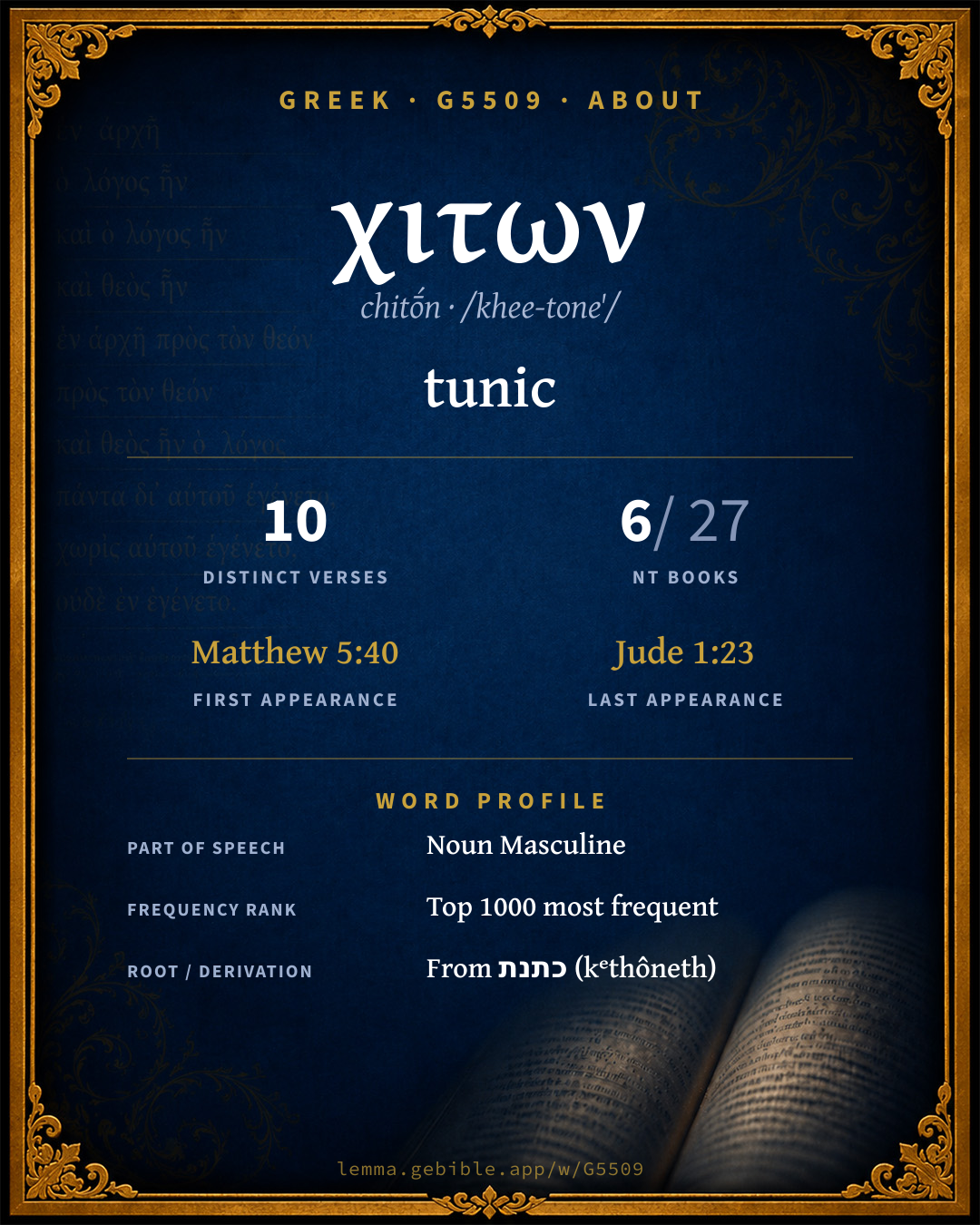
χιτών
tunic
Full lexicon entry — Thayer's Greek Lexicon
From Thayer's Greek Lexicon
Where this word appears
See every Accusative-case word in the Greek New Testament →
Grammar key — what these labels mean
Part of speech
- Noun
- A naming word — a person, place, thing, or idea.
Case
- Accusative
- The case of the direct object and of extent.
- Nominative
- The case of the subject (and the predicate nominative).
Gender
- Masculine
- Grammatically masculine.
Number
- Plural
- More than one.
- Singular
- One.
1 distinct verse where G5509 appears in the Nominative case, across 1 book. Filtered view — show all forms. Click any verse to open its interlinear word-by-word view. Verse text shown in the World English Bible for context — . Each verse’s Greek form is shown with its reference; the English is not keyword-highlighted, since the data carries no word-level English alignment. Use “Compare translations” on any verse to read it across multiple English versions. This concordance covers the Greek New Testament; Septuagint (Greek Old Testament) occurrences of this word are not indexed here.
John 1 verse
About this entry
At a glance — auto-summarized from this page’s data, not written by a person. Every figure links to its source below. This summary describes the numbers; it doesn’t interpret them.
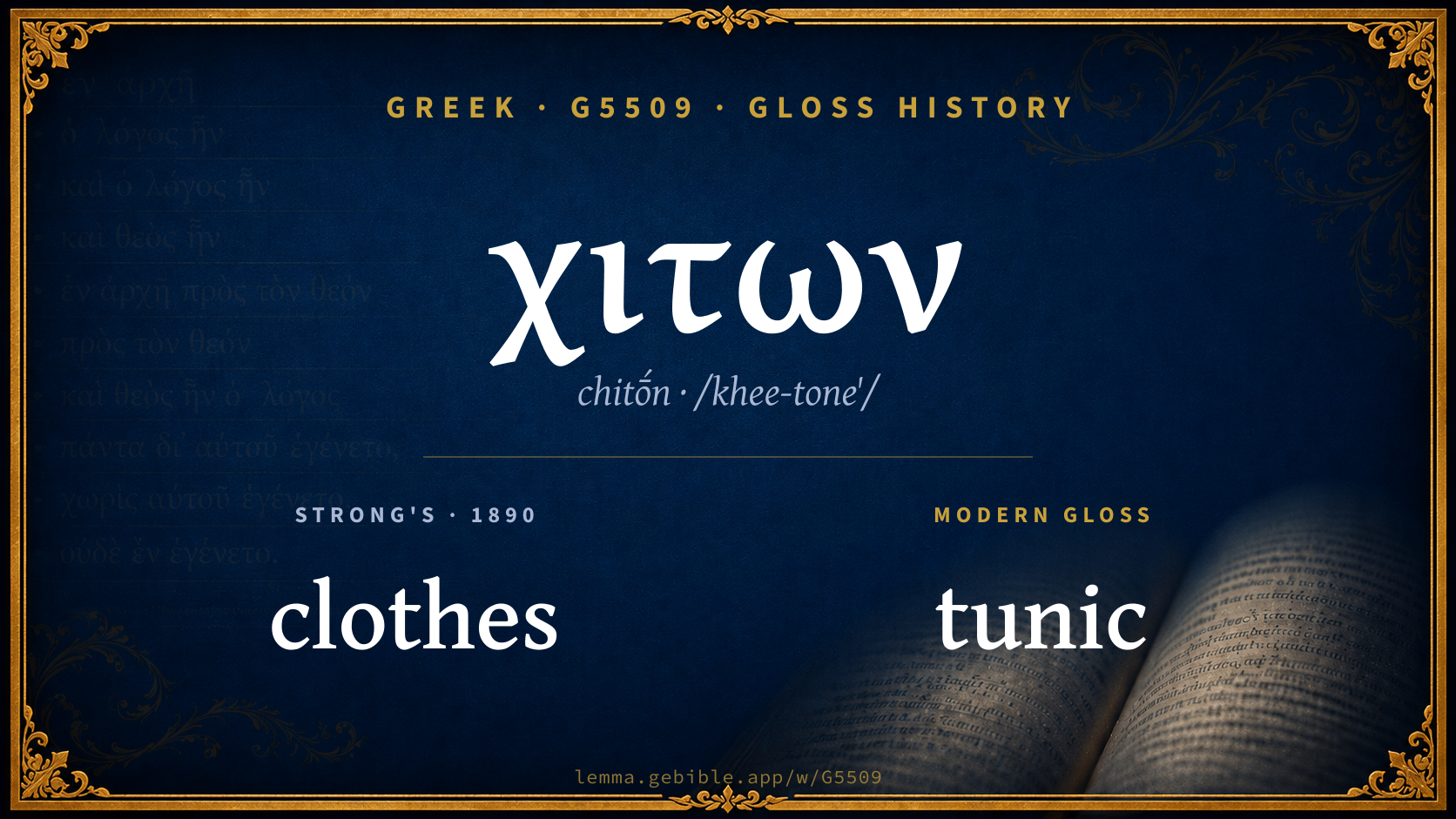
“tunic” is the headline sense of the Greek noun χιτων (chitṓn). Older and newer Bibles part ways — “coats” in the King James Version, “tunic” (Berean Standard Bible) and “tunics” (unfoldingWord Literal Text) in modern versions. See the renderings breakdown. It appears 10 verses across 6 books of the Greek New Testament, among its uncommon vocabulary. More than a quarter of its appearances fall in Luke. Scripture first uses it in Matthew 5:40. The sections below give every sense, occurrence, and version rendering.
Gloss history
Strong's 1890 vs modern scholarship
About this word
Strong's G5509 catalogs a Greek word from the Greek New Testament.
These counts are not copied from any lexicon or concordance. They are computed here, from the morphology-tagged Greek New Testament. What Lemma adds →
- 10
- distinct verses
- The word appears in 10 distinct verses.
- 6 / 27
- NT books
- The word appears in 6 of 27 New Testament books.
- #978
- by frequency
- Top 1000 most frequent Greek words (rank 978 of 5,347 Greek words by occurrence).
View all 10 occurrences in the concordance →
By section of the New Testament
By traditional corpus
Conventional, traditional groupings — biblical authorship is debated, so this is a traditional corpus grouping, not an authorship claim. Some books belong to more than one corpus (Luke is in both the Gospels and the Lukan corpus, and so on), so these shares overlap and need not total 100%. Each figure is a share of the word’s 10 distinct verses.
- Gospels 8 verses · 80%
- Lukan (Luke–Acts) 4 verses · 40%
- Johannine 1 verse · 10%
- General (Catholic) Epistles 1 verse · 10%
How translations render this word
Counts come from each version’s own published word-to-Strong’s tagging or interlinear alignment — an approximate guide to how each version renders this word, not a word-level alignment the data otherwise carries. Because each total is that version’s own tagged count, the per-version totals vary from one another and need not match the appearance or distinct-verse counts above. These counts may also differ from a printed concordance because Lemma counts each distinctly tagged rendering and does not collapse phrase taggings into a single head-word total. This is a fixed set of word-tagged versions (KJV, ASV, BSB, ULT) and does not change with the reading translation you choose elsewhere. Each version’s license is shown beside its name below (and on Sources).
- King James Version: Coats 5×, Coat 3×
- American Standard Version: Coats 5×, Coat 4×
- Berean Standard Bible: Tunic 6×, Tunics 2×
- unfoldingWord Literal Text: Tunics 5×, Tunic 4×
King James Version Public Domain
Renders G5509 across 11 tagged occurrences — most commonly:
Plus 3 renderings that appear only once — usually multi-word phrases or single function words the recovered tagging swept in, not distinct renderings.
American Standard Version Public Domain
Renders G5509 across 11 tagged occurrences — most commonly:
Plus 2 renderings that appear only once — usually multi-word phrases or single function words the recovered tagging swept in, not distinct renderings.
Berean Standard Bible Public Domain
Renders G5509 across 10 tagged occurrences — most commonly:
Plus 2 renderings that appear only once — usually multi-word phrases or single function words the recovered tagging swept in, not distinct renderings. Not rendered by a distinct English word in 1 further occurrence.
unfoldingWord Literal Text CC BY-SA 4.0
Renders G5509 across 11 tagged occurrences — most commonly:
Plus 2 renderings that appear only once — usually multi-word phrases or single function words the recovered tagging swept in, not distinct renderings.
Senses in Thayer's
The 1 sense Thayer's distinguishes for this word, in lexicon order (not ranked by frequency or importance). The full entry — with sub-senses — is in the Lexicon Entry tab.
- a tunic, an undergarment, usually worn next to the skin, a garment, a vestment
Word origin
Derived from כתנת (kᵉthôneth) (H3801) — tunic.
Of foreign origin [ H3801 ]; a tunic or shirt : - clothes coat garment.
— Strong’s Exhaustive Concordance (1890), public domain.
Forms in the corpus
The 4 distinct written forms G5509 takes in the Greek New Testament, most frequent first — each parse links to that case’s occurrences in the concordance.
| Form | Parsing | Example | Uses |
|---|---|---|---|
| χιτῶνας chitō̂nas | Noun, Accusative, Plural, Masculine | Matthew 10:10 | 6 |
| χιτῶνα chitō̂na | Noun, Accusative, Singular, Masculine | Luke 6:29 | 3 |
| χιτὼν chitṑn | Noun, Nominative, Singular, Masculine | John 19:23 | 1 |
| χιτῶνά chitō̂ná | Noun, Accusative, Singular, Masculine | Matthew 5:40 | 1 |
Septuagint usage
The same Greek word χιτων appears 31 times in the Greek Old Testament (Septuagint), across 29 verses in 8 books.
- 31
- LXX occurrences
- Tagged occurrences of this Greek word in the Septuagint.
- 29
- verses
- Distinct Septuagint verses containing this word.
- 8 / 39
- OT books
- The word appears in 8 of the 39 Old Testament books.
Sample Septuagint occurrences
- Genesis 3:21 χιτών
- Exodus 28:4 χιτών
- Leviticus 6:3 χιτών
- 2 Samuel 13:18 χιτών
- 1 Kings 20:27 χιτών
- Job 30:18 χιτών
- Song of Solomon 5:3 χιτών
- Isaiah 3:16 χιτών
Septuagint occurrences (same lexeme)
Every verse where the same Strong’s number (G5509) appears in the Greek Septuagint. Verse text shown in the World English Bible for context; the Greek form is the matched word — the English is not keyword-highlighted.
- Genesis 3:21 χιτών Yahweh God made coats of skins for Adam and for his wife, and clothed them.
- Genesis 37:3 χιτών Now Israel loved Joseph more than all his children, because he was the son of his old age, and he made him a coat of many colors.
- Genesis 37:23 χιτών It happened, when Joseph came to his brothers, that they stripped Joseph of his coat, the coat of many colors that was on him;
- Genesis 37:31 χιτών They took Joseph's coat, and killed a male goat, and dipped the coat in the blood.
- Genesis 37:32 χιτών They took the coat of many colors, and they brought it to their father, and said, "We have found this. Examine it, now, whether it is your son's coat or not."
- Genesis 37:33 χιτών He recognized it, and said, "It is my son's coat. An evil animal has devoured him. Joseph is without doubt torn in pieces."
- Exodus 28:4 χιτών These are the garments which they shall make: a breastplate, and an ephod, and a robe, and a coat of checker work, a turban, and a sash: and they shall make holy garments for Aaron your brother, and his sons, that he may minister to me in the priest's office.
- Exodus 28:39 χιτών You shall weave the coat in checker work of fine linen, and you shall make a turban of fine linen, and you shall make a sash, the work of the embroiderer.
- Exodus 28:40 χιτών "You shall make coats for Aaron's sons, and you shall make sashes for them and headbands shall you make for them, for glory and for beauty.
- Exodus 29:5 χιτών You shall take the garments, and put on Aaron the coat, the robe of the ephod, the ephod, and the breastplate, and dress him with the skillfully woven band of the ephod;
- Exodus 29:8 χιτών You shall bring his sons, and put coats on them.
- Exodus 35:19 χιτών the finely worked garments, for ministering in the holy place, the holy garments for Aaron the priest, and the garments of his sons, to minister in the priest's office.'"
- Exodus 36:34 χιτών He overlaid the boards with gold, and made their rings of gold for places for the bars, and overlaid the bars with gold.
- Exodus 40:14 χιτών You shall bring his sons, and put coats on them.
- Leviticus 6:3 χιτών or has found that which was lost, and dealt falsely therein, and swearing to a lie; in any of all these things that a man does, sinning therein;
- Leviticus 8:7 χιτών He put the coat on him, tied the sash on him, clothed him with the robe, put the ephod on him, and he tied the skillfully woven band of the ephod on him, and fastened it to him with it.
- Leviticus 8:13 χιτών Moses brought Aaron's sons, and clothed them with coats, and tied sashes on them, and put headbands on them; as Yahweh commanded Moses.
- Leviticus 10:5 χιτών So they drew near, and carried them in their coats out of the camp, as Moses had said.
- Leviticus 16:4 χιτών He shall put on the holy linen coat, and he shall have the linen breeches on his body, and shall put on the linen sash, and he shall be dressed with the linen turban. They are the holy garments. He shall bathe his body in water, and put them on.
- 2 Samuel 13:18 χιτών She had a garment of various colors on her; for with such robes were the king's daughters who were virgins dressed. Then his servant brought her out, and bolted the door after her.
- 2 Samuel 13:19 χιτών Tamar put ashes on her head, and tore her garment of various colors that was on her; and she laid her hand on her head, and went her way, crying aloud as she went.
- 2 Samuel 15:32 χιτών It happened that when David had come to the top [of the ascent], where God was worshiped, behold, Hushai the Archite came to meet him with his coat torn, and earth on his head.
- 1 Kings 20:27 χιτών The children of Israel were mustered, and were provisioned, and went against them: and the children of Israel encamped before them like two little flocks of kids; but the Syrians filled the country.
- Job 30:18 χιτών By great force is my garment disfigured. It binds me about as the collar of my coat.
- Song of Solomon 5:3 χιτών I have taken off my robe. Indeed, must I put it on? I have washed my feet. Indeed, must I soil them?
- Isaiah 3:16 χιτών Moreover Yahweh said, "Because the daughters of Zion are haughty, And walk with outstretched necks and flirting eyes, Walking to trip as they go, Jingling ornaments on their feet;
- Isaiah 3:24 χιτών It shall happen that instead of sweet spices, there shall be rottenness; Instead of a belt, a rope; Instead of well set hair, baldness; Instead of a robe, a girding of sackcloth; And branding instead of beauty.
- Isaiah 36:22 χιτών Then came Eliakim the son of Hilkiah, who was over the household, and Shebna the scribe, and Joah, the son of Asaph, the recorder, to Hezekiah with their clothes torn, and told him the words of Rabshakeh.
- Isaiah 61:10 χιτών I will greatly rejoice in Yahweh, my soul shall be joyful in my God; for he has clothed me with the garments of salvation, he has covered me with the robe of righteousness, as a bridegroom decks himself with a garland, and as a bride adorns herself with her jewels.
These are occurrences of the same Greek lexeme (G5509) in the Septuagint — not a translation of any one Hebrew word. The store carries no word-level Hebrew↔Greek alignment, so no Hebrew original is asserted here. Counts come from the recovered LXX Strong's tagging — high-frequency vocabulary is well covered, while rare or late forms may be untagged — so they reflect tagged occurrences and may slightly undercount.