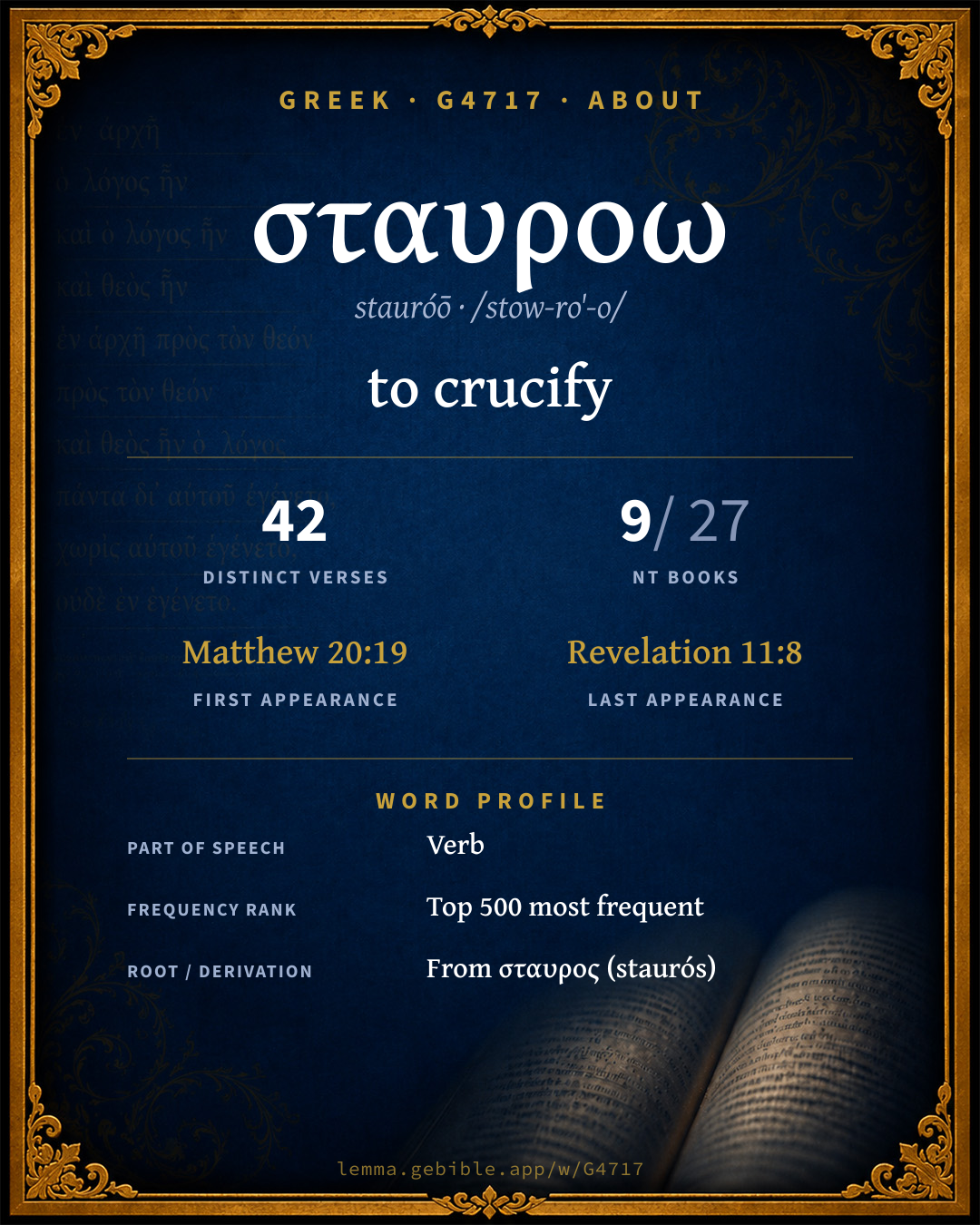
σταυρόω
to crucify
‘to crucify’ is one of 4 main senses fuller range ↓
Full lexicon entry — Thayer's Greek Lexicon
From Thayer's Greek Lexicon
Where this word appears
See every Aorist-tense verb in the Greek New Testament →
Grammar key — what these labels mean
Part of speech
- Verb
- An action or state-of-being word.
Tense
- Aorist
- Action viewed as a simple whole, without regard to duration — often past (perfective aspect).
- Perfect
- A completed past action with continuing present results.
- Present
- Ongoing or general action in present time (imperfective aspect).
- Future
- Action expected in future time.
Voice
- Active
- The subject performs the action.
- Passive
- The subject receives the action.
Mood
- Indicative
- States a fact or asks a factual question (the mood of reality).
- Imperative
- Expresses a command or request.
- Participle
- A verbal adjective (“writing,” “having written”).
- Infinitive
- A verbal noun (“to write”), unmarked for person or number.
- Subjunctive
- Expresses probability, purpose, or possibility (the mood of contingency).
Case
- Accusative
- The case of the direct object and of extent.
- Nominative
- The case of the subject (and the predicate nominative).
Person
- 3rd person
- The one spoken about (“he / she / it / they”).
- 2nd person
- The one addressed (“you”).
- 1st person
- The speaker (“I / we”).
Gender
- Masculine
- Grammatically masculine.
Number
- Plural
- More than one.
- Singular
- One.
Grammatical forms 19 distinct
- Verb, Aorist, Active, Indicative, 3rd person, Plural 7 times (15%)
- Verb, Aorist, Active, Imperative, 2nd person, Singular 5 times (11%)
- Verb, Aorist, Passive, Indicative, 3rd person, Singular 5 times (11%)
- Verb, Perfect, Passive, Participle, Accusative, Singular, Masculine 4 times (9%)
- Verb, Aorist, Active, Infinitive 3 times (7%)
- Verb, Aorist, Passive, Infinitive 3 times (7%)
- Verb, Aorist, Passive, Subjunctive, 3rd person, Singular 3 times (7%)
- Verb, Aorist, Active, Indicative, 2nd person, Plural 2 times (4%)
+11 more forms (14 occurrences)
Parsed forms decoded from the imported morphology (Robinson–Tischendorf, public domain), counted across 46 parsed occurrences — not distinct verses.
Every verse where G4717 appears — 42 distinct verses across 9 books. Click any verse to open its interlinear word-by-word view. Verse text shown in the World English Bible for context — . Each verse’s Greek form is shown with its reference; the English is not keyword-highlighted, since the data carries no word-level English alignment. Use “Compare translations” on any verse to read it across multiple English versions. This concordance covers the Greek New Testament; Septuagint (Greek Old Testament) occurrences of this word are not indexed here.
Matthew 10 verses
- Matthew 20:19 σταυρῶσαι aor act inf and will hand him over to the Gentiles to mock, to scourge, and to crucify; and the third day he will be raised up."
- Matthew 23:34 σταυρώσετε fut act ind 2pl Therefore, behold, I send to you prophets, wise men, and scribes. Some of them you will kill and crucify; and some of them you will scourge in your synagogues, and persecute from city to city;
- Matthew 26:2 σταυρωθῆναι aor pass inf "You know that after two days the Passover is coming, and the Son of Man will be delivered up to be crucified."
- Matthew 27:22 σταυρωθήτω aor pass impv 3sg Pilate said to them, "What then shall I do to Jesus, who is called Christ?" They all said to him, "Let him be crucified!"
- Matthew 27:23 σταυρωθήτω aor pass impv 3sg But the governor said, "Why? What evil has he done?" But they cried out exceedingly, saying, "Let him be crucified!"
- Matthew 27:26 σταυρωθῇ aor pass subj 3sg Then he released to them Barabbas, but Jesus he flogged and delivered to be crucified.
- Matthew 27:31 σταυρῶσαι aor act inf When they had mocked him, they took the robe off of him, and put his clothes on him, and led him away to crucify him.
- Matthew 27:35 σταυρώσαντες aor act ptcp nom pl masc When they had crucified him, they divided his clothing among them, casting lots,
- Matthew 27:38 σταυροῦνται pres pass ind 3pl Then there were two robbers crucified with him, one on his right hand and one on the left.
- Matthew 28:5 ἐσταυρωμένον perf pass ptcp acc sg masc The angel answered the women, "Don't be afraid, for I know that you seek Jesus, who has been crucified.
Mark 8 verses
- Mark 15:13 σταύρωσον aor act impv 2sg They cried out again, "Crucify him!"
- Mark 15:14 σταύρωσον aor act impv 2sg Pilate said to them, "Why, what evil has he done?" But they cried out exceedingly, "Crucify him!"
- Mark 15:15 σταυρωθῇ aor pass subj 3sg Pilate, wishing to please the multitude, released Barabbas to them, and handed over Jesus, when he had flogged him, to be crucified.
- Mark 15:20 σταυρώσουσιν fut act ind 3pl When they had mocked him, they took the purple off of him, and put his own garments on him. They led him out to crucify him.
- Mark 15:24 σταυροῦσιν pres act ind 3pl Crucifying him, they parted his garments among them, casting lots on them, what each should take.
- Mark 15:25 ἐσταύρωσαν aor act ind 3pl It was the third hour, and they crucified him.
- Mark 15:27 σταυροῦσιν pres act ind 3pl With him they crucified two robbers; one on his right hand, and one on his left.
- Mark 16:6 ἐσταυρωμένον perf pass ptcp acc sg masc He said to them, "Don't be amazed. You seek Jesus, the Nazarene, who has been crucified. He has risen. He is not here. Behold, the place where they laid him!
Luke 5 verses
- Luke 23:21 σταύρου σταύρου pres act impv 2sg pres act impv 2sg but they shouted, saying, "Crucify! Crucify him!"
- Luke 23:23 σταυρωθῆναι aor pass inf But they were urgent with loud voices, asking that he might be crucified. Their voices and the voices of the chief priests prevailed.
- Luke 23:33 ἐσταύρωσαν aor act ind 3pl When they came to the place that is called The Skull, they crucified him there with the criminals, one on the right and the other on the left.
- Luke 24:7 σταυρωθῆναι aor pass inf saying that the Son of Man must be delivered up into the hands of sinful men, and be crucified, and the third day rise again?"
- Luke 24:20 ἐσταύρωσαν aor act ind 3pl and how the chief priests and our rulers delivered him up to be condemned to death, and crucified him.
John 8 verses
- John 19:6 σταύρωσον σταύρωσον σταυρώσατε aor act impv 2sg aor act impv 2sg aor act impv 2pl When therefore the chief priests and the officers saw him, they shouted, saying, "Crucify! Crucify!" Pilate said to them, "Take him yourselves, and crucify him, for I find no basis for a charge against him."
- John 19:10 σταυρῶσαί aor act inf Pilate therefore said to him, "Aren't you speaking to me? Don't you know that I have power to release you, and have power to crucify you?"
- John 19:15 σταύρωσον σταυρώσω aor act impv 2sg fut act ind 1sg They cried out, "Away with him! Away with him! Crucify him!" Pilate said to them, "Shall I crucify your King?" The chief priests answered, "We have no king but Caesar!"
- John 19:16 σταυρωθῇ aor pass subj 3sg So then he delivered him to them to be crucified. So they took Jesus and led him away.
- John 19:18 ἐσταύρωσαν aor act ind 3pl where they crucified him, and with him two others, on either side one, and Jesus in the middle.
- John 19:20 ἐσταυρώθη aor pass ind 3sg Therefore many of the Jews read this title, for the place where Jesus was crucified was near the city; and it was written in Hebrew, in Latin, and in Greek.
- John 19:23 ἐσταύρωσαν aor act ind 3pl Then the soldiers, when they had crucified Jesus, took his garments and made four parts, to every soldier a part; and also the coat. Now the coat was without seam, woven from the top throughout.
- John 19:41 ἐσταυρώθη aor pass ind 3sg Now in the place where he was crucified there was a garden. In the garden a new tomb in which no man had ever yet been laid.
Acts 2 verses
- Acts 2:36 ἐσταυρώσατε aor act ind 2pl "Let all the house of Israel therefore know assuredly that God has made him both Lord and Christ, this Jesus whom you crucified."
- Acts 4:10 ἐσταυρώσατε aor act ind 2pl be it known to you all, and to all the people of Israel, that in the name of Jesus Christ of Nazareth, whom you crucified, whom God raised from the dead, in him does this man stand here before you whole.
1 Corinthians 4 verses
- 1 Corinthians 1:13 ἐσταυρώθη aor pass ind 3sg Is Christ divided? Was Paul crucified for you? Or were you baptized into the name of Paul?
- 1 Corinthians 1:23 ἐσταυρωμένον perf pass ptcp acc sg masc but we preach Christ crucified; a stumbling block to Jews, and foolishness to Greeks,
- 1 Corinthians 2:2 ἐσταυρωμένον perf pass ptcp acc sg masc For I determined not to know anything among you, except Jesus Christ, and him crucified.
- 1 Corinthians 2:8 ἐσταύρωσαν aor act ind 3pl which none of the rulers of this world has known. For had they known it, they wouldn't have crucified the Lord of glory.
2 Corinthians 1 verse
Galatians 3 verses
- Galatians 3:1 ἐσταυρωμένος perf pass ptcp nom sg masc Foolish Galatians, who has bewitched you not to obey the truth, before whose eyes Jesus Christ was openly set forth among you as crucified?
- Galatians 5:24 ἐσταύρωσαν aor act ind 3pl Those who belong to Christ have crucified the flesh with its passions and lusts.
- Galatians 6:14 ἐσταύρωται perf pass ind 3sg But far be it from me to boast, except in the cross of our Lord Jesus Christ, through which the world has been crucified to me, and I to the world.
Revelation 1 verse
About this entry
At a glance — auto-summarized from this page’s data, not written by a person. Every figure links to its source below. This summary describes the numbers; it doesn’t interpret them.
At its core, σταυροω (stauróō) means “to crucify.” Catalogued under 4 senses, its meaning is not single-sense. It turns up in 42 verses across 9 books, a moderately common footprint. Scripture first uses it in Matthew 20:19. Each statement above links to its evidence; the full detail follows below.
Gloss history
Strong's 1890 vs modern scholarship
About this word
Strong's G4717 catalogs a Greek word from the Greek New Testament.
These counts are not copied from any lexicon or concordance. They are computed here, from the morphology-tagged Greek New Testament. What Lemma adds →
- 42
- distinct verses
- The word appears in 42 distinct verses.
- 9 / 27
- NT books
- The word appears in 9 of 27 New Testament books.
- #334
- by frequency
- Top 500 most frequent Greek words (rank 334 of 5,347 Greek words by occurrence).
View all 42 occurrences in the concordance →
By section of the New Testament
By traditional corpus
Conventional, traditional groupings — biblical authorship is debated, so this is a traditional corpus grouping, not an authorship claim. Some books belong to more than one corpus (Luke is in both the Gospels and the Lukan corpus, and so on), so these shares overlap and need not total 100%. Each figure is a share of the word’s 42 distinct verses.
- Gospels 31 verses · 74%
- Johannine 9 verses · 21%
- Pauline corpus 8 verses · 19%
- Lukan (Luke–Acts) 7 verses · 17%
- Revelation 1 verse · 2%
How translations render this word
Counts come from each version’s own published word-to-Strong’s tagging or interlinear alignment — an approximate guide to how each version renders this word, not a word-level alignment the data otherwise carries. Because each total is that version’s own tagged count, the per-version totals vary from one another and need not match the appearance or distinct-verse counts above. These counts may also differ from a printed concordance because Lemma counts each distinctly tagged rendering and does not collapse phrase taggings into a single head-word total. This is a fixed set of word-tagged versions (KJV, ASV, BSB, ULT) and does not change with the reading translation you choose elsewhere. Each version’s license is shown beside its name below (and on Sources).
- King James Version: Crucify 13×, Crucified 6×, Be crucified 5×
- American Standard Version: Crucify 11×, Crucified 8×, Be crucified 5×
- Berean Standard Bible: Crucify 12×, Crucified 7×, Be crucified 6×
- unfoldingWord Literal Text: Crucified 9×, Crucify 8×, Crucify him 4×
King James Version Public Domain
Renders G4717 across 48 tagged occurrences — most commonly:
Plus 6 renderings that appear only once — usually multi-word phrases or single function words the recovered tagging swept in, not distinct renderings.
American Standard Version Public Domain
Renders G4717 across 49 tagged occurrences — most commonly:
Plus 13 renderings that appear only once — usually multi-word phrases or single function words the recovered tagging swept in, not distinct renderings.
Berean Standard Bible Public Domain
Renders G4717 across 46 tagged occurrences — most commonly:
Plus 9 renderings that appear only once — usually multi-word phrases or single function words the recovered tagging swept in, not distinct renderings.
unfoldingWord Literal Text CC BY-SA 4.0
Renders G4717 across 51 tagged occurrences — most commonly:
Plus 11 renderings that appear only once — usually multi-word phrases or single function words the recovered tagging swept in, not distinct renderings.
Senses in Thayer's
The 4 senses Thayer's distinguishes for this word, in lexicon order (not ranked by frequency or importance). The full entry — with sub-senses — is in the Lexicon Entry tab.
- to stake, drive down stakes
- to fortify with driven stakes, to palisade
- to crucify one
- metaph. to crucify the flesh…
Word origin
Derived from σταυρος (staurós) (G4716) — cross.
From G4716 ; to impale on the cross; figuratively to extinguish ( subdue ) passion or selfishness : - crucify.
— Strong’s Exhaustive Concordance (1890), public domain.
Forms in the corpus
The 20 distinct written forms G4717 takes in the Greek New Testament, most frequent first — each parse links to that tense’s occurrences in the concordance.
Septuagint usage
The same Greek word σταυροω appears 1 time in the Greek Old Testament (Septuagint), across 1 verse in 1 book.
- 1
- LXX occurrences
- Tagged occurrences of this Greek word in the Septuagint.
- 1
- verse
- Distinct Septuagint verses containing this word.
- 1 / 39
- OT books
- The word appears in 1 of the 39 Old Testament books.
Sample Septuagint occurrences
- Esther 7:9 σταυρόω
Septuagint occurrences (same lexeme)
Every verse where the same Strong’s number (G4717) appears in the Greek Septuagint. Verse text shown in the World English Bible for context; the Greek form is the matched word — the English is not keyword-highlighted.
These are occurrences of the same Greek lexeme (G4717) in the Septuagint — not a translation of any one Hebrew word. The store carries no word-level Hebrew↔Greek alignment, so no Hebrew original is asserted here. Counts come from the recovered LXX Strong's tagging — high-frequency vocabulary is well covered, while rare or late forms may be untagged — so they reflect tagged occurrences and may slightly undercount.