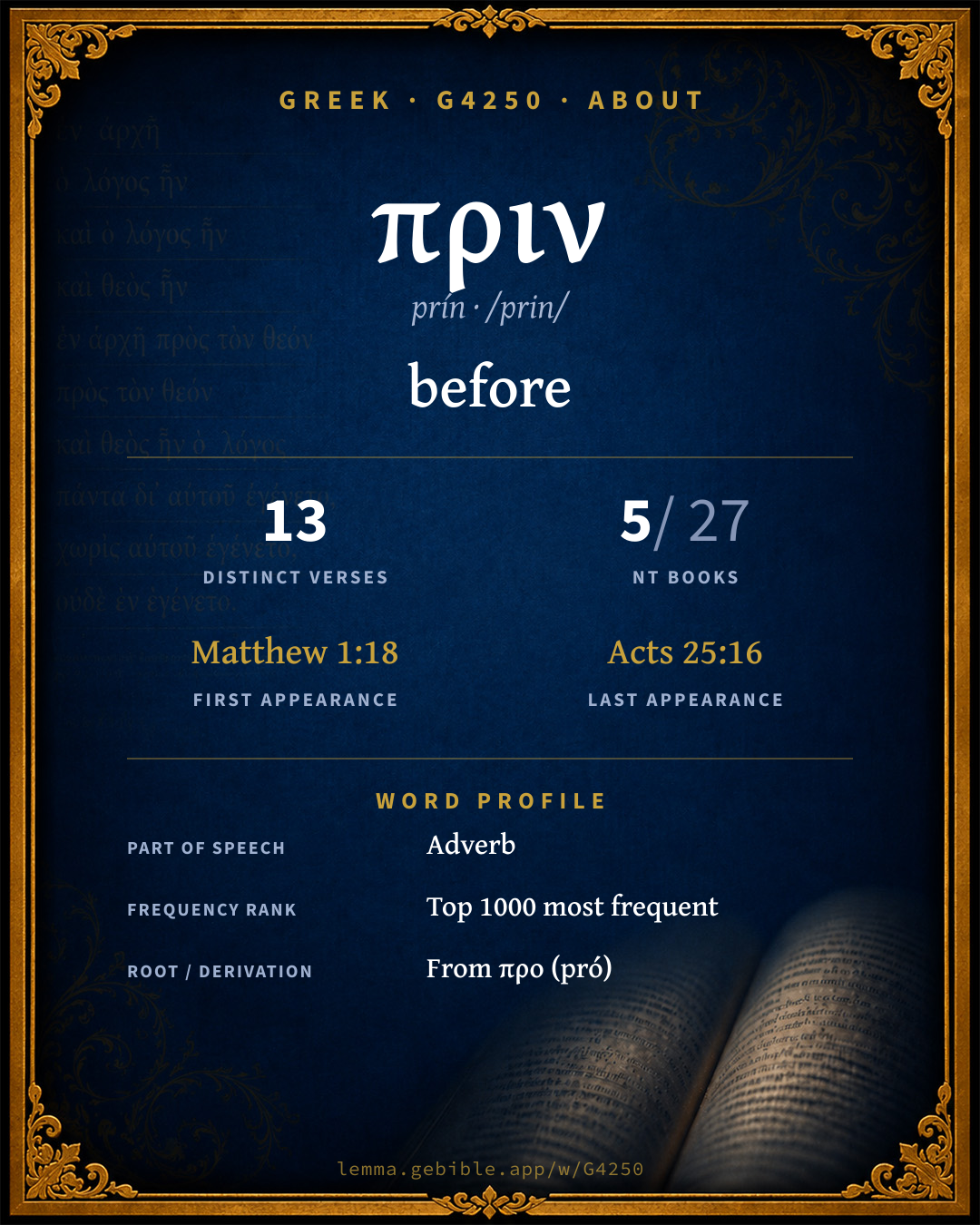
πρίν
before
Full lexicon entry — Thayer's Greek Lexicon
From Thayer's Greek Lexicon
Where this word appears
Grammar key — what these labels mean
Part of speech
- Adverb
- A word that modifies a verb, adjective, or other adverb.
Every verse where G4250 appears in the Book of Luke — 2 distinct verses. Click any verse to open its interlinear word-by-word view. Verse text shown in the World English Bible for context — . Each verse’s Greek form is shown with its reference; the English is not keyword-highlighted, since the data carries no word-level English alignment. Use “Compare translations” on any verse to read it across multiple English versions. This concordance covers the Greek New Testament; Septuagint (Greek Old Testament) occurrences of this word are not indexed here.
Luke
- Luke 2:26 πρὶν adv It had been revealed to him by the Holy Spirit that he should not see death before he had seen the Lord's Christ.
- Luke 22:61 πρὶν adv The Lord turned, and looked at Peter. Then Peter remembered the Lord's word, how he said to him, "Before the rooster crows you will deny me three times."
About this entry
At a glance — auto-summarized from this page’s data, not written by a person. Every figure links to its source below. This summary describes the numbers; it doesn’t interpret them.
“before” is the headline sense of the Greek verb πριν (prín). First canonically at Matthew 1:18, it enters the text early. With 13 verses in 5 books, it is an uncommon word in the Greek New Testament. It clusters with προ, πορρω and πρηνης under a shared root. See the sense tree, 13-verse concordance, and the renderings breakdown below.
Gloss history
Strong's 1890 vs modern scholarship

About this word
Strong's G4250 catalogs a Greek word from the Greek New Testament.
These counts are not copied from any lexicon or concordance. They are computed here, from the morphology-tagged Greek New Testament. What Lemma adds →
- 13
- distinct verses
- The word appears in 13 distinct verses.
- 5 / 27
- NT books
- The word appears in 5 of 27 New Testament books.
- #863
- by frequency
- Top 1000 most frequent Greek words (rank 863 of 5,347 Greek words by occurrence).
View all 13 occurrences in the concordance →
By section of the New Testament
By traditional corpus
Conventional, traditional groupings — biblical authorship is debated, so this is a traditional corpus grouping, not an authorship claim. Some books belong to more than one corpus (Luke is in both the Gospels and the Lukan corpus, and so on), so these shares overlap and need not total 100%. Each figure is a share of the word’s 13 distinct verses.
- Gospels 10 verses · 77%
- Lukan (Luke–Acts) 5 verses · 38%
- Johannine 3 verses · 23%
How translations render this word
Counts come from each version’s own published word-to-Strong’s tagging or interlinear alignment — an approximate guide to how each version renders this word, not a word-level alignment the data otherwise carries. Because each total is that version’s own tagged count, the per-version totals vary from one another and need not match the appearance or distinct-verse counts above. These counts may also differ from a printed concordance because Lemma counts each distinctly tagged rendering and does not collapse phrase taggings into a single head-word total. This is a fixed set of word-tagged versions (KJV, ASV, BSB, ULT) and does not change with the reading translation you choose elsewhere. Each version’s license is shown beside its name below (and on Sources).
- King James Version: Before 9×
- American Standard Version: Before 11×, That 2×
- Berean Standard Bible: Before 13×
- unfoldingWord Literal Text: Before 13×
King James Version Public Domain
Renders G4250 across 11 tagged occurrences — most commonly:
Plus 2 renderings that appear only once — usually multi-word phrases or single function words the recovered tagging swept in, not distinct renderings. Not rendered by a distinct English word in 3 further occurrences.
American Standard Version Public Domain
Renders G4250 across 15 tagged occurrences — most commonly:
Plus 2 renderings that appear only once — usually multi-word phrases or single function words the recovered tagging swept in, not distinct renderings.
Berean Standard Bible Public Domain
Renders G4250 across 13 tagged occurrences — most commonly:
unfoldingWord Literal Text CC BY-SA 4.0
Renders G4250 across 13 tagged occurrences — most commonly:
Senses in Thayer's
The 1 sense Thayer's distinguishes for this word, in lexicon order (not ranked by frequency or importance). The full entry — with sub-senses — is in the Lexicon Entry tab.
- before, formerly
Word origin
Derived from προ (pró) (G4253) — before.
Adverb from G4253 ; prior sooner : - before (that) ere.
— Strong’s Exhaustive Concordance (1890), public domain.
Same root — word family
Other Thayer's entries built from the same root as G4250, grouped by Strong’s listed origin. These share a root / origin per the lexicon — not necessarily a shared meaning. Each links to that word’s own entry.
Derives from
Shares the same root
- πορρω pórrhō G4206 far
- πρηνης prēnḗs G4248 headlong
- προαγω proágō G4254 to lead forward
- προαιρεομαι proairéomai G4255 to choose before
- προαιτιαομαι proaitiáomai G4256 to charge previously
- προακουω proakoúō G4257 to hear before
- προαμαρτανω proamartánō G4258 to sin before
- προαυλιον proaúlion G4259 porch
- προβαινω probaínō G4260 to go forward
- προβαλλω probállō G4261 to throw forward
- προβιβαζω probibázō G4264 to drag forward
- προβλεπω problépō G4265 to foresee
- προγινομαι progínomai G4266 to come before
- προγινωσκω proginṓskō G4267 to foreknow
- προγραφω prográphō G4270 to write before
- προδηλος pródēlos G4271 manifest
- προδιδωμι prodídōmi G4272 to give before
- προειδω proeídō G4275 to foresee
- προελπιζω proelpízō G4276 to hope before
- προεπω proépō G4277 to say before
- προεναρχομαι proenárchomai G4278 to begin before
- προεπαγγελλομαι proepangéllomai G4279 to promise before
- προερεω proeréō G4280 to say before
- προερχομαι proérchomai G4281 to go before
+47 more words share this root (not shown).
Proper names from this root
People and places named from this root — a name, not an additional meaning of the word.
Compare all same-root words → Showing 4 of 74 — not the complete family. 1 of the same-root words is a proper name (a person or place). They share a root, not necessarily a meaning.
Septuagint usage
The same Greek word πριν appears 27 times in the Greek Old Testament (Septuagint), across 26 verses in 11 books.
- 27
- LXX occurrences
- Tagged occurrences of this Greek word in the Septuagint.
- 26
- verses
- Distinct Septuagint verses containing this word.
- 11 / 39
- OT books
- The word appears in 11 of the 39 Old Testament books.
Sample Septuagint occurrences
- Genesis 27:4 πρίν
- Exodus 1:19 πρίν
- Numbers 11:33 πρίν
- Joshua 2:8 πρίν
- 1 Samuel 2:15 πρίν
- 2 Kings 2:9 πρίν
- Proverbs 18:13 πρίν
- Isaiah 7:15 πρίν
- Ezekiel 33:22 πρίν
- Joel 3:4 πρίν
- Malachi 3:22 πρίν
Septuagint occurrences (same lexeme)
Every verse where the same Strong’s number (G4250) appears in the Greek Septuagint. Verse text shown in the World English Bible for context; the Greek form is the matched word — the English is not keyword-highlighted.
- Genesis 27:4 πρίν Make me savory food, such as I love, and bring it to me, that I may eat, and that my soul may bless you before I die."
- Genesis 29:26 πρίν Laban said, "It is not done so in our place, to give the younger before the first born.
- Exodus 1:19 πρίν The midwives said to Pharaoh, "Because the Hebrew women aren't like the Egyptian women; for they are vigorous, and give birth before the midwife comes to them."
- Numbers 11:33 πρίν While the flesh was yet between their teeth, before it was chewed, the anger of Yahweh was kindled against the people, and Yahweh struck the people with a very great plague.
- Joshua 2:8 πρίν Before they were laid down, she came up to them on the roof;
- 1 Samuel 2:15 πρίν Yes, before they burnt the fat, the priest's servant came, and said to the man who sacrificed, Give flesh to roast for the priest; for he will not have boiled flesh of you, but raw.
- 1 Samuel 3:3 πρίν and the lamp of God hadn't yet gone out, and Samuel had laid down [to sleep], in the temple of Yahweh, where the ark of God was;
- 1 Samuel 3:7 πρίν Now Samuel didn't yet know Yahweh, neither was the word of Yahweh yet revealed to him.
- 1 Samuel 9:13 πρίν as soon as you are come into the city, you shall immediately find him, before he goes up to the high place to eat; for the people will not eat until he come, because he does bless the sacrifice; [and] afterwards they eat who are invited. Now therefore get you up; for at this time you shall find him.
- 2 Kings 2:9 πρίν It happened, when they had gone over, that Elijah said to Elisha, Ask what I shall do for you, before I am taken from you. Elisha said, please let a double portion of your spirit be on me.
- 2 Kings 6:32 πρίν But Elisha was sitting in his house, and the elders were sitting with him; and [the king] sent a man from before him: but before the messenger came to him, he said to the elders, See you how this son of a murderer has sent to take away my head? behold, when the messenger comes, shut the door, and hold the door fast against him: isn't the sound of his master's feet behind him?
- Proverbs 18:13 πρίν He who gives answer before he hears, That is folly and shame to him.
- Isaiah 7:15 πρίν He shall eat butter and honey when he knows to refuse the evil, and choose the good.
- Isaiah 7:16 πρίν For before the child knows to refuse the evil, and choose the good, the land whose two kings you abhor shall be forsaken.
- Isaiah 8:4 πρίν For before the child shall have knowledge to cry, My father, and, My mother, the riches of Damascus and the spoil of Samaria shall be carried away before the king of Assyria.
- Isaiah 17:14 πρίν At evening, behold, terror; [and] before the morning they are no more. This is the portion of those who despoil us, and the lot of those who rob us.
- Isaiah 23:7 πρίν Is this your joyous [city], whose antiquity is of ancient days, whose feet carried her afar off to sojourn?
- Isaiah 28:4 πρίν and the fading flower of his glorious beauty, which is on the head of the fat valley, shall be as the first-ripe fig before the summer; which when he who looks on it sees, while it is yet in his hand he eats it up.
- Isaiah 28:24 πρίν Does he who plows to sow plow continually? does he [continually] open and harrow his ground?
- Isaiah 46:10 πρίν declaring the end from the beginning, and from ancient times things that are not [yet] done; saying, My counsel shall stand, and I will do all my pleasure;
- Isaiah 48:5 πρίν therefore I have declared it to you from of old; before it came to pass I shown it you; lest you should say, My idol has done them, and my engraved image, and my molten image, has commanded them.
- Isaiah 65:24 πρίν It shall happen that, before they call, I will answer; and while they are yet speaking, I will hear.
- Isaiah 66:7 πρίν Before she travailed, she brought forth; before her pain came, she was delivered of a man-child.
- Ezekiel 33:22 πρίν Now the hand of Yahweh had been on me in the evening, before he who was escaped came; and he had opened my mouth, until he came to me in the morning; and my mouth was opened, and I was no more mute.
- Joel 3:4 πρίν "Yes, and what are you to me, Tyre, and Sidon, And all the regions of Philistia? Will you repay me? And if you repay me, I will swiftly and speedily return your repayment on your own head.
- Malachi 3:22 πρίν
These are occurrences of the same Greek lexeme (G4250) in the Septuagint — not a translation of any one Hebrew word. The store carries no word-level Hebrew↔Greek alignment, so no Hebrew original is asserted here. Counts come from the recovered LXX Strong's tagging — high-frequency vocabulary is well covered, while rare or late forms may be untagged — so they reflect tagged occurrences and may slightly undercount.