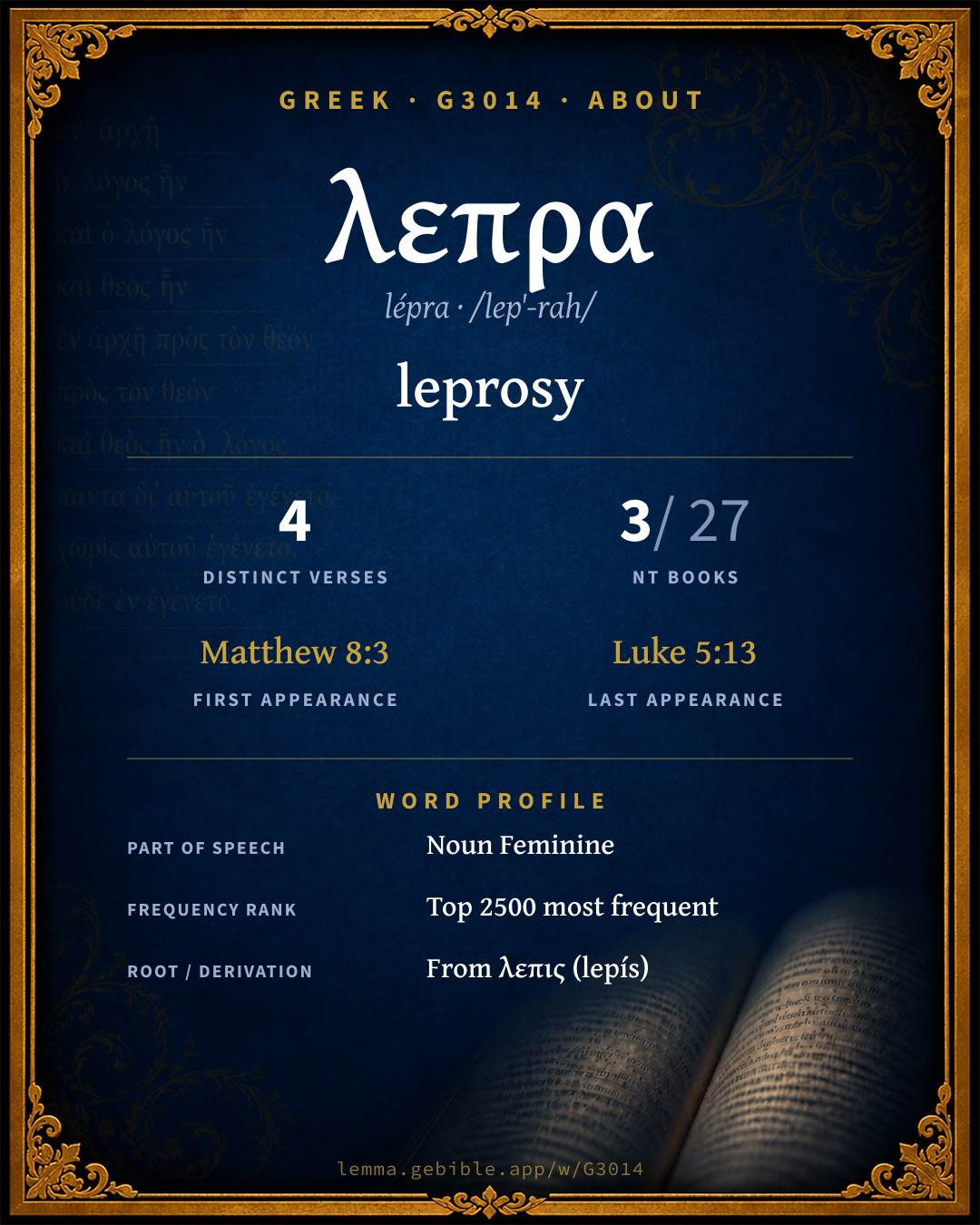
λέπρα
leprosy
‘leprosy’ is one of 2 main senses fuller range ↓
Full lexicon entry — Thayer's Greek Lexicon
From Thayer's Greek Lexicon
Where this word appears
Grammar key — what these labels mean
Part of speech
- Noun
- A naming word — a person, place, thing, or idea.
Case
- Nominative
- The case of the subject (and the predicate nominative).
- Genitive
- The case of source, possession, or “of” — answers “whose / from what.”
Gender
- Feminine
- Grammatically feminine.
Number
- Singular
- One.
Every verse where G3014 appears in the Book of Mark — 1 distinct verse. Click any verse to open its interlinear word-by-word view. Verse text shown in the World English Bible for context — . Each verse’s Greek form is shown with its reference; the English is not keyword-highlighted, since the data carries no word-level English alignment. Use “Compare translations” on any verse to read it across multiple English versions. This concordance covers the Greek New Testament; Septuagint (Greek Old Testament) occurrences of this word are not indexed here.
Mark
About this entry
At a glance — auto-summarized from this page’s data, not written by a person. Every figure links to its source below. This summary describes the numbers; it doesn’t interpret them.
λεπρα (lépra) is a Greek noun most often rendered “leprosy.” A scarce word — 4 verses in all of the Greek New Testament. It clusters heavily in Luke, which alone accounts for 50% of its uses. It first appears in Matthew 8:3. Its lexical range runs to 2 senses. For the data behind this summary, explore the sense tree and the renderings breakdown below.
Gloss history
Strong's 1890 vs modern scholarship

About this word
Strong's G3014 catalogs a Greek word from the Greek New Testament.
These counts are not copied from any lexicon or concordance. They are computed here, from the morphology-tagged Greek New Testament. What Lemma adds →
- 4
- distinct verses
- The word appears in 4 distinct verses.
- 3 / 27
- NT books
- The word appears in 3 of 27 New Testament books.
- #1,877
- by frequency
- Top 2500 most frequent Greek words (rank 1,877 of 5,347 Greek words by occurrence).
View all 4 occurrences in the concordance →
By section of the New Testament
By traditional corpus
Conventional, traditional groupings — biblical authorship is debated, so this is a traditional corpus grouping, not an authorship claim. Some books belong to more than one corpus (Luke is in both the Gospels and the Lukan corpus, and so on), so these shares overlap and need not total 100%. Each figure is a share of the word’s 4 distinct verses.
- Gospels 4 verses · 100%
- Lukan (Luke–Acts) 2 verses · 50%
How translations render this word
Counts come from each version’s own published word-to-Strong’s tagging or interlinear alignment — an approximate guide to how each version renders this word, not a word-level alignment the data otherwise carries. Because each total is that version’s own tagged count, the per-version totals vary from one another and need not match the appearance or distinct-verse counts above. These counts may also differ from a printed concordance because Lemma counts each distinctly tagged rendering and does not collapse phrase taggings into a single head-word total. This is a fixed set of word-tagged versions (KJV, ASV, BSB, ULT) and does not change with the reading translation you choose elsewhere. Each version’s license is shown beside its name below (and on Sources).
- King James Version: Leprosy 4×
- American Standard Version: Leprosy 3×
- Berean Standard Bible: Leprosy 4×
- unfoldingWord Literal Text: Leprosy 4×
King James Version Public Domain
Renders G3014 across 4 tagged occurrences — most commonly:
American Standard Version Public Domain
Renders G3014 across 3 tagged occurrences — most commonly:
Berean Standard Bible Public Domain
Renders G3014 across 4 tagged occurrences — most commonly:
unfoldingWord Literal Text CC BY-SA 4.0
Renders G3014 across 4 tagged occurrences — most commonly:
Senses in Thayer's
The 2 senses Thayer's distinguishes for this word, in lexicon order (not ranked by frequency or importance). The full entry — with sub-senses — is in the Lexicon Entry tab.
- leprosy
- a most offensive…
Word origin
Derived from λεπις (lepís) (G3013) — scale.
From the same as G3013 ; scaliness that is leprosy : - leprosy.
— Strong’s Exhaustive Concordance (1890), public domain.
Forms in the corpus
The 2 distinct written forms G3014 takes in the Greek New Testament, most frequent first — each parse links to that case’s occurrences in the concordance.
| Form | Parsing | Example | Uses |
|---|---|---|---|
| λέπρα lépra | Noun, Nominative, Singular, Feminine | Matthew 8:3 | 3 |
| λέπρας lépras | Noun, Genitive, Singular, Feminine | Luke 5:12 | 1 |
Same root — word family
Other Thayer's entries built from the same root as G3014, grouped by Strong’s listed origin. These share a root / origin per the lexicon — not necessarily a shared meaning. Each links to that word’s own entry.
Derives from
Shares the same root
Derived from this word
Compare all same-root words → They share a root, not necessarily a meaning.
Septuagint usage
The same Greek word λεπρα appears 39 times in the Greek Old Testament (Septuagint), across 36 verses in 4 books.
- 39
- LXX occurrences
- Tagged occurrences of this Greek word in the Septuagint.
- 36
- verses
- Distinct Septuagint verses containing this word.
- 4 / 39
- OT books
- The word appears in 4 of the 39 Old Testament books.
Sample Septuagint occurrences
- Leviticus 13:2 λέπρα
- Deuteronomy 24:8 λέπρα
- 2 Kings 5:3 λέπρα
- 2 Chronicles 26:19 λέπρα
Septuagint occurrences (same lexeme)
Every verse where the same Strong’s number (G3014) appears in the Greek Septuagint. Verse text shown in the World English Bible for context; the Greek form is the matched word — the English is not keyword-highlighted.
- Leviticus 13:2 λέπρα "When a man shall have a rising in his body's skin, or a scab, or a bright spot, and it becomes in the skin of his body the plague of leprosy, then he shall be brought to Aaron the priest, or to one of his sons the priests:
- Leviticus 13:3 λέπρα and the priest shall examine the plague in the skin of the body: and if the hair in the plague has turned white, and the appearance of the plague is deeper than the body's skin, it is the plague of leprosy; and the priest shall examine him, and pronounce him unclean.
- Leviticus 13:8 λέπρα The priest shall examine him; and, behold, if the scab has spread on the skin, then the priest shall pronounce him unclean. It is leprosy.
- Leviticus 13:9 λέπρα "When the plague of leprosy is in a man, then he shall be brought to the priest;
- Leviticus 13:11 λέπρα it is a chronic leprosy in the skin of his body, and the priest shall pronounce him unclean. He shall not isolate him, for he is unclean.
- Leviticus 13:12 λέπρα "If the leprosy breaks out all over the skin, and the leprosy covers all the skin of the infected person from his head even to his feet, as far as it appears to the priest;
- Leviticus 13:13 λέπρα then the priest shall examine him; and, behold, if the leprosy has covered all his flesh, he shall pronounce him clean of the plague. It has all turned white: he is clean.
- Leviticus 13:15 λέπρα The priest shall examine the raw flesh, and pronounce him unclean: the raw flesh is unclean. It is leprosy.
- Leviticus 13:20 λέπρα and the priest shall examine it; and, behold, if the appearance of it is lower than the skin, and the hair of it has turned white, then the priest shall pronounce him unclean. It is the plague of leprosy. It has broken out in the boil.
- Leviticus 13:22 λέπρα If it spreads in the skin, then the priest shall pronounce him unclean. It is a plague.
- Leviticus 13:25 λέπρα then the priest shall examine it; and, behold, if the hair in the bright spot has turned white, and the appearance of it is deeper than the skin; it is leprosy. It has broken out in the burning, and the priest shall pronounce him unclean. It is the plague of leprosy.
- Leviticus 13:27 λέπρα The priest shall examine him on the seventh day. If it has spread in the skin, then the priest shall pronounce him unclean. It is the plague of leprosy.
- Leviticus 13:29 λέπρα "When a man or woman has a plague on the head or on the beard,
- Leviticus 13:30 λέπρα then the priest shall examine the plague; and, behold, if the appearance of it is deeper than the skin, and the hair in it is yellow and thin, then the priest shall pronounce him unclean: it is an itch, it is leprosy of the head or of the beard.
- Leviticus 13:42 λέπρα But if there is in the bald head, or the bald forehead, a reddish-white plague; it is leprosy breaking out in his bald head, or his bald forehead.
- Leviticus 13:43 λέπρα Then the priest shall examine him; and, behold, if the rising of the plague is reddish-white in his bald head, or in his bald forehead, like the appearance of leprosy in the skin of the flesh,
- Leviticus 13:47 λέπρα "The garment also that the plague of leprosy is in, whether it is a woolen garment, or a linen garment;
- Leviticus 13:49 λέπρα if the plague is greenish or reddish in the garment, or in the skin, or in the warp, or in the woof, or in anything made of skin; it is the plague of leprosy, and shall be shown to the priest.
- Leviticus 13:51 λέπρα He shall examine the plague on the seventh day. If the plague has spread in the garment, either in the warp, or in the woof, or in the skin, whatever use the skin is used for, the plague is a destructive mildew. It is unclean.
- Leviticus 13:52 λέπρα He shall burn the garment, whether the warp or the woof, in wool or in linen, or anything of skin, in which the plague is: for it is a destructive mildew. It shall be burned in the fire.
- Leviticus 13:57 λέπρα and if it appears again in the garment, either in the warp, or in the woof, or in anything of skin, it is spreading. You shall burn with fire that in which the plague is.
- Leviticus 13:59 λέπρα This is the law of the plague of mildew in a garment of wool or linen, either in the warp, or the woof, or in anything of skin, to pronounce it clean, or to pronounce it unclean.
- Leviticus 14:3 λέπρα and the priest shall go forth out of the camp. The priest shall examine him, and, behold, if the plague of leprosy is healed in the leper,
- Leviticus 14:7 λέπρα He shall sprinkle on him who is to be cleansed from the leprosy seven times, and shall pronounce him clean, and shall let the living bird go into the open field.
- Leviticus 14:32 λέπρα This is the law for him in whom is the plague of leprosy, who is not able to afford the sacrifice for his cleansing.
- Leviticus 14:34 λέπρα "When you have come into the land of Canaan, which I give to you for a possession, and I put a spreading mildew in a house in the land of your possession,
- Leviticus 14:44 λέπρα then the priest shall come in and look; and, behold, if the plague has spread in the house, it is a destructive mildew in the house. It is unclean.
- Leviticus 14:54 λέπρα This is the law for any plague of leprosy, and for an itch,
- Leviticus 14:55 λέπρα and for the destructive mildew of a garment, and for a house,
- Leviticus 14:57 λέπρα to teach when it is unclean, and when it is clean. This is the law of leprosy.
- Deuteronomy 24:8 λέπρα Take heed in the plague of leprosy, that you observe diligently, and do according to all that the priests the Levites shall teach you: as I commanded them, so you shall observe to do.
- 2 Kings 5:3 λέπρα She said to her mistress, Would that my lord were with the prophet who is in Samaria! then would he recover him of his leprosy.
- 2 Kings 5:6 λέπρα He brought the letter to the king of Israel, saying, Now when this letter is come to you, behold, I have sent Naaman my servant to you, that you may recover him of his leprosy.
- 2 Kings 5:7 λέπρα It happened, when the king of Israel had read the letter, that he tore his clothes, and said, Am I God, to kill and to make alive, that this man does send to me to recover a man of his leprosy? but consider, I pray you, and see how he seeks a quarrel against me.
- 2 Kings 5:27 λέπρα The leprosy therefore of Naaman shall cleave to you, and to your seed forever. He went out from his presence a leper [as white] as snow.
- 2 Chronicles 26:19 λέπρα Then Uzziah was angry; and he had a censer in his hand to burn incense; and while he was angry with the priests, the leprosy broke forth in his forehead before the priests in the house of Yahweh, beside the altar of incense.
These are occurrences of the same Greek lexeme (G3014) in the Septuagint — not a translation of any one Hebrew word. The store carries no word-level Hebrew↔Greek alignment, so no Hebrew original is asserted here. Counts come from the recovered LXX Strong's tagging — high-frequency vocabulary is well covered, while rare or late forms may be untagged — so they reflect tagged occurrences and may slightly undercount.