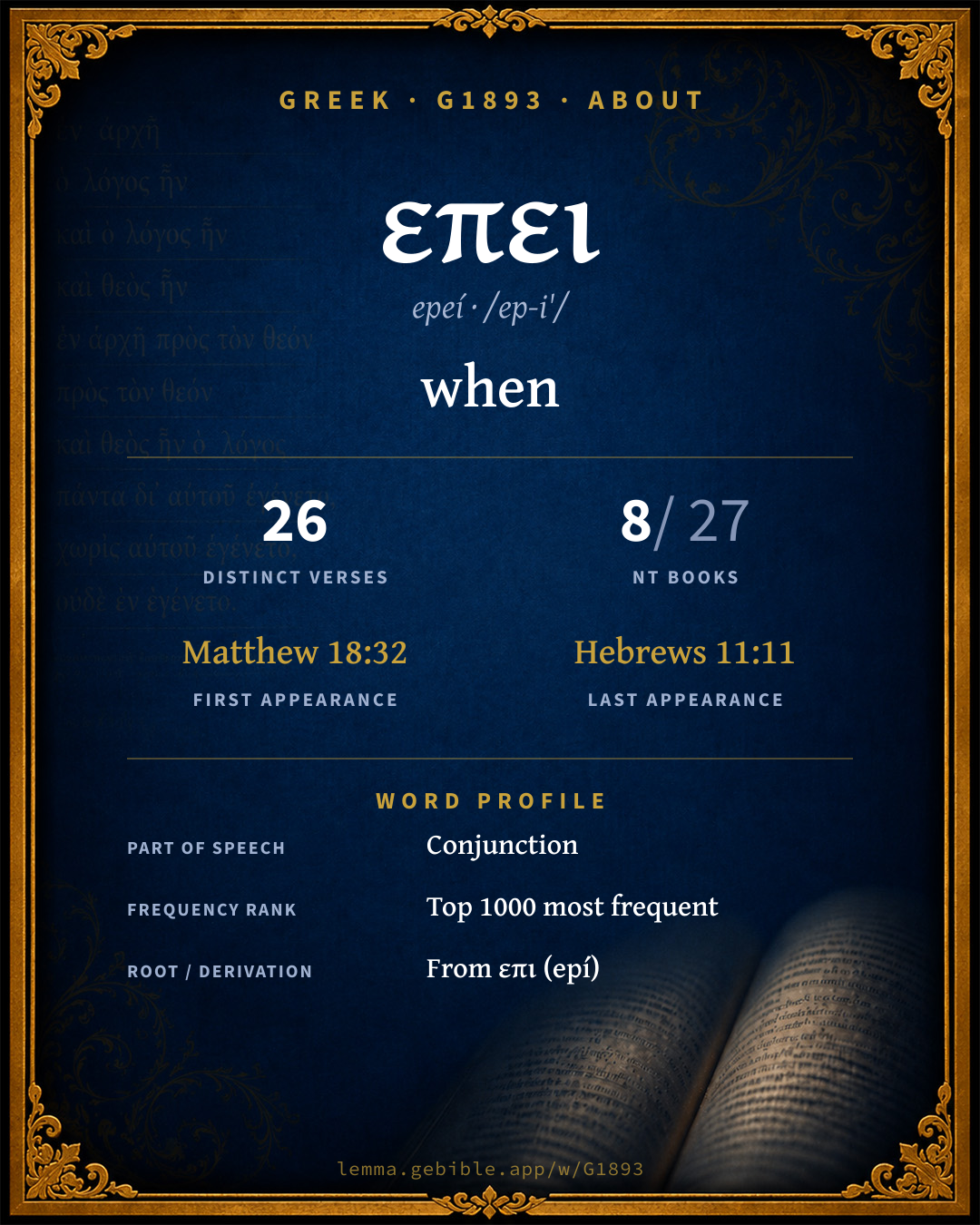
ἐπεί
when
Full lexicon entry — Thayer's Greek Lexicon
From Thayer's Greek Lexicon
Where this word appears
Grammar key — what these labels mean
Part of speech
- Conjunction
- A joining word linking words or clauses.
Every verse where G1893 appears — 26 distinct verses across 8 books. Click any verse to open its interlinear word-by-word view. Verse text shown in the World English Bible for context — . Each verse’s Greek form is shown with its reference; the English is not keyword-highlighted, since the data carries no word-level English alignment. Use “Compare translations” on any verse to read it across multiple English versions. This concordance covers the Greek New Testament; Septuagint (Greek Old Testament) occurrences of this word are not indexed here.
Matthew 3 verses
- Matthew 18:32 ἐπεὶ conj Then his lord called him in, and said to him, 'You wicked servant! I forgave you all that debt, because you begged me.
- Matthew 21:46 ἐπεὶ conj When they sought to seize him, they feared the multitudes, because they considered him to be a prophet.
- Matthew 27:6 ἐπεὶ conj The chief priests took the pieces of silver, and said, "It's not lawful to put them into the treasury, since it is the price of blood."
Mark 1 verse
Luke 1 verse
John 2 verses
- John 13:29 ἐπεὶ conj For some thought, because Judas had the money box, that Jesus said to him, "Buy what things we need for the feast," or that he should give something to the poor.
- John 19:31 ἐπεὶ conj Therefore the Jews, because it was the Preparation Day, so that the bodies wouldn't remain on the cross on the Sabbath (for that Sabbath was a special one), asked of Pilate that their legs might be broken, and that they might be taken away.
Romans 3 verses
- Romans 3:6 ἐπεὶ conj May it never be! For then how will God judge the world?
- Romans 11:6 ἐπεὶ conj And if by grace, then it is no longer of works; otherwise grace is no longer grace. But if it is of works, it is no longer grace; otherwise work is no longer work.
- Romans 11:22 ἐπεὶ conj See then the goodness and severity of God. Toward those who fell, severity; but toward you, goodness, if you continue in his goodness; otherwise you also will be cut off.
1 Corinthians 5 verses
- 1 Corinthians 5:10 ἐπεὶ conj yet not at all meaning with the sexual sinners of this world, or with the covetous and extortioners, or with idolaters; for then you would have to leave the world.
- 1 Corinthians 7:14 ἐπεὶ conj For the unbelieving husband is sanctified in the wife, and the unbelieving wife is sanctified in the husband. Otherwise your children would be unclean, but now are they holy.
- 1 Corinthians 14:12 ἐπεὶ conj So also you, since you are zealous for spiritual gifts, seek that you may abound to the building up of the assembly.
- 1 Corinthians 14:16 ἐπεὶ conj Otherwise if you bless with the spirit, how will he who fills the place of the unlearned say the "Amen" at your giving of thanks, seeing he doesn't know what you say?
- 1 Corinthians 15:29 Ἐπεὶ conj Or else what will they do who are baptized for the dead? If the dead aren't raised at all, why then are they baptized for the dead?
2 Corinthians 2 verses
Hebrews 9 verses
- Hebrews 2:14 ἐπεὶ conj Since then the children have shared in flesh and blood, he also himself in like manner partook of the same, that through death he might bring to nothing him who had the power of death, that is, the devil,
- Hebrews 4:6 ἐπεὶ conj Seeing therefore it remains that some should enter therein, and they to whom the good news was before preached failed to enter in because of disobedience,
- Hebrews 5:2 ἐπεὶ conj The high priest can deal gently with those who are ignorant and going astray, because he himself is also surrounded with weakness.
- Hebrews 5:11 ἐπεὶ conj About him we have many words to say, and hard to interpret, seeing you have become dull of hearing.
- Hebrews 6:13 ἐπεὶ conj For when God made a promise to Abraham, since he could swear by none greater, he swore by himself,
- Hebrews 9:17 ἐπεὶ conj For a will is in force where there has been death, for it is never in force while he who made it lives.
- Hebrews 9:26 ἐπεὶ conj or else he must have suffered often since the foundation of the world. But now once at the end of the ages, he has been revealed to put away sin by the sacrifice of himself.
- Hebrews 10:2 ἐπεὶ conj Or else wouldn't they have ceased to be offered, because the worshippers, having been once cleansed, would have had no more consciousness of sins?
- Hebrews 11:11 ἐπεὶ conj By faith, even Sarah herself received power to conceive, and she bore a child when she was past age, since she counted him faithful who had promised.
About this entry
At a glance — auto-summarized from this page’s data, not written by a person. Every figure links to its source below. This summary describes the numbers; it doesn’t interpret them.
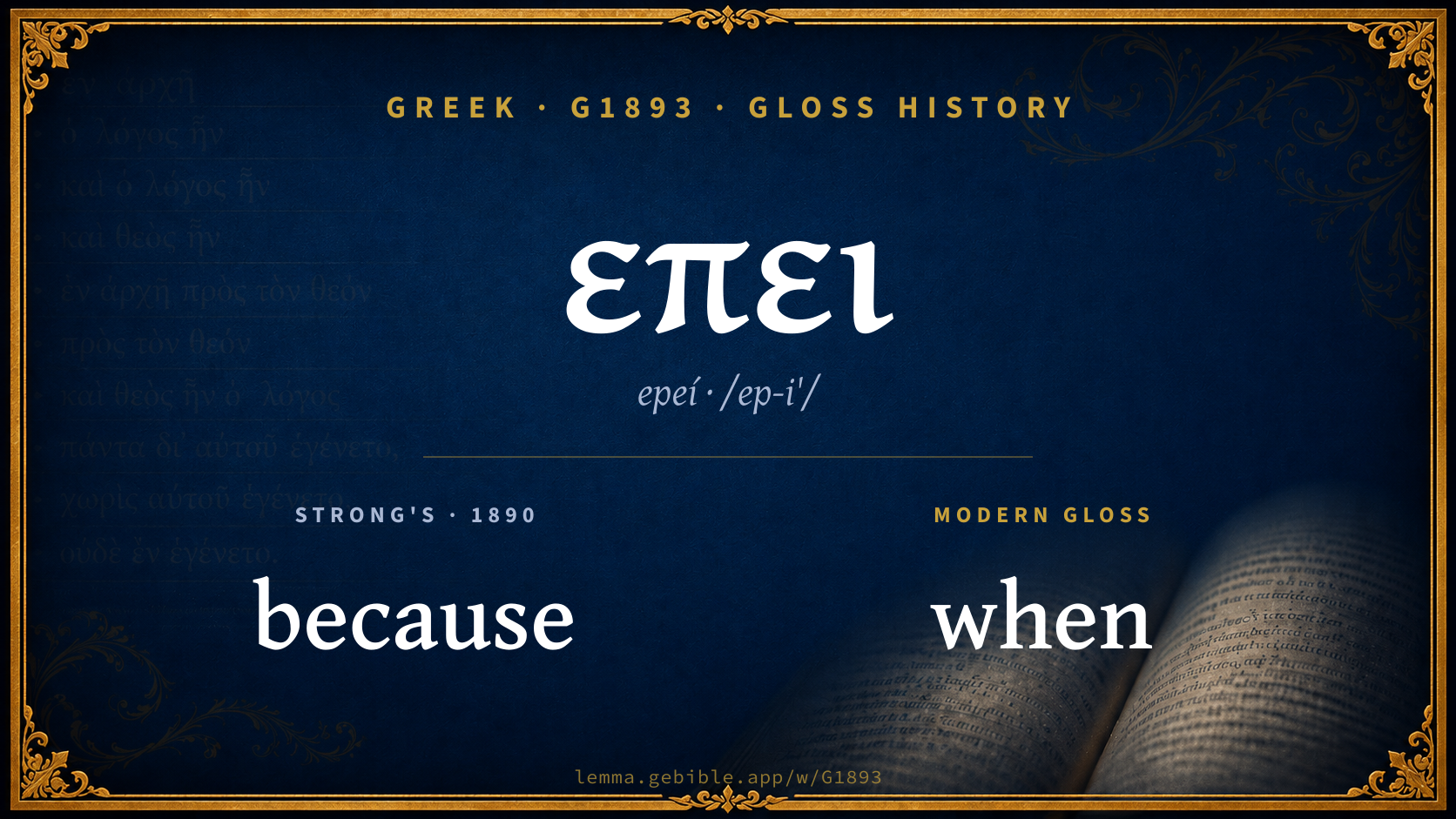
At its core, επει (epeí) means “when.” Older and newer Bibles part ways — “because” in the King James Version, “since” (Berean Standard Bible) in modern versions. See the renderings breakdown. It turns up in 26 verses across 8 books, a moderately common footprint. The word gravitates to Hebrews (35%), then 1 Corinthians and Matthew. Scripture first uses it in Matthew 18:32. Dig into 26-verse concordance and the renderings breakdown below.
Gloss history
Strong's 1890 vs modern scholarship
About this word
Strong's G1893 catalogs a Greek word from the Greek New Testament.
These counts are not copied from any lexicon or concordance. They are computed here, from the morphology-tagged Greek New Testament. What Lemma adds →
- 26
- distinct verses
- The word appears in 26 distinct verses.
- 8 / 27
- NT books
- The word appears in 8 of 27 New Testament books.
- #513
- by frequency
- Top 1000 most frequent Greek words (rank 513 of 5,347 Greek words by occurrence).
View all 26 occurrences in the concordance →
Most concentrated in
- Hebrews 9 verses 35%
- 1 Corinthians 5 verses 19%
- Matthew 3 verses 12%
By section of the New Testament
By traditional corpus
Conventional, traditional groupings — biblical authorship is debated, so this is a traditional corpus grouping, not an authorship claim. Some books belong to more than one corpus (Luke is in both the Gospels and the Lukan corpus, and so on), so these shares overlap and need not total 100%. Each figure is a share of the word’s 26 distinct verses.
- Pauline corpus 10 verses · 38%
- Hebrews 9 verses · 35%
- Gospels 7 verses · 27%
- Johannine 2 verses · 8%
- Lukan (Luke–Acts) 1 verse · 4%
How translations render this word
Counts come from each version’s own published word-to-Strong’s tagging or interlinear alignment — an approximate guide to how each version renders this word, not a word-level alignment the data otherwise carries. Because each total is that version’s own tagged count, the per-version totals vary from one another and need not match the appearance or distinct-verse counts above. These counts may also differ from a printed concordance because Lemma counts each distinctly tagged rendering and does not collapse phrase taggings into a single head-word total. This is a fixed set of word-tagged versions (KJV, ASV, BSB, ULT) and does not change with the reading translation you choose elsewhere. Each version’s license is shown beside its name below (and on Sources).
- King James Version: Because 7×, Otherwise 4×, Seeing 3×
- American Standard Version: Since 5×, Because 4×, Else 4×
- Berean Standard Bible: Since 11×, Otherwise 5×, Because 4×
- unfoldingWord Literal Text: Since 12×, Because 7×, Otherwise 7×
King James Version Public Domain
Renders G1893 across 26 tagged occurrences — most commonly:
Plus 5 renderings that appear only once — usually multi-word phrases or single function words the recovered tagging swept in, not distinct renderings. Not rendered by a distinct English word in 1 further occurrence.
American Standard Version Public Domain
Renders G1893 across 26 tagged occurrences — most commonly:
Plus 4 renderings that appear only once — usually multi-word phrases or single function words the recovered tagging swept in, not distinct renderings.
Berean Standard Bible Public Domain
Renders G1893 across 22 tagged occurrences — most commonly:
Plus 2 renderings that appear only once — usually multi-word phrases or single function words the recovered tagging swept in, not distinct renderings. Not rendered by a distinct English word in 4 further occurrences.
unfoldingWord Literal Text CC BY-SA 4.0
Renders G1893 across 26 tagged occurrences — most commonly:
Senses in Thayer's
The 1 sense Thayer's distinguishes for this word, in lexicon order (not ranked by frequency or importance). The full entry — with sub-senses — is in the Lexicon Entry tab.
- when, since
Word origin
Derived from επι (epí) (G1909) — upon.
Forms in the corpus
The 2 distinct written forms G1893 takes in the Greek New Testament, most frequent first — each parse links to that case’s occurrences in the concordance.
| Form | Parsing | Example | Uses |
|---|---|---|---|
| ἐπεὶ epeì | Conjunction | Matthew 18:32 | 25 |
| Ἐπεὶ Epeì | Conjunction | 1 Corinthians 15:29 | 1 |
Same root — word family
Other Thayer's entries built from the same root as G1893, grouped by Strong’s listed origin. These share a root / origin per the lexicon — not necessarily a shared meaning. Each links to that word’s own entry.
Derives from
Shares the same root
- επαγγελλω epangéllō G1861 to announce
- επαγω epágō G1863 to bring upon
- επαγωνιζομαι epagōnízomai G1864 to contend
- επαθροιζω epathroízō G1865 to gather together
- επαινεω epainéō G1867 to approve
- επαινος épainos G1868 approval
- επαιρω epaírō G1869 to lift up
- επαισχυνομαι epaischýnomai G1870 to be ashamed
- επαιτεω epaitéō G1871 to ask repeatedly
- επακουω epakoúō G1873 to give ear to
- επακροαομαι epakroáomai G1874 to listen to
- επαν epán G1875 after
- επαναγκες epánankes G1876 necessarily
- επαναγω epanágō G1877 to lead back
- επαναμιμνησκω epanamimnḗskō G1878 to remind
- επαναπαυομαι epanapaúomai G1879 to rest upon
- επανερχομαι epanérchomai G1880 to return
- επανισταμαι epanístamai G1881 to raise up against
- επανορθωσις epanórthōsis G1882 correction
- επανω epánō G1883 above
- επαρκεω eparkéō G1884 to avail
- επαρχια eparchía G1885 office of governor
- επαυλις épaulis G1886 farm
- επαυριον epaúrion G1887 the next day
+110 more words share this root (not shown).
Derived from this word
Proper names from this root
People and places named from this root — a name, not an additional meaning of the word.
Compare all same-root words → Showing 4 of 139 — not the complete family. 1 of the same-root words is a proper name (a person or place). They share a root, not necessarily a meaning.
Septuagint usage
The same Greek word επει appears 15 times in the Greek Old Testament (Septuagint), across 15 verses in 7 books.
- 15
- LXX occurrences
- Tagged occurrences of this Greek word in the Septuagint.
- 15
- verses
- Distinct Septuagint verses containing this word.
- 7 / 39
- OT books
- The word appears in 7 of the 39 Old Testament books.
Sample Septuagint occurrences
- Genesis 15:17 ἐπεί
- Exodus 2:3 ἐπεί
- Deuteronomy 2:16 ἐπεί
- Joshua 4:1 ἐπεί
- Job 13:15 ἐπεί
- Psalms 37:21 ἐπεί
- Daniel 4:19 ἐπεί
Septuagint occurrences (same lexeme)
Every verse where the same Strong’s number (G1893) appears in the Greek Septuagint. Verse text shown in the World English Bible for context; the Greek form is the matched word — the English is not keyword-highlighted.
- Genesis 15:17 ἐπεί It came to pass that, when the sun went down, and it was dark, behold, a smoking furnace, and a flaming torch passed between these pieces.
- Genesis 46:30 ἐπεί Israel said to Joseph, "Now let me die, since I have seen your face, that you are still alive."
- Exodus 2:3 ἐπεί When she could no longer hide him, she took a papyrus basket for him, and coated it with tar and with pitch. She put the child in it, and laid it in the reeds by the river's bank.
- Deuteronomy 2:16 ἐπεί So it happened, when all the men of war were consumed and dead from among the people,
- Joshua 4:1 ἐπεί It happened, when all the nation were clean passed over the Jordan, that Yahweh spoke to Joshua, saying,
- Joshua 7:8 ἐπεί Oh, Lord, what shall I say, after that Israel has turned their backs before their enemies!
- Joshua 10:24 ἐπεί It happened, when they brought forth those kings to Joshua, that Joshua called for all the men of Israel, and said to the chiefs of the men of war who went with him, Come near, put your feet on the necks of these kings. They came near, and put their feet on the necks of them.
- Joshua 17:13 ἐπεί It happened, when the children of Israel had grown strong, that they put the Canaanites to forced labor, and didn't utterly drive them out.
- Job 13:15 ἐπεί Behold, he will kill me; I have no hope. Nevertheless, I will maintain my ways before him.
- Job 35:7 ἐπεί If you are righteous, what do you give him? Or what does he receive from your hand?
- Psalms 37:21 ἐπεί The wicked borrow, and don't pay back, But the righteous give generously.
- Psalms 77:20 ἐπεί You led your people like a flock, By the hand of Moses and Aaron.
- Psalms 118:136 ἐπεί
- Daniel 4:19 ἐπεί Then Daniel, whose name was Belteshazzar, was stricken mute for a while, and his thoughts troubled him. The king answered, Belteshazzar, don't let the dream, or the interpretation, trouble you. Belteshazzar answered, My lord, the dream be to those who hate you, and the interpretation of it to your adversaries.
- Daniel 6:5 ἐπεί Then said these men, We shall not find any occasion against this Daniel, except we find it against him concerning the law of his God.
These are occurrences of the same Greek lexeme (G1893) in the Septuagint — not a translation of any one Hebrew word. The store carries no word-level Hebrew↔Greek alignment, so no Hebrew original is asserted here. Counts come from the recovered LXX Strong's tagging — high-frequency vocabulary is well covered, while rare or late forms may be untagged — so they reflect tagged occurrences and may slightly undercount.