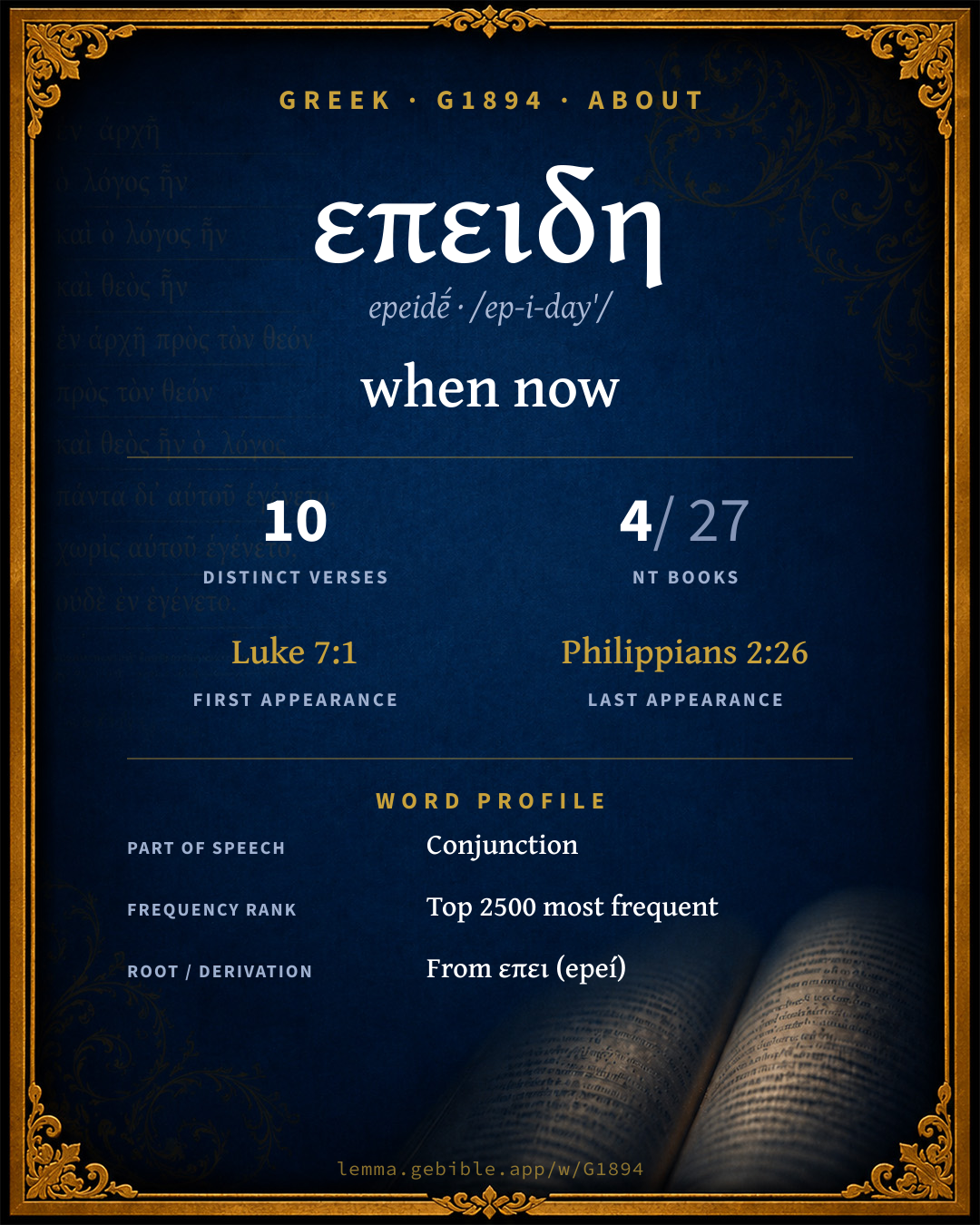
ἐπειδή
when now
Full lexicon entry — Thayer's Greek Lexicon
From Thayer's Greek Lexicon
Where this word appears
Grammar key — what these labels mean
Part of speech
- Conjunction
- A joining word linking words or clauses.
Every verse where G1894 appears — 10 distinct verses across 4 books. Click any verse to open its interlinear word-by-word view. Verse text shown in the World English Bible for context — . Each verse’s Greek form is shown with its reference; the English is not keyword-highlighted, since the data carries no word-level English alignment. Use “Compare translations” on any verse to read it across multiple English versions. This concordance covers the Greek New Testament; Septuagint (Greek Old Testament) occurrences of this word are not indexed here.
Luke 2 verses
Acts 3 verses
- Acts 13:46 ἐπειδὴ conj Paul and Barnabas spoke out boldly, and said, "It was necessary that God's word should be spoken to you first. Since indeed you thrust it from you, and judge yourselves unworthy of eternal life, behold, we turn to the Gentiles.
- Acts 14:12 ἐπειδὴ conj They called Barnabas "Jupiter," and Paul "Mercury," because he was the chief speaker.
- Acts 15:24 ἐπειδὴ conj Because we have heard that some who went out from us have troubled you with words, unsettling your souls, saying, 'You must be circumcised and keep the law,' to whom we gave no commandment;
1 Corinthians 4 verses
- 1 Corinthians 1:21 ἐπειδὴ conj For seeing that in the wisdom of God, the world through its wisdom didn't know God, it was God's good pleasure through the foolishness of the preaching to save those who believe.
- 1 Corinthians 1:22 ἐπειδὴ conj For Jews ask for signs, Greeks seek after wisdom,
- 1 Corinthians 14:16 ἐπειδὴ conj Otherwise if you bless with the spirit, how will he who fills the place of the unlearned say the "Amen" at your giving of thanks, seeing he doesn't know what you say?
- 1 Corinthians 15:21 ἐπειδὴ conj For since death came by man, the resurrection of the dead also came by man.
Philippians 1 verse
About this entry
At a glance — auto-summarized from this page’s data, not written by a person. Every figure links to its source below. This summary describes the numbers; it doesn’t interpret them.
“when now” is the headline sense of the Greek conjunction επειδη (epeidḗ). Its earliest occurrence is Luke 7:1. It turns up in 10 verses across 4 books, an uncommon footprint. It concentrates in 1 Corinthians, which alone accounts for 40% of its uses. It clusters with επει, επειπερ and επειδηπερ under a shared root. See the sense tree, 10-verse concordance, and the renderings breakdown below.
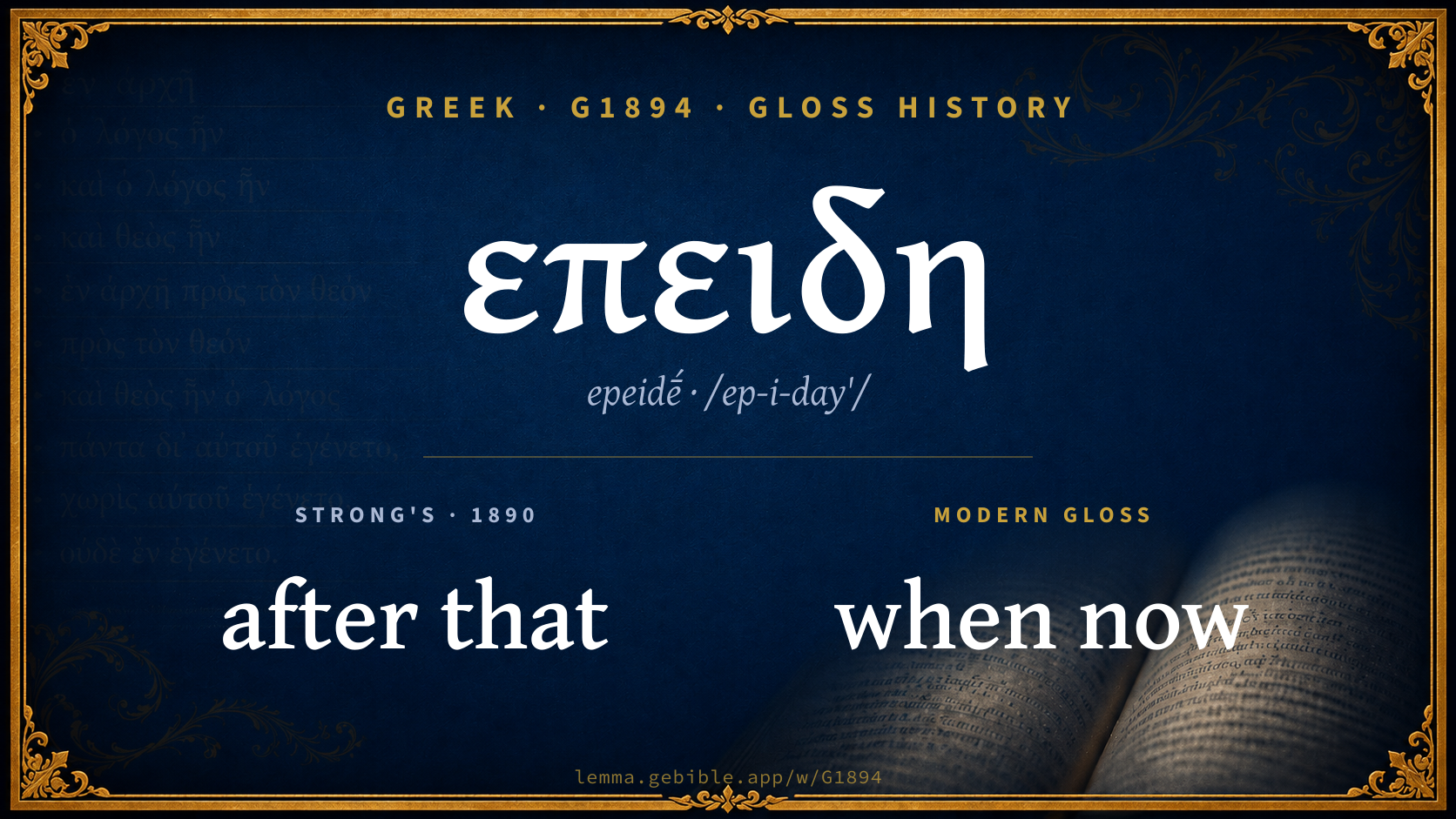
Gloss history
Strong's 1890 vs modern scholarship
About this word
Strong's G1894 catalogs a Greek word from the Greek New Testament.
These counts are not copied from any lexicon or concordance. They are computed here, from the morphology-tagged Greek New Testament. What Lemma adds →
- 10
- distinct verses
- The word appears in 10 distinct verses.
- 4 / 27
- NT books
- The word appears in 4 of 27 New Testament books.
- #1,056
- by frequency
- Top 2500 most frequent Greek words (rank 1,056 of 5,347 Greek words by occurrence).
View all 10 occurrences in the concordance →
Most concentrated in
- 1 Corinthians 4 verses 40%
- Acts 3 verses 30%
- Luke 2 verses 20%
By section of the New Testament
By traditional corpus
Conventional, traditional groupings — biblical authorship is debated, so this is a traditional corpus grouping, not an authorship claim. Some books belong to more than one corpus (Luke is in both the Gospels and the Lukan corpus, and so on), so these shares overlap and need not total 100%. Each figure is a share of the word’s 10 distinct verses.
- Lukan (Luke–Acts) 5 verses · 50%
- Pauline corpus 5 verses · 50%
- Gospels 2 verses · 20%
How translations render this word
Counts come from each version’s own published word-to-Strong’s tagging or interlinear alignment — an approximate guide to how each version renders this word, not a word-level alignment the data otherwise carries. Because each total is that version’s own tagged count, the per-version totals vary from one another and need not match the appearance or distinct-verse counts above. These counts may also differ from a printed concordance because Lemma counts each distinctly tagged rendering and does not collapse phrase taggings into a single head-word total. This is a fixed set of word-tagged versions (KJV, ASV, BSB, ULT) and does not change with the reading translation you choose elsewhere. Each version’s license is shown beside its name below (and on Sources).
- King James Version: Because 2×, For 2×, Seeing 2×
- American Standard Version: Because 2×, For 2×, Seeing 2×
- Berean Standard Bible: Since 4×, Because 2×
- unfoldingWord Literal Text: Since 5×
King James Version Public Domain
Renders G1894 across 10 tagged occurrences — most commonly:
Plus 4 renderings that appear only once — usually multi-word phrases or single function words the recovered tagging swept in, not distinct renderings. Not rendered by a distinct English word in 1 further occurrence.
American Standard Version Public Domain
Renders G1894 across 10 tagged occurrences — most commonly:
Plus 2 renderings that appear only once — usually multi-word phrases or single function words the recovered tagging swept in, not distinct renderings.
Berean Standard Bible Public Domain
Renders G1894 across 9 tagged occurrences — most commonly:
Plus 3 renderings that appear only once — usually multi-word phrases or single function words the recovered tagging swept in, not distinct renderings. Not rendered by a distinct English word in 1 further occurrence.
unfoldingWord Literal Text CC BY-SA 4.0
Renders G1894 across 10 tagged occurrences — most commonly:
Plus 5 renderings that appear only once — usually multi-word phrases or single function words the recovered tagging swept in, not distinct renderings.
Senses in Thayer's
The 1 sense Thayer's distinguishes for this word, in lexicon order (not ranked by frequency or importance). The full entry — with sub-senses — is in the Lexicon Entry tab.
- when now, since now
Word origin
Derived from επει (epeí) (G1893) — when.
Forms in the corpus
Same root — word family
Other Thayer's entries built from the same root as G1894, grouped by Strong’s listed origin. These share a root / origin per the lexicon — not necessarily a shared meaning. Each links to that word’s own entry.
Derives from
Shares the same root
Derived from this word
Compare all same-root words → They share a root, not necessarily a meaning.
Septuagint usage
The same Greek word επειδη appears 16 times in the Greek Old Testament (Septuagint), across 16 verses in 7 books.
- 16
- LXX occurrences
- Tagged occurrences of this Greek word in the Septuagint.
- 16
- verses
- Distinct Septuagint verses containing this word.
- 7 / 39
- OT books
- The word appears in 7 of the 39 Old Testament books.
Sample Septuagint occurrences
- Genesis 15:3 ἐπειδή
- Exodus 1:21 ἐπειδή
- Job 9:29 ἐπειδή
- Proverbs 1:24 ἐπειδή
- Jeremiah 25:8 ἐπειδή
- Ezekiel 28:6 ἐπειδή
- Daniel 3:22 ἐπειδή
Septuagint occurrences (same lexeme)
Every verse where the same Strong’s number (G1894) appears in the Greek Septuagint. Verse text shown in the World English Bible for context; the Greek form is the matched word — the English is not keyword-highlighted.
- Genesis 15:3 ἐπειδή Abram said, "Behold, to me you have given no seed: and, behold, one born in my house is my heir."
- Genesis 18:31 ἐπειδή He said, "See now, I have taken it on myself to speak to the Lord. What if there are twenty found there?" He said, "I will not destroy it for the twenty's sake."
- Genesis 19:19 ἐπειδή See now, your servant has found favor in your sight, and you have magnified your loving kindness, which you have shown to me in saving my life. I can't escape to the mountain, lest evil overtake me, and I die.
- Genesis 23:13 ἐπειδή He spoke to Ephron in the audience of the people of the land, saying, "But if you will, please hear me. I will give the price of the field. Take it from me, and I will bury my dead there."
- Genesis 41:39 ἐπειδή Pharaoh said to Joseph, "Because God has shown you all of this, there is none so discreet and wise as you.
- Genesis 50:4 ἐπειδή When the days of weeping for him were past, Joseph spoke to the house of Pharaoh, saying, "If now I have found favor in your eyes, please speak in the ears of Pharaoh, saying,
- Exodus 1:21 ἐπειδή It happened, because the midwives feared God, that he gave them families.
- Exodus 34:33 ἐπειδή When Moses was done speaking with them, he put a veil on his face.
- Job 9:29 ἐπειδή I shall be condemned; Why then do I labor in vain?
- Proverbs 1:24 ἐπειδή Because I have called, and you have refused; I have stretched out my hand, and no one has paid attention;
- Jeremiah 25:8 ἐπειδή Therefore thus says Yahweh of Hosts: Because you have not heard my words,
- Jeremiah 31:7 ἐπειδή For thus says Yahweh, Sing with gladness for Jacob, and shout for the chief of the nations: publish you, praise you, and say, Yahweh, save your people, the remnant of Israel.
- Jeremiah 36:26 ἐπειδή The king commanded Jerahmeel the king's son, and Seraiah the son of Azriel, and Shelemiah the son of Abdeel, to take Baruch the scribe and Jeremiah the prophet; but Yahweh hid them.
- Jeremiah 42:18 ἐπειδή For thus says Yahweh of Hosts, the God of Israel: As my anger and my wrath has been poured forth on the inhabitants of Jerusalem, so shall my wrath be poured forth on you, when you shall enter into Egypt; and you shall be an object of horror, and an astonishment, and a curse, and a reproach; and you shall see this place no more.
- Ezekiel 28:6 ἐπειδή therefore thus says the Lord Yahweh: Because you have set your heart as the heart of God,
- Daniel 3:22 ἐπειδή Therefore because the king's commandment was urgent, and the furnace exceeding hot, the flame of the fire killed those men who took up Shadrach, Meshach, and Abednego.
These are occurrences of the same Greek lexeme (G1894) in the Septuagint — not a translation of any one Hebrew word. The store carries no word-level Hebrew↔Greek alignment, so no Hebrew original is asserted here. Counts come from the recovered LXX Strong's tagging — high-frequency vocabulary is well covered, while rare or late forms may be untagged — so they reflect tagged occurrences and may slightly undercount.