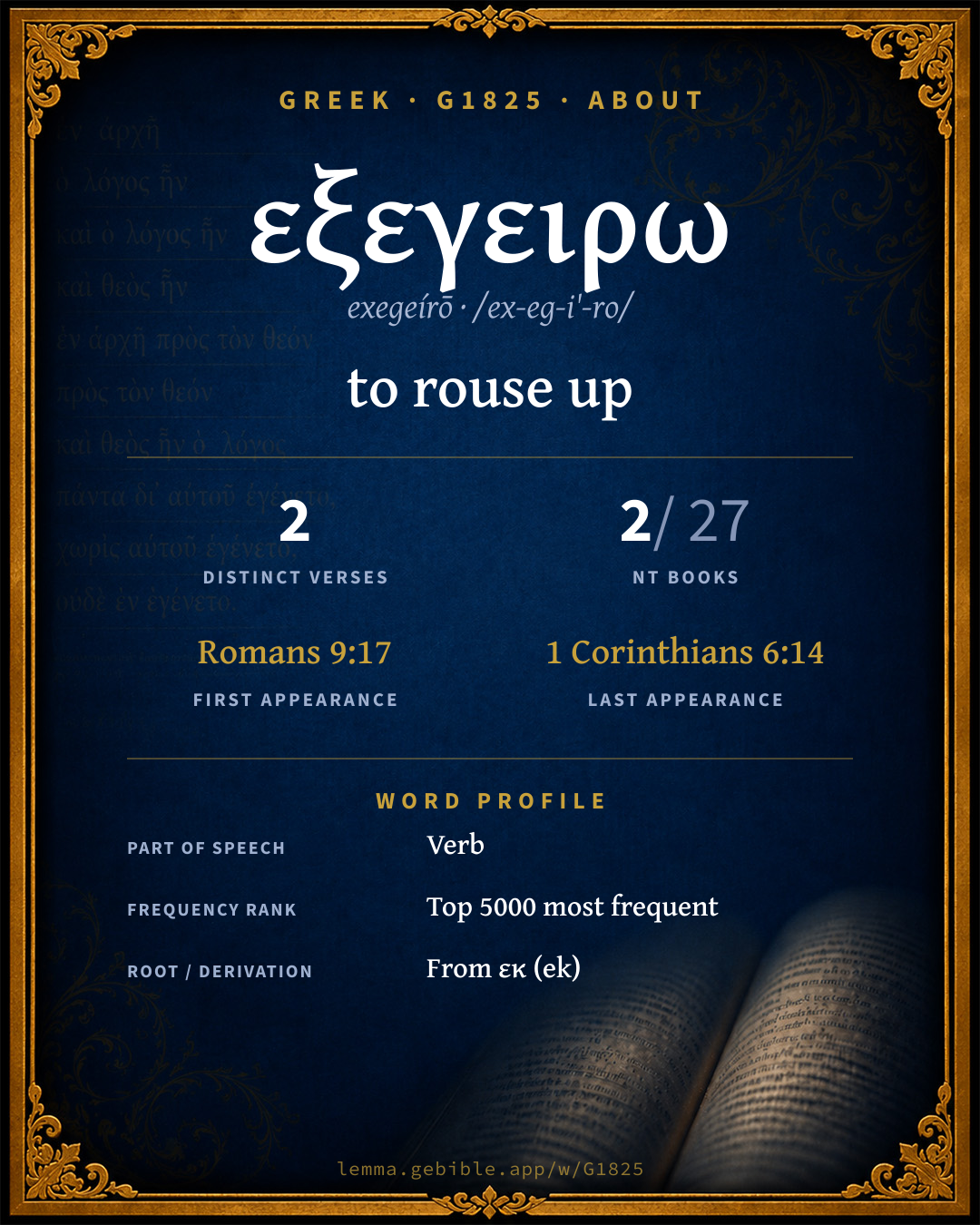
ἐξεγείρω
to rouse up
‘to rouse up’ is one of 2 main senses fuller range ↓
Full lexicon entry — Thayer's Greek Lexicon
From Thayer's Greek Lexicon
Where this word appears
Grammar key — what these labels mean
Part of speech
- Verb
- An action or state-of-being word.
Tense
- Aorist
- Action viewed as a simple whole, without regard to duration — often past (perfective aspect).
- Future
- Action expected in future time.
Voice
- Active
- The subject performs the action.
Mood
- Indicative
- States a fact or asks a factual question (the mood of reality).
Person
- 1st person
- The speaker (“I / we”).
- 3rd person
- The one spoken about (“he / she / it / they”).
Number
- Singular
- One.
Every verse where G1825 appears in the Book of 1 Corinthians — 1 distinct verse. Click any verse to open its interlinear word-by-word view. Verse text shown in the World English Bible for context — . Each verse’s Greek form is shown with its reference; the English is not keyword-highlighted, since the data carries no word-level English alignment. Use “Compare translations” on any verse to read it across multiple English versions. This concordance covers the Greek New Testament; Septuagint (Greek Old Testament) occurrences of this word are not indexed here.
1 Corinthians
About this entry
At a glance — auto-summarized from this page’s data, not written by a person. Every figure links to its source below. This summary describes the numbers; it doesn’t interpret them.
εξεγειρω (exegeírō) is a Greek verb most often rendered “to rouse up.” The Greek New Testament uses it only 2 verses. Romans dominates its distribution — 1 of 2 verses. It first appears in Romans 9:17. Its lexical range runs to 2 senses. For the data behind this summary, explore the sense tree and the renderings breakdown below.
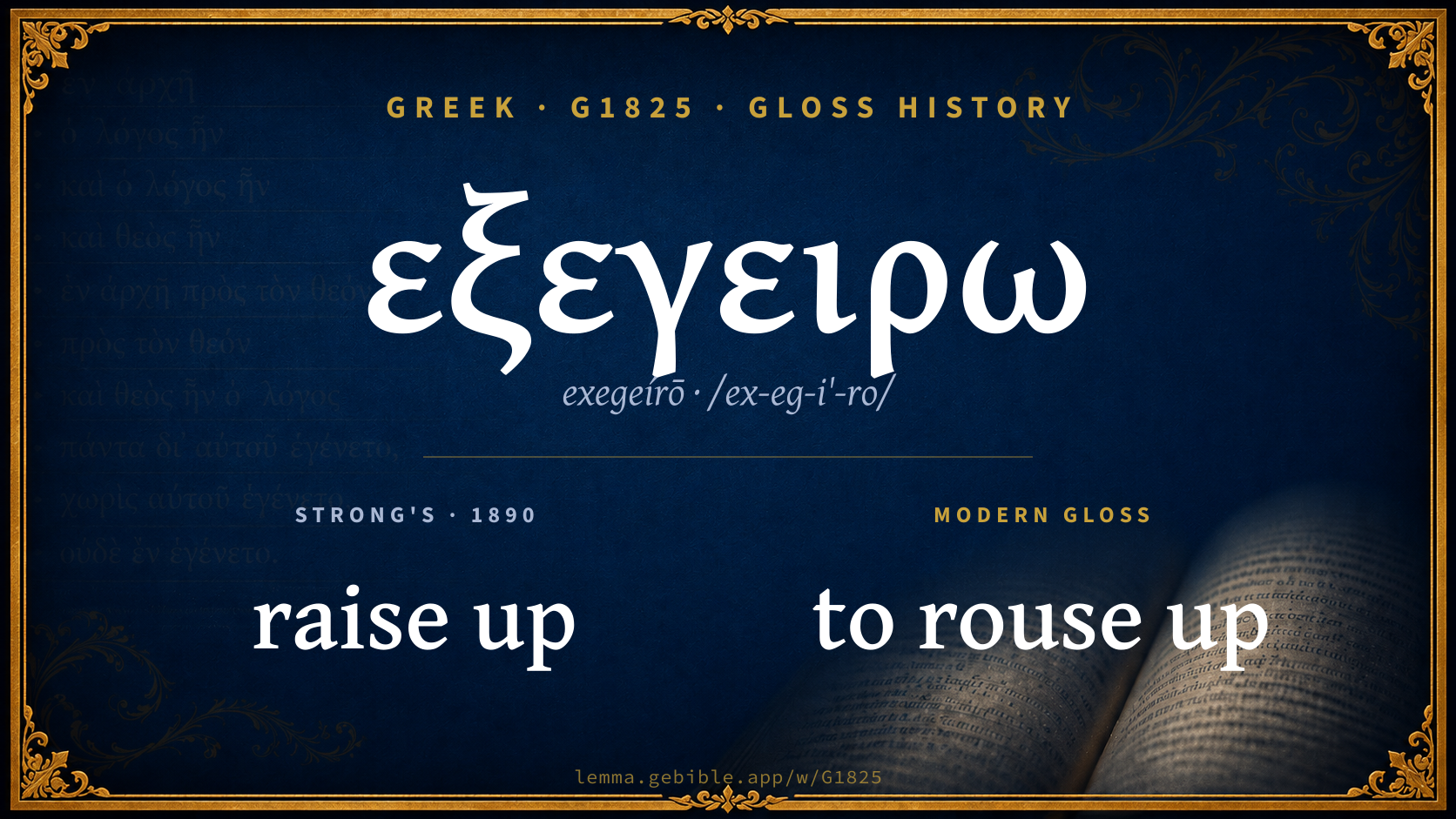
Gloss history
Strong's 1890 vs modern scholarship
About this word
Strong's G1825 catalogs a Greek word from the Greek New Testament.
These counts are not copied from any lexicon or concordance. They are computed here, from the morphology-tagged Greek New Testament. What Lemma adds →
- 2
- distinct verses
- The word appears in 2 distinct verses.
- 2 / 27
- NT books
- The word appears in 2 of 27 New Testament books.
- #2,678
- by frequency
- Top 5000 most frequent Greek words (rank 2,678 of 5,347 Greek words by occurrence).
View all 2 occurrences in the concordance →
Most concentrated in
- Romans 1 verse 50%
- 1 Corinthians 1 verse 50%
By section of the New Testament
By traditional corpus
Conventional, traditional groupings — biblical authorship is debated, so this is a traditional corpus grouping, not an authorship claim. Some books belong to more than one corpus (Luke is in both the Gospels and the Lukan corpus, and so on), so these shares overlap and need not total 100%. Each figure is a share of the word’s 2 distinct verses.
- Pauline corpus 2 verses · 100%
How translations render this word
Counts come from each version’s own published word-to-Strong’s tagging or interlinear alignment — an approximate guide to how each version renders this word, not a word-level alignment the data otherwise carries. Because each total is that version’s own tagged count, the per-version totals vary from one another and need not match the appearance or distinct-verse counts above. These counts may also differ from a printed concordance because Lemma counts each distinctly tagged rendering and does not collapse phrase taggings into a single head-word total. This is a fixed set of word-tagged versions (KJV, ASV, BSB, ULT) and does not change with the reading translation you choose elsewhere. Each version’s license is shown beside its name below (and on Sources).
- King James Version: Have i raised 1×, Raise up 1×, Up 1×
- American Standard Version: Did i raise 1×, Up 1×
- Berean Standard Bible: He will raise us 1×, I raised you up 1×
- unfoldingWord Literal Text: I raised 1×, Raise up 1×, Up 1×
King James Version Public Domain
Renders G1825 across 4 tagged occurrences — most commonly:
American Standard Version Public Domain
Renders G1825 across 2 tagged occurrences — most commonly:
Berean Standard Bible Public Domain
Renders G1825 across 2 tagged occurrences — most commonly:
unfoldingWord Literal Text CC BY-SA 4.0
Renders G1825 across 4 tagged occurrences — most commonly:
Senses in Thayer's
The 2 senses Thayer's distinguishes for this word, in lexicon order (not ranked by frequency or importance). The full entry — with sub-senses — is in the Lexicon Entry tab.
- to arouse, raise up (from sleep)
- to rouse up, stir up, incite
Word origin
Derived from εκ (ek) (G1537) — from.
Forms in the corpus
The 2 distinct written forms G1825 takes in the Greek New Testament, most frequent first — each parse links to that tense’s occurrences in the concordance.
| Form | Parsing | Example | Uses |
|---|---|---|---|
| ἐξήγειρά exḗgeirá | Verb, Aorist, Active, Indicative, 1st person, Singular | Romans 9:17 | 1 |
| ἐξεγερεῖ exegereî | Verb, Future, Active, Indicative, 3rd person, Singular | 1 Corinthians 6:14 | 1 |
Same root — word family
Other Thayer's entries built from the same root as G1825, grouped by Strong’s listed origin. These share a root / origin per the lexicon — not necessarily a shared meaning. Each links to that word’s own entry.
Derives from
Shares the same root
- εκβαλλω ekbállō G1544 to cast out
- εκβασις ékbasis G1545 exit
- εκγαμιζω ekgamízō G1547 to give in marriage
- εκγαμισκω ekgamískō G1548 to give in marriage
- εκγονον ékgonon G1549 offspring
- εκδαπαναω ekdapanáō G1550 to spend
- εκδεχομαι ekdéchomai G1551 to receive
- εκδηλος ékdēlos G1552 evident
- εκδημεω ekdēméō G1553 to depart
- εκδιδωμι ekdídōmi G1554 to give out
- εκδιηγεομαι ekdiēgéomai G1555 to relate
- εκδικος ékdikos G1558 without justice
- εκδιωκω ekdiṓkō G1559 to banish
- εκδοτος ékdotos G1560 delivered up
- εκδυω ekdýō G1562 to put off
- εκζητεω ekzētéō G1567 to seek out
- εκθαμβος ékthambos G1569 astonished
- εκθετος ékthetos G1570 exposed
- εκκαθαιρω ekkathaírō G1571 to cleanse
- εκκαιω ekkaíō G1572 to burn
- εκκακεω ekkakéō G1573 to be exhausted
- εκκεντεω ekkentéō G1574 to pierce
- εκκλαω ekkláō G1575 to cut off
- εκκλειω ekkleíō G1576 to shut out
+88 more words share this root (not shown).
Compare all same-root words → Showing 4 of 114 — not the complete family. They share a root, not necessarily a meaning.
Septuagint usage
The same Greek word εξεγειρω appears 55 times in the Greek Old Testament (Septuagint), across 45 verses in 17 books.
- 55
- LXX occurrences
- Tagged occurrences of this Greek word in the Septuagint.
- 45
- verses
- Distinct Septuagint verses containing this word.
- 17 / 39
- OT books
- The word appears in 17 of the 39 Old Testament books.
Sample Septuagint occurrences
- Genesis 28:16 ἐκἐγείρω
- Numbers 24:19 ἐκἐγείρω
- Judges 5:12 ἐκἐγείρω
- 1 Samuel 26:12 ἐκἐγείρω
- 2 Samuel 12:11 ἐκἐγείρω
- 1 Kings 16:3 ἐκἐγείρω
- Esther 8:4 ἐκἐγείρω
- Job 5:11 ἐκἐγείρω
- Psalms 3:6 ἐκἐγείρω
- Proverbs 25:23 ἐκἐγείρω
- Song of Solomon 2:7 ἐκἐγείρω
- Isaiah 51:9 ἐκἐγείρω
Septuagint occurrences (same lexeme)
Every verse where the same Strong’s number (G1825) appears in the Greek Septuagint. Verse text shown in the World English Bible for context; the Greek form is the matched word — the English is not keyword-highlighted.
- Genesis 28:16 ἐκἐγείρω Jacob awakened out of his sleep, and he said, "Surely Yahweh is in this place, and I didn't know it."
- Genesis 41:21 ἐκἐγείρω and when they had eaten them up, it couldn't be known that they had eaten them, but they were still ill-favored, as at the beginning. So I awoke.
- Numbers 24:19 ἐκἐγείρω Out of Jacob shall one have dominion, Shall destroy the remnant from the city.
- Judges 5:12 ἐκἐγείρω Awake, awake, Deborah; Awake, awake, utter a song: Arise, Barak, and lead away your captives, you son of Abinoam.
- 1 Samuel 26:12 ἐκἐγείρω So David took the spear and the jar of water from Saul's head; and they got them away: and no man saw it, nor knew it, neither did any awake; for they were all asleep, because a deep sleep from Yahweh was fallen on them.
- 2 Samuel 12:11 ἐκἐγείρω This is what Yahweh says: 'Behold, I will raise up evil against you out of your own house; and I will take your wives before your eyes, and give them to your neighbor, and he will lie with your wives in the sight of this sun.
- 2 Samuel 19:19 ἐκἐγείρω He said to the king, Don't let my lord impute iniquity to me, neither do you remember that which your servant did perversely the day that my lord the king went out of Jerusalem, that the king should take it to his heart.
- 1 Kings 16:3 ἐκἐγείρω behold, I will utterly sweep away Baasha and his house; and I will make your house like the house of Jeroboam the son of Nebat.
- Esther 8:4 ἐκἐγείρω Then the king held out to Esther the golden scepter. So Esther arose, and stood before the king.
- Job 5:11 ἐκἐγείρω So that he sets up on high those who are low, Those who mourn are exalted to safety.
- Psalms 3:6 ἐκἐγείρω I will not be afraid of tens of thousands of people Who have set themselves against me on every side.
- Psalms 7:7 ἐκἐγείρω Let the congregation of the peoples surround you. Rule over them on high.
- Psalms 34:23 ἐκἐγείρω
- Psalms 43:24 ἐκἐγείρω
- Psalms 56:9 ἐκἐγείρω Then my enemies shall turn back in the day that I call. I know this, that God is for me.
- Psalms 58:5 ἐκἐγείρω Which doesn't listen to the voice of charmers, No matter how skillful the charmer may be.
- Psalms 72:20 ἐκἐγείρω This ends the prayers by David, the son of Jesse.
- Psalms 77:65 ἐκἐγείρω
- Psalms 79:3 ἐκἐγείρω Their blood they have shed like water around Jerusalem. There was no one to bury them.
- Psalms 107:3 ἐκἐγείρω And gathered out of the lands, From the east and from the west, From the north and from the south.
- Psalms 138:18 ἐκἐγείρω
- Proverbs 25:23 ἐκἐγείρω The north wind brings forth rain: So a backbiting tongue brings an angry face.
- Song of Solomon 2:7 ἐκἐγείρω I adjure you, daughters of Jerusalem, By the roes, or by the hinds of the field, That you not stir up, nor awaken love, Until it so desires.
- Song of Solomon 3:5 ἐκἐγείρω I adjure you, daughters of Jerusalem, By the roes, or by the hinds of the field, That you not stir up, nor awaken love, Until it so desires.
- Song of Solomon 4:16 ἐκἐγείρω Awake, north wind; and come, you south; Blow on my garden, that its spices may flow out. Let my beloved come into his garden, And taste his precious fruits. Lover
- Song of Solomon 8:4 ἐκἐγείρω I adjure you, daughters of Jerusalem, That you not stir up, nor awaken love, Until it so desires. Friends
- Isaiah 51:9 ἐκἐγείρω Awake, awake, put on strength, arm of Yahweh; awake, as in the days of old, the generations of ancient times. Isn't it you who did cut Rahab in pieces, who pierced the monster?
- Isaiah 51:17 ἐκἐγείρω Awake, awake, stand up, Jerusalem, that have drunk at the hand of Yahweh the cup of his wrath; you have drunken the bowl of the cup of staggering, and drained it.
- Isaiah 52:1 ἐκἐγείρω Awake, awake, put on your strength, Zion; put on your beautiful garments, Jerusalem, the holy city: for henceforth there shall no more come into you the uncircumcised and the unclean.
- Jeremiah 6:22 ἐκἐγείρω Thus says Yahweh, Behold, a people comes from the north country; and a great nation shall be stirred up from the uttermost parts of the earth.
- Jeremiah 27:41 ἐκἐγείρω
- Jeremiah 28:1 ἐκἐγείρω It happened the same year, in the beginning of the reign of Zedekiah king of Judah, in the fourth year, in the fifth month, that Hananiah the son of Azzur, the prophet, who was of Gibeon, spoke to me in the house of Yahweh, in the presence of the priests and of all the people, saying,
- Jeremiah 28:38 ἐκἐγείρω
- Jeremiah 38:26 ἐκἐγείρω then you shall tell them, I presented my supplication before the king, that he would not cause me to return to Jonathan's house, to die there.
- Ezekiel 21:21 ἐκἐγείρω For the king of Babylon stood at the parting of the way, at the head of the two ways, to use divination: he shook the arrows back and forth, he consulted the teraphim, he looked in the liver.
- Ezekiel 23:22 ἐκἐγείρω Therefore, Oholibah, thus says the Lord Yahweh: Behold, I will raise up your lovers against you, from whom your soul is alienated, and I will bring them against you on every side:
- Joel 4:7 ἐκἐγείρω
- Joel 4:9 ἐκἐγείρω
- Joel 4:12 ἐκἐγείρω
- Habakkuk 1:6 ἐκἐγείρω For, behold, I raise up the Chaldeans, that bitter and hasty nation, that march through the breadth of the earth, to possess dwelling places that are not theirs.
- Habakkuk 2:19 ἐκἐγείρω Woe to him who says to the wood, 'Awake!' or to the mute stone, 'Arise!' Shall this teach? Behold, it is overlaid with gold and silver, and there is no breath at all in the midst of it.
- Zechariah 2:17 εκἐγείρω
- Zechariah 4:1 ἐκἐγείρω The angel who talked with me came again, and wakened me, as a man who is wakened out of his sleep.
- Zechariah 11:16 ἐκἐγείρω For, behold, I will raise up a shepherd in the land, who will not visit those who are cut off, neither will seek those who are scattered, nor heal that which is broken, nor feed that which is sound; but he will eat the flesh of the fat sheep, and will tear their hoofs in pieces.
- Zechariah 13:7 ἐκἐγείρω "Awake, sword, against my shepherd, And against the man who is close to me," says Yahweh of Hosts. Strike the shepherd, and the sheep will be scattered; And I will turn my hand against the little ones.
These are occurrences of the same Greek lexeme (G1825) in the Septuagint — not a translation of any one Hebrew word. The store carries no word-level Hebrew↔Greek alignment, so no Hebrew original is asserted here. Counts come from the recovered LXX Strong's tagging — high-frequency vocabulary is well covered, while rare or late forms may be untagged — so they reflect tagged occurrences and may slightly undercount.