
Psalms 58:5

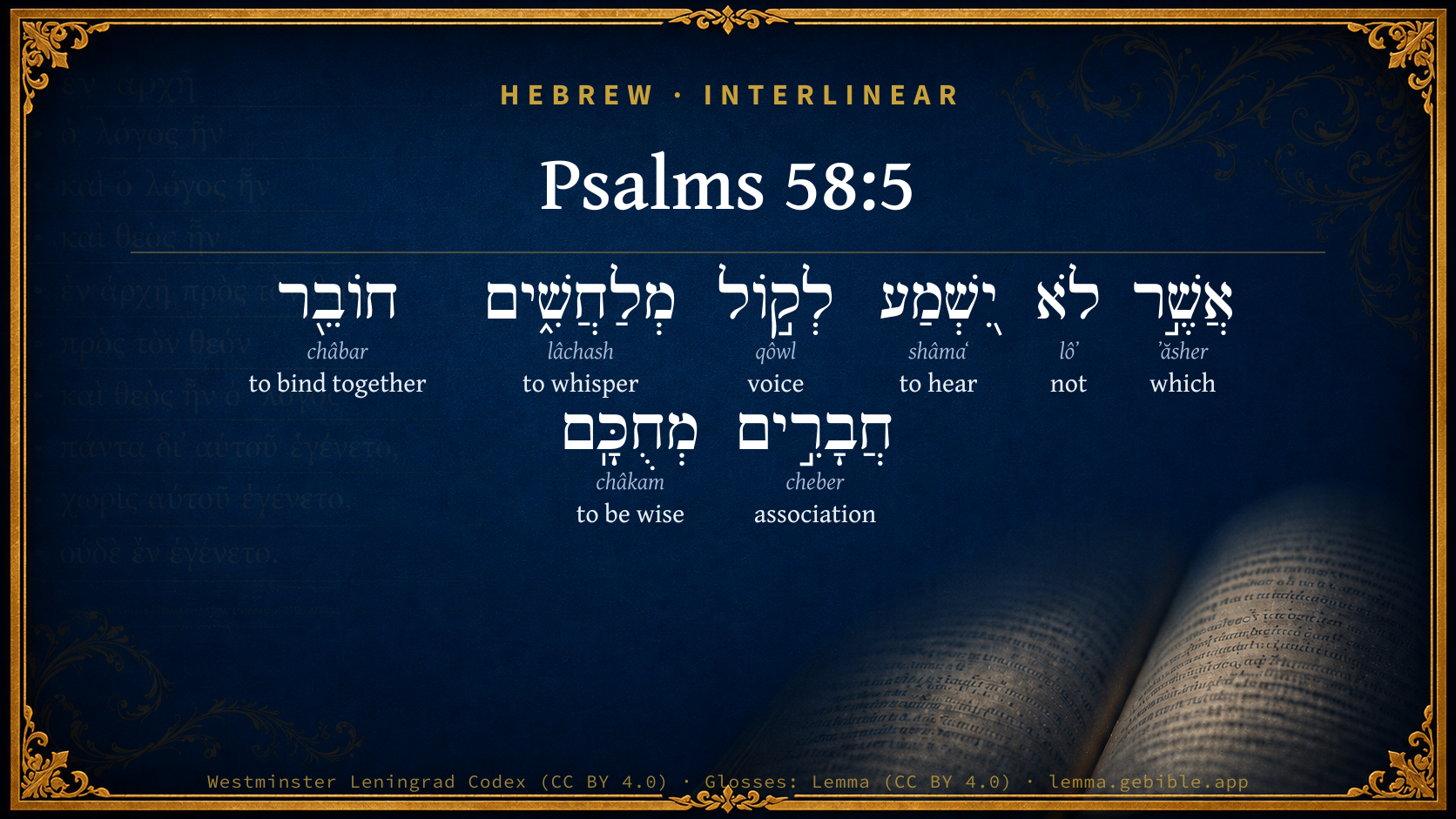
Hebrew (Westminster Leningrad Codex) Psalms 58:5 appears in the Hebrew Old Testament. The text above is from the Westminster Leningrad Codex. Each word links to its Strong’s number, a concise gloss, and parsing drawn from the Open Scriptures Hebrew Bible morphology. Click any word for its full Brown-Driver-Briggs (BDB) entry.
Download image
Cite this verse

Psalms 58:5 (World English Bible). Public Domain. Lemma interlinear Bible study tool, https://lemma.gebible.app/v/psalms/58/5.

Show BibTeX & RIS
BibTeX
RIS
English Translation
Which doesn't listen to the voice of charmers, No matter how skillful the charmer may be.
World English Bible · Public Domain
Download a study sheet

One document with this verse’s original text, its word-by-word gloss line, the meaning frame, cross-references with their text, attributed commentary, and full source and license credits — printable, and it pastes into notes with its structure intact.

This verse Autodidact and up

Study sheet (.html) Plain text (.txt)

A passage Seminary Student

Up to 50 verses in one chapter. A passage sheet keeps up to 6 commentary sources and 12 cross-references per verse, in the order this page ranks them, and says so on the sheet whenever that leaves anything out. Ask for a single verse and you get the Autodidact verse sheet above.

Everything on this page stays free to read, with no account — the sheet is a download of what is already on screen, not access to it.

Want to remove ads? Support Godless Engineer
Compare translations 3

The same verse in 3 English versions, stacked beneath the original-language interlinear above. Click any original word for its lexicon entry.

Each is an independent rendering of the whole verse — the interlinear is not word-aligned to these translations.

Highlighted words mark where these versions differ — a whole-verse word diff, not a word-by-word alignment.

  • World English Bible Public Domain
    Which doesn't listen to the voice of charmers, No matter how skillful the charmer may be.
  • King James Version Public Domain
    Which will not hearken to the voice of charmers, charming never so wisely.
  • unfoldingWord Literal Text CC BY-SA 4.0
    that does not listen to the voice of charmers, one charming charms, being made wise.

unfoldingWord Literal Text — © unfoldingWord, licensed CC BY-SA 4.0. Word-aligned USFM3 via Door43 (git.door43.org/unfoldingWord/en_ult).

Versions to compare (up to 4)

3 of 4 selected

Show all 18 translations

Every available English version of this verse, each an independent rendering of the whole verse.

  • World English Bible Public Domain
    Which doesn't listen to the voice of charmers, No matter how skillful the charmer may be.
  • Berean Standard Bible Public Domain
    refusing to hear the tune of the charmer who skillfully weaves his spell.
  • Majority Standard Bible Public Domain
    refusing to hear the tune of the charmer who skillfully weaves his spell.
  • King James Version Public Domain
    Which will not hearken to the voice of charmers, charming never so wisely.
  • American Standard Version (1901) Public Domain
    Which hearkeneth not to the voice of charmers, Charming never so wisely.
  • Revised Version (1885) Public Domain
    Which hearkeneth not to the voice of charmers, charming never so wisely.
  • Geneva Bible (1599) Public Domain
    Which heareth not the voyce of the inchanter, though he be most expert in charming.
  • Douay-Rheims (1899) Public Domain
    Their madness is according to the likeness of a serpent: like the deaf asp that stoppeth her ears:
  • Young's Literal Translation Public Domain
    Which hearkeneth not to the voice of whisperers, A charmer of charms most skilful.
  • Literal Standard Version CC BY-SA 4.0
    Which does not listen to the voice of whisperers, || A charmer of most skillful charms.
  • Unlocked Literal Bible CC BY-SA 4.0
    that pays no attention to the voice of charmers, no matter how skillful they are.
  • unfoldingWord Literal Text CC BY-SA 4.0
    that does not listen to the voice of charmers, one charming charms, being made wise.
  • Darby Bible Public Domain
    Which doth not hearken to the voice of enchanters, of one charming ever so wisely.
  • World Messianic Bible Public Domain
    which doesn’t listen to the voice of charmers, no matter how skillful the charmer may be.
  • Webster's Bible Public Domain
    \\58:4\\Their poison is like the poison of a serpent: they are like the deaf adder that stoppeth her ear;
  • Free Bible Version CC BY-SA 4.0
    refusing to hear the voice of the snake charmers or the spellbinders.
  • Bible in Basic English Public Domain
    Who will not be moved by the voice of the wonder-worker, however great are his powers.
  • JPS Tanakh (1917) Public Domain
    (58-6) Which hearkeneth not to the voice of charmers, or of the most cunning binder of spells.

Literal Standard Version (2020), Covenant Press — licensed CC BY-SA 4.0. Text via the HelloAO Bible API (eBible.org). Unlocked Literal Bible (unfoldingWord) — licensed CC BY-SA 4.0. Text via the HelloAO Bible API (eBible.org). unfoldingWord Literal Text — © unfoldingWord, licensed CC BY-SA 4.0. Word-aligned USFM3 via Door43 (git.door43.org/unfoldingWord/en_ult). Free Bible Version, Dr. Jonathan Gallagher — licensed CC BY-SA 4.0. Text via the HelloAO Bible API (eBible.org).

Word by word

More ways to search: Search by grammar → Find every occurrence → Compare this word →

Practice this passage: Drill this verse → Learn its vocabulary →

About this verse

These counts appear in no published source. They are computed here, from the morphology-tagged text and Lemma’s own curated glosses. What Lemma adds →

8
words
8
distinct lemmas
Wisdom
section

Notable vocabulary

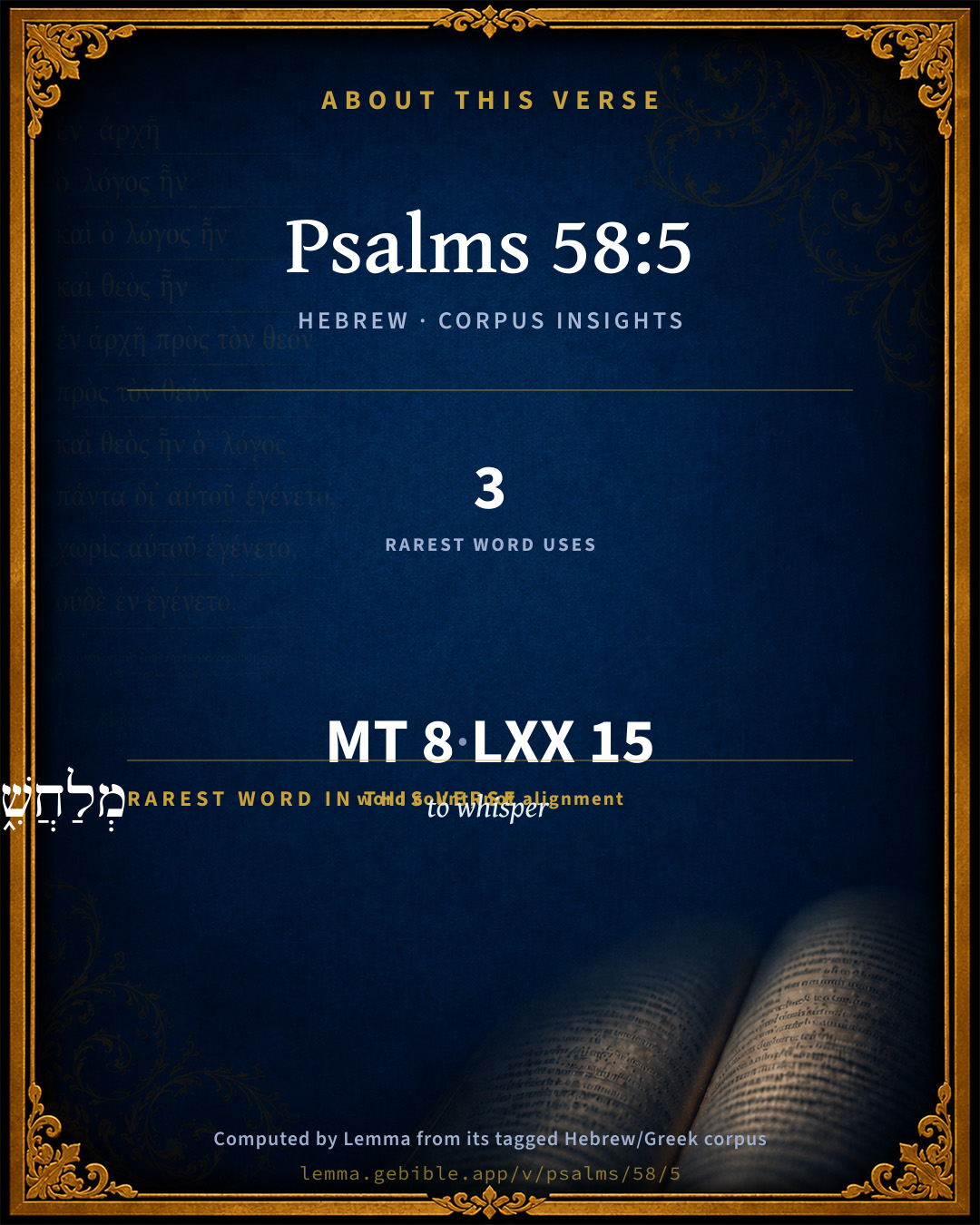
The rarest word here is מְלַחֲשִׁ֑ים to whisper H3907 — appearing just 3 times in the whole Hebrew Bible.

Shared distinctive vocabulary

מְלַחֲשִׁ֑ים to whisper H3907 occurs in 3 verses of the Hebrew Bible. Also found in:

Grammatical profile

  • 4 verbs
  • 2 nouns
  • 2 particles

Verb forms

  • יִ֭שְׁמַע Qal · Imperfect
  • מְלַחֲשִׁ֑ים Piel · Participle Active
  • חוֹבֵ֖ר Qal · Participle Active
  • מְחֻכָּֽם Pual · Participle Passive

Hebrew & Septuagint length

In English translation the verse runs 16 words from the Hebrew and 17 from the Septuagint (LXX English) — closely comparable.

A rough comparison of the two English renderings, which tokenize alike — not a word-level alignment.

Word counts can differ between the Hebrew and the Greek without any difference in meaning — e.g. the Hebrew direct-object marker אֵת has no separate Greek word, and Greek often adds the article ὁ.

In the original languages it is 8 Hebrew tokens and 15 Greek tokens — but the two are counted differently (Hebrew bundles its prefixes and suffixes into one token; the Greek is in lemma form), so that isn’t a like-for-like length.

Cross-references

3

Topical passages linked to Psalms 58:5 in the Treasury of Scripture Knowledge — connected by theme and wording, ordered by reader-vote popularity; previews shown in the World English Bible.

  • Jeremiah 8:17 For, behold, I will send serpents, adders, among you, which will not be charmed; and they shall bite you, says Yahweh.
  • Deuteronomy 18:11 or a charmer, or a consulter with a familiar spirit, or a wizard, or a necromancer.
  • Isaiah 19:3 The spirit of Egypt shall fail in the midst of it; and I will destroy the counsel of it: and they shall seek to the idols, and to the charmers, and to those who have familiar spirits, and to the wizards.

Cross-references courtesy of OpenBible.info (CC BY 4.0).

Hebrew and Greek witnesses Masoretic Hebrew ↔ Greek Septuagint

The same verse in the two great witnesses to the Old Testament, shown verse-for-verse.

You’re reading Greek Psalm 57 (Hebrew Psalm 58). The Septuagint counts the superscription, so verse numbers can differ from the Hebrew — chapter-level alignment, not verse-by-verse. Numbering follows Rahlfs.

These are two independent witnesses, not word-aligned to each other, and the Septuagint is shown in lemma (dictionary) form.

Hebrew Psalms 58:5 Masoretic · Westminster Leningrad Codex

אֲשֶׁ֣ר לֹא יִ֭שְׁמַע לְק֣וֹל מְלַחֲשִׁ֑ים חוֹבֵ֖ר חֲבָרִ֣ים מְחֻכָּֽם

Which doesn't listen to the voice of charmers, No matter how skillful the charmer may be.

World English Bible · Public Domain

Greek LXX Greek Psalm 57:5 Septuagint · lemma form

θυμός αὐτός κατά ὁ ὁμοίωσις ὁ ὄφις ὡσεί ἀσπίς κωφός καί βύω ὁ οὖς αὐτός

which will not hear the voice of charmers, nor heed the charm prepared skillfully by the wise.

LXX2012 (modern English Septuagint) · Public Domain

Hebrew: Westminster Leningrad Codex (CC BY 4.0). Greek: Septuagint (public domain); English from LXX2012 (modern English Septuagint) (Public Domain). How the Septuagint differs from the Hebrew →

Commentary

Notes on Psalms 58:5 from classic Christian and Jewish commentators (each source and its license shown beneath its notes). The classic Christian expositions comment on the surrounding passage and are grouped to its opening verse, so a note may address several verses; the Jewish commentaries on the Tanakh (Rashi and others) are per-verse, so they appear only where the commentator wrote on this verse.

Lemma curates 59 commentaries, every one of them public domain or Creative Commons licensed, each selected and text-cleaned for this edition rather than reprinted as found. About our sources →

Trapp's Complete Commentary

John Trapp

Psa 58:5 Which will not hearken to the voice of charmers, charming never so wisely.

Ver. 5. Which will not hearken to the voice of charmers] Such there are, the devil’s spellmen, Ecc 10:8, that can enchant some kind of serpents, and some they cannot, as Jer 8:17. That the serpent here spoken of, when she beginneth to feel the charmer, clappeth one of her ears close to the ground, and stoppeth the other with her tail, is affirmed by Jerome, Austin, and Cassiodorus. Vide Plin. lib. 2, c. 7; l. 8, c. 3. Quum coeperit incantatorem suum pati, allidit unam aurem terrae et cauda obturat alteram (Aug. in loc.; Horat. Epist. 2). And that she doth this, although by hearkening to the charmer, provoking her to spit out her poison, she might renew her age, is affirmed by others; semblably, perverse people will not be persuaded to live happily, reign everlastingly.

- At Paris ut vivat regnetque beatus,

Cogi posse negat.

John Trapp, A Commentary or Exposition upon All the Books of the Old and New Testament (1647–1656) — public domain. Text from a community e-Sword module.

Adam Clarke's Commentary

Verse 5. Which will not hearken to the voice of charmers] The old Psalter translates and paraphrases these two verses curiously: -

Vulg. Furor illis secundum similitudinem serpentis; sicut aspidis surdae et obturantis aures suas: Quae non exaudiet vocem incantantium et venefici in cantantis sapienter.

Trans. Wodes (madness) til thaim aftir the liking of the neddir, as of the snake doumb and stoppand her eres.

Paraph. Right calles he tham wod, (mad,) for that hafe na witte to se whider that ga: for that louke thair eghen, and rennys till the are thaire wodness til clumsthed that wil noght be turned as of the snake that festis (fastens) the ta ere til the erth, and the tother ere stoppis with hir taile: Sua do thai that thai here not Godis word; that stope thair eris with luf of erthli thing that thai delite thaim in; and with thair taile, that es with all synnes, that that will noght amend.

Trans. The whitk salle noght here the voyce of charmand, and of the venim in akare of charmand wisli.

Paraph. This snake stopis hir eres that she be noght broth to light; for if she herd it, she come forth sone, he charmes swa wysli in his craft. Swa the wikkid men wit noght here the voyce of Crist and his lufers that are wys charmes; for thi wild (would) bring them till light of heven. Wyt ye well (know) that he (i.e., Christ) lufes noght charmars and venim makers but be (by) vices of bestes, he takes lickening of vices of men.

It seems as if there were a species of snake or adder that is nearly deaf; and as their instinct informs them that if they listen to the sounds which charmers use they shall become a prey; therefore they stop their ears to prevent the little hearing they have from being the means of their destruction. To this the Old Psalter refers. We have also an account of a species of snake, which, if it cast its eye on the charmer, feels itself obliged to come out of its hole; it therefore keeps close, and takes care neither to see nor be seen. To this also the Old Psalter alludes; and of this fact, if it be one, he makes a good use.

Adam Clarke's Commentary on the Bible (1810–1826) — public domain. Text from a community e-Sword/MySword module.

Ellicott's Commentary for English Readers

(5) Charmers.—Heb., melachashîm, a word undoubtedly formed from the sound made by the charmer in imitating the snake, in order to entice it from its hole. Lane, in Modern Egyptians, describing a snake charmer at his task, says: “He assumes an air of mystery, strikes the walls with a short palm stick, whistles, makes a clacking noise with his tongue.” The art of serpent charming, and the magic connected with it, was of great antiquity in Egypt, and passed thence to surrounding countries.

Charming never so wisely.—Literally, one tying knots wisely, i.e., a most skilful charmer.

A Bible Commentary for English Readers, edited by Charles John Ellicott (1878–1897) — public domain. Text from a community e-Sword module.

John Gill's Exposition

Which will not hearken to the voice of charmers,.... Or "that use enchantments", to enchant serpents, by muttering certain words, or by magical songs; by which means it is said that they have been drawn out of their holes, or caused to fly, or have become stupefied, and have lost their poison, and even burst asunder; as Bochart (b) relates from Pliny, Aelianus, Lucan, Isidore, Virgil, Ovid, Horace, and others: but an "asp" is unmoved by enchantments, and they are of no avail against its bites and poison (c). Nor do these words suppose that the psalmist approved of enchantments, or affirms the virtue of them to be real, but rather suggests the contrary; he only takes his similitude from the seeming deafness and disregard of serpents to enchantments, to set forth the obstinacy of wicked men: and their resolution to continue in their wicked ways; like the serpent that disregards men:

charming never so wisely; being "wise, skilful" (d), or made wise in enchanting enchantments; one very learned and expert in the art; or in "associating associations, skilful" (e): who makes a consort of magical words to obtain his point, as some think; or because by his enchantments he associates and gathers many serpents together, and tames them; or because he does this by society and fellowship with the devil; methods no ways approved of by the psalmist, only alluded to. It may perhaps better be rendered, "which will not hearken to the voice of the eloquent, putting things together ever so wisely": the word is used for an eloquent orator, Isa 3:3. Such Gospel ministers are, who are mighty in the Scriptures. The voice of the Gospel is a charming voice; it publishes good news and glad tidings; it is a voice of love, grace, and mercy, of peace, pardon, righteousness, and salvation by Christ; and is wisely charmed when it gives no uncertain sound, is all of a piece, and is faithfully preached, as it was by the apostles of Christ; who, as wise men, laid him as the foundation of eternal life and salvation; and especially as it was preached by Christ himself, who spake as never man did: and yet, such were the hardness and obstinacy of the wicked Jews, that they stopped their ears to his ministry, nor would they suffer others to attend upon it; and so it is now: which shows the insufficiency of the best means of themselves, and the necessity of powerful and efficacious grace, to work upon the hearts of men.

(b) Hierozoic. par. 2. l. 2. c. 6. col. 390. (c) Aelian. de Animal. l. 1. c. 54. (d) "incantantis incantationem periti", Vatablus; "vel incantationes exercitati ac peritissimi", Michaelis; "of him that is made wise", Ainsworth. (e) "Jungentis conjunctiones docti", Montanus; "consociantis societates serpentum", Michaelis.

John Gill's Exposition of the Whole Bible (1746–1763) — public domain (CC PDM 1.0). Text via the HelloAO Bible API.

Albert Barnes' Notes on the Bible

Which will not hearken to the voice of charmers - The word rendered “charmers” - לחשׁ lachash - means properly “whisperers, mutterers,” and it refers here to those who made use of spells or incantations - sorcerers or magicians. See the notes at Isa 8:19. These incantations were accompanied usually with a low, muttering sound, or with a gentle whisper, as if for the purpose of calming and controlling the object of the incantation. Such charmers of serpents (or pretended charmers) abounded among the ancients, and still abound in India. The art is carried in India to great perfection; and there are multitudes of persons who obtain a livelihood by this pretended or real power over venomous serpents. Their living is obtained either by “exhibiting” their power over serpents which they carry with them in their peregrinations, or by “drawing” them by their incantations from the walls of gardens, houses, and hedges, where they had taken up their abode. Multitudes of facts, referred to by those who have resided in India, seem to confirm the opinion that this power is real.

Charming never so wisely - Margin, “Be the charmer never so cunning.” The word rendered here “charming” - חובר chober - means properly to bind; to bind together. The “literal” meaning of the original Hebrew is, “binding spells that are wise,” or, that are “cunning;” in other words, making use of the most cunning or skillful of their incantations and charms. The meaning is, that the utmost skill of enchantment will be unsuccessful. They are beyond the reach of any such arts. So with the people referred to by David. They were malignant and venomous; and nothing would disarm them of their malignity, and destroy their venom. What is here affirmed of these men is true in a certain sense of all people. The depravity of the human heart is such that nothing that man can employ will subdue it. No eloquence, no persuasion, no commands, no remonstrances, no influence that man can exert, will subdue it.

It cannot be charmed down; it cannot be removed by any skill or power of man, however great. The following remarks from Dr. Thomson, who has spent twenty years in Palestine (land and the Book, vol. i. pp. 221-223), will illustrate this passage: “I have seen many serpent-charmers who do really exercise some extraordinary power over these reptiles. They carry enormous snakes, generally black, about them, allow them to crawl all over their persons and into their bosoms; always, however, with certain precautions, either necessary, or pretended to be so. They repeatedly breathe strongly into the face of the serpent, and occasionally blow spittle, or some medicated composition upon them. It is needless to describe the mountebank tricks which they perform. That which I am least able to account for is the power of detecting the presence of serpents in a house, and of enticing or ‘charming’ them out of it. The thing is far too common to be made a matter of scepticism. The following account, by Mr. Lane, is a fair statement of this matter: ‘The charmer professes to discover, without ocular perception (but perhaps he does so by a unique smell), whether there be any serpents in the house, and if there be, to attract them to him, as the fowler, by the fascination of his voice, allures the bird into his net.

As the serpent seeks the darkest place in which to hide himself, the charmer has, in most eases, to exercise his skill in an obscure chamber, where he might easily take a serpent from his bosom, bring it to the people without the door, and affirm that he had found it in the apartment, for no one would venture to enter with him, after having been assured of the presence of one of these reptiles within. But he is often required to perform in the full light of day, surrounded by spectators; and incredulous persons have searched him beforehand, and even stripped him naked, yet his success has been complete. He assumes an air of mystery, strikes the walls with a short palm-stick, whistles, makes a clucking noise with his tongue, and spits upon the ground, and generally says - I adjure you, by God, if ye be above or if ye be below, that ye come forth; I adjure you by the most great name, if ye be obedient, come forth, and if ye be disobedient, die! die! die!’ The serpent is generally dislodged by his stick from a fissure in the wall or from the ceiling of the room.

I have heard it asserted that a serpent-charmer, before he enters a house in which he is to try his skill, always employs a servant of that house to introduce one or more serpents; but I have known instances in which this could not be the case, and am inclined to believe that the dervishes above mentioned are generally acquainted with some physical means of discovering the presence of serpents without seeing them, and of attracting them from their lurking-places. What these ‘physical means’ may be is yet a secret, as also the ‘means’ by which persons can handle live scorpions, and can put them into their bosom without fear or injury. I have seen this done again and again, even by small boys. This has always excited my curiosity and astonishment, for scorpions are the most malignant and irascible of all insects. The Hindoos, and after them the Egyptians, are the most famous snake-charmers, scorpion-eaters, etc., etc., although gipsies, Arabs, and others are occasionally found, who gain a vagabond livelihood by strolling round the country, and confounding the ignorant with these feats.”

Albert Barnes' Notes on the Bible (1834–1885) — public domain. Text from a community e-Sword/MySword module.

Matthew Poole's English Annotations

This similitude doth neither justify the practice of charming, which, in the very word here used, is condemned, Deu 18:11, no more than those which are drawn from the unjust steward, Luk 16:1, &c.; Luk 18:2, &c., and from a thief, Rev 16:15; nor yet affirm the truth of what is reported concerning the asps or adders, which are said to lay one ear close to the ground, and to cover the other with their tail, that so they may avoid the danger of enchantment; but only was taken from the common opinion, which he poetically mentions to this purpose: As they commonly say of the asps or adders, &c., such really are these men; deaf to all my counsels, and to the dictates of their own consciences, and to the voice of God’s law. And yet of the

charming or enchanting of serpents, mention is made both in other places of Scripture, as Ecc 10:11; Jer 8:17, and in all sorts of authors, ancient and modern, Hebrew, and Arabic, and Greek, and Latin of which see my Latin Synopsis. And particularly the Arabic writers (to whom these creatures were best known) name some sorts of serpents, among which the adder is one, which they call deaf, not because they are dull of hearing, but, as one of them expressly saith, because they will not be charmed.

Matthew Poole's English Annotations on the Holy Bible (1683–1685) — public domain. Text from a community e-Sword/MySword module.

The Treasury of David

Charles H. Spurgeon

Ver. 5. Which will not hearken to the voice of charmers, charming never so wisely. Ungodly men are not to be won to right by arguments the most logical, or appeals the most pathetic. Try all your arts, ye preachers of the word! Lay yourselves out to meet the prejudices and tastes of sinners, and ye shall yet have to cry, "Who hath believed our report?" It is not in your music, but in the sinner's ear that the cause of failure lies, and it is only the power of God that can remove it.

"You can call spirits from the vast deep,

But will they come when you do call for them?"

No, we call and call, and call in vain, till the arm of the Lord is revealed. This is at once the sinner's guilt and danger. He ought to hear but will not, and because he will not hear, he cannot escape the damnation of hell.

Ver. 5. Will not hearken. The Lord hath some of his elect ones whom he seeth walking in bypaths and crooked ways: the Lord giveth a commission to his servants, the ministers, and saith, Go invite and call yon soul to come to me, and say, Return, O Shulamite; but the soul stirs not: the Lord sends and calls again: yet with the deaf adder, he hearkeneth not to the voice of the enchanter: well, saith the Lord, "If you will not come; I will fetch you"; if fair means will not do, foul means must; then he hisses for the fly and the bee of affliction, and calls forth armies of trouble, and gives them commission to seize upon, and to lay siege to such a man or woman, and saith, Ply them with your cannon shot, till you make them yield, give up the keys and strike the sail; he sends sickness to their bodies, a consumption to their estate, death to their friends, shame to their reputation, a fire to their house, and the like, and bids them prey and spoil, till they see and acknowledge the hand of the Lord lifted up. J. Votier's "Survey of Effectual Calling, "1652.

Ver. 5. The serpent charmer.

I. He charms with moral persuasion, promise, threatening,

etc.

II. He charms wisely, earnestly, affectionately,

argumentively.

III. He charms in vain; the will is averse. Hence the

need of divine grace and of the gospel.

Psalms 58:6*

Charles H. Spurgeon's The Treasury of David (1869–1885) — public domain. Psalms only. Text from a community e-Sword/MySword module.

Whedon's Commentary on the Bible

Daniel D. Whedon

5. Charmers—From which it appears that the art of serpent charming was known in David’s day. The object was to render them tractable and harmless. See Ecc_10:11; Jer_8:17. The art is still practised in Egypt and the East as a profession, for amusement, and for dislodging serpents from houses.

Daniel D. Whedon (gen. ed.), Commentary on the Old and New Testaments (1874–1909) — public domain. Text from a community e-Sword module.

The Pulpit Commentary

Which will not hearken to the voice of charmers. Serpent charmers are alluded to in Ecc_10:11 and Jer_6:17. They have at all times been common in the East, as they are still in India; and it is with reason suspected that the magicians of Pharaoh employed the art in their contest with Moses and Aaron. Charming never so wisely; literally, though they bind their spells skilfully.

The Pulpit Commentary (1880–1919), ed. H.D.M. Spence-Jones & Joseph S. Exell — public domain. Text from a community e-Sword module.

John Wesley's Explanatory Notes

Not hearken - As they commonly say of the adders, such really are these men: deaf to all my counsels, to their own consciences, and to God's law. Of the charming or enchanting of serpents, mention is made both in other places of scripture, and in all sorts of authors, ancient and modern, Hebrew and Arabick, and Greek and Latin. And particularly the Arabick writers (to whom these creatures were best known) name some sorts of serpents, among which the adder is one, which they call deaf, not because they are dull of hearing, but, as one of them expressly faith, because they will not be charmed.

John Wesley, Explanatory Notes Upon the Whole Bible (1754–1765) — public domain. Text via the GEBible commentary corpus.

Rashi

Rabbi Shlomo Yitzchaki (Rashi)

They have venom They have venom to kill people, like the venom of a serpent.

like a deaf cobra that closes its ear When the snake ages, it becomes deaf in one ear, and closes the other ear with dust so that it should not hear the incantation of the charmer, adjuring it not to cause injury.

Rashi on the Tanakh — English translations: “The Judaica Press complete Tanach with Rashi, translated by A. J. Rosenberg” (CC BY 4.0); “Pentateuch with Rashi's commentary by M. Rosenbaum and A.M. Silbermann, 1929-1934” (public domain); “The Metsudah Tanach series, Lakewood, N.J” (CC BY 4.0); and “The Book of Joshua, Metsudah Publications, 1997” (CC BY 4.0). Text via Sefaria.

Lesson kit

Teaching starters — assembled from the data on this page, not authored interpretation. Every prompt links to the verse data it draws on. Edit before teaching.

Psalms, in the Wisdom, opens this verse with 8 words (8 distinct Hebrew lemmas). Its most distinctive word is lâchash (“to whisper”). A historical commentator’s framing appears above. Read the whole chapter for the surrounding context.

Discussion questions

  1. What does “to whisper” (lâchash) contribute to the verse as a whole?
  2. 2 Samuel 12:19 shares the word «to whisper» with this verse. How do the two illuminate each other?
  3. These translations render this verse differently. What is at stake in choosing one wording over another?
  4. The verb «יִ֭שְׁמַע» is Qal Imperfect. How does its form color the action?
  5. Reading how Trapp's Complete Commentary and Adam Clarke's Commentary read this verse, where do the two commentators agree and where do they part?

Things to notice

Reading settings

Reading text

Shown beneath each verse's original-language words.

Old Testament
Old Testament edition

Read the OT as the Masoretic Hebrew (MT) or the Greek Septuagint (LXX).

English shown for the Greek Septuagint (in the Hebrew ↔ Greek comparison).

Comparing translations? Open the Compare panel on any verse page to stack up to four side by side.