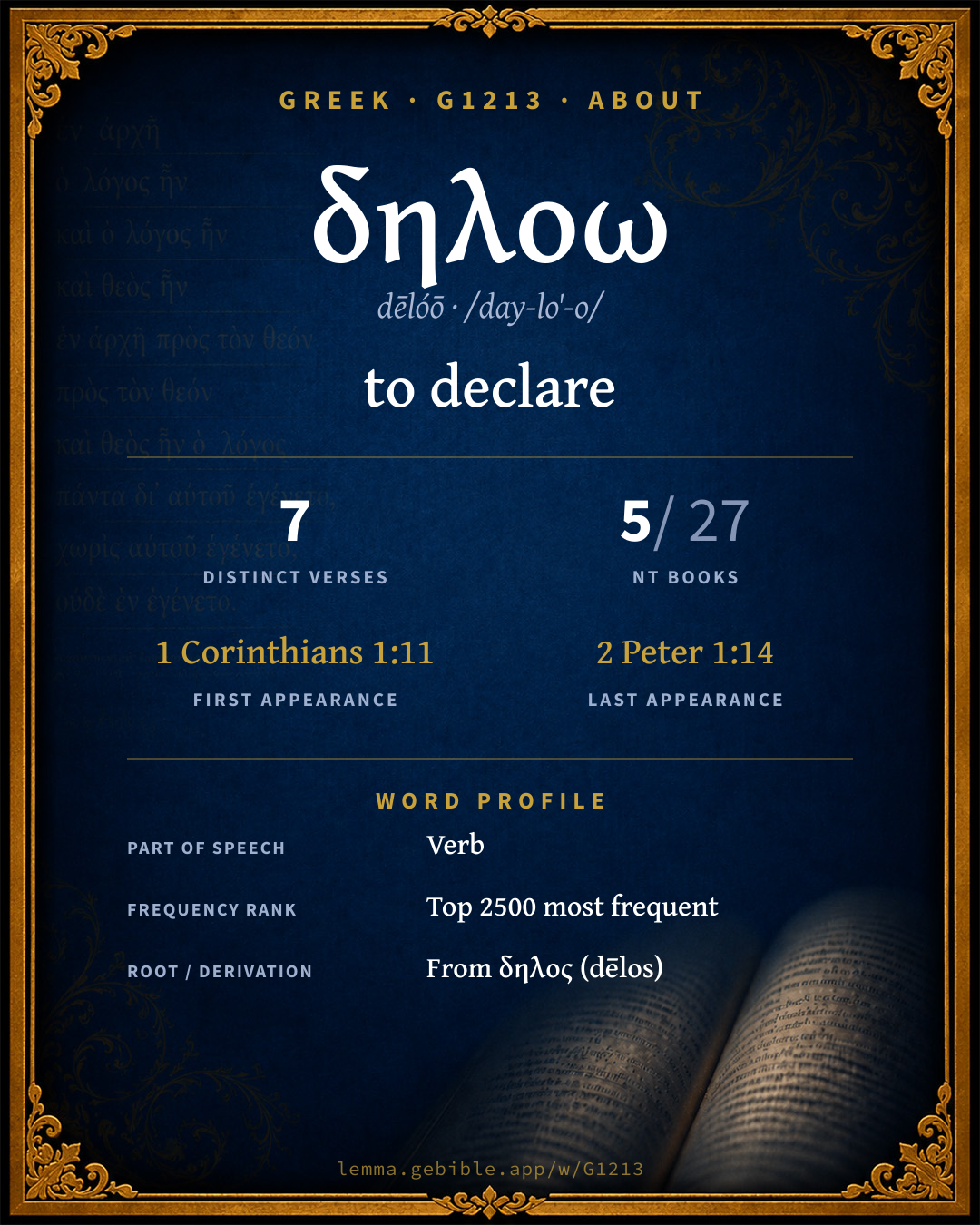
δηλόω
to declare
‘to declare’ is one of 3 main senses fuller range ↓
Full lexicon entry — Thayer's Greek Lexicon
From Thayer's Greek Lexicon
Where this word appears
See every Aorist-tense verb in the Greek New Testament →
Grammar key — what these labels mean
Part of speech
- Verb
- An action or state-of-being word.
Tense
- Aorist
- Action viewed as a simple whole, without regard to duration — often past (perfective aspect).
- Future
- Action expected in future time.
- Imperfect
- Continuous or repeated action in past time (“was writing”).
- Present
- Ongoing or general action in present time (imperfective aspect).
Voice
- Active
- The subject performs the action.
- Passive
- The subject receives the action.
Mood
- Indicative
- States a fact or asks a factual question (the mood of reality).
- Participle
- A verbal adjective (“writing,” “having written”).
Case
- Nominative
- The case of the subject (and the predicate nominative).
- Genitive
- The case of source, possession, or “of” — answers “whose / from what.”
Person
- 3rd person
- The one spoken about (“he / she / it / they”).
Gender
- Masculine
- Grammatically masculine.
- Neuter
- Grammatically neuter.
Number
- Singular
- One.
1 verse where G1213 appears in the Future tense in the Book of 1 Corinthians. Filtered view — show all forms. Click any verse to open its interlinear word-by-word view. Verse text shown in the World English Bible for context — . Each verse’s Greek form is shown with its reference; the English is not keyword-highlighted, since the data carries no word-level English alignment. Use “Compare translations” on any verse to read it across multiple English versions. This concordance covers the Greek New Testament; Septuagint (Greek Old Testament) occurrences of this word are not indexed here.
1 Corinthians
About this entry
At a glance — auto-summarized from this page’s data, not written by a person. Every figure links to its source below. This summary describes the numbers; it doesn’t interpret them.
δηλοω — transliterated dēlóō — is a Greek verb carrying the sense “to declare.” Its earliest occurrence is 1 Corinthians 1:11. It appears 7 verses across 5 books of the Greek New Testament, among its uncommon vocabulary. More than a quarter of its appearances fall in 1 Corinthians. Thayer's distinguishes 3 senses for it. Each statement above links to its evidence; the full detail follows below.
Gloss history
Strong's 1890 vs modern scholarship
About this word
Strong's G1213 catalogs a Greek word from the Greek New Testament.
These counts are not copied from any lexicon or concordance. They are computed here, from the morphology-tagged Greek New Testament. What Lemma adds →
- 7
- distinct verses
- The word appears in 7 distinct verses.
- 5 / 27
- NT books
- The word appears in 5 of 27 New Testament books.
- #1,358
- by frequency
- Top 2500 most frequent Greek words (rank 1,358 of 5,347 Greek words by occurrence).
View all 7 occurrences in the concordance →
Most concentrated in
- 1 Corinthians 2 verses 29%
- Hebrews 2 verses 29%
- Colossians 1 verse 14%
By section of the New Testament
By traditional corpus
Conventional, traditional groupings — biblical authorship is debated, so this is a traditional corpus grouping, not an authorship claim. Some books belong to more than one corpus (Luke is in both the Gospels and the Lukan corpus, and so on), so these shares overlap and need not total 100%. Each figure is a share of the word’s 7 distinct verses.
- Pauline corpus 3 verses · 43%
- Hebrews 2 verses · 29%
- General (Catholic) Epistles 2 verses · 29%
How translations render this word
Counts come from each version’s own published word-to-Strong’s tagging or interlinear alignment — an approximate guide to how each version renders this word, not a word-level alignment the data otherwise carries. Because each total is that version’s own tagged count, the per-version totals vary from one another and need not match the appearance or distinct-verse counts above. These counts may also differ from a printed concordance because Lemma counts each distinctly tagged rendering and does not collapse phrase taggings into a single head-word total. This is a fixed set of word-tagged versions (KJV, ASV, BSB, ULT) and does not change with the reading translation you choose elsewhere. Each version’s license is shown beside its name below (and on Sources).
- King James Version: Declared 1×, Did signify 1×, Hath been declared 1×
- American Standard Version: Declared 1×, Did point 1×, Hath been signified 1×
- Berean Standard Bible: Has made clear 1×, Have informed 1×, Informed 1×
- unfoldingWord Literal Text: Having made known 1×, Indicates 1×, Is making clear 1×
King James Version Public Domain
Renders G1213 across 7 tagged occurrences — most commonly:
American Standard Version Public Domain
Renders G1213 across 7 tagged occurrences — most commonly:
Berean Standard Bible Public Domain
Renders G1213 across 7 tagged occurrences — most commonly:
unfoldingWord Literal Text CC BY-SA 4.0
Renders G1213 across 9 tagged occurrences — most commonly:
Senses in Thayer's
The 3 senses Thayer's distinguishes for this word, in lexicon order (not ranked by frequency or importance). The full entry — with sub-senses — is in the Lexicon Entry tab.
- to make manifest
- to make known by relating, to declare
- to give one to understand, to indicate, signify
Word origin
Derived from δηλος (dēlos) (G1212) — clear.
From G1212 ; to make plain (by words): - declare shew signify.
— Strong’s Exhaustive Concordance (1890), public domain.
Forms in the corpus
The 7 distinct written forms G1213 takes in the Greek New Testament, most frequent first — each parse links to that tense’s occurrences in the concordance.
| Form | Parsing | Example | Uses |
|---|---|---|---|
| δηλοῖ dēloî | Verb, Present, Active, Indicative, 3rd person, Singular | Hebrews 12:27 | 1 |
| δηλοῦντος dēloûntos | Verb, Present, Active, Participle, Genitive, Singular, Neuter | Hebrews 9:8 | 1 |
| δηλώσας dēlṓsas | Verb, Aorist, Active, Participle, Nominative, Singular, Masculine | Colossians 1:8 | 1 |
| δηλώσει dēlṓsei | Verb, Future, Active, Indicative, 3rd person, Singular | 1 Corinthians 3:13 | 1 |
| ἐδήλου edḗlou | Verb, Imperfect, Active, Indicative, 3rd person, Singular | 1 Peter 1:11 | 1 |
| ἐδήλωσέν edḗlōsén | Verb, Aorist, Active, Indicative, 3rd person, Singular | 2 Peter 1:14 | 1 |
| ἐδηλώθη edēlṓthē | Verb, Aorist, Passive, Indicative, 3rd person, Singular | 1 Corinthians 1:11 | 1 |
Septuagint usage
The same Greek word δηλοω appears 28 times in the Greek Old Testament (Septuagint), across 27 verses in 11 books.
- 28
- LXX occurrences
- Tagged occurrences of this Greek word in the Septuagint.
- 27
- verses
- Distinct Septuagint verses containing this word.
- 11 / 39
- OT books
- The word appears in 11 of the 39 Old Testament books.
Sample Septuagint occurrences
- Exodus 6:3 δηλόω
- Deuteronomy 33:10 δηλόω
- Joshua 4:7 δηλόω
- 1 Samuel 3:21 δηλόω
- 1 Kings 8:36 δηλόω
- 2 Chronicles 6:27 δηλόω
- Esther 2:22 δηλόω
- Psalms 24:14 δηλόω
- Isaiah 42:9 δηλόω
- Jeremiah 16:21 δηλόω
- Daniel 2:5 δηλόω
Septuagint occurrences (same lexeme)
Every verse where the same Strong’s number (G1213) appears in the Greek Septuagint. Verse text shown in the World English Bible for context; the Greek form is the matched word — the English is not keyword-highlighted.
- Exodus 6:3 δηλόω and I appeared to Abraham, to Isaac, and to Jacob, as God Almighty; but by my name Yahweh I was not known to them.
- Exodus 33:12 δηλόω Moses said to Yahweh, "Behold, you tell me, 'Bring up this people:' and you haven't let me know whom you will send with me. Yet you have said, 'I know you by name, and you have also found favor in my sight.'
- Deuteronomy 33:10 δηλόω They shall teach Jacob your ordinances, Israel your law: They shall put incense before you, Whole burnt offering on your altar.
- Joshua 4:7 δηλόω then you shall tell them, Because the waters of the Jordan were cut off before the ark of the covenant of Yahweh; when it passed over the Jordan, the waters of the Jordan were cut off: and these stones shall be for a memorial to the children of Israel forever.
- 1 Samuel 3:21 δηλόω Yahweh appeared again in Shiloh; for Yahweh revealed himself to Samuel in Shiloh by the word of Yahweh.
- 1 Kings 8:36 δηλόω then hear in heaven, and forgive the sin of your servants, and of your people Israel, when you teach them the good way in which they should walk; and send rain on your land, which you have given to your people for an inheritance.
- 2 Chronicles 6:27 δηλόω then hear in heaven, and forgive the sin of your servants, and of your people Israel, when you teach them the good way in which they should walk; and send rain on your land, which you have given to your people for an inheritance.
- Esther 2:22 δηλόω The thing became known to Mordecai, who shown it to Esther the queen; and Esther told the king [of it] in Mordecai's name.
- Psalms 24:14 δηλόω
- Psalms 50:8 δηλόω I don't rebuke you for your sacrifices. Your burnt offerings are continually before me.
- Psalms 147:9 δηλόω He provides food for the cattle, And for the young ravens when they call.
- Isaiah 42:9 δηλόω Behold, the former things have happened, and new things do I declare. Before they spring forth I tell you of them.
- Jeremiah 16:21 δηλόω Therefore, behold, I will cause them to know, this once will I cause them to know my hand and my might; and they shall know that my name is Yahweh.
- Daniel 2:5 δηλόω The king answered the Chaldeans, The thing is gone from me: if you don't make known to me the dream and the interpretation of it, you shall be cut in pieces, and your houses shall be made a dunghill.
- Daniel 2:6 δηλόω But if you show the dream and the interpretation of it, you shall receive of me gifts and rewards and great honor: therefore show me the dream and the interpretation of it.
- Daniel 2:9 δηλόω But if you don't make known to me the dream, there is but one law for you; for you have prepared lying and corrupt words to speak before me, until the time be changed: therefore tell me the dream, and I shall know that you can show me the interpretation of it.
- Daniel 2:11 δηλόω It is a rare thing that the king requires, and there is no other who can show it before the king, except the gods, whose dwelling is not with flesh.
- Daniel 2:16 δηλόω Daniel went in, and desired of the king that he would appoint him a time, and he would show the king the interpretation.
- Daniel 2:23 δηλόω I thank you, and praise you, you God of my fathers, who have given me wisdom and might, and have now made known to me what we desired of you; for you have made known to us the king's matter.
- Daniel 2:24 δηλόω Therefore Daniel went in to Arioch, whom the king had appointed to destroy the wise men of Babylon; he went and said thus to him: Don't destroy the wise men of Babylon; bring me in before the king, and I will show to the king the interpretation.
- Daniel 2:25 δηλόω Then Arioch brought in Daniel before the king in haste, and said thus to him, I have found a man of the children of the captivity of Judah, who will make known to the king the interpretation.
- Daniel 2:26 δηλόω The king answered Daniel, whose name was Belteshazzar, Are you able to make known to me the dream which I have seen, and the interpretation of it?
- Daniel 2:28 δηλόω but there is a God in heaven who reveals secrets, and he has made known to the king Nebuchadnezzar what shall be in the latter days. Your dream, and the visions of your head on your bed, are these:
- Daniel 2:29 δηλόω as for you, O king, your thoughts came [into your mind] on your bed, what should happen hereafter; and he who reveals secrets has made known to you what shall happen.
- Daniel 2:30 δηλόω But as for me, this secret is not revealed to me for any wisdom that I have more than any living, but to the intent that the interpretation may be made known to the king, and that you may know the thoughts of your heart.
- Daniel 2:47 δηλόω The king answered to Daniel, and said, Of a truth your God is the God of gods, and the Lord of kings, and a revealer of secrets, seeing you have been able to reveal this secret.
- Daniel 7:16 δηλόω I came near to one of those who stood by, and asked him the truth concerning all this. So he told me, and made me know the interpretation of the things.
These are occurrences of the same Greek lexeme (G1213) in the Septuagint — not a translation of any one Hebrew word. The store carries no word-level Hebrew↔Greek alignment, so no Hebrew original is asserted here. Counts come from the recovered LXX Strong's tagging — high-frequency vocabulary is well covered, while rare or late forms may be untagged — so they reflect tagged occurrences and may slightly undercount.