
2 Peter 1:14

Greek (Tischendorf 8th ed.) 2 Peter 1:14 appears in the Greek New Testament. The text above is from the Tischendorf 8th edition. Each word links to its Strong’s number and a concise gloss. Click any word for its full Thayer’s Greek Lexicon entry.
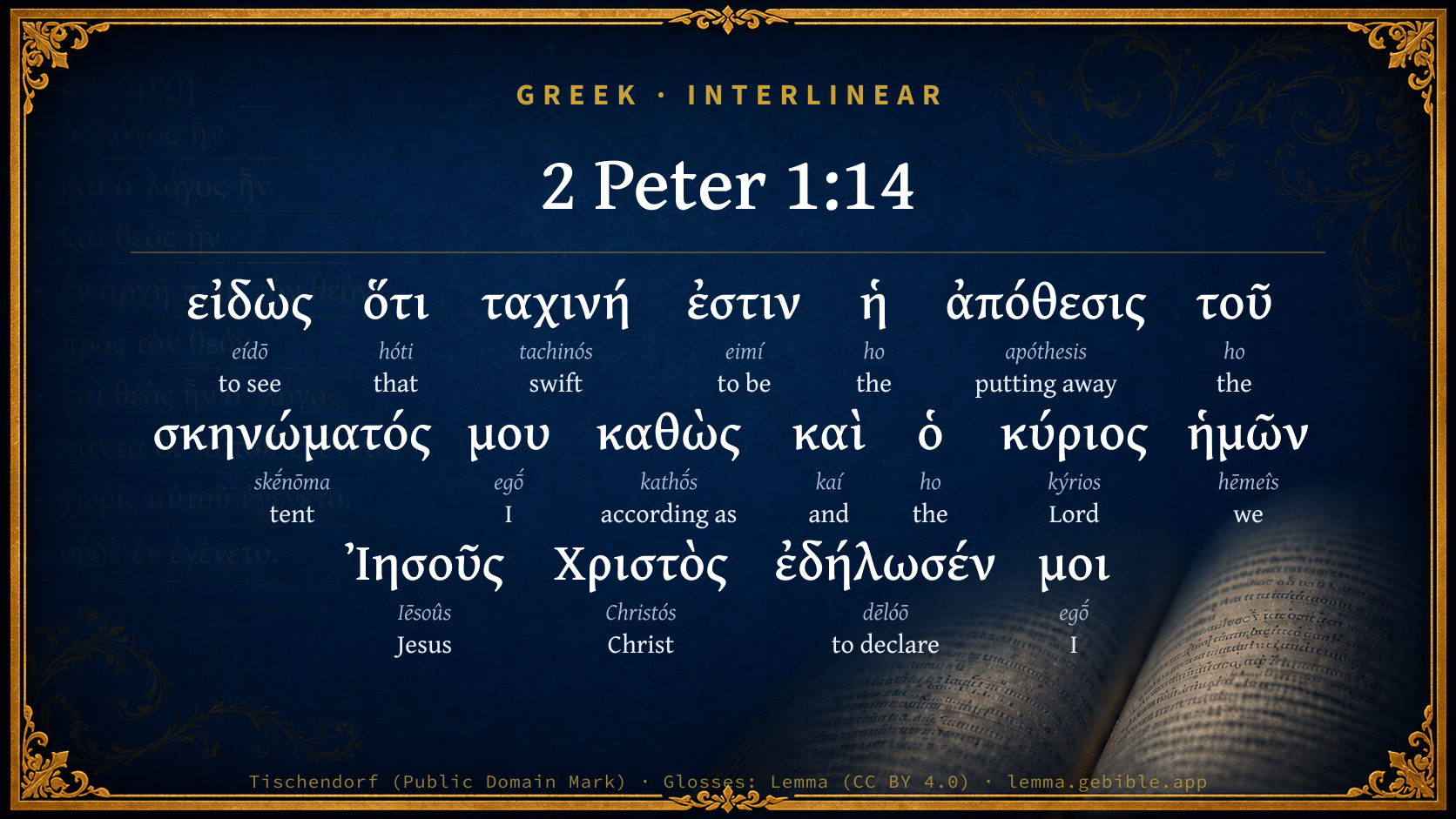
Download image
Cite this verse

2 Peter 1:14 (World English Bible). Public Domain. Lemma interlinear Bible study tool, https://lemma.gebible.app/v/2-peter/1/14.

Show BibTeX & RIS
BibTeX
RIS
English Translation
knowing that the putting off of my tent comes swiftly, even as our Lord Jesus Christ made clear to me.
World English Bible · Public Domain
Highlights
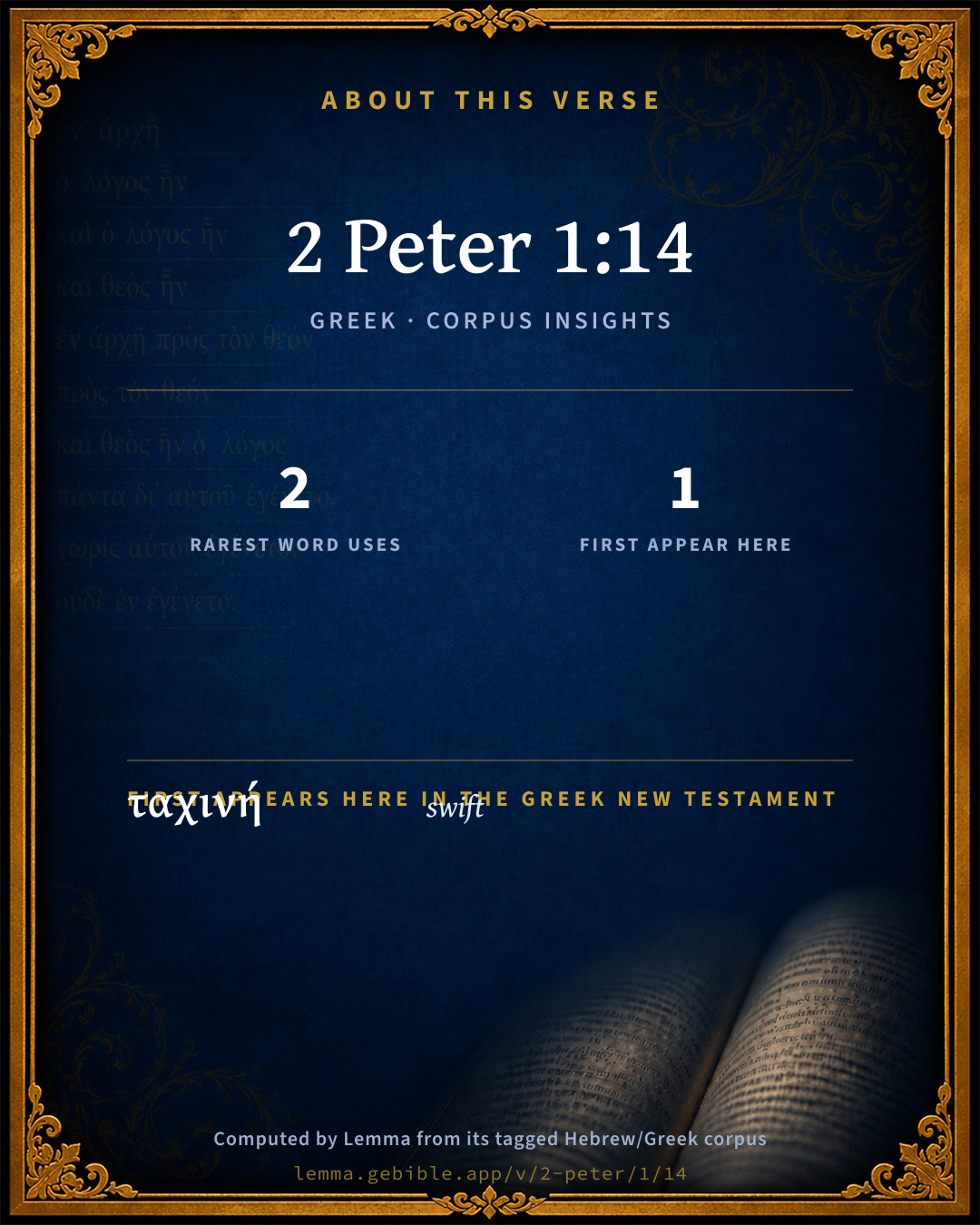
  • 1 first appearance in the Greek New Testament
Full analysis ↓
Download a study sheet

One document with this verse’s original text, its word-by-word gloss line, the meaning frame, cross-references with their text, attributed commentary, and full source and license credits — printable, and it pastes into notes with its structure intact.

This verse Autodidact and up

Study sheet (.html) Plain text (.txt)

A passage Seminary Student

Up to 50 verses in one chapter. A passage sheet keeps up to 6 commentary sources and 12 cross-references per verse, in the order this page ranks them, and says so on the sheet whenever that leaves anything out. Ask for a single verse and you get the Autodidact verse sheet above.

Everything on this page stays free to read, with no account — the sheet is a download of what is already on screen, not access to it.

Want to remove ads? Support Godless Engineer
Compare translations 3

The same verse in 3 English versions, stacked beneath the original-language interlinear above. Click any original word for its lexicon entry.

Each is an independent rendering of the whole verse — the interlinear is not word-aligned to these translations.

Highlighted words mark where these versions differ — a whole-verse word diff, not a word-by-word alignment.

  • World English Bible Public Domain
    knowing that the putting off of my tent comes swiftly, even as our Lord Jesus Christ made clear to me.
  • King James Version Public Domain
    Knowing that shortly I must put off this my tabernacle, even as our Lord Jesus Christ hath shewed me.
  • unfoldingWord Literal Text CC BY-SA 4.0
    knowing that the putting off of my tent is imminent, just as also our Lord Jesus Christ revealed this to me.

unfoldingWord Literal Text — © unfoldingWord, licensed CC BY-SA 4.0. Word-aligned USFM3 via Door43 (git.door43.org/unfoldingWord/en_ult).

Versions to compare (up to 4)

3 of 4 selected

Show all 19 translations

Every available English version of this verse, each an independent rendering of the whole verse.

  • World English Bible Public Domain
    knowing that the putting off of my tent comes swiftly, even as our Lord Jesus Christ made clear to me.
  • Berean Standard Bible Public Domain
    because I know that this tent will soon be laid aside, as our Lord Jesus Christ has made clear to me.
  • Majority Standard Bible Public Domain
    because I know that this tent will soon be laid aside, as our Lord Jesus Christ has made clear to me.
  • King James Version Public Domain
    Knowing that shortly I must put off this my tabernacle, even as our Lord Jesus Christ hath shewed me.
  • American Standard Version (1901) Public Domain
    knowing that the putting off of my tabernacle cometh swiftly, even as our Lord Jesus Christ signified unto me.
  • Revised Version (1885) Public Domain
    knowing that the putting off of my tabernacle cometh swiftly, even as our Lord Jesus Christ signified unto me.
  • Geneva Bible (1599) Public Domain
    Seeing I knowe that the time is at hand that I must lay downe this my tabernacle, euen as our Lord Iesus Christ hath shewed me.
  • Douay-Rheims (1899) Public Domain
    Being assured that the laying away of this my tabernacle is at hand, according as our Lord Jesus Christ also hath signified to me.
  • Young's Literal Translation Public Domain
    having known that soon is the laying aside of my tabernacle, even as also our Lord Jesus Christ did shew to me,
  • Literal Standard Version CC BY-SA 4.0
    having known that the laying aside of my tent is soon, even as our Lord Jesus Christ also showed to me.
  • Unlocked Literal Bible CC BY-SA 4.0
    For I know that the putting off of my tent will be soon, because our Lord Jesus Christ has revealed this to me.
  • unfoldingWord Literal Text CC BY-SA 4.0
    knowing that the putting off of my tent is imminent, just as also our Lord Jesus Christ revealed this to me.
  • Darby Bible Public Domain
    knowing that the putting off of my tabernacle is speedily [to take place], as also our Lord Jesus Christ has manifested to me;
  • World Messianic Bible Public Domain
    knowing that the putting off of my tent comes swiftly, even as our Lord Yeshua the Messiah made clear to me.
  • Webster's Bible Public Domain
    Knowing that shortly I must put off this my tabernacle, even as our Lord Jesus Christ hath shown me.
  • Free Bible Version CC BY-SA 4.0
    I know the time when I shall leave this life will be coming soon— our Lord Jesus Christ has made this clear to me.
  • Bible in Basic English Public Domain
    For I am conscious that in a short time I will have to put off this tent of flesh, as our Lord Jesus Christ has made clear to me.
  • Text-Critical English NT CC BY 4.0
    because I know that this tent will soon be laid aside, as our Lord Jesus Christ made clear to me.
  • Tyndale New Testament (1534) Public Domain
    for as moch as I am sure howe that the tyme is at honde that I must put of my tabernacle even as oure lorde Iesus Christ hath shewed me.

Literal Standard Version (2020), Covenant Press — licensed CC BY-SA 4.0. Text via the HelloAO Bible API (eBible.org). Unlocked Literal Bible (unfoldingWord) — licensed CC BY-SA 4.0. Text via the HelloAO Bible API (eBible.org). unfoldingWord Literal Text — © unfoldingWord, licensed CC BY-SA 4.0. Word-aligned USFM3 via Door43 (git.door43.org/unfoldingWord/en_ult). Free Bible Version, Dr. Jonathan Gallagher — licensed CC BY-SA 4.0. Text via the HelloAO Bible API (eBible.org).

Word by word

More ways to search: Search by grammar → Find every occurrence → Compare this word →

Practice this passage: Drill this verse → Learn its vocabulary →

ταχινή
tachinós
G5031
“swift”
Adjective, Nominative, Singular, Feminine
Part of Speech
Adjective
Case
Nominative
Number
Singular
Gender
Feminine
Full Thayer's Definition

Origin: from G5034

TDNT: None

1. swift, quick
  1. εἰδὼς eídō G1492 “to see” Verb, Perfect, Active, Participle, Nominative, Singular, Masculine
  2. ὅτι hóti G3754 “that” Conjunction
  3. ἐστιν eimí G1510 “to be” Verb, Present, Active, Indicative, 3rd person, Singular
  4. ἡ ho G3588 “the” Article, Nominative, Singular, Feminine
  5. ἀπόθεσις apóthesis G595 “putting away” Noun, Nominative, Singular, Feminine
  6. τοῦ ho G3588 “the” Article, Genitive, Singular, Neuter
  7. σκηνώματός skḗnōma G4638 “tent” Noun, Genitive, Singular, Neuter
  8. μου egṓ G1473 “I” Personal pronoun, 1st person, Genitive, Singular
  9. καθὼς kathṓs G2531 “according as” Adverb
  10. καὶ kaí G2532 “and” Conjunction
  11. ὁ ho G3588 “the” Article, Nominative, Singular, Masculine
  12. κύριος kýrios G2962 “Lord” Noun, Nominative, Singular, Masculine
  13. ἡμῶν hēmeîs G2249 “we” Personal pronoun, 1st person, Genitive, Plural
  14. Ἰησοῦς Iēsoûs G2424 “Jesus” Noun, Nominative, Singular, Masculine
  15. Χριστὸς Christós G5547 “Christ” Noun, Nominative, Singular, Masculine
  16. ἐδήλωσέν dēlóō G1213 “to declare” Verb, Aorist, Active, Indicative, 3rd person, Singular
  17. μοι egṓ G1473 “I” Personal pronoun, 1st person, Dative, Singular

About this verse

These counts appear in no published source. They are computed here, from the morphology-tagged text and Lemma’s own curated glosses. What Lemma adds →

18
words
15
distinct lemmas
General Epistles
section

Notable vocabulary

The rarest word here is ταχινή swift G5031 — appearing just 2 times in the whole Greek New Testament.

First appearance in Scripture

This word makes its first canonical appearance in the Greek New Testament here:

  • ταχινή swift G5031

Shared distinctive vocabulary

ταχινή swift G5031 occurs in 2 verses of the Greek New Testament. Also found in:
Repetition

Words recur within this verse:

Cross-references

7

Topical passages linked to 2 Peter 1:14 in the Treasury of Scripture Knowledge — connected by theme and wording, ordered by reader-vote popularity; previews shown in the World English Bible.

  • 2 Timothy 4:6 For I am already being offered, and the time of my departure has come.
  • John 21:18–19 Most assuredly I tell you, when you were young, you dressed yourself, and walked where you wanted to. But when you are old, you will stretch out your hands, and another will dress you, and carry you where you don't want to go."
  • Deuteronomy 4:21–22 Furthermore Yahweh was angry with me for your sakes, and swore that I should not go over the Jordan, and that I should not go in to that good land, which Yahweh your God gives you for an inheritance:
  • Deuteronomy 31:14 Yahweh said to Moses, Behold, your days approach that you must die: call Joshua, and present yourselves in the tent of meeting, that I may give him a charge. Moses and Joshua went, and presented themselves in the tent of meeting.
  • Joshua 23:14 Behold, this day I am going the way of all the earth: and you know in all your hearts and in all your souls, that not one thing has failed of all the good things which Yahweh your God spoke concerning you; all are happen to you, not one thing has failed of it.
  • 1 Kings 2:2–3 I am going the way of all the earth: be you strong therefore, and show yourself a man;
  • Acts 20:25 Now, behold, I know that you all, among whom I went about preaching the Kingdom of God, will see my face no more.

Cross-references courtesy of OpenBible.info (CC BY 4.0).

Commentary

Notes on 2 Peter 1:14 from classic Christian and Jewish commentators (each source and its license shown beneath its notes). The classic Christian expositions comment on the surrounding passage and are grouped to its opening verse, so a note may address several verses; the Jewish commentaries on the Tanakh (Rashi and others) are per-verse, so they appear only where the commentator wrote on this verse.

Lemma curates 59 commentaries, every one of them public domain or Creative Commons licensed, each selected and text-cleaned for this edition rather than reprinted as found. About our sources →

Tyndale Open Study Notes

Tyndale Open Resources

1:14 This prophecy might have come in a vision, but it is more likely that Peter was recalling Jesus’ prophecy about his death (John 21:18-19).

Tyndale Open Study Notes — © Tyndale Open Resources, licensed CC BY-SA 4.0. Text via the HelloAO Bible API.

Bengel's Gnomon

Johann Albrecht Bengel

2Pe 1:14. Ταχινή ἐστιν) is sudden. The present. They who are for a long time sick, are able as yet to feed others. The cross was not about to permit that to Peter. Therefore he first does that which he has to do.—ἀπόθεσις, the laying aside) A violent process, but still wished for. Thus departure, 2Pe 1:15.—ἐδήλωσε, hath disclosed or showed) He had long ago showed this; Joh 21:18-19, When thou shalt be old. The “old age” of Peter was now close at hand. It is possible that some other indication had afterwards been given him.

Bengel's Gnomon of the New Testament — English translation (T&T Clark, Edinburgh, 1860) — public domain. Text from a community e-Sword module.

Expositor's Greek Testament

ed. W. Robertson Nicoll

2Pe 1:14 . ταχινή “imminent,” cf. 2Pe 2:1 . A poetical word peculiar to 2 Peter in N.T. The process described by ἀπόθεσις can hardly be “sudden,” Plat. Rep. 553 D , but there is always an impression of suddenness to the onlooker, who lifts up his eyes some morning, and finds the tent or the encampment gone where he had seen it yesterday. An inscription in C.I.A. III. 1344 3 , reads ζωῆς καὶ καμάτου τέρμα δραμὼν ταχινόν , where sense can only be “brief” (but see discussion in Zahn. Introd. , ii., pp. 212 f.). ἀπόθεσιν τοῦ σκην . ἀποτίθεμαι is used of “putting off a garment” (Act 7:58 ); and might here be connected with the idea of taking off a tent-cover (So Spitta). Probably “removal” is the proper translation. In B.G.U. 606 (4. A.D.) [ πρὸς ἀ ] πόθεσιν ἀχύρου (for removal of a chaff-heap) is found. cf. 1Pe 3:21 , οὐ σαρκὸς ἀπόθεσις ῥύπου . καθὼς καὶ .… ἐδήλωσέν μοι . There seems no reason to doubt the reference here to Joh 21:18-19 , as Spitta and others have done (see Introduction, pp. 96 f.).

The Expositor's Greek Testament, edited by W. Robertson Nicoll (1897–1910) — public domain. Text from a community e-Sword module.

Jamieson, Fausset & Brown

Robert Jamieson, A. R. Fausset & David Brown

shortly I must put off--Greek, "the putting off (as a garment) of my tabernacle is speedy": implying a soon approaching, and also a sudden death (as a violent death is). Christ's words, Joh 21:18-19, "When thou art old," &c., were the ground of his "knowing," now that he was old, that his foretold martyrdom was near. Compare as to Paul, Ti2 4:6. Though a violent death, he calls it a "departure" (Greek for "decease," Pe2 1:15), compare Act 7:60.

Jamieson, Fausset & Brown — Commentary Critical and Explanatory on the Whole Bible (1871) — public domain (CC PDM 1.0). Text via the HelloAO Bible API.

Adam Clarke's Commentary

Verse 14. Knowing that shortly I must put off] St. Peter plainly refers to the conversation between our Lord and himself, related Joh 21:18; Joh 21:19. And it is likely that he had now a particular intimation that he was shortly to seal the truth with his blood. But as our Lord told him that his death would take place when he should be old, being aged now he might on this ground fairly suppose that his departure was at hand.

Adam Clarke's Commentary on the Bible (1810–1826) — public domain. Text from a community e-Sword/MySword module.

John Calvin's Commentaries

14 I must put off this my tabernacle. Literally the words are, “Short is the putting; away of this tabernacle.” By this mode of speaking, and afterwards by the word “departing,” he designates death, which it behooves us to notice; for we are here taught how much death differs from perdition. Besides, too much dread of death terrifies us, because we do not sufficiently consider how fading and evanescent this life is, and do not reflect on the perpetuity of future life. But what does Peter say? He declares that death is departing from this world, that we may remove elsewhere, even to the Lord. It ought not, then, to be dreadful to us, as though we were to perish when we die. He declares that it is the putting away of a tabernacle, by which we are covered only for a short time. There is, then, no reason why we should regret to be removed from it.

But there is to be understood an implied contrast between a fading tabernacle and a perpetual habitation, which Paul explains in 2 Corinthians 5:1.

When he says that it had been revealed to him by Christ, he refers not to the kind of death, but to the time. But if he received the oracle at Babylon respecting his death being near, how was he crucified at Rome? It certainly appears that he died very far from Italy, except he flew in a moment over seas and lands. But the Papists, in order to claim for themselves the body of Peter, make themselves Babylonians, and say that Rome is called Babylon by Peter: this shall be refuted in its proper place. What he says of remembering these things after his death, was intended to shew, that posterity ought to learn from him when dead. For the apostles had not regard only for their own age, but purposed to do us good also. Though, then, they are dead, their doctrine lives and prevails: and it is our duty to profit by their writings, as though they were manifestly present with. us.

John Calvin's Commentaries (1540-1563) — public domain. Text from the Calvin Translation Society English edition (1840s-50s) via the Christian Classics Ethereal Library (ccel.org). Calvin's coverage is partial (roughly two-thirds of the Bible); uncommented books and verses are honest gaps, never fabricated. The 19th-century editor's footnotes and remarks are omitted so the notes are faithfully Calvin's own voice.

Ellicott's Commentary for English Readers

(14) Knowing that shortly I must put off this my tabernacle.—This is rather wide of the mark. Among English versions Wiclif alone is right. The meaning is, Knowing as I do that the putting off of my tabernacle will be done swiftly (comp. 2Pe_2:1)—i.e., will soon be over when it once begins. The point is not that the writer believes himself to be near his end, but that his end would be such as to allow of no deathbed exhortations; what he has to say must be said in good time, for Christ had told him that his death would be a violent one (Joh_21:18). Some of those who have taken the passage in the sense of the Authorised version have supposed a special revelation to be implied in the last half of the verse. But without any revelation an old man might know that his end must soon come; and Christ had already told him that it should come when he began to be old. “The putting off of my tabernacle” involves rather a mixture of metaphors; we have a similar mixture in Col_2:11. The word for “putting off” occurs nowhere but here and 1Pe_3:21; but the coincidence is not one on which much stress can be laid.

Hath shewed me.—More strictly, shewed me. The substitution of perfect for aorist is here objectionable, as it obscures the reference to a definite moment in the Apostle’s life. If the reference were to Joh_21:18, this would be at once fatal to the authenticity of our Epistle; for of course no part of St. John’s Gospel, and least of all the last chapter, was written during the life of St. Peter. But if the reference be to the event narrated in Joh_21:18, then that narrative confirms what is said here, this being a prior and independent allusion to the same occurrence. In this case we have strong evidence of the authenticity of St. Peter.

A Bible Commentary for English Readers, edited by Charles John Ellicott (1878–1897) — public domain. Text from a community e-Sword module.

The Cambridge Bible for Schools and Colleges

gen. ed. J. J. S. Perowne

14. knowing that shortly I must put off this my tabernacle] Better, knowing that swift will be the putting off of my tabernacle. He speaks not so much of the nearness of his death, as of the suddenness with which it would come upon him, and he is therefore anxious to make all necessary preparations for it. In the word for “putting off” we have, as in 2Co_5:1-3, a blending of the two closely connected ideas of a tent and a garment. Comp. a like association of ideas in Psa_104:2.

even as our Lord Jesus Christ hath shewed me] Better, shewed me, the aorist pointing to some time definitely present to his mind. The only extant record of any such intimation in the Gospels is that in Joh_21:18-19, and, assuming the genuineness of this Epistle, it is obvious that it supplies an interesting testimony to the truth of that narrative. It will be remembered that we have already seen an interesting allusive reference to it in 1Pe_5:2. Even on the other hypothesis it is, at least, evidence of the early date of a tradition corresponding to that which St John has recorded.

The Cambridge Bible for Schools and Colleges (gen. ed. J. J. S. Perowne; Cambridge University Press, 1878–1918) — public domain. Text from a community e-Sword module.

John Gill's Exposition

Knowing that shortly I must put off this my tabernacle,.... Which is another reason why the apostle was so pressing in this case, and so much urged the exhortation, and was so diligent in reminding the saints of it, and stirring them to observe it, because he knew he had but a little time to live, and which therefore he was willing to improve for their good. He sets forth his death in a very easy and familiar way, it being not at all terrible and distressing to him; it was but like the putting off of a garment, or unpinning of a tabernacle, or a removing from a tent to a palace. Saints are pilgrims here, they dwell in tents or tabernacles, at death they remove to their own country, and Father's house. Death is not a destruction of man, an annihilation of him, neither of his soul nor body: the soul is not mortal, it dies not with the body; it only removes from this world to another, from a cottage to a kingdom; and the body though it dies, it is not reduced to nothing, it is only like a tabernacle put off, or taken down, which will be put together again in better order than now it is.

Even as our Lord Jesus hath showed me; by some special revelation lately made to him; or by some strong impulse upon his mind; just as the Apostle Paul knew that the time of his departure was at hand, Ti2 4:7 or this may have respect to the words of Christ to Peter, above thirty years before, in Joh 21:18, which both signified what kind of death he should die, and when it should be; namely, when he was old, as now he was.

John Gill's Exposition of the Whole Bible (1746–1763) — public domain (CC PDM 1.0). Text via the HelloAO Bible API.

Trapp's Complete Commentary

John Trapp

14 Knowing that shortly I must put off this my tabernacle, even as our Lord Jesus Christ hath shewed me.

Ver. 14. I must put off] {See Trapp on "2Co 5:1"} What is this life, but a spot of time between two eternities? Our tents shall he taken down.

John Trapp, A Commentary or Exposition upon All the Books of the Old and New Testament (1647–1656) — public domain. Text from a community e-Sword module.

Albert Barnes' Notes on the Bible

Knowing that shortly I must put off this my tabernacle - That I must die. This he knew, probably, because he was growing old, and was reaching the outer period of human life. It does not appear that he had any express revelation on the point.

Even as our Lord Jesus Christ hath shewed me - See the notes at Joh 21:18-19. This does not mean that he had any new revelation on the subject, showing him that he was soon to die, as many of the ancients supposed; but the idea is, that the time drew near when he was to die “in the manner” in which the Saviour had told him that he would. He had said Joh 21:18 that this would occur when he should be “old,” and as he was now becoming old, he felt that the predicted event was drawing near. Many years had now elapsed since this remarkable prophecy was uttered. It would seem that Peter had never doubted the truth of it, and during all that time he had had before him the distinct assurance that he must die by violence; by having “his hands stretched forth;” and by being conveyed by force to some place of death to which he would not of himself go Joh 21:18, but, though the prospect of such a death must have been painful, he never turned away from it; never sought to abandon his Master’s cause; and never doubted that it would be so.

This is one of the few instances that have occurred in the world, where a man knew distinctly, long beforehand, what would be the manner of his own death, and where he could have it constantly in his eye. we cannot foresee this in regard to ourselves, but we may learn to feel that death is not far distant, and may accustom ourselves to think upon it in whatever manner it may come upon us, as Peter did, and endeavor to prepare for it. Peter would naturally seek to prepare himself for death in the particular form in which he knew it would occur to him; we should prepare for it in whatever way it may occur to us. The subject of crucifixion would be one of special interest to him; to us death itself should be the subject of unusual interest - the manner is to be left to God. Whatever may be the signs of its approach, whether sickness or grey hairs, we should meditate much upon an event so solemn to us; and as these indications thicken we should be more diligent, as Peter was, in doing the work that God has given us to do. Our days, like the fabled Sybil’s leaves, become more valuable as they are diminished in number; and as the inevitable hour draws nearer to us, we should labor more diligently in our Master’s cause, gird our loins more closely, and trim our lamps. Peter thought of the cross, for it was such a death that he was led to anticipate. Let us think of the bed of languishing on which we may die, or of the blow that may strike us suddenly down in the midst of our way, calling us without a moment’s warning into the presence of our Judge.

Albert Barnes' Notes on the Bible (1834–1885) — public domain. Text from a community e-Sword/MySword module.

Haydock's Catholic Bible Commentary

The laying aside,[4] or dissolution; i.e. my death is at hand. (Witham)

===============================

[BIBLIOGRAPHY]

Depositio, Greek: e apothesis.

George Leo Haydock (1774–1849), Haydock's Catholic Family Bible and Commentary, 1859 edition — public domain. Excludes Psalms (Douay-Rheims chapter numbering differs from Protestant) and Deuterocanonical books (Catholic canon only).

Matthew Poole's English Annotations

I must put off; a metaphor taken from garments; the soul, while in the body, is clothed with flesh, and death to the godly is but the putting off their clothes, and going to bed, Isa 57:2.

This my tabernacle: see 2Co 5:1.

Even as our Lord Jesus Christ hath showed me: Joh 21:18,19, Christ tells Peter of the kind of his death, that it should be violent, but speaks nothing there of the circumstance of the time; and therefore either this apostle had a twofold revelation of his death, the former as to the manner of it, and this latter concerning the time; or, if this here were no other but that, Joh 21:1-25, it may be said, that, Joh 21:18,22 Christ intimates that Peter’s death should be before John’s, who should live till he came, viz. in judgment against Jerusalem to destroy it, which Peter now (observing the affairs of the Jews, and considering his Master’s words, Mat 24:1-51) perceived to be nigh at hand; and thence infers, that his own death was not far off.

Matthew Poole's English Annotations on the Holy Bible (1683–1685) — public domain. Text from a community e-Sword/MySword module.

Whedon's Commentary on the Bible

Daniel D. Whedon

14. Knowing—The Lord Jesus had said to him, pointing to his death by martyrdom, “When thou shalt be old, thou shalt stretch forth thy hands, and another shall gird thee, and carry thee whither thou wouldest not.” Joh_21:18. He was now become old, and well knew that the end could not be far distant. It is not needful to suppose, as do some, that he had received a recent revelation of his death as near.

Shortly—Quickly, swiftly, rather than soon. Whenever the departure might come, it would be sudden and rapid. Calmly does the apostle speak of the putting off of my tabernacle, as if it were a garment, leaving the inner man, the soul, living and untrammelled.

Daniel D. Whedon (gen. ed.), Commentary on the Old and New Testaments (1874–1909) — public domain. Text from a community e-Sword module.

The Pulpit Commentary

Knowing that shortly I must put off this my tabernacle; literally, knowing that swift is the putting off of my tabernacle. St. Peter may mean by these words either that his death was near at hand, or that, when it came, it would be sudden, a violent death, not a lengthened illness. So Bengel, "Qui diu aegrotant, possunt altos adhuc pascere. Crux id Petro non erat permisura. Ideo prius agit quod agendum est." Compare the use of the same word (tacinh) in 2Pe_2:1. St. Paul, in 2Co_5:1-4, speaks, like St. Peter here, of putting off a tabernacle or tent as we talk of putting off a garment. Alford quotes Josephus, "Ant.," 4:8. 2, where Moses says, "Since I must depart from life, I have thought it right not even now to lay aside my zeal for your happiness." The word used here for "putting off" (ajpoqesiv) is one of the links between the two Epistles; it occurs also in 1Pe_3:21. Even as our Lord Jesus Christ hath showed me; better, as in the Revised Version, signified unto me. The aorist points to a definite time. St. Peter is thinking of our Lord"s prophecy, which St. John afterwards recorded; (Joh_21:18) he could never forget that touching interview; he had already referred to it once in 1Pe_5:2.

The Pulpit Commentary (1880–1919), ed. H.D.M. Spence-Jones & Joseph S. Exell — public domain. Text from a community e-Sword module.

John Wesley's Explanatory Notes

Even as the Lord Jesus showed me - In the manner which had foretold, John xxi, 18, &c. It is not improbable, he had also showed him that the time was now drawing nigh.

John Wesley, Explanatory Notes Upon the Whole Bible (1754–1765) — public domain. Text via the GEBible commentary corpus.

The People's New Testament

B. W. Johnson

14. Knowing that shortly I must put off, etc. Must die very soon. Even as our Lord Jesus Christ hath showed me. Christ had predicted his death as a martyr (John 21:18, 19). It is to this prediction that Peter refers.

B. W. Johnson's The People's New Testament with Notes (1889–1891) — public domain. Electronic text from the Christian Classics Ethereal Library (CCEL) ThML edition.

Alford’s Greek Testament

Henry Alford

14.] knowing (as I do: reason for δίκαιον ἡγοῦμαι above) that rapid is (see below. ἔστιν, of that which is to be: the normal present) the putting off (the two figures, of a tabernacle or tent, and a garment, are intermingled, as in 2Co 5:1 ff.) of my tabernacle, even as our Lord Jesus Christ declared to me (the allusion is to Joh 21:18 ff., where a swift and sharp death is announced to St. Peter by our risen Lord. And the sentence does not mean to say, as commonly understood, that he must soon put off his tabernacle, but that the putting off, whenever it did come, would be sudden and quick; so vulg: “certus quod velox est depositio tabernaculi mei” (which can hardly be interpreted with Estius, “id est, brevi futura est”): so Bengel, “repentina est; præsens. Qui diu ægrotant, possunt alios adhuc pascere. Crux id Petro non erat permissura. Ideo prius agit quod agendum est.” So Eur. Hippol. 1044, ταχὺς γὰρ ᾅδης ῥᾷστος ἀνδρὶ δυστυχεῖ: Soph. Ajax 833, σὺν ἀσφαδάστῳ καὶ ταχεῖ πηδήματι πλευρὰν διαῤῥήξαντα: Mosch. iii. 26, σεῖο, Βίων, ἔκλαυσε ταχὺν μόρον αὐτὸς Ἀπόλλων. Missing this point, some have imagined that some other special revelation to St. Peter is implied: and such revelations are related by Hegesippus de excid. Hierosol. iii. 2, Ambros. Sermo de bas. trad. Ep. 21 (32), vol. iii., p. 867: see especially Corn.a-Lapide h. l. But even if ταχινή be understood ‘soon,’ ‘not far off,’ no such inference need be drawn. For it might well be that advancing old age might lead the Apostle to the conclusion that the end prophesied to him ὅταν γηράσῃς could not be far off. The Commentators quote Jos. Antt. iv. 8. 2, where Moses says, ἐπεὶ … δεῖ με τοῦ ζῇν ἀπελθεῖν.… δίκαιον ἡγησάμην μηδὲ νῦν ἐγκαταλιπεῖν τὸ ἐμὸν ὑπὲρ τῆς ὑμετέρας εὐδαιμονίας πρόθυμον).

Henry Alford, The Greek Testament (1849–1861) — public domain. Text from a community e-Sword module.

Vincent's Word Studies in the New Testament

Marvin R. Vincent

Shortly I must put off this my tabernacle [ταχινη εστιν η αποθωσις του σκηνωματος μου] . Lit., quick is the putting off of my tabernacle. Rev., the putting off of my tabernacle cometh swiftly. Possibly in allusion to his advanced age. Putting off is a metaphor, from putting off a garment. So Paul, 2Co 5:3, 4, being clothed, unclothed, clothed upon. The word occurs, also, 1Pe 3:21, and is used by Peter only. Cometh swiftly, implying the speedy approach of death; though others understand it of the quick, violent death which Christ prophesied he should die. "Even as our Lord Jesus Christ hath showed me." See Joh 21:18, 19. Compare, also, Joh 13:36, and note the word follow in both passages. "Peter had now learnt the full force of Christ 's sayings, and to what end the following of Jesus was to bring him" (Lumby).

Hath shewed [εδηλωσεν] . But the tense is the aorist, pointing back to a definite act at a past time (Joh 21:18). Hence, shewed me, or, as Rev., signified. Compare 1Pe 1:11, did signify.

Marvin R. Vincent, Word Studies in the New Testament (1887–1900) — public domain. Text from a community e-Sword/MySword module.

Lesson kit

Teaching starters — assembled from the data on this page, not authored interpretation. Every prompt links to the verse data it draws on. Edit before teaching.

2 Peter, in the General Epistles, opens this verse with 18 words (15 distinct Greek lemmas). Its most distinctive word is tachinós (“swift”). A historical commentator’s framing appears above. Read the whole chapter for the surrounding context.

Discussion questions

  1. What does “swift” (tachinós) contribute to the verse as a whole?
  2. The word “swift” first appears here in Scripture. What is being introduced at this debut?
  3. 2 Peter 2:1 shares the word «swift» with this verse. How do the two illuminate each other?
  4. “the” occurs 3× in this one verse. What is the effect of the repetition?
  5. The translations on this page render this verse differently — a whole-verse word diff, not a word-by-word alignment. What might account for the different wordings?
  6. Reading how Tyndale Open Study Notes and Bengel's Gnomon read this verse, where do the two commentators agree and where do they part?

Things to notice

  • 1 word makes its first canonical appearance in Scripture here.
  • These translations choose different wording for 17 words in this verse.
  • “the” occurs 3× in this single verse.
  • 15 distinct Greek lemmas span 18 words in this verse.

Reading settings

Reading text

Shown beneath each verse's original-language words.

Old Testament
Old Testament edition

Read the OT as the Masoretic Hebrew (MT) or the Greek Septuagint (LXX).

English shown for the Greek Septuagint (in the Hebrew ↔ Greek comparison).

Comparing translations? Open the Compare panel on any verse page to stack up to four side by side.