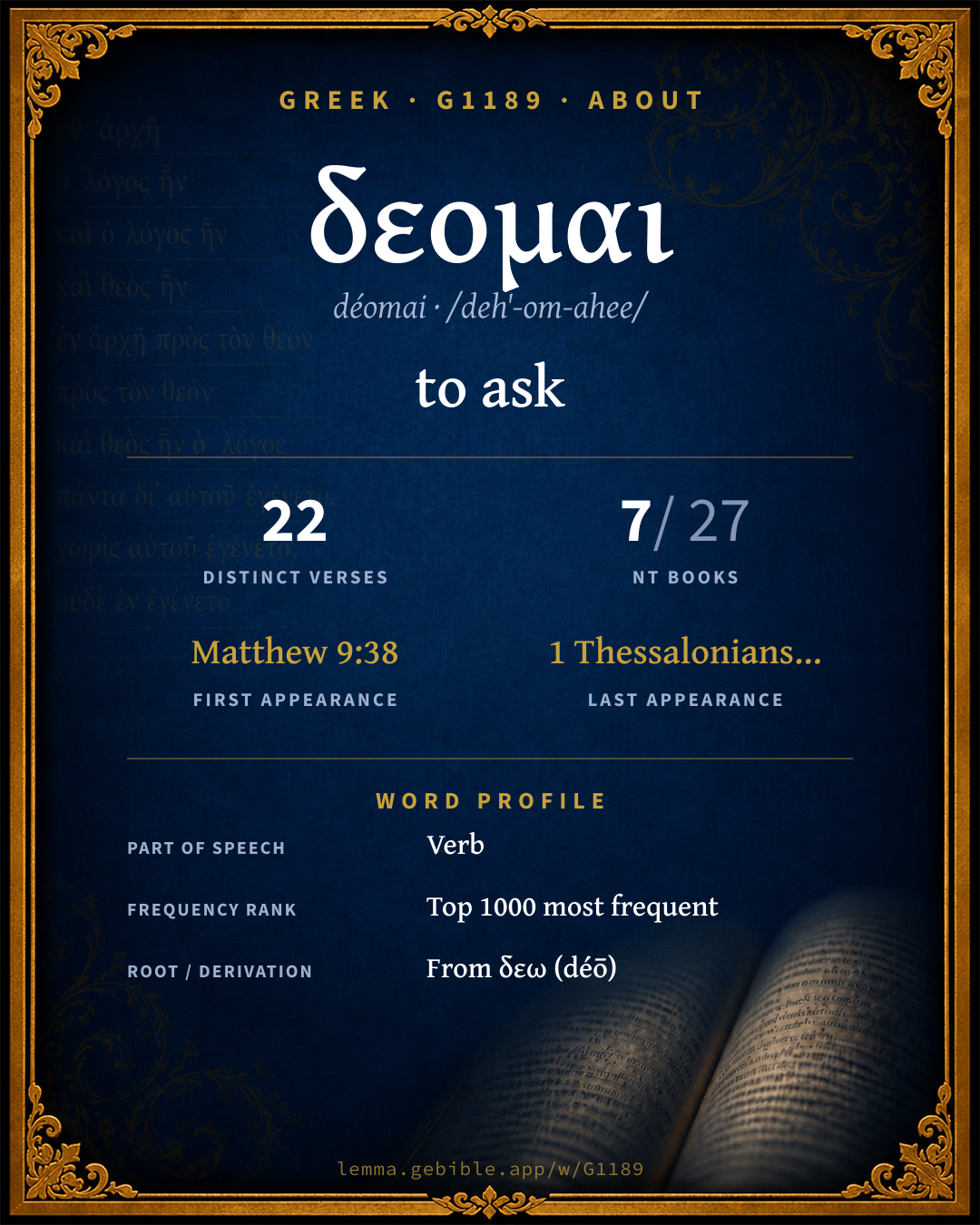
δέομαι
to ask
‘to ask’ is one of 4 main senses fuller range ↓
Full lexicon entry — Thayer's Greek Lexicon
From Thayer's Greek Lexicon
Where this word appears
See every Present-tense verb in the Greek New Testament →
Grammar key — what these labels mean
Part of speech
- Verb
- An action or state-of-being word.
Tense
- Present
- Ongoing or general action in present time (imperfective aspect).
- Aorist
- Action viewed as a simple whole, without regard to duration — often past (perfective aspect).
- Imperfect
- Continuous or repeated action in past time (“was writing”).
Voice
- Middle or Passive deponent
- Middle/passive in form but active in meaning.
- Passive deponent
- Passive in form but active in meaning.
- Passive
- The subject receives the action.
Mood
- Indicative
- States a fact or asks a factual question (the mood of reality).
- Imperative
- Expresses a command or request.
- Participle
- A verbal adjective (“writing,” “having written”).
Case
- Nominative
- The case of the subject (and the predicate nominative).
- Genitive
- The case of source, possession, or “of” — answers “whose / from what.”
Person
- 1st person
- The speaker (“I / we”).
- 2nd person
- The one addressed (“you”).
- 3rd person
- The one spoken about (“he / she / it / they”).
Gender
- Masculine
- Grammatically masculine.
Number
- Singular
- One.
- Plural
- More than one.
Grammatical forms 10 distinct
- Verb, Present, Middle or Passive deponent, Indicative, 1st person, Singular 7 times (32%)
- Verb, Aorist, Passive deponent, Imperative, 2nd person, Plural 3 times (14%)
- Verb, Present, Middle or Passive deponent, Participle, Nominative, Plural, Masculine 3 times (14%)
- Verb, Aorist, Passive, Indicative, 1st person, Singular 2 times (9%)
- Verb, Present, Middle or Passive deponent, Participle, Nominative, Singular, Masculine 2 times (9%)
- Verb, Aorist, Passive deponent, Imperative, 2nd person, Singular 1 time (5%)
- Verb, Aorist, Passive deponent, Participle, Genitive, Plural, Masculine 1 time (5%)
- Verb, Aorist, Passive, Indicative, 3rd person, Singular 1 time (5%)
+2 more forms (2 occurrences)
Parsed forms decoded from the imported morphology (Robinson–Tischendorf, public domain), counted across 22 parsed occurrences — not distinct verses.
Every verse where G1189 appears — 22 distinct verses across 7 books. Click any verse to open its interlinear word-by-word view. Verse text shown in the World English Bible for context — . Each verse’s Greek form is shown with its reference; the English is not keyword-highlighted, since the data carries no word-level English alignment. Use “Compare translations” on any verse to read it across multiple English versions. This concordance covers the Greek New Testament; Septuagint (Greek Old Testament) occurrences of this word are not indexed here.
Matthew 1 verse
Luke 8 verses
- Luke 5:12 ἐδεήθη aor pass ind 3sg It happened, while he was in one of the cities, behold, there was a man full of leprosy. When he saw Jesus, he fell on his face, and begged him, saying, "Lord, if you want to, you can make me clean."
- Luke 8:28 δέομαί pres mid/pass.dep ind 1sg When he saw Jesus, he cried out, and fell down before him, and with a loud voice said, "What do I have to do with you, Jesus, you Son of the Most High God? I beg you, don't torment me!"
- Luke 8:38 ἐδέετο impf mid/pass.dep ind 3sg But the man from whom the demons had gone out begged him that he might go with him, but Jesus sent him away, saying,
- Luke 9:38 δέομαί pres mid/pass.dep ind 1sg Behold, a man from the crowd called out, saying, "Teacher, I beg you to look at my son, for he is my only child.
- Luke 9:40 ἐδεήθην aor pass ind 1sg I begged your disciples to cast it out, and they couldn't."
- Luke 10:2 δεήθητε aor pass.dep impv 2pl Then he said to them, "The harvest is indeed plentiful, but the laborers are few. Pray therefore to the Lord of the harvest, that he may send out laborers into his harvest.
- Luke 21:36 δεόμενοι pres mid/pass.dep ptcp nom pl masc Therefore be watchful all the time, asking that you may be counted worthy to escape all these things that will happen, and to stand before the Son of Man."
- Luke 22:32 ἐδεήθην aor pass ind 1sg but I prayed for you, that your faith wouldn't fail. You, when once you have turned again, establish your brothers."
Acts 7 verses
- Acts 4:31 δεηθέντων aor pass.dep ptcp gen pl masc When they had prayed, the place was shaken where they were gathered together. They were all filled with the Holy Spirit, and they spoke the word of God with boldness.
- Acts 8:22 δεήθητι aor pass.dep impv 2sg Repent therefore of this, your wickedness, and ask God if perhaps the thought of your heart may be forgiven you.
- Acts 8:24 δεήθητε aor pass.dep impv 2pl Simon answered, "Pray for me to the Lord, that none of the things which you have spoken happen to me."
- Acts 8:34 δέομαί pres mid/pass.dep ind 1sg The eunuch answered Philip, "Who is the prophet talking about? About himself, or about someone else?"
- Acts 10:2 δεόμενος pres mid/pass.dep ptcp nom sg masc a devout man, and one who feared God with all his house, who gave gifts for the needy generously to the people, and always prayed to God.
- Acts 21:39 δέομαι pres mid/pass.dep ind 1sg But Paul said, "I am a Jew, from Tarsus in Cilicia, a citizen of no insignificant city. I beg you, allow me to speak to the people."
- Acts 26:3 δέομαι pres mid/pass.dep ind 1sg especially because you are expert in all customs and questions which are among the Jews. Therefore I beg you to hear me patiently.
Romans 1 verse
2 Corinthians 3 verses
- 2 Corinthians 5:20 δεόμεθα pres mid/pass.dep ind 1pl We are therefore ambassadors on behalf of Christ, as though God were entreating by us. We beg you on behalf of Christ, be reconciled to God.
- 2 Corinthians 8:4 δεόμενοι pres mid/pass.dep ptcp nom pl masc begging us with much entreaty to receive this grace and the fellowship in the service to the saints.
- 2 Corinthians 10:2 δέομαι pres mid/pass.dep ind 1sg Yes, I beg you that I may not, when present, show courage with the confidence with which I intend to be bold against some, who consider us to be walking according to the flesh.
Galatians 1 verse
1 Thessalonians 1 verse
About this entry
At a glance — auto-summarized from this page’s data, not written by a person. Every figure links to its source below. This summary describes the numbers; it doesn’t interpret them.
At its core, δεομαι (déomai) means “to ask.” Translators differ — “i beseech” in the King James Version, then “i beg” (Berean Standard Bible), as the renderings breakdown shows. It turns up in 22 verses across 7 books, an uncommon footprint. The word gravitates to Luke (36%), then Acts and 2 Corinthians. Ranging over 4 senses, it is not a single-sense word. Each statement above links to its evidence; the full detail follows below.
Gloss history
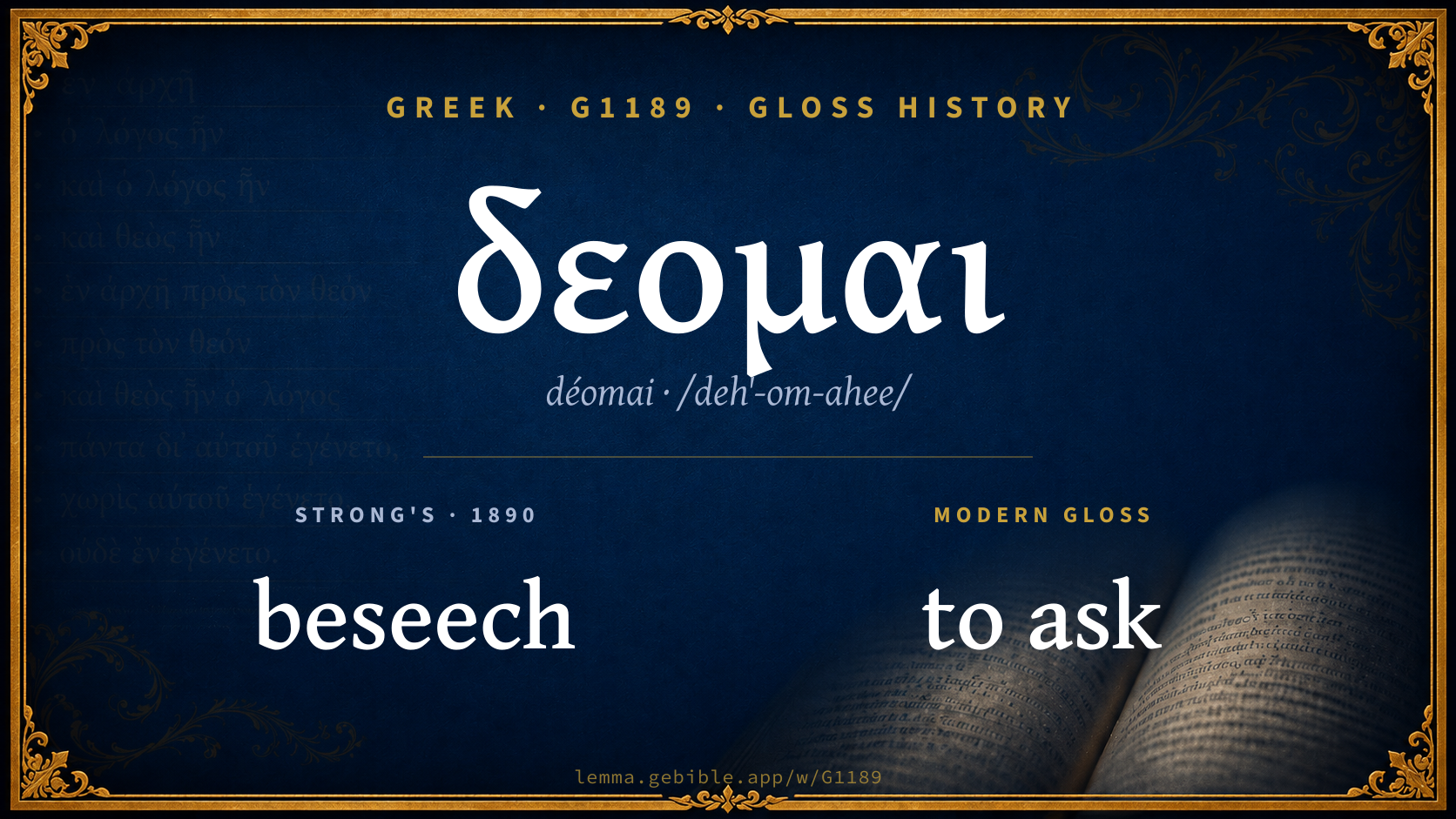
Strong's 1890 vs modern scholarship
About this word
Strong's G1189 catalogs a Greek word from the Greek New Testament.
These counts are not copied from any lexicon or concordance. They are computed here, from the morphology-tagged Greek New Testament. What Lemma adds →
- 22
- distinct verses
- The word appears in 22 distinct verses.
- 7 / 27
- NT books
- The word appears in 7 of 27 New Testament books.
- #586
- by frequency
- Top 1000 most frequent Greek words (rank 586 of 5,347 Greek words by occurrence).
View all 22 occurrences in the concordance →
Most concentrated in
- Luke 8 verses 36%
- Acts 7 verses 32%
- 2 Corinthians 3 verses 14%
By section of the New Testament
By traditional corpus
Conventional, traditional groupings — biblical authorship is debated, so this is a traditional corpus grouping, not an authorship claim. Some books belong to more than one corpus (Luke is in both the Gospels and the Lukan corpus, and so on), so these shares overlap and need not total 100%. Each figure is a share of the word’s 22 distinct verses.
- Lukan (Luke–Acts) 15 verses · 68%
- Gospels 9 verses · 41%
- Pauline corpus 6 verses · 27%
How translations render this word
Counts come from each version’s own published word-to-Strong’s tagging or interlinear alignment — an approximate guide to how each version renders this word, not a word-level alignment the data otherwise carries. Because each total is that version’s own tagged count, the per-version totals vary from one another and need not match the appearance or distinct-verse counts above. These counts may also differ from a printed concordance because Lemma counts each distinctly tagged rendering and does not collapse phrase taggings into a single head-word total. This is a fixed set of word-tagged versions (KJV, ASV, BSB, ULT) and does not change with the reading translation you choose elsewhere. Each version’s license is shown beside its name below (and on Sources).
- King James Version: I beseech 6×, Pray 3×, Besought 2×
- American Standard Version: I beseech 5×, Pray 2×, Pray ye 2×
- Berean Standard Bible: I beg 6×, Ask 2×, Begged 2×
- unfoldingWord Literal Text: Awe 1×
King James Version Public Domain
Renders G1189 across 22 tagged occurrences — most commonly:
Plus 7 renderings that appear only once — usually multi-word phrases or single function words the recovered tagging swept in, not distinct renderings.
American Standard Version Public Domain
Renders G1189 across 23 tagged occurrences — most commonly:
Plus 12 renderings that appear only once — usually multi-word phrases or single function words the recovered tagging swept in, not distinct renderings.
Berean Standard Bible Public Domain
Renders G1189 across 22 tagged occurrences — most commonly:
Plus 10 renderings that appear only once — usually multi-word phrases or single function words the recovered tagging swept in, not distinct renderings.
unfoldingWord Literal Text CC BY-SA 4.0
Renders G1189 across 1 tagged occurrence — most commonly:
Senses in Thayer's
The 4 senses Thayer's distinguishes for this word, in lexicon order (not ranked by frequency or importance). The full entry — with sub-senses — is in the Lexicon Entry tab.
- to want, lack
- to desire, long for
- the thing asked for
- to pray, make supplications
Word origin
Derived from δεω (déō) (G1210) — to bind.
Forms in the corpus
The 11 distinct written forms G1189 takes in the Greek New Testament, most frequent first — each parse links to that tense’s occurrences in the concordance.
Same root — word family
Other Thayer's entries built from the same root as G1189, grouped by Strong’s listed origin. These share a root / origin per the lexicon — not necessarily a shared meaning. Each links to that word’s own entry.
Derives from
Shares the same root
- δει deî G1163 it is necessary
- δεσμον desmón G1199 bond
- δεσποτης despótēs G1203 master
- δημος dēmos G1218 people
- δουλος doûlos G1401 slave
Derived from this word
Compare all same-root words → Showing 4 of 8 — not the complete family. They share a root, not necessarily a meaning.
Septuagint usage
The same Greek word δεομαι appears 17 times in the Greek Old Testament (Septuagint), across 16 verses in 7 books.
- 17
- LXX occurrences
- Tagged occurrences of this Greek word in the Septuagint.
- 16
- verses
- Distinct Septuagint verses containing this word.
- 7 / 39
- OT books
- The word appears in 7 of the 39 Old Testament books.
Sample Septuagint occurrences
- Genesis 19:18 δέομαι
- Exodus 4:10 δέομαι
- Numbers 12:11 δέομαι
- Deuteronomy 3:23 δέομαι
- Joshua 7:7 δέομαι
- Job 19:16 δέομαι
- Daniel 4:20 δέομαι
Septuagint occurrences (same lexeme)
Every verse where the same Strong’s number (G1189) appears in the Greek Septuagint. Verse text shown in the World English Bible for context; the Greek form is the matched word — the English is not keyword-highlighted.
- Genesis 19:18 δέομαι Lot said to them, "Oh, not so, my lord.
- Genesis 43:20 δέομαι and said, "Oh, my lord, we came indeed down at the first time to buy food:
- Genesis 44:18 δέομαι Then Judah came near to him, and said, "Oh, my lord, please let your servant speak a word in my lord's ears, and don't let your anger burn against your servant; for you are even as Pharaoh.
- Exodus 4:10 δέομαι Moses said to Yahweh, "Oh, Lord, I am not eloquent, neither before now, nor since you have spoken to your servant; for I am slow of speech, and of a slow tongue."
- Exodus 4:13 δέομαι He said, "Oh, Lord, please send someone else."
- Exodus 32:31 δέομαι Moses returned to Yahweh, and said, "Oh, this people have sinned a great sin, and have made themselves gods of gold.
- Numbers 12:11 δέομαι Aaron said to Moses, Oh, my lord, please don't lay sin on us, for that we have done foolishly, and for that we have sinned.
- Numbers 12:13 δέομαι Moses cried to Yahweh, saying, Heal her, God, I beg you.
- Deuteronomy 3:23 δέομαι I begged Yahweh at that time, saying,
- Deuteronomy 9:18 δέομαι I fell down before Yahweh, as at the first, forty days and forty nights; I did neither eat bread nor drink water; because of all your sin which you sinned, in doing that which was evil in the sight of Yahweh, to provoke him to anger.
- Deuteronomy 9:25 δέομαι So I fell down before Yahweh the forty days and forty nights that I fell down, because Yahweh had said he would destroy you.
- Joshua 7:7 δέομαι Joshua said, Alas, Lord Yahweh, why have you at all brought this people over the Jordan, to deliver us into the hand of the Amorites, to cause us to perish? would that we had been content and lived beyond the Jordan!
- Job 19:16 δέομαι I call to my servant, and he gives me no answer; I beg him with my mouth.
- Daniel 4:20 δέομαι The tree that you saw, which grew, and was strong, whose height reached to the sky, and the sight of it to all the earth;
- Daniel 4:26 δέομαι Whereas they commanded to leave the stump of the roots of the tree; your kingdom shall be sure to you, after that you shall have known that the heavens do rule.
- Daniel 4:27 δέομαι Therefore, O king, let my counsel be acceptable to you, and break off your sins by righteousness, and your iniquities by showing mercy to the poor; if there may be a lengthening of your tranquillity.
These are occurrences of the same Greek lexeme (G1189) in the Septuagint — not a translation of any one Hebrew word. The store carries no word-level Hebrew↔Greek alignment, so no Hebrew original is asserted here. Counts come from the recovered LXX Strong's tagging — high-frequency vocabulary is well covered, while rare or late forms may be untagged — so they reflect tagged occurrences and may slightly undercount.