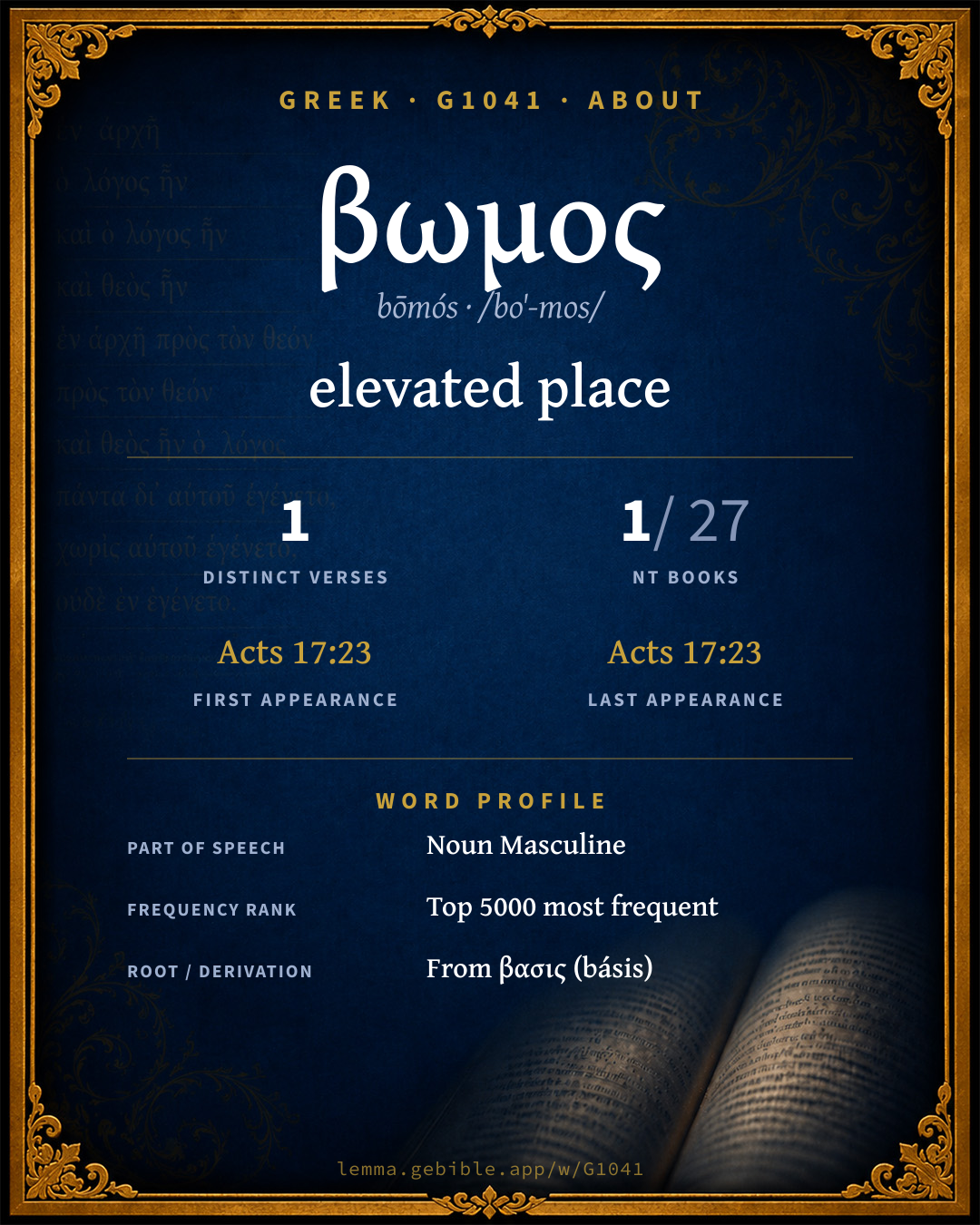
βῶμος
elevated place
Full lexicon entry — Thayer's Greek Lexicon
From Thayer's Greek Lexicon
Where this word appears
Grammar key — what these labels mean
Part of speech
- Noun
- A naming word — a person, place, thing, or idea.
Case
- Accusative
- The case of the direct object and of extent.
Gender
- Masculine
- Grammatically masculine.
Number
- Singular
- One.
Every verse where G1041 appears — 1 distinct verse across 1 book. Click any verse to open its interlinear word-by-word view. Verse text shown in the World English Bible for context — . Each verse’s Greek form is shown with its reference; the English is not keyword-highlighted, since the data carries no word-level English alignment. Use “Compare translations” on any verse to read it across multiple English versions. This concordance covers the Greek New Testament; Septuagint (Greek Old Testament) occurrences of this word are not indexed here.
Acts 1 verse
About this entry
At a glance — auto-summarized from this page’s data, not written by a person. Every figure links to its source below. This summary describes the numbers; it doesn’t interpret them.
At its core, βωμος (bōmós) means “elevated place.” With only 1 verse it sits in the long tail of Greek New Testament vocabulary. The word gravitates to Acts (100%). It occurs only once, in Acts 17:23. It clusters with βασις, βαθυς and βαΐον under a shared root. Each statement above links to its evidence; the full detail follows below.
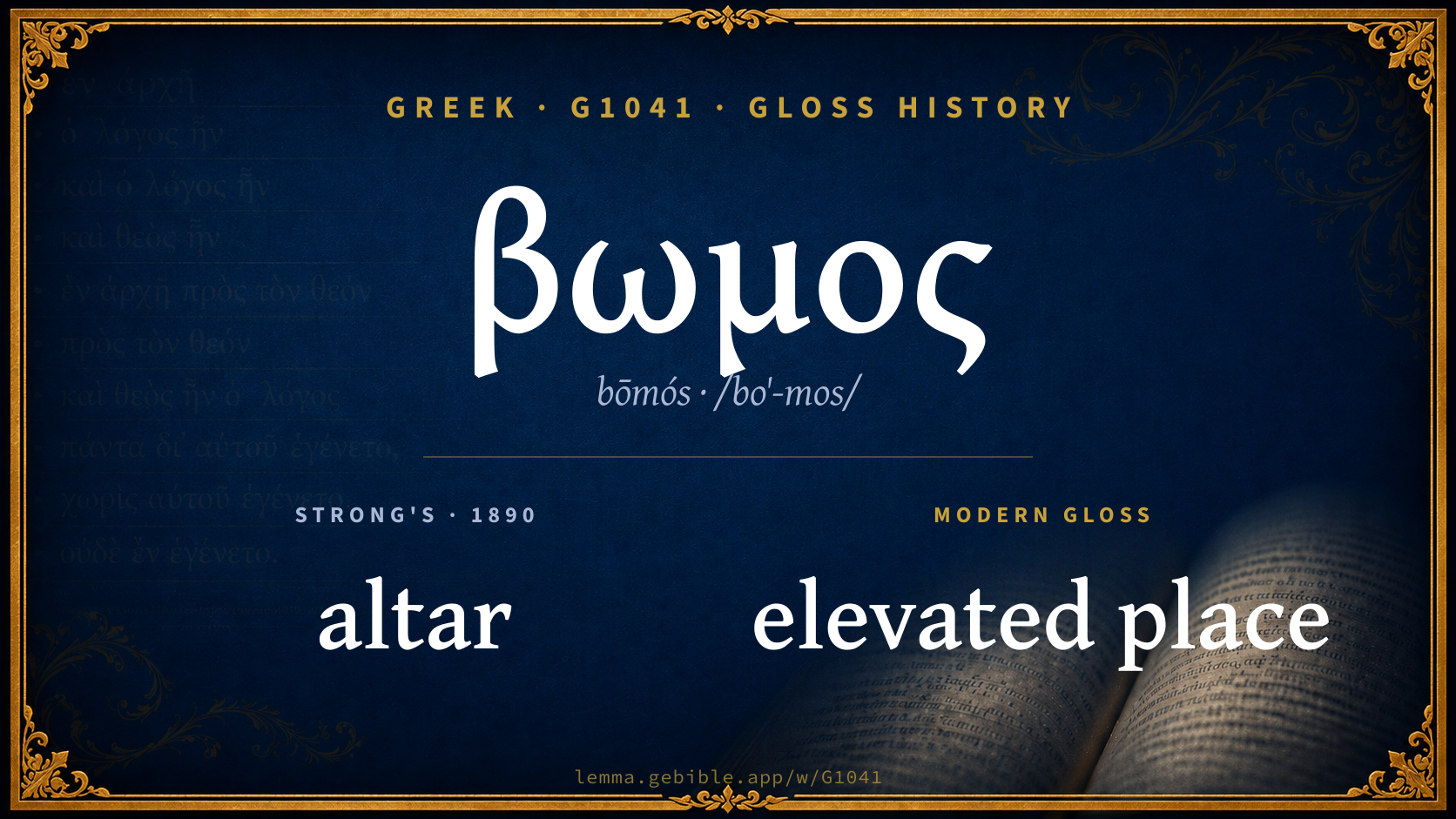
Gloss history
Strong's 1890 vs modern scholarship
About this word
Strong's G1041 catalogs a Greek word from the Greek New Testament.
These counts are not copied from any lexicon or concordance. They are computed here, from the morphology-tagged Greek New Testament. What Lemma adds →
- 1
- distinct verses
- The word appears in 1 distinct verse.
- 1 / 27
- NT books
- The word appears in 1 of 27 New Testament books.
- #3,503
- by frequency
- Top 5000 most frequent Greek words (rank 3,503 of 5,347 Greek words by occurrence).
View all 1 occurrence in the concordance →
Most concentrated in
- Acts 1 verse 100%
By section of the New Testament
By traditional corpus
Conventional, traditional groupings — biblical authorship is debated, so this is a traditional corpus grouping, not an authorship claim. Some books belong to more than one corpus (Luke is in both the Gospels and the Lukan corpus, and so on), so these shares overlap and need not total 100%. Each figure is a share of the word’s 1 distinct verse.
- Lukan (Luke–Acts) 1 verse · 100%
How translations render this word
Counts come from each version’s own published word-to-Strong’s tagging or interlinear alignment — an approximate guide to how each version renders this word, not a word-level alignment the data otherwise carries. Because each total is that version’s own tagged count, the per-version totals vary from one another and need not match the appearance or distinct-verse counts above. These counts may also differ from a printed concordance because Lemma counts each distinctly tagged rendering and does not collapse phrase taggings into a single head-word total. This is a fixed set of word-tagged versions (KJV, ASV, BSB, ULT) and does not change with the reading translation you choose elsewhere. Each version’s license is shown beside its name below (and on Sources).
- King James Version: Altar 1×
- American Standard Version: Altar 1×
- Berean Standard Bible: Altar 1×
- unfoldingWord Literal Text: Altar 1×
King James Version Public Domain
Renders G1041 across 1 tagged occurrence — most commonly:
American Standard Version Public Domain
Renders G1041 across 1 tagged occurrence — most commonly:
Berean Standard Bible Public Domain
Renders G1041 across 1 tagged occurrence — most commonly:
unfoldingWord Literal Text CC BY-SA 4.0
Renders G1041 across 1 tagged occurrence — most commonly:
Senses in Thayer's
The 1 sense Thayer's distinguishes for this word, in lexicon order (not ranked by frequency or importance). The full entry — with sub-senses — is in the Lexicon Entry tab.
- very often a raised place on which to offer a sacrifice, an altar
Word origin
Derived from βασις (básis) (G939) — foot.
From the base of G939 ; properly a stand that is (specifically) an altar : - altar.
— Strong’s Exhaustive Concordance (1890), public domain.
Same root — word family
Other Thayer's entries built from the same root as G1041, grouped by Strong’s listed origin. These share a root / origin per the lexicon — not necessarily a shared meaning. Each links to that word’s own entry.
Derives from
Shares the same root
- βαθυς bathýs G901 deep
- βαΐον baḯon G902 palm branch
- βαρος báros G922 heaviness
- βασανος básanos G931 touchstone
- βασιλευς basileús G935 king
- βασταζω bastázō G941 to take up
- βεβαιος bébaios G949 firm
- βεβηλος bébēlos G952 profane
- βημα bēma G968 judgment seat
Compare all same-root words → Showing 4 of 11 — not the complete family. They share a root, not necessarily a meaning.
Septuagint usage
The same Greek word βωμος appears 33 times in the Greek Old Testament (Septuagint), across 30 verses in 9 books.
- 33
- LXX occurrences
- Tagged occurrences of this Greek word in the Septuagint.
- 30
- verses
- Distinct Septuagint verses containing this word.
- 9 / 39
- OT books
- The word appears in 9 of the 39 Old Testament books.
Sample Septuagint occurrences
- Exodus 34:13 βωμός
- Numbers 3:10 βωμός
- Deuteronomy 7:5 βωμός
- Joshua 22:10 βωμός
- 2 Chronicles 31:1 βωμός
- Isaiah 15:2 βωμός
- Jeremiah 7:31 βωμός
- Hosea 10:8 βωμός
- Amos 7:9 βωμός
Septuagint occurrences (same lexeme)
Every verse where the same Strong’s number (G1041) appears in the Greek Septuagint. Verse text shown in the World English Bible for context; the Greek form is the matched word — the English is not keyword-highlighted.
- Exodus 34:13 βωμός but you shall break down their altars, and dash in pieces their pillars, and you shall cut down their Asherim;
- Numbers 3:10 βωμός You shall appoint Aaron and his sons, and they shall keep their priesthood. The stranger who comes near shall be put to death."
- Numbers 23:1 βωμός Balaam said to Balak, Build me here seven altars, and prepare me here seven bulls and seven rams.
- Numbers 23:2 βωμός Balak did as Balaam had spoken; and Balak and Balaam offered on every altar a bull and a ram.
- Numbers 23:4 βωμός God met Balaam: and he said to him, I have prepared the seven altars, and I have offered up a bull and a ram on every altar.
- Numbers 23:14 βωμός He took him into the field of Zophim, to the top of Pisgah, and built seven altars, and offered up a bull and a ram on every altar.
- Numbers 23:29 βωμός Balaam said to Balak, Build me here seven altars, and prepare me here seven bulls and seven rams.
- Numbers 23:30 βωμός Balak did as Balaam had said, and offered up a bull and a ram on every altar.
- Deuteronomy 7:5 βωμός But thus shall you deal with them: you shall break down their altars, and dash in pieces their pillars, and hew down their Asherim, and burn their engraved images with fire.
- Deuteronomy 12:3 βωμός and you shall break down their altars, and dash in pieces their pillars, and burn their Asherim with fire; and you shall cut down the engraved images of their gods; and you shall destroy their name out of that place.
- Joshua 22:10 βωμός When they came to the region about the Jordan, that is in the land of Canaan, the children of Reuben and the children of Gad and the half-tribe of Manasseh built there an altar by the Jordan, a great altar to look on.
- Joshua 22:11 βωμός The children of Israel heard say, Behold, the children of Reuben and the children of Gad and the half-tribe of Manasseh have built an altar in the forefront of the land of Canaan, in the region about the Jordan, on the side that pertains to the children of Israel.
- Joshua 22:16 βωμός Thus says the whole congregation of Yahweh, What trespass is this that you have committed against the God of Israel, to turn away this day from following Yahweh, in that you have built you an altar, to rebel this day against Yahweh?
- Joshua 22:19 βωμός However, if the land of your possession be unclean, then pass over to the land of the possession of Yahweh, in which Yahweh's tent dwells, and take possession among us: but don't rebel against Yahweh, nor rebel against us, in building you an altar besides the altar of Yahweh our God.
- Joshua 22:23 βωμός that we have built us an altar to turn away from following Yahweh; or if to offer thereon burnt offering or meal-offering, or if to offer sacrifices of peace-offerings thereon, let Yahweh himself require it;
- Joshua 22:26 βωμός Therefore we said, Let us now prepare to build us an altar, not for burnt offering, nor for sacrifice:
- Joshua 22:34 βωμός The children of Reuben and the children of Gad called the altar [Ed]: For, [said they], it is a witness between us that Yahweh is God.
- 2 Chronicles 31:1 βωμός Now when all this was finished, all Israel who were present went out to the cities of Judah, and broke in pieces the pillars, and hewed down the Asherim, and broke down the high places and the altars out of all Judah and Benjamin, in Ephraim also and Manasseh, until they had destroyed them all. Then all the children of Israel returned, every man to his possession, into their own cities.
- Isaiah 15:2 βωμός They are gone up to Bayith, and to Dibon, to the high places, to weep: Moab wails over Nebo, and over Medeba; on all their heads is baldness, every beard is cut off.
- Isaiah 16:12 βωμός It shall happen, when Moab presents himself, when he wearies himself on the high place, and shall come to his sanctuary to pray, that he shall not prevail.
- Isaiah 17:8 βωμός They shall not look to the altars, the work of their hands; neither shall they have respect to that which their fingers have made, either the Asherim, or the sun-images.
- Isaiah 27:9 βωμός Therefore by this shall the iniquity of Jacob be forgiven, and this is all the fruit of taking away his sin: that he makes all the stones of the altar as chalk stones that are beaten in sunder, [so that] the Asherim and the sun-images shall rise no more.
- Jeremiah 7:31 βωμός They have built the high places of Topheth, which is in the valley of the son of Hinnom, to burn their sons and their daughters in the fire; which I didn't command, neither came it into my mind.
- Jeremiah 7:32 βωμός Therefore, behold, the days come, says Yahweh, that it shall no more be called Topheth, nor The valley of the son of Hinnom, but The valley of Slaughter: for they shall bury in Topheth, until there be no place [to bury].
- Jeremiah 11:13 βωμός For according to the number of your cities are your gods, Judah; and according to the number of the streets of Jerusalem have you set up altars to the shameful thing, even altars to burn incense to Baal.
- Jeremiah 30:18 βωμός Thus says Yahweh: Behold, I will turn again the captivity of Jacob's tents, and have compassion on his dwelling-places; and the city shall be built on its own hill, and the palace shall be inhabited after its own manner.
- Jeremiah 31:35 βωμός Thus says Yahweh, who gives the sun for a light by day, and the ordinances of the moon and of the stars for a light by night, who stirs up the sea, so that the waves of it roar; Yahweh of hosts is his name:
- Jeremiah 39:35 βωμός
- Hosea 10:8 βωμός The high places also of Aven, the sin of Israel, will be destroyed. The thorn and the thistle will come up on their altars. They will tell the mountains, "Cover us!" and the hills, "Fall on us!"
- Amos 7:9 βωμός The high places of Isaac will be desolate, the sanctuaries of Israel will be laid waste; and I will rise against the house of Jeroboam with the sword."
These are occurrences of the same Greek lexeme (G1041) in the Septuagint — not a translation of any one Hebrew word. The store carries no word-level Hebrew↔Greek alignment, so no Hebrew original is asserted here. Counts come from the recovered LXX Strong's tagging — high-frequency vocabulary is well covered, while rare or late forms may be untagged — so they reflect tagged occurrences and may slightly undercount.