Acts 23:25

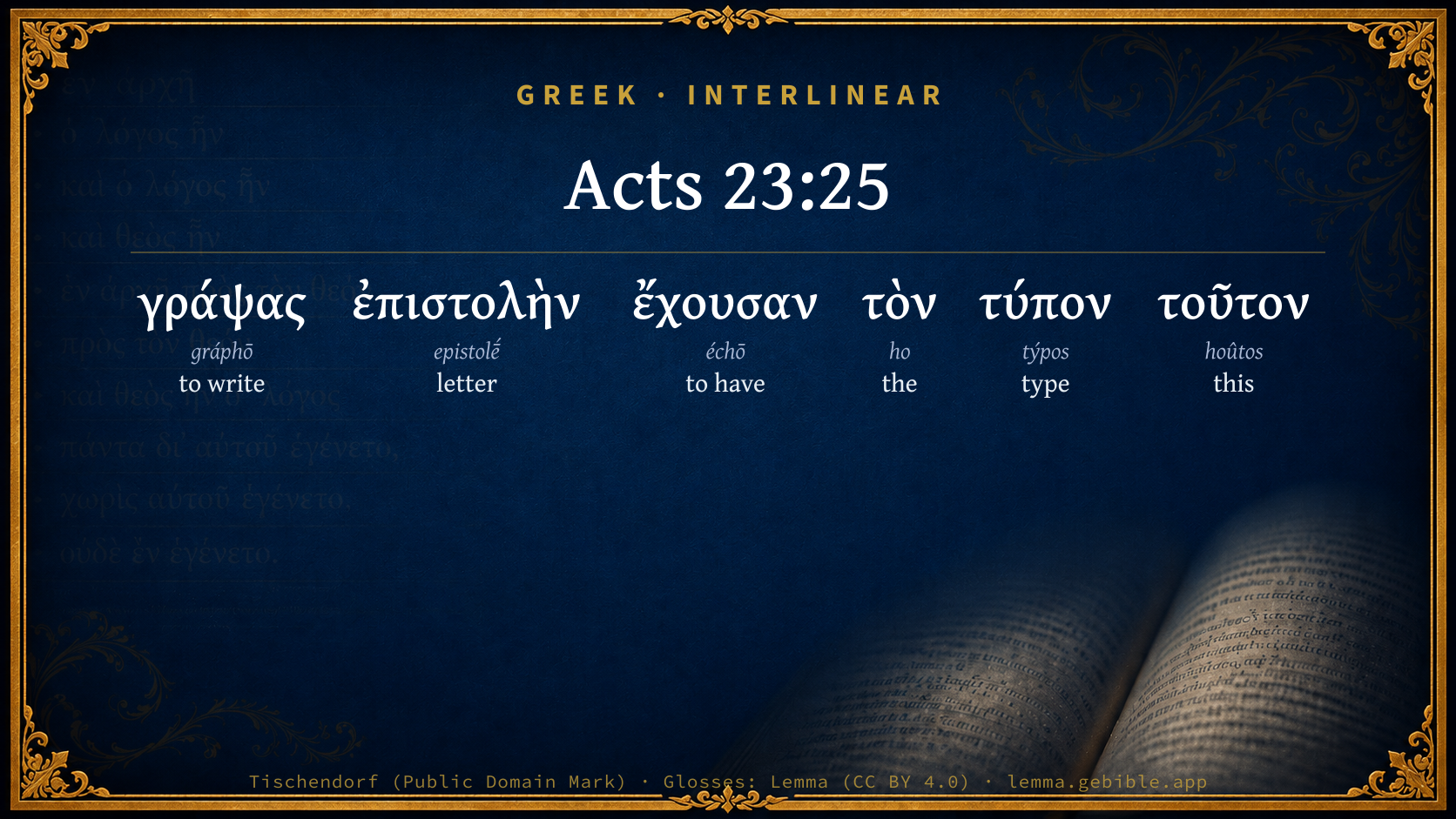
Greek (Tischendorf 8th ed.) Acts 23:25 appears in the Greek New Testament. The text above is from the Tischendorf 8th edition. Each word links to its Strong’s number and a concise gloss. Click any word for its full Thayer’s Greek Lexicon entry.
Download image
Cite this verse

Acts 23:25 (World English Bible). Public Domain. Lemma interlinear Bible study tool, https://lemma.gebible.app/v/acts/23/25.

Show BibTeX & RIS
BibTeX
RIS
English Translation
He wrote a letter like this:
World English Bible · Public Domain
Download a study sheet

One document with this verse’s original text, its word-by-word gloss line, the meaning frame, cross-references with their text, attributed commentary, and full source and license credits — printable, and it pastes into notes with its structure intact.

This verse Autodidact and up

Study sheet (.html) Plain text (.txt)

A passage Seminary Student

Up to 50 verses in one chapter. A passage sheet keeps up to 6 commentary sources and 12 cross-references per verse, in the order this page ranks them, and says so on the sheet whenever that leaves anything out. Ask for a single verse and you get the Autodidact verse sheet above.

Everything on this page stays free to read, with no account — the sheet is a download of what is already on screen, not access to it.

Want to remove ads? Support Godless Engineer
Compare translations 3

The same verse in 3 English versions, stacked beneath the original-language interlinear above. Click any original word for its lexicon entry.

Each is an independent rendering of the whole verse — the interlinear is not word-aligned to these translations.

Highlighted words mark where these versions differ — a whole-verse word diff, not a word-by-word alignment.

  • World English Bible Public Domain
    He wrote a letter like this:
  • King James Version Public Domain
    And he wrote a letter after this manner:
  • unfoldingWord Literal Text CC BY-SA 4.0
    writing a letter, having this form:

unfoldingWord Literal Text — © unfoldingWord, licensed CC BY-SA 4.0. Word-aligned USFM3 via Door43 (git.door43.org/unfoldingWord/en_ult).

Versions to compare (up to 4)

3 of 4 selected

Show all 19 translations

Every available English version of this verse, each an independent rendering of the whole verse.

  • World English Bible Public Domain
    He wrote a letter like this:
  • Berean Standard Bible Public Domain
    And he wrote the following letter:
  • Majority Standard Bible Public Domain
    And he wrote the following letter:
  • King James Version Public Domain
    And he wrote a letter after this manner:
  • American Standard Version (1901) Public Domain
    And he wrote a letter after this form:
  • Revised Version (1885) Public Domain
    And he wrote a letter after this form:
  • Geneva Bible (1599) Public Domain
    And he wrote an epistle in this maner:
  • Douay-Rheims (1899) Public Domain
    (For he feared lest perhaps the Jews might take him away by force and kill him, and he should afterwards be slandered, as if he was to take money.) And he wrote a letter after this manner:
  • Young's Literal Translation Public Domain
    he having written a letter after this description:
  • Literal Standard Version CC BY-SA 4.0
    he having written a letter after this description:
  • Unlocked Literal Bible CC BY-SA 4.0
    Then he wrote a letter like this:
  • unfoldingWord Literal Text CC BY-SA 4.0
    writing a letter, having this form:
  • Darby Bible Public Domain
    having written a letter, couched in this form:
  • World Messianic Bible Public Domain
    He wrote a letter like this:
  • Webster's Bible Public Domain
    And he wrote a letter after this manner:
  • Free Bible Version CC BY-SA 4.0
    He also wrote a letter that went like this:
  • Bible in Basic English Public Domain
    And he sent a letter in these words:
  • Text-Critical English NT CC BY 4.0
    Then he wrote the following letter:
  • Tyndale New Testament (1534) Public Domain
    and wrote a letter in this maner.

Literal Standard Version (2020), Covenant Press — licensed CC BY-SA 4.0. Text via the HelloAO Bible API (eBible.org). Unlocked Literal Bible (unfoldingWord) — licensed CC BY-SA 4.0. Text via the HelloAO Bible API (eBible.org). unfoldingWord Literal Text — © unfoldingWord, licensed CC BY-SA 4.0. Word-aligned USFM3 via Door43 (git.door43.org/unfoldingWord/en_ult). Free Bible Version, Dr. Jonathan Gallagher — licensed CC BY-SA 4.0. Text via the HelloAO Bible API (eBible.org).

Word by word

More ways to search: Search by grammar → Find every occurrence → Compare this word →

Practice this passage: Drill this verse → Learn its vocabulary →

τύπον
týpos
G5179
“type”
Noun, Accusative, Singular, Masculine
Part of Speech
Noun
Case
Accusative
Number
Singular
Gender
Masculine
Full Thayer's Definition

Origin: from G5180

TDNT: 12:06,1

1. the mark of a stroke or blow, print 2. a figure formed by a blow or impression a. of a figure or image b. of the image of the gods 3. form a. the teaching which embodies the sum and substance of religion and represents it to the mind, manner of writing, the contents and form of a letter 4. an example a. in the technical sense, the pattern in conformity to which a thing must be made b. in an ethical sense, a dissuasive example, a pattern of warning 1. of ruinous events which serve as admonitions or warnings to others c. an example to be imitated 1. of men worthy of imitation d. in a doctrinal sense 1. of a type i.e. a person or thing prefiguring a future (Messianic) person or thing
  1. γράψας gráphō G1125 “to write” Verb, Aorist, Active, Participle, Nominative, Singular, Masculine
  2. ἐπιστολὴν epistolḗ G1992 “letter” Noun, Accusative, Singular, Feminine
  3. ἔχουσαν échō G2192 “to have” Verb, Present, Active, Participle, Accusative, Singular, Feminine
  4. τὸν ho G3588 “the” Article, Accusative, Singular, Masculine
  5. τοῦτον hoûtos G3778 “this” Demonstrative pronoun, Accusative, Singular, Masculine

About this verse

These counts appear in no published source. They are computed here, from the morphology-tagged text and Lemma’s own curated glosses. What Lemma adds →

6
words
6
distinct lemmas
Acts
section

Notable vocabulary

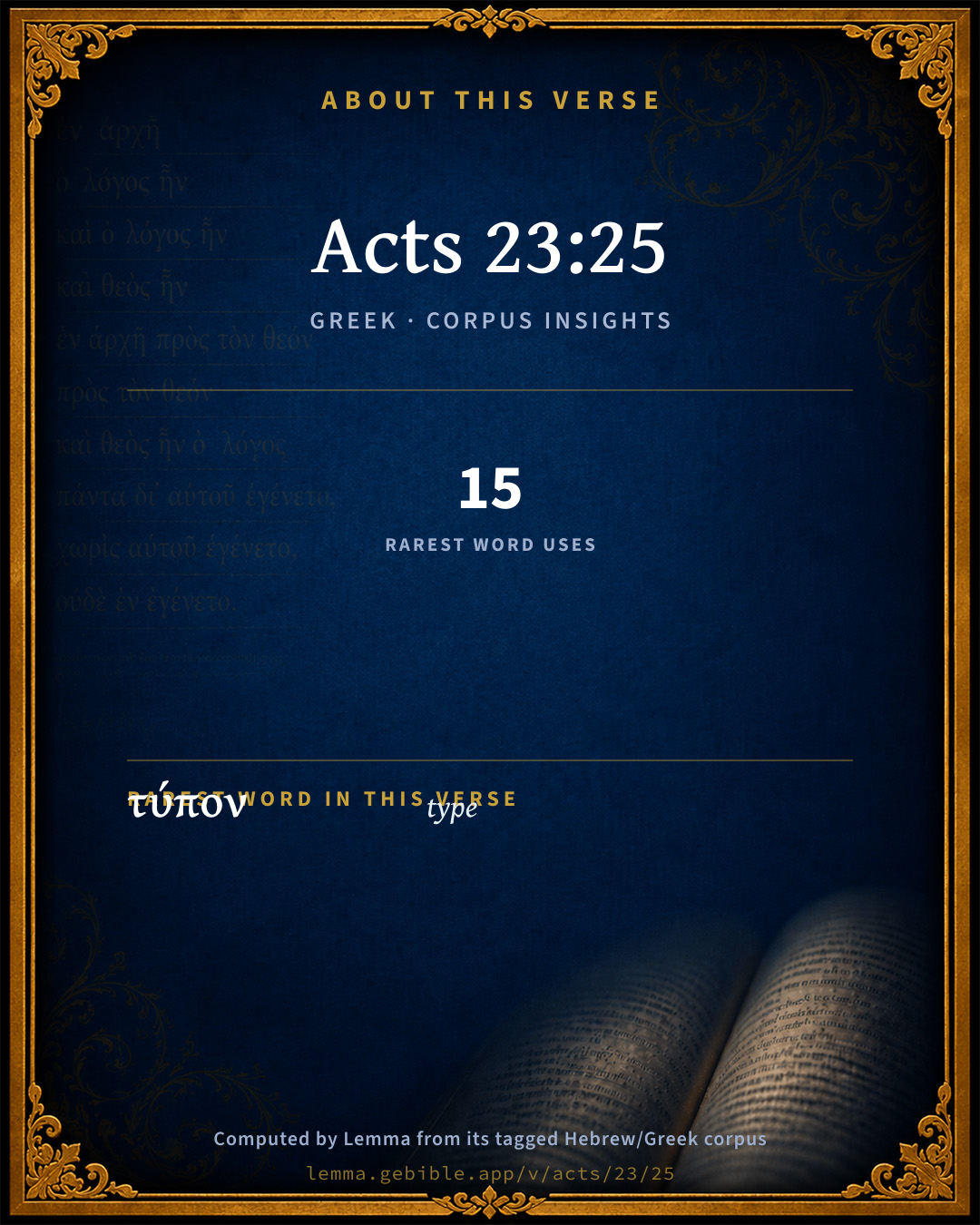
The rarest word here is τύπον type G5179 — appearing just 15 times in the whole Greek New Testament.

Shared distinctive vocabulary

τύπον type G5179 occurs in 15 verses of the Greek New Testament. Also found in:

Commentary

Notes on Acts 23:25 from classic Christian and Jewish commentators (each source and its license shown beneath its notes). The classic Christian expositions comment on the surrounding passage and are grouped to its opening verse, so a note may address several verses; the Jewish commentaries on the Tanakh (Rashi and others) are per-verse, so they appear only where the commentator wrote on this verse.

Lemma curates 59 commentaries, every one of them public domain or Creative Commons licensed, each selected and text-cleaned for this edition rather than reprinted as found. About our sources →

Bengel's Gnomon

Johann Albrecht Bengel

Act 23:25. Ἐπιστολὴν περιέχουσαν τὸν τύπον τοῦτον) 1Ma 15:2, ἦσαν (ἐπιστολαί̔) περιέχουσαι τὸν τρόπον τοῦτον.—τύπον) mould, form, purport. This, which was without doubt written in Latin, and preserved in the Roman archives, afterwards convinced the Romans, when they read it, of the truth of the apostolic history.

Bengel's Gnomon of the New Testament — English translation (T&T Clark, Edinburgh, 1860) — public domain. Text from a community e-Sword module.

Meyer's Critical & Exegetical Commentary

Heinrich August Wilhelm Meyer

Act_23:25-26. Γράψας] adds to εἶπεν, Act_23:23, a contemporaneous accompanying action. Such passports, given with transported prisoners, were called at a later period (in the Cod. Theodos.) elogia.

περιέχ. τ. τύπον τοῦτ.] which contained the following form; τύπος (3Ma_3:30), the same as τρόπος elsewhere (Kypke, II. p. 119; Grimm, on 1Ma_11:29), corresponds entirely to the Latin exemplum, the literal form, the verbal contents of a letter. Cic. ad Div. x. 5 : literae binae eodem exemplo.

The lie in Act_23:27 (see in loc.) is a proof that in what follows the literal expression is authentically contained; therefore there is no reason, with Olshausen, to regard the letter as a literary production of Luke. A documentary source, it is true, from which the verbal form came to him, cannot be specified, although possibilities of this nature may well be imagined.

τῷ κρατίστῳ] see on Luke, Introd. § 3. Comp. Act_24:3, Act_26:25.

Meyer — Critical and Exegetical Commentary on the New Testament — English translation by Peter Christie, edited by Frederick Crombie (T&T Clark, 1880) — public domain. Text from a community e-Sword module.

Expositor's Greek Testament

ed. W. Robertson Nicoll

Act 23:25 . περιέχουσαν , see critical note above. τύπον : “form,” R.V., a précis or summary of the contents of a letter, 3Ma 3:30 . Such a letter would be called elogium , Alford, in loco , Renan, Saint Paul , p. 532. It is quite true that τύπος does not demand that the letter should have been given verbally, and in an oft-quoted passage, Plato, Polit. , 3, p. 414, ἐν τύπῳ is contrasted with διʼ ἀκριβείας , but the letter bears the marks of genuineness, e.g. , the part which Lysias claims to have played, and the expression “questions of their law” (see below). Moreover St. Luke might have easily learnt its contents, as there is reason for supposing that the letter would have been read in open court before Felix, as containing the preliminary inquiry, and that a copy may have been given to Paul after his appeal, see Bethge, Die Paulinischen Reden Apostelgeschichte , p. 226.

The Expositor's Greek Testament, edited by W. Robertson Nicoll (1897–1910) — public domain. Text from a community e-Sword module.

Adam Clarke's Commentary

Verse 25. He wrote a letter after this manner] It appears that this was not only the substance of the letter, but the letter itself: the whole of it is so perfectly formal as to prove this; and in this simple manner are all the letters of the ancients formed. In this also we have an additional proof of St. Luke's accuracy.

Adam Clarke's Commentary on the Bible (1810–1826) — public domain. Text from a community e-Sword/MySword module.

John Calvin's Commentaries

25. And he wrote a letter. First, we must briefly admonish the readers who have not been conversant in histories, that this Felix was brother to Pallas, who being Caesar’s freeman, became equal with the chief of the city in wealth and power. Yea, moreover, the senate gave him the ornaments of the praetor, not without titles of filthy and shameful flattery. Therefore, seeing the servants of Claudius abusing his folly, did rule the Roman empire at their pleasure, and chiefly Narcissus and Pallas, no marvel if this latter did appoint his brother to be governor of Judea. The sum of the epistle tendeth to this end, that the chief captain may help Paul with his prejudice; and may admonish Felix of the injuries of his adversaries, and may so discredit them, that they may not be able to do him any hurt.

John Calvin's Commentaries (1540-1563) — public domain. Text from the Calvin Translation Society English edition (1840s-50s) via the Christian Classics Ethereal Library (ccel.org). Calvin's coverage is partial (roughly two-thirds of the Bible); uncommented books and verses are honest gaps, never fabricated. The 19th-century editor's footnotes and remarks are omitted so the notes are faithfully Calvin's own voice.

The Cambridge Bible for Schools and Colleges

gen. ed. J. J. S. Perowne

25. a letter after this manner] [Rev. Ver. form]. As both the writer and receiver of the letter were Romans, it is most likely that Latin would be the language of the original, and that St Luke has given us a representation of the substance of the document rather than its very words.

The Cambridge Bible for Schools and Colleges (gen. ed. J. J. S. Perowne; Cambridge University Press, 1878–1918) — public domain. Text from a community e-Sword module.

John Gill's Exposition

This man was taken by the Jews,.... Meaning Paul, who was presented by the centurions to the governor, and was in his presence when the letter was opened and read, and who was taken by the Jews in the temple, and from thence dragged out and beaten by them:

and should have been killed of them; and would have been killed, had it not been for the chief captain; he was very near being killed by them, he was nigh unto death:

then came I with an army and rescued him; he came with the Roman band, which he had the command of, perhaps a thousand soldiers; for such a number he should have under him by his title; with these he came upon the Jews on a sudden, as they were beating Paul, and took him out of their hands, and saved him:

having understood that he was a Roman; but this he did not know till afterwards, after he had bound him with two chains, and after he had ordered him to be bound with thongs, and examined by scourging; all which he covers and hides from the governor, and suggests that it was his great concern for the Roman name, and for a Roman citizen, which put him upon this enterprise.

John Gill's Exposition of the Whole Bible (1746–1763) — public domain (CC PDM 1.0). Text via the HelloAO Bible API.

Trapp's Complete Commentary

John Trapp

25 And he wrote a letter after this manner:

Ver. 25. And he wrote a letter] Gr. an epistle, cuius ornamentum est ornamentis carere, saith Politian.

John Trapp, A Commentary or Exposition upon All the Books of the Old and New Testament (1647–1656) — public domain. Text from a community e-Sword module.

Haydock's Catholic Bible Commentary

This verse is omitted in the Greek. Antipatris was a pleasant city on the Mediterranean sea, situated at equal distance, about 24 miles, between Joppe and Cæsarea, on the way from Jerusalem to this latter city. (Matt. Polus)

George Leo Haydock (1774–1849), Haydock's Catholic Family Bible and Commentary, 1859 edition — public domain. Excludes Psalms (Douay-Rheims chapter numbering differs from Protestant) and Deuterocanonical books (Catholic canon only).

Matthew Poole's English Annotations

It is not certain whether the following words were the letter itself, or only the sum or contents of the letter.

Matthew Poole's English Annotations on the Holy Bible (1683–1685) — public domain. Text from a community e-Sword/MySword module.

Whedon's Commentary on the Bible

Daniel D. Whedon

25. This manner—This type or form. The regular letter form of this document, according to the fashion of that day, shows that Luke offers it as a literal copy. There is no difficulty in supposing that in the many interviews held by Festus with Paul the latter might have seen the original, and furnished a copy to Luke. The latter would value it as an authentic and characteristic document, and worthy to be inserted in his history.

Daniel D. Whedon (gen. ed.), Commentary on the Old and New Testaments (1874–1909) — public domain. Text from a community e-Sword module.

The Pulpit Commentary

Form for manner, A.V. After this form. Luke does not profess to give the letter verbatim, but merely its general tenor, which Lysias might have communicated to Paul, or which Paul might have learnt at Caesarea.

The Pulpit Commentary (1880–1919), ed. H.D.M. Spence-Jones & Joseph S. Exell — public domain. Text from a community e-Sword module.

Burkitt's Expository Notes on the New Testament

William Burkitt

The chief captain Lysias having sent St. Paul under a strong guard to Cesarea by night, where Felix the Roman governor resided, he writes a letter to acquaint Felix with the accusation laid to the prisoner’s charge.

In which letter observe, 1. The title given to the Roman governor, Most excellent: Claudius Lysias to the most excellent governor Felix, sendeth greeting.

Titles of civil honour and respect given to persons in place and power are agreeable to the mind and will of God. There is an honour which belongs to men, with respect to their internal qualifications. He that is very honourable as to his place, may not deserve any honour as to his worth; yet ought he to be honoured so far as his place requireth.

Observe, 2. How God overruled the heart and pen of this captain, Lysias, to do the apostle right, in representing his case fairly and indifferently: that he found nothing brought against him that was punishable, either with death or bonds, by the Roman law.

Observe, 3. How triflingly he speaks of the great things in question concerning our blessed Redeemer’s death and resurrection, as also of the whole gospel: he calls them, under-valuingly, questions of their law.

As the wisdom of the world is foolishness with God, so the manifold wisdom of God is accounted and esteemed folly by the ignorant and blind world.

Yet observe, 4. How God overruled his very slighting of these controversies in dispute for the apostle’s advantage: he being by that means preserved from the rage of the Jews. When this man was taken of the Jews, and should have been killed by them, I came with an army and rescued him.

Behold how God accompolishes his own designs for the preservation of his servants, by the hands of those from whom destruction could rather have been expected.

Thus here, God made use of a heathen captain, to rescue and defend the apostle from the enraged Jews, who sends him under a strong guard, with a friendly letter in favour of him, to Felix the governor at Cesarea, where he gives notice to his accusers to implead him face to face.

Blessed by God, that our times are in hands, not in our enemies’ hands, nor yet in our own; until we have finished the work which God designed us, neither men nor devils can take us off.

William Burkitt's Expository Notes on the New Testament (1700–1703) — public domain. Text from a community e-Sword module.

McGarvey & Pendleton's Commentaries

J. W. McGarvey

See notes on verse 23

J. W. McGarvey (with Philip Y. Pendleton), Commentaries on the New Testament (The Fourfold Gospel, 1914; Acts; and the epistles) — public domain. Text from a community e-Sword/MySword module.

The People's New Testament

B. W. Johnson

25–30. He wrote a letter. Roman law required that when a prisoner was sent by a lower official to a higher for trial, a letter should be sent stating the charges. That of Lysias states his understanding of the case.

I rescued him, having understood that he was a Roman. Like many modern officials, he prevaricates. He found out he was a Roman after he rescued him.

I sent him straightway to thee. “Though I held him to be innocent, hearing of the plot against his life, I thought it best to send him to thee.” Had he released Paul in Jerusalem, the conspirators would have murdered him.

B. W. Johnson's The People's New Testament with Notes (1889–1891) — public domain. Electronic text from the Christian Classics Ethereal Library (CCEL) ThML edition.

unfoldingWord translationNotes

Door43 World Missions Community

General Information:

The chief captain writes a letter to Governor Felix about the arrest of Paul.

General Information:

Claudius Lysias is the name of the chief captain. Governor Felix was the Roman governor over the whole region. (See: How to Translate Names)

Claudius Lysias to the most excellent Governor Felix, greetings

This is a formal introduction to the letter. The chief captain begins by referring to himself. You can translate it in the first person. The words "am writing" are understood. AT: "I, Claudius Lysias, am writing to you, the most excellent Governor Felix. Greetings to you" (See: First, Second, or Third Person and Ellipsis)

to the most excellent Governor Felix

"to Governor Felix who deserves greatest honors"

This man was arrested by the Jews

Here "Jews" means "some of the Jews." This can be stated in active form. AT: "Some of the Jews arrested this man" (See: Synecdoche and Active or Passive)

was about to be killed

This can be stated in active form. AT: "they were ready to kill Paul" (See: Active or Passive)

I came upon them with soldiers

"I with my soldiers arrived at the place where Paul and these Jews were"

translationWords

govern

Jew

Rome

citizen

unfoldingWord translationNotes — © Distant Shores Media and the Door43 World Missions Community, licensed CC BY-SA 4.0. Source: git.door43.org/Door43/en_tn.

Cambridge Greek Testament for Schools and Colleges

25. ἐπιστολὴν ἔχουσαν τὸν τύπον τοῦτον, a letter after this form. As both the writer and receiver of the letter were Romans, it is most likely that Latin was the language in which it was written, and that St Luke has given us a representation of the substance of the document rather than its very words.

Cambridge Greek Testament for Schools and Colleges (Cambridge University Press, 1896; 21 vols, various authors incl. Carr, Maclear, Plummer, Farrar, Lumby, Moule, M. R. James, Simcox) — public domain. Text from a community e-Sword module.

Alford’s Greek Testament

Henry Alford

25.] [περι]έχ., τύπ., see reff.

Henry Alford, The Greek Testament (1849–1861) — public domain. Text from a community e-Sword module.

Vincent's Word Studies in the New Testament

Marvin R. Vincent

After this manner [περιεχουσαν τον τυπον τουτον] . Lit., containing this form or type. See on it is contained, 1Pe 2:6.

Marvin R. Vincent, Word Studies in the New Testament (1887–1900) — public domain. Text from a community e-Sword/MySword module.

Lesson kit

Teaching starters — assembled from the data on this page, not authored interpretation. Every prompt links to the verse data it draws on. Edit before teaching.

Acts, in the Acts, opens this verse with 6 words (6 distinct Greek lemmas). Its most distinctive word is týpos (“type”). A historical commentator’s framing appears above. Read the whole chapter for the surrounding context.

Discussion questions

  1. The word týpos carries the sense “type.” How does it shape the verse?
  2. How does John 20:25, which shares the word «type», read alongside this verse?
  3. These translations render this verse differently; the difference is in the English rendering, not the original. What questions does that raise?
  4. Compare how Bengel's Gnomon and Meyer's Critical & Exegetical Commentary read this verse. Where do they agree or differ?

Things to notice

Reading settings

Reading text

Shown beneath each verse's original-language words.

Old Testament
Old Testament edition

Read the OT as the Masoretic Hebrew (MT) or the Greek Septuagint (LXX).

English shown for the Greek Septuagint (in the Hebrew ↔ Greek comparison).

Comparing translations? Open the Compare panel on any verse page to stack up to four side by side.