
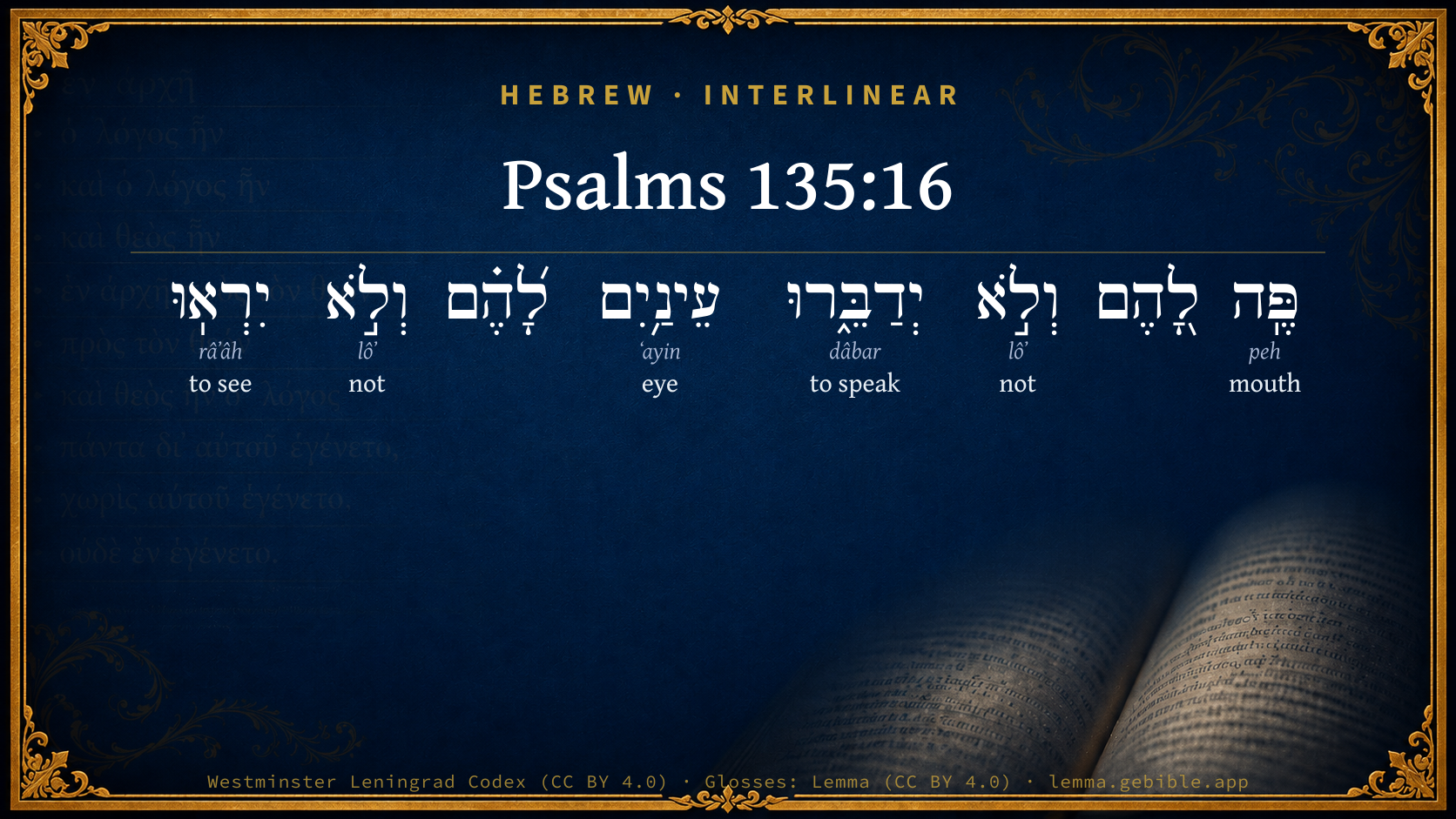
Psalms 135:16

Hebrew (Westminster Leningrad Codex) Psalms 135:16 appears in the Hebrew Old Testament. The text above is from the Westminster Leningrad Codex. Each word links to its Strong’s number, a concise gloss, and parsing drawn from the Open Scriptures Hebrew Bible morphology. Click any word for its full Brown-Driver-Briggs (BDB) entry.
Download image
Cite this verse

Psalms 135:16 (World English Bible). Public Domain. Lemma interlinear Bible study tool, https://lemma.gebible.app/v/psalms/135/16.

Show BibTeX & RIS
BibTeX
RIS
English Translation
They have mouths, but they can't speak; They have eyes, but they can't see;
World English Bible · Public Domain
Download a study sheet

One document with this verse’s original text, its word-by-word gloss line, the meaning frame, cross-references with their text, attributed commentary, and full source and license credits — printable, and it pastes into notes with its structure intact.

This verse Autodidact and up

Study sheet (.html) Plain text (.txt)

A passage Seminary Student

Up to 50 verses in one chapter. A passage sheet keeps up to 6 commentary sources and 12 cross-references per verse, in the order this page ranks them, and says so on the sheet whenever that leaves anything out. Ask for a single verse and you get the Autodidact verse sheet above.

Everything on this page stays free to read, with no account — the sheet is a download of what is already on screen, not access to it.

Want to remove ads? Support Godless Engineer
Compare translations 3

The same verse in 3 English versions, stacked beneath the original-language interlinear above. Click any original word for its lexicon entry.

Each is an independent rendering of the whole verse — the interlinear is not word-aligned to these translations.

Highlighted words mark where these versions differ — a whole-verse word diff, not a word-by-word alignment.

  • World English Bible Public Domain
    They have mouths, but they can't speak; They have eyes, but they can't see;
  • King James Version Public Domain
    They have mouths, but they speak not; eyes have they, but they see not;
  • unfoldingWord Literal Text CC BY-SA 4.0
    A mouth to them, but they do not speak; eyes to them, but they do not see.

unfoldingWord Literal Text — © unfoldingWord, licensed CC BY-SA 4.0. Word-aligned USFM3 via Door43 (git.door43.org/unfoldingWord/en_ult).

Versions to compare (up to 4)

3 of 4 selected

Show all 17 translations

Every available English version of this verse, each an independent rendering of the whole verse.

  • World English Bible Public Domain
    They have mouths, but they can't speak; They have eyes, but they can't see;
  • Berean Standard Bible Public Domain
    They have mouths, but cannot speak; they have eyes, but cannot see;
  • Majority Standard Bible Public Domain
    They have mouths, but cannot speak; they have eyes, but cannot see;
  • King James Version Public Domain
    They have mouths, but they speak not; eyes have they, but they see not;
  • American Standard Version (1901) Public Domain
    They have mouths, but they speak not; Eyes have they, but they see not;
  • Revised Version (1885) Public Domain
    They have mouths, but they speak not; eyes have they, but they see not;
  • Geneva Bible (1599) Public Domain
    They haue a mouth, and speake not: they haue eyes and see not.
  • Young's Literal Translation Public Domain
    A mouth they have, and they speak not, Eyes they have, and they see not,
  • Literal Standard Version CC BY-SA 4.0
    They have a mouth, and they do not speak, || They have eyes, and they do not see,
  • Unlocked Literal Bible CC BY-SA 4.0
    Those idols have mouths, but they do not speak; they have eyes, but they do not see;
  • unfoldingWord Literal Text CC BY-SA 4.0
    A mouth to them, but they do not speak; eyes to them, but they do not see.
  • Darby Bible Public Domain
    They have a mouth, and they speak not; eyes have they, and they see not;
  • World Messianic Bible Public Domain
    They have mouths, but they can’t speak. They have eyes, but they can’t see.
  • Webster's Bible Public Domain
    They have mouths, but they speak not; eyes have they, but they see not.
  • Free Bible Version CC BY-SA 4.0
    They have mouths, but can't speak; they have eyes, but can't see.
  • Bible in Basic English Public Domain
    They have mouths, but no voice, they have eyes, but they do not see;
  • JPS Tanakh (1917) Public Domain
    They have mouths, but they speak not; eyes have they, but they see not;

Literal Standard Version (2020), Covenant Press — licensed CC BY-SA 4.0. Text via the HelloAO Bible API (eBible.org). Unlocked Literal Bible (unfoldingWord) — licensed CC BY-SA 4.0. Text via the HelloAO Bible API (eBible.org). unfoldingWord Literal Text — © unfoldingWord, licensed CC BY-SA 4.0. Word-aligned USFM3 via Door43 (git.door43.org/unfoldingWord/en_ult). Free Bible Version, Dr. Jonathan Gallagher — licensed CC BY-SA 4.0. Text via the HelloAO Bible API (eBible.org).

Word by word

More ways to search: Search by grammar → Find every occurrence → Compare this word →

Practice this passage: Drill this verse → Learn its vocabulary →

פֶּֽה
peh
H6310
“mouth”
Noun, Common, Masculine, Singular, Absolute
Part of Speech
Noun
Type
Common
Gender
Masculine
Number
Singular
State
Absolute
Full BDB Definition

Origin: from H6284

TWOT: 1738

mouth - mouth (of man) - mouth (as organ of speech) - mouth (of animals) - mouth, opening, orifice (of a well, river, etc) - extremity, end - a weight equal to one third of a shekel, occurs only in 1Sa 13:21
  1. וְלֹ֣א lôʼ H3808 “and · not” Conjunction + Particle, Negative
  2. יְדַבֵּ֑רוּ dâbar H1696 “to speak” Verb, Piel, Imperfect, 3rd Person, Masculine, Plural
  3. עֵינַ֥יִם ʻayin H5869 “eyes” Noun, Common, Both, Dual, Absolute
  4. וְלֹ֣א lôʼ H3808 “and · not” Conjunction + Particle, Negative
  5. יִרְאֽוּ râʼâh H7200 “to see” Verb, Qal, Imperfect, 3rd Person, Masculine, Plural

About this verse

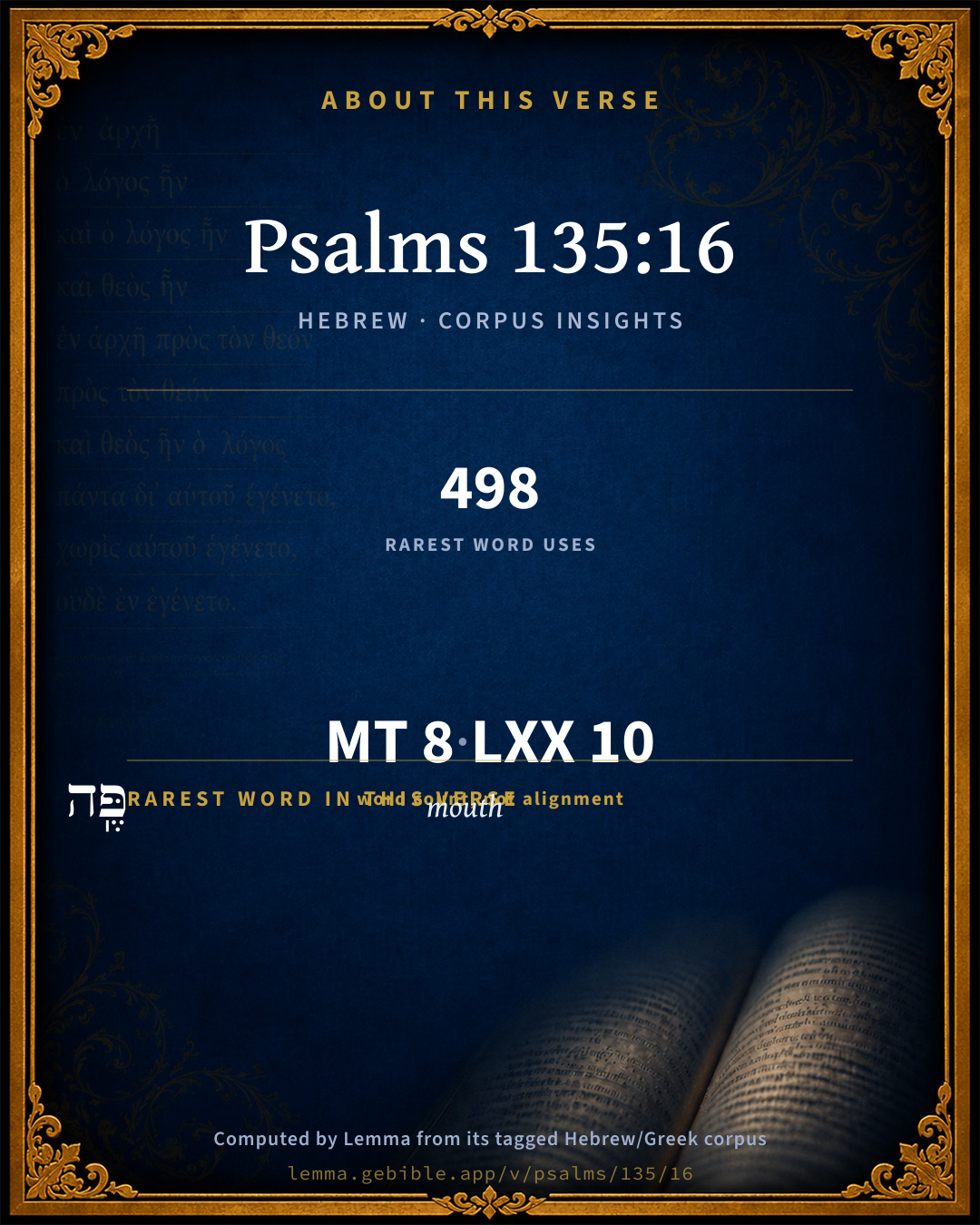
These counts appear in no published source. They are computed here, from the morphology-tagged text and Lemma’s own curated glosses. What Lemma adds →

8
words
5
distinct lemmas
Wisdom
section

Grammatical profile

  • 2 verbs
  • 2 nouns
  • 2 prepositions
  • 2 particles

Verb forms

  • יְדַבֵּ֑רוּ Piel · Imperfect
  • יִרְאֽוּ Qal · Imperfect

Repetition

A word recurs within this verse — often emphatic in Hebrew:

  • וְלֹ֣א not H3808 ×2

Hebrew & Septuagint length

In English translation the verse runs 14 words from the Hebrew and 15 from the Septuagint (LXX English) — closely comparable.

A rough comparison of the two English renderings, which tokenize alike — not a word-level alignment.

Word counts can differ between the Hebrew and the Greek without any difference in meaning — e.g. the Hebrew direct-object marker אֵת has no separate Greek word, and Greek often adds the article ὁ.

In the original languages it is 8 Hebrew tokens and 10 Greek tokens — but the two are counted differently (Hebrew bundles its prefixes and suffixes into one token; the Greek is in lemma form), so that isn’t a like-for-like length.

Cross-references

2

Topical passages linked to Psalms 135:16 in the Treasury of Scripture Knowledge — connected by theme and wording, ordered by reader-vote popularity; previews shown in the World English Bible.

  • Matthew 13:14–16 In them the prophecy of Isaiah is fulfilled, which says, 'By hearing you will hear, And will in no way understand; Seeing you will see, And will in no way perceive:
  • Isaiah 6:10 Make the heart of this people fat; Make their ears heavy, and shut their eyes; Lest they see with their eyes, And hear with their ears, And understand with their heart, And turn again, and be healed."

Cross-references courtesy of OpenBible.info (CC BY 4.0).

Hebrew and Greek witnesses Masoretic Hebrew ↔ Greek Septuagint

The same verse in the two great witnesses to the Old Testament, shown verse-for-verse.

You’re reading Greek Psalm 134 (Hebrew Psalm 135). The Septuagint counts the superscription, so verse numbers can differ from the Hebrew — chapter-level alignment, not verse-by-verse. Numbering follows Rahlfs.

These are two independent witnesses, not word-aligned to each other, and the Septuagint is shown in lemma (dictionary) form.

Hebrew Psalms 135:16 Masoretic · Westminster Leningrad Codex

פֶּֽה לָ֭הֶם וְלֹ֣א יְדַבֵּ֑רוּ עֵינַ֥יִם לָ֝הֶ֗ם וְלֹ֣א יִרְאֽוּ

They have mouths, but they can't speak; They have eyes, but they can't see;

World English Bible · Public Domain

Greek LXX Greek Psalm 134:16 Septuagint · lemma form

στόμα ἔχω καί οὐ λαλέω ὀφθαλμός ἔχω καί οὐ ὁράω

They have a mouth, but they can’t speak; they have eyes, but they can’t see;

LXX2012 (modern English Septuagint) · Public Domain

Hebrew: Westminster Leningrad Codex (CC BY 4.0). Greek: Septuagint (public domain); English from LXX2012 (modern English Septuagint) (Public Domain). How the Septuagint differs from the Hebrew →

Commentary

Notes on Psalms 135:16 from classic Christian and Jewish commentators (each source and its license shown beneath its notes). The classic Christian expositions comment on the surrounding passage and are grouped to its opening verse, so a note may address several verses; the Jewish commentaries on the Tanakh (Rashi and others) are per-verse, so they appear only where the commentator wrote on this verse.

Lemma curates 59 commentaries, every one of them public domain or Creative Commons licensed, each selected and text-cleaned for this edition rather than reprinted as found. About our sources →

Trapp's Complete Commentary

John Trapp

Psa 135:16 They have mouths, but they speak not; eyes have they, but they see not;

Ver. 16. The idols of the heathen] See Psa 115:4-6, &c.

John Trapp, A Commentary or Exposition upon All the Books of the Old and New Testament (1647–1656) — public domain. Text from a community e-Sword module.

The Biblical Illustrator

Joseph S. Exell

Psa_135:16

The idols . . . are silver and gold.

The gold-god

Idolatry consists in giving to any object, whether animate or inanimate, the work of mans hands, or the work of the Divine hands, the love and worship which belongs to the Supreme Existence. Thou shalt have no other God but Me. But to have Him means to love Him with all the heart, mind, and strength. The god of the man is the object he most loves. Hence gold is a divinity, and by no means an insignificant one, perhaps the chief.

I. The gold-god is the most popular of the gods. It is said that ancient Greece and Rome had not less than thirty thousand divinities, and that in modern heathendom, at present, their name is legion. But throughout this civilized world the gold-god reigns supreme. Tell me, is there aught besides that engrosses so much of human thoughts, human affections, human plans, activities and time, as gold? Civilization everywhere multiplies the shrines, the altars, and the devotees of mammon.

II. The gold-god is the most mischievous of the gods. The ponderous wheels of Juggernauts chariot have crushed millions; Krishna, Moloch and other heathen divinities have tortured and destroyed their devotees, but is there a divinity in the long roll of idolatrous worship more terribly destructive than the gold-god?

1. How soul-debasing! It deadens the sense of virtue, blinds moral perceptions, seals up the social sympathies, manacles the moral faculties, and chains that soul made to wing the immeasurable regions of light and truth to a mere clod of dust. It is a law that the soul can never rise above its god.

2. How peace disturbing! It keeps its devotee in a constant tumult. It breaks the harmony of families, disturbs the order of society, raises nations into war and bloodshed. Midas, says Carlyle, longed for gold and insulted the Olympians. He got gold so that whatever he touched became gold, and he, with his long ears, was little the better for it. Midas had insulted Apollo and the gods: the gods gave him his wish, and a pair of long ears which also were a good appendage to it. What a truth in these old fables! (David Thomas, D. D.)

The Biblical Illustrator, edited by Joseph S. Exell (c. 1880s–1900s) — public domain. Text from a community e-Sword module.

J. A. Alexander on Psalms

Joseph Addison Alexander

16. (Psa 135:16) (There is) a mouth to them, and (yet) they speak not; (there are) eyes to them, and (yet) they see not. See above, on Psa 115:5, which agrees exactly with the verse before us.

Joseph Addison Alexander, The Psalms Translated and Explained (1850) — public domain. Text from a community e-Sword module.

John Gill's Exposition

They have ears, but they hear not,.... See Gill on Psa 115:6;

neither is there any breath in their mouths; they are lifeless statues, they have not so much as what the brute creatures have, breath; our Jehovah, as the living God, is rightly opposed to them, who gives life, and breath, and all things, unto man; and yet what amazing stupidity is it, that any of them should worship such as gods, who have not what they themselves have.

John Gill's Exposition of the Whole Bible (1746–1763) — public domain (CC PDM 1.0). Text via the HelloAO Bible API.

The Treasury of David

Charles H. Spurgeon

Ver. 16. They have mouths. For their makers fashioned them like themselves. An opening is made where the mouth should be, and yet it is no mouth, for they eat not, they speak not. They cannot communicate with their worshippers; they are dumb as death. If they cannot even speak, they are not even so worthy of worship as our children at school. Jehovah speaks, and it is done: but these images utter never a word. Surely, if they could speak, they would rebuke their votaries. Is not their silence a still more powerful rebuke? When our philosophical teachers deny that God has made any verbal revelation of himself they also confess that their god is dumb.

Eyes have they, but they see not. Who would adore a blind man how can the heathen be so mad as to bow themselves before a blind image? The eyes of idols have frequently been very costly; diamonds have been used for that purpose; but of what avail is the expense, since they see nothing? If they cannot even see us, how can they know our wants, appreciate our sacrifices, or spy out for us the means of help! What a wretched thing, that a man who can see should bow down before an image which is blind! The worshipper is certainly physically in advance of his god, and yet mentally he is on a level with it; for assuredly his foolish heart is darkened, or he would not so absurdly play the feel.

Ver. 16-17. Mouths, eyes, ears. So many members as the images have, serving to represent perfections ascribed to them, so many are the lies. David Dickson.

Ver. 16-17. They can neither speak in answer to your prayers and inquiries, nor see what you do or what you want, nor hear your petitions, nor smell your incenses and sacrifices, nor use their hands either to take anything from you, or to give anything to you; nor so much as mutter, nor give the least sign of apprehending your condition or concerns. Matthew Pool.

Ver. 16-17. Mouths, but they speak not: ears, but they hear not.

A heated fancy or imagination

May be mistaken for an inspiration.

True; but is this conclusion fair to make

That inspiration must be all mistake?

A pebble stone is not a diamond: true;

But must a diamond be a pebble too?

To own a God who does not speak to men,

Is first to own, and then disown again;

Of all idolatry the total sum

lase having gods that are both deaf and dumb. John Byron, 1691-1763.

Ver. 16-17. The Portrait of many,

1. "Mouths, but they speak not." No prayer, praise, confession.

2. "Eyes, but they see not." Discern not, understand not, take no warning; do not look to Christ.

3. "Ears, but they hear not." Attend no ministry, or are present but unaffected; hear not God.

4. "Neither is there any breath in their mouths." No life, no tokens of life, no prayer and praise which are the breath of spiritual life.

Psalms 135:17*

Charles H. Spurgeon's The Treasury of David (1869–1885) — public domain. Psalms only. Text from a community e-Sword/MySword module.

Lesson kit

Teaching starters — assembled from the data on this page, not authored interpretation. Every prompt links to the verse data it draws on. Edit before teaching.

Psalms, in the Wisdom, opens this verse with 8 words (5 distinct Hebrew lemmas). Its most distinctive word is peh (“mouth”). A historical commentator’s framing appears above. Read the whole chapter for the surrounding context.

Discussion questions

  1. The word peh carries the sense “mouth.” How does it shape the verse?
  2. Matthew 13:14–16 shares this passage’s theme. How do the two illuminate each other?
  3. “not” occurs 2× in this one verse. What is the effect of the repetition?
  4. The translations on this page render this verse differently — a whole-verse word diff, not a word-by-word alignment. What might account for the different wordings?
  5. The verb «יְדַבֵּ֑רוּ» is Piel Imperfect. How does its form color the action?
  6. Reading how Trapp's Complete Commentary and The Biblical Illustrator read this verse, where do the two commentators agree and where do they part?

Things to notice

Reading settings

Reading text

Shown beneath each verse's original-language words.

Old Testament
Old Testament edition

Read the OT as the Masoretic Hebrew (MT) or the Greek Septuagint (LXX).

English shown for the Greek Septuagint (in the Hebrew ↔ Greek comparison).

Comparing translations? Open the Compare panel on any verse page to stack up to four side by side.