
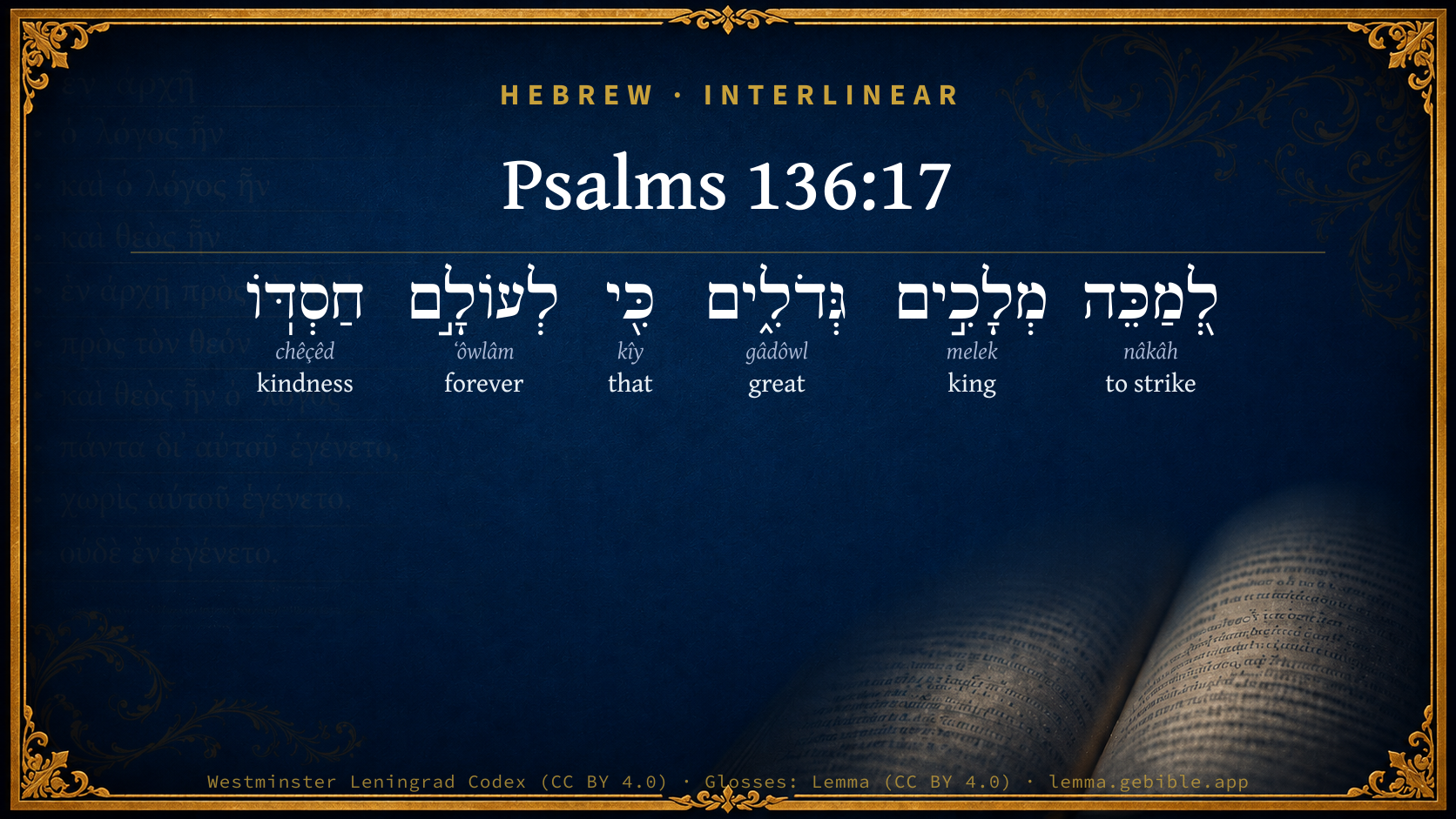
Psalms 136:17

Hebrew (Westminster Leningrad Codex) Psalms 136:17 appears in the Hebrew Old Testament. The text above is from the Westminster Leningrad Codex. Each word links to its Strong’s number, a concise gloss, and parsing drawn from the Open Scriptures Hebrew Bible morphology. Click any word for its full Brown-Driver-Briggs (BDB) entry.
Download image
Cite this verse

Psalms 136:17 (World English Bible). Public Domain. Lemma interlinear Bible study tool, https://lemma.gebible.app/v/psalms/136/17.

Show BibTeX & RIS
BibTeX
RIS
English Translation
To him who struck great kings; For his loving kindness endures forever;
World English Bible · Public Domain
Download a study sheet

One document with this verse’s original text, its word-by-word gloss line, the meaning frame, cross-references with their text, attributed commentary, and full source and license credits — printable, and it pastes into notes with its structure intact.

This verse Autodidact and up

Study sheet (.html) Plain text (.txt)

A passage Seminary Student

Up to 50 verses in one chapter. A passage sheet keeps up to 6 commentary sources and 12 cross-references per verse, in the order this page ranks them, and says so on the sheet whenever that leaves anything out. Ask for a single verse and you get the Autodidact verse sheet above.

Everything on this page stays free to read, with no account — the sheet is a download of what is already on screen, not access to it.

Want to remove ads? Support Godless Engineer
Compare translations 3

The same verse in 3 English versions, stacked beneath the original-language interlinear above. Click any original word for its lexicon entry.

Each is an independent rendering of the whole verse — the interlinear is not word-aligned to these translations.

Highlighted words mark where these versions differ — a whole-verse word diff, not a word-by-word alignment.

  • World English Bible Public Domain
    To him who struck great kings; For his loving kindness endures forever;
  • King James Version Public Domain
    To him which smote great kings: for his mercy endureth for ever:
  • unfoldingWord Literal Text CC BY-SA 4.0
    To the one striking great kings, for his covenant faithfulness to forever.

unfoldingWord Literal Text — © unfoldingWord, licensed CC BY-SA 4.0. Word-aligned USFM3 via Door43 (git.door43.org/unfoldingWord/en_ult).

Versions to compare (up to 4)

3 of 4 selected

Show all 18 translations

Every available English version of this verse, each an independent rendering of the whole verse.

  • World English Bible Public Domain
    To him who struck great kings; For his loving kindness endures forever;
  • Berean Standard Bible Public Domain
    He struck down great kings His loving devotion endures forever.
  • Majority Standard Bible Public Domain
    He struck down great kings His loving devotion endures forever.
  • King James Version Public Domain
    To him which smote great kings: for his mercy endureth for ever:
  • American Standard Version (1901) Public Domain
    To him that smote great kings; For his lovingkindness `endureth' for ever;
  • Revised Version (1885) Public Domain
    To him which smote great kings: for his mercy endureth for ever:
  • Geneva Bible (1599) Public Domain
    Which smote great Kings: for his mercie endureth for euer:
  • Douay-Rheims (1899) Public Domain
    They have ears, but they hear not: neither is there any breath in their mouths.
  • Young's Literal Translation Public Domain
    To Him smiting great kings, For to the age `is' His kindness.
  • Literal Standard Version CC BY-SA 4.0
    To Him striking great kings, || For His kindness [is] for all time.
  • Unlocked Literal Bible CC BY-SA 4.0
    to him who killed great kings, for his covenant faithfulness endures forever.
  • unfoldingWord Literal Text CC BY-SA 4.0
    To the one striking great kings, for his covenant faithfulness to forever.
  • Darby Bible Public Domain
    To him that smote great kings, for his loving-kindness [endureth] for ever,
  • World Messianic Bible Public Domain
    to him who struck great kings, for his loving kindness endures forever;
  • Webster's Bible Public Domain
    To him who smote great kings: for his mercy endureth for ever:
  • Free Bible Version CC BY-SA 4.0
    To him who struck down powerful kings. For his trustworthy love lasts forever.
  • Bible in Basic English Public Domain
    To him who overcame great kings: for his mercy is unchanging for ever:
  • JPS Tanakh (1917) Public Domain
    To Him that smote great kings; for His mercy endureth for ever;

Literal Standard Version (2020), Covenant Press — licensed CC BY-SA 4.0. Text via the HelloAO Bible API (eBible.org). Unlocked Literal Bible (unfoldingWord) — licensed CC BY-SA 4.0. Text via the HelloAO Bible API (eBible.org). unfoldingWord Literal Text — © unfoldingWord, licensed CC BY-SA 4.0. Word-aligned USFM3 via Door43 (git.door43.org/unfoldingWord/en_ult). Free Bible Version, Dr. Jonathan Gallagher — licensed CC BY-SA 4.0. Text via the HelloAO Bible API (eBible.org).

Word by word

More ways to search: Search by grammar → Find every occurrence → Compare this word →

Practice this passage: Drill this verse → Learn its vocabulary →

About this verse

These counts appear in no published source. They are computed here, from the morphology-tagged text and Lemma’s own curated glosses. What Lemma adds →

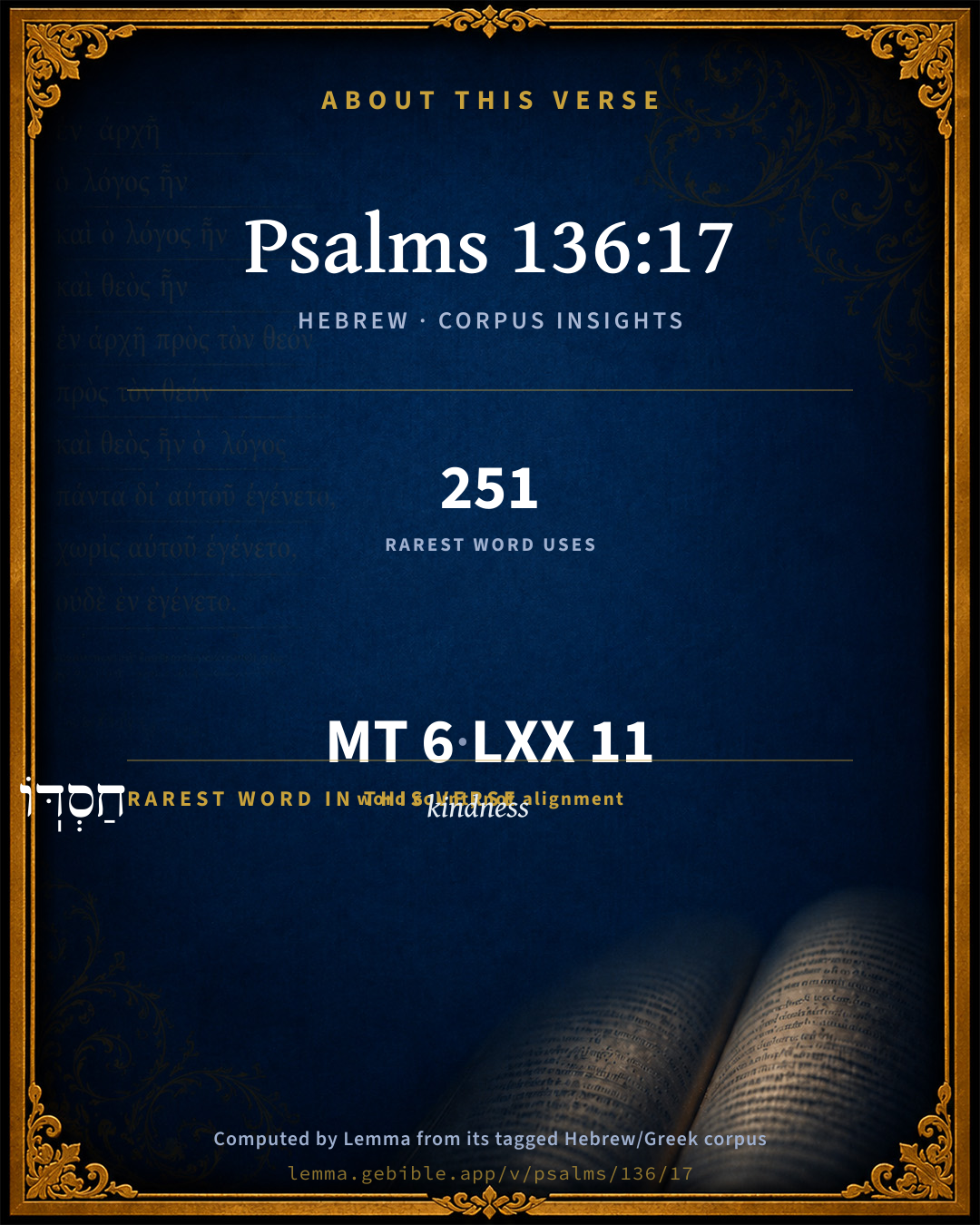
6
words
6
distinct lemmas
Wisdom
section

Grammatical profile

  • 1 verb
  • 3 nouns
  • 1 adjective
  • 1 conjunction

Verb forms

  • לְ֭מַכֵּה Hiphil · Participle Active

Hebrew & Septuagint length

In English translation the verse runs 12 words from the Hebrew and 12 from the Septuagint (LXX English) — the same length.

A rough comparison of the two English renderings, which tokenize alike — not a word-level alignment.

Word counts can differ between the Hebrew and the Greek without any difference in meaning — e.g. the Hebrew direct-object marker אֵת has no separate Greek word, and Greek often adds the article ὁ.

In the original languages it is 6 Hebrew tokens and 11 Greek tokens — but the two are counted differently (Hebrew bundles its prefixes and suffixes into one token; the Greek is in lemma form), so that isn’t a like-for-like length.

Cross-references

2

Topical passages linked to Psalms 136:17 in the Treasury of Scripture Knowledge — connected by theme and wording, ordered by reader-vote popularity; previews shown in the World English Bible.

  • Psalms 135:10–12 Who struck many nations, And killed mighty kings,
  • Joshua 12:1–24 Now these are the kings of the land, whom the children of Israel struck, and possessed their land beyond the Jordan toward the sunrise, from the valley of the Arnon to Mount Hermon, and all the Arabah eastward:

Cross-references courtesy of OpenBible.info (CC BY 4.0).

Hebrew and Greek witnesses Masoretic Hebrew ↔ Greek Septuagint

The same verse in the two great witnesses to the Old Testament, shown verse-for-verse.

You’re reading Greek Psalm 135 (Hebrew Psalm 136). The Septuagint counts the superscription, so verse numbers can differ from the Hebrew — chapter-level alignment, not verse-by-verse. Numbering follows Rahlfs.

These are two independent witnesses, not word-aligned to each other, and the Septuagint is shown in lemma (dictionary) form.

Hebrew Psalms 136:17 Masoretic · Westminster Leningrad Codex

לְ֭מַכֵּה מְלָכִ֣ים גְּדֹלִ֑ים כִּ֖י לְעוֹלָ֣ם חַסְדּֽוֹ

To him who struck great kings; For his loving kindness endures forever;

World English Bible · Public Domain

Greek LXX Greek Psalm 135:17 Septuagint · lemma form

ὁ πατάσσω βασιλεύς μέγας ὅτι εἰς ὁ αἰών ὁ ἔλεος αὐτός

To him who struck great kings: for his mercy endures for ever:

LXX2012 (modern English Septuagint) · Public Domain

Hebrew: Westminster Leningrad Codex (CC BY 4.0). Greek: Septuagint (public domain); English from LXX2012 (modern English Septuagint) (Public Domain). How the Septuagint differs from the Hebrew →

Commentary

Notes on Psalms 136:17 from classic Christian and Jewish commentators (each source and its license shown beneath its notes). The classic Christian expositions comment on the surrounding passage and are grouped to its opening verse, so a note may address several verses; the Jewish commentaries on the Tanakh (Rashi and others) are per-verse, so they appear only where the commentator wrote on this verse.

Lemma curates 59 commentaries, every one of them public domain or Creative Commons licensed, each selected and text-cleaned for this edition rather than reprinted as found. About our sources →

Trapp's Complete Commentary

John Trapp

Psa 136:17 To him which smote great kings: for his mercy [endureth] for ever:

Ver. 17. To him which smote great kings] Great, as those times accounted them, when every small city almost had their king; Canaan had thirty and more of them. Great also in regard of their stature and strength; for they were of the giant’s race, Deu 3:11-13 Amo 2:1

John Trapp, A Commentary or Exposition upon All the Books of the Old and New Testament (1647–1656) — public domain. Text from a community e-Sword module.

The Biblical Illustrator

Joseph S. Exell

Psa_136:17-22

To Him which smote great kings.

Mercy in the destruction of tyrants

I. The mercy of God recognized in the destruction of tyrants.

1. It appears in their own destruction.

(1) If there be no future state it puts an end to their miseries.

(2) If there be, as we believe there is, a state of future punishment, the sooner the incorrigible sinner dies the better for himself; the longer he lives the more guilt he contracts, and the greater his guilt the greater his agonies in a world of retribution.

2. It appears in the relief afforded to the race. When such demons in human flesh are cut down, the world breathes freer, obstacles are swept from its path of progress; when the Pharaohs are engulfed the human Israel can march forward to promised lands.

II. The praises of God celebrated on account of the perpetuity of His mercy.

1. Because Divine mercy will always work for good. Therefore, the longer it continues, the better.

2. Because the future ages of the world will require mercy. There will be much for mercy to do on this planet yet, before the race will be brought hack into harmony with God.

3. Because we ourselves shall ever be dependent on mercy. (Homilist.)

Sihon and Og, or mercies in detail

These six verses reiterate the same fact. Is the tautology tedious; do the chimes weary you with their monotony? For my part I like a repetition in the tune of a psalm as well as in its language. No doubt one verse instead of these six might have sufficed. It might have run thus, Who slew famous kings, Sihon, king of the Amorites, Og, king of Bashan, and gave their land for a heritage to His people, for His mercy endureth for ever. That would have comprehended all the sense. But by this repetition we learn that it is well to dwell long and to dwell deliberately upon some of Gods dealings with Us. This is the theme on which I want to thread a few reflections. And--

I. It is well to deliberate long over the merciful side of Gods judgments. We might have thought it more natural if we had read, for His justice, or, for His vengeance endureth for ever. But though terrible for these tyrants, it was a great mercy for others. When tyrants die nations have time to breathe. When lions fall, or the wolves are slain, the deer and sheep have time to rest. Not mercy to the one man, perhaps, to Nero, Caligula, Tiberius or the like, but to the millions who groaned under his abominable rule. And so of huge systems of error and superstition which have oppressed men. They have passed away, and others shall, for His mercy endureth for ever.

II. Each mercy deserves to be remembered. See with what special point and emphasis each instance is put. They are thus given--

1. Because each mercy we have received is undeserved. In the very chapter which tells of these victories of Israel their murmurings and the fiery serpents that chastised them are told of also. It was to these people God gave these repeated victories.

2. Not one could be dispensed with. Had the Lord stopped when Sihon was slain, what would have become of Israel?

3. There was a peculiarity about each mercy. You never had two mercies from God that were quite alike.

4. But if any mercy deserves to be particularly remembered, it is early mercy. The children of Israel had not got their hands into fighting yet. They were young recruits. And so with ourselves, how we ought to remember Gods mercy to us in the beginning of our career.

III. Each mercy does really in itself deserve separate contemplation. How we dwell in detail and fulness on our troubles. Should we not do so also with our mercies? When I have got some trouble of my own, I think I generally find myself turning it inside out and showing every bit of it--every point of it--upside down, the wrong way up, the right way up, and all ways. Ought I not to do the same with my mercies?

IV. Continued benefits are a special proof of enduring mercy. For God to give one mercy might not prove that His mercy endureth for ever, but when no sooner is one given than another follows, and another follows that, the unbroken succession of wave upon wave in ceaseless regularity does show that His mercy endureth for ever. And is not this what so many of us have to tell of?

V. The overruling of trials is a subject to dwell upon with delight. Israel did not expect to have the territory of Sihon and Og. Their land was on the other side Jordan, but since they attacked them as unexpected foes, they got out of them unexpected territory. Unexpected trials often issue in unexpected advantages.

VI. That all this should be for the same persons further shows that His mercy, etc. For whom does Sihon, does Og, fall but for Israel? All is for them, undeserving, evil, full of provocation as they were. Is there one of us who might not justly be in hell before the clock ticks again, if it were not that His mercy endureth for ever? Do any say, My sins are strong, how can I master them? Cannot He who slew great kings, yea, famous kings, cannot He slay them? (C. H. Spurgeon.)

The Biblical Illustrator, edited by Joseph S. Exell (c. 1880s–1900s) — public domain. Text from a community e-Sword module.

J. A. Alexander on Psalms

Joseph Addison Alexander

17. (Psa 136:17) To him that smote great kings—for unto eternity (is) his mercy. Compare the parallel passage, Psa 135:10, which is here divided by the theme or chorus. See above, on Psa 136:8.

Joseph Addison Alexander, The Psalms Translated and Explained (1850) — public domain. Text from a community e-Sword module.

John Gill's Exposition

To him which smote great kings,.... Either the thirty one kings in the land of Canaan; or those who are after particularly mentioned; which seems best, since the kings of Canaan were petty kings, when these were greater ones;

for his mercy endureth for ever; the smiting of those kings were in mercy to Israel; both to preserve them from falling into their hands, and that they might possess their countries, as is later declared.

John Gill's Exposition of the Whole Bible (1746–1763) — public domain (CC PDM 1.0). Text via the HelloAO Bible API.

Albert Barnes' Notes on the Bible

To him which smote great kings - On this passage see the notes at Psa 135:10-12. There is little difference in the two places, except that here the statement is divided by the refrain, “For his mercy endureth forever.” The idea in the whole passage, in view of the divine interposition in slaying the mighty kings, and in giving their land for a possession to the Hebrew people, is, that it was a proof of mercy and benevolence. It is benevolence to mankind and to the church of God - it is in the interests of humanity, of domestic peace, and of the charities of life, to remove wicked people from the world. This mercy may be manifested further, not merely in removing the wicked, but in transferring their possessions to those who will make a better use of them. Thus the possessions of these mighty kings, Sihon and Og, were transferred to the people of God, and lands which had been devoted to the service of blood, ambition, crime, pollution, and idolatry, became devoted to the service of religion and righteousness. In like manner, through the removal of a wicked man from the world by death, God may cause his wealth, accumulated by avarice and dishonesty, to be transferred to the hands of children who will make a good use of it - children converted as if in anticipation of this, and with a view to this. Among the highest expressions of mercy to the world may be, therefore, the removal of wicked princes in war - or the removal of wicked people, in other ranks of life, by death in any form.

Albert Barnes' Notes on the Bible (1834–1885) — public domain. Text from a community e-Sword/MySword module.

The Treasury of David

Charles H. Spurgeon

Ver. 17. To him which smote great kings. Within sight of their inheritance Israel had to face powerful enemies. Kings judged to be great because of the armies at their back blocked up their road. This difficulty soon disappeared, for the Lord smote their adversaries, and a single stroke sufficed for their destruction. He who had subdued the really mighty ruler of Egypt made short work of these petty sovereigns, great though they were in the esteem of neighbouring princes.

For his mercy endureth for ever. Mercy, which had brought the chosen tribes so far, would not be balked by the opposition of boastful foes. The Lord who smote Pharaoh at the beginning of the wilderness march, smote Sihon and Og at the close of it. How could these kings hope to succeed when even mercy itself was in arms against them.

Evermore his mercy stands

Saving from the foe man's hands.

Ver. 17. Great kings. Great, as those times accounted them, when every small city almost had her king. Canaan had thirty and more of them. Great also in regard of their stature and strength; for they were of the giants' race. De 3:1-29 Am 2:1-16 John Trapp.

Ver. 17-22. See "Spurgeon's Sermons", No. 1285: "Sihon and Og; or, Mercies in Detail."

Psalms 136:18*

Charles H. Spurgeon's The Treasury of David (1869–1885) — public domain. Psalms only. Text from a community e-Sword/MySword module.

Whedon's Commentary on the Bible

Daniel D. Whedon

17-21. On these verses see notes on Psa_135:10-12. It is possible, as some have hinted, that Sihon and Og, with their powerful kingdoms, are here specially alluded to, because these rich trans-Jordanic regions were, at this date, lost to the Jewish territory, and, with Samaria and Galilee on the west, were never fully restored until after the captivity. But faith in their restoration the exiles sought to cherish and strengthen by the rehearsal of their ancient conquest by Moses and Joshua.

Daniel D. Whedon (gen. ed.), Commentary on the Old and New Testaments (1874–1909) — public domain. Text from a community e-Sword module.

The Pulpit Commentary

To him which smote great kings. (see the comment on Psa_135:10) For his mercy, etc.

The Pulpit Commentary (1880–1919), ed. H.D.M. Spence-Jones & Joseph S. Exell — public domain. Text from a community e-Sword module.

Rashi

Rabbi Shlomo Yitzchaki (Rashi)

great kings Here he alluded to the thirty-one kings, and he compared for them Pharaoh and his host and the plagues of Egypt to mighty kings, harsher than they. Sihon was equal to all of them, [and Og was equal to all of them (Machzor Vitry)], each one individually, and so did he explain above (135: 11): “Sihon the king of the Amorites and Og the king of Bashan and all the kingdoms of Canaan.” So it is in the Aggadah.

Rashi on the Tanakh — English translations: “The Judaica Press complete Tanach with Rashi, translated by A. J. Rosenberg” (CC BY 4.0); “Pentateuch with Rashi's commentary by M. Rosenbaum and A.M. Silbermann, 1929-1934” (public domain); “The Metsudah Tanach series, Lakewood, N.J” (CC BY 4.0); and “The Book of Joshua, Metsudah Publications, 1997” (CC BY 4.0). Text via Sefaria.

Lesson kit

Teaching starters — assembled from the data on this page, not authored interpretation. Every prompt links to the verse data it draws on. Edit before teaching.

Psalms, in the Wisdom, opens this verse with 6 words (6 distinct Hebrew lemmas). Its most distinctive word is chêçêd (“kindness”). A historical commentator’s framing appears above. Read the whole chapter for the surrounding context.

Discussion questions

  1. What does “kindness” (chêçêd) contribute to the verse as a whole?
  2. Psalms 135:10–12 shares this passage’s theme. How do the two illuminate each other?
  3. These translations render this verse differently. What is at stake in choosing one wording over another?
  4. The verb «לְ֭מַכֵּה» is Hiphil Participle Active. How does its form color the action?
  5. Reading how Trapp's Complete Commentary and The Biblical Illustrator read this verse, where do the two commentators agree and where do they part?

Things to notice

Reading settings

Reading text

Shown beneath each verse's original-language words.

Old Testament
Old Testament edition

Read the OT as the Masoretic Hebrew (MT) or the Greek Septuagint (LXX).

English shown for the Greek Septuagint (in the Hebrew ↔ Greek comparison).

Comparing translations? Open the Compare panel on any verse page to stack up to four side by side.