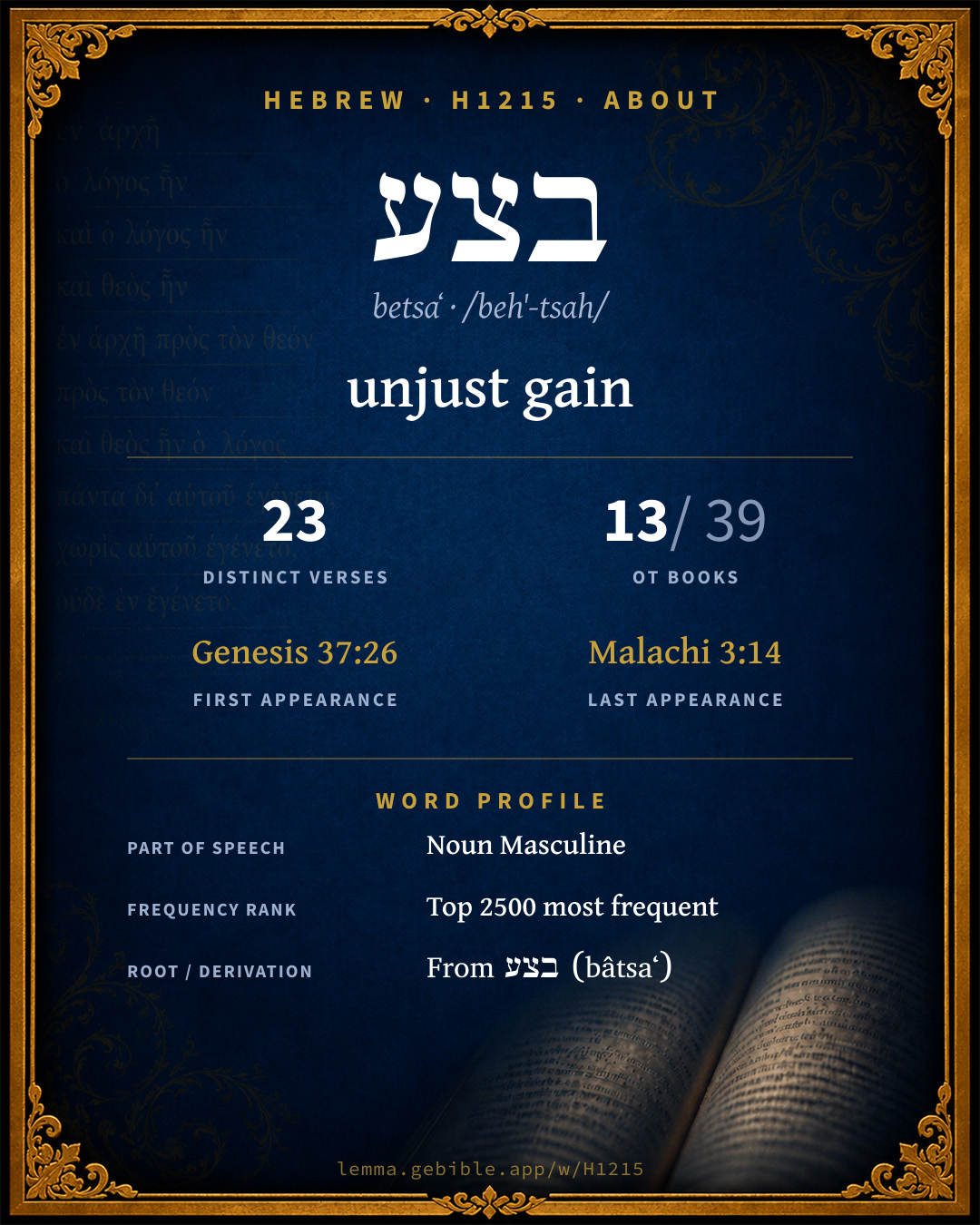
בֶּ֫צַע
unjust gain
Full lexicon entry — Brown-Driver-Briggs (BDB)
From Brown-Driver-Briggs (BDB)
Where this word appears
See every Absolute-state word in the Hebrew Bible →
Grammar key — what these labels mean
Part of speech
- Noun
- A naming word — a person, place, thing, or idea.
Noun type
- Common
- A common noun — a general class of person, place, or thing (“king,” “city,” “water”), not a specific name.
State
- Absolute
- The independent form of a noun, not bound to a following word.
- Construct
- A noun bound to a following noun in a possessive / “of” relationship (the construct chain).
Gender
- Masculine
- Grammatically masculine.
Number
- Singular
- One.
Grammatical forms
- Noun, Common, Masculine, Singular, Absolute 14 times (61%)
- Noun, Common, Masculine, Singular, Construct 9 times (39%)
Parsed forms decoded from the imported morphology (morphhb / Westminster Leningrad Codex — WLC text public domain, morphhb tagging CC BY 4.0), counted across 23 parsed occurrences — not distinct verses.
Every verse where H1215 appears — 23 distinct verses across 13 books. Click any verse to open its interlinear word-by-word view. Verse text shown in the World English Bible for context — . Each verse’s Hebrew form is shown with its reference; the English is not keyword-highlighted, since the data carries no word-level English alignment. Use “Compare translations” on any verse to read it across multiple English versions. This concordance covers the Hebrew Bible; Septuagint (Greek Old Testament) occurrences are not indexed here.
Genesis 1 verse
Exodus 1 verse
Judges 1 verse
1 Samuel 1 verse
Job 1 verse
Psalms 2 verses
Proverbs 3 verses
- Proverbs 1:19 בָּ֑צַע n c ms So are the ways of everyone who is greedy for gain. It takes away the life of its owners.
- Proverbs 15:27 בָּ֑צַע n c ms He who is greedy for gain troubles his own house, But he who hates bribes will live.
- Proverbs 28:16 בֶ֝֗צַע n c ms A tyrannical ruler lacks judgment. One who hates ill-gotten gain will have long days.
Isaiah 3 verses
- Isaiah 33:15 בְּ/בֶ֣צַע prep + n c ms cs He who walks righteously, and speaks blamelessly; he who despises the gain of oppressions, who shakes his hands from taking a bribe, who stops his ears from hearing of blood, and shuts his eyes from looking on evil:
- Isaiah 56:11 לְ/בִצְע֖/וֹ prep + n c ms cs + sfx pers 3ms Yes, the dogs are greedy, they can never have enough; and these are shepherds who can't understand: they have all turned to their own way, each one to his gain, from every quarter.
- Isaiah 57:17 בִּצְע֛/וֹ n c ms cs + sfx pers 3ms For the iniquity of his covetousness was I angry, and struck him; I hid [my face] and was angry; and he went on backsliding in the way of his heart.
Jeremiah 4 verses
- Jeremiah 6:13 בָּ֑צַע n c ms For from the least of them even to the greatest of them everyone is given to covetousness; and from the prophet even to the priest everyone deals falsely.
- Jeremiah 8:10 בָּ֑צַע n c ms Therefore will I give their wives to others, and their fields to those who shall possess them: for everyone from the least even to the greatest is given to covetousness; from the prophet even to the priest every one deals falsely.
- Jeremiah 22:17 בִּצְעֶ֑/ךָ n c ms cs + sfx pers 2ms But your eyes and your heart are not but for your covetousness, and for shedding innocent blood, and for oppression, and for violence, to do it.
- Jeremiah 51:13 בִּצְעֵֽ/ךְ n c ms cs + sfx pers 2fs You who dwell on many waters, abundant in treasures, your end is come, the measure of your covetousness.
Ezekiel 3 verses
- Ezekiel 22:13 בִּצְעֵ֖/ךְ n c ms cs + sfx pers 2fs Behold, therefore, I have struck my hand at your dishonest gain which you have made, and at your blood which has been in the midst of you.
- Ezekiel 22:27 בָּֽצַע n c ms Her princes in the midst of it are like wolves ravening the prey, to shed blood, [and] to destroy souls, that they may get dishonest gain.
- Ezekiel 33:31 בִצְעָ֖/ם n c ms cs + sfx pers 3mp They come to you as the people comes, and they sit before you as my people, and they hear your words, but don't do them; for with their mouth they show much love, but their heart goes after their gain.
Micah 1 verse
Habakkuk 1 verse
Malachi 1 verse
About this entry
At a glance — auto-summarized from this page’s data, not written by a person. Every figure links to its source below. This summary describes the numbers; it doesn’t interpret them.
At its core, בצע (betsaʻ) means “unjust gain.” First canonically at Genesis 37:26, it enters the text early. With 23 verses in 13 books, it is an uncommon word in the Hebrew Bible. Each statement above links to its evidence; the full detail follows below.
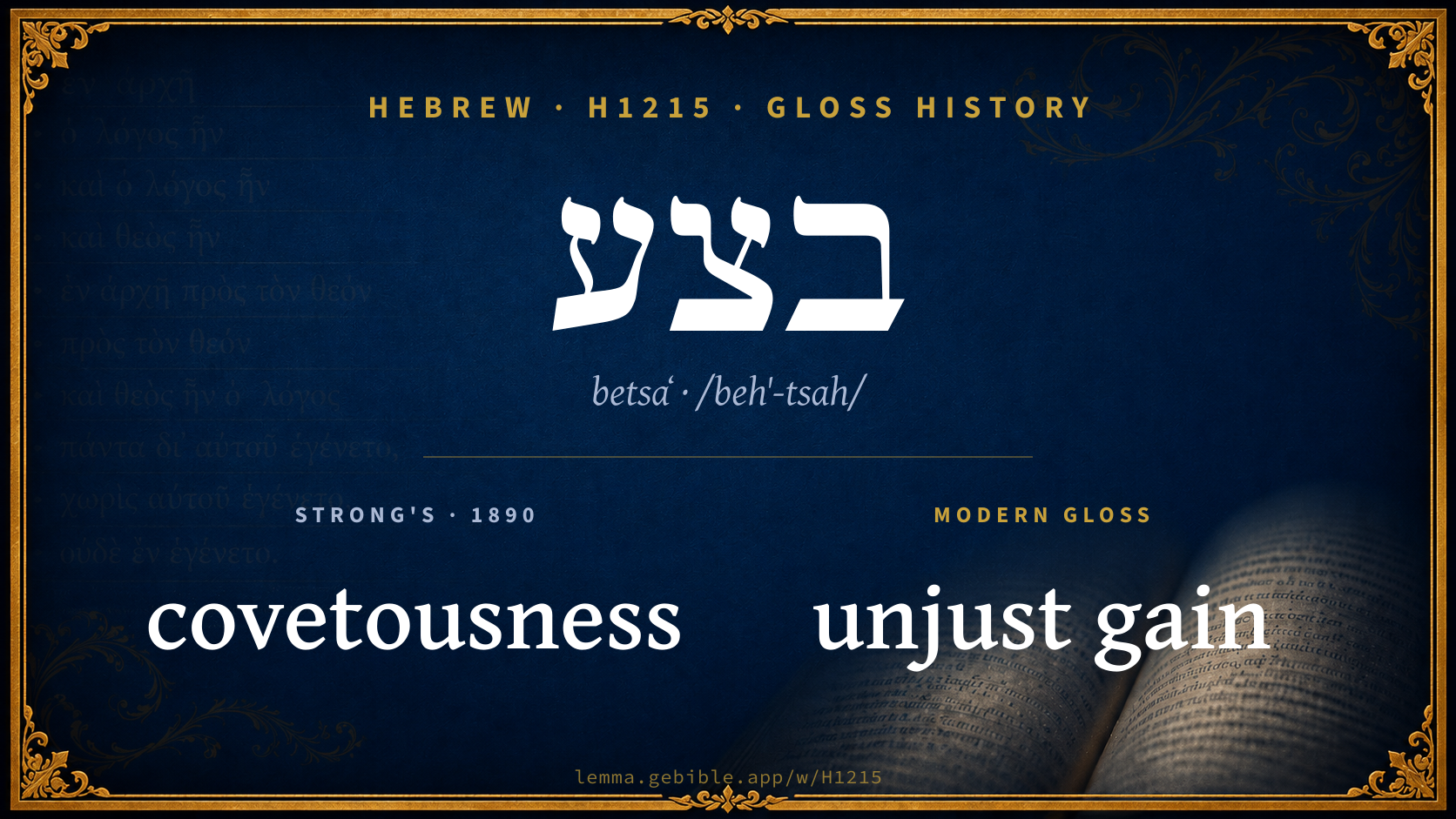
Gloss history
Strong's 1890 vs modern scholarship
About this word
Strong's H1215 catalogs a Hebrew word from the Hebrew Old Testament.
These counts are not copied from any lexicon or concordance. They are computed here, from the morphology-tagged Hebrew Old Testament. What Lemma adds →
- 23
- distinct verses
- The word appears in 23 distinct verses.
- 13 / 39
- OT books
- The word appears in 13 of 39 Old Testament books.
- #1,368
- by frequency
- Top 2500 most frequent Hebrew words (rank 1,368 of 8,640 Hebrew words by occurrence).
View all 23 occurrences in the concordance →
By section of the Old Testament
By traditional corpus
Conventional, traditional groupings — biblical authorship is debated, so this is a traditional corpus grouping, not an authorship claim. Each share is this word’s portion of its verses in that division of the Hebrew canon. Each figure is a share of the word’s 23 distinct verses.
- Prophets (Nevi'im) 15 verses · 65%
- Writings (Ketuvim) 6 verses · 26%
- Torah (Pentateuch) 2 verses · 9%
How translations render this word
Counts come from each version’s own published word-to-Strong’s tagging or interlinear alignment — an approximate guide to how each version renders this word, not a word-level alignment the data otherwise carries. Because each total is that version’s own tagged count, the per-version totals vary from one another and need not match the appearance or distinct-verse counts above. These counts may also differ from a printed concordance because Lemma counts each distinctly tagged rendering and does not collapse phrase taggings into a single head-word total. This is a fixed set of word-tagged versions (KJV, ASV, BSB, ULT) and does not change with the reading translation you choose elsewhere. Each version’s license is shown beside its name below (and on Sources).
- King James Version: Covetousness 9×, Gain 6×, Profit 3×
- American Standard Version: Gain 8×, Covetousness 6×, Profit 3×
- Berean Standard Bible: Gain 6×, Dishonest gain 3×, Unjust gain 3×
- unfoldingWord Literal Text: Gain 5×, Unjust gain 4×, Dishonest gain 3×
King James Version Public Domain
Renders H1215 across 23 tagged occurrences — most commonly:
Plus 3 renderings that appear only once — usually multi-word phrases or single function words the recovered tagging swept in, not distinct renderings.
American Standard Version Public Domain
Renders H1215 across 23 tagged occurrences — most commonly:
Plus 4 renderings that appear only once — usually multi-word phrases or single function words the recovered tagging swept in, not distinct renderings.
Berean Standard Bible Public Domain
Renders H1215 across 22 tagged occurrences — most commonly:
Plus 10 renderings that appear only once — usually multi-word phrases or single function words the recovered tagging swept in, not distinct renderings. Not rendered by a distinct English word in 1 further occurrence.
unfoldingWord Literal Text CC BY-SA 4.0
Renders H1215 across 25 tagged occurrences — most commonly:
Plus 9 renderings that appear only once — usually multi-word phrases or single function words the recovered tagging swept in, not distinct renderings.
Senses in BDB
The 1 sense BDB distinguishes for this word, in lexicon order (not ranked by frequency or importance). The full entry — with sub-senses — is in the Lexicon Entry tab.
- profit, unjust gain, gain (profit) acquired by violence
Word origin
בֶ֫צַע n.m. gain made by violence, unjust gain, profit
— Brown-Driver-Briggs (Oxford 1906, public domain), digitized via Sefaria, supplemented by the OpenScriptures HebrewLexicon (CC BY 4.0). See Sources.
Derived from בצע (bâtsaʻ) (H1214) — to cut off.
Jastrow Dictionary
A second Hebrew/Aramaic lexicon for comparison, covering Aramaic and post-biblical (Talmudic, Targumic, Midrashic) usage that the biblical-Hebrew BDB does not. Matched by lemma rather than by Strong’s number, so a lemma may carry more than one Jastrow headword (shown separately below), and the entries cover usage well beyond the Bible.
בָּצַע
- 1. to cut, break, esp. to break bread and say the blessing. Ḥull. 7ᵇ מימיו לא ב׳ על וכ׳ never said grace over a piece of bread which was not his own (never accepted an invitation). Ber. 46ᵃ בע"הב בּוֹצֵעַ וכ׳ the host breaks the bread and the guest says grace after meal. Ib. 47ᵃ אין הבוצע רשאי לִבְצוֹעַ וכ׳ he who is chosen to break the bread, must not begin to break until the Amen of those that respond (to the blessing) is finished; a. fr.
- 2. to split the difference, to adjust, compromise. Snh. 6ᵇ top נגמר … לבצוע after the legal proceedings are closed, thou must not act as an arbiter in a compromise. Ib. אסור לב׳ the court is forbidden to attempt a settlement (you must let the law take its course). Ib. מצוה לב׳ it is a meritorious act to bring about a settlement. Ib. (before having formed an opinion the judge may say) צאו ובִצְעוּ go out and settle; a. fr.
- to adjust. Y. Snh. I, 18ᵇ top המְבַצֵּעַ חוטא the judge who settles a case is a sinner. Ib. לְבַצֵּעַ (interch. with לבצוע). V. בִּיצּוּעַ.
בְּצַע
- 1. to break. B. Bath. 91ᵇ כד הוה ב׳ ינוקא וכ׳ when a child broke apart a piece of St. John’s bread. Sabb. 140ᵇ, v. בִּיצּוּעָא.—
- *2. to tear away, rescue (cmp. פצי). Targ. Job XXXIII, 18 יבצע Ms. (ed. ימנע).
- to break. Targ. O. Lev. II, 6 (Var. בְּצַע Pe.). [Y. Taan. IV, 69ᵇ; Y. Meg. I, 70ᵃ bot. מבצע (Cant. R. to I, 16 מצנעה) read: מנצב, מנצבה, v. נְצַב.]
A Dictionary of the Targumim, the Talmud Babli and Yerushalmi, and the Midrashic Literature (Marcus Jastrow; London, Luzac, 1903) — Public Domain. Digitized via Sefaria. Digitized via Sefaria. Full attribution on Sources.
Forms in the corpus
The 16 distinct written forms H1215 takes in the Hebrew Bible, most frequent first — each parse links to that state’s occurrences in the concordance. Hebrew forms include their vowel points and cantillation, so a single lemma takes many written forms.
Septuagint verse parallels
This word appears in 22 verses that also exist in the Greek Old Testament (Septuagint), out of the 23 Hebrew verses it occurs in. You can read those verses in Greek by switching the Old Testament edition to the Septuagint.
Read these verses in the Septuagint
- Genesis 37:26
- Exodus 18:21
- Judges 5:19
- 1 Samuel 8:3
- Job 22:3
- Psalms 30:9
- Proverbs 1:19
- Isaiah 33:15
- Jeremiah 6:13
- Ezekiel 22:13
- Micah 4:13
- Habakkuk 2:9
This is a verse-level parallel only — the same verses exist in both the Hebrew and Greek Old Testaments. No word-level Hebrew↔Greek correspondence is claimed: the data carries no such alignment, so no Greek word is shown as this Hebrew word’s translation. Coverage is not total — the Septuagint omits the deuterocanon and renumbers the Psalms, so some Hebrew verses have no direct Greek parallel.