
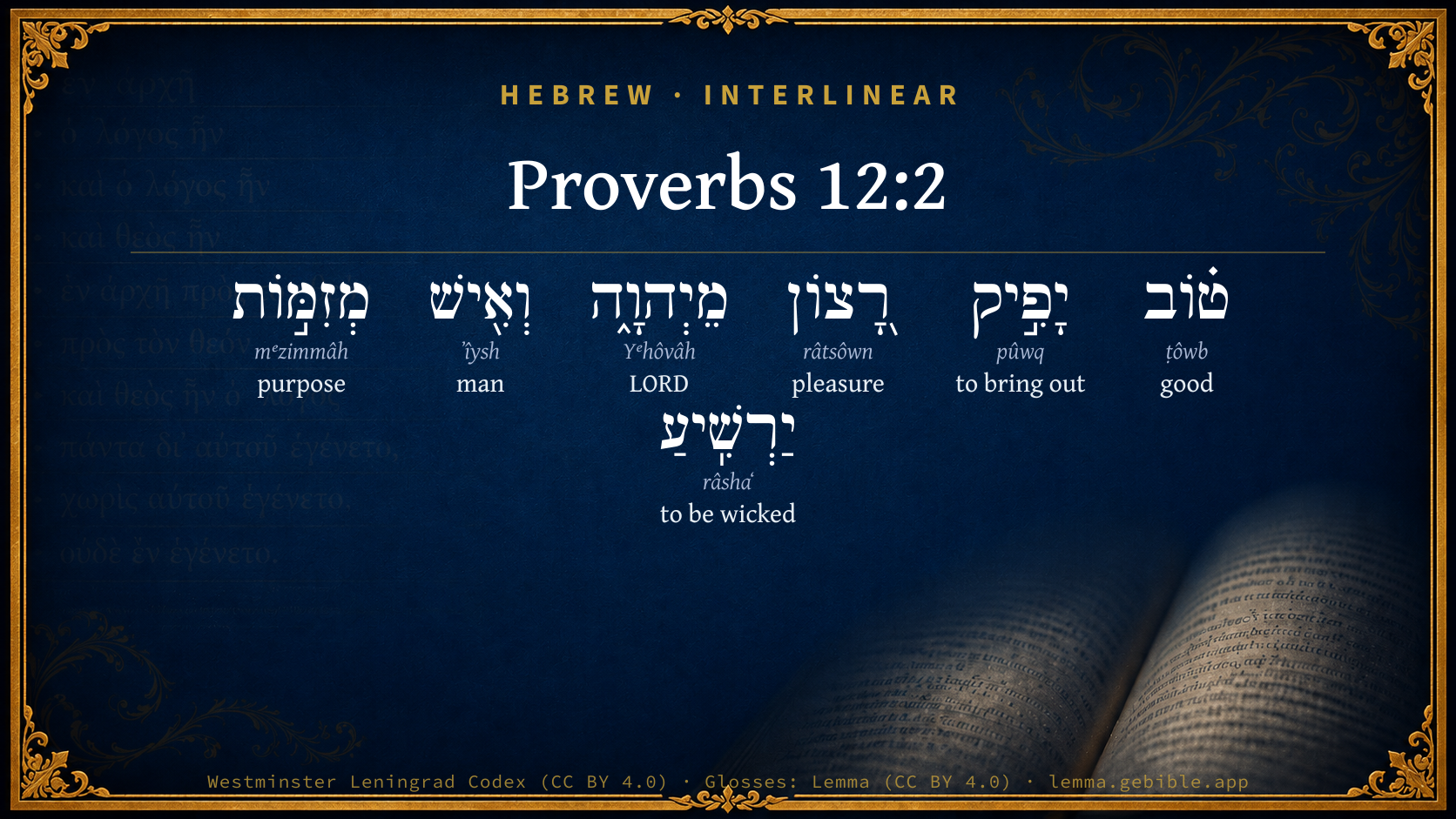
Proverbs 12:2

Hebrew (Westminster Leningrad Codex) Proverbs 12:2 appears in the Hebrew Old Testament. The text above is from the Westminster Leningrad Codex. Each word links to its Strong’s number, a concise gloss, and parsing drawn from the Open Scriptures Hebrew Bible morphology. Click any word for its full Brown-Driver-Briggs (BDB) entry.
Download image
Cite this verse

Proverbs 12:2 (World English Bible). Public Domain. Lemma interlinear Bible study tool, https://lemma.gebible.app/v/proverbs/12/2.

Show BibTeX & RIS
BibTeX
RIS
English Translation
A good man shall obtain favor from Yahweh, But he will condemn a man of wicked devices.
World English Bible · Public Domain
Download a study sheet

One document with this verse’s original text, its word-by-word gloss line, the meaning frame, cross-references with their text, attributed commentary, and full source and license credits — printable, and it pastes into notes with its structure intact.

This verse Autodidact and up

Study sheet (.html) Plain text (.txt)

A passage Seminary Student

Up to 50 verses in one chapter. A passage sheet keeps up to 6 commentary sources and 12 cross-references per verse, in the order this page ranks them, and says so on the sheet whenever that leaves anything out. Ask for a single verse and you get the Autodidact verse sheet above.

Everything on this page stays free to read, with no account — the sheet is a download of what is already on screen, not access to it.

Want to remove ads? Support Godless Engineer
Compare translations 3

The same verse in 3 English versions, stacked beneath the original-language interlinear above. Click any original word for its lexicon entry.

Each is an independent rendering of the whole verse — the interlinear is not word-aligned to these translations.

Highlighted words mark where these versions differ — a whole-verse word diff, not a word-by-word alignment.

  • World English Bible Public Domain
    A good man shall obtain favor from Yahweh, But he will condemn a man of wicked devices.
  • King James Version Public Domain
    A good man obtaineth favour of the LORD: but a man of wicked devices will he condemn.
  • unfoldingWord Literal Text CC BY-SA 4.0
    A good one obtains favor from Yahweh, but a man of schemes he will condemn.

unfoldingWord Literal Text — © unfoldingWord, licensed CC BY-SA 4.0. Word-aligned USFM3 via Door43 (git.door43.org/unfoldingWord/en_ult).

Versions to compare (up to 4)

3 of 4 selected

Show all 18 translations

Every available English version of this verse, each an independent rendering of the whole verse.

  • World English Bible Public Domain
    A good man shall obtain favor from Yahweh, But he will condemn a man of wicked devices.
  • Berean Standard Bible Public Domain
    The good man obtains favor from the LORD, but the LORD condemns a man who devises evil.
  • Majority Standard Bible Public Domain
    The good man obtains favor from the LORD, but the LORD condemns a man who devises evil.
  • King James Version Public Domain
    A good man obtaineth favour of the LORD: but a man of wicked devices will he condemn.
  • American Standard Version (1901) Public Domain
    A good man shall obtain favor of Jehovah; But a man of wicked devices will he condemn.
  • Revised Version (1885) Public Domain
    A good man shall obtain favour of the LORD: but a man of wicked devices will he condemn.
  • Geneva Bible (1599) Public Domain
    A good man getteth fauour of the Lord: but the man of wicked immaginations will hee condemne.
  • Douay-Rheims (1899) Public Domain
    He that is good, shall draw grace from the Lord: but he that trusteth in his own devices doth wickedly.
  • Young's Literal Translation Public Domain
    The good bringeth forth favour from Jehovah, And the man of wicked devices He condemneth.
  • Literal Standard Version CC BY-SA 4.0
    The good brings forth favor from YHWH, || And the man of wicked schemes He condemns.
  • Unlocked Literal Bible CC BY-SA 4.0
    Yahweh gives favor to a good man, but he condemns a man who makes evil plans.
  • unfoldingWord Literal Text CC BY-SA 4.0
    A good one obtains favor from Yahweh, but a man of schemes he will condemn.
  • Darby Bible Public Domain
    A good [man] obtaineth favour of Jehovah; but a man of mischievous devices will he condemn.
  • World Messianic Bible Public Domain
    A good man shall obtain favor from the LORD, but he will condemn a man of wicked plans.
  • Webster's Bible Public Domain
    A good man obtaineth favor from the LORD: but a man of wicked devices he will condemn.
  • Free Bible Version CC BY-SA 4.0
    The Lord blesses the good, but he condemns anyone with evil schemes.
  • Bible in Basic English Public Domain
    A good man has grace in the eyes of the Lord; but the man of evil designs gets punishment from him.
  • JPS Tanakh (1917) Public Domain
    A good man shall obtain favour of the LORD; but a man of wicked devices will He condemn.

Literal Standard Version (2020), Covenant Press — licensed CC BY-SA 4.0. Text via the HelloAO Bible API (eBible.org). Unlocked Literal Bible (unfoldingWord) — licensed CC BY-SA 4.0. Text via the HelloAO Bible API (eBible.org). unfoldingWord Literal Text — © unfoldingWord, licensed CC BY-SA 4.0. Word-aligned USFM3 via Door43 (git.door43.org/unfoldingWord/en_ult). Free Bible Version, Dr. Jonathan Gallagher — licensed CC BY-SA 4.0. Text via the HelloAO Bible API (eBible.org).

Word by word

More ways to search: Search by grammar → Find every occurrence → Compare this word →

Practice this passage: Drill this verse → Learn its vocabulary →

About this verse

These counts appear in no published source. They are computed here, from the morphology-tagged text and Lemma’s own curated glosses. What Lemma adds →

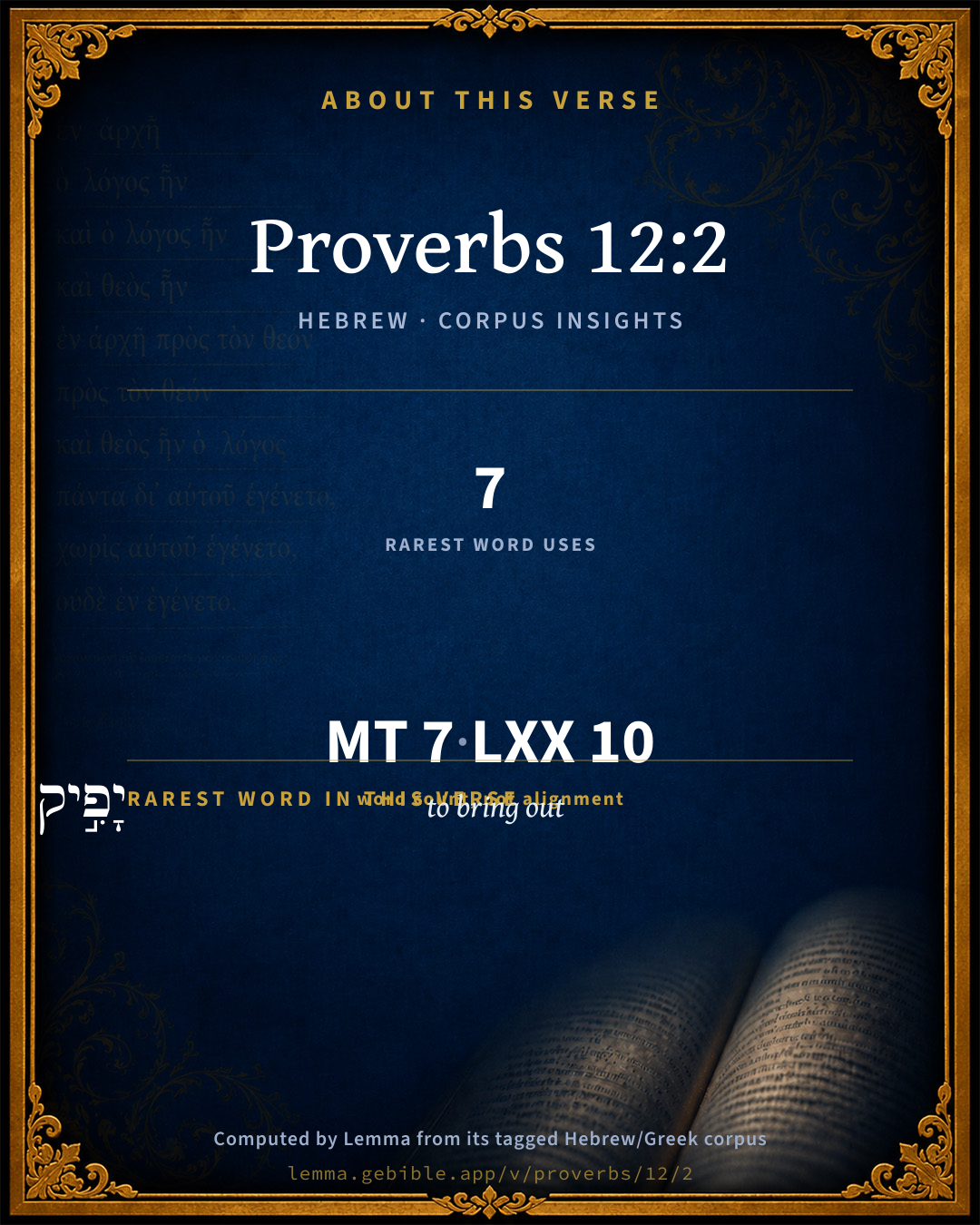
7
words
7
distinct lemmas
Wisdom
section

Notable vocabulary

The rarest word here is יָפִ֣יק to bring out H6329 — appearing just 7 times in the whole Hebrew Bible.

Shared distinctive vocabulary

יָפִ֣יק to bring out H6329 occurs in 7 verses of the Hebrew Bible. Also found in:

Grammatical profile

  • 2 verbs
  • 4 nouns
  • 1 adjective

Verb forms

  • יָפִ֣יק Hiphil · Imperfect
  • יַרְשִֽׁיעַ Hiphil · Imperfect

Hebrew & Septuagint length

In English translation the verse runs 17 words from the Hebrew and 20 from the Septuagint (LXX English) — closely comparable.

A rough comparison of the two English renderings, which tokenize alike — not a word-level alignment.

Word counts can differ between the Hebrew and the Greek without any difference in meaning — e.g. the Hebrew direct-object marker אֵת has no separate Greek word, and Greek often adds the article ὁ.

In the original languages it is 7 Hebrew tokens and 10 Greek tokens — but the two are counted differently (Hebrew bundles its prefixes and suffixes into one token; the Greek is in lemma form), so that isn’t a like-for-like length.

Cross-references

9

Topical passages linked to Proverbs 12:2 in the Treasury of Scripture Knowledge — connected by theme and wording, ordered by reader-vote popularity; previews shown in the World English Bible.

  • Proverbs 8:35 For whoever finds me, finds life, And will obtain favor from Yahweh.
  • Acts 11:24 For he was a good man, and full of the Holy Spirit and of faith, and many people were added to the Lord.
  • Psalms 112:5 It is well with the man who deals graciously and lends. He will maintain his cause in judgment.
  • Romans 5:7 For one will hardly die for a righteous man. Yet perhaps for a righteous person someone would even dare to die.
  • Proverbs 1:31 Therefore they will eat of the fruit of their own way, And be filled with their own schemes.
  • Isaiah 32:5–7 The fool shall be no more called noble, nor the scoundrel be highly respected.
  • Psalms 9:15 The nations have sunk down in the pit that they made; In the net which they hid, their own foot is taken.
  • Proverbs 6:18 A heart that devises wicked schemes, Feet that are swift in running to mischief,
  • Ecclesiastes 8:8 There is no man who has power over the spirit to contain the spirit; neither does he have power over the day of death. There is no discharge in war; neither shall wickedness deliver those who practice it.

Cross-references courtesy of OpenBible.info (CC BY 4.0).

Hebrew and Greek witnesses Masoretic Hebrew ↔ Greek Septuagint

The same verse in the two great witnesses to the Old Testament, shown verse-for-verse.

These are two independent witnesses, not word-aligned to each other, and the Septuagint is shown in lemma (dictionary) form.

Hebrew Proverbs 12:2 Masoretic · Westminster Leningrad Codex

ט֗וֹב יָפִ֣יק רָ֭צוֹן מֵיְהוָ֑ה וְאִ֖ישׁ מְזִמּ֣וֹת יַרְשִֽׁיעַ

A good man shall obtain favor from Yahweh, But he will condemn a man of wicked devices.

World English Bible · Public Domain

Greek LXX Proverbs 12:2 Septuagint · lemma form

κρείσσων ὁ εὑρίσκω χάρις παρά κύριος ἀνήρ δέ παράνομος παρασιωπάω

He that has found favor with the Lord is made better; but a transgressor shall be passed over in silence.

LXX2012 (modern English Septuagint) · Public Domain

On this verse, The Pulpit Commentary discusses the Septuagint’s reading. Read the note in Commentary ↓

Hebrew: Westminster Leningrad Codex (CC BY 4.0). Greek: Septuagint (public domain); English from LXX2012 (modern English Septuagint) (Public Domain). How the Septuagint differs from the Hebrew →

Commentary

Notes on Proverbs 12:2 from classic Christian and Jewish commentators (each source and its license shown beneath its notes). The classic Christian expositions comment on the surrounding passage and are grouped to its opening verse, so a note may address several verses; the Jewish commentaries on the Tanakh (Rashi and others) are per-verse, so they appear only where the commentator wrote on this verse.

Lemma curates 59 commentaries, every one of them public domain or Creative Commons licensed, each selected and text-cleaned for this edition rather than reprinted as found. About our sources →

Trapp's Complete Commentary

John Trapp

Pro 12:2 A good [man] obtaineth favour of the LORD: but a man of wicked devices will he condemn.

Ver. 2. A good man obtaineth favour of the Lord.] Or, "Hath what he will of God"; id quod vult a Domino impetrat; quia eius voluntas est ipsissima Dei voluntas, nec aliud vult. Thus Mercer out of Rabbi Levi. Thus it is written of Luther, that by his prayers he could prevail with God at his pleasure. When great gifts were offered him, he refused them with this brave speech, Valde protestatus sum me nolle sic satiari a Deo: - I solemnly protested to God, that I would not be put off with these low things. And on a time praying for the recovery of a godly useful man, among other passages, he let fall this transcendent rapture of a daring faith, Fiat mea voluntas, "Let my will be done"; and then falls off sweetly, Mea voluntas, Domine, quia tua; " My will, Lord, because thy will!" Here was a good man, here was a blessed man; according to that rule, Beatus est qui habet quicquid vult, et nihil male vult; - Blessed is he that hath what he will, and wills nothing but what he should.

But a man of wicked devices.] Such as no good man is; he doth not plot or plough mischief; he doth not cater and "make provision for the flesh"; {Rom 13:14} there is no "way of wickedness" {Psa 139:24} found in him; the peace is not broken between God and him, because his mind never yields to sin, {Rom 7:25} he "walks not after the flesh, but after the Spirit, therefore no condemnation." {Rom 8:1} If an evil thought haunt his heart, as again it befalls, it is the device of the man, he is not the man of such devices. The wicked, on the contrary, is wholly made up of sinful thoughts and purposes, and is in the midst of them; therefore God will call him to a heavy reckoning. See Jer 6:19 Rev 2:23.

John Trapp, A Commentary or Exposition upon All the Books of the Old and New Testament (1647–1656) — public domain. Text from a community e-Sword module.

The Biblical Illustrator

Joseph S. Exell

Pro_12:2

A good man obtaineth favour of the Lord.

The blessing of the righteous and misery of the wicked

There is s marked difference between the righteous and the wicked both in their characteristics and in their condition.

I. The teaching of the passage regarding the blessing of the righteous.

1. The righteous has the favour of the Lord (Pro_12:2). In the Divine favour is the guarantee of all good.

2. The righteous is firmly fixed (Pro_12:3).

3. He is wiser in his speech (Pro_12:6).

4. His blessings are continued to his children (verse 71.

5. He wins the confidence of his fellow-men. In spiritual privileges, at least, the good man gains advantages of inestimable worth. Some of the advantages of the righteous man are specified. Because he is industrious, he--

(1) Shall have plenty of bread.

(2) His labour shall not be without results.

(3) He shall somehow come out of trouble triumphant.

(4) He shall be satisfied with good (Pro_12:11-14).

The longings of the child of God are so controlled and directed that in time they are fully met. They keep themselves within the channels of the Divine will, and so are never stranded and wrecked by their self-will.

II. The passage pictures the misery of the wicked. This consists, first of all, in the disapproval of God; then in the disapproval of his fellow-men. By their misdeeds the wicked forfeit the esteem of the public, and this is a blow they find hard to bear. A wrong course of conduct is also sure to ensnare one in difficulties. Each sin is a misstep which brings one into new entanglements. One lie necessitates another to bolster it. The immediate results of sin may not be seen to be evil. But the end is sure to come. Sin persisted in brings ruin. The end of unrepented wrong is sure. The law of moral turpitude cannot be broken.

III. The characteristics of both these classes. The wicked are marked by a dislike for reproof. Their very sinfulness is an indication that they are void of understanding. They are self-conceited. An indifference to the opinions of others, a certain self-assurance, an unwillingness to learn, these are some of the characteristics of the wicked. Another almost certain indication of wrong-doing is the keeping of bad company. The wrong-doer followeth after vain persons. He naturally seeks those of his own kind. His conduct is all in the line of injury to others. Selfishness has in it the seeds of cruelty. Self is steadily seeking its own gratification, and does not stop at any injury to others who chance to stand in its way. The characteristics of the righteous are--

1. He loveth knowledge. He is honestly seeking to find out what it is best to do. Hence he gladly welcomes correction. He does not shrink from reproof.

2. His thoughts are just. He desires to treat all rightly and to give every man his just dues. His thoughts even are under control in this matter. Not only does he not do others wrong, but he has no wish to; nor even does the thought of evil rise up in his mind. (A. F. Foster.)

The man of wisdom

I. The relation of the man of wisdom to God. He is in favour with God, whereas the man of unwisdom is condemned of God (Pro_12:2). The ethics of Proverbs is most deeply religious. All moral obligations derive from the Creator, and the foundation of wisdom is over and over again stated to be in the fear of the Lord. Many a moral teacher fails because he tries to induce men to act right without first setting their hearts right.

II. The traits of character belonging to the wise man are set forth partially here.

1. He is truthful.

2. He is receptive.

3. He has good practical judgment.

4. He is industrious.

5. He is kind-hearted.

III. The wise man in his relations with other men is here set forth.

1. He has honour from others. That man only has true honour whose name is honestly revered. Such reverence comes only to that nobility of character whose spring is in that heart-wisdom which consists in the fear of the Lord.

2. Such a character brings honour to others.

3. Such a man is safe from embroilments with others. A man without principle is always getting into troubles from which the righteous escape.

IV. The results to himself of the wisdom Of the good man.

1. The wise man has a return for his devotion to that which is good. Satisfaction is dealt out to him.

2. In this passage the character of the result is described.

3. Stability is specially noted as one of the rewards of the good. (D. J. Burrell.)

The good man

By a good man we are to understand a benevolent man; that is, a man who always wills happiness to others and carries forward his benevolence into the active form of beneficence. The good man is not an intellectual fop, or a moral phenomenon, but is well disciplined, thoroughly chastened, adjusted in all his faculties, and sometimes concealing exceptional excellences under a general average of fine nature; that is to say, instead of living in his eccentricities and making a reputation out of his occasional excellences he brings down these mountains and irregularities and smooths them so as to consolidate a general average of true worth. Whoever does good is an ally of God; he is in immediate co-operation with Him. (J. Parker, D. D.)

The Biblical Illustrator, edited by Joseph S. Exell (c. 1880s–1900s) — public domain. Text from a community e-Sword module.

Matthew Henry's Commentary

Note, 1. We are really as we are with God. Those are happy, truly happy, for ever happy, that obtain favour of the Lord, though the world frown upon them, and they find little favour with men; for in God's favour is life, and that is the fountain of all good. On the other hand those are miserable whom he condemns, however men may applaud them, and cry them up; whom he condemns he condemns to the second death. 2. We are with God as we are with men, as we have our conversation in this world. Our Father judges of his children very much by their conduct one to another; and therefore a good man, that is merciful, and charitable, and does good, draws out favour from the Lord by his prayers; but a malicious man, that devises wickedness against his neighbours, he will condemn, as unworthy of a place in his kingdom.

Matthew Henry's Commentary on the Whole Bible (1708–1710) — public domain (CC PDM 1.0). Text via the HelloAO Bible API.

Adam Clarke's Commentary

Verse 2. A good man obtaineth favour] First, it is God who makes him good; for every child of Adam is bad till the grace of God changes his heart. Secondly, while he walks in the path of obedience he increases in goodness, and consequently in the favour of the Lord.

Adam Clarke's Commentary on the Bible (1810–1826) — public domain. Text from a community e-Sword/MySword module.

Ellicott's Commentary for English Readers

(2) A good man.—The corresponding phrase, “a man of wicked devices,” i.e., who plots against his neighbour, fixes the sense of “good” as signifying “benevolent” (comp. Psa_73:1); and for the sentiment, Luk_6:35.

A Bible Commentary for English Readers, edited by Charles John Ellicott (1878–1897) — public domain. Text from a community e-Sword module.

The Cambridge Bible for Schools and Colleges

gen. ed. J. J. S. Perowne

2. obtaineth] See Pro_3:13, note. Comp. Pro_8:35.

The Cambridge Bible for Schools and Colleges (gen. ed. J. J. S. Perowne; Cambridge University Press, 1878–1918) — public domain. Text from a community e-Sword module.

John Gill's Exposition

A good man obtaineth favour of the Lord,.... One that is made so by the grace of God, for no man is so naturally; there is none good, nor does good, no, not one, until some good thing is put into him, or the good work of grace is begun in him. And such a man obtains favour or good will from the Lord; that is, as Gersom explains it, what he himself wills, for the will of God is his will; or rather the good will of God, his grace, and layout; fresh manifestations and discoveries of which he obtains and enjoys, not by merit, through any goodness of his own, or by means of his obedience but he draws it out, as the word (l) signifies, as out of a fountain, by prayer and supplication, and by fresh repeated acts of faith upon it; which may be said to be ad and enjoyed, when it is remembered to him, he is encompassed with it, or it is shed abroad in his heart, or his heart is directed into it; and he also obtains and enjoys all the blessings, of grace here, and glory hereafter, as springing from it;

but a man of wicked devices will he condemn; whose thoughts, and the imaginations of his heart, are evil continually; who is always contriving mischief to others: such a man shall be so far from enjoying the favour of God, that he shall be pronounced guilty of death, and condemned to it; he shall be banished from the presence of the Lord, and be punished with everlasting destruction. As the man of sin is continually devising wicked things against God, against Christ, against his interest and people; he shall be condemned by the Lord, consumed with the breath of his mouth; go into perdition, and be cast into the lake burning with fire and brimstone: and this will be the portion of all his followers, that join with him in forming and executing his wicked devices.

(l) "educet", Pagninus, Montanus, "hauriet", V. L. "haurit", Mercerus, Gejerus.

John Gill's Exposition of the Whole Bible (1746–1763) — public domain (CC PDM 1.0). Text via the HelloAO Bible API.

Haydock's Catholic Bible Commentary

But. Hebrew, "and he will condemn the man of devices," (Mont.[Montanus?]; Haydock) or, "the man of thoughts doth wickedly," (Calmet) as he trusts in them, rather than in God. (Menochius)

George Leo Haydock (1774–1849), Haydock's Catholic Family Bible and Commentary, 1859 edition — public domain. Excludes Psalms (Douay-Rheims chapter numbering differs from Protestant) and Deuterocanonical books (Catholic canon only).

Matthew Poole's English Annotations

Obtaineth favour; whereby he is and shall be acquitted and justified.

A man of wicked devices, who designeth and industriously committeth wickedness, will he condemn, when he standeth in judgment, howsoever he may for the present justify himself, and deceive others into a good opinion of him.

Matthew Poole's English Annotations on the Holy Bible (1683–1685) — public domain. Text from a community e-Sword/MySword module.

Whedon's Commentary on the Bible

Daniel D. Whedon

2. A good man — שׂוב, (tobh,) an unusual word to express moral qualities.

Obtaineth — Hebrew, draws out. There is some disagreement on the proper rendering of the latter clause, but the weight of criticism is in favour of our version.

Wicked devices — Plots, usually with a bad sense, and supposed to be so used here.

Daniel D. Whedon (gen. ed.), Commentary on the Old and New Testaments (1874–1909) — public domain. Text from a community e-Sword module.

The Pulpit Commentary

A good man. The word is general, the particular virtue intended being often modified by the context. In view of the contrast in the second clause, it means here "pure," "straightforward." having a heart free from evil thoughts. As the psalm says, "Surely God is good to Israel, even to such as are pure in heart". (Psa_73:1) Obtaineth favour of the Lord; (Pro_8:35) Septuagint, "Better is he who findeth favour from the Lord." A man of wicked devices; (Pro_14:17) one whose thoughts are perverse and artful. Will he Jehovahcondemn; Vulgate, "He who trusts to his imaginations doeth wickedly;" Septuagint, "A man that is a sinner shall be passed over in silence (parasiwphyhsetai )."

The Pulpit Commentary (1880–1919), ed. H.D.M. Spence-Jones & Joseph S. Exell — public domain. Text from a community e-Sword module.

Keil & Delitzsch

C. F. Keil & F. Delitzsch

2 A good man obtaineth favour with Jahve,

But the man of wicked devices He condemns.

He who is an אישׁ מזמּות (Pro 14:17, cf. Psa 37:7) is defined in Pro 24:8 : he is a man of devices, namely, that are wicked, one who contrives evil against his neighbour. The meaning of the subject-conception טוב is defined according to this, although in itself also it is clear, for טוב, used of God (e.g., Psa 73:1; Psa 86:5) and of men (Pro 13:22; Pro 14:14), denotes the good (bonus) in the sense of the benevolent (benignus); the Scripture truths, that God is love, that love is the essence of goodness and is the fulfilling of the law, are so conformed to reason, that they stamp themselves as immediate component parts of the human consciousness. A טוב is thus a man who acts according to the ruling motive of self-sacrificing love; such an one obtains (vid., on יפיק, educit = adipiscitur, at Pro 3:13) the favour of God, He is and shows Himself kind to him, while on the contrary He condemns the wicked intriguer. Hitzig translates: the former of intrigues is punishable (as the Syr.: is condemned; Targ.: his contrivance is shattered to pieces); but to become a רשׁע = reus הרשׁיע does not denote, but either to practise רשׁע, Job 34:12, or to set forth as רשׁע = to condemn, Isa 50:9. Taken in the former signification (Jerome, impie agit), a declaration is made which is not needed, since the moral badness already lies in the reference of the subject: thus ירשׁיע will be used also of Jahve. In proof that the poet did not need to say ואת־אישׁ, Zckler rightly points to Pro 10:6; Job 22:29.

Keil & Delitzsch — Biblical Commentary on the Old Testament (1861–1891) — public domain (CC PDM 1.0). Text via the HelloAO Bible API. (Old Testament only.)

Bridges on Proverbs

Charles Bridges

Goodness is "the fruit of the Spirit." (Gal 5:22 .) The good man therefore is a man filled with the Spirit. He reflects the munificent goodness of God. (Mat 5:44-45 .) He is not only the subject, but the almoner, of grace; not only "enriched" with all blessings for himself, but "unto all bountifulness" (2Co 9:11 ) for the service of his fellow-creatures. As a benefactor to mankind, he commands our devoted gratitude. But as a far richer reward (of grace indeed, not of debt) (Luk 17:10 ) he obtaineth favour of the LORD. (Isa 58:8-11 . Neh 13:14 . 1Pe 3:12 .) What are all this world’s treasures compared with it? (Psa 4:6-7 .) Is it not the joy of our salvation; our soothing mercy (Psa 119:76 ); our covering shield (Psa 5:12 ); in the near prospect of eternity, our absorbing interest? (2Co 5:9-10 .) And if here, in a world of sin, it be "life, yea, better than life" (Psa 63:3 ); what will be that unclouded sunshine; "the path of life;" "the fullness of joy in his heavenly presence; the pleasures at his right hand for evermore!" (Psa 16:11 .)

The contrast to the good man is — not the man — (which alas! may be a child of God) (2Sa 11:12-15 ) in whom, wicked devices are found, but the man of these devices. He lives in them as his element; his mind is set upon them. He contrives them. He follows them as his course and delight. (Pro 1:10-12 ; Pro 6:18 . Isa 32:6-7 .) Instead of favour, he "is condemned already." (Joh 3:19-20 .) His sting of conscience and the curse of God is present condemnation. (Zec 5:3-4 . 1Ki 12:25-30 ; 1Ki 14:10 .) And in the great day, the All-seeing Judge "shall be a swift witness against him!" (Mal 3:5 . Psa 50:16-21 .)

Charles Bridges, An Exposition of the Book of Proverbs (1846) — public domain. Text from a community e-Sword module.

Kretzmann's Popular Commentary

Paul E. Kretzmann

v. 2. A good man obtaineth favor of the Lord, is an object of Jehovah’ s good pleasure; but a man of wicked devices will He condemn, for He loathes planning which intends the neighbor’ s harm.

Paul E. Kretzmann, Popular Commentary of the Bible (1921–1924) — public domain. Text from a community e-Sword module.

Rashi

Rabbi Shlomo Yitzchaki (Rashi)

A good man will obtain Heb. יפיק. He will draw satisfaction from the Holy One, blessed be He, to bring goodness to the world.

but a man of evil devices will condemn One who has evil devices will condemn. He will condemn the people to bring evil [upon them], and so he states (Ecc. 9:18): “but one sinner destroys much good.”

Rashi on the Tanakh — English translations: “The Judaica Press complete Tanach with Rashi, translated by A. J. Rosenberg” (CC BY 4.0); “Pentateuch with Rashi's commentary by M. Rosenbaum and A.M. Silbermann, 1929-1934” (public domain); “The Metsudah Tanach series, Lakewood, N.J” (CC BY 4.0); and “The Book of Joshua, Metsudah Publications, 1997” (CC BY 4.0). Text via Sefaria.

Lesson kit

Teaching starters — assembled from the data on this page, not authored interpretation. Every prompt links to the verse data it draws on. Edit before teaching.

Proverbs, in the Wisdom, opens this verse with 7 words (7 distinct Hebrew lemmas). Its most distinctive word is pûwq (“to bring out”). A historical commentator’s framing appears above. Read the whole chapter for the surrounding context.

Discussion questions

  1. What does “to bring out” (pûwq) contribute to the verse as a whole?
  2. Psalms 140:8 shares the word «to bring out» with this verse. How do the two illuminate each other?
  3. These translations render this verse differently; the difference is in the English rendering, not the original. What questions does that raise?
  4. The verb «יָפִ֣יק» is Hiphil Imperfect. How does its form color the action?
  5. Reading how Trapp's Complete Commentary and The Biblical Illustrator read this verse, where do the two commentators agree and where do they part?

Things to notice

Reading settings

Reading text

Shown beneath each verse's original-language words.

Old Testament
Old Testament edition

Read the OT as the Masoretic Hebrew (MT) or the Greek Septuagint (LXX).

English shown for the Greek Septuagint (in the Hebrew ↔ Greek comparison).

Comparing translations? Open the Compare panel on any verse page to stack up to four side by side.