
1 Peter 2:14

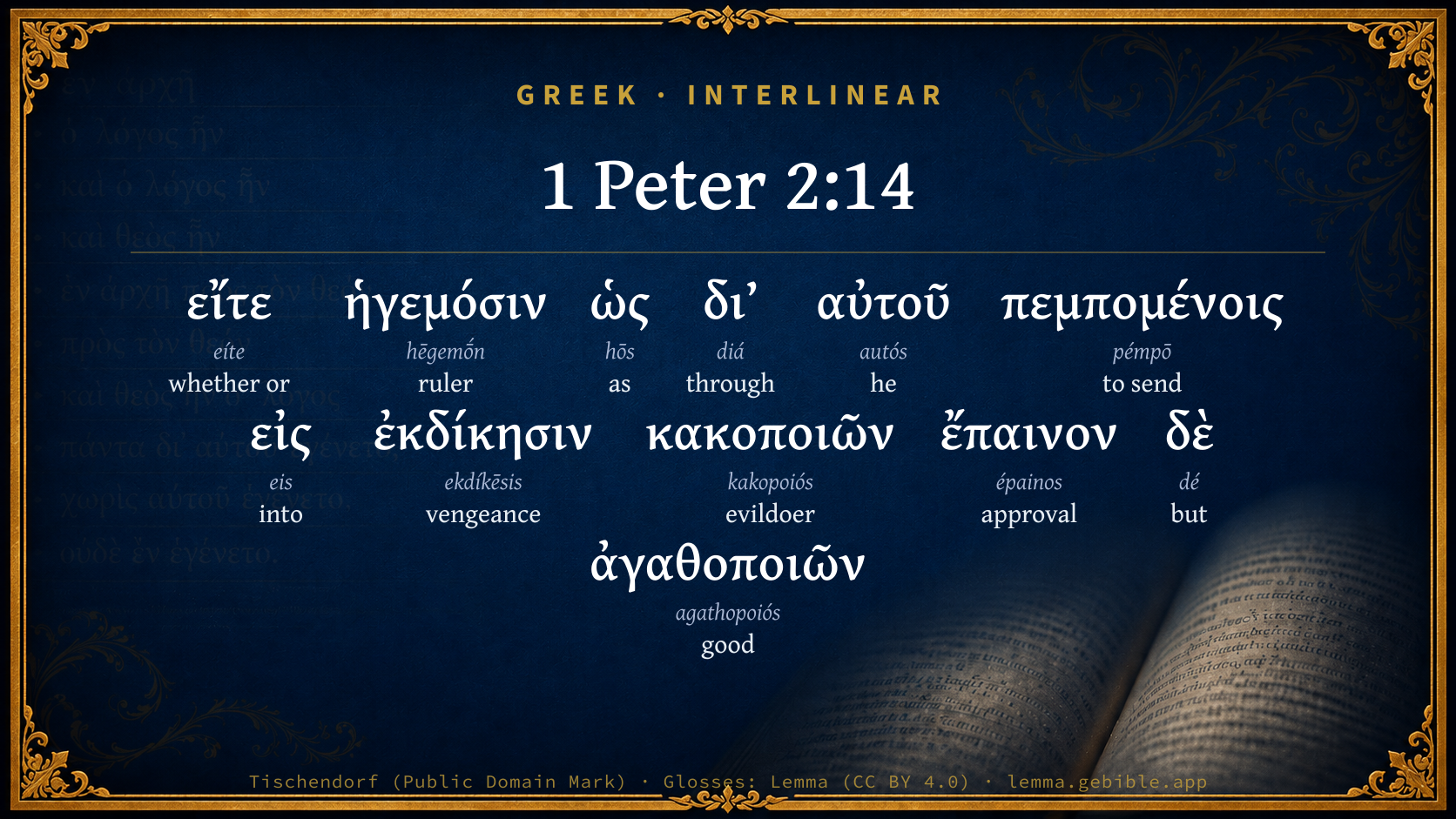
Greek (Tischendorf 8th ed.) 1 Peter 2:14 appears in the Greek New Testament. The text above is from the Tischendorf 8th edition. Each word links to its Strong’s number and a concise gloss. Click any word for its full Thayer’s Greek Lexicon entry.
Download image
Cite this verse

1 Peter 2:14 (World English Bible). Public Domain. Lemma interlinear Bible study tool, https://lemma.gebible.app/v/1-peter/2/14.

Show BibTeX & RIS
BibTeX
RIS
English Translation
or to governors, as sent by him for vengeance on evil-doers and for praise to those who do well.
World English Bible · Public Domain
Highlights
  • 1 hapax legomenon — only here in the Greek New Testament
  • 1 first appearance in the Greek New Testament
Full analysis ↓
Download a study sheet

One document with this verse’s original text, its word-by-word gloss line, the meaning frame, cross-references with their text, attributed commentary, and full source and license credits — printable, and it pastes into notes with its structure intact.

This verse Autodidact and up

Study sheet (.html) Plain text (.txt)

A passage Seminary Student

Up to 50 verses in one chapter. A passage sheet keeps up to 6 commentary sources and 12 cross-references per verse, in the order this page ranks them, and says so on the sheet whenever that leaves anything out. Ask for a single verse and you get the Autodidact verse sheet above.

Everything on this page stays free to read, with no account — the sheet is a download of what is already on screen, not access to it.

Want to remove ads? Support Godless Engineer
Compare translations 3

The same verse in 3 English versions, stacked beneath the original-language interlinear above. Click any original word for its lexicon entry.

Each is an independent rendering of the whole verse — the interlinear is not word-aligned to these translations.

Highlighted words mark where these versions differ — a whole-verse word diff, not a word-by-word alignment.

  • World English Bible Public Domain
    or to governors, as sent by him for vengeance on evil-doers and for praise to those who do well.
  • King James Version Public Domain
    Or unto governors, as unto them that are sent by him for the punishment of evildoers, and for the praise of them that do well.
  • unfoldingWord Literal Text CC BY-SA 4.0
    or to governors as those being sent through him for punishment of evildoers and praise of doers of good;

unfoldingWord Literal Text — © unfoldingWord, licensed CC BY-SA 4.0. Word-aligned USFM3 via Door43 (git.door43.org/unfoldingWord/en_ult).

Versions to compare (up to 4)

3 of 4 selected

Show all 19 translations

Every available English version of this verse, each an independent rendering of the whole verse.

  • World English Bible Public Domain
    or to governors, as sent by him for vengeance on evil-doers and for praise to those who do well.
  • Berean Standard Bible Public Domain
    or to governors as those sent by him to punish those who do wrong and to praise those who do right.
  • Majority Standard Bible Public Domain
    or to governors as those sent by him to punish those who do wrong and to praise those who do right.
  • King James Version Public Domain
    Or unto governors, as unto them that are sent by him for the punishment of evildoers, and for the praise of them that do well.
  • American Standard Version (1901) Public Domain
    or unto governors, as sent by him for vengeance on evil-doers and for praise to them that do well.
  • Revised Version (1885) Public Domain
    or unto governors, as sent by him for vengeance on evil-doers and for praise to them that do well.
  • Geneva Bible (1599) Public Domain
    Or vnto gouernours, as vnto them that are sent of him, for the punishment of euill doers, and for the praise of them that doe well.
  • Douay-Rheims (1899) Public Domain
    Or to governors as sent by him for the punishment of evildoers, and for the praise of the good:
  • Young's Literal Translation Public Domain
    whether to governors, as to those sent through him, for punishment, indeed, of evil-doers, and a praise of those doing good;
  • Literal Standard Version CC BY-SA 4.0
    whether to governors, as to those sent through him, for punishment, indeed, of evildoers, and a praise of those doing good;
  • Unlocked Literal Bible CC BY-SA 4.0
    and also the governors, who are sent to punish evildoers and to praise those who do good.
  • unfoldingWord Literal Text CC BY-SA 4.0
    or to governors as those being sent through him for punishment of evildoers and praise of doers of good;
  • Darby Bible Public Domain
    or to rulers as sent by him, for vengeance on evildoers, and praise to them that do well.
  • World Messianic Bible Public Domain
    or to governors, as sent by him for vengeance on evildoers and for praise to those who do well.
  • Webster's Bible Public Domain
    Or to governors, as to them that are sent by him for the punishment of evil-doers, and for the praise of them that do well.
  • Free Bible Version CC BY-SA 4.0
    or governors that God appoints to punish those who do evil and to commend those who do good.
  • Bible in Basic English Public Domain
    And those of the rulers who are sent by him for the punishment of evil-doers and for the praise of those who do well.
  • Text-Critical English NT CC BY 4.0
    or to governors as those who are sent by him to punish evildoers and to praise those who do good.
  • Tyndale New Testament (1534) Public Domain
    other vnto rulars as vnto them that are sent of him for the punysshment of evyll doars: but for the laude of them that do well.

Literal Standard Version (2020), Covenant Press — licensed CC BY-SA 4.0. Text via the HelloAO Bible API (eBible.org). Unlocked Literal Bible (unfoldingWord) — licensed CC BY-SA 4.0. Text via the HelloAO Bible API (eBible.org). unfoldingWord Literal Text — © unfoldingWord, licensed CC BY-SA 4.0. Word-aligned USFM3 via Door43 (git.door43.org/unfoldingWord/en_ult). Free Bible Version, Dr. Jonathan Gallagher — licensed CC BY-SA 4.0. Text via the HelloAO Bible API (eBible.org).

Word by word

More ways to search: Search by grammar → Find every occurrence → Compare this word →

Practice this passage: Drill this verse → Learn its vocabulary →

About this verse

These counts appear in no published source. They are computed here, from the morphology-tagged text and Lemma’s own curated glosses. What Lemma adds →

12
words
12
distinct lemmas
General Epistles
section

Notable vocabulary

1 hapax legomenon — a word that appears only here in the entire Greek New Testament:

  • ἀγαθοποιῶν good G17

First appearance in Scripture

This word makes its first canonical appearance in the Greek New Testament here:

  • ἀγαθοποιῶν good G17

Shared distinctive vocabulary

κακοποιῶν evildoer G2555 occurs in 3 verses of the Greek New Testament. Also found in:

Cross-references

1

Topical passages linked to 1 Peter 2:14 in the Treasury of Scripture Knowledge — connected by theme and wording, ordered by reader-vote popularity; previews shown in the World English Bible.

  • Romans 13:3–4 For rulers are not a terror to the good work, but to the evil. Do you desire to have no fear of the authority? Do that which is good, and you will have praise from the same,

Cross-references courtesy of OpenBible.info (CC BY 4.0).

Commentary

Notes on 1 Peter 2:14 from classic Christian and Jewish commentators (each source and its license shown beneath its notes). The classic Christian expositions comment on the surrounding passage and are grouped to its opening verse, so a note may address several verses; the Jewish commentaries on the Tanakh (Rashi and others) are per-verse, so they appear only where the commentator wrote on this verse.

Lemma curates 59 commentaries, every one of them public domain or Creative Commons licensed, each selected and text-cleaned for this edition rather than reprinted as found. About our sources →

Tyndale Open Study Notes

Tyndale Open Resources

2:14 to punish those who do wrong and honor those who do right: Cp. Rom 13:3-4.

Tyndale Open Study Notes — © Tyndale Open Resources, licensed CC BY-SA 4.0. Text via the HelloAO Bible API.

Bengel's Gnomon

Johann Albrecht Bengel

1Pe 2:14. Ἀγαθοποιῶν, those that do well) A word of frequent occurrence in this Epistle.

Bengel's Gnomon of the New Testament — English translation (T&T Clark, Edinburgh, 1860) — public domain. Text from a community e-Sword module.

Geneva Bible (1599)

Geneva Bible translators

The second argument taken of the end of this order, which is not only most profitable, but also very necessary: seeing that by this means virtue is rewarded, and vice punished: wherein the quietness and happiness of this life consisteth.

Geneva Bible (1599) marginal notes — public domain. Text via Bolls.life.

Jamieson, Fausset & Brown

Robert Jamieson, A. R. Fausset & David Brown

governors--subordinate to the emperor, "sent," or delegated by Cæsar to preside over the provinces.

for the punishment--No tyranny ever has been so unprincipled as that some appearance of equity was not maintained in it; however corrupt a government be, God never suffers it to be so much so as not to be better than anarchy [CALVIN]. Although bad kings often oppress the good, yet that is scarcely ever done by public authority (and it is of what is done by public authority that Peter speaks), save under the mask of right. Tyranny harasses many, but anarchy overwhelms the whole state [HORNEIUS]. The only justifiable exception is in cases where obedience to the earthly king plainly involves disobedience to the express command of the King of kings.

praise of them that do well--Every government recognizes the excellence of truly Christian subjects. Thus PLINY, in his letter to the Emperor Trajan, acknowledges, "I have found in them nothing else save a perverse and extravagant superstition." The recognition in the long run mitigates persecution (Pe1 3:13).

Jamieson, Fausset & Brown — Commentary Critical and Explanatory on the Whole Bible (1871) — public domain (CC PDM 1.0). Text via the HelloAO Bible API.

Adam Clarke's Commentary

Verse 14. Or unto governors] By king as supreme, the Roman emperor is meant; and by governors, ηγεμοσιν, are meant, leaders, governors, presidents, proconsuls, and other chief magistrates, sent by him into the provinces dependent on the Roman empire.

For the punishment of evil doers] This was the object of their mission; they were to punish delinquents, and encourage and protect the virtuous.

Adam Clarke's Commentary on the Bible (1810–1826) — public domain. Text from a community e-Sword/MySword module.

John Calvin's Commentaries

14 Or unto governors, or, Whether to presidents. He designates every kind of magistrates, as though he had said, that there is no kind of government to which we ought not to submit. He confirms this by saying that they are God’s ministers; for they who apply him to the king, are greatly mistaken. There is then a common reason, which extols the authority of all magistrates, that they rule by the command of God, and are sent by him. It hence follows (as Paul also teaches us) that they resist God, who do not obediently submit to a power ordained by him.

For the punishment This is the second reason why it behoves us reverently to regard and to respect civil authority, and that is, because it has been appointed by the Lord for the common good of mankind; for we must be extremely barbarous and brutal, if the public good is not regarded by us. This, then, in short, is what Peter means, that since God keeps the world in order by the ministry of magistrates, all they who despise their authority are enemies to mankind.

Now he assumes these two things, which belong, as Plato says, to a commonwealth, that is, reward to the good and punishment to the wicked; for, in ancient times, not only punishment was allotted to evil-doers, but also rewards to the doers of good. But though it often happens that honors are not rightly distributed, nor rewards given to the deserving, yet it is an honor, not to be despised, that the good are at the least under the care and protection of magistrates, that they are not exposed to the violence and injuries of the ungodly, that they live more quietly under laws and better retain their reputation, than if every one, unrestrained, lived as he pleased. In short, it is a singular blessing of God, that the wicked are not allowed to do what they like.

It may, however, be objected here and said, that kings and magistrates often abuse their power, and exercise tyrannical cruelty rather than justice. Such were almost all the magistrates, when this Epistle was written. To this I answer, that tyrants and those like them, do not produce such effects by their abuse, but that the ordinance of God ever remains in force, as the institution of marriage is not subverted though the wife and the husband were to act in a way not becoming them. However, therefore, men may go astray, yet the end fixed by God cannot be changed.

Were any one again to object and say, that we ought not to obey princes who, as far as they can, pervert the holy ordinance of God, and thus become savage wild beasts, while magistrates ought to bear the image of God. My reply is this, that government established by God ought to be so highly valued by us, as to honor even tyrants when in power. There is yet another reply still more evident, — that there has never been a tyranny, (nor can one be imagined,) however cruel and unbridled, in which some portion of equity has not appeared; and further, some kind of government, however deformed and corrupt it may be, is still better and more beneficial than anarchy.

John Calvin's Commentaries (1540-1563) — public domain. Text from the Calvin Translation Society English edition (1840s-50s) via the Christian Classics Ethereal Library (ccel.org). Calvin's coverage is partial (roughly two-thirds of the Bible); uncommented books and verses are honest gaps, never fabricated. The 19th-century editor's footnotes and remarks are omitted so the notes are faithfully Calvin's own voice.

Ellicott's Commentary for English Readers

(14) Governors, as unto them that are sent by him.—This word will include legati, proconsuls, propraetors, procurators, all officers entrusted with the administration of provinces. Of course the person “by” whom they are here said to be (from time to time) “sent” is Cæsar, not “the Lord.” The persons to whom the letter is addressed would have very little to do with Cæsar himself directly, their submission would be chiefly shown to the lieutenants. Yet how personal was the Imperial government, even in details, is shown in Pliny’s letters; the very letter before that in which he asks how to deal with the Christians of Bithynia requests Trajan’s leave to cover in an unhealthy beck in the town of Amastris.

For the punishment of evildoers.—St. Peter credits Roman imperialism (rightly in the main) with having as its aim the promotion of moral behaviour among its subjects. The word for “punishment” is that which is translated “vengeance” in 2Th_1:8, and implies forcing the malefactors to make satisfaction to those whom they had wronged, the “avenger” being, of course, quite disinterested. The “praise” which here, as in Rom_13:3, is said to have been bestowed by the government on welldoers, must mean the solid praise of preferments, which is hardly so marked a feature of government as the foregoing. Be it observed that neither St. Peter nor St. Paul lay down any exceptions to the rule of complete obedience. They refuse to contemplate, at least to formulate, the occasions when disobedience may be necessary. Obedience is the first thing to learn, and when they have learnt it, they will know of themselves when to disobey. St. Peter himself stands to all time as the type of magnificent disobedience (Act_4:19).

A Bible Commentary for English Readers, edited by Charles John Ellicott (1878–1897) — public domain. Text from a community e-Sword module.

The Cambridge Bible for Schools and Colleges

gen. ed. J. J. S. Perowne

14. as unto them that are sent by him] The tense of the Greek participle indicates that obedience was to be paid to those who, from time to time, were the local representatives of the central supreme authority. The identity of thought with Rom_13:3-4, will be noticed as another interesting coincidence in the teaching of the two Apostles. Both alike recognise that even an imperfect and corrupt government works, on the whole, for a greater good than lawless anarchy. Both therefore are against revolutionary attempts to destroy an established order. It has, of course, to be remembered that the Christian citizens of a Christian country now stand in a different position, in relation to the state, from that occupied by the disciples of the Apostolic Church, and have therefore different duties and responsibilities; among others, that of defending the “ordinance” or “institution” under which they live, whether that institution be monarchical or republican in its form, against open or insidious aggression.

The Cambridge Bible for Schools and Colleges (gen. ed. J. J. S. Perowne; Cambridge University Press, 1878–1918) — public domain. Text from a community e-Sword module.

John Gill's Exposition

For so is the will of God,.... Which refers not so much to what goes before; though it is a truth, that it is the will of God that men should be subject to magistrates, and that magistrates should encourage virtue, and discourage vice, reward the obedient, and punish delinquents; but to what follows:

that with well doing; by doing good works, and those well; by living soberly, righteously, and godly; by having the conversation honest among the Gentiles, agreeably to the law of God, and as becomes the Gospel of Christ; particularly, by living according to the laws of civil society, so far as is consistent with, and not contrary to the commands of God; and by being subject to every civil magistrate, and ordinance of man:

ye may put to silence the ignorance of foolish men: or, as the Syriac version renders it, "that ye may stop the mouths of those foolish men who know not God"; or, as the Ethiopic version has it, "who know not these things"; who are ignorant of God, of his righteousness, of his law, his Gospel, and ordinances. The Gentiles were very ignorant of these things, and very foolish in their imaginations about religious affairs; and from this their ignorance and folly arose calumnies, reflections, and censures upon the people of God; they neither knew God, nor them, nor true religion, and reproached what they understood not, and for want of knowing it: now the apostle signified, that it was the declared will of God that his people should so behave in civil life, that their enemies should be entirely confounded, and silenced, and have nothing to say against them; the word signifies to be muzzled, to have the mouth shut up, as with a bit or bridle; it is used in Mat 22:12.

John Gill's Exposition of the Whole Bible (1746–1763) — public domain (CC PDM 1.0). Text via the HelloAO Bible API.

Trapp's Complete Commentary

John Trapp

14 Or unto governors, as unto them that are sent by him for the punishment of evildoers, and for the praise of them that do well.

Ver. 14. Or unto governors] In the kingdom of Christ, this is wonderful, saith Zanchy, that he wills and commands all princes and potentates to be subject to his kingdom, and yet he wills and commands likewise that his kingdom be subject to the kingdoms of the world.

John Trapp, A Commentary or Exposition upon All the Books of the Old and New Testament (1647–1656) — public domain. Text from a community e-Sword module.

Albert Barnes' Notes on the Bible

Or unto governors - Subordinate officers, appointed by the chief magistrate, over provinces. Perhaps Roman proconsuls are here particularly intended.

As unto them that are sent by him - By the king, or the Roman emperor. They represent the supreme power.

For the punishment of evil doers - One of the leading ends of government. “The Roman governors had the power of life and death in such conquered provinces as those mentioned in 1Pe 1:1“ - Doddridge. Ulpian, the celebrated Roman lawyer, who flourished two hundred years after Christ, thus describes the power of the governors of the Roman provinces: “It is the duty of a good and vigilant president to see to it that his province be peaceable and quiet. And that he ought to make diligent search after sacrilegious persons, robbers, man-stealers, and thieves, and to punish everyone according to their guilt.” Again, “They who govern whole provinces, have the power of sending to the mines.” And again,” The presidents of provinces have the highest authority, next to the emperor.” Peter has described the office of the Roman governors in language nearly resembling that of Ulpian. See Lardner’s Credibility, (Works, i. 77, edit. 8vo., Lond. 1829)

And for the praise of them that do well - Praise here stands opposed to punishment, and means commendation, applause, reward. That is, it is a part of their business to reward in a suitable manner those who are upright and virtuous as citizens. This would be by protecting their persons and property; by defending their rights, and, perhaps, by admitting those to share the honors and emoluments of office who showed that they were worthy to be trusted. It is as important a part of the functions of magistracy to protect the innocent, as it is to punish the wicked.

Albert Barnes' Notes on the Bible (1834–1885) — public domain. Text from a community e-Sword/MySword module.

Matthew Poole's English Annotations

Or unto governors; he seems immediately to intend the governors of provinces under the Roman emperors, such as Pilate, Felix, Festus were in Judea, Sergius Paulus in Cyprus, Act 13:7; and other places; see Luk 3:1; but so as to imply, under the name of governors, all inferior magistrates, as under the name of king he doth all supreme.

As unto them that are sent by him; either:

1. By the king, or supreme magistrate, and then the next words show what should be his end in sending, or appointing officers, or subordinate rulers under him: or rather:

2. Sent by God, from whom all rulers, subordinate as well as supreme, have their authority, and which is the great motive on which they are to be obeyed; and then the following words show what is God’s end in appointing them, and another reason for yielding obedience to them, viz. their being set up for the common good of the societies which they rule.

For the praise of them that do well: praise is a kind of reward, and is here to be taken by a synecdoche for all sorts of rewards given to those that do well, and are obedient to the laws: see Rom 13:3,4.

Matthew Poole's English Annotations on the Holy Bible (1683–1685) — public domain. Text from a community e-Sword/MySword module.

Whedon's Commentary on the Bible

Daniel D. Whedon

14. Governors—Presidents, proconsuls, and legates, appointed by the emperor, and sent out by him into the provinces.

Punishment… praise— The end and duty of good government.

Daniel D. Whedon (gen. ed.), Commentary on the Old and New Testaments (1874–1909) — public domain. Text from a community e-Sword module.

The Pulpit Commentary

Or unto governors, as ante them that are sent by him; literally, through him. Some commentators, following Calvin, understand the pronoun of the Lord. Certainly, governors are sent through him; he "ordereth all things, both in heaven and earth." But it seems more natural in this place to refer the pronoun to the nearer substantive, the king; it was through the Roman emperor that the various governors, legates, etc., were sent from time to time (as the Greek present participle implies) to administer the provinces. For the punish-meat of evil-doers, and for the praise of them that do well. Observe the close resemblance to Rom_13:3, Rom_13:4. St. Peter recognizes the Roman sense of justice which we see in men like Festus and Gallio. At first the Jews were the persecutors of the Christians; the Roman magistrates were their protectors. St. Peter wrote before the great outbreaks of Roman persecution; he was himself to suffer under that emperor whose authority he upheld.

The Pulpit Commentary (1880–1919), ed. H.D.M. Spence-Jones & Joseph S. Exell — public domain. Text from a community e-Sword module.

John Wesley's Explanatory Notes

Or to subordinate governors, or magistrates.

John Wesley, Explanatory Notes Upon the Whole Bible (1754–1765) — public domain. Text via the GEBible commentary corpus.

The People's New Testament

B. W. Johnson

14. Governors. The magistrates placed over the provinces of the Roman empire. Rulers are necessary, both to punish the evil and to reward the good. Compare Rom., chapter 13.

B. W. Johnson's The People's New Testament with Notes (1889–1891) — public domain. Electronic text from the Christian Classics Ethereal Library (CCEL) ThML edition.

Cambridge Greek Testament for Schools and Colleges

14. βασιλεῖ = here primarily the Emperor. If, as seems probable, the Epistle was written during the later years of Nero, loyalty to such an Emperor would be extremely difficult for Christians unless they regarded him, despite his unworthiness, as the representative of a divine institution.

With St Peter’s language about obedience to civil rulers cf. Rom 13:1-4.

ὑποτάγητε … ὡς ὑπερέχοντι εἰς ἐκδίκησιν κακοποιῶν ἔπαινον δὲ ἀγαθοποιῶν (see Introd. p. lxii).

ὑποτασσέσθω ἐξουσίαις ὑπερεχούσαις ἔκδικος … τῷ τὸ κακὸν πράσσοντι τὸ ἀγαθὸν ποίει καὶ ἕξεις ἔπαινον

ὑπερέχοντι, as supreme, i.e. as compared with subordinate magistrates; cf. 1Ti 2:2.

ἡγεμόσιν refers chiefly to provincial governors.

διʼ αὐτοῦ. Such governors are here regarded not as sent by the king, but by God through the king as His agent. Cf. Joh 19:11, also Rom 13:1-2; Rom 13:4; Rom 13:6.

ἐκδίκησιν … ἔπαινον. The retribution on crime inflicted by the magistrates, and the praise which well-doers receive in consequence of their recognition by the magistrates is only an earthly echo of God’s retribution or approval.

Cambridge Greek Testament for Schools and Colleges (Cambridge University Press, 1896; 21 vols, various authors incl. Carr, Maclear, Plummer, Farrar, Lumby, Moule, M. R. James, Simcox) — public domain. Text from a community e-Sword module.

Alford’s Greek Testament

Henry Alford

14.] or to governors (“ἡγεμόνες præsides provinciarum, qui a Cæsare mittebantur in provincias,” Gerh.) as to men sent (in the habit of being sent,—sent from time to time: the pres. part. describes the genus: the particular ἡγεμόνες would be described as πεμφθέντες) through him (the king, not κυρίου, as some, and Calvin very positively, “qui pronomen ad regem referunt multum falluntur.” But there can be little doubt that he is wrong. For first the analogy of the clauses, ὡς ὑπερέχοντι … ὡς διʼ αὐτοῦ πεμπομένοις, shews that the grounds of obedience in each case, all being alike διὰ κύριον, belong to the actually existing rights of power in that case. The king is supreme, in his own right: governors rule by delegation from the king, ‘mittuntur’ διʼ αὐτοῦ. Then, the right understanding of διὰ κύριον, as applying to all, forbids this view. For thus we should obey the king as ὑπερέχων, no mention of the Lord being made, whereas rulers are to be obeyed as sent by the Lord. Finally, the prep. διὰ, as distinguished from ὑπό, designates rather the subordinate than the original sender. A governor could surely not be said to be sent διὰ κυρίου) for (to bring about) vengeance on (as in ref.: ἐκδίκησις, being a ‘vox media,’ has another meaning, that of “avenging of,” in Luk 18:7, Luk 18:8. Œc., taking it in this latter meaning, gives a convenient limitation to the duty, which was the furthest possible from the mind of the Apostle: ἔδειξε καὶ αὐτὸς ὁ Πέτρος τίσι καὶ ποίοις ἄρχουσιν ὑποτάσσεσθαι δεῖ, ὅτι τοῖς τὸ δίκαιον ἐκδικοῦσιν) evil-doers, and praise of well-doers.

Henry Alford, The Greek Testament (1849–1861) — public domain. Text from a community e-Sword module.

Vincent's Word Studies in the New Testament

Marvin R. Vincent

Sent [πεμπομενοις] . The present participle. In the habit of being sent : sent from time to time.

By him. The king; not the Lord.

Punishment [εκδικησιν] . Not strong enough. Better, vengeance, as Rev. Compare Luk 18:7; Rom 12:19.

Them that do well [αγαθοποιων] . Only here in New Testament.

Marvin R. Vincent, Word Studies in the New Testament (1887–1900) — public domain. Text from a community e-Sword/MySword module.

Lesson kit

Teaching starters — assembled from the data on this page, not authored interpretation. Every prompt links to the verse data it draws on. Edit before teaching.

1 Peter, in the General Epistles, opens this verse with 12 words (12 distinct Greek lemmas). Its most distinctive word is agathopoiós (“good”). A historical commentator’s framing appears above. Read the whole chapter for the surrounding context.

Discussion questions

  1. The word agathopoiós carries the sense “good.” How does it shape the verse?
  2. This verse holds 1 word here found nowhere else in the Greek New Testament. What might the rare word draw attention to?
  3. The word “good” first appears here in Scripture. What is being introduced at this debut?
  4. 1 Peter 2:12 shares the word «evildoer» with this verse. How do the two illuminate each other?
  5. These translations render this verse differently. What is at stake in choosing one wording over another?
  6. Reading how Tyndale Open Study Notes and Bengel's Gnomon read this verse, where do the two commentators agree and where do they part?

Things to notice

  • 1 word in this verse appears nowhere else in the Greek New Testament.
  • 1 word makes its first canonical appearance in Scripture here.
  • These translations choose different wording for 11 words in this verse.
  • 12 distinct Greek lemmas span 12 words in this verse.

Reading settings

Reading text

Shown beneath each verse's original-language words.

Old Testament
Old Testament edition

Read the OT as the Masoretic Hebrew (MT) or the Greek Septuagint (LXX).

English shown for the Greek Septuagint (in the Hebrew ↔ Greek comparison).

Comparing translations? Open the Compare panel on any verse page to stack up to four side by side.