
Numbers 3:11

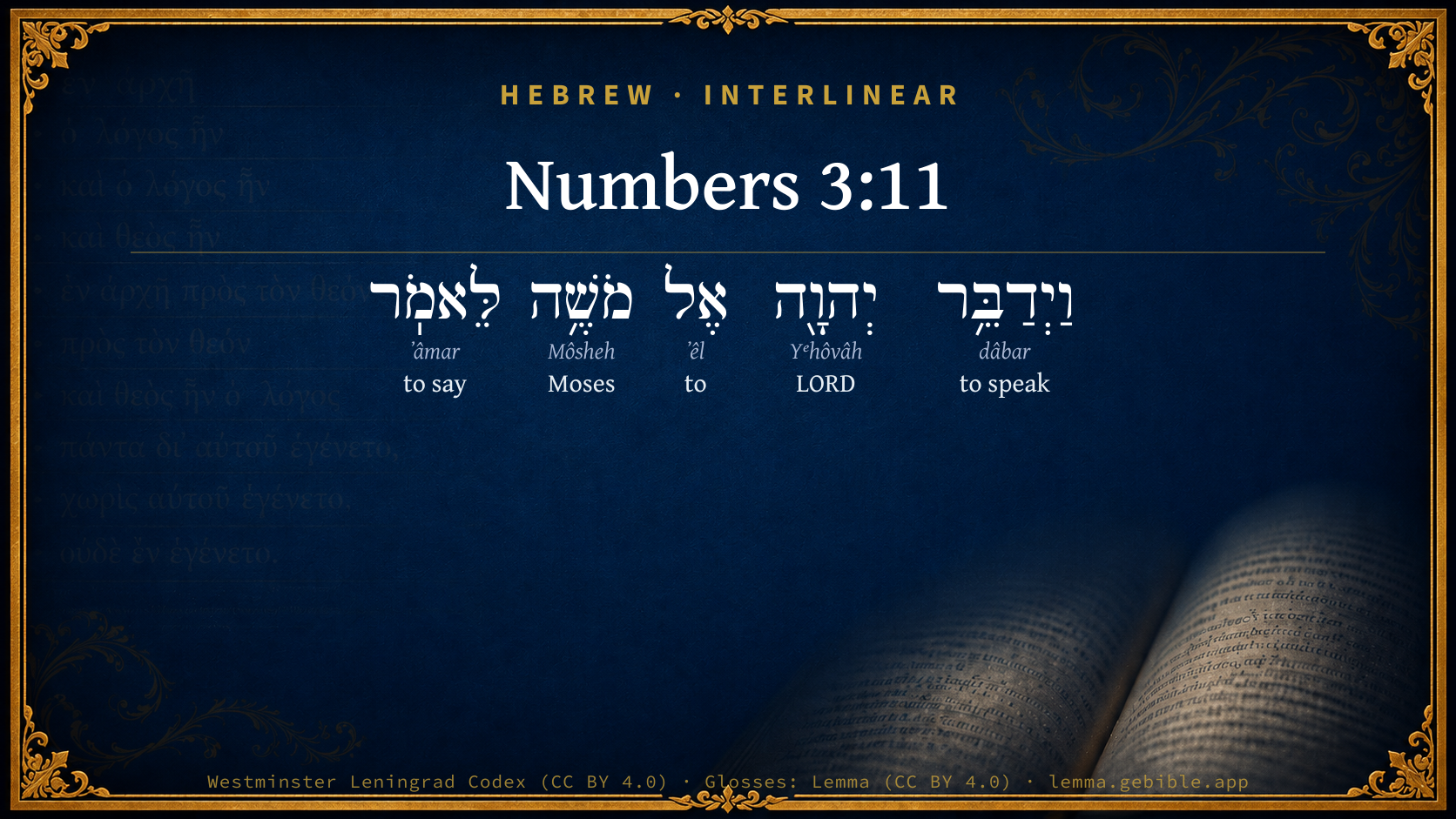
Hebrew (Westminster Leningrad Codex) Numbers 3:11 appears in the Hebrew Old Testament. The text above is from the Westminster Leningrad Codex. Each word links to its Strong’s number, a concise gloss, and parsing drawn from the Open Scriptures Hebrew Bible morphology. Click any word for its full Brown-Driver-Briggs (BDB) entry.
Download image
Cite this verse

Numbers 3:11 (World English Bible). Public Domain. Lemma interlinear Bible study tool, https://lemma.gebible.app/v/numbers/3/11.

Show BibTeX & RIS
BibTeX
RIS
English Translation
Yahweh spoke to Moses, saying,
World English Bible · Public Domain
Download a study sheet

One document with this verse’s original text, its word-by-word gloss line, the meaning frame, cross-references with their text, attributed commentary, and full source and license credits — printable, and it pastes into notes with its structure intact.

This verse Autodidact and up

Study sheet (.html) Plain text (.txt)

A passage Seminary Student

Up to 50 verses in one chapter. A passage sheet keeps up to 6 commentary sources and 12 cross-references per verse, in the order this page ranks them, and says so on the sheet whenever that leaves anything out. Ask for a single verse and you get the Autodidact verse sheet above.

Everything on this page stays free to read, with no account — the sheet is a download of what is already on screen, not access to it.

Want to remove ads? Support Godless Engineer
Compare translations 3

The same verse in 3 English versions, stacked beneath the original-language interlinear above. Click any original word for its lexicon entry.

Each is an independent rendering of the whole verse — the interlinear is not word-aligned to these translations.

Highlighted words mark where these versions differ — a whole-verse word diff, not a word-by-word alignment.

  • World English Bible Public Domain
    Yahweh spoke to Moses, saying,
  • King James Version Public Domain
    And the LORD spake unto Moses, saying,
  • unfoldingWord Literal Text CC BY-SA 4.0
    And Yahweh spoke to Moses, saying,

unfoldingWord Literal Text — © unfoldingWord, licensed CC BY-SA 4.0. Word-aligned USFM3 via Door43 (git.door43.org/unfoldingWord/en_ult).

Versions to compare (up to 4)

3 of 4 selected

Show all 18 translations

Every available English version of this verse, each an independent rendering of the whole verse.

  • World English Bible Public Domain
    Yahweh spoke to Moses, saying,
  • Berean Standard Bible Public Domain
    Again the LORD spoke to Moses, saying,
  • Majority Standard Bible Public Domain
    Again the LORD spoke to Moses, saying,
  • King James Version Public Domain
    And the LORD spake unto Moses, saying,
  • American Standard Version (1901) Public Domain
    And Jehovah spake unto Moses, saying,
  • Revised Version (1885) Public Domain
    And the LORD spake unto Moses, saying,
  • Geneva Bible (1599) Public Domain
    Also the Lord spake vnto Moses, saying,
  • Douay-Rheims (1899) Public Domain
    And the Lord spoke to Moses, saying:
  • Young's Literal Translation Public Domain
    And Jehovah speaketh unto Moses, saying,
  • Literal Standard Version CC BY-SA 4.0
    And YHWH speaks to Moses, saying,
  • Unlocked Literal Bible CC BY-SA 4.0
    Yahweh spoke to Moses. He said,
  • unfoldingWord Literal Text CC BY-SA 4.0
    And Yahweh spoke to Moses, saying,
  • Darby Bible Public Domain
    And Jehovah spoke to Moses, saying,
  • World Messianic Bible Public Domain
    The LORD spoke to Moses, saying,
  • Webster's Bible Public Domain
    And the LORD spoke to Moses, saying,
  • Free Bible Version CC BY-SA 4.0
    The Lord told Moses,
  • Bible in Basic English Public Domain
    And the Lord said to Moses,
  • JPS Tanakh (1917) Public Domain
    And the LORD spoke unto Moses, saying:

Literal Standard Version (2020), Covenant Press — licensed CC BY-SA 4.0. Text via the HelloAO Bible API (eBible.org). Unlocked Literal Bible (unfoldingWord) — licensed CC BY-SA 4.0. Text via the HelloAO Bible API (eBible.org). unfoldingWord Literal Text — © unfoldingWord, licensed CC BY-SA 4.0. Word-aligned USFM3 via Door43 (git.door43.org/unfoldingWord/en_ult). Free Bible Version, Dr. Jonathan Gallagher — licensed CC BY-SA 4.0. Text via the HelloAO Bible API (eBible.org).

Word by word

More ways to search: Search by grammar → Find every occurrence → Compare this word →

Practice this passage: Drill this verse → Learn its vocabulary →

About this verse

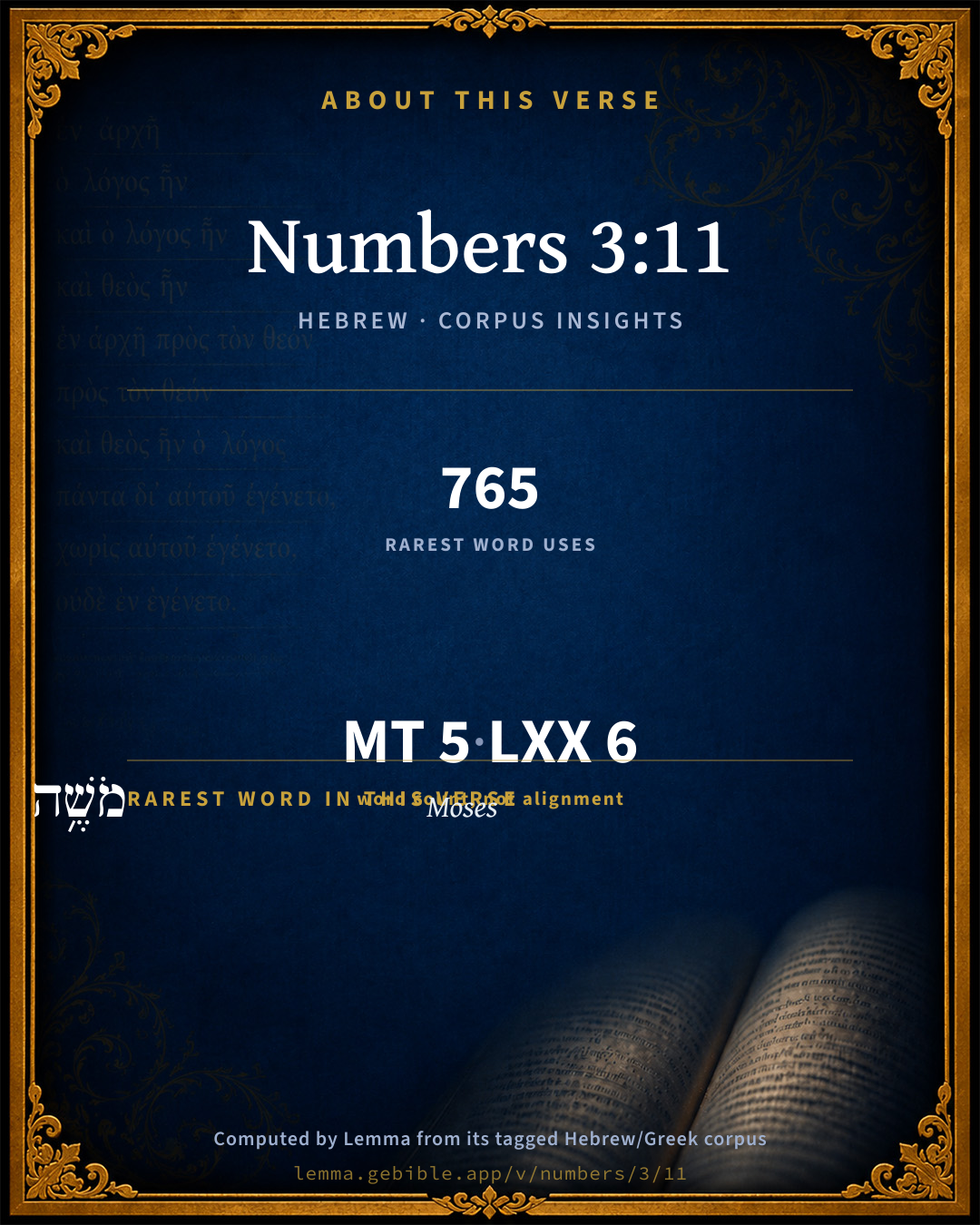
These counts appear in no published source. They are computed here, from the morphology-tagged text and Lemma’s own curated glosses. What Lemma adds →

5
words
5
distinct lemmas
Pentateuch
section

Grammatical profile

  • 2 verbs
  • 2 nouns
  • 1 preposition

Verb forms

  • וַיְדַבֵּ֥ר Piel · Sequential Imperfect
  • לֵּאמֹֽר Qal · Infinitive Construct

Hebrew & Septuagint length

In English translation the verse runs 5 words from the Hebrew and 7 from the Septuagint (LXX English) — closely comparable.

A rough comparison of the two English renderings, which tokenize alike — not a word-level alignment.

Word counts can differ between the Hebrew and the Greek without any difference in meaning — e.g. the Hebrew direct-object marker אֵת has no separate Greek word, and Greek often adds the article ὁ.

In the original languages it is 5 Hebrew tokens and 6 Greek tokens — but the two are counted differently (Hebrew bundles its prefixes and suffixes into one token; the Greek is in lemma form), so that isn’t a like-for-like length.

Hebrew and Greek witnesses Masoretic Hebrew ↔ Greek Septuagint

The same verse in the two great witnesses to the Old Testament, shown verse-for-verse.

These are two independent witnesses, not word-aligned to each other, and the Septuagint is shown in lemma (dictionary) form.

Hebrew Numbers 3:11 Masoretic · Westminster Leningrad Codex

וַיְדַבֵּ֥ר יְהוָ֖ה אֶל מֹשֶׁ֥ה לֵּאמֹֽר

Yahweh spoke to Moses, saying,

World English Bible · Public Domain

Greek LXX Numbers 3:11 Septuagint · lemma form

καί λαλέω κύριος πρός μωυσῆς λέγω

And the Lord spoke to Moses, saying,

LXX2012 (modern English Septuagint) · Public Domain

Hebrew: Westminster Leningrad Codex (CC BY 4.0). Greek: Septuagint (public domain); English from LXX2012 (modern English Septuagint) (Public Domain). How the Septuagint differs from the Hebrew →

Targum (Aramaic paraphrase)

2

The Targum is the ancient Jewish Aramaic paraphrase of the Hebrew Scriptures — an interpretive translation, not the Hebrew text itself. Onkelos (literal) and Pseudo-Jonathan (expansive) render the Torah, and Jonathan the Prophets. Coverage is partial: where no permissively-licensed English translation exists for a verse, only the Aramaic is shown. This is verse-level text, not a word-by-word alignment to the Hebrew.

  1. Targum Onkelos Torah (Genesis–Deuteronomy)
    וּמַלִיל יְיָ עִם משֶׁה לְמֵימָר

    (no public-domain English translation for this verse)

    Targum Onkelos — Aramaic: “Onkelos Genesis” (public domain); “Onkelos Exodus” (public domain); “Onkelos Leviticus” (public domain); “Onkelos Numbers” (public domain); “Onkelos Deuteronomy” (public domain). English: “Sefaria Community Translation” (CC0 1.0 (public-domain dedication)); “J.W. Etheridge. The Targums of Onkelos and Jonathan Ben Uzziel on the Pentateuch. London: Longmans, Green, 1862” (public domain). Text via Sefaria.

  2. Targum Pseudo-Jonathan Torah (Genesis–Deuteronomy)
    וּמַלֵיל יְיָ עִם משֶׁה לְמֵימָר

    And the Lord spake with Mosheh, saying:

    Targum Pseudo-Jonathan — Aramaic: “Targum Jonathan on Genesis” (public domain); “Targum Jonathan on Exodus” (public domain); “Targum Jonathan on Leviticus” (public domain); “Targum Jonathan on Numbers” (public domain); “Targum Jonathan on Deuteronomy” (public domain). English: “The Targum of Jonathan ben Uzziel, trans. J. W. Etheridge, London, 1862” (public domain). Text via Sefaria.

Commentary

Notes on Numbers 3:11 from classic Christian and Jewish commentators (each source and its license shown beneath its notes). The classic Christian expositions comment on the surrounding passage and are grouped to its opening verse, so a note may address several verses; the Jewish commentaries on the Tanakh (Rashi and others) are per-verse, so they appear only where the commentator wrote on this verse.

Lemma curates 59 commentaries, every one of them public domain or Creative Commons licensed, each selected and text-cleaned for this edition rather than reprinted as found. About our sources →

Whedon's Commentary on the Bible

Daniel D. Whedon

THE LEVITES SUBSTITUTED FOR THE FIRSTBORN, Num_3:11-13.

On that night of wailing in Egypt, the saddest in the annals of mankind, the fifteenth of the month Nisan, when at midnight Jehovah smote all the firstborn in the land of Egypt, from”the firstborn of Pharaoh that sat on his throne unto the firstborn of the captive that was in the dungeon,” he passed over the blood-stained doors of the Hebrews, sparing their firstborn. These he commanded Moses to “set apart unto the Lord.” Exo_13:12-16. For reasons not made known Jehovah relinquished this claim, and appointed the tribe of Levi to minister unto him instead of the firstborn. The substitution of adults capable of immediate service harmonizes well with the hypothesis that the phrase, “all the firstborn,” is to be understood prospectively, and so includes only infants born since the Exode, and incapable till thirty years old of rendering service. Levi may have had this honour for special fidelity in times of trial, especially against the abomination of the golden calf, set up and worshipped at the foot of Mount Sinai. Exo_32:26-28. Dr. A. Clarke suggests that Levi was taken because it was the smallest tribe. This substitution accounts for the census of the tribe of Levi, the enumeration of the firstborn males, (Num_3:40,) and the redemption of the number in excess. Num_3:47. We are not to understand that the claim on the firstborn was to be retrospective, like an ex post facto law, and to cover all the firstborn of all ages, but those born after the passover night up to the census in the wilderness — all born during the first thirteen months of the Exodus. Our reasons for this limitation will be seen when we discuss the number of firstborn, and their ratio to the fighting men. See Num_3:40, note.

Daniel D. Whedon (gen. ed.), Commentary on the Old and New Testaments (1874–1909) — public domain. Text from a community e-Sword module.

Tyndale Open Study Notes

Tyndale Open Resources

3:11-13 The firstborn sons . . . of Israel belonged to God, having been spared when the Egyptian firstborn sons died (3:13; see Exod 11–12). The Levites were chosen . . . to serve as substitutes in their place.

Tyndale Open Study Notes — © Tyndale Open Resources, licensed CC BY-SA 4.0. Text via the HelloAO Bible API.

Jamieson, Fausset & Brown

Robert Jamieson, A. R. Fausset & David Brown

I have taken the Levites, &c.--The consecration of this tribe did not originate in the legislative wisdom of Moses, but in the special appointment of God, who chose them as substitutes for the first-born. By an appointment made in memory of the last solemn judgment on Egypt (from which the Israelitish households were miraculously exempt) all the first-born were consecrated to God (Exo 13:12; Exo 22:29), who thus, under peculiar circumstances, seemed to adopt the patriarchal usage of appointing the oldest to act as the priest of the family. But the privilege of redemption that was allowed the first-born opened the way for a change; and accordingly, on the full organization of the Mosaic economy, the administration of sacred things formerly committed to the first-born was transferred from them to the Levites, who received that honor partly as a tribute to Moses and Aaron, partly because this tribe had distinguished themselves by their zeal in the affair of the golden calf (Exo 32:29), and also because, being the smallest of the tribes, they could ill find suitable employment and support in the work. (See on Deu 33:8). The designation of a special class for the sacred offices of religion was a wise arrangement; for, on their settlement in Canaan, the people would be so occupied that they might not be at leisure to wait on the service of the sanctuary, and sacred things might, from various causes, fall into neglect. But the appointment of an entire tribe to the divine service ensured the regular performance of the rites of religion. The subsequent portion of the chapter relates to the formal substitution of this tribe.

I am the Lord--that is, I decree it to be so; and being possessed of sovereign authority, I expect full obedience.

Jamieson, Fausset & Brown — Commentary Critical and Explanatory on the Whole Bible (1871) — public domain (CC PDM 1.0). Text via the HelloAO Bible API.

The Cambridge Bible for Schools and Colleges

gen. ed. J. J. S. Perowne

11–13. The Levites substituted for the first-born.

The Cambridge Bible for Schools and Colleges (gen. ed. J. J. S. Perowne; Cambridge University Press, 1878–1918) — public domain. Text from a community e-Sword module.

John Gill's Exposition

And the Lord spake unto Moses,.... Continued to speak unto him, and give him the reason of his appointing the Levites to minister to the priests and serve the tabernacle:

saying: as follows.

John Gill's Exposition of the Whole Bible (1746–1763) — public domain (CC PDM 1.0). Text via the HelloAO Bible API.

Keil & Delitzsch

C. F. Keil & F. Delitzsch

God appointed the Levites for this service, because He had decided to adopt them as His own in the place of all the first-born of Egypt. When He slew the first-born of Egypt, He sanctified to Himself all the first-born of Israel, of man and beast, for His own possession (see Exo 13:1-2). By virtue of this sanctification, which was founded upon the adoption of the whole nation as His first-born son, the nation was required to dedicate to Him its first-born sons for service at the sanctuary, and sacrifice all the first-born of its cattle to Him. But now the Levites and their cattle were to be adopted in their place, and the first-born sons of Israel to be released in return (Num 3:40.). By this arrangement, through which the care of the service at the sanctuary was transferred to one tribe, which would and should henceforth devote itself with undivided interest to this vocation, not only was a more orderly performance of this service secured, than could have been effected through the first-born of all the tribes; but so far as the whole nation was concerned, the fulfilment of its obligations in relation to this service was undoubtedly facilitated. Moreover, the Levites had proved themselves to be the most suitable of all the tribes for his post, through their firm and faithful defence of the honour of the Lord at the worship of the golden calf (Exo 32:26.). It is in this spirit, which distinguished the tribe of Levi, that we may undoubtedly discover the reason why they were chosen by God for the service of the sanctuary, and not in the fact that Moses and Aaron belonged to the tribe, and desired to form a hierarchical caste of the members of their own tribe, such as was to be found among other nations: the magi, for example, among the Medes, the Chaldeans among the Persians, and the Brahmins among the Indians. יהוה אני לי, "to Me, to Me, Jehovah" (Num 3:13, Num 3:41, and Num 3:45; cf. Ges. 121, 3).

Keil & Delitzsch — Biblical Commentary on the Old Testament (1861–1891) — public domain (CC PDM 1.0). Text via the HelloAO Bible API. (Old Testament only.)

unfoldingWord translationNotes

Door43 World Missions Community

Look

"Listen" or "Pay attention to what I am about to tell you"

I have taken the Levites

"I have chosen the Levites"

translationWords

Yahweh

Moses

Levi

firstborn

Egypt

set apart

unfoldingWord translationNotes — © Distant Shores Media and the Door43 World Missions Community, licensed CC BY-SA 4.0. Source: git.door43.org/Door43/en_tn.

Lesson kit

Teaching starters — assembled from the data on this page, not authored interpretation. Every prompt links to the verse data it draws on. Edit before teaching.

Numbers, in the Pentateuch, opens this verse with 5 words (5 distinct Hebrew lemmas). Its most distinctive word is Môsheh (“Moses”). A historical commentator’s framing appears above. Read the whole chapter for the surrounding context.

Discussion questions

  1. The word Môsheh carries the sense “Moses.” How does it shape the verse?
  2. These translations render this verse differently; the difference is in the English rendering, not the original. What questions does that raise?
  3. «וַיְדַבֵּ֥ר» is a Piel Sequential Imperfect verb. How does that grammatical form shape the action described?
  4. Compare how Whedon's Commentary on the Bible and Tyndale Open Study Notes read this verse. Where do they agree or differ?

Things to notice

Reading settings

Reading text

Shown beneath each verse's original-language words.

Old Testament
Old Testament edition

Read the OT as the Masoretic Hebrew (MT) or the Greek Septuagint (LXX).

English shown for the Greek Septuagint (in the Hebrew ↔ Greek comparison).

Comparing translations? Open the Compare panel on any verse page to stack up to four side by side.