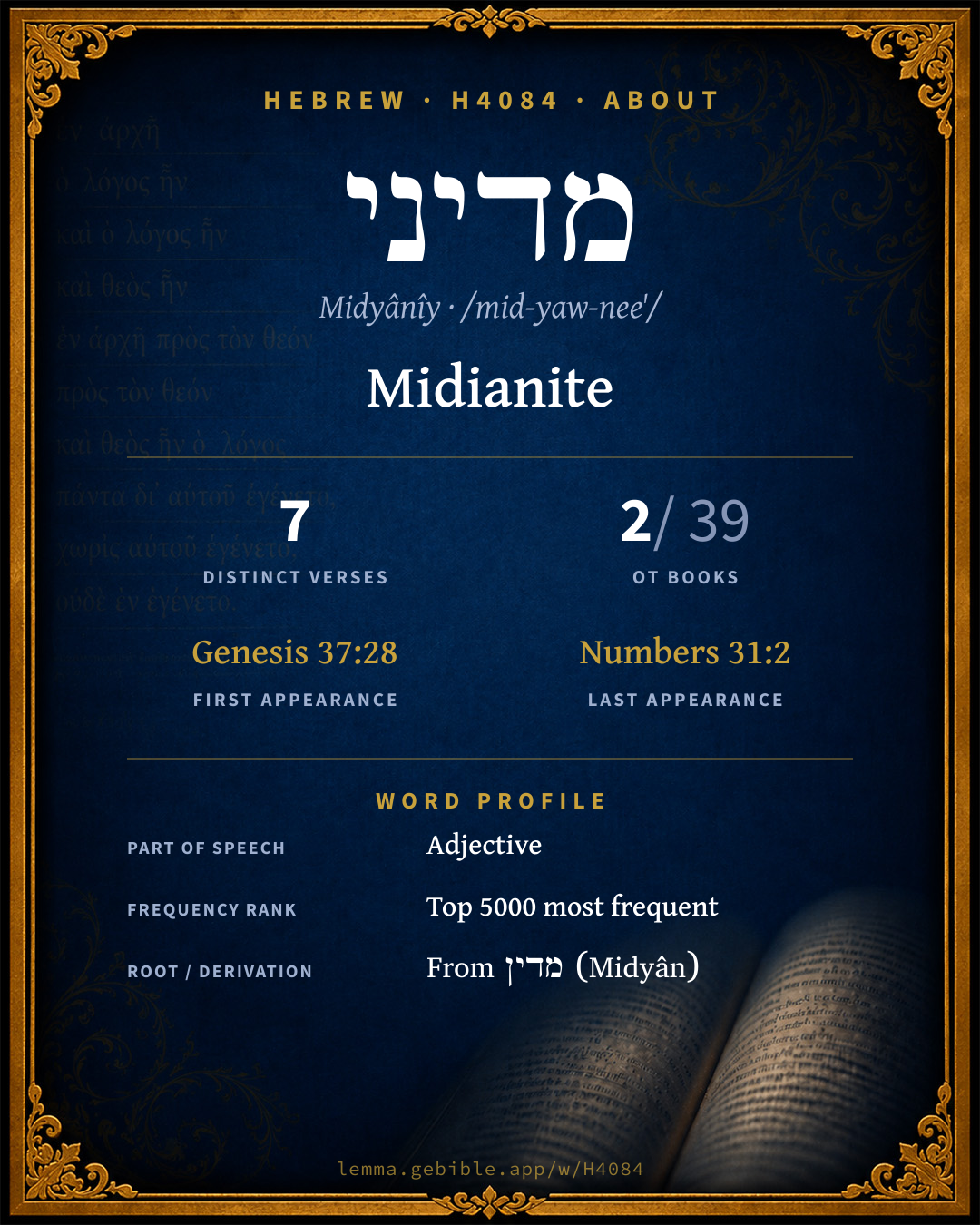
מִדְיָנִי
Midianite
BDB lists 3 entries for ‘Midianite’ fuller range ↓
Full lexicon entry — Brown-Driver-Briggs (BDB)
From Brown-Driver-Briggs (BDB)
Where this word appears
Grammar key — what these labels mean
Part of speech
- Noun
- A naming word — a person, place, thing, or idea.
Noun type
- Gentilic
- A noun naming a member of a people, tribe, or region of origin (e.g. an Israelite, a Moabite).
State
- Absolute
- The independent form of a noun, not bound to a following word.
Gender
- Feminine
- Grammatically feminine.
- Masculine
- Grammatically masculine.
Number
- Singular
- One.
- Plural
- More than one (in Hebrew, generally three or more).
Grammatical forms
- Adjective, Adjective, Feminine, Singular, Absolute 3 times (43%)
- Noun, Gentilic, Masculine, Plural, Absolute 3 times (43%)
- Noun, Gentilic, Masculine, Singular, Absolute 1 time (14%)
Parsed forms decoded from the imported morphology (morphhb / Westminster Leningrad Codex — WLC text public domain, morphhb tagging CC BY 4.0), counted across 7 parsed occurrences — not distinct verses.
Every verse where H4084 appears — 7 distinct verses across 2 books. Click any verse to open its interlinear word-by-word view. Verse text shown in the World English Bible for context — . Each verse’s Hebrew form is shown with its reference; the English is not keyword-highlighted, since the data carries no word-level English alignment. Use “Compare translations” on any verse to read it across multiple English versions. This concordance covers the Hebrew Bible; Septuagint (Greek Old Testament) occurrences are not indexed here.
Genesis 1 verse
Numbers 6 verses
- Numbers 10:29 הַ/מִּדְיָנִי֮ ptcl def.art + n Gentilic ms Moses said to Hobab, the son of Reuel the Midianite, Moses' father-in-law, We are journeying to the place of which Yahweh said, I will give it you: come you with us, and we will do you good; for Yahweh has spoken good concerning Israel.
- Numbers 25:6 הַ/מִּדְיָנִ֔ית ptcl def.art + Adjective Adjective fs Behold, one of the children of Israel came and brought to his brothers a Midianite woman in the sight of Moses, and in the sight of all the congregation of the children of Israel, while they were weeping at the door of the tent of meeting.
- Numbers 25:14 הַ/מִּדְיָנִ֔ית ptcl def.art + Adjective Adjective fs Now the name of the man of Israel that was slain, who was slain with the Midianite woman, was Zimri, the son of Salu, a prince of a fathers' house among the Simeonites.
- Numbers 25:15 הַ/מִּדְיָנִ֖ית ptcl def.art + Adjective Adjective fs The name of the Midianite woman who was slain was Cozbi, the daughter of Zur; he was head of the people of a fathers' house in Midian.
- Numbers 25:17 הַ/מִּדְיָנִ֑ים ptcl def.art + n Gentilic mp Vex the Midianites, and strike them;
- Numbers 31:2 הַ/מִּדְיָנִ֑ים ptcl def.art + n Gentilic mp Avenge the children of Israel of the Midianites: afterward you shall be gathered to your people.
About this entry
At a glance — auto-summarized from this page’s data, not written by a person. Every figure links to its source below. This summary describes the numbers; it doesn’t interpret them.
At its core, מדיני (Midyânîy) means “Midianite.” The word gravitates to Numbers (86%), then Genesis. It turns up in 7 verses across 2 books, an uncommon footprint. It first appears in Genesis 37:28. Dig into 7-verse concordance and the renderings breakdown below.
Gloss history
Strong's 1890 vs modern scholarship
About this word
Strong's H4084 catalogs a Hebrew word from the Hebrew Old Testament.
These counts are not copied from any lexicon or concordance. They are computed here, from the morphology-tagged Hebrew Old Testament. What Lemma adds →
- 7
- distinct verses
- The word appears in 7 distinct verses.
- 2 / 39
- OT books
- The word appears in 2 of 39 Old Testament books.
- #2,835
- by frequency
- Top 5000 most frequent Hebrew words (rank 2,835 of 8,640 Hebrew words by occurrence).
View all 7 occurrences in the concordance →
By traditional corpus
Conventional, traditional groupings — biblical authorship is debated, so this is a traditional corpus grouping, not an authorship claim. Each share is this word’s portion of its verses in that division of the Hebrew canon. Each figure is a share of the word’s 7 distinct verses.
- Torah (Pentateuch) 7 verses · 100%
How translations render this word
Counts come from each version’s own published word-to-Strong’s tagging or interlinear alignment — an approximate guide to how each version renders this word, not a word-level alignment the data otherwise carries. Because each total is that version’s own tagged count, the per-version totals vary from one another and need not match the appearance or distinct-verse counts above. These counts may also differ from a printed concordance because Lemma counts each distinctly tagged rendering and does not collapse phrase taggings into a single head-word total. This is a fixed set of word-tagged versions (KJV, ASV, BSB, ULT) and does not change with the reading translation you choose elsewhere. Each version’s license is shown beside its name below (and on Sources).
- King James Version: Midianites 3×, Midianitish woman 2×
- American Standard Version: Midianites 3×, Midianitish woman 2×
- Berean Standard Bible: Midianite 3×, Midianite woman 2×, Midianites 2×
- unfoldingWord Literal Text: Midianite 2×, Midianite woman 2×, Midianites 2×
King James Version Public Domain
Renders H4084 across 7 tagged occurrences — most commonly:
Plus 2 renderings that appear only once — usually multi-word phrases or single function words the recovered tagging swept in, not distinct renderings.
American Standard Version Public Domain
Renders H4084 across 7 tagged occurrences — most commonly:
Plus 2 renderings that appear only once — usually multi-word phrases or single function words the recovered tagging swept in, not distinct renderings.
Berean Standard Bible Public Domain
Renders H4084 across 7 tagged occurrences — most commonly:
unfoldingWord Literal Text CC BY-SA 4.0
Renders H4084 across 7 tagged occurrences — most commonly:
Plus 1 rendering that appears only once — usually multi-word phrases or single function words the recovered tagging swept in, not distinct renderings.
Senses in BDB
The 3 senses BDB distinguishes for this word, in lexicon order (not ranked by frequency or importance). The full entry — with sub-senses — is in the Lexicon Entry tab.
- Midianite = see Midian " strife"
- a member of the tribe of Midian
- an inhabitant of the land of Midian
Word origin
Derived from מדין (Midyân) (H4080) — Midian.
Jastrow Dictionary
A second Hebrew/Aramaic lexicon for comparison, covering Aramaic and post-biblical (Talmudic, Targumic, Midrashic) usage that the biblical-Hebrew BDB does not. Matched by lemma rather than by Strong’s number, so a lemma may carry more than one Jastrow headword (shown separately below), and the entries cover usage well beyond the Bible.
דֵּן
- c. (cmp. דָּא, דֵּךְ) this, that. Targ. Is. VI, 3. Targ. Deut. II, 3 הָדֵן (ed. Berl. הָדֵין = הָא ד׳); a. v. fr.—Lev. R. s. 7 מן הד׳ קריא from this verse (it is proven). Lev. R. s. 8 ד׳ אמר לינא בעיא לד׳ וכ׳ the one said, I do not want this (woman) &c. Sabb. 112ᵇ לית ד׳ ב"א this is not (an ordinary) human being; ib. כגון ד׳ וכ׳ a man like this is worth the name of a human being; a. fr.—Y. Ab. Zar. II, 41ᵈ bot.; a. e. אסיר לך דנא this (piece) is forbidden to thee.—מן קדמת דנא ere this, formerly. Y. Sot. II, 17ᵈ; a. e.—כְּדֵ׳ a) = h. פֹּה, here (cmp. כָּא, הָכָא). Targ. Jud. XVIII, 3. Targ. Is. XXII, 16 (some ed. בְּדֵין); b) like this, thus. Targ. Gen. XXXII, 4. Targ. Jud. XVIII, 4; a. fr. [Targ. Ps. II, 10 read; כְּדוּן.]—B. Bath. 75ᵃ (play on כדכד, Is. LIV, 12) ליהוי כד׳ וכד׳ let it be as this one says, and as that one; Pesik. Aniy. p. 135ᵇ; Pesik. R. s. 32.—בִּכְדֵין in this manner. Targ. I Kings XXII, 20.—מָדֵין = h. מַה־זֶּה, why. Targ. Jer. XXVI, 9; a. e.—אֵי מִדֵּין from what, which. Targ. Jon. I, 8.—דֵּינוּ (= דֵּין הוּ) this. Y. Erub. VII, 24ᶜ top, a. e. חֵי ד׳ צד וכ׳ (= h. אֵיזֶהוּ) which is ‘side’, and which &c.?, v. הַיְידְּנוּ.—Pl. דֵּינוּן, דֵּינֵי. Y. Snh. IV, 22ᵇ bot. הי ד׳ וכ׳ which are the two additional ones?—[הָדֵין then, v. הֵידֵין.] e.g. Isaiah 54:12
A Dictionary of the Targumim, the Talmud Babli and Yerushalmi, and the Midrashic Literature (Marcus Jastrow; London, Luzac, 1903) — Public Domain. Digitized via Sefaria. Digitized via Sefaria. Full attribution on Sources.
Forms in the corpus
The 5 distinct written forms H4084 takes in the Hebrew Bible, most frequent first — each parse links to that state’s occurrences in the concordance. Hebrew forms include their vowel points and cantillation, so a single lemma takes many written forms.
| Form | Parsing | Example | Uses |
|---|---|---|---|
| הַ/מִּדְיָנִ֑ים | Noun, Gentilic, Masculine, Plural, Absolute | Numbers 25:17 | 2 |
| הַ/מִּדְיָנִ֔ית | Adjective, Adjective, Feminine, Singular, Absolute | Numbers 25:6 | 2 |
| הַ/מִּדְיָנִ֖ית | Adjective, Adjective, Feminine, Singular, Absolute | Numbers 25:15 | 1 |
| הַ/מִּדְיָנִי֮ | Noun, Gentilic, Masculine, Singular, Absolute | Numbers 10:29 | 1 |
| מִדְיָנִ֜ים | Noun, Gentilic, Masculine, Plural, Absolute | Genesis 37:28 | 1 |
Same root — word family
Other BDB entries built from the same root as H4084, grouped by Strong’s listed origin. These share a root / origin per the lexicon — not necessarily a shared meaning. Each links to that word’s own entry.
Derives from
Proper names from this root
People and places named from this root — a name, not an additional meaning of the word.
Compare all same-root words → Showing 4 of 5 — not the complete family. 4 of the same-root words are proper names (people or places). They share a root, not necessarily a meaning.
Bible dictionary
Public-domain dictionary articles matched to this entry by name (Midianite). A biblical name can be shared by more than one person or place, so an article may treat several.
Easton's Bible Dictionary · M. G. Easton, 1897
An Arabian tribe descended from Midian. They inhabited principally the desert north of the peninsula of Arabia. The peninsula of Sinai was the pasture-ground for their flocks. They were virtually the rulers of Arabia, being the dominant tribe. Like all Arabians, they were a nomad people. They early engaged in commercial pursuits. It was to one of their caravans that Joseph was sold (Gen. 37:28, 36). The next notice of them is in connection with Moses' flight from Egypt (Ex. 2:15-21). Here in Midian Moses became the servant and afterwards the son-in-law of Reuel or Jethro, the priest. After the Exodus, the Midianites were friendly to the Israelites so long as they traversed only their outlying pasture-ground on the west of the Arabah; but when, having passed the southern end of Edom, they entered into the land of Midian proper, they joined with Balak, the king of Moab, in a conspiracy against them (Num. 22:4-7). Balaam, who had been sent for to curse Israel, having utterly failed to do so, was dismissed by the king of Moab; nevertheless he still tarried among the Midianites, and induced them to enter into correspondence with the Israelites, so as to bring them into association with them in the licentious orgies connected with the worship of Baal-Peor. This crafty counsel prevailed. The Israelites took part in the heathen festival, and so brought upon themselves a curse indeed. Their apostasy brought upon them a severe punishment. A plague broke out amongst them, and more than twenty-four thousand of the people perished (Num. 25:9). But the Midianites were not to be left unpunished. A terrible vengeance was denounced against them. A thousand warriors from each tribe, under the leadership of Phinehas, went forth against them. The Midianites were utterly routed. Their cities were consumed by fire, five of their kings were put to death, and the whole nation was destroyed (Josh. 13:21, 22). Balaam also perished by the sword, receiving the "wages of his unrighteousness" (Num. 31:8; 2 Pet. 2:15). The whole of the country on the east of Jordan, now conquered by the Israelites (see SIHON; OG), was divided between the two tribes of Reuben and Gad and the half tribe of Manasseh.
Some two hundred and fifty years after this the Midianites had regained their ancient power, and in confederation with the Amalekites and the "children of the east" they made war against their old enemies the Israelites, whom for seven years they oppressed and held in subjection. They were at length assailed by Gideon in that ever-memorable battle in the great plain of Esdraelon, and utterly destroyed (Judg. 6:1-ch. 7). Frequent allusions are afterwards made to this great victory (Ps. 83:10, 12; Isa. 9:4; 10:6). They now wholly pass away from the page of history both sacred and profane.
Classic public-domain reference works; full attribution on Sources.
Septuagint verse parallels
This word appears in 7 verses that also exist in the Greek Old Testament (Septuagint), out of the 7 Hebrew verses it occurs in. You can read those verses in Greek by switching the Old Testament edition to the Septuagint.
Read these verses in the Septuagint
This is a verse-level parallel only — the same verses exist in both the Hebrew and Greek Old Testaments. No word-level Hebrew↔Greek correspondence is claimed: the data carries no such alignment, so no Greek word is shown as this Hebrew word’s translation. Coverage is not total — the Septuagint omits the deuterocanon and renumbers the Psalms, so some Hebrew verses have no direct Greek parallel.