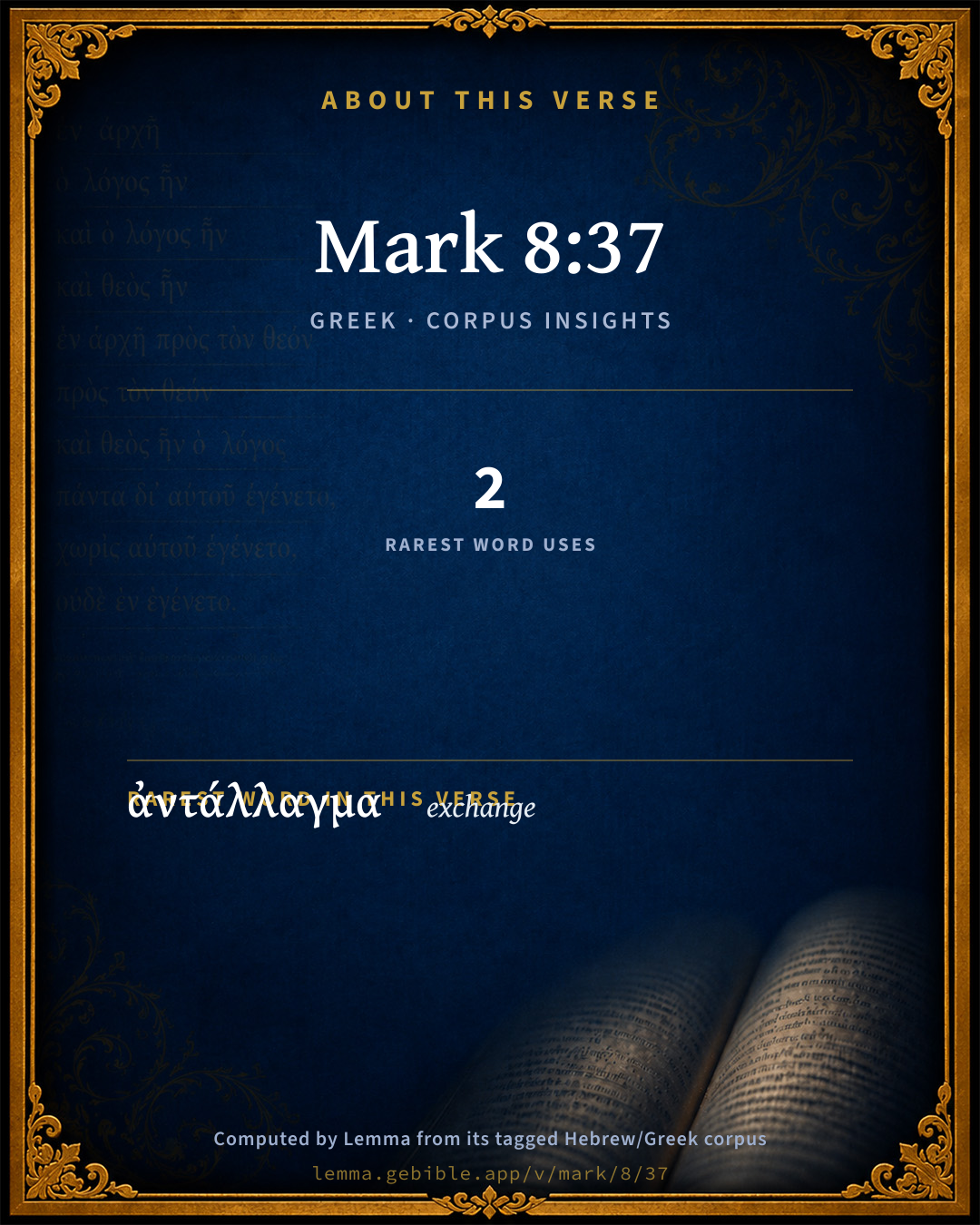
Mark 8:37

Greek (Tischendorf 8th ed.) Mark 8:37 appears in the Greek New Testament. The text above is from the Tischendorf 8th edition. Each word links to its Strong’s number and a concise gloss. Click any word for its full Thayer’s Greek Lexicon entry.
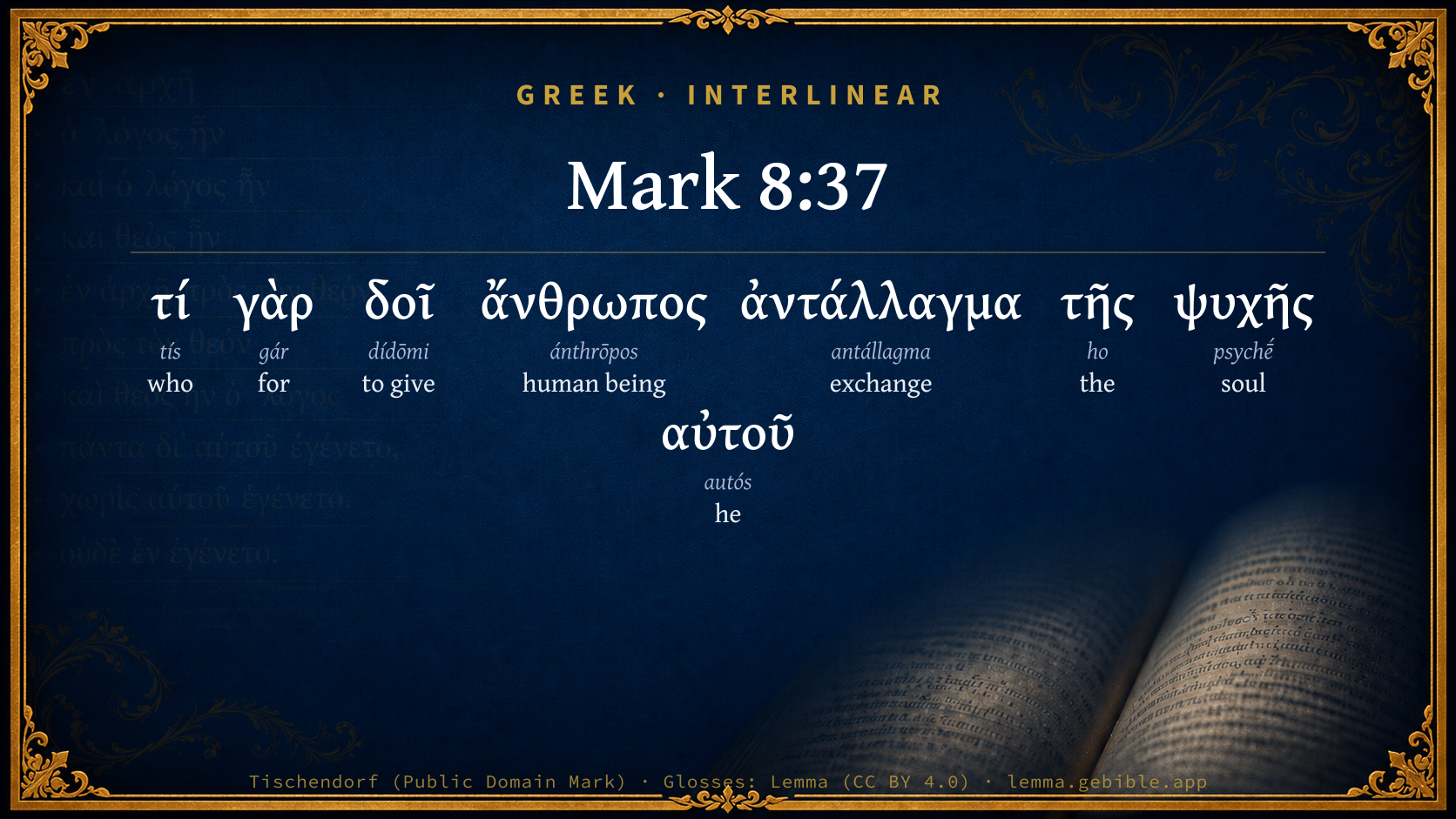
Download image
Cite this verse

Mark 8:37 (World English Bible). Public Domain. Lemma interlinear Bible study tool, https://lemma.gebible.app/v/mark/8/37.

Show BibTeX & RIS
BibTeX
RIS
English Translation
For what will a man give in exchange for his life?
World English Bible · Public Domain
Download a study sheet

One document with this verse’s original text, its word-by-word gloss line, the meaning frame, cross-references with their text, attributed commentary, and full source and license credits — printable, and it pastes into notes with its structure intact.

This verse Autodidact and up

Study sheet (.html) Plain text (.txt)

A passage Seminary Student

Up to 50 verses in one chapter. A passage sheet keeps up to 6 commentary sources and 12 cross-references per verse, in the order this page ranks them, and says so on the sheet whenever that leaves anything out. Ask for a single verse and you get the Autodidact verse sheet above.

Everything on this page stays free to read, with no account — the sheet is a download of what is already on screen, not access to it.

Want to remove ads? Support Godless Engineer
Compare translations 3

The same verse in 3 English versions, stacked beneath the original-language interlinear above. Click any original word for its lexicon entry.

Each is an independent rendering of the whole verse — the interlinear is not word-aligned to these translations.

Highlighted words mark where these versions differ — a whole-verse word diff, not a word-by-word alignment.

  • World English Bible Public Domain
    For what will a man give in exchange for his life?
  • King James Version Public Domain
    Or what shall a man give in exchange for his soul?
  • unfoldingWord Literal Text CC BY-SA 4.0
    For what might a man give in exchange for his life?

unfoldingWord Literal Text — © unfoldingWord, licensed CC BY-SA 4.0. Word-aligned USFM3 via Door43 (git.door43.org/unfoldingWord/en_ult).

Versions to compare (up to 4)

3 of 4 selected

Show all 19 translations

Every available English version of this verse, each an independent rendering of the whole verse.

  • World English Bible Public Domain
    For what will a man give in exchange for his life?
  • Berean Standard Bible Public Domain
    Or what can a man give in exchange for his soul?
  • Majority Standard Bible Public Domain
    Or what can a man give in exchange for his soul?
  • King James Version Public Domain
    Or what shall a man give in exchange for his soul?
  • American Standard Version (1901) Public Domain
    For what should a man give in exchange for his life?
  • Revised Version (1885) Public Domain
    For what should a man give in exchange for his life?
  • Geneva Bible (1599) Public Domain
    Or what exchange shall a man giue for his soule?
  • Douay-Rheims (1899) Public Domain
    Or what shall a man give in exchange for his soul?
  • Young's Literal Translation Public Domain
    Or what shall a man give as an exchange for his life?
  • Literal Standard Version CC BY-SA 4.0
    Or what will a man give as an exchange for his life?
  • Unlocked Literal Bible CC BY-SA 4.0
    What can a person give in exchange for his life?
  • unfoldingWord Literal Text CC BY-SA 4.0
    For what might a man give in exchange for his life?
  • Darby Bible Public Domain
    for what should a man give in exchange for his soul?
  • World Messianic Bible Public Domain
    For what will a man give in exchange for his life?
  • Webster's Bible Public Domain
    Or what will a man give in exchange for his soul?
  • Free Bible Version CC BY-SA 4.0
    What would you give in exchange for your life?
  • Bible in Basic English Public Domain
    And what would a man give in exchange for his life?
  • Text-Critical English NT CC BY 4.0
    Or what can a person give in exchange for his soul?
  • Tyndale New Testament (1534) Public Domain
    or els what shall a man geve to redeme his soule agayne?

Literal Standard Version (2020), Covenant Press — licensed CC BY-SA 4.0. Text via the HelloAO Bible API (eBible.org). Unlocked Literal Bible (unfoldingWord) — licensed CC BY-SA 4.0. Text via the HelloAO Bible API (eBible.org). unfoldingWord Literal Text — © unfoldingWord, licensed CC BY-SA 4.0. Word-aligned USFM3 via Door43 (git.door43.org/unfoldingWord/en_ult). Free Bible Version, Dr. Jonathan Gallagher — licensed CC BY-SA 4.0. Text via the HelloAO Bible API (eBible.org).

Word by word

More ways to search: Search by grammar → Find every occurrence → Compare this word →

Practice this passage: Drill this verse → Learn its vocabulary →

About this verse

These counts appear in no published source. They are computed here, from the morphology-tagged text and Lemma’s own curated glosses. What Lemma adds →

8
words
8
distinct lemmas
Gospels
section

Notable vocabulary

The rarest word here is ἀντάλλαγμα exchange G465 — appearing just 2 times in the whole Greek New Testament.

Shared distinctive vocabulary

ἀντάλλαγμα exchange G465 occurs in 2 verses of the Greek New Testament. Also found in:

Cross-references

2

Topical passages linked to Mark 8:37 in the Treasury of Scripture Knowledge — connected by theme and wording, ordered by reader-vote popularity; previews shown in the World English Bible.

  • Psalms 49:7–8 None of them can by any means redeem his brother, Nor give God a ransom for him.
  • 1 Peter 1:18–19 knowing that you were redeemed, not with corruptible things, with silver or gold, from the useless way of life handed down from your fathers,

Cross-references courtesy of OpenBible.info (CC BY 4.0).

Commentary

Notes on Mark 8:37 from classic Christian and Jewish commentators (each source and its license shown beneath its notes). The classic Christian expositions comment on the surrounding passage and are grouped to its opening verse, so a note may address several verses; the Jewish commentaries on the Tanakh (Rashi and others) are per-verse, so they appear only where the commentator wrote on this verse.

Lemma curates 59 commentaries, every one of them public domain or Creative Commons licensed, each selected and text-cleaned for this edition rather than reprinted as found. About our sources →

The Biblical Illustrator

Joseph S. Exell

Mar_8:37

Or what shall a man give in exchange for his soul?

The folly of setting the heart on things below, and not on things above

No ransom can purchase life. You may remember, as I do, the dying hours of a monarch who emphatically lived to pamper the flesh, to serve lusts and pleasures, but not for God or his fellow men. When he knew the fatal hour was approaching, he said to the medical men about him, Oh, I would give any sum you name, if you would but give me another year of life. But it was of no use. They could not; they could but shake their heads and tell him that One only could give life, and when He saw fit He would take it away-God, even God. There is nothing in this world that a man can find, which will bribe death to stop away. Kings die, and their sceptre and crown roll in the dust, Philosophers succumb, and all their busy chambers of the brain, which have been occupied by deep researches, become occupied by the worms of the earth. The young man, glorying in his beauty and strength, succumbs to death, and his sun sets at noonday. And the pretty babe, which is just opening like a bud in all its infantine beauty-ah, how often does death lay its cold hand on that! There is no conceivable thing capable of saving a man, woman, or child, whom God has appointed to die. By the question in the text, our Lord means this; and He means more than this. He refers also to the life of the world to come. What ransom shall a man give for that life? There is such a ransom. There is One who has found a ransom. It is Jesus. He is the life of the world. He that hath the Son hath life. Have you found this ransom? (R. W. Dibdin, M. A.)

The souls ransom

What is the world, but the means of having food and raiment and ease, in greater variety and abundance than others have them-a distinction which, if viewed narrowly, is not worth half the pains and labour by which only it can be obtained. But what is the sold? It is the immortal and everlasting principle of all thought and feeling in mans nature-the subject in which abide all hope and fear, all joy and sorrow, all happiness and all misery. It is that part of our intellectual frame which cannot die, forget, cease to be conscious, or fly from itself; but which lives forever, either beloved and cherished by its Almighty Creator, or expelled from His presence in horror and despair. If threescore years and ten were to bring it to an end, and make all its thoughts perish; if, after death, there were no judgment; if the worm of remorse were to become extinct on the bed where the last breath goes forth, and to cease its gnawings with the mortal pains of the body,-then might we hesitate between the interests of the present and the future, and adopt the maxim of the atheist, Let us eat and drink, for tomorrow we die. But, as these things cannot be; as the soul, which sinneth and repenteth not, has to die a death which will never be completed, a death of horror and despair, of which the sighs and agony and groaning ascend up perpetually; the question which should now interest us the most is, What shall we give in exchange for our souls? We must, in the first place, present before God, on the altar of faith, the Atonement which He Himself has provided, the sole procuring cause of human salvation; we must offer up to Him a broken and contrite heart, weaned from the world, and devoted to His service; we must solicit His mercy with the tears of penitence and vows of reformation, entreating that His grace may be sufficient for us, and His strength made perfect in our weakness;-and these are the things which the Lord will accept in exchange for our souls. (Bp. Russell.)

Incomputable value of the soul

What would a man not give? If he had the whole world, would he not willingly give it, provided he really knew, believed, or felt, that otherwise he would be utterly lost? King Richard, in Shakespeare, says, My kingdom for a horse! How many kingdoms would be surrendered-if man were not utterly infatuated-for the safety of the soul? The Saviour has gone forward in thought, and takes His standpoint in eternity. It is from that standpoint that He puts His question. It is implied that the time will come, in the experience of the persistently infatuated, when kingdom upon kingdom-were they available-would be an insufficient exchange for the soul. (J. Morison, D. D.)

Nothing can compensate for loss of soul

I was called upon, says an American clergyman, some years ago, to visit an individual, a part of whose face had been eaten away by a most loathsome cancer. Fixing my eyes on this man in his agony, I said, Supposing that Almighty God were to give you your choice, which would you prefer, your cancer, your pain, and your sufferings, with a certainty of death before you, but of immortality hereafter; or health, prosperity, long life in this world, and the risk of losing your immortal soul? Ah, sir! said the man, give me the cancer and the pain, with the Bible and the hope of heaven, and others may take the world, long life, and prosperity.

Gain cannot satisfy the heart

Mr. Jeremiah Burroughs, a pious minister, mentions the case of a rich man who, when he lay on his death bed, called for his bags of money; and, having laid a bag of gold to his heart, after a little he bade them take it away, saying, It will not do; it will not do.

Exchange for his soul-Cost of an estate

What is the value of this estate? said a gentleman to another with whom he was riding, as they passed a fine mansion surrounded by fair and fertile fields. I dont know what it is valued at; I know what it cost its late possessor. How much? His soul, Early in life, he professed faith in Christ, and obtained a subordinate position in a mercantile establishment. He continued to maintain a reputable religious profession, till he became a partner in the firm. Then he gave less attention to religion, and more and more to business; and the care of this world choked the Word. He became exceedingly rich in money, but so poor and miserly in soul, that none would have suspected he had ever been religious. At length he purchased this large estate, built a costly mansion, and then sickened and died. Just before he died, he remarked, My prosperity has been my ruin!

No satisfaction from the world at death

The dying tell us that earthly possessions cannot satisfy us in death. Philip II of Spain cried, O would God I had never reigned! O that I had lived alone with God! What doth all my glory profit, but that I have so much the more torment in death. Albert the Good said, I am surrounded with wealth and rank, but if I trusted only to them, I should be a miserable man. Salmasius declared, I have lost a world of time. Oh, sirs! mind the world less, and God more. Bunsen exclaimed, My riches and experience is having known Jesus Christ. All the rest is nothing.

The Biblical Illustrator, edited by Joseph S. Exell (c. 1880s–1900s) — public domain. Text from a community e-Sword module.

The Cambridge Bible for Schools and Colleges

gen. ed. J. J. S. Perowne

37. in exchange] i. e. to purchase back. By soul here is meant “life” in the higher sense. The “price” which the earthly-minded man gives for the world is his soul. But after having laid that down as the price, what has he for a “ransom-price,” to purchase it again? The LXX. use the original word in Rth_4:7; Jer_15:13.

The Cambridge Bible for Schools and Colleges (gen. ed. J. J. S. Perowne; Cambridge University Press, 1878–1918) — public domain. Text from a community e-Sword module.

John Gill's Exposition

Or what shall a man give in exchange for his soul? To deliver it out of its miserable state and condition; all the riches of the world, and the whole world itself, are not an equivalent to it, or a sufficient ransom for it; riches will not profit in the day of wrath, or deliver a soul from damnation, and ruin: wherefore, if he had the whole world, he could not redeem his soul with it; and he has nothing else to give for it, and therefore it is past all recovery: See Gill on Mat 16:26.

Mark 8:38

John Gill's Exposition of the Whole Bible (1746–1763) — public domain (CC PDM 1.0). Text via the HelloAO Bible API.

Trapp's Complete Commentary

John Trapp

37 Or what shall a man give in exchange for his soul?

Ver. 37. Or, what shall a man give?] {See Trapp on "Mat 16:26"}

John Trapp, A Commentary or Exposition upon All the Books of the Old and New Testament (1647–1656) — public domain. Text from a community e-Sword module.

The Pulpit Commentary

In exchange (antallagma) for his life. The Greek term here means an equivalent," "a compensation. " The" life," in its largest sense and meaning, defies all comparison, surpasses all value. It has been bought and redeemed with the precious blood of Christ; therefore the whole world would be a poor price for the soul of one man.

The Pulpit Commentary (1880–1919), ed. H.D.M. Spence-Jones & Joseph S. Exell — public domain. Text from a community e-Sword module.

Cambridge Greek Testament for Schools and Colleges

37. τί γάρ ([1808][1809][1810][1811]) rather than ἤ τί ([1812][1813][1814][1815]). δοῖ ([1816][1817] rather than δώσει ([1818][1819][1820][1821][1822]).

[1808] Codex Sinaiticus. 4th cent. Discovered by Tischendorf in 1859 at the Monastery of St Katharine on Mount Sinai. Now at St Petersburg. The whole Gospel, ending at Mar 16:8. Photographic facsimile, 1911.

[1809] Codex Vaticanus. 4th cent., but perhaps a little later than א. In the Vatican Library almost since its foundation by Pope Nicolas V., and one of its greatest treasures. The whole Gospel, ending at Mar 16:8. Photographic facsimile, 1889.

[1810] Codex Regius. 8th cent. An important witness. At Paris. Contains Mar 1:1 to Mar 10:15; Mar 10:30 to Mar 15:1; Mar 15:20 to Mar 16:20, but the shorter ending is inserted between Mar 16:8 and Mar 16:9, showing that the scribe preferred it to the longer one.

[1811] Codex Sangallensis. 9th or 10th cent. Contains the Gospels nearly complete, with an interlinear Latin translation. The text of Mark is specially good, agreeing often with CL. At St Gall.

[1812] Codex Alexandrinus. 5th cent. Brought by Cyril Lucar, Patriarch of Constantinople, from Alexandria, and afterwards presented by him to King Charles I. in 1628. In the British Museum. The whole Gospel. Photographic facsimile, 1879.

[1813] Codex Ephraemi. 5th cent. A palimpsest: the original writing has been partially rubbed out, and the works of Ephraem the Syrian have been written over it; but a great deal of the original writing has been recovered; of Mark we have Mar 1:17 to Mar 6:31, Mar 8:5 to Mar 12:29, Mar 13:19 to Mar 16:20. In the National Library at Paris.

[1814] Codex Oxoniensis. 9th cent. Contains Mark, except Mar 3:35 to Mar 6:20.

[1815] Codex Petropolitanus. 9th cent. Gospels almost complete. Mar 16:18-20 is in a later hand.

[1816] Codex Sinaiticus. 4th cent. Discovered by Tischendorf in 1859 at the Monastery of St Katharine on Mount Sinai. Now at St Petersburg. The whole Gospel, ending at Mar 16:8. Photographic facsimile, 1911.

[1817] Codex Vaticanus. 4th cent., but perhaps a little later than א. In the Vatican Library almost since its foundation by Pope Nicolas V., and one of its greatest treasures. The whole Gospel, ending at Mar 16:8. Photographic facsimile, 1889.

[1818] Codex Alexandrinus. 5th cent. Brought by Cyril Lucar, Patriarch of Constantinople, from Alexandria, and afterwards presented by him to King Charles I. in 1628. In the British Museum. The whole Gospel. Photographic facsimile, 1879.

[1819] Codex Ephraemi. 5th cent. A palimpsest: the original writing has been partially rubbed out, and the works of Ephraem the Syrian have been written over it; but a great deal of the original writing has been recovered; of Mark we have Mar 1:17 to Mar 6:31, Mar 8:5 to Mar 12:29, Mar 13:19 to Mar 16:20. In the National Library at Paris.

[1820] Codex Bezae. 6th cent. Has a Latin translation (d) side by side with the Greek text, and the two do not quite always agree. Presented by Beza to the University Library of Cambridge in 1581. Remarkable for its frequent divergences from other texts. Contains Mark, except Mar 16:15-20, which has been added by a later hand. Photographic facsimile, 1899.

[1821] Codex Oxoniensis. 9th cent. Contains Mark, except Mar 3:35 to Mar 6:20.

[1822] Codex Petropolitanus. 9th cent. Gospels almost complete. Mar 16:18-20 is in a later hand.

37. τί γὰρ δοῖ. Cf. παραδοῖ (Mar 4:29, Mar 14:10) and γνοῖ (Mar 5:43). The common interpretation, that nothing can compensate a man for the loss of his higher personal life, may stand. But in that case we ought to have “take” rather than “give.” Therefore the rendering in Tyndale, Cranmer, and the Genevan deserves consideration, “What shall a man geve to redeme his soule agayne?” So also Coverdale, “What can a man geve, to redeme his soule withall?” When he has forfeited it by sinful folly, what can he pay to get it back? The loss is irrevocable. Ἀντάλλαγμα is “an equivalent in value” (Job 28:15; Sir 26:14), esp. a marketable equivalent.

Cambridge Greek Testament for Schools and Colleges (Cambridge University Press, 1896; 21 vols, various authors incl. Carr, Maclear, Plummer, Farrar, Lumby, Moule, M. R. James, Simcox) — public domain. Text from a community e-Sword module.

Alford’s Greek Testament

Henry Alford

37.] If (see var. readd.) the words in brackets be omitted, the sense will be, For what can be an equivalent for his life?

Henry Alford, The Greek Testament (1849–1861) — public domain. Text from a community e-Sword module.

International Critical Commentary

37. Τί γὰρ δοῖ1—For what shall a man give? ἀντάλλαγμα—as an exchange. The questions means, if a man has forfeited his life, by what price or ransom can he buy it back? It is the rhetorical form of saying that the loss is irrevocable. It is the irrevocableness of the loss that makes the gain to be nothing by its side. The whole world, if a man had it, would not buy back his life, if he lost it.

τί γὰρ, instead of ἣ τί, Tisch. Treg. WH. RV. א BL Δ 28, one ms. Lat. Vet. Memph. δοῖ, instead of δώσει, Tisch. Treg. WH. RV. א* B (אc L δῷ) ἐὰν, instead of ἂν, Tisch. Treg. WH. א BCEFLMVX ΓΔ.

International Critical Commentary — older volumes (1896–1929), various authors — public domain. Text from a community e-Sword module.

Lesson kit

Teaching starters — assembled from the data on this page, not authored interpretation. Every prompt links to the verse data it draws on. Edit before teaching.

Mark, in the Gospels, opens this verse with 8 words (8 distinct Greek lemmas). Its most distinctive word is antállagma (“exchange”). A historical commentator’s framing appears above. Read the whole chapter for the surrounding context.

Discussion questions

  1. How does “exchange” (antállagma) shape what this verse is saying?
  2. How does Matthew 16:26, which shares the word «exchange», read alongside this verse?
  3. These translations render this verse differently. What is at stake in choosing one wording over another?
  4. Compare how The Biblical Illustrator and The Cambridge Bible for Schools and Colleges read this verse. Where do they agree or differ?

Things to notice

Reading settings

Reading text

Shown beneath each verse's original-language words.

Old Testament
Old Testament edition

Read the OT as the Masoretic Hebrew (MT) or the Greek Septuagint (LXX).

English shown for the Greek Septuagint (in the Hebrew ↔ Greek comparison).

Comparing translations? Open the Compare panel on any verse page to stack up to four side by side.