
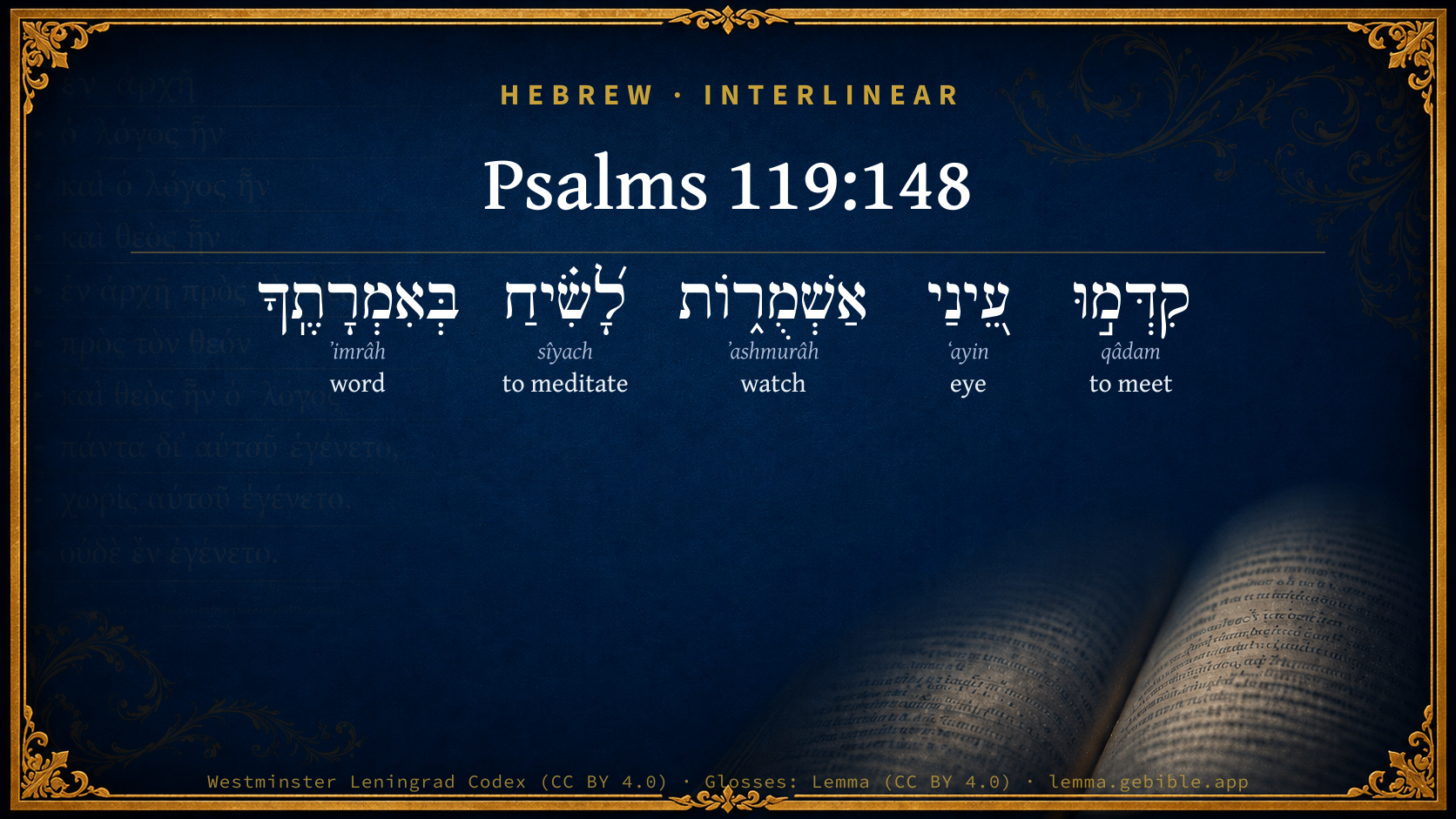
Psalms 119:148

Hebrew (Westminster Leningrad Codex) Psalms 119:148 appears in the Hebrew Old Testament. The text above is from the Westminster Leningrad Codex. Each word links to its Strong’s number, a concise gloss, and parsing drawn from the Open Scriptures Hebrew Bible morphology. Click any word for its full Brown-Driver-Briggs (BDB) entry.
Download image
Cite this verse

Psalms 119:148 (World English Bible). Public Domain. Lemma interlinear Bible study tool, https://lemma.gebible.app/v/psalms/119/148.

Show BibTeX & RIS
BibTeX
RIS
English Translation
My eyes stay open through the night watches, That I might meditate on your word.
World English Bible · Public Domain
Download a study sheet

One document with this verse’s original text, its word-by-word gloss line, the meaning frame, cross-references with their text, attributed commentary, and full source and license credits — printable, and it pastes into notes with its structure intact.

This verse Autodidact and up

Study sheet (.html) Plain text (.txt)

A passage Seminary Student

Up to 50 verses in one chapter. A passage sheet keeps up to 6 commentary sources and 12 cross-references per verse, in the order this page ranks them, and says so on the sheet whenever that leaves anything out. Ask for a single verse and you get the Autodidact verse sheet above.

Everything on this page stays free to read, with no account — the sheet is a download of what is already on screen, not access to it.

Want to remove ads? Support Godless Engineer
Compare translations 3

The same verse in 3 English versions, stacked beneath the original-language interlinear above. Click any original word for its lexicon entry.

Each is an independent rendering of the whole verse — the interlinear is not word-aligned to these translations.

Highlighted words mark where these versions differ — a whole-verse word diff, not a word-by-word alignment.

  • World English Bible Public Domain
    My eyes stay open through the night watches, That I might meditate on your word.
  • King James Version Public Domain
    Mine eyes prevent the night watches, that I might meditate in thy word.
  • unfoldingWord Literal Text CC BY-SA 4.0
    My eyes preempt the night watches, to meditate on your word.

unfoldingWord Literal Text — © unfoldingWord, licensed CC BY-SA 4.0. Word-aligned USFM3 via Door43 (git.door43.org/unfoldingWord/en_ult).

Versions to compare (up to 4)

3 of 4 selected

Show all 17 translations

Every available English version of this verse, each an independent rendering of the whole verse.

  • World English Bible Public Domain
    My eyes stay open through the night watches, That I might meditate on your word.
  • Berean Standard Bible Public Domain
    My eyes anticipate the watches of night, that I may meditate on Your word.
  • Majority Standard Bible Public Domain
    My eyes anticipate the watches of night, that I may meditate on Your word.
  • King James Version Public Domain
    Mine eyes prevent the night watches, that I might meditate in thy word.
  • American Standard Version (1901) Public Domain
    Mine eyes anticipated the night-watches, That I might meditate on thy word.
  • Revised Version (1885) Public Domain
    Mine eyes prevented the night watches, that I might meditate in thy word.
  • Geneva Bible (1599) Public Domain
    Mine eyes preuent the night watches to meditate in thy word.
  • Young's Literal Translation Public Domain
    Mine eyes have gone before the watches, To meditate in Thy saying.
  • Literal Standard Version CC BY-SA 4.0
    My eyes have gone before the watches, || To meditate on Your saying.
  • Unlocked Literal Bible CC BY-SA 4.0
    My eyes are open before the night watches change so that I might meditate on your word.
  • unfoldingWord Literal Text CC BY-SA 4.0
    My eyes preempt the night watches, to meditate on your word.
  • Darby Bible Public Domain
    Mine eyes anticipate the night-watches, that I may meditate in thy ùword.
  • World Messianic Bible Public Domain
    My eyes stay open through the night watches, that I might meditate on your word.
  • Webster's Bible Public Domain
    My eyes anticipated the night watches, that I might meditate in thy word.
  • Free Bible Version CC BY-SA 4.0
    During the night I stay awake, meditating on your word.
  • Bible in Basic English Public Domain
    In the night watches I am awake, so that I may give thought to your saying.
  • JPS Tanakh (1917) Public Domain
    Mine eyes forestalled the night-watches, that I might meditate in Thy word.

Literal Standard Version (2020), Covenant Press — licensed CC BY-SA 4.0. Text via the HelloAO Bible API (eBible.org). Unlocked Literal Bible (unfoldingWord) — licensed CC BY-SA 4.0. Text via the HelloAO Bible API (eBible.org). unfoldingWord Literal Text — © unfoldingWord, licensed CC BY-SA 4.0. Word-aligned USFM3 via Door43 (git.door43.org/unfoldingWord/en_ult). Free Bible Version, Dr. Jonathan Gallagher — licensed CC BY-SA 4.0. Text via the HelloAO Bible API (eBible.org).

Word by word

More ways to search: Search by grammar → Find every occurrence → Compare this word →

Practice this passage: Drill this verse → Learn its vocabulary →

About this verse

These counts appear in no published source. They are computed here, from the morphology-tagged text and Lemma’s own curated glosses. What Lemma adds →

5
words
5
distinct lemmas
Wisdom
section

Notable vocabulary

The rarest word here is אַשְׁמֻר֑וֹת watch H821 — appearing just 7 times in the whole Hebrew Bible.

Shared distinctive vocabulary

אַשְׁמֻר֑וֹת watch H821 occurs in 7 verses of the Hebrew Bible. Also found in:

Grammatical profile

  • 2 verbs
  • 3 nouns

Verb forms

  • קִדְּמ֣וּ Piel · Perfect
  • לָ֝שִׂ֗יחַ Qal · Infinitive Construct

Hebrew & Septuagint length

In English translation the verse runs 15 words from the Hebrew and 12 from the Septuagint (LXX English) — closely comparable.

A rough comparison of the two English renderings, which tokenize alike — not a word-level alignment.

Word counts can differ between the Hebrew and the Greek without any difference in meaning — e.g. the Hebrew direct-object marker אֵת has no separate Greek word, and Greek often adds the article ὁ.

Cross-references

6

Topical passages linked to Psalms 119:148 in the Treasury of Scripture Knowledge — connected by theme and wording, ordered by reader-vote popularity; previews shown in the World English Bible.

  • Psalms 63:6 When I remember you on my bed, And think about you in the night watches.
  • Lamentations 2:19 Arise, cry out in the night, at the beginning of the watches; Pour out your heart like water before the face of the Lord: Lift up your hands toward him for the life of your young children, that faint for hunger at the head of every street.
  • Luke 6:12 It happened in these days, that he went out to the mountain to pray, and he continued all night in prayer to God.
  • Psalms 63:1 God, you are my God. I will earnestly seek you. My soul thirsts for you, My flesh longs for you, In a dry and weary land, where there is no water.
  • Psalms 139:17–18 How precious to me are your thoughts, God! How vast is the sum of them!
  • Psalms 119:62 At midnight I will rise to give thanks to you, Because of your righteous ordinances.

Cross-references courtesy of OpenBible.info (CC BY 4.0).

Hebrew and Greek witnesses Masoretic Hebrew ↔ Greek Septuagint

The same verse in the two great witnesses to the Old Testament, shown verse-for-verse.

You’re reading Greek Psalm 118 (Hebrew Psalm 119). The Septuagint counts the superscription, so verse numbers can differ from the Hebrew — chapter-level alignment, not verse-by-verse. Numbering follows Rahlfs.

These are two independent witnesses, not word-aligned to each other, and the Septuagint is shown in lemma (dictionary) form.

Hebrew Psalms 119:148 Masoretic · Westminster Leningrad Codex

קִדְּמ֣וּ עֵ֭ינַי אַשְׁמֻר֑וֹת לָ֝שִׂ֗יחַ בְּאִמְרָתֶֽךָ

My eyes stay open through the night watches, That I might meditate on your word.

World English Bible · Public Domain

Greek LXX Greek Psalm 118:148 Septuagint · lemma form

προφθάνω ὁ ὀφθαλμός ἐγώ πρός ὄρθρος ὁ μελετάω ὁ λόγιον σύ

My eyes prevented the dawn, that I might meditate on your oracles.

LXX2012 (modern English Septuagint) · Public Domain

Hebrew: Westminster Leningrad Codex (CC BY 4.0). Greek: Septuagint (public domain); English from LXX2012 (modern English Septuagint) (Public Domain). How the Septuagint differs from the Hebrew →

Commentary

Notes on Psalms 119:148 from classic Christian and Jewish commentators (each source and its license shown beneath its notes). The classic Christian expositions comment on the surrounding passage and are grouped to its opening verse, so a note may address several verses; the Jewish commentaries on the Tanakh (Rashi and others) are per-verse, so they appear only where the commentator wrote on this verse.

Lemma curates 59 commentaries, every one of them public domain or Creative Commons licensed, each selected and text-cleaned for this edition rather than reprinted as found. About our sources →

Trapp's Complete Commentary

John Trapp

Psa 119:148 Mine eyes prevent the [night] watches, that I might meditate in thy word.

Ver. 148. Mine eyes prevent the night watches] By this verse and the former it appeareth that he spent whole nights in prayer and meditation of God’s word. Jerome counselled some godly women thus, Tenenti codicem somnus obrepat, et cadentem faciem pagina sacra suspiciat (Hier. ad Eusta.).

John Trapp, A Commentary or Exposition upon All the Books of the Old and New Testament (1647–1656) — public domain. Text from a community e-Sword module.

The Biblical Illustrator

Joseph S. Exell

Psa_119:148

Mine eyes prevent the night watches, that I might meditate in Thy Word.

The inexhaustibleness of the Bible

There is something very surprising in the fact--but that it is a fact admits of no debate--that the Bible is not of a size to alarm any one, be his time ever so occupied, and yet that it is of a size to engage all his time, be that time ever so completely at his disposal. You cannot find the individual, however many the years, and however great the diligence, which he has given to the study of the sacred volume, who feels that there is no more to be learnt from that volume; and that it is useless for him to re-peruse that volume. Yet, on the other hand, if you wish to guide a man into an acquaintance with the things which belong to his peace, and accordingly press upon him the duty of reading the Bible, you can be met with no plausible excuse from the greatness of the prescribed task. It is not a huge library; it is only a single, and not very large book, which we entreat him to investigate; and with what fairness can a man of the most engrossing occupation plead want of time as his apology for refusing? We say again, this is one of the most extraordinary things to be observed in regard of the Bible. If the inspired writings together had filled a vast array of volumes, the great mass of men would have argued that the quantity sanctioned neglect. In our every endeavour at enforcing on them the duty of studying the Scriptures, we should have been met with the apparently reasonable statement that the necessary engagements of life forbade the embarking on so gigantic an undertaking. Then, on the other hand, had the Bible not been of so condensed and comprehensive a character that its chapters are libraries and its sentences volumes, the righteous of the earth, having nothing but this single book to study, would presently have been left with nothing to study--nothing to ponder. A few short weeks would have finished a common book of the same size. What, then, is it but the Deity in the Bible which makes it like a fire for ever consuming and yet for ever unconsumed? These are two features which, in their combination, strongly mark off the Bible from all other books: these are two features, I say--that it is so small, that in regard of its study no one can be afraid of making a beginning; and that it is so large, that no one is ever able to make an end: and he who prevents the night watches may always find fresh matter for meditation. Who amongst us that is accustomed to read the Bible with diligence and prayer can be ignorant that the contents of this Book seem to grow with the being examined; so that in place of exhausting, we multiply materials of thought? and that passages in which we observed no particular beauty or force, though they had been a hundred times read, will suddenly strike us as being full of the most valuable meaning, and words which we had overlooked as unimportant, dilate into sermons, preaching to us of duties and unfolding mysteries? There are texts in the Bible which we have often given up as hopelessly obscure; but with greater experience has come greater light; and dark sayings have burst forth as amongst the most brilliant and precious in Scripture. He is, indeed, a rare character amongst Christians who should feel the want of a larger Bible! There may undoubtedly be many points on which men long for fuller information, and many subjects which they may wish elucidated with greater clearness than is derivable from the pages of Holy Writ--but can any say that there remains nothing for him to examine in Scripture; that he has gone the whole length that revelation would carry him, and that he is at a standstill for want of a larger Bible? A larger Bible! Who is there of us who will dare to say that he has so exhausted a single chapter of the Bible that he may be confident that there is nothing more of instruction, nothing more of warning, nothing more of consolation to draw from its statements? And if it he thus true that the Bible is still unexhauted, though the world has for many centuries been diving into its treasures--that there are yet unexplored stores and riches to stimulate the industry and recompense the toil of every lover of its glorious truths, then must it on all hands be admitted that the Bible is adapted in its size, as well as in every other respect, to the capacities of human kind, since now in the old age of this creation, the sacred volume still presents fresh veins of precious ore, like a mine which, the more it is worked, the more it seems to contain and to yield. And since the world, if we may so express it, will not have finished the Bible when the concerns of humanity are wound up, and time itself shall die in eternity, then, indeed, we may well assent to the saying of St. John, that had all which Christ did been written--had, that is, great additions been made to the inspired volume of God Himself--the world could not have held the books. But we also learn that the student of Holy Writ will never come to a stand in the study, as though the book were mastered, and had nothing further to yield to patient inquiry: nay, not even if from youth upwards to extreme old age, he could give as descriptive of himself the words of David in our text--Mine eyes prevent the night watches, that I may meditate in Thy Word. (H. Melvill, B. D.)

The Biblical Illustrator, edited by Joseph S. Exell (c. 1880s–1900s) — public domain. Text from a community e-Sword module.

J. A. Alexander on Psalms

Joseph Addison Alexander

148. (Psa 119:148) My eyes anticipate the watches, to muse of thy promise. Before the stated hours of vigil he is awake and ready for devout meditation. To muse, that I may muse or meditate. See above, on Psa 119:62, and compare Psa 63:6; Psa 77:4, Lam 2:19.

Joseph Addison Alexander, The Psalms Translated and Explained (1850) — public domain. Text from a community e-Sword module.

Geneva Bible (1599)

Geneva Bible translators

He was more earnest in the study of God’s word, than they that kept the watch were in their charge.

Geneva Bible (1599) marginal notes — public domain. Text via Bolls.life.

Adam Clarke's Commentary

Verse 148. Mine eyes prevent] קדמו kiddemu, "go before the watches." Before the watchman proclaims the hour, I am awake, meditating on thy words. The Jews divided the night into three watches, which began at what we call six o'clock in the evening, and consisted each of four hours. The Romans taught them afterwards to divide it into four watches of three hours each; and to divide the day and night into twelve hours each; wherein different guards of soldiers were appointed to watch. At the proclaiming of each watch the psalmist appears to have risen and performed some act of devotion. For a remarkable custom of our Saxon ancestors, See Clarke on Ps 119:164.

Adam Clarke's Commentary on the Bible (1810–1826) — public domain. Text from a community e-Sword/MySword module.

John Calvin's Commentaries

148. My eyes have prevented the night watchers. The Hebrews divided the natural day into three portions--morning, noon, and evening — which are mentioned by David as seasons in which he engaged in prayer. (Psalm 55:17.) They also divided the night into three parts, called “watches,” consisting of four hours each, and commencing at our six o’clock in the evening. In Lamentations 2:19, we read of the first watch; or, as it is there designated, “the beginning of the watches;” in Judges 7:19, of “the middle watch;” and in Exodus 14:24, of “the morning watch.” A similar division of the night seems to have been made by other ancient nations, as appears from the references made to it by Homer and the early Greek writers. The Greeks and Romans, however, in improving their military discipline, afterwards divided the night into four watches, each consisting of three hours; and when the Jews fell under the dominion of the latter people, they adopted from them this division of the night. Hence we read of “the fourth watch of the night” in Matthew 14:25. And the four watches are mentioned together in Mark 13:35:

“Watch ye therefore: for ye know not when the master of the house cometh, at even, or at midnight, or at cock-crowing, or in the morning.”

The time at which each of these four watches began and ended is thus determined by Dr. Hales, who has written elaborately on the subject: “1. Οψε, the late, began at sunset, and ended with the third hour of the night, including the evening-dawn, or twilight. It was also called οψια ὡρα, eventide, Mark 11:11; or simply οψια, evening, John 20:19, etc. 2. Μεσονυκτιον, the midnight, lasted from the third hour till midnight. 3. Αλεκτοροφωνια, the cock-crowing, midnight till the third hour after, or the ninth hour of the night. It included the two cock-crowings, with the second or principal of which it ended. 4. Πρωι, the early, lasted from the ninth to the twelfth hor of the night, or sunrise, including the morning-dawn or twilight. It is also called πρωια, morning, or morningtide, (ὡρα being understood,) John 18:28, etc.

“When the Psalmist here declares, that his eyes prevented the nightwatches, we are to understand him as chiefly referring to the middle and morning watches, which falling at that period of the night when men in general are devoted to rest, envinced the strength, fervour, and self-sacrificing character of his devotions.” — Dr. Morison.

John Calvin's Commentaries (1540-1563) — public domain. Text from the Calvin Translation Society English edition (1840s-50s) via the Christian Classics Ethereal Library (ccel.org). Calvin's coverage is partial (roughly two-thirds of the Bible); uncommented books and verses are honest gaps, never fabricated. The 19th-century editor's footnotes and remarks are omitted so the notes are faithfully Calvin's own voice.

The Cambridge Bible for Schools and Colleges

gen. ed. J. J. S. Perowne

148. Mine eyes prevent [or are beforehand with, the same word as in Psa_119:147] the night watches] The night was divided into three watches by the Israelites (Lam_2:19; Jdg_7:19; 1Sa_11:11). He compares himself to a sentinel who wakes before it is time for him to go on duty. Possibly, as Baethgen suggests, there is a reference to the author’s duties as a Levite. Before the hour when he must rise for his watch in the Temple he is awake, and meditating on God’s words. Cp. Psa_119:62; Psa_63:6.

The Cambridge Bible for Schools and Colleges (gen. ed. J. J. S. Perowne; Cambridge University Press, 1878–1918) — public domain. Text from a community e-Sword module.

John Gill's Exposition

Concerning thy testimonies, I have known of old,.... Or, "from thy testimonies, I have known of old" (d): by carefully reading the Scriptures which testify of God, his mind an will, and frequently meditating on them, he had learned a long time ago, even from his youth, what follows,

that thou hast founded them for ever; that the things contained in them are sure and certain, established and eternal truths; the moral law and the precepts of it are eternal, and of perpetual obligation; not one jot or tittle of them shall ever fail; the Gospel, and the truths of it, are everlasting, and shall ever remain; in spite of all the opposition, craft and cunning, fury and force of men, to undermine and root them out; see Psa 119:89.

(d) "ex obtestationibus tuis", Tigurine version; so Cocceius, Gejerus.

John Gill's Exposition of the Whole Bible (1746–1763) — public domain (CC PDM 1.0). Text via the HelloAO Bible API.

Albert Barnes' Notes on the Bible

Mine eyes prevent the night watches - Luther renders this, “I wake up early.” The Hebrew word means a “watch” - a part of the night, so called from military watches, or a dividing of the night to “keep guard.” See the notes at Psa 90:4. The idea of the psalmist here is, that he anticipated these regular divisions of the night in order that he might engage in devotion. Instead of waiting for their return, he arose for prayer before they recurred - so much did his heart delight in the service of God. The language would seem to be that of one who was accustomed to pray in these successive “watches” of the night - the early, the middle, and the dawn. This may illustrate what occurs in the life of all who love God. They will have regular seasons of devotion, but they will often anticipate those seasons. They will be in a state of mind which prompts them to pray; when nothing will meet their state of mind but prayer; and when they cannot wait for the regular and ordinary season of devotion - like a hungry man who cannot wait for the usual and regular hour of his meals. The meaning of the phrase, “mine eyes prevent,” is that he awoke before the usual time for devotion.

That I might meditate in thy word - See the notes at Psa 1:2.

Albert Barnes' Notes on the Bible (1834–1885) — public domain. Text from a community e-Sword/MySword module.

Matthew Poole's English Annotations

The night watches, Heb. the watches; which were kept only by night. And these watches were then three, as hath been more than once observed. And this is not to be understood of the first watch, which was at the beginning of the night, for the prevention thereof was very easy, and frequent, and inconsiderable; but of the middle watch, as it is called, Jdg 7:19, which was set in the middle of the night; and especially of the morning watch, as it is called, Exo 14:24, which was set some hours before the dawning of the day; and so this is an aggravation and addition to what he said Psa 119:147.

Matthew Poole's English Annotations on the Holy Bible (1683–1685) — public domain. Text from a community e-Sword/MySword module.

The Treasury of David

Charles H. Spurgeon

Ver. 148. Mine eyes prevent the night watches. Or rather, the watches. Before the watchman cried the hour, he was crying to God. He did not need to be informed as to how the hours were flying, for every hour his heart was flying towards heaven. He began the day with prayer, and he continued in prayer through the watches of the day, and the watches of the night. The soldiers changed guard, but David did not change his holy occupation. Specially, however, at night did he keep his eyes open, and drive away sleep, that he might maintain communion with his God. He worshipped on from watch to watch as travellers journey from stage to stage.

That I might meditate in thy word. This had become meat and drink to him. Meditation was the food of his hope, and the solace of his sorrow: the one theme upon which his thoughts ran was that blessed "word" which he continually mentions, and in which his heart rejoices. He preferred study to slumber; and he learned to forego his necessary sleep for much more necessary devotion. It is instructive to find meditation so constantly connected with fervent prayer: it is the fuel which sustains the flame. How rare an article is it in these days.

Ver. 148. Mine eyes prevent the night watches, that I might meditate in thy word. You will all admit that this is the language of an ardent, earnest, and painstaking student. David represents himself as "rising early, and late taking rest, "on purpose that he might employ himself in the study of God's word. "He meditates in this word, "the expression implying close and patient thought; as if there were much in the word which was not to be detected by a cursory glance, and which required the strictest application both of the head and the heart.

The Bible is a book in which we may continually meditate, and yet not exhaust its contents. When David expressed himself in the language of our text, Holy Writ the word of God was of course a far smaller volume than it now is, though, even now, the Bible is far from a large book. Yet David could not, so to speak, get to the end of the book. He might have been studying the book for years, nay, we are sure that he had been, and yet, as though he were just entering on a new course of reading, with volume upon volume to peruse, lie must rise before day to prosecute the study. "Mine eyes prevent the night watches, that I might meditate in thy word."

The same remark may be made upon precepts which enjoin continued study of the Bible. Is there material for that study? Unless there be, the precepts will become out of place; the Scriptural student will have exhausted the Scriptures; and what is he to do then? He can no longer obey the precepts, and the precepts will prove that they cannot have been made for perpetuity for the men of all ages and all conditions...

Here is a servant of God, who, from his youth upward, has been diligent in the study of the Bible. Year after year he has devoted to that study, and yet the Bible is but a single volume, and that not a large volume. "Well, then, "you might be inclined to say, "the study must surely by this time have exhausted the book! There can be nothing new for him to bring out; nothing which he has not investigated and fathomed." Ah, how you mistake the Bible! What a much larger book it must be than it seems! In place of having exhausted it, the royal student speaks as though there were more work before him than he knew how to compass. "Mine eyes prevent the night watches, that I might meditate in thy word." Henry Melvill.

Ver. 148. "Mine eyes prevent the night watches." The Hebrew word means a watch a part of the night, so called from military watches, or a dividing of the night to keep guard. The idea of the Psalmist here is, that he anticipated these regular divisions of the night in order that he might engage in devotion. Instead of waiting for their return, he arose for prayer before they recurred; so much did his heart delight in the service of God. The language would seem to be that of one who was accustomed to pray in these successive "watches" of the night; the early, the middle, and the dawn. This may illustrate what occurs in the life of all who love God. They will have regular seasons of devotion, but they will often anticipate those seasons. They will be in a state of mind which prompts them to pray; when nothing will meet their state of mind but prayer; and when they cannot wait for the regular and ordinary season of devotion; like a hungry man, who cannot wait for the usual and regular hour of his meals. The meaning of the phrase, "Mine eyes prevent, "is that he awoke before the usual time for devotion. Albert Barnes.

Ver. 148. Mine eyes prevent the night watches, etc. His former purpose is yet continued, declaring his indefatigable perseverance in prayer. Oh, that we could learn of him to use our time well! At evening he lay down with prayers and tears; at midnight he rose to give thanks; he got up before the morning light to call upon the Lord. This is to imitate the life of angels, who ever are delighted to behold the face of God, singing alway a new song without wearying. This is to begin our heaven upon earth: Oh, that we could alway remember it! William Cowper.

Ver. 148. Night watches. The Jews, like the Greeks and Romans, divided the night into military watches instead of hours, each watch representing the period for which sentinels or pickets remained on duty. The proper Jewish reckoning recognized only three such watches, entitled the first, "or beginning of the watches" (La 2:19), "the middle watch" (Jud 7:19), and "the morning watch" (Ex 14:24; 1Sa 11:11). These would last respectively from sunset to 10 p.m.; from 10 p.m. to 2 a.m.; and from 2 a.m. to sunrise. It has been contended by Lightfoot that the Jews really reckoned four watches, three only of which were in the dead of the night, the fourth being in the morning. This, however, is rendered improbable by the use of the term "middle, "and is opposed to Rabbinical authority. Subsequently to establishment of Roman supremacy, the number of watches was increased four which was described either according to their numerical order, as the case of the "fourth watch" (Mt 14:25), or by the terms" midnight, cock crowing, and morning" (Mr 13:35). These, terminated at 9 p.m., midnight, 3 a.m., and 6 a.m. Conformably to this, the guard of soldiers was divided into four relays (Ac 12:4), showing that the Roman regime was followed in Herod's army. Watchmen appear have patrolled the streets of the Jewish towns (So 3:3 5:7; Ps 127:1) where for "maketh" we should substitute "watcheth"; Ps 130:6. William Latham Beyan, in Smith's Dictionary of the Bible, 1863.

Ver. 148. The Inexhaustibleness of the Bible. A sermon by Henry Melvill, at "The Golden Lecture." 1850.

Ver. 148. Meditation. Appropriate time, and fruitful subject.

Ver. 148. Meditation in the word well worth self denial and care on the part of the Christian.

1. Without meditation reading is a waste of time and an indignity offered to the word.

2. Meditation with prayer, but not prayer without meditation, will discover the sense of the word, when all other means fail; and it has this advantage, that the meaning sinks into the mind.

3. Meditation extracts sweetness from the promises, and nourishment from the whole truth.

4. Meditation makes a wise teacher and an efficient worker of one who has little natural skill or learning.

5. Meditation subjects the soul to the sanctifying power of the word.

6. Meditation is an invitation to the Holy Spirit to bless the soul, for he is closely associated with the truth, and delights to see the truth honoured. J.F.

Psalms 119:149*

Charles H. Spurgeon's The Treasury of David (1869–1885) — public domain. Psalms only. Text from a community e-Sword/MySword module.

The Pulpit Commentary

Mine eyes prevent the night watches. As ver. 146 is a repetition of ver. 145, so this verse is very nearly a repetition of ver. 147. The only change of idea is in the second clausethat I might meditate in thy Word; or, "on thy promise which makes meditation rather than prayer the psalmist"s object in his early rising.

The helpfulness of meditation.

"Mine eyes prevent the night-watches." "Prevent" is here used in the sense of "anticipate." When the night-watches come he is wide awake; he does not let them interrupt his meditations by their demand for sleep. He is not taken at unawares. According to the psalmist"s thought, morning is the fitting time for earnest resolves, and evening the time for quiet meditation. Meditation can be understood when contrasted with study. Study deals with something outside the mind, and presented to it. Meditation deals with the contents of the mind itself, and that which may be suggested by the indwelling Spirit. A panorama of the contents of our mind is continually moving before us. Usually we rapidly select to meet the need of the moment, according to the mental laws of association. In meditation we let the panorama move by more slowly, pay more quiet heed to its varied contents, End so discover and enjoy much that usually escapes attention. Apply this to the panorama of our knowledge of God"s Word, and we have religious meditation.

I MEDITATION HELPS US BY MAKING US KNOW" MORE. Illustrate by the difference between the tourist who rushes through delightful scenery, getting no more than general impressions, and the tourist who tarries awhile in one place, finding out ever-fresh charms, and seeing everything beautiful in new moods and settings. The man who only read God"s Word may know much, but the man who quietly meditates therein knows more.

II MEDITATION HELPS US BY MAKING US KNOW BETTER. Illustrate by the stereo-scope. Just look into it, and you can see nothing unusual. Look fixedly, quietly, and everything in the picture seems to get place and relation. You realize vistas and distances, and the full charm is revealed. The Word of God has but little to give in response to a mere look; all its best things come to view when the soul is quiet enough to fix its gaze, and look long and lovingly. R.T.

The Pulpit Commentary (1880–1919), ed. H.D.M. Spence-Jones & Joseph S. Exell — public domain. Text from a community e-Sword module.

John Wesley's Explanatory Notes

Watches - The middle watch, which was set in the middle of the night; and the morning watch, which was set some hours before the dawning of the day.

John Wesley, Explanatory Notes Upon the Whole Bible (1754–1765) — public domain. Text via the GEBible commentary corpus.

Rashi

Rabbi Shlomo Yitzchaki (Rashi)

watches Half the night, two watches, and according to one who says that the night consists of three watches, David would rise from bed at the first third of the night and engage in Torah until midnight, as it is said: “to speak of Your word.” From midnight on, he would engage in songs and praises, as it is said (verse 62): “At midnight, I rise to give thanks to You.”

Rashi on the Tanakh — English translations: “The Judaica Press complete Tanach with Rashi, translated by A. J. Rosenberg” (CC BY 4.0); “Pentateuch with Rashi's commentary by M. Rosenbaum and A.M. Silbermann, 1929-1934” (public domain); “The Metsudah Tanach series, Lakewood, N.J” (CC BY 4.0); and “The Book of Joshua, Metsudah Publications, 1997” (CC BY 4.0). Text via Sefaria.

Lesson kit

Teaching starters — assembled from the data on this page, not authored interpretation. Every prompt links to the verse data it draws on. Edit before teaching.

Psalms, in the Wisdom, opens this verse with 5 words (5 distinct Hebrew lemmas). Its most distinctive word is ʼashmurâh (“watch”). A historical commentator’s framing appears above. Read the whole chapter for the surrounding context.

Discussion questions

  1. How does “watch” (ʼashmurâh) shape what this verse is saying?
  2. Exodus 14:24 shares the word «watch» with this verse. How do the two illuminate each other?
  3. The translations on this page render this verse differently — a whole-verse word diff, not a word-by-word alignment. What might account for the different wordings?
  4. The verb «קִדְּמ֣וּ» is Piel Perfect. How does its form color the action?
  5. Reading how Trapp's Complete Commentary and The Biblical Illustrator read this verse, where do the two commentators agree and where do they part?

Things to notice

Reading settings

Reading text

Shown beneath each verse's original-language words.

Old Testament
Old Testament edition

Read the OT as the Masoretic Hebrew (MT) or the Greek Septuagint (LXX).

English shown for the Greek Septuagint (in the Hebrew ↔ Greek comparison).

Comparing translations? Open the Compare panel on any verse page to stack up to four side by side.