
Psalms 119:147

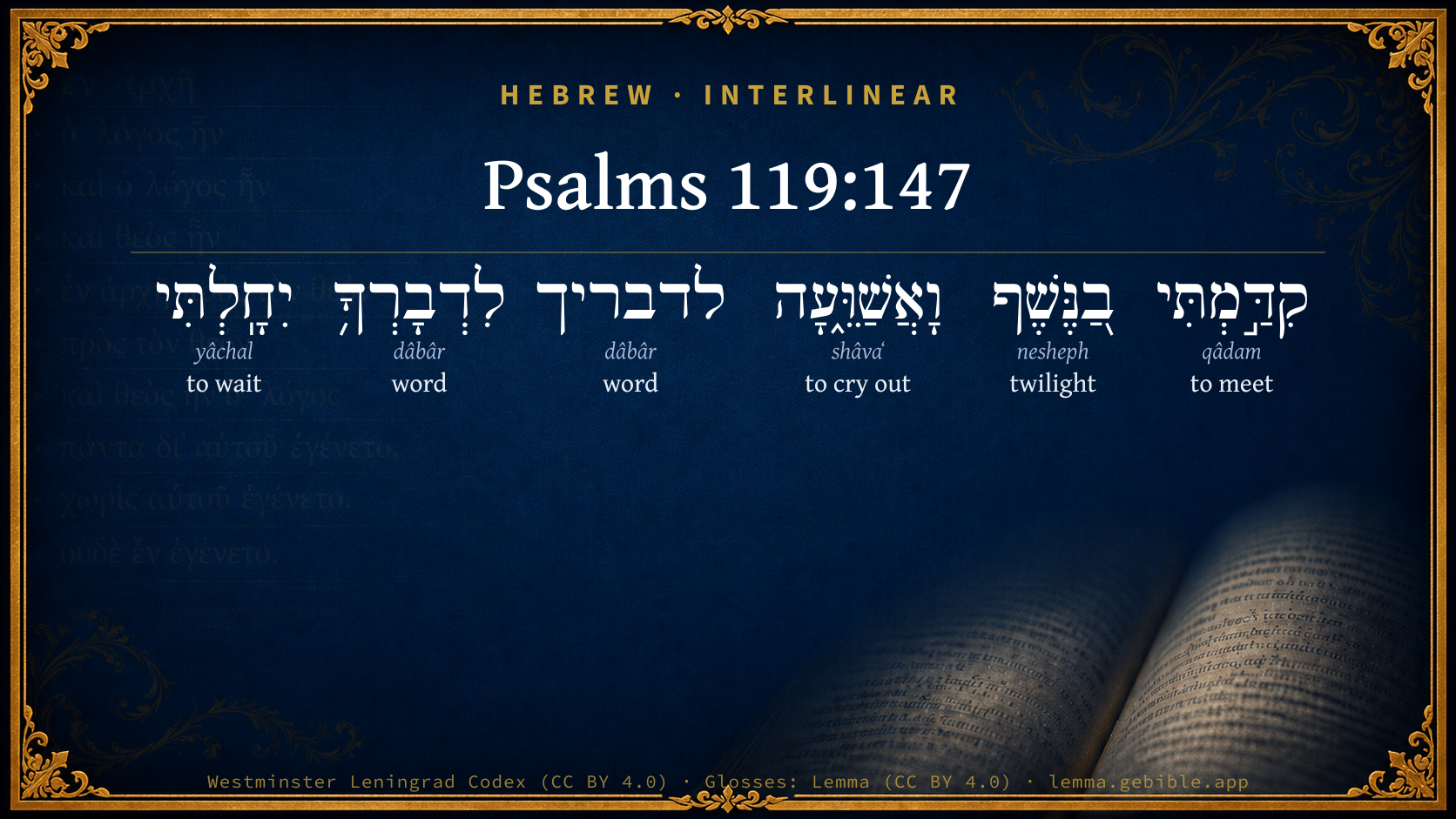
Hebrew (Westminster Leningrad Codex) Psalms 119:147 appears in the Hebrew Old Testament. The text above is from the Westminster Leningrad Codex. Each word links to its Strong’s number, a concise gloss, and parsing drawn from the Open Scriptures Hebrew Bible morphology. Click any word for its full Brown-Driver-Briggs (BDB) entry.
Download image
Cite this verse

Psalms 119:147 (World English Bible). Public Domain. Lemma interlinear Bible study tool, https://lemma.gebible.app/v/psalms/119/147.

Show BibTeX & RIS
BibTeX
RIS
English Translation
I rise before dawn and cry for help. I put my hope in your words.
World English Bible · Public Domain
Download a study sheet

One document with this verse’s original text, its word-by-word gloss line, the meaning frame, cross-references with their text, attributed commentary, and full source and license credits — printable, and it pastes into notes with its structure intact.

This verse Autodidact and up

Study sheet (.html) Plain text (.txt)

A passage Seminary Student

Up to 50 verses in one chapter. A passage sheet keeps up to 6 commentary sources and 12 cross-references per verse, in the order this page ranks them, and says so on the sheet whenever that leaves anything out. Ask for a single verse and you get the Autodidact verse sheet above.

Everything on this page stays free to read, with no account — the sheet is a download of what is already on screen, not access to it.

Want to remove ads? Support Godless Engineer
Compare translations 3

The same verse in 3 English versions, stacked beneath the original-language interlinear above. Click any original word for its lexicon entry.

Each is an independent rendering of the whole verse — the interlinear is not word-aligned to these translations.

Highlighted words mark where these versions differ — a whole-verse word diff, not a word-by-word alignment.

  • World English Bible Public Domain
    I rise before dawn and cry for help. I put my hope in your words.
  • King James Version Public Domain
    I prevented the dawning of the morning, and cried: I hoped in thy word.
  • unfoldingWord Literal Text CC BY-SA 4.0
    I preempt the dawn and cry for help; for your words I wait.

unfoldingWord Literal Text — © unfoldingWord, licensed CC BY-SA 4.0. Word-aligned USFM3 via Door43 (git.door43.org/unfoldingWord/en_ult).

Versions to compare (up to 4)

3 of 4 selected

Show all 17 translations

Every available English version of this verse, each an independent rendering of the whole verse.

  • World English Bible Public Domain
    I rise before dawn and cry for help. I put my hope in your words.
  • Berean Standard Bible Public Domain
    I rise before dawn and cry for help; in Your word I have put my hope.
  • Majority Standard Bible Public Domain
    I rise before dawn and cry for help; in Your word I have put my hope.
  • King James Version Public Domain
    I prevented the dawning of the morning, and cried: I hoped in thy word.
  • American Standard Version (1901) Public Domain
    I anticipated the dawning of the morning, and cried: I hoped in thy words.
  • Revised Version (1885) Public Domain
    I prevented the dawning of the morning, and cried: I hoped in thy words.
  • Geneva Bible (1599) Public Domain
    I preuented the morning light, and cried: for I waited on thy word.
  • Young's Literal Translation Public Domain
    I have gone forward in the dawn, and I cry, For Thy word I have hoped.
  • Literal Standard Version CC BY-SA 4.0
    I have gone forward in the dawn, and I cry, || I have hoped for Your word.
  • Unlocked Literal Bible CC BY-SA 4.0
    I rise before the dawn of the morning and cry for help. I hope in your words.
  • unfoldingWord Literal Text CC BY-SA 4.0
    I preempt the dawn and cry for help; for your words I wait.
  • Darby Bible Public Domain
    I anticipate the morning-dawn and I cry: I hope in thy word.
  • World Messianic Bible Public Domain
    I rise before dawn and cry for help. I put my hope in your words.
  • Webster's Bible Public Domain
    I came before the dawning of the morning, and cried: I hoped in thy word.
  • Free Bible Version CC BY-SA 4.0
    I get up before dawn, and call out to you for help and put my hope in your word.
  • Bible in Basic English Public Domain
    Before the sun is up, my cry for help comes to your ear; my hope is in your words.
  • JPS Tanakh (1917) Public Domain
    I rose early at dawn, and cried; I hoped in Thy word.

Literal Standard Version (2020), Covenant Press — licensed CC BY-SA 4.0. Text via the HelloAO Bible API (eBible.org). Unlocked Literal Bible (unfoldingWord) — licensed CC BY-SA 4.0. Text via the HelloAO Bible API (eBible.org). unfoldingWord Literal Text — © unfoldingWord, licensed CC BY-SA 4.0. Word-aligned USFM3 via Door43 (git.door43.org/unfoldingWord/en_ult). Free Bible Version, Dr. Jonathan Gallagher — licensed CC BY-SA 4.0. Text via the HelloAO Bible API (eBible.org).

Word by word

More ways to search: Search by grammar → Find every occurrence → Compare this word →

Practice this passage: Drill this verse → Learn its vocabulary →

About this verse

These counts appear in no published source. They are computed here, from the morphology-tagged text and Lemma’s own curated glosses. What Lemma adds →

6
words
5
distinct lemmas
Wisdom
section

Notable vocabulary

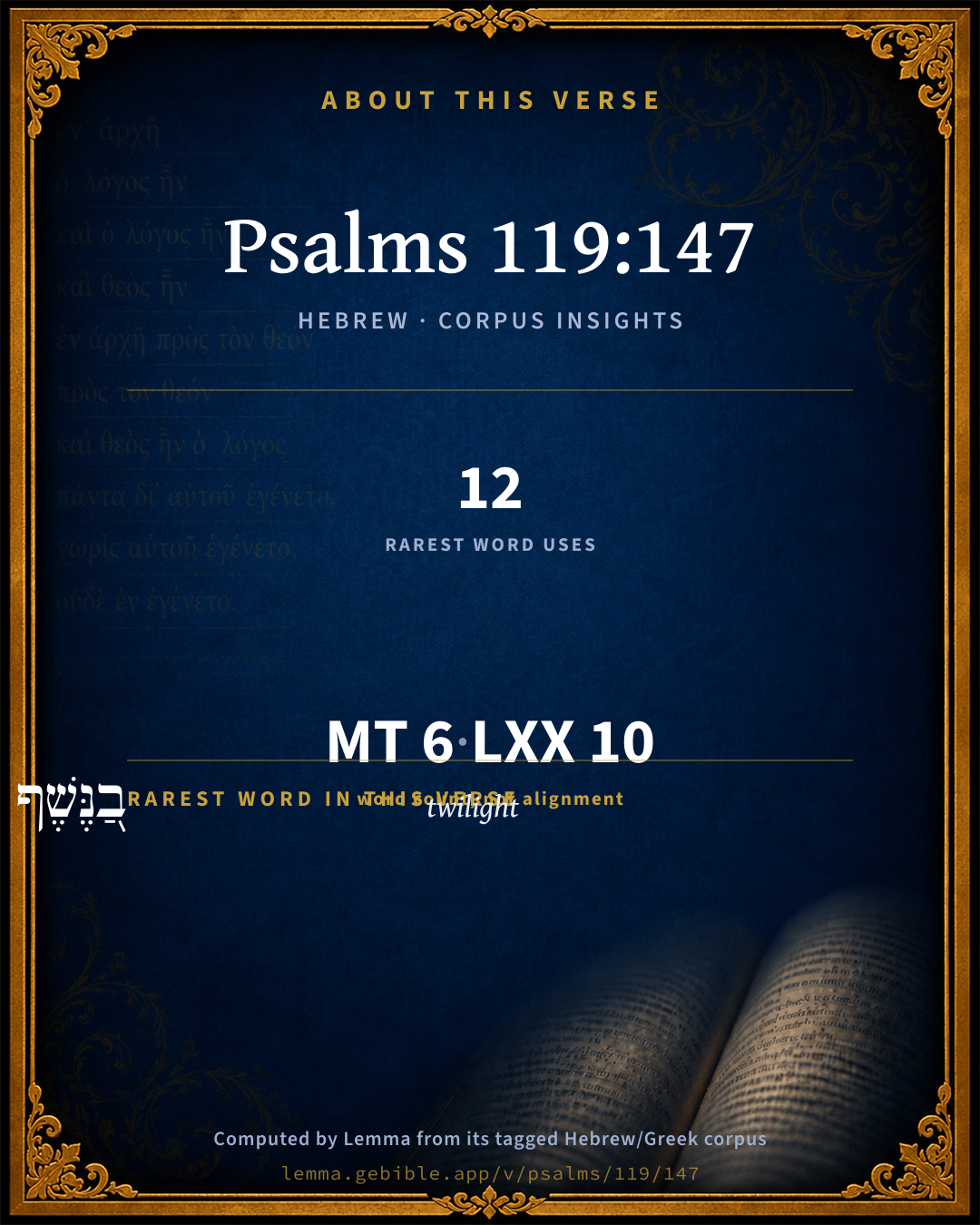
The rarest word here is בַ֭נֶּשֶׁף twilight H5399 — appearing just 12 times in the whole Hebrew Bible.

Shared distinctive vocabulary

בַ֭נֶּשֶׁף twilight H5399 occurs in 12 verses of the Hebrew Bible. Also found in:

Grammatical profile

  • 3 verbs
  • 3 nouns

Verb forms

  • קִדַּ֣מְתִּי Piel · Perfect
  • וָאֲשַׁוֵּ֑עָה Piel · Sequential Imperfect
  • יִחָֽלְתִּי Piel · Perfect

Repetition

A word recurs within this verse — often emphatic in Hebrew:

  • לדבריך word H1697 ×2

Hebrew & Septuagint length

In English translation the verse runs 15 words from the Hebrew and 12 from the Septuagint (LXX English) — closely comparable.

A rough comparison of the two English renderings, which tokenize alike — not a word-level alignment.

Word counts can differ between the Hebrew and the Greek without any difference in meaning — e.g. the Hebrew direct-object marker אֵת has no separate Greek word, and Greek often adds the article ὁ.

In the original languages it is 6 Hebrew tokens and 10 Greek tokens — but the two are counted differently (Hebrew bundles its prefixes and suffixes into one token; the Greek is in lemma form), so that isn’t a like-for-like length.

Cross-references

13

Topical passages linked to Psalms 119:147 in the Treasury of Scripture Knowledge — connected by theme and wording, ordered by reader-vote popularity; previews shown in the World English Bible.

  • Mark 1:35 Early in the night, he rose up and went out, and departed into a deserted place, and prayed there.
  • Psalms 5:3 Yahweh, in the morning you shall hear my voice. In the morning I will lay my requests before you, and will watch expectantly.
  • Psalms 130:5–6 I wait for Yahweh. My soul waits. I hope in his word.
  • Psalms 88:13 But to you, Yahweh, I have cried. In the morning, my prayer comes before you.
  • Psalms 42:8 Yahweh will command his loving kindness in the daytime. In the night his song shall be with me: A prayer to the God of my life.
  • Psalms 56:4 In God, I praise his word. In God, I put my trust. I will not be afraid. What can flesh do to me?
  • Psalms 119:74 Those who fear you will see me and be glad, Because I have put my hope in your word.
  • Psalms 119:81 My soul faints for your salvation. I hope in your word.
  • Psalms 57:8 Wake up, my glory! Wake up, psaltery and harp! I will wake up the dawn.
  • Psalms 108:2 Wake up, harp and lyre! I will wake up the dawn.
  • Isaiah 26:9 With my soul have I desired you in the night; yes, with my spirit within me will I seek you earnestly: for when your judgments are in the earth, the inhabitants of the world learn righteousness.
  • Hebrews 6:17–19 In this way God, being determined to show more abundantly to the heirs of the promise the immutability of his counsel, interposed with an oath;
  • Psalms 21:3 For you meet him with the blessings of goodness; You set a crown of fine gold on his head.

Cross-references courtesy of OpenBible.info (CC BY 4.0).

Hebrew and Greek witnesses Masoretic Hebrew ↔ Greek Septuagint

The same verse in the two great witnesses to the Old Testament, shown verse-for-verse.

You’re reading Greek Psalm 118 (Hebrew Psalm 119). The Septuagint counts the superscription, so verse numbers can differ from the Hebrew — chapter-level alignment, not verse-by-verse. Numbering follows Rahlfs.

These are two independent witnesses, not word-aligned to each other, and the Septuagint is shown in lemma (dictionary) form.

Hebrew Psalms 119:147 Masoretic · Westminster Leningrad Codex

קִדַּ֣מְתִּי בַ֭נֶּשֶׁף וָאֲשַׁוֵּ֑עָה לדבריך לִדְבָרְךָ֥ יִחָֽלְתִּי

I rise before dawn and cry for help. I put my hope in your words.

World English Bible · Public Domain

Greek LXX Greek Psalm 118:147 Septuagint · lemma form

προφθάνω ἐν ἀωρία καί κράζω εἰς ὁ λόγος σύ ἐπιἐλπίζω

I arose before the dawn, and cried: I hoped in your words.

LXX2012 (modern English Septuagint) · Public Domain

Hebrew: Westminster Leningrad Codex (CC BY 4.0). Greek: Septuagint (public domain); English from LXX2012 (modern English Septuagint) (Public Domain). How the Septuagint differs from the Hebrew →

Commentary

Notes on Psalms 119:147 from classic Christian and Jewish commentators (each source and its license shown beneath its notes). The classic Christian expositions comment on the surrounding passage and are grouped to its opening verse, so a note may address several verses; the Jewish commentaries on the Tanakh (Rashi and others) are per-verse, so they appear only where the commentator wrote on this verse.

Lemma curates 59 commentaries, every one of them public domain or Creative Commons licensed, each selected and text-cleaned for this edition rather than reprinted as found. About our sources →

Trapp's Complete Commentary

John Trapp

Psa 119:147 I prevented the dawning of the morning, and cried: I hoped in thy word.

Ver. 147. I prevented the dawning of the morning] I was up and at it before daybreak. This is check to our sluggishness.

I hoped in thy word] The word furnished his hope, and his hope his prayer.

John Trapp, A Commentary or Exposition upon All the Books of the Old and New Testament (1647–1656) — public domain. Text from a community e-Sword module.

Joseph Benson's Commentary

KOPH.

Psa 119:147-148. I prevented the dawning of the morning — Hebrew, בנשׁŠ, the twilight, namely, of the morning. In this sense this word is used 1Sa 30:17. Mine eyes prevent the night-watches — In the Hebrew it is only the watches, there being nothing for night. “The Jews,” the reader will observe, “anciently divided the night into three watches, which began at what we now call six o’clock in the evening, and consisted each of four hours. The Romans afterward introduced among them the custom of dividing it into four watches, consisting of three hours each, as well as of dividing the day and the night into twelve hours each. David intimates that he meditated on God, not only in the day-time, but also in the several divisions of the night, wherein different soldiers, or different parties of soldiers, were appointed to watch, or keep guard. In all these, or at least during a considerable part of each of them, he was thus wakeful, and employed in meditation and prayer.”

Joseph Benson's Commentary on the Old and New Testaments (1811–1818) — public domain. Text from a community e-Sword module.

J. A. Alexander on Psalms

Joseph Addison Alexander

147. (Psa 119:147) I come before (thee) in the (morning) twilight, and I cry to (thee); for thy words do I wait. The first verb has the same sense as in Psa 95:2. Compare Ps. l88:13. Early prayer implies importunate desire. The twilight meant is that of morning, as in 1Sa 30:17, Job 8:4. The second verb means to cry for help. Its augmented form is common in verbs of speaking, and supposed by some grammarians to denote motion or direction towards the object of address, like the local or directive nouns. See Judges 10, 1Sa 28:15, Neh 5:7; Neh 13:11; Neh 13:17; Neh 13:21, Dan 9:4.

Joseph Addison Alexander, The Psalms Translated and Explained (1850) — public domain. Text from a community e-Sword module.

Matthew Henry's Commentary

David goes on here to relate how he had abounded in the duty of prayer, much to his comfort and advantage: he cried unto God, that is, offered up to him his pious and devout affections with all seriousness. Observe,

I. The handmaids of his devotion. The two great exercises that attended his prayers, and were helpful to them, were, 1. Hope in God's word, which encouraged him to continue instant in prayer, though the answer did not come immediately: "I cried, and hoped that at last I should speed, because the vision is for an appointed time, and at the end it will speak and not lie. I hoped in thy word, which I knew would not fail me." 2. Meditation in God's word. The more intimately we converse with the word of God, and the more we dwell upon it in our thoughts, the better able we shall be to speak to God in his own language and the better we shall know what to pray for as we ought. Reading the word will not serve, but we must meditate in it.

II. The hours of his devotion. He anticipated the dawning of the morning, nay, and the night-watches. See here, 1. That David was an early riser, which perhaps contributed to his eminency. He was none of those that say, Yet a little sleep. 2. That he began the day with God. The first thing he did in the morning, before he admitted any business, was to pray, when his mind was most fresh and in the best frame. If our first thoughts in the morning be of God they will help to keep us in his fear all the day long. 3. That his mind was so full of God, and the cares and delights of his religion, that a little sleep served his turn. Even in the night-watches, when he awaked from his first sleep, he would rather meditate and pray than turn himself and go to sleep again. He esteemed the words of God's mouth more than his necessary repose, which we can as ill spare as our food, Job 23:12. 4. That he would redeem time for religious exercises. He was full of business all day, but that will excuse no man from secret devotion; it is better to take time from sleep, as David did, than not to find time for prayer. And this is our comfort, when we pray in the night, that we can never come unseasonably to the throne of grace; for we may have access to it at all hours. Baal may be asleep, but Israel's God never slumbers, nor are there any hours in which he may not be spoken with.

Matthew Henry's Commentary on the Whole Bible (1708–1710) — public domain (CC PDM 1.0). Text via the HelloAO Bible API.

Adam Clarke's Commentary

Verse 147. I prevented the dawning] קדמתי kiddamti, "I went before the dawn or twilight."

Adam Clarke's Commentary on the Bible (1810–1826) — public domain. Text from a community e-Sword/MySword module.

John Calvin's Commentaries

147. I have prevented the twilight. The Hebrew noun נשף, nesheph, is in this place improperly translated by crepusculum, twilight; for it rather signifies the dawn of morning. But as the Latin’s derive the word crepusculum, from creperus, which signifies doubtful or uncertain, so that it may signify the doubtful and intermediate time between light and darkness, I have not been particularly nice in the selection of the term only let my readers understand that the evening twilight commencing with sunset is not here denoted, but the imperfect light which precedes the rising of the sun. David then expresses the most eager haste when he says, that he prevented the dawn of the morning by his prayers. The verb cry always conveys the idea of earnestness; referring, as it does, not so much to the loudness of the voice as to the vehemency and ardor of the mind. In mentioning his haste, his object is the better to set forth his perseverance; for he tells us, that although he betook himself to prayer with such promptitude, yet he did not immediately become weary of that exercise, like the unbelieving, who, if God does not suddenly grant them their requests, murmur and complain against him. Thus, in conjoining patience of hope with earnestness of desire, he shows what is the true manner of praying; even as Paul, in Philippians 4:6, when he exhorts us to

“let our requests be made known unto God with thanksgiving,” (Philippians 4:6)

admonishes us, while engaged in the exercise of prayer, to bridle our turbulent affections, because one of the ends of prayer is to nourish our hope. Nor is the mention made of the word in the close of the verse superfluous; for it is only by having the Word of God continually before our eyes, that we can bridle the wanton impetuosity of our corrupt nature.

John Calvin's Commentaries (1540-1563) — public domain. Text from the Calvin Translation Society English edition (1840s-50s) via the Christian Classics Ethereal Library (ccel.org). Calvin's coverage is partial (roughly two-thirds of the Bible); uncommented books and verses are honest gaps, never fabricated. The 19th-century editor's footnotes and remarks are omitted so the notes are faithfully Calvin's own voice.

Ellicott's Commentary for English Readers

KOPH.

(147) Prevented.—See Psa_18:5; Psa_79:8. The Authorised Version gives the sense, I was up before the morning.

Dawning of the morning.—The Hebrew word means literally “breath,” and is used of the fresh breeze that blows both at sunset (Job_24:15; Pro_7:9) and sunrise (Job_7:4). Generally in our version rendered “twilight.”

A Bible Commentary for English Readers, edited by Charles John Ellicott (1878–1897) — public domain. Text from a community e-Sword module.

The Cambridge Bible for Schools and Colleges

gen. ed. J. J. S. Perowne

147. In the earliest twilight did I cry for help,

(While) I waited with hope for thy words.

Lit. In the twilight I was beforehand and cried for help. With Psa_50:2 cp. Psa_119:74; Psa_119:81; Psa_119:114.

The Cambridge Bible for Schools and Colleges (gen. ed. J. J. S. Perowne; Cambridge University Press, 1878–1918) — public domain. Text from a community e-Sword module.

John Gill's Exposition

Thou art near, O Lord,.... This was the comfort of the psalmist, that though his enemies drew nigh with a mischievous design upon him, yet his God was also near, and nearer than they; he was near as to relation to him, being his God and Father; near as to union, the bond of which is his everlasting love, which can never be dissolved; near as to communion, which he admits all his people to at one time or another; so that they are said to be "a people near unto the Lord"; Psa 148:14; and near as to his gracious presence, and the divine assistance he affords; he is a present help in time of need; he is nigh to all that call on him in truth, and in all things in which they do call upon him for, Psa 145:18;

and all thy commandments are truth; not only the precepts of the word of God, but his covenant, and the promises of it; the word which he has commanded to a thousand generations, Psa 105:8; and even the whole word of God, doctrines and duties; see Joh 17:17.

John Gill's Exposition of the Whole Bible (1746–1763) — public domain (CC PDM 1.0). Text via the HelloAO Bible API.

Albert Barnes' Notes on the Bible

I prevented the dawning of the morning, and cried - I anticipated it; I rose up to pray before the morning dawned. On the word “prevent,” see the notes at 1Th 4:15; notes at Psa 21:3; notes at Psa 59:10; notes at Psa 79:8. The meaning here is, that he rose up before the dawn, to pray. Thus the Saviour did, Mar 1:35.

(a) It is proper thus to pray, for our earliest thoughts should be those of devotion; our earliest acts should be in acknowledgment of God.

(b) Such a time is eminently favorable to devotion. Calm, still, quiet; before the thoughts are engaged in the world, and before the cares of life press upon us when the thoughts are clear, and the mind tranquil, the soul is in the best state for devotion.

(c) All people, if they will, can secure this time, before the “dawning of the morning,” to pray. Compare Psa 5:3, note; Psa 88:13, note; see also Psa 130:6. The word rendered “dawning of the morning,” is from a verb which means to blow; to blow gently; and is usually applied to the evening, when the breezes blow gently. It may be applied, however, as it clearly is here, also to the morning.

I hoped in thy word - I prayed because I had hope in thy word; I exercised hope in thy word then. Alone with thee in the morning, I found consolation by trusting in thy gracious promises.

Albert Barnes' Notes on the Bible (1834–1885) — public domain. Text from a community e-Sword/MySword module.

Matthew Poole's English Annotations

The dawning of the morning, Heb. the twilight, to wit, of the morning, by comparing Psa 88:13. And so this word is used 1Sa 30:17.

Matthew Poole's English Annotations on the Holy Bible (1683–1685) — public domain. Text from a community e-Sword/MySword module.

The Treasury of David

Charles H. Spurgeon

Ver. 147. I prevented the dawning of the morning, and cried. He was up before the sun, and began his pleadings before the dew began to leave the grass. Whatever is worth doing is worth doing speedily. This is the third time that he mentions that he cried. He cried, and cried, and cried again. His supplications had become so frequent, fervent, and intense, that he might hardly be said to be doing anything else from morning to night but crying unto his God. So strong was his desire after salvation that he could not rest in his bed; so eagerly did he seek it that at the first possible moment he was on his knees.

I hoped in thy word. Hope is a very powerful means of strengthening us in prayer. Who would pray if he had no hope that God would hear him? Who would not pray when he has a good hope of a blessed issue to his entreaties? His hope was fixed upon God's word, and this is a sure anchorage, because God is true, and in no case has he ever run back from his promise, or altered the thing that has gone forth from his mouth. He who is diligent in prayer will never be destitute of hope. Observe that as the early bird gets the worm, so the early prayer is soon refreshed with hope.

Ver. 147. I prevented the dawning of the morning. The manner of speech is to be marked. He saith he prevented the morning watch, thereby declaring that he lived, as it were, in a strife with time, careful that it should not overrun him. He knew that time posts away, and in running by wearieth man to dust and ashes. But David pressed to get before it, by doing some good in it, before that it should spur away from him. And this care which David had of every day, alas, how may it make them ashamed who have no care of a whole life! He was afraid to lose a day; they take no thought to lose months and years without doing good in them: yea, having spent the three ages of their life in vanity and licentiousness, scarce will they consecrate their old and decrepit age to the Lord. William Cowper.

Ver. 147. I prevented the dawning of the morning, etc. Those that make a business of prayer will use great vigilance and diligence therein. I say, that make a business of prayer; others that use it as a compliment and customary formality, will not be thus affected; they do it as a thing by-the-by, or a work that might well be spared, and do not look upon it as a necessary duty; but if a man's heart be in it, he will be early at work, and follow it close, morning and night: his business is to maintain communion with God, his desires will not let him sleep, and he gets up early to be calling upon God. "But unto thee have I cried, O Lord: and in the morning shall my prayer prevent thee." Ps 88:13. Thus will good men even break their sleep to give themselves to prayer, and calling upon the name of God. Thomas Manton.

Ver. 147. I prevented the dawning of the morning. It is a grievous thing if the rays of the rising sun find thee lazy and ashamed in thy bed, and the bright light strike on eyes still weighed down with slumbering sloth. Knowest thou not, O man, that thou owest the daily firstfruits of thy heart and voice to God? Thou hast a daily harvest, a daily revenue. The Lord Jesus remained all night in prayer, not that he needed its help, but putting an example before thee to imitate. He spent the night in prayer for thee, that thou mightest learn how to ask for thyself. Give him again, therefore what he paid for thee. Ambrose.

Ver. 147. I prevented the dawning of the morning. David was a good husband, up, early at it: at night he was late at this duty: "At midnight will I rise to give thanks unto thee": Ps 119:62. This surely was his meaning when he said he should dwell in the house of the Lord for ever; he would be ever in the house of prayer... I wish that when I first open my eyes in the morning, I may then, in soul ejaculatory prayer, open my heart to my God, that at night prayer may make my bed soft, and lay my pillow easy; that in the daytime prayer may perfume my clothes, sweeten my food, oil the wheels of my particular vocation, keep me company upon all occasions, and gild over all my natural, civil, and religious actions. I wish that, after I have poured out my prayer in the name of Christ, according to the will of God, having sowed my seed, I may expect a crop, looking earnestly for the springing of it up, and believing assuredly that I shall reap in time if I faint not. George Swinnock.

Ver. 147. I prevented the dawning of the morning. Early prayers are undisturbed by the agitating cares of life, and resemble the sweet melody of those birds which sing loudest and sweetest when fewest cars are open to listen to them. O my soul, canst thou say that thou hast thus "prevented the dawning of the morning" in thy approaches to God? Has the desire of communion with heaven raised thee from thy slumbers, shaken off thy sloth, and carried thee to thy knees? John Morison.

Ver. 147. And cried. Here is a repetition of the same prayer, "I cried"; yea, again I cried, and a third time, "I prevented the dawning of the morning, and cried." We use to knock at a door thrice, and then depart. Our Lord Jesus "prayed the third time, saying the same words" (Mt 26:44), "Father, if it he possible, let this cup pass from me." So the apostle Paul: "For this thing I besought the Lord thrice, that it might depart from me": 2Co 12:8. So, "And he stretched himself upon the child three times, and cried unto the Lord, and said, O Lord my God, I pray thee, let this child's soul come into him again": 1Ki 17:21. This, it seemeth, was the time in which they expected an answer in weighty cases; and yet I will not confine it to that number; for here we are to reiterate our petitions for one and the same thing as often as occasion requireth, till it be granted. Thomas Manton.

Ver. 147. Poets have delighted to sing of the morning as "Mother of the Dews, ""sowing the earth with orient pearl"; and many of the saints rising up from their beds at the first blush of dawn have round the poetry of nature to be the reality of grace as they have felt the dews of heaven refreshing their spirit. Hence morning exercises have ever been dear to the enlightened, heaven cloying souls, and it has been their rule, never to see the face of man till they have first seen the face of God. The breath of morn redolent of the smell of flowers is incense offered by earth to her Creator, and living men should never let the dead earth excel them; truly living men tuning their hearts for song, like the birds, salute the radiant mercy which reveals itself in the east. The first fresh hour of every morning should be dedicated to the Lord whose mercy gladdens it with golden light. The eye of day openeth its lids, and in so doing opens the eyes of hosts of heaven protected slumberers; it is fitting that those eyes should first look up to the great Father of Lights, the fount and source of all the good upon which the sunlight gleams. It augurs for us a day of grace when we begin betimes with God; the sanctifying influence of the season spent upon the mount operates upon each succeeding hour. Morning devotion anchors the soul so that it will not very readily drift far away from God during the day; it perfumes the heart so that it smells fragrant with piety until nightfall; it girds up the soul's garments so that it is less apt to stumble, and feeds all its rowers so that it is not permitted to faint. The morning is the gate of the day, and should be well guarded with prayer. It is one end of the thread on which the day's actions are strung, and should be well knotted with devotion. If we felt more the majesty of life we should be more careful of its mornings. He who rushes from his bed to his business and waiteth not to worship, is as foolish as though he had not put on his clothes, or cleansed his face, and as unwise as though he dashed into battle without arms or armour. Be it ours to bathe in the softly flowing river of communion with God, before the heat of the wilderness and the burden of the way begin to oppress us. C.H.S.

Ver. 147. I hoped in thy word. Even if there should not be actual enjoyment, at least let us honour God by the spirit of expectancy. Charles Bridges.

Ver. 147,148. The student of theology and the minister of the word should begin the day with prayer, and this chiefly to seek from God, that he may rightly understand the word of God, and be able to teach others. Solomon Gesner Brethren, note this! C.H.S.

Ver. 147,148. See here:

1. That David was an early riser, which perhaps contributed to his eminency. He was none of those that say, "Yet a little sleep."

2. That he began the day with God; the first thing he did in the morning, before he admitted any business, was to pray; when his mind was most fresh and in the best frame. If our first thoughts in the morning be of God, it will help to keep us in his fear all the day long.

3. That his mind was so full of God and the cares and delights of his religion, that a little sleep served his turn, even in "the night watches, "when he awaked from his first sleep, he would rather meditate and pray, than turn him and go to sleep again. He esteemed the words of God's mouth more than his necessary repose, which we can as ill want as our food: Job 23:12.

4. That he would redeem time for religious exercises; he was full of business all day, but that will excuse no man from secret devotion; it is better to take time from sleep, as David did, than not find time for prayer. And this is our comfort when we pray in the night, that we can never come unseasonably to the throne of grace, if we may have access to it at all hours. Baal may be asleep, but Israel's God never slumbers, nor are there any hours in which he may not be spoken with. Matthew Henry.

Ver. 147,148.

1. The heavenly Companions: prayer and meditation. Inseparable. Mutually helpful.

2. Their favourite seasons: times of stillness; night; the hour before day.

3. Their volume and night lamp: "Thy word; ""Hope." Or

a) A grand plea: "Thy lovingkindness." Who can match it? Who can measure it? Who can mar it?

b) An insignificant pleader: "my voice.' What can "my voice" ever say to keep step with "thy loving kindness"? Asking too much out of the question.

c) A clever petition ("according to thy judgment"); requesting life; stolen from God's mouth. God's lovingkindness is matched by God's own promise.

W. B. H.

Verse 147. Observe in this David's diligence. 1) That it was a personal, closet, or secret prayer; "I cried"; I alone, with thee in secret. 2) That it was an early morning prayer: "I prevented the dawning of the morning." 3) That it was a vehement and earnest prayer; for it is expressed by crying. T. Manton

Verse 147 Early rising commended. 1) A fit time for prayer.

2) For reading the word. 3) For indulging the emotions excited by it: "I hoped in they word."

Psalms 119:148*

Charles H. Spurgeon's The Treasury of David (1869–1885) — public domain. Psalms only. Text from a community e-Sword/MySword module.

The Pulpit Commentary

I prevented the dawning of the morning, and cried (comp. ver. 62). Evening, morning, and noonday were the three usual times of prayer. (Psa_55:17) The writer could not wait for morning. Either he woke up to pray at midnight, or at any rate he anticipated the dawn, and began his morning prayer while it was still dark. I hoped in thy Word. Hope was so strong in him that it did not suffer him to rest.

The plea of the prayerful.

So intent was the psalmist on devout meditation and prayer, that he arose before the dawn for that purpose. And in his prayer he pleaded his trust. "I hoped in thy Word." It is as if he had said, "I trusted thee, surely thou wilt respond to my trust." There are two great pleas which man may use when approaching God in prayer God"s promise, his own trust. And both are powerful and prevailing pleas with God.

I TRUST DRAWS OUT THE REST OF EVERY MAN. It is perhaps the mightiest of all moral forces. The parent gets the best out of the child by trusting him; and the child gets the best out of the parents by trusting them. In common business relations, the keen man, who trusts nobody, is badly served; the man who trusts his fellows is indeed occasionally deceived, but usually he gets the best attention, the best goods, and the best services. The master who trusts his servants and employees puts them on their mettle, and secures their best of energy and devotion. Show little or no confidence in your fellow-men, and all you can get from them is drudgery. It is often noticed how positions of trust rapidly develop a man"s powers. It would be a world full of poor characters but for the ennobling power of mutual trust. Society is built on mutual trust.

II TRUST DRAWS THE MOST GRACIOUS RESPONSES FROM GOD. "Because he hath set his love upon me, therefore will I deliver him.

1. God is to be thought of as a Father, and his relations with us understood through our paternity; and we have suggested what wonders child-trust works in family life.

2. God is to be thought of as a Master; and we have seen what response the workman makes to the trust of the master, and the master to the trust of the workman.

3. God is to be thought of as a King; and we know how he is moved when any one relies upon his gracious Word. It is but using imperfect human language, based on human analogies, if we say, "Would we take God at his best?" Then we must trust him fully, absolutely rely on him, take him at his word, commit ourselves to him. This is our all-prevailing plea, "I have hoped in thy Word. R.T.

The Pulpit Commentary (1880–1919), ed. H.D.M. Spence-Jones & Joseph S. Exell — public domain. Text from a community e-Sword module.

unfoldingWord translationNotes

Door43 World Missions Community

dawn of the morning

"before the sun first appears"

My eyes are open before the night watches change

This is an idiom. In Hebrew culture, the night was usually divided into three "watches" or periods. AT: "I am awake all night" (See: Idiom)

translationWords

raise

hope

meditate

word of God

unfoldingWord translationNotes — © Distant Shores Media and the Door43 World Missions Community, licensed CC BY-SA 4.0. Source: git.door43.org/Door43/en_tn.

Lesson kit

Teaching starters — assembled from the data on this page, not authored interpretation. Every prompt links to the verse data it draws on. Edit before teaching.

Psalms, in the Wisdom, opens this verse with 6 words (5 distinct Hebrew lemmas). Its most distinctive word is nesheph (“twilight”). A historical commentator’s framing appears above. Read the whole chapter for the surrounding context.

Discussion questions

  1. The word nesheph carries the sense “twilight.” How does it shape the verse?
  2. How does 1 Samuel 30:17, which shares the word «twilight», read alongside this verse?
  3. What does the repetition of “word” (2× in this one verse) do in this verse?
  4. The translations on this page render this verse differently — a whole-verse word diff, not a word-by-word alignment. What might account for the different wordings?
  5. «קִדַּ֣מְתִּי» is a Piel Perfect verb. How does that grammatical form shape the action described?
  6. Compare how Trapp's Complete Commentary and Joseph Benson's Commentary read this verse. Where do they agree or differ?

Things to notice

Reading settings

Reading text

Shown beneath each verse's original-language words.

Old Testament
Old Testament edition

Read the OT as the Masoretic Hebrew (MT) or the Greek Septuagint (LXX).

English shown for the Greek Septuagint (in the Hebrew ↔ Greek comparison).

Comparing translations? Open the Compare panel on any verse page to stack up to four side by side.