Leviticus 11:22

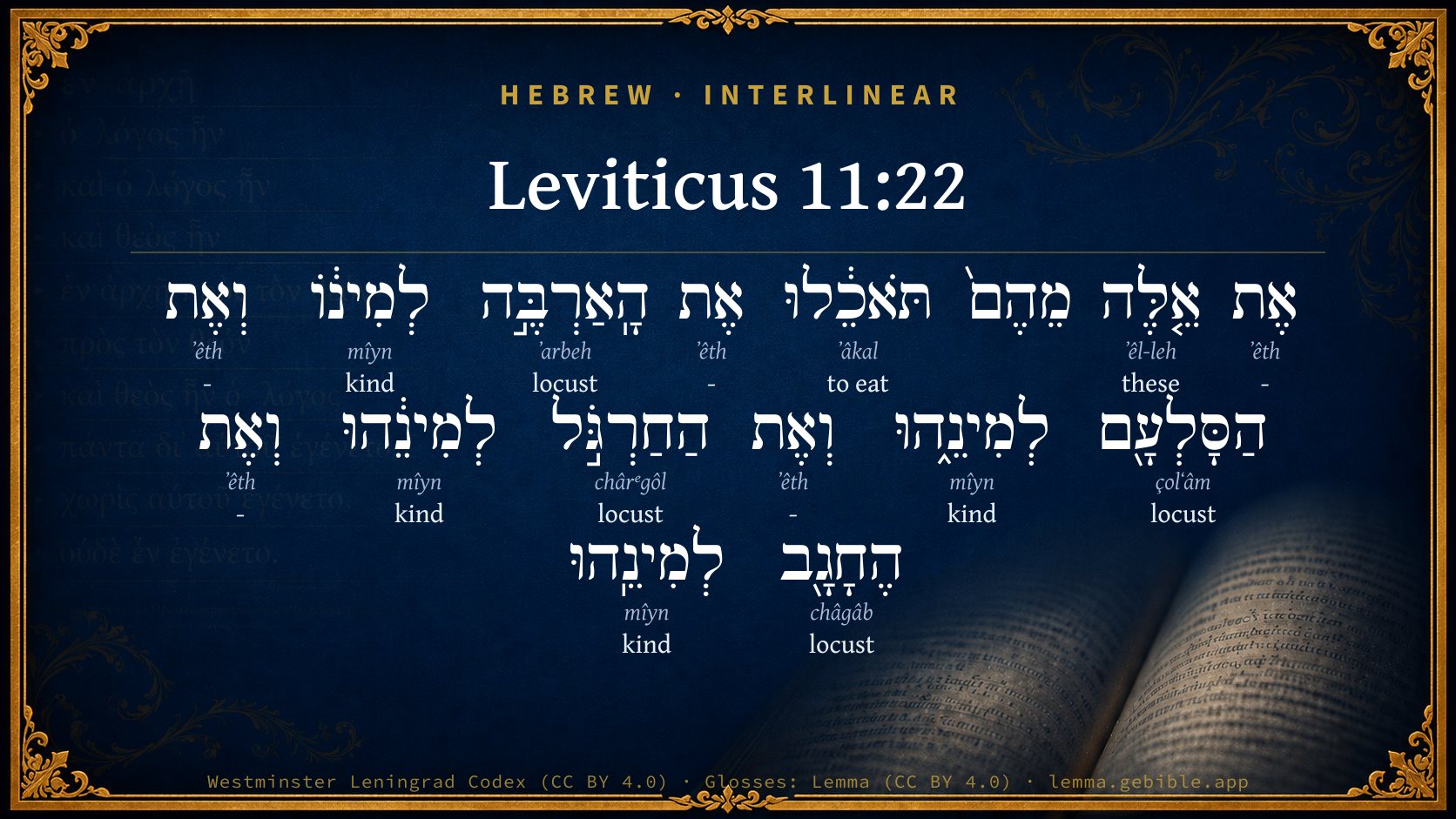
Hebrew (Westminster Leningrad Codex) Leviticus 11:22 appears in the Hebrew Old Testament. The text above is from the Westminster Leningrad Codex. Each word links to its Strong’s number, a concise gloss, and parsing drawn from the Open Scriptures Hebrew Bible morphology. Click any word for its full Brown-Driver-Briggs (BDB) entry.
Download image
Cite this verse

Leviticus 11:22 (World English Bible). Public Domain. Lemma interlinear Bible study tool, https://lemma.gebible.app/v/leviticus/11/22.

Show BibTeX & RIS
BibTeX
RIS
English Translation
Even of these you may eat: any kind of locust, any kind of katydid, any kind of cricket, and any kind of grasshopper.
World English Bible · Public Domain
Highlights
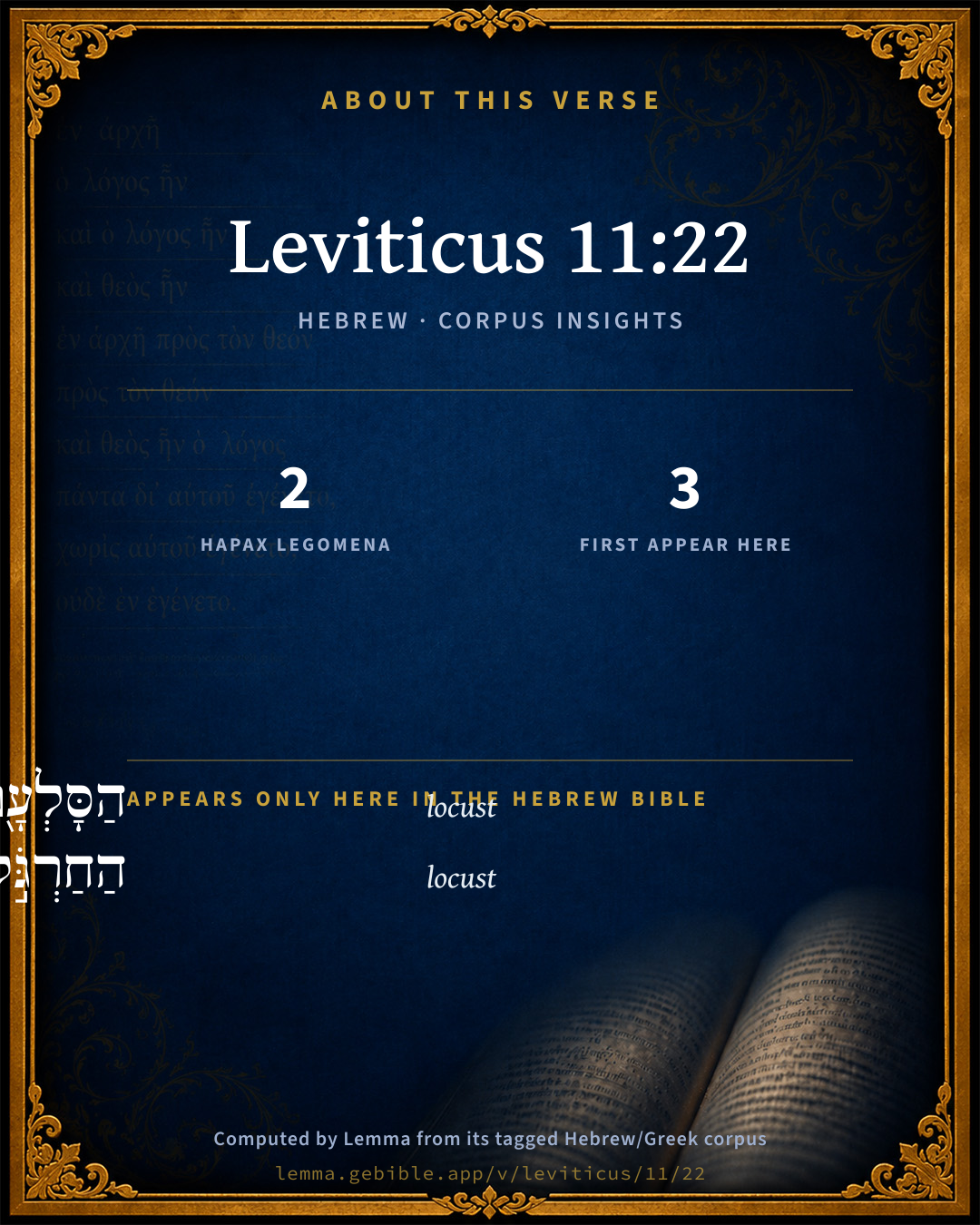
  • 2 hapax legomena — only here in the Hebrew Bible
  • 3 first appearances in the Hebrew Bible
Full analysis ↓
Download a study sheet

One document with this verse’s original text, its word-by-word gloss line, the meaning frame, cross-references with their text, attributed commentary, and full source and license credits — printable, and it pastes into notes with its structure intact.

This verse Autodidact and up

Study sheet (.html) Plain text (.txt)

A passage Seminary Student

Up to 50 verses in one chapter. A passage sheet keeps up to 6 commentary sources and 12 cross-references per verse, in the order this page ranks them, and says so on the sheet whenever that leaves anything out. Ask for a single verse and you get the Autodidact verse sheet above.

Everything on this page stays free to read, with no account — the sheet is a download of what is already on screen, not access to it.

Want to remove ads? Support Godless Engineer
Compare translations 3

The same verse in 3 English versions, stacked beneath the original-language interlinear above. Click any original word for its lexicon entry.

Each is an independent rendering of the whole verse — the interlinear is not word-aligned to these translations.

Highlighted words mark where these versions differ — a whole-verse word diff, not a word-by-word alignment.

  • World English Bible Public Domain
    Even of these you may eat: any kind of locust, any kind of katydid, any kind of cricket, and any kind of grasshopper.
  • King James Version Public Domain
    Even these of them ye may eat; the locust after his kind, and the bald locust after his kind, and the beetle after his kind, and the grasshopper after his kind.
  • unfoldingWord Literal Text CC BY-SA 4.0
    These from them you shall eat: the locust of its kind and the bald locust of its kind and the cricket of its kind and the grasshopper of its kind.

unfoldingWord Literal Text — © unfoldingWord, licensed CC BY-SA 4.0. Word-aligned USFM3 via Door43 (git.door43.org/unfoldingWord/en_ult).

Versions to compare (up to 4)

3 of 4 selected

Show all 18 translations

Every available English version of this verse, each an independent rendering of the whole verse.

  • World English Bible Public Domain
    Even of these you may eat: any kind of locust, any kind of katydid, any kind of cricket, and any kind of grasshopper.
  • Berean Standard Bible Public Domain
    Of these you may eat any kind of locust, katydid, cricket, or grasshopper.
  • Majority Standard Bible Public Domain
    Of these you may eat any kind of locust, katydid, cricket, or grasshopper.
  • King James Version Public Domain
    Even these of them ye may eat; the locust after his kind, and the bald locust after his kind, and the beetle after his kind, and the grasshopper after his kind.
  • American Standard Version (1901) Public Domain
    Even these of them ye may eat: the locust after its kind, and the bald locust after its kind, and the cricket after its kind, and the grasshopper after its kind.
  • Revised Version (1885) Public Domain
    even these of them ye may eat; the locust after its kind, and the bald locust after its kind, and the cricket after its kind, and the grasshopper after its kind.
  • Geneva Bible (1599) Public Domain
    Of them ye shall eate these, the grashopper after his kinde, and the solean after his kinde, the hargol after his kinde, and the hagab after his kind.
  • Douay-Rheims (1899) Public Domain
    That you shall eat, as the bruchus in its kind, the attacus, and ophiomachus, and the locust, every one according to their kind.
  • Young's Literal Translation Public Domain
    these of them ye do eat: the locust after its kind, and the bald locust after its kind, and the beetle after its kind, and the grasshopper after its kind;
  • Literal Standard Version CC BY-SA 4.0
    these of them you eat: the locust after its kind, and the bald locust after its kind, and the cricket after its kind, and the grasshopper after its kind;
  • Unlocked Literal Bible CC BY-SA 4.0
    You may also eat any kind of locust, katydid, cricket, or grasshopper.
  • unfoldingWord Literal Text CC BY-SA 4.0
    These from them you shall eat: the locust of its kind and the bald locust of its kind and the cricket of its kind and the grasshopper of its kind.
  • Darby Bible Public Domain
    These shall ye eat of them: the arbeh after its kind, and the solam after its kind, and the hargol after its kind, and the hargab after its kind.
  • World Messianic Bible Public Domain
    Even of these you may eat: any kind of locust, any kind of katydid, any kind of cricket, and any kind of grasshopper.
  • Webster's Bible Public Domain
    Even these of them ye may eat; the locust after its kind, and the bald locust after its kind, and the beetle after its kind, and the grasshopper after its kind.
  • Free Bible Version CC BY-SA 4.0
    So in this category you can eat any kind of locust, bald locust, cricket, or grasshopper.
  • Bible in Basic English Public Domain
    Such as all the different sorts of locust.
  • JPS Tanakh (1917) Public Domain
    even these of them ye may eat: the locust after its kinds, and the bald locust after its kinds, and the cricket after its kinds, and the grasshopper after its kinds.

Literal Standard Version (2020), Covenant Press — licensed CC BY-SA 4.0. Text via the HelloAO Bible API (eBible.org). Unlocked Literal Bible (unfoldingWord) — licensed CC BY-SA 4.0. Text via the HelloAO Bible API (eBible.org). unfoldingWord Literal Text — © unfoldingWord, licensed CC BY-SA 4.0. Word-aligned USFM3 via Door43 (git.door43.org/unfoldingWord/en_ult). Free Bible Version, Dr. Jonathan Gallagher — licensed CC BY-SA 4.0. Text via the HelloAO Bible API (eBible.org).

Word by word

More ways to search: Search by grammar → Find every occurrence → Compare this word →

Practice this passage: Drill this verse → Learn its vocabulary →

הַסָּלְעָ֖ם
çolʻâm
H5556
“the · locust”
Particle, Definite Article + Noun, Common, Masculine, Singular, Absolute
Part of Speech
Particle + Noun
Type
Common
Gender
Masculine
Number
Singular
State
Absolute
Full BDB Definition

Origin: apparently from the same as H5553 in the sense of crushing as with a rock, i.e. consuming

TWOT: 1509

locust - an edible winged locust
  1. אֶת ʼêth H853 “-” Particle, Direct Object
  2. אֵ֤לֶּה ʼêl-leh H428 “these” Pronoun, Demonstrative, Common, Plural
  3. תֹּאכֵ֔לוּ ʼâkal H398 “to eat” Verb, Qal, Imperfect, 2nd Person, Masculine, Plural
  4. אֶת ʼêth H853 “-” Particle, Direct Object
  5. הָֽאַרְבֶּ֣ה ʼarbeh H697 “the · locust” Particle, Definite Article + Noun, Common, Masculine, Singular, Absolute
  6. לְמִינ֔וֹ mîyn H4327 “to/for · kind · his” Preposition + Noun, Common, Masculine, Singular, Construct + Suffix, Personal, 3rd Person, Masculine, Singular
  7. וְאֶת ʼêth H853 “and · -” Conjunction + Particle, Direct Object
  8. לְמִינֵ֑הוּ mîyn H4327 “to/for · kind · his” Preposition + Noun, Common, Masculine, Singular, Construct + Suffix, Personal, 3rd Person, Masculine, Singular
  9. וְאֶת ʼêth H853 “and · -” Conjunction + Particle, Direct Object
  10. הַחַרְגֹּ֣ל chârᵉgôl H2728 “the · locust” Particle, Definite Article + Noun, Common, Masculine, Singular, Absolute
  11. לְמִינֵ֔הוּ mîyn H4327 “to/for · kind · his” Preposition + Noun, Common, Masculine, Singular, Construct + Suffix, Personal, 3rd Person, Masculine, Singular
  12. וְאֶת ʼêth H853 “and · -” Conjunction + Particle, Direct Object
  13. הֶחָגָ֖ב châgâb H2284 “the · locust” Particle, Definite Article + Noun, Common, Masculine, Singular, Absolute
  14. לְמִינֵֽהוּ mîyn H4327 “to/for · kind · his” Preposition + Noun, Common, Masculine, Singular, Construct + Suffix, Personal, 3rd Person, Masculine, Singular

About this verse

These counts appear in no published source. They are computed here, from the morphology-tagged text and Lemma’s own curated glosses. What Lemma adds →

16
words
8
distinct lemmas
Pentateuch
section

Notable vocabulary

2 hapax legomena — words that appear only here in the entire Hebrew Bible:

  • הַסָּלְעָ֖ם locust H5556
  • הַחַרְגֹּ֣ל locust H2728

First appearance in Scripture

These words make their first canonical appearance in the Hebrew Bible here:

  • הַסָּלְעָ֖ם locust H5556
  • הַחַרְגֹּ֣ל locust H2728
  • הֶחָגָ֖ב locust H2284

Shared distinctive vocabulary

הֶחָגָ֖ב locust H2284 occurs in 5 verses of the Hebrew Bible. Also found in:

Grammatical profile

  • 1 verb
  • 8 nouns
  • 1 pronoun
  • 1 preposition
  • 5 particles

Verb forms

  • תֹּאכֵ֔לוּ Qal · Imperfect

Repetition

A word recurs within this verse — often emphatic in Hebrew:

  • לְמִינ֔וֹ kind H4327 ×4

Hebrew & Septuagint length

In English translation the verse runs 23 words from the Hebrew and 30 from the Septuagint (LXX English) — closely comparable.

A rough comparison of the two English renderings, which tokenize alike — not a word-level alignment.

Word counts can differ between the Hebrew and the Greek without any difference in meaning — e.g. the Hebrew direct-object marker אֵת has no separate Greek word, and Greek often adds the article ὁ.

Cross-references

8

Topical passages linked to Leviticus 11:22 in the Treasury of Scripture Knowledge — connected by theme and wording, ordered by reader-vote popularity; previews shown in the World English Bible.

  • Matthew 3:4 Now John himself wore clothing made of camel's hair, with a leather belt around his waist. His food was locusts and wild honey.
  • Mark 1:6 John was clothed with camel's hair and a leather belt around his loins. He ate locusts and wild honey.
  • Exodus 10:4–5 Or else, if you refuse to let my people go, behold, tomorrow I will bring locusts into your country,
  • Isaiah 35:3 Strengthen you the weak hands, and confirm the feeble knees.
  • Romans 14:1 Now receive one who is weak in faith, but not for disputes over opinions.
  • Romans 15:1 Now we who are strong ought to bear the weaknesses of the weak, and not to please ourselves.
  • Hebrews 5:11 About him we have many words to say, and hard to interpret, seeing you have become dull of hearing.
  • Hebrews 12:12–13 Therefore, lift up the hands that hang down and the feeble knees,

Cross-references courtesy of OpenBible.info (CC BY 4.0).

Hebrew and Greek witnesses Masoretic Hebrew ↔ Greek Septuagint

The same verse in the two great witnesses to the Old Testament, shown verse-for-verse.

These are two independent witnesses, not word-aligned to each other, and the Septuagint is shown in lemma (dictionary) form.

Hebrew Leviticus 11:22 Masoretic · Westminster Leningrad Codex

אֶת אֵ֤לֶּה מֵהֶם֙ תֹּאכֵ֔לוּ אֶת הָֽאַרְבֶּ֣ה לְמִינ֔וֹ וְאֶת הַסָּלְעָ֖ם לְמִינֵ֑הוּ וְאֶת הַחַרְגֹּ֣ל לְמִינֵ֔הוּ וְאֶת הֶחָגָ֖ב לְמִינֵֽהוּ

Even of these you may eat: any kind of locust, any kind of katydid, any kind of cricket, and any kind of grasshopper.

World English Bible · Public Domain

Greek LXX Leviticus 11:22 Septuagint · lemma form

καί οὗτος ἐσθίω ἀπό αὐτός ὁ βροῦχος καί ὁ ὅμοιος αὐτός καί ὁ ἀττάκης καί ὁ ὅμοιος αὐτός καί ὁ ἀκρίς καί ὁ ὅμοιος αὐτός καί ὁ ὀφιομάχης καί ὁ ὅμοιος αὐτός

And these of them you⌃ shall eat: the caterpillar and his like, and the attacus and his like, and the cantharus and his like, and the locust and his like.

LXX2012 (modern English Septuagint) · Public Domain

On this verse, John Gill's Exposition discusses the Septuagint’s reading. Read the note in Commentary ↓

Hebrew: Westminster Leningrad Codex (CC BY 4.0). Greek: Septuagint (public domain); English from LXX2012 (modern English Septuagint) (Public Domain). How the Septuagint differs from the Hebrew →

Targum (Aramaic paraphrase)

2

The Targum is the ancient Jewish Aramaic paraphrase of the Hebrew Scriptures — an interpretive translation, not the Hebrew text itself. Onkelos (literal) and Pseudo-Jonathan (expansive) render the Torah, and Jonathan the Prophets. Coverage is partial: where no permissively-licensed English translation exists for a verse, only the Aramaic is shown. This is verse-level text, not a word-by-word alignment to the Hebrew.

  1. Targum Onkelos Torah (Genesis–Deuteronomy)
    יָת אִלֵין מִנְהוֹן תֵּיכְלוּן יָת גוֹבָא לִזְנֵהּ וְיָת רָשׁוּנָא לִזְנוֹהִי וְיָת חַרְגוֹלָא לִזְנוֹהִי וְיָת חַגָבָא לִזְנוֹהִי

    (no public-domain English translation for this verse)

    Targum Onkelos — Aramaic: “Onkelos Genesis” (public domain); “Onkelos Exodus” (public domain); “Onkelos Leviticus” (public domain); “Onkelos Numbers” (public domain); “Onkelos Deuteronomy” (public domain). English: “Sefaria Community Translation” (CC0 1.0 (public-domain dedication)); “J.W. Etheridge. The Targums of Onkelos and Jonathan Ben Uzziel on the Pentateuch. London: Longmans, Green, 1862” (public domain). Text via Sefaria.

  2. Targum Pseudo-Jonathan Torah (Genesis–Deuteronomy)
    יַת אִלֵין מִינַיָיא מִנְהוֹן תֵּיכְלוּן יַת גוּבָאֵי לִזְנֵיהּ וְיַת רְשׁוּנָא לִזְנֵיהּ וְיַת נִיפוֹלָא לִזְנֵיהּ וְיַת כַּרְזְבָא דְהוּא נִדוּנָא לִזְנֵיהּ

    Of these kinds of them you may eat: the wingless locust after his kind, and the bald locust after his kind, the serpent-killer after his kind, and the karzeba, which is the palmerworm, after his kind.

    Targum Pseudo-Jonathan — Aramaic: “Targum Jonathan on Genesis” (public domain); “Targum Jonathan on Exodus” (public domain); “Targum Jonathan on Leviticus” (public domain); “Targum Jonathan on Numbers” (public domain); “Targum Jonathan on Deuteronomy” (public domain). English: “The Targum of Jonathan ben Uzziel, trans. J. W. Etheridge, London, 1862” (public domain). Text via Sefaria.

Commentary

Notes on Leviticus 11:22 from classic Christian and Jewish commentators (each source and its license shown beneath its notes). The classic Christian expositions comment on the surrounding passage and are grouped to its opening verse, so a note may address several verses; the Jewish commentaries on the Tanakh (Rashi and others) are per-verse, so they appear only where the commentator wrote on this verse.

Lemma curates 59 commentaries, every one of them public domain or Creative Commons licensed, each selected and text-cleaned for this edition rather than reprinted as found. About our sources →

Trapp's Complete Commentary

John Trapp

Lev 11:22 [Even] these of them ye may eat; the locust after his kind, and the bald locust after his kind, and the beetle after his kind, and the grasshopper after his kind.

Ver. 22. The locust, &c.] All creeping fowls that go upon all four might not be beaten, except Arbe, Soleam, Chargol, and Chargah, names to us unknown.

John Trapp, A Commentary or Exposition upon All the Books of the Old and New Testament (1647–1656) — public domain. Text from a community e-Sword module.

Joseph Benson's Commentary

Lev 11:22. The locust after his kind — The Hebrew word ארבהarbeh, is sometimes a common name for all locusts, but here signifies a peculiar sort of them The name derived from רבהrabah, to multiply, imports a multitude, no animal being more prolific. The bald locust — As it is not easy to determine what species of locust this is, and as it has not any name in modern languages, it might be better, in a translation, to retain the original name סלעם solgnam, which, in the Chaldaic, signifies to consume. The beetle — As none ever eat beetles, and they are not four-footed with legs to leap withal, it is the opinion of good critics that the Hebrew word חרגל chargol is not properly translated. It is rather to be taken for another sort of locust unknown to us. The grasshopper — Another species of locust, the Hebrew name of which is derived, according to Bochart, from an Arabic word, which signifies to veil, because they fly in such swarms as sometimes to veil or darken the sun. But how to distinguish these locusts from the rest is difficult, if not impossible to us. They were, however, well known of old in the eastern countries. For locusts, though unusual food with us, were commonly eaten by the Æthiopians, Lybians, Parthians, and other eastern people bordering upon Judea. And as it is certain the eastern locusts were much larger than ours, so it is probable they were of different qualities, and yielded better nourishment.

Joseph Benson's Commentary on the Old and New Testaments (1811–1818) — public domain. Text from a community e-Sword module.

Geneva Bible (1599)

Geneva Bible translators

These were certain kinds of grasshoppers, which are not now properly known.

Geneva Bible (1599) marginal notes — public domain. Text via Bolls.life.

Adam Clarke's Commentary

Verse 22. The locust] ארבה arbeh, either from ארב arab, to lie in wait or in ambush, because often immense flights of them suddenly alight upon the fields, vineyards, c., and destroy all the produce of the earth or from רבה rabah, he multiplied, because of their prodigious swarms. See a particular account of these insects in the notes, See "Ex 10:4".

The bald locust] סלעם solam, compounded, says Mr. Parkhurst, from סלע sala, to cut, break, and עם am, contiguity; a kind of locust, probably so called from its rugged, craggy form. See the first of Scheuchzer's plates, vol. iii., p. 100.

The beetle] חרגל chargol. "The Hebrew name seems a derivative from חרג charag, to shake, and רגל regel, the foot; and so to denote the nimbleness of its motions. Thus in English we call an animal of the locust kind a grasshopper; the French name of which is souterelle, from the verb sauter, to leap" - Parkhurst. This word occurs only in this place. The beetle never can be intended here, as that insect never was eaten by man, perhaps, in any country of the universe.

The grasshopper] חגב chagab. Bochart supposes that this species of locust has its name from the Arabic verb [Arabic] hajaba to veil; because when they fly, as they often do, in great swarms, they eclipse even the light of the sun. See the notes on "Ex 10:4", and the description of ten kinds of locusts in Bochart, vol. iii., col. 441. And see the figures in Scheuchzer, in whose plates 20 different species are represented, vol. iii., p. 100. And see Dr. Shaw on the animals mentioned in this chapter. Travels, p. 419, c., 4to. edition and when all these are consulted, the reader will see how little dependence can be placed on the most learned conjectures relative to these and the other animals mentioned in Scripture. One thing however is fully evident, viz., that the locust was eaten, not only in those ancient times, in the time of John Baptist, Mt 3:4, but also in the present day. Dr. Shaw ate of them in Barbary "fried and salted," and tells us that "they tasted very like crayfish." They have been eaten in Africa, Greece, Syria, Persia, and throughout Asia; and whole tribes seem to have lived on them, and were hence called acridophagoi, or locust-eaters by the Greeks. See Strabo lib. xvi., and Pliny, Hist. Nat., lib. xvii., c. 30.

Adam Clarke's Commentary on the Bible (1810–1826) — public domain. Text from a community e-Sword/MySword module.

Ellicott's Commentary for English Readers

(22) The locust after his kind.—Of the four species of locusts here specified as permitted to be eaten, this one called arbe is the most frequently mentioned in the Bible. It occurs no less than twenty-four times, and is in four instances wrongly rendered in the Authorised Version by “grasshopper” (Jdg_6:5; Jdg_7:12; Job_39:20; Jer_46:23). It is the locust which constituted the eighth plague of Egypt (Exo_10:4-19); which is described as committing the terrible ravages (Deu_28:38; Joe_1:4; Joe_2:25; Nah_3:7); and which swarmed in such innumerable quantities that it became a proverb in the Bible, “like the locusts in multitude” (Jdg_7:12; Jer_46:23). From these characteristics the arbe is supposed to be the flying migratory locust. The administrators of the law in the time of Christ described the arbe by the name gubai, which is the species most commonly eaten, and ordained the following benediction to be recited before eating it: “Blessed be He by whose word everything was created.” The locusts which are still eaten by the Jews and other Eastern nations are prepared in different ways. Generally they are thrown alive into a pot of boiling water mixed with salt, and taken out after a few minutes, when the heads, feet, and wings are plucked off, and the trunks are dried in an oven or in the sun on the roofs of houses, and are kept in bags for winter use. They are also broiled or stewed, or fried in butter; or they are mixed with butter and spread on thin cakes of bread. In taste they resemble shrimps or prawns. There are shops in some Eastern towns where they only sell locusts, strung upon cords or by measure. The locusts thus form an antidote to the famine they create by the devastation which they commit. They formed, along with “wild honey,” the food of John the Baptist (Mat_3:4).

And the bald locust.—This is the only place where salam, which is the name in the original, occurs as one of the edible kinds of leaping insects. Any attempt to identify the species is simply conjecture, since all which tradition tells us about it is that this kind of locust “has no tail but has a hump.”

The beetle.—Rather, the hopping locust. Though it is difficult to identify the exact species, as the name (chargol) does not occur again in the Bible, yet it is perfectly certain that a sort of locust is here intended, since the context clearly shows that four different kinds of the same insect are enumerated. This is moreover confirmed by the administrators of the law in the time of Christ, who assure us the chargol is a species of locust having both a hump and a tail, the eggs of which Jewish women suspended in the ear as a remedy against ear-ache. This shows that it must have been a very large kind, and as the name denotes the galloping or hopping one, it is evidently designed to describe an unwinged species.

The grasshopper.—Rather, the small locust. This name (chagab) occurs four times more in the Bible (Num_13:33; 2Ch_7:13; Ecc_12:5; Isa_40:22), and is only in one place rightly rendered by locust (2Ch_7:13) in the Authorised Version. From the fact that it is described as laying waste the fields (2Ch_7:13), and that its insignificant appearance is contrasted with giant men (Num_13:33) and with the great God of heaven (Isa_40:22), it is justly inferred that it denotes a small devastating locust which swarms in great quantities. According to the authorities in the time of Christ, it is a species which has a tail, but no hump. It was so common that the name (chagab) became a generic term for many of the locust tribe. Some kinds bearing this name were beautifully marked, and were eagerly caught by Jewish children as playthings, just as butterflies and cockchafers are sought after by children in the present day. Others again were caught in large numbers, sprinkled over with wine, and then sold. Hence the following two rules obtained during the second Temple: (1) No Israelite was allowed to buy them after the dealer had prepared them in this manner; and (2) he that vowed to abstain from flesh is not allowed to eat the flesh of fish and of (chagabim) locusts. Because the edible kinds of locusts are passed over in the parallel dietary laws in Deuteronomy, some have concluded that the eating of these insects was prohibited at the more advanced time when Deuteronomy was written. The fact, however, that John the Baptist ate locusts, and that a benediction was ordered during the second Temple to be recited at eating them, plainly shows the futility of the assertion. The Lawgiver never intended to repeat in Deuteronomy every particular point of legislation.

A Bible Commentary for English Readers, edited by Charles John Ellicott (1878–1897) — public domain. Text from a community e-Sword module.

John Gill's Exposition

Even these of them ye may eat, &c. The four following ones, which seem to be no other than four sorts of locusts:

the locust after his kind; this is the common locust, called by the name of Arbeh, from the great multiplication and vast multitudes of them; the phrase, "after his kind", and which also is used in all the following instances, signifies the whole entire species of them, which might be eaten:

and the bald locust after his kind; which in the Hebrew text is Soleam, and has its name, as Aben Ezra suggests, from its ascending rocks: but since locusts do not climb rocks, or have any peculiar regard for them, rather this kind of locust may be so called, from their devouring and consuming all that come in their way (g), from the Chaldee word which signifies to swallow, devour, and consume; but why we should call it the bald locust is not so clear, though it seems there were such, since the Jews describe some that have no baldness, which the gloss explains, whose head is not bald (h), which shows that some are bald; and so, this is described by Kimchi (i), it has an eminence, a rising, or bunch upon it; some render it baldness, and it hath no tail, and its head is long; and so Ben Melech:

and the beetle after his kind; which is another sort of locust called Chargol, and should not be rendered a beetle, for no sort of beetles are eatable, nor have legs to leap withal, and so come not under the general description given of such flying, creeping things, fit to eat: Kimchi says it is one kind of a locust (k), and Hiscuni derives its name from and because it strives to leap with its feet, which answers to the above descriptive character: the Septuagint and Vulgate Latin versions, and some others, render it by Ophiomachus, a fighter with serpents, to which the locust is an enemy, and kills them, taking fast hold of their jaws, as Pliny says (l), and so Aristotle (m):

and the grasshopper after his kind; this is another, and the fourth kind of the locust that might be eaten; its name is Chagab, from the Arabic word Chaguba, "to vail", locusts vailing the light of the sun: and according to the Jewish doctors, it is a name which every locust fit to eat should have;"among the locusts (fit for food) are these, who have four feet, and four wings and thighs, and wings covering the greatest part of them, and whose name is Chagab (n);''and commentators say (o), it must be called by this name, as well as have those signs: the difference between these several sorts is with them this; the Chagab has a tail, but no bunch; Arbeh neither bunch nor tail; and Soleam has a bunch, but not a tail; and Chargol has both bunch and tail (p): Maimonides (q) reckons up eight sorts of them fit to eat; and these creatures were not only eaten by the Jews, but by several other nations: with the Parthians they were very agreeable and grateful food, as Pliny (r) relates; who also says (s), that some part of the Ethiopians live only upon them all the year, hardened in smoke, and with salt: Diodorus Siculus (t) makes mention of the same, and calls them Acridophagi, locust eaters, and gives a particular account of their hunting and taking them, and preserving them for food; and so does Strabo (u); and the same Solinus (w) relates of those that border on Mauritania; and they are still eaten in Barbary, where they dry them in ovens to preserve them, and then either eat them alone, or pounded and mixed with milk: their taste is said to be like shrimps (x); and Bochart (y) has shown, from various writers, that they were a delicious food with the Greeks, especially among the common people; and so they are with the Indians (z).

(g) So R. Sol. Urbin. Ohel Moed, fol. 88. 1. (h) T. Bab. Cholin, fol. 65. 2. (i) Sepher Shorash. in voc. (k) Ib. in voc. (l) Ut supra. (Nat. Hist. l. 11. c. 29.) (m) Hist. Animal. l. 9. c. 6. (n) Misn. Cholin, c. 3. sect. 7. (o) Maimon. & Bartenora in ib. (p) Vid. T. Bab. Cholin, fol. 65. 2. (q) Maacolot Asurot, c. 1. sect. 21. (r) Nat. Hist. l. 11. c. 29. (s) Ib. l. 6. c. 30. (t) Bibliothec. l. 3. p. 162, 163. (u) Geograph. l. 16. p. 531. (w) Polyhistor. c. 43. (x) Sir Hans Sloane's Natural History of Jamaica, vol. 1. p. 29. (y) Hierozoic. par. 2. l. 4. c. 7. col. 490, 491. (z) Agreement of Customs of the East Indians and Jews, art. 12. p. 60.

John Gill's Exposition of the Whole Bible (1746–1763) — public domain (CC PDM 1.0). Text via the HelloAO Bible API.

Albert Barnes' Notes on the Bible

In the uncertainty of identifying these four creatures, it has been suggested that some of the names may belong to locusts in an imperfect state of development. Most modern versions have taken a safer course than our translators, by retaining the Hebrew names.

Albert Barnes' Notes on the Bible (1834–1885) — public domain. Text from a community e-Sword/MySword module.

Haydock's Catholic Bible Commentary

Locust. The three former are species of the same kind. The bruchus is a young locust, without wings, (St. Augustine in Psal. civ.,) and the attachus the least of all. (Pliny, xxix. 5.) The ophiomachus is large, "encounters serpents," and is destitute of wings. The nations called Acridophagi, received their name from their feeding upon locusts, which are the food of the common people in Syria and Africa. See Pliny, xi. 29, &c. Clenard, in 1541, wrote from Fez, that he had seen the sky darkened with clouds of locusts, which the people endeavoured presently to destroy, and filled wagons with their bodies, for food. Kirsten says, they are very delicious. Arnulph assures us, that they are a finger’s breadth, and are fried in oil by the poor. (Raban. in Matthew iii. 4.) See Joel ii. (Calmet) --- There is no need, therefore, of having recourse to crab fish and wild pears, for John the Baptist’s food, as Beza has done. (Tirinus)

George Leo Haydock (1774–1849), Haydock's Catholic Family Bible and Commentary, 1859 edition — public domain. Excludes Psalms (Douay-Rheims chapter numbering differs from Protestant) and Deuterocanonical books (Catholic canon only).

Matthew Poole's English Annotations

Locusts, though unusual in our food, were commonly eaten by the Ethiopians, Libyans, Parthians, and other eastern people bordering upon the Jews, which is expressly affirmed by Diodorus Siculus, Aristotle, Pllny, St. Hierom, and others, as well as Mat 3:4. And it is certain that the eastern locusts were much larger than ours, so it is probable they were of different qualities, and yielded better nourishment; and the familiar use of them made them more agreeable to their bodies; for even poisons themselves have by frequent use been made not only harmless, but nourishing also to some persons.

Matthew Poole's English Annotations on the Holy Bible (1683–1685) — public domain. Text from a community e-Sword/MySword module.

Whedon's Commentary on the Bible

Daniel D. Whedon

22. The locust — The Hebrew arbeh. All the Bedawin of Arabia — but only the poorest beggars in Egypt and Nubia — eat locusts. Scalded in boiling sea water, dried, and deprived of their heads and wings, they are sold by measure in Arabian towns. See Exo_10:4, note.

The bald locust — The Hebrew salam. It occurs only in the catalogues, hence all that can possibly be known of it is, that it is some kind of straight-winged, leaping insect, good for food. “From the statement of the peculiar characteristic of the head, the name may with some reason be assigned to the genus truxalis, very common in the Holy Land, and which has a long, narrow, smooth head, and straight sword-shaped antennae.” — Tristram.

The beetle — Hebrew chargol. It occurs only here. It certainly is not the beetle, which is not a leaping insect, nor is it fit to be eaten. Rosenmuller pronounces all attempts to identify the chargol “merae conjecturae.” The Revised Version has cricket instead of beetle.

The grasshopper — The Hebrew chagab is four times translated grasshopper and once locust. 2Ch_7:13. It is utterly impossible to distinguish this species of locust from the arbeh, though according to the Talmud it contains eight hundred kinds. Tristram thinks that the chagab was a small species, and that grasshopper is as near a translation as could be given.

Daniel D. Whedon (gen. ed.), Commentary on the Old and New Testaments (1874–1909) — public domain. Text from a community e-Sword module.

John Wesley's Explanatory Notes

The locust - Locusts, though unusual in our food, were commonly eaten by the Ethiopians, Lybians, Parthians, and other eastern people bordering upon the Jews. And as it is certain the eastern locusts were much larger than ours, so it is probable they were of different qualities, and yielding better nourishment.

John Wesley, Explanatory Notes Upon the Whole Bible (1754–1765) — public domain. Text via the GEBible commentary corpus.

Lesson kit

Teaching starters — assembled from the data on this page, not authored interpretation. Every prompt links to the verse data it draws on. Edit before teaching.

Leviticus, in the Pentateuch, opens this verse with 16 words (8 distinct Hebrew lemmas). Its most distinctive word is çolʻâm (“locust”). A historical commentator’s framing appears above. Read the whole chapter for the surrounding context.

Discussion questions

  1. What does “locust” (çolʻâm) contribute to the verse as a whole?
  2. This verse holds 2 words here found nowhere else in the Hebrew Bible. What might the rare words draw attention to?
  3. 3 words here appear for the first time in Scripture. What is being introduced at this debut?
  4. Numbers 13:33 shares the word «locust» with this verse. How do the two illuminate each other?
  5. “kind” occurs 4× in this one verse. What is the effect of the repetition?
  6. These translations render this verse differently; the difference is in the English rendering, not the original. What questions does that raise?
  7. The verb «תֹּאכֵ֔לוּ» is Qal Imperfect. How does its form color the action?
  8. Reading how Trapp's Complete Commentary and Joseph Benson's Commentary read this verse, where do the two commentators agree and where do they part?

Things to notice

  • 2 words in this verse appear nowhere else in the Hebrew Bible.
  • 3 words make their first canonical appearance in Scripture here.
  • These translations choose different wording for 10 words in this verse.
  • “kind” occurs 4× in this single verse.
  • 8 distinct Hebrew lemmas span 16 words in this verse.

Reading settings

Reading text

Shown beneath each verse's original-language words.

Old Testament
Old Testament edition

Read the OT as the Masoretic Hebrew (MT) or the Greek Septuagint (LXX).

English shown for the Greek Septuagint (in the Hebrew ↔ Greek comparison).

Comparing translations? Open the Compare panel on any verse page to stack up to four side by side.