
Joshua 6:27

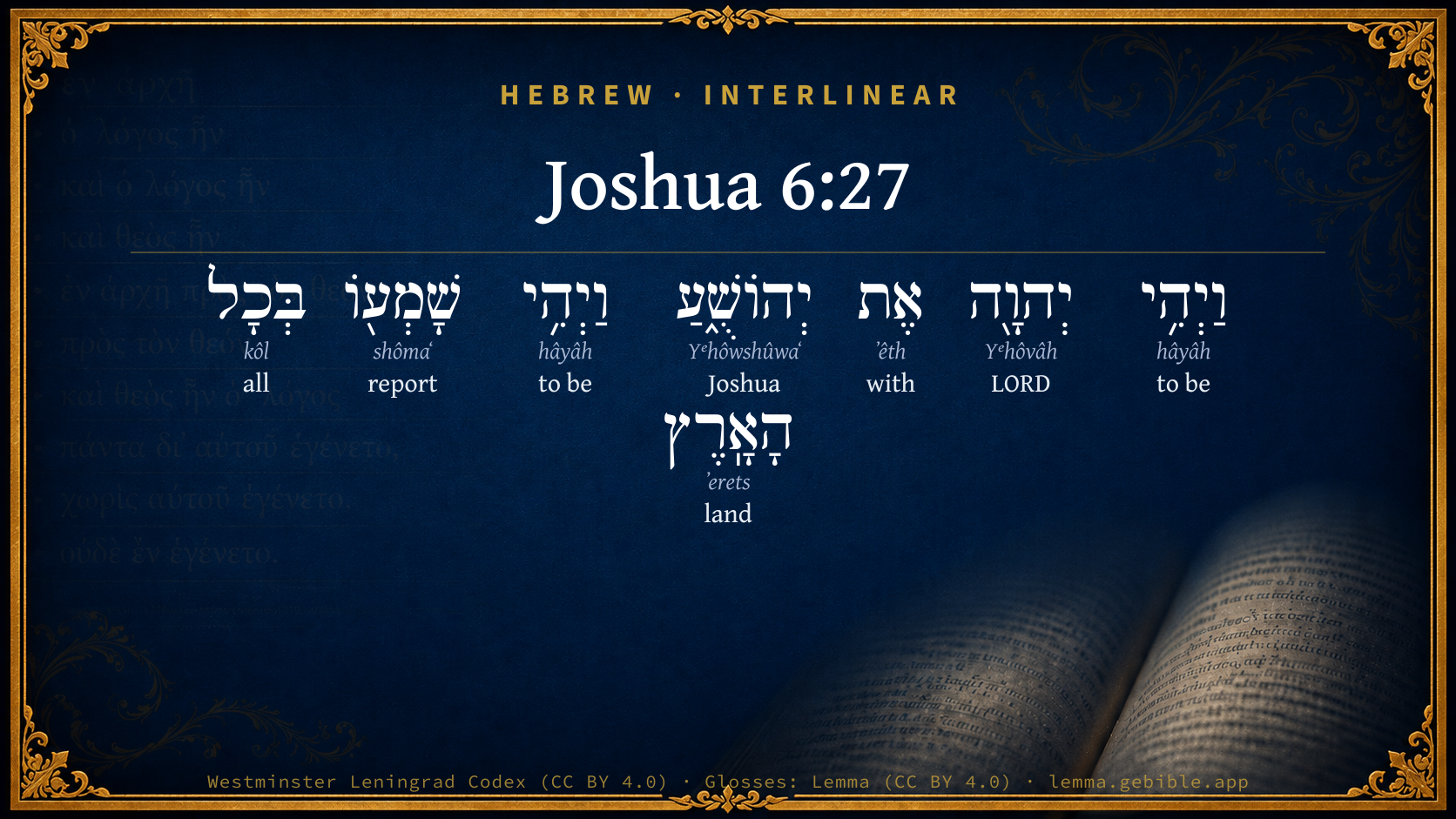
Hebrew (Westminster Leningrad Codex) Joshua 6:27 appears in the Hebrew Old Testament. The text above is from the Westminster Leningrad Codex. Each word links to its Strong’s number, a concise gloss, and parsing drawn from the Open Scriptures Hebrew Bible morphology. Click any word for its full Brown-Driver-Briggs (BDB) entry.
Download image
Cite this verse

Joshua 6:27 (World English Bible). Public Domain. Lemma interlinear Bible study tool, https://lemma.gebible.app/v/joshua/6/27.

Show BibTeX & RIS
BibTeX
RIS
English Translation
So Yahweh was with Joshua; and his fame was in all the land.
World English Bible · Public Domain
Highlights
  • 1 first appearance in the Hebrew Bible
Full analysis ↓
Download a study sheet

One document with this verse’s original text, its word-by-word gloss line, the meaning frame, cross-references with their text, attributed commentary, and full source and license credits — printable, and it pastes into notes with its structure intact.

This verse Autodidact and up

Study sheet (.html) Plain text (.txt)

A passage Seminary Student

Up to 50 verses in one chapter. A passage sheet keeps up to 6 commentary sources and 12 cross-references per verse, in the order this page ranks them, and says so on the sheet whenever that leaves anything out. Ask for a single verse and you get the Autodidact verse sheet above.

Everything on this page stays free to read, with no account — the sheet is a download of what is already on screen, not access to it.

Want to remove ads? Support Godless Engineer
Compare translations 3

The same verse in 3 English versions, stacked beneath the original-language interlinear above. Click any original word for its lexicon entry.

Each is an independent rendering of the whole verse — the interlinear is not word-aligned to these translations.

Highlighted words mark where these versions differ — a whole-verse word diff, not a word-by-word alignment.

  • World English Bible Public Domain
    So Yahweh was with Joshua; and his fame was in all the land.
  • King James Version Public Domain
    So the LORD was with Joshua; and his fame was noised throughout all the country.
  • unfoldingWord Literal Text CC BY-SA 4.0
    And Yahweh was with Joshua, and the report of him was in all of the land.

unfoldingWord Literal Text — © unfoldingWord, licensed CC BY-SA 4.0. Word-aligned USFM3 via Door43 (git.door43.org/unfoldingWord/en_ult).

Versions to compare (up to 4)

3 of 4 selected

Show all 18 translations

Every available English version of this verse, each an independent rendering of the whole verse.

  • World English Bible Public Domain
    So Yahweh was with Joshua; and his fame was in all the land.
  • Berean Standard Bible Public Domain
    So the LORD was with Joshua, and his fame spread throughout the land.
  • Majority Standard Bible Public Domain
    So the LORD was with Joshua, and his fame spread throughout the land.
  • King James Version Public Domain
    So the LORD was with Joshua; and his fame was noised throughout all the country.
  • American Standard Version (1901) Public Domain
    So Jehovah was with Joshua; and his fame was in all the land.
  • Revised Version (1885) Public Domain
    So the LORD was with Joshua; and his fame was in all the land.
  • Geneva Bible (1599) Public Domain
    So the Lord was with Ioshua, and he was famous through all the world.
  • Douay-Rheims (1899) Public Domain
    And the Lord was with Josue, and his name was noised throughout all the land.
  • Young's Literal Translation Public Domain
    and Jehovah is with Joshua, and his fame is in all the land.
  • Literal Standard Version CC BY-SA 4.0
    And YHWH is with Joshua, and his fame is in all the land.
  • Unlocked Literal Bible CC BY-SA 4.0
    So Yahweh was with Joshua, and his fame spread throughout the land.
  • unfoldingWord Literal Text CC BY-SA 4.0
    And Yahweh was with Joshua, and the report of him was in all of the land.
  • Darby Bible Public Domain
    And Jehovah was with Joshua; and his fame was in all the land.
  • World Messianic Bible Public Domain
    So the LORD was with Joshua; and his fame was in all the land.
  • Webster's Bible Public Domain
    So the LORD was with Joshua; and his fame was noised throughout all the country.
  • Free Bible Version CC BY-SA 4.0
    So the Lord was with Joshua, and his fame spread throughout the land.
  • Bible in Basic English Public Domain
    So the Lord was with Joshua; and news of him went through all the land.
  • JPS Tanakh (1917) Public Domain
    So the LORD was with Joshua; and his fame was in all the land.

Literal Standard Version (2020), Covenant Press — licensed CC BY-SA 4.0. Text via the HelloAO Bible API (eBible.org). Unlocked Literal Bible (unfoldingWord) — licensed CC BY-SA 4.0. Text via the HelloAO Bible API (eBible.org). unfoldingWord Literal Text — © unfoldingWord, licensed CC BY-SA 4.0. Word-aligned USFM3 via Door43 (git.door43.org/unfoldingWord/en_ult). Free Bible Version, Dr. Jonathan Gallagher — licensed CC BY-SA 4.0. Text via the HelloAO Bible API (eBible.org).

Word by word

More ways to search: Search by grammar → Find every occurrence → Compare this word →

Practice this passage: Drill this verse → Learn its vocabulary →

About this verse

These counts appear in no published source. They are computed here, from the morphology-tagged text and Lemma’s own curated glosses. What Lemma adds →

8
words
7
distinct lemmas
Historical
section

Notable vocabulary

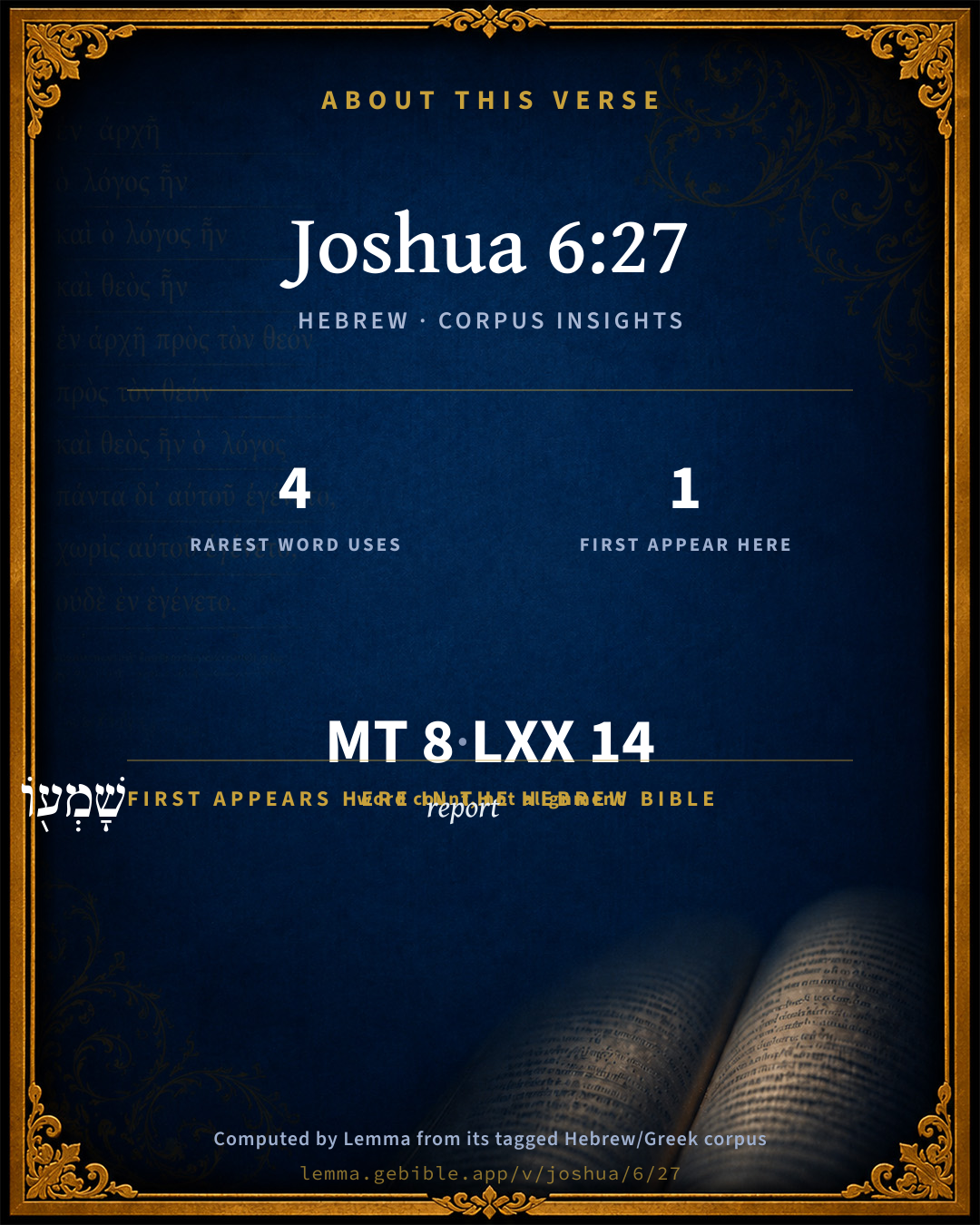
The rarest word here is שָׁמְע֖וֹ report H8089 — appearing just 4 times in the whole Hebrew Bible.

First appearance in Scripture

This word makes its first canonical appearance in the Hebrew Bible here:

  • שָׁמְע֖וֹ report H8089

Shared distinctive vocabulary

שָׁמְע֖וֹ report H8089 occurs in 4 verses of the Hebrew Bible. Also found in:

Grammatical profile

  • 2 verbs
  • 5 nouns
  • 1 preposition

Verb forms

  • וַיְהִ֥י Qal · Sequential Imperfect
  • וַיְהִ֥י Qal · Sequential Imperfect

Repetition

A word recurs within this verse — often emphatic in Hebrew:

  • וַיְהִ֥י to be H1961 ×2

Hebrew & Septuagint length

In English translation the verse runs 13 words from the Hebrew and 14 from the Septuagint (LXX English) — closely comparable.

A rough comparison of the two English renderings, which tokenize alike — not a word-level alignment.

Word counts can differ between the Hebrew and the Greek without any difference in meaning — e.g. the Hebrew direct-object marker אֵת has no separate Greek word, and Greek often adds the article ὁ.

In the original languages it is 8 Hebrew tokens and 14 Greek tokens — but the two are counted differently (Hebrew bundles its prefixes and suffixes into one token; the Greek is in lemma form), so that isn’t a like-for-like length.

Cross-references

18

Topical passages linked to Joshua 6:27 in the Treasury of Scripture Knowledge — connected by theme and wording, ordered by reader-vote popularity; previews shown in the World English Bible.

  • Joshua 1:5 There shall not any man be able to stand before you all the days of your life. As I was with Moses, so I will be with you; I will not fail you, nor forsake you.
  • Joshua 9:3 But when the inhabitants of Gibeon heard what Joshua had done to Jericho and to Ai,
  • Joshua 9:1 It happened, when all the kings who were beyond the Jordan, in the hill-country, and in the lowland, and on all the shore of the great sea in front of Lebanon, the Hittite, and the Amorite, the Canaanite, the Perizzite, the Hivite, and the Jebusite, heard of it;
  • Matthew 18:20 For where two or three are gathered together in my name, there I am in the midst of them."
  • Matthew 28:20 teaching them to observe all things that I commanded you. Behold, I am with you always, even to the end of the age." Amen.
  • Joshua 9:9 They said to him, From a very far country your servants are come because of the name of Yahweh your God: for we have heard the fame of him, and all that he did in Egypt,
  • Matthew 14:1 At that time, Herod the tetrarch heard the report concerning Jesus,
  • Acts 18:9–10 The Lord said to Paul in the night by a vision, "Don't be afraid, but speak and don't be silent;
  • 2 Timothy 4:17 But the Lord stood by me, and strengthened me, that through me the message might be fully proclaimed, and that all the Gentiles might hear; and I was delivered out of the mouth of the lion.
  • 2 Timothy 4:22 The Lord Jesus Christ be with your spirit. Grace be with you. Amen.
  • Genesis 39:2–3 Yahweh was with Joseph, and he was a prosperous man. He was in the house of his master the Egyptian.
  • Genesis 39:21 But Yahweh was with Joseph, and showed kindness to him, and gave him favor in the sight of the keeper of the prison.
  • Deuteronomy 31:6 Be strong and of good courage, don't be afraid, nor be scared of them: for Yahweh your God, he it is who does go with you; he will not fail you, nor forsake you.
  • Joshua 1:9 Haven't I commanded you? Be strong and of good courage; don't be afraid, neither be dismayed: for Yahweh your God is with you wherever you go.
  • 1 Samuel 2:30 Therefore Yahweh, the God of Israel, says, I said indeed that your house, and the house of your father, should walk before me forever: but now Yahweh says, Be it far from me; for those who honor me I will honor, and those who despise me shall be lightly esteemed.
  • Matthew 4:24 The report about him went out into all Syria. They brought to him all who were sick, afflicted with various diseases and torments, possessed with demons, epileptics, and paralytics; and he healed them.
  • 2 Samuel 7:9 and I have been with you wherever you went, and have cut off all your enemies from before you; and I will make you a great name, like the name of the great ones who are in the earth.
  • 2 Corinthians 13:14 The grace of the Lord Jesus Christ, the love of God, and the communion of the Holy Spirit, be with you all. Amen.

Cross-references courtesy of OpenBible.info (CC BY 4.0).

Hebrew and Greek witnesses Masoretic Hebrew ↔ Greek Septuagint

The same verse in the two great witnesses to the Old Testament, shown verse-for-verse.

These are two independent witnesses, not word-aligned to each other, and the Septuagint is shown in lemma (dictionary) form.

Hebrew Joshua 6:27 Masoretic · Westminster Leningrad Codex

וַיְהִ֥י יְהוָ֖ה אֶת יְהוֹשֻׁ֑עַ וַיְהִ֥י שָׁמְע֖וֹ בְּכָל הָאָֽרֶץ

So Yahweh was with Joshua; and his fame was in all the land.

World English Bible · Public Domain

Greek LXX Joshua 6:27 Septuagint · lemma form

καί εἰμί κύριος μετά ἰησοῦς καί εἰμί ὁ ὄνομα αὐτός κατά πᾶς ὁ γῆ

And the Lord was with Joshua, and his name was in all the land.

LXX2012 (modern English Septuagint) · Public Domain

Hebrew: Westminster Leningrad Codex (CC BY 4.0). Greek: Septuagint (public domain); English from LXX2012 (modern English Septuagint) (Public Domain). How the Septuagint differs from the Hebrew →

Targum (Aramaic paraphrase)

1

The Targum is the ancient Jewish Aramaic paraphrase of the Hebrew Scriptures — an interpretive translation, not the Hebrew text itself. Onkelos (literal) and Pseudo-Jonathan (expansive) render the Torah, and Jonathan the Prophets. Coverage is partial: where no permissively-licensed English translation exists for a verse, only the Aramaic is shown. This is verse-level text, not a word-by-word alignment to the Hebrew.

  1. Targum Jonathan Prophets (Joshua–Malachi)
    וַהֲוָה מֵימְרָא דַייָ בְּסַעֲדֵיהּ דִיהוֹשֻׁעַ וַהֲוָה שִׁמְעֵיהּ סַגִי בְּכָל אַרְעָא:

    (no public-domain English translation for this verse)

    Targum Jonathan — Aramaic: “Mikraot Gedolot” (public domain). English: “Sefaria Community Translation” (CC0 1.0 (public-domain dedication)); “London "Chaldee Paraphrase," 1871” (public domain). Text via Sefaria.

Commentary

Notes on Joshua 6:27 from classic Christian and Jewish commentators (each source and its license shown beneath its notes). The classic Christian expositions comment on the surrounding passage and are grouped to its opening verse, so a note may address several verses; the Jewish commentaries on the Tanakh (Rashi and others) are per-verse, so they appear only where the commentator wrote on this verse.

Lemma curates 59 commentaries, every one of them public domain or Creative Commons licensed, each selected and text-cleaned for this edition rather than reprinted as found. About our sources →

Joseph Benson's Commentary

Jos 6:27. So the Lord was with Joshua — The Chaldee interprets it, The Word of the Lord was with him, even Christ, the eternal Word, the same that was with Moses. Nothing makes a man more truly great than to have evidences that God is with him.

Joseph Benson's Commentary on the Old and New Testaments (1811–1818) — public domain. Text from a community e-Sword module.

Tyndale Open Study Notes

Tyndale Open Resources

6:27 As the first chapter in Israel’s conquest of Canaan closed, both the Israelites and the Canaanites could see that the Lord was with Joshua, as he had promised (1:5, 9; cp. 4:14). Crossing the Jordan and taking Jericho established Israel’s presence in the land, causing the people of Canaan to fear Israel and Israel’s God.

Tyndale Open Study Notes — © Tyndale Open Resources, licensed CC BY-SA 4.0. Text via the HelloAO Bible API.

Adam Clarke's Commentary

Verse 27. So the Lord was with Joshua] Giving him miraculous assistance in all his enterprises; and this was what he was naturally led to expect from the communication made to him by the captain of the Lord's host, Jos 5:14, c.

1. MANY attempts have been made either to deny the miracle in the fall of Jericho, or to account for it on natural causes. Reference has already been made to some of these in the note on Jos 6:20. But to those who believe the Divine authenticity of the New Testament, every objection of this kind is removed by the authority of the author of the Epistle to the Hebrews, Heb 11:30: By FAITH the walls of Jericho fell down, after they had been compassed about seven days. Hence we find that it was a miraculous interference and that Joshua's faith in the promise made to him by the captain of the Lord's host, was the instrument which God chose to employ in the accomplishment of this important purpose.

2. The same is said of Rahab: By FAITH the harlot Rahab perished not with them that believed not, when she had received the spies with peace, Heb 11:31. She believed that the true God was on the side of the Hebrews, and that all opposition to them must be in vain; and this faith led her to put herself under the Divine protection, and in virtue of it she escaped the destruction that fell on her countrymen. Thus God has ever chosen to put honour on faith, as the instrument by which he will perform his greatest miracles of justice and mercy. God, who cannot lie, has given the promise; he that believes shall have it accomplished; for with God nothing shall be impossible, and all things are possible to him that believes. These are Scriptural maxims, and God cannot deny himself.

3. On the curse pronounced by Joshua on those who should rebuild Jericho, it may be necessary to make a few remarks. In ancient history we have many instances of execrations against those who should rebuild those cities which had been destroyed in war, the revival of whose power and influence was dreaded; especially such cities as had been remarkable for oppression, insolence, or perfidy. Strabo observes, lib. xiii., p. 898, ed. 1707, that Agamemnon pronounced execrations on those who should rebuild Troy, as Croesus did against those who should rebuild Sidena, in which the tyrant Glaucias had taken refuge; and this mode of execrating cities, according to Strabo, was an ancient custom - Ειτε και καταρασαμενου του Αγαμεμνονος κατα παλαιον εθος· καθαπερ και ὁ Κροισος εξελων την Σιδηνην, εις ἡν ὁ τυραννος κατεφυγε Γλαυκιας, αρας εθετο κατα των τειχιουντων παλιν τον τοπον.

The Romans made a decree full of execrations against those who should rebuild Carthage, which had been the rival of their empire; and which, from its advantageous situation, might again become formidable should it be rebuilt. See Zonaras, Anal.

The Ionians, according to Isocrates, pronounced the most awful execrations on those who should rebuild the temples destroyed by the Persians, that they might remain to posterity an endless monument of the impiety of those barbarians; and that none might put confidence in a people who were so wicked as to make war on the gods themselves. The other Greeks who had suffered by the Persians acted in the same way, leaving the desolated temples as a public monument of the enmity that should ever subsist between the two nations. See Calmet, and See Clarke on Nu 22:6.

Adam Clarke's Commentary on the Bible (1810–1826) — public domain. Text from a community e-Sword/MySword module.

The Cambridge Bible for Schools and Colleges

gen. ed. J. J. S. Perowne

27. So the Lord was with Joshua] He and He alone had achieved the victory for His people, and they had “stood still” and “seen the salvation of Jehovah” (Exo_14:13; 2Ch_20:17):—

(a) The entrance into Canaan itself had been effected by the miraculous receding of the waters of the Jordan;

(b) The walls of the city had fallen down flat, not before Israel, but before the Ark of Jehovah, Whose presence was ever connected with its golden Mercy-Seat;

(c) When it had been bestowed upon the people as a free gift, without any effort on their part, all that it contained was devoted entirely to the Lord, nothing in the way of gain was to be made out of it;

(d) The means they had been allowed to employ as preliminary to the capture were such as could not fail to make them a scorn and derision to the proud warriors of the Doomed City, and so called into exercise, in a striking degree, their faith, patience, and obedience.

The Cambridge Bible for Schools and Colleges (gen. ed. J. J. S. Perowne; Cambridge University Press, 1878–1918) — public domain. Text from a community e-Sword module.

John Gill's Exposition

So the Lord was with Joshua,.... Counselling and directing him what to do, prospering and succeeding him in all that he engaged; the Targum is,"the Word of the Lord was for the help of Joshua;''the essential Word, Christ the Son of God, called the Captain of the Lord's host, Jos 5:14; and who, continued with him speaking to him and giving him orders, Jos 6:2,

and his fame was noised throughout all the country; for his wisdom and courage, for the wonderful things done for him and by him, and the great success that attended him, through the power and presence of God with him; which struck terror into the inhabitants of the land, and made his conquest of it the more easy.

Next: Joshua Chapter 7

John Gill's Exposition of the Whole Bible (1746–1763) — public domain (CC PDM 1.0). Text via the HelloAO Bible API.

Whedon's Commentary on the Bible

Daniel D. Whedon

27. So the Lord was with Joshua — The promise made to Joshua in chap. 1 is fulfilled.

His fame was noised — True fame has been styled the shadow of greatness. He who demonstrates that God is with him cannot dwell in obscurity.

Daniel D. Whedon (gen. ed.), Commentary on the Old and New Testaments (1874–1909) — public domain. Text from a community e-Sword module.

John Wesley's Explanatory Notes

The word of the Lord was with him - (So the Chaldee:) Even Christ himself, the same that was with Moses. Nothing makes a man appear more truly great, than to have the evidences of God's presence with him.

John Wesley, Explanatory Notes Upon the Whole Bible (1754–1765) — public domain. Text via the GEBible commentary corpus.

Lesson kit

Teaching starters — assembled from the data on this page, not authored interpretation. Every prompt links to the verse data it draws on. Edit before teaching.

Joshua, in the Historical, opens this verse with 8 words (7 distinct Hebrew lemmas). Its most distinctive word is shômaʻ (“report”). A historical commentator’s framing appears above. Read the whole chapter for the surrounding context.

Discussion questions

  1. The word shômaʻ carries the sense “report.” How does it shape the verse?
  2. This is the first place “report” appears in Scripture (first appears here). What does its debut here establish?
  3. How does Joshua 9:9, which shares the word «report», read alongside this verse?
  4. What does the repetition of “to be” (2× in this one verse) do in this verse?
  5. The translations on this page render this verse differently — a whole-verse word diff, not a word-by-word alignment. What might account for the different wordings?
  6. «וַיְהִ֥י» is a Qal Sequential Imperfect verb. How does that grammatical form shape the action described?
  7. Compare how Joseph Benson's Commentary and Tyndale Open Study Notes read this verse. Where do they agree or differ?

Things to notice

Reading settings

Reading text

Shown beneath each verse's original-language words.

Old Testament
Old Testament edition

Read the OT as the Masoretic Hebrew (MT) or the Greek Septuagint (LXX).

English shown for the Greek Septuagint (in the Hebrew ↔ Greek comparison).

Comparing translations? Open the Compare panel on any verse page to stack up to four side by side.