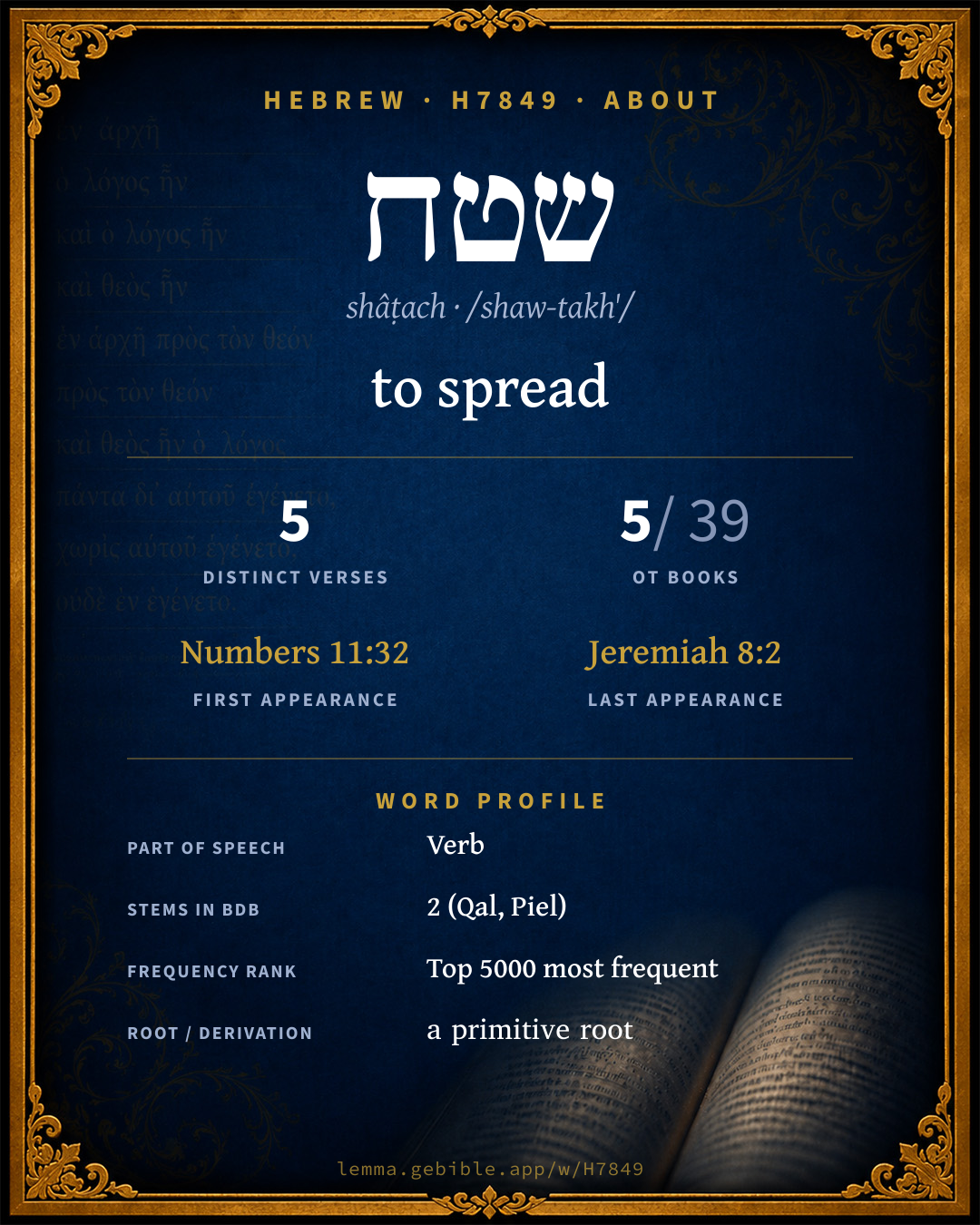
שָׁטַח
to spread
also: spread abroad, stretch out fuller range ↓
Full lexicon entry — Brown-Driver-Briggs (BDB)
From Brown-Driver-Briggs (BDB)
Where this word appears
See every Qal verb in the Hebrew Bible →
Grammar key — what these labels mean
Part of speech
- Verb
- An action or state-of-being word.
Stem
- Qal
- The basic, simple active stem — the plain form of the verb (“he wrote”).
- Piel
- An intensive or resultative active stem.
Form
- Sequential Perfect
- A perfect with prefixed waw continuing a preceding imperfect or command (waw-consecutive perfect).
- Sequential Imperfect
- An imperfect with prefixed waw — the standard past-narrative form (waw-consecutive imperfect).
- Perfect
- A completed action or state — Hebrew marks aspect (completeness) more than strict tense (“he wrote”).
- Infinitive Absolute
- An unbound verbal noun, often intensifying or standing in for a finite verb.
- Participle Active
- A verbal adjective expressing ongoing or characteristic action (“writing / one who writes”).
State
- Absolute
- The independent form of a noun, not bound to a following word.
Person
- 3rd Person
- The one spoken about (“he / she / it / they”).
- 1st Person
- The speaker (“I / we”).
Gender
- Common
- Either gender — not distinguished for this form.
- Feminine
- Grammatically feminine.
- Masculine
- Grammatically masculine.
Number
- Plural
- More than one (in Hebrew, generally three or more).
- Singular
- One.
Grammatical forms
- Verb, Qal, Sequential Perfect, 3rd Person, Common, Plural 1 time (17%)
- Verb, Qal, Sequential Imperfect, 3rd Person, Feminine, Singular 1 time (17%)
- Verb, Qal, Sequential Imperfect, 3rd Person, Masculine, Plural 1 time (17%)
- Verb, Piel, Perfect, 1st Person, Common, Singular 1 time (17%)
- Verb, Qal, Infinitive Absolute 1 time (17%)
- Verb, Qal, Participle Active, Masculine, Singular, Absolute 1 time (17%)
Parsed forms decoded from the imported morphology (morphhb / Westminster Leningrad Codex — WLC text public domain, morphhb tagging CC BY 4.0), counted across 6 parsed occurrences — not distinct verses.
Every verse where H7849 appears — 5 distinct verses across 5 books. Click any verse to open its interlinear word-by-word view. Verse text shown in the World English Bible for context — . Each verse’s Hebrew form is shown with its reference; the English is not keyword-highlighted, since the data carries no word-level English alignment. Use “Compare translations” on any verse to read it across multiple English versions. This concordance covers the Hebrew Bible; Septuagint (Greek Old Testament) occurrences are not indexed here.
Numbers 1 verse
2 Samuel 1 verse
Job 1 verse
Psalms 1 verse
Jeremiah 1 verse
About this entry
At a glance — auto-summarized from this page’s data, not written by a person. Every figure links to its source below. This summary describes the numbers; it doesn’t interpret them.
“to spread” is the headline sense of the Hebrew verb שטח (shâṭach). With only 5 verses it sits in the long tail of Hebrew Bible vocabulary. Scripture first uses it in Numbers 11:32. The verb spans 2 stems, from Qal to Piel. It shares a root with משטוח. See the sense tree, 5-verse concordance, and the renderings breakdown below.
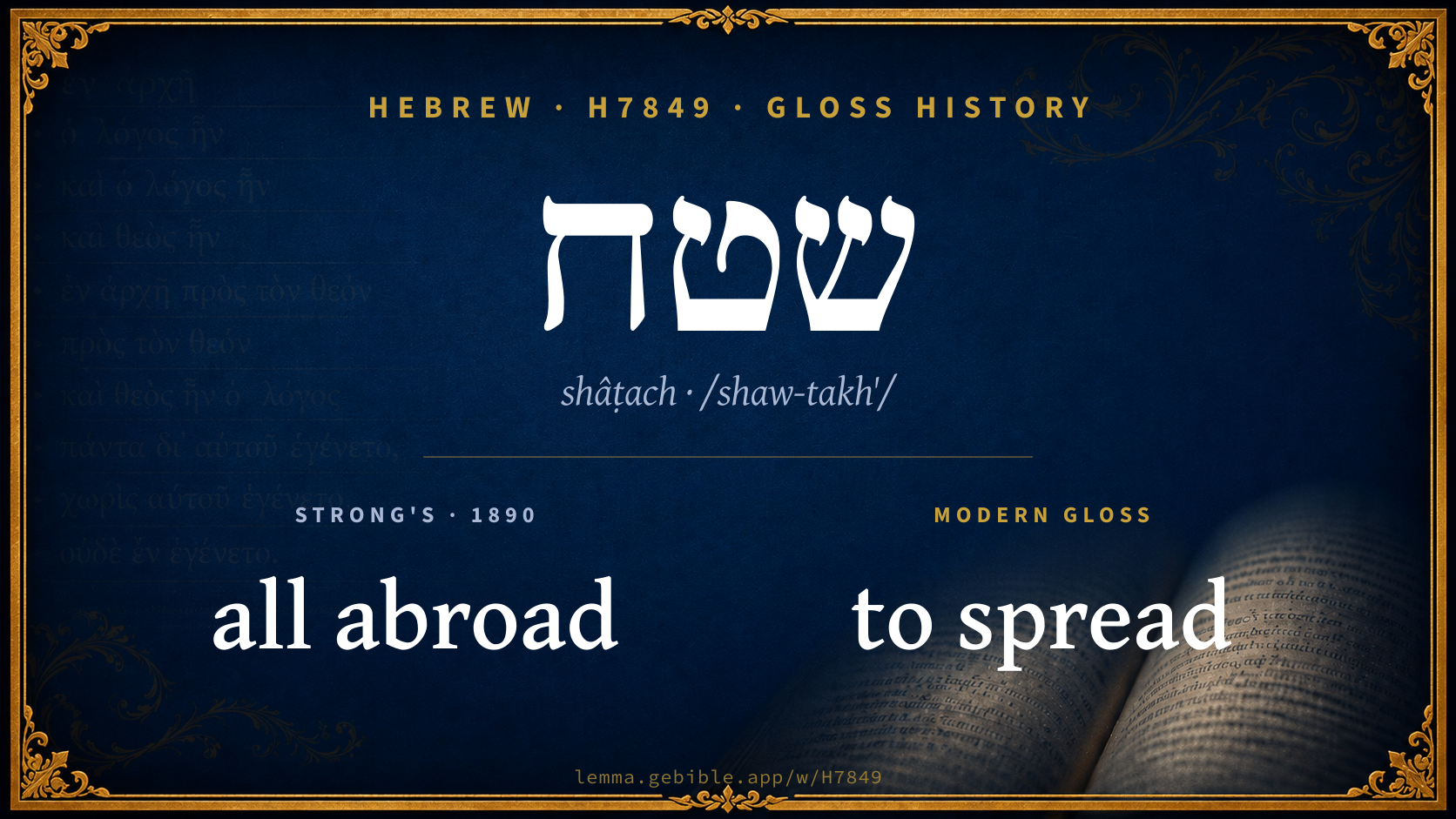
Gloss history
Strong's 1890 vs modern scholarship
About this word
Strong's H7849 catalogs a Hebrew word from the Hebrew Old Testament.
These counts are not copied from any lexicon or concordance. They are computed here, from the morphology-tagged Hebrew Old Testament. What Lemma adds →
- 5
- distinct verses
- The word appears in 5 distinct verses.
- 5 / 39
- OT books
- The word appears in 5 of 39 Old Testament books.
- #3,040
- by frequency
- Top 5000 most frequent Hebrew words (rank 3,040 of 8,640 Hebrew words by occurrence).
View all 5 occurrences in the concordance →
By section of the Old Testament
By traditional corpus
Conventional, traditional groupings — biblical authorship is debated, so this is a traditional corpus grouping, not an authorship claim. Each share is this word’s portion of its verses in that division of the Hebrew canon. Each figure is a share of the word’s 5 distinct verses.
- Prophets (Nevi'im) 2 verses · 40%
- Writings (Ketuvim) 2 verses · 40%
- Torah (Pentateuch) 1 verse · 20%
How translations render this word
Counts come from each version’s own published word-to-Strong’s tagging or interlinear alignment — an approximate guide to how each version renders this word, not a word-level alignment the data otherwise carries. Because each total is that version’s own tagged count, the per-version totals vary from one another and need not match the appearance or distinct-verse counts above. These counts may also differ from a printed concordance because Lemma counts each distinctly tagged rendering and does not collapse phrase taggings into a single head-word total. This is a fixed set of word-tagged versions (KJV, ASV, BSB, ULT) and does not change with the reading translation you choose elsewhere. Each version’s license is shown beside its name below (and on Sources).
- King James Version: All abroad 1×, He enlargeth 1×, Spread 1×
- American Standard Version: All abroad 1×, Jehovah i have spread forth 1×, Strewed 1×
- Berean Standard Bible: He enlarges 1×, I spread out 1×, Scattered 1×
- unfoldingWord Literal Text: And 1×, I spread out 1×, One enlarging 1×
King James Version Public Domain
Renders H7849 across 6 tagged occurrences — most commonly:
American Standard Version Public Domain
Renders H7849 across 6 tagged occurrences — most commonly:
Berean Standard Bible Public Domain
Renders H7849 across 5 tagged occurrences — most commonly:
Not rendered by a distinct English word in 1 further occurrence.
unfoldingWord Literal Text CC BY-SA 4.0
Renders H7849 across 7 tagged occurrences — most commonly:
Senses in the full BDB
Hebrew verbs can shift meaning by stem (binyan): Qal is the basic action, Niphal is often passive or reflexive, Piel often intensifies or makes it factitive, and Hiphil is typically causative. The senses below are grouped under the stem BDB assigns to each.
What do BDB’s symbols mean?
BDB uses these scholarly abbreviations:
| Symbol | Meaning |
|---|---|
| 𝔊 | the Septuagint (the ancient Greek translation, LXX) |
| 𝔙 | the Vulgate (the Latin translation) |
| 𝔖 | the Syriac version (the Peshitta) |
| 𝔗 | the Targum (the Aramaic translation) |
| ψ | the Psalms |
| √ | root (the underlying root or stem) |
| ‖ | parallel passage (a synonymous or contrasted parallel) |
| † | the dagger: every passage where the word occurs is cited |
The 2 senses and sub-senses the full Brown-Driver-Briggs lexicon distinguishes for this word, in lexicon order (not ranked by frequency), with BDB’s own verbatim wording and sub-sense lettering. Shown in Hebrew script with BDB’s own scholarly abbreviations. The condensed entry is in the Lexicon Entry tab. See also the Forms in the corpus table below.
Qal
- Pf. 3 pl. sf. consec. וּשְׁטָחוּם לַשֶּׁמֶשׁ Je 8:2 they shall spread them abroad, etc., acc. of many separate things, so Impf. 3 fs. וַתִּשְׁטַח 2 S 17:19 (עַל loc.; disting. from פָּרַשׂ spread covering); 3 mpl. + Inf. abs. וַיִּשְׁטְחוּ לָהֶם שָׁטוֹחַ Nu 11:32 (J) they spread (sc. the quails) for themselves all abroad round about the camp (i.e. to dry them; 𝔙 siccaverunt; cf. Di Gray); Pt. שֹׁטֵחַ לַגּוֹיִם Jb 12:23 expanding the nations (cf. ל 3 b). e.g. Jeremiah 8:2
Piel
- Pf. 1 s. שִׁטַּחְתִּי אֵלֶיךָ כַפָּ֑י ψ 88:10 I have spread out unto thee my palms. e.g. Psalms 88:10
Senses from the full Brown-Driver-Briggs lexicon (Brown, Driver, Briggs; Oxford 1906 — public domain), digitized via Sefaria, supplemented by the OpenScriptures HebrewLexicon (CC BY 4.0). Full attribution on Sources.
Word origin
vb. spread, spread abroad (NH id.; Arabic سَطَحَ spread out; so Ethiopic ሰጥሐ: Aramaic שְׁטַח, ܫܛܰܚ );—
— Brown-Driver-Briggs (Oxford 1906, public domain), digitized via Sefaria, supplemented by the OpenScriptures HebrewLexicon (CC BY 4.0). See Sources.
Origin: a primitive root
Jastrow Dictionary
A second Hebrew/Aramaic lexicon for comparison, covering Aramaic and post-biblical (Talmudic, Targumic, Midrashic) usage that the biblical-Hebrew BDB does not. Matched by lemma rather than by Strong’s number, so a lemma may carry more than one Jastrow headword (shown separately below), and the entries cover usage well beyond the Bible.
שָׁטַח
- (b. h.) to spread, stretch. Sabb. XXII, 4 שׁוֹטְחָן בחמה he may spread them (to dry) in the sun. Bets. 11ᵃ שוטחן ברוח וכ׳ he may spread them in the air on pins; a. fr.—Part. pass. שָׁטוּחַ; f. שְׁטוּחָה &c. Ruth R. to IV, 12 (ref. to Gen. XXI, 25) שהיה יצחק ש׳ כאן וכ׳ Isaac was stretched out (prostrated in prayer) on one side, and Rebekah on the other; Gen. R. s. 63; Yalk. ib. 110; Yalk. Ruth 608. Tosef. Toh. IX, 10 כלים שְׁטוּחִין וכ׳ garments which are spread (hung up) … higher than ten handbreadths; a. e. e.g. Genesis 21:25
- to prostrate one’s self. Ḥag. 22ᵇ הלך … ונ׳ על קברי וכ׳ R. J. went and prostrated himself on the graves of &c. Midr. Till. to Ps. XVIII, 2 [read:] והן … ומִשְׁתַּטְּחִין ונופלין על פניהם (ed. Bub. משתחוין) וכ׳ and they alighted from their horses and threw themselves down and fell upon their faces &c.; Yalk. Sam. 133. Midr. Till. to Ps. II, 1 וכיון שמגיע … מִשְׁתַּטֵּחַ וכ׳ but when the wave reaches the shore of the sea, it prostrates itself before the sand; (Yalk. Is. 350 כורע); a. fr. e.g. Psalms 2:1
שְׁטַח
- Targ. Num. XI, 32 (O. ed. Berl. שַׁטַּחוּ Pa.; ed. Vien. O. שחטו, corr. acc.). Targ. Is. XXXVIII, 21 Regia (ed. ישורטון; ed. Lag. וישיטרון, Var. וישרטון; h. text מרח). Targ. Jer. VIII, 2; a. e.—Bets. 11ᵇ מה לי למִשְׁטְחִינְהוּ וכ׳ what difference is there between spreading the hides (on the Holy Day) and salting them? Y. Sabb. VII, 10ᵃ bot., v. מסבסלה; a. e.—Ruth R. to I, 17 ובתר … אנן שַׁטְחִין (שַׁטְחוּן) שַׁטְהִין קליה וכ׳ after the festival we shall spread the report of it (the precious stone), and whatever price it may fetch &c.
- same. Targ. Job XII, 23.
- same, v. supra.
- to prostrate one’s self. Targ. Y. I Gen. XVII, 17 Ar. (ed. נפל). Targ. Deut. IX, 25. Targ. Jer. IV, 31; a. fr.—B. Mets. 85ᵇ אִשְׁתֵּטְּחִי אמערתיה I prostrated myself over his (Elijah’s) burial cave.
A Dictionary of the Targumim, the Talmud Babli and Yerushalmi, and the Midrashic Literature (Marcus Jastrow; London, Luzac, 1903) — Public Domain. Digitized via Sefaria. Digitized via Sefaria. Full attribution on Sources.
Forms in the corpus
The 6 distinct written forms H7849 takes in the Hebrew Bible, most frequent first — each parse links to that stem’s occurrences in the concordance. Hebrew forms include their vowel points and cantillation, so a single lemma takes many written forms.
| Form | Parsing | Example | Uses |
|---|---|---|---|
| וַ/יִּשְׁטְח֤וּ | Verb, Qal, Sequential Imperfect, 3rd Person, Masculine, Plural | Numbers 11:32 | 1 |
| וַ/תִּשְׁטַ֥ח | Verb, Qal, Sequential Imperfect, 3rd Person, Feminine, Singular | 2 Samuel 17:19 | 1 |
| וּ/שְׁטָחוּ/ם֩ | Verb, Qal, Sequential Perfect, 3rd Person, Common, Plural | Jeremiah 8:2 | 1 |
| שִׁטַּ֖חְתִּי | Verb, Piel, Perfect, 1st Person, Common, Singular | Psalms 88:9 | 1 |
| שָׁט֔וֹחַ | Verb, Qal, Infinitive Absolute | Numbers 11:32 | 1 |
| שֹׁטֵ֥חַ | Verb, Qal, Participle Active, Masculine, Singular, Absolute | Job 12:23 | 1 |
Same root — word family
Other BDB entries built from the same root as H7849, grouped by Strong’s listed origin. These share a root / origin per the lexicon — not necessarily a shared meaning. Each links to that word’s own entry.
Derived from this word
Compare all same-root words → They share a root, not necessarily a meaning.
Septuagint verse parallels
This word appears in 5 verses that also exist in the Greek Old Testament (Septuagint), out of the 5 Hebrew verses it occurs in. You can read those verses in Greek by switching the Old Testament edition to the Septuagint.
Read these verses in the Septuagint
This is a verse-level parallel only — the same verses exist in both the Hebrew and Greek Old Testaments. No word-level Hebrew↔Greek correspondence is claimed: the data carries no such alignment, so no Greek word is shown as this Hebrew word’s translation. Coverage is not total — the Septuagint omits the deuterocanon and renumbers the Psalms, so some Hebrew verses have no direct Greek parallel.